

Daily Vocabulary from Indian Newspapers and Publications
Welcome to Wordpandit’s Indian Vocabulary Hub
At Wordpandit, we understand the importance of staying rooted in the local context while expanding your language skills. This section focuses on enriching your vocabulary with words and phrases drawn from India’s leading newspapers and publications, ensuring you're learning vocabulary that is practical, relevant, and uniquely Indian.
Why Indian Sources Matter
We believe that the best way to master any language is by immersing yourself in local content. That’s why we carefully curate vocabulary from top Indian publications, including:
- The Hindu
- The Times of India
- The Economic Times
- Hindustan Times
- Live Mint
- The Indian Express
- And many others...
Stay Updated, Stay Relevant
With daily updates from Indian news sources, you’ll be consistently learning words that reflect the trends and shifts in Indian society and culture. Our focus is to provide vocabulary that enhances your understanding of the language in an Indian context.
How Wordpandit Supports Your Goals
Whether you’re preparing for exams, aiming to improve your professional communication, or simply want to stay connected with the latest Indian vocabulary, Wordpandit is here to guide you every step of the way.
Learn with a Practical Approach
Our interactive learning methodology includes real-world examples, engaging activities, and context-specific usage to ensure that every word becomes part of your active vocabulary.
Dive into Indian Vocabulary Today!

Why Choose Wordpandit?
Practical Learning: Focus on words you'll actually encounter in real-world reading, enhancing your comprehension and communication skills.
Diverse Content: From current affairs to scientific breakthroughs, our varied sources expose you to vocabulary across multiple domains.
Effortless Integration: Make Wordpandit a part of your daily routine. Just a few minutes each day can significantly boost your lexicon over time.
Your Path to Vocabulary Mastery
- Visit our Daily Vocabulary section regularly
- Explore new words and their usage in context
- Practice incorporating these words into your own writing and speech
- Track your progress as your vocabulary expands
Start Your Journey Today
Embark on your vocabulary enhancement journey with Wordpandit. By consistently engaging with our daily posts, you'll build a robust vocabulary that serves you well in academic, professional, and personal contexts.
Remember, a word a day keeps linguistic limitations at bay. Make Wordpandit your daily companion in the quest for vocabulary excellence!
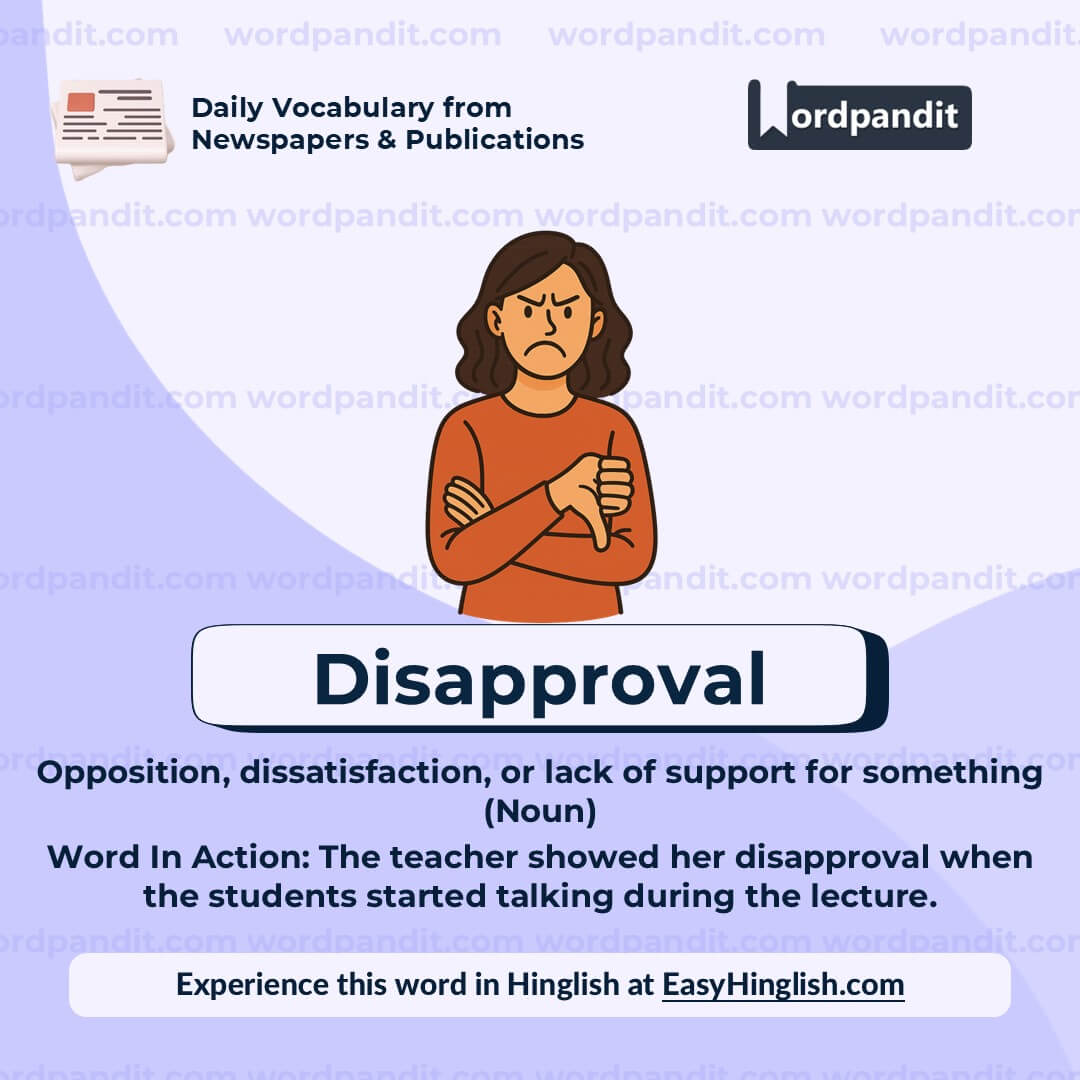
WORD-1: Disapproval
Context:
"Much to Mr. Trump's disapproval…" - The Hindu
Explanatory Paragraph:
Disapproval meaning in English is 'a feeling or expression of opposition, dissatisfaction, or lack of support for something or someone.' This word is used when someone shows they don't agree with or support a particular action, decision, or behavior. How to use disapproval correctly depends on the context—it appears frequently in formal writing, news articles about political disagreements, and competitive exam passages to describe negative reactions or judgments.
Meaning: Opposition, dissatisfaction, or lack of support for something (Noun)
Pronunciation: dis-uh-PROO-vuhl
Difficulty Level: ⭐⭐ Basic to Intermediate
Etymology: Disapproval comes from the prefix 'dis-' meaning 'opposite of' combined with 'approval,' which traces back to Latin 'approbare' meaning 'to assent to or favor.' The word evolved in English during the 17th century to express the specific act of withholding approval or expressing opposition to something.
Prashant Sir's Notes:
Many students confuse disapproval with 'disappointment'—while both are negative feelings, the difference between disapproval and disappointment is crucial. Disapproval means you oppose something because you believe it's wrong, while disappointment means something didn't meet your expectations. For CAT and GRE aspirants, disapproval frequently appears in RC passages about conflicts, debates, or controversial decisions. In Indian English newspapers, you'll often see phrases like "met with widespread disapproval" or "expressed strong disapproval"—these signal criticism from authority figures or public opinion. Remember, disapproval usage in sentences typically involves showing one person's negative judgment of another's actions or choices.
Synonyms & Antonyms:
Synonyms: criticism, objection, opposition, condemnation, disfavor, censure, dissatisfaction, displeasure, rejection, discontent
Antonyms: approval, support, acceptance, endorsement, favor, agreement
Usage Examples:
- The Chief Minister's decision to privatize the state transport corporation met with strong disapproval from trade unions across Karnataka.
- Priya's parents showed their disapproval when she announced her plan to quit her engineering job and pursue photography full-time.
- Despite widespread public disapproval, the government proceeded with implementing the controversial policy that affected millions of farmers.
- Rajesh could sense his manager's disapproval through her cold tone and lack of eye contact during the presentation feedback.
Cultural Reference:
"In Indian families, parental disapproval of career choices remains a common theme, as seen in countless Bollywood films where children struggle between their dreams and family expectations." - Reflecting Indian social dynamics
Think About It:
Why does disapproval from certain people affect us more deeply than disapproval from others? Does social disapproval always mean something is wrong, or can it sometimes indicate progress?
Quick Activity:
Write two sentences describing a time when you faced disapproval for a decision you made. In the first sentence, describe the disapproval you received. In the second, explain whether that disapproval changed your mind or strengthened your resolve.
Memory Tip:
Think of 'Disapproval' as 'DIS + APPROVAL'—when someone adds 'DIS' (meaning opposite) to their approval, they're showing disapproval. Imagine a cricket umpire shaking his head in disapproval when a player argues against his decision—that head shake removes the approval.
Real-World Application:
Disapproval is commonly used in news reporting, political analysis, and business communications to describe negative reactions from stakeholders, public opinion, or authority figures. In formal emails and reports, phrases like "expressed disapproval," "met with disapproval," or "despite disapproval" help convey opposition professionally. For UPSC aspirants, understanding disapproval is essential when analyzing editorial pieces about policy decisions and public sentiment.

WORD-2: Assurance
Context:
"An alleged assurance by Prime Minister Narendra Modi that India would halt its oil imports from Russia." - The Hindu
Explanatory Paragraph:
Assurance meaning in English is 'a confident statement or promise meant to remove doubt and give confidence or security.' This word is used when someone makes a declaration to convince others that something will or will not happen, especially in situations involving trust or commitment. Assurance is commonly used in formal writing, diplomatic communication, business agreements, and competitive exam passages to describe pledges, guarantees, or confident statements that aim to provide certainty.
Meaning: A confident statement or promise intended to inspire trust or remove doubt; a guarantee (Noun)
Pronunciation: uh-SHOOR-uhns
Difficulty Level: ⭐⭐ Basic to Intermediate
Etymology: Assurance comes from the Old French word 'assurance,' derived from 'assurer' meaning 'to assure or make secure,' which itself traces back to Latin 'ad-' (to) and 'securus' (secure). The word evolved to represent both the act of providing confidence and the state of being confident, especially in the context of promises and guarantees.
Prashant Sir's Notes:
Many students confuse 'assurance' with 'insurance'—while both relate to security, assurance usage in formal contexts refers to verbal or written promises, whereas insurance is a financial product. The difference between assurance and guarantee is subtle: assurance emphasizes the confidence behind a statement, while guarantee focuses on the binding commitment. For CAT and UPSC aspirants, assurance frequently appears in passages about diplomacy, political negotiations, and corporate communications. How to use assurance correctly: it typically follows phrases like "give assurance," "provide assurance," or "seek assurance." In Indian newspapers, you'll often see "government's assurance on" or "assurance regarding" when discussing policy commitments or official promises.
Synonyms & Antonyms:
Synonyms: guarantee, pledge, promise, commitment, word, warranty, vow, affirmation, declaration, confidence
Antonyms: doubt, uncertainty, threat, warning, denial, disclaimer
Usage Examples:
- The Indian government gave assurances to foreign investors that policy changes would not affect existing agreements or tax structures.
- Despite repeated assurances from Priya's manager about a promotion, she remained skeptical after being passed over twice before.
- The company's assurance of complete data privacy did little to calm customers after news of the massive security breach spread.
- Rahul sought assurance from his parents that they would support his unconventional career choice before dropping out of engineering college.
Cultural Reference:
"In cricket, captains often give assurances about team selection and strategy before important matches, though actual decisions may differ based on pitch conditions." - Common practice in Indian cricket commentary
Think About It:
How often do political leaders give assurances during elections that remain unfulfilled after they come to power? What makes some assurances more credible than others?
Quick Activity:
Write two sentences about situations where you received an assurance that was either kept or broken. What made you trust or doubt that assurance initially?
Memory Tip:
Think of 'Assurance' as 'A-SURE-ANCE'—when someone gives you assurance, they're making you SURE about something. Imagine a friend saying "I'm SURE I'll help you"—that confident promise is an assurance.
Real-World Application:
In business communication and formal reports, 'assurance' is commonly used to describe commitments made by companies, governments, or leaders. Journalists use it frequently when reporting on diplomatic statements, policy announcements, and corporate promises. In exam essays for CAT, GRE, or UPSC, using 'assurance' demonstrates sophisticated vocabulary when discussing credibility, trust, or official commitments in analytical or argumentative writing.
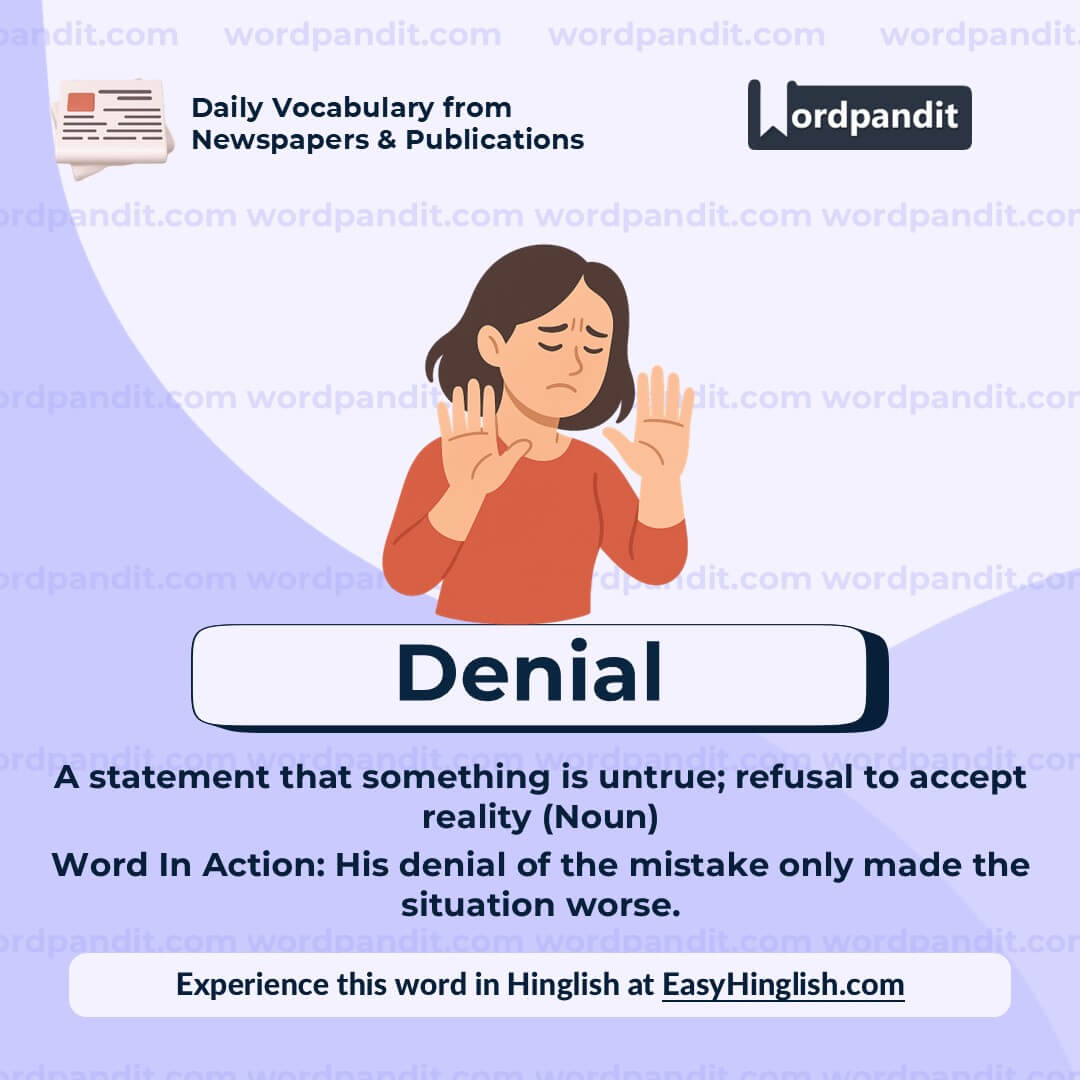
WORD-3: Denial
Context:
"A similar 'soft denial' approach seemed to be the chosen tack…" - The Hindu
Explanatory Paragraph:
Denial meaning in English is 'a statement or action that says something is not true, or a refusal to accept reality or facts.' This word is used when someone rejects an accusation, refuses to acknowledge the truth, or declines to give something. How to use denial depends on context—it appears in news articles about official statements, psychology discussions about coping mechanisms, and competitive exam passages describing situations where truth is contested or rejected.
Meaning: A statement that something is untrue; refusal to accept reality (Noun)
Pronunciation: dih-NY-uhl
Difficulty Level: ⭐⭐ Basic to Intermediate
Etymology: Denial comes from the verb 'deny,' which traces back to Latin 'denegare' meaning 'to refuse or reject,' formed from 'de-' (completely) and 'negare' (to say no). The word entered English through Old French 'denier' in the 14th century. Over time, denial evolved to encompass both the act of saying something isn't true and the psychological state of refusing to accept unpleasant realities.
Prashant Sir's Notes:
Students often ask: what is the difference between denial and refusal? While both involve saying "no," denial specifically means claiming something isn't true, whereas refusal means declining to do something. For CAT and GRE aspirants, denial frequently appears in RC passages about controversies, scandals, or psychological discussions. The phrase "in denial" is particularly important—it means someone is psychologically refusing to accept an uncomfortable truth. In Indian English newspapers, you'll see "issued a denial," "flat denial," or "soft denial" (as in the context above), where "soft denial" means a gentle rejection without directly calling someone a liar. Denial usage in formal writing often signals conflict between official statements and actual facts.
Synonyms & Antonyms:
Synonyms: refutation, rejection, negation, contradiction, disavowal, repudiation, disclaimer, refusal, dismissal, rebuttal
Antonyms: admission, acknowledgment, acceptance, confession, affirmation, confirmation
Usage Examples:
- Despite overwhelming evidence of corruption, the minister issued a categorical denial of all charges against him during the press conference.
- Amit remained in denial about his business losses, refusing to acknowledge that his startup was running out of funds rapidly.
- The company's denial of any environmental violations was contradicted by the pollution control board's detailed inspection report from last month.
- After her medical diagnosis, Meera went through several stages of grief, beginning with denial before gradually accepting her condition.
Cultural Reference:
"In cricket controversies, we often see players issue denials after being accused of ball-tampering or match-fixing, with the famous phrase 'flat denial' becoming part of sports journalism vocabulary." - Common in Indian sports reporting
Think About It:
Why do people sometimes remain in denial even when faced with clear evidence? Is denial always harmful, or can it serve as a temporary coping mechanism during difficult times?
Quick Activity:
Find three news headlines from today's newspaper that contain the word "denial" or phrases like "denied the allegations." Notice whether these are political denials, corporate denials, or personal denials, and what patterns you observe.
Memory Tip:
Think of 'Denial' as 'De-Nile'—imagine someone standing on the bank of the Nile river saying "This is NOT the Nile!" even though it obviously is. That's denial—refusing to accept what's clearly in front of you. The 'de' prefix means 'opposite of' or 'away from' accepting the truth.
Real-World Application:
Denial is commonly used in journalism, legal documents, corporate communications, and psychological discussions. In news reporting, phrases like "issued a denial," "categorically denied," or "in complete denial" help describe official responses to accusations. For UPSC and banking exam aspirants, understanding denial is crucial when analyzing current affairs, especially political scandals and corporate controversies. In business emails, denial might appear in phrases like "denial of liability" or "denial of the claim," making it essential vocabulary for professional communication.
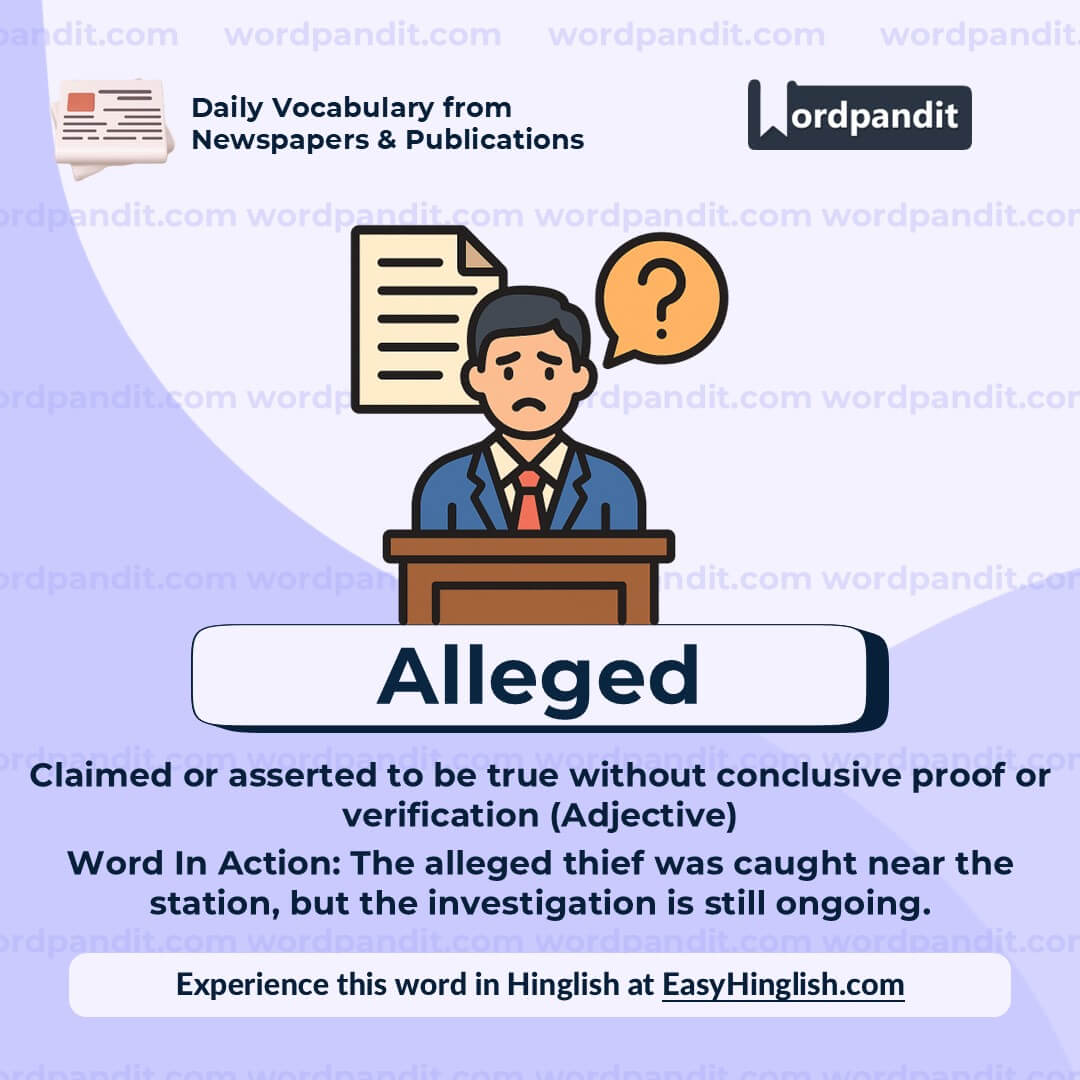
WORD-4: Alleged
Context:
"An alleged assurance by Prime Minister Narendra Modi that India would halt its oil imports from Russia." - The Hindu
Explanatory Paragraph:
Alleged meaning in English is 'claimed or stated to be true without proof or before legal verification.' This word is used when describing accusations, claims, or reports that have not been confirmed or proven yet. Alleged is commonly used in news articles, legal contexts, formal reports, and competitive exam passages to indicate that something is claimed but remains unverified, helping writers maintain neutrality and avoid stating unproven facts as truth.
Meaning: Claimed or asserted to be true without conclusive proof or verification (Adjective)
Pronunciation: uh-LEJD
Difficulty Level: ⭐⭐ Basic to Intermediate
Etymology: Alleged comes from the Latin word 'allegare' meaning 'to send as a representative, cite, or allege,' formed from 'ad-' (to) and 'legare' (to send or depute). Through Old French 'alegier,' it entered English in the 14th century. The word evolved to specifically mean making a claim or assertion, particularly one that requires proof, and became essential in legal and journalistic language to distinguish between proven facts and unverified claims.
Prashant Sir's Notes:
Many students confuse 'alleged' with 'accused'—while both deal with claims, the difference between alleged and accused is that alleged describes any unproven claim (not just crimes), whereas accused specifically refers to someone charged with wrongdoing. How to use alleged correctly: it always comes BEFORE the noun it modifies—"alleged crime," "alleged incident," never "crime alleged." For CAT and GRE aspirants, alleged frequently appears in reading comprehension passages involving investigations, controversies, or disputed events. In Indian English newspapers, you'll constantly see "alleged scam," "alleged involvement," or "alleged corruption"—this word is journalism's safeguard against defamation lawsuits. Understanding alleged usage in sentences helps you identify when authors are being cautious versus making definitive statements, which is crucial for tone-based questions in competitive exams.
Synonyms & Antonyms:
Synonyms: claimed, purported, supposed, so-called, reported, rumored, suspected, unproven, suspected, ostensible
Antonyms: proven, verified, confirmed, established, authenticated, substantiated
Usage Examples:
- The Mumbai police arrested three individuals in connection with the alleged data breach that compromised millions of customer records.
- Meera decided to wait for the investigation results before commenting on her colleague's alleged misconduct at the workplace.
- The newspaper carefully used the word 'alleged' when reporting the corruption scandal involving several senior bureaucrats and business leaders.
- Despite the alleged friendship between the two political parties, they competed fiercely against each other during the state assembly elections.
Cultural Reference:
"In Bollywood gossip columns, every relationship is 'alleged' until the couple posts a wedding photo—and even then, some journalists remain skeptical!" - Common observation about Indian entertainment journalism
Think About It:
Why is the word 'alleged' so important in journalism and legal contexts? What might happen if newspapers reported unverified claims as definite facts?
Quick Activity:
Find three headlines in today's newspaper that use the word 'alleged' or 'allegedly.' Notice how the word protects the publication from legal issues while still reporting newsworthy claims.
Memory Tip:
Think of 'Alleged' as 'ALL-EDGED'—imagine a story with ALL its EDGES still rough and unpolished because it hasn't been proven yet. Until something is verified, it remains at the alleged (rough edge) stage, not the confirmed (polished) stage.
Real-World Application:
In news reporting and legal documentation, 'alleged' is essential vocabulary for maintaining objectivity and avoiding defamation. Journalists use it to report on investigations, controversies, and accusations while protecting themselves legally. In competitive exam essays for UPSC, CAT, or GRE, using 'alleged' demonstrates awareness of the difference between claims and proven facts. Business professionals use it in incident reports and formal communications when describing disputed events or unverified information, making it crucial for professional writing across multiple domains.
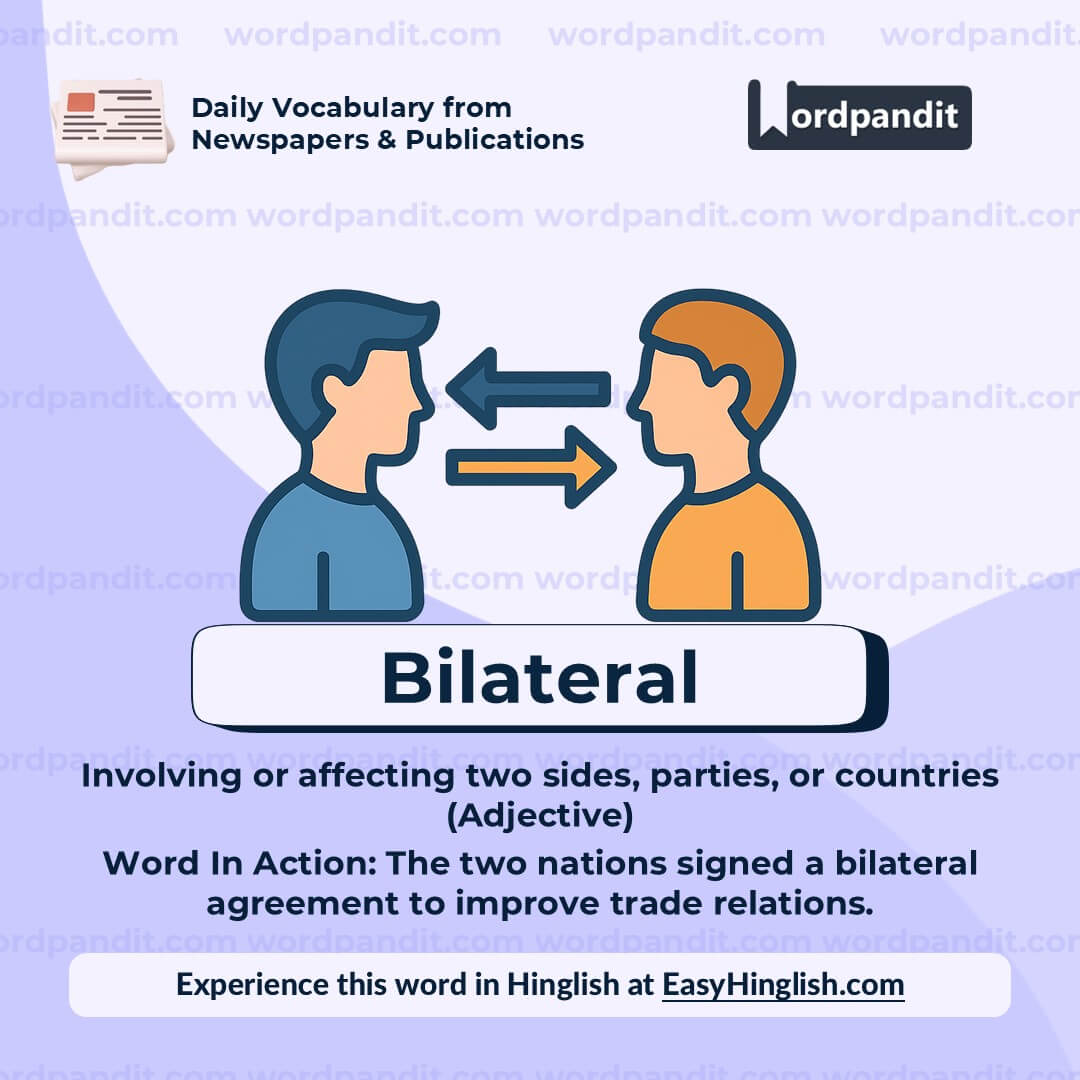
WORD-5: Bilateral
Context:
"A sensitive phase of bilateral engagement with the U.S." - The Hindu
Explanatory Paragraph:
Bilateral meaning in English is 'involving two sides, parties, or countries; affecting or undertaken by two parties equally.' This word is used when describing agreements, negotiations, relations, or discussions between exactly two entities. How to use bilateral is straightforward—it appears frequently in international relations news, diplomatic discussions, business agreements, and competitive exam passages about trade deals, treaties, or partnerships between two nations or organizations.
Meaning: Involving or affecting two sides, parties, or countries (Adjective)
Pronunciation: by-LAT-er-uhl
Difficulty Level: ⭐⭐⭐ Intermediate
Etymology: Bilateral comes from Latin 'bi-' meaning 'two' and 'lateralis' meaning 'of or belonging to the side,' from 'latus' (side). The word entered English in the mid-19th century, originally used in anatomy to describe body parts having two sides. It later expanded into political and diplomatic vocabulary to describe agreements or relations involving exactly two parties, making it essential terminology in international relations.
Prashant Sir's Notes:
Many students confuse bilateral with multilateral—the difference between bilateral and multilateral is critical for competitive exams. Bilateral involves exactly two parties (India-USA bilateral trade), while multilateral involves three or more parties (BRICS is a multilateral organization). For UPSC and CAT aspirants, bilateral frequently appears in questions about international relations, trade agreements, and diplomatic negotiations. In Indian English newspapers, you'll constantly see "bilateral ties," "bilateral talks," or "bilateral engagement"—these phrases specifically mean discussions or relationships between India and one other country. Remember, bilateral usage in sentences almost always involves agreements, relations, or discussions, and you can spot it by counting—if there are exactly two parties mentioned, bilateral is the right word.
Synonyms & Antonyms:
Synonyms: two-sided, mutual, reciprocal, joint (when involving two parties), dual-party, binational (for countries)
Antonyms: unilateral, multilateral, one-sided, independent, solo
Usage Examples:
- India and Japan signed a bilateral agreement to strengthen defense cooperation and enhance security collaboration in the Indo-Pacific region.
- The bilateral trade between India and Bangladesh has grown significantly over the past decade, reaching nearly fifteen billion dollars annually.
- During the summit in New Delhi, both prime ministers emphasized the importance of bilateral dialogue to resolve border disputes peacefully.
- Infosys entered into a bilateral partnership with the German technology firm to develop innovative artificial intelligence solutions for European markets.
Cultural Reference:
"Every time the Indian Prime Minister visits another country, news channels discuss 'strengthening bilateral ties'—a phrase that has become synonymous with diplomatic visits and state-level negotiations in Indian political discourse." - Common in Indian news media
Think About It:
Why do countries often prefer bilateral agreements over multilateral ones? In what situations would a bilateral approach be more effective than involving multiple nations?
Quick Activity:
Search today's newspaper or news websites for the term "bilateral." List three different bilateral relationships or agreements mentioned, and note which two countries or parties are involved in each case.
Memory Tip:
Break 'Bilateral' into 'BI + LATERAL'—'BI' means two (like bicycle has two wheels, binoculars have two lenses), and 'LATERAL' means side. So bilateral literally means 'two sides.' Imagine two cricket captains shaking hands before a match—that's a bilateral moment between exactly two teams, not involving any third party.
Real-World Application:
Bilateral is essential vocabulary in international relations, diplomacy, business negotiations, and current affairs. In newspapers, bilateral appears in headlines about trade deals, defense pacts, diplomatic visits, and treaty signings. For UPSC aspirants, understanding bilateral versus multilateral is crucial for International Relations optional and General Studies papers. In corporate communications, bilateral agreements refer to contracts between two companies. CAT and GRE reading comprehension passages frequently feature bilateral in contexts discussing international cooperation, making it high-priority vocabulary for competitive exam preparation.


