

Daily Vocabulary from Indian Newspapers and Publications
Welcome to Wordpandit’s Indian Vocabulary Hub
At Wordpandit, we understand the importance of staying rooted in the local context while expanding your language skills. This section focuses on enriching your vocabulary with words and phrases drawn from India’s leading newspapers and publications, ensuring you're learning vocabulary that is practical, relevant, and uniquely Indian.
Why Indian Sources Matter
We believe that the best way to master any language is by immersing yourself in local content. That’s why we carefully curate vocabulary from top Indian publications, including:
- The Hindu
- The Times of India
- The Economic Times
- Hindustan Times
- Live Mint
- The Indian Express
- And many others...
Stay Updated, Stay Relevant
With daily updates from Indian news sources, you’ll be consistently learning words that reflect the trends and shifts in Indian society and culture. Our focus is to provide vocabulary that enhances your understanding of the language in an Indian context.
How Wordpandit Supports Your Goals
Whether you’re preparing for exams, aiming to improve your professional communication, or simply want to stay connected with the latest Indian vocabulary, Wordpandit is here to guide you every step of the way.
Learn with a Practical Approach
Our interactive learning methodology includes real-world examples, engaging activities, and context-specific usage to ensure that every word becomes part of your active vocabulary.
Dive into Indian Vocabulary Today!

Why Choose Wordpandit?
Practical Learning: Focus on words you'll actually encounter in real-world reading, enhancing your comprehension and communication skills.
Diverse Content: From current affairs to scientific breakthroughs, our varied sources expose you to vocabulary across multiple domains.
Effortless Integration: Make Wordpandit a part of your daily routine. Just a few minutes each day can significantly boost your lexicon over time.
Your Path to Vocabulary Mastery
- Visit our Daily Vocabulary section regularly
- Explore new words and their usage in context
- Practice incorporating these words into your own writing and speech
- Track your progress as your vocabulary expands
Start Your Journey Today
Embark on your vocabulary enhancement journey with Wordpandit. By consistently engaging with our daily posts, you'll build a robust vocabulary that serves you well in academic, professional, and personal contexts.
Remember, a word a day keeps linguistic limitations at bay. Make Wordpandit your daily companion in the quest for vocabulary excellence!
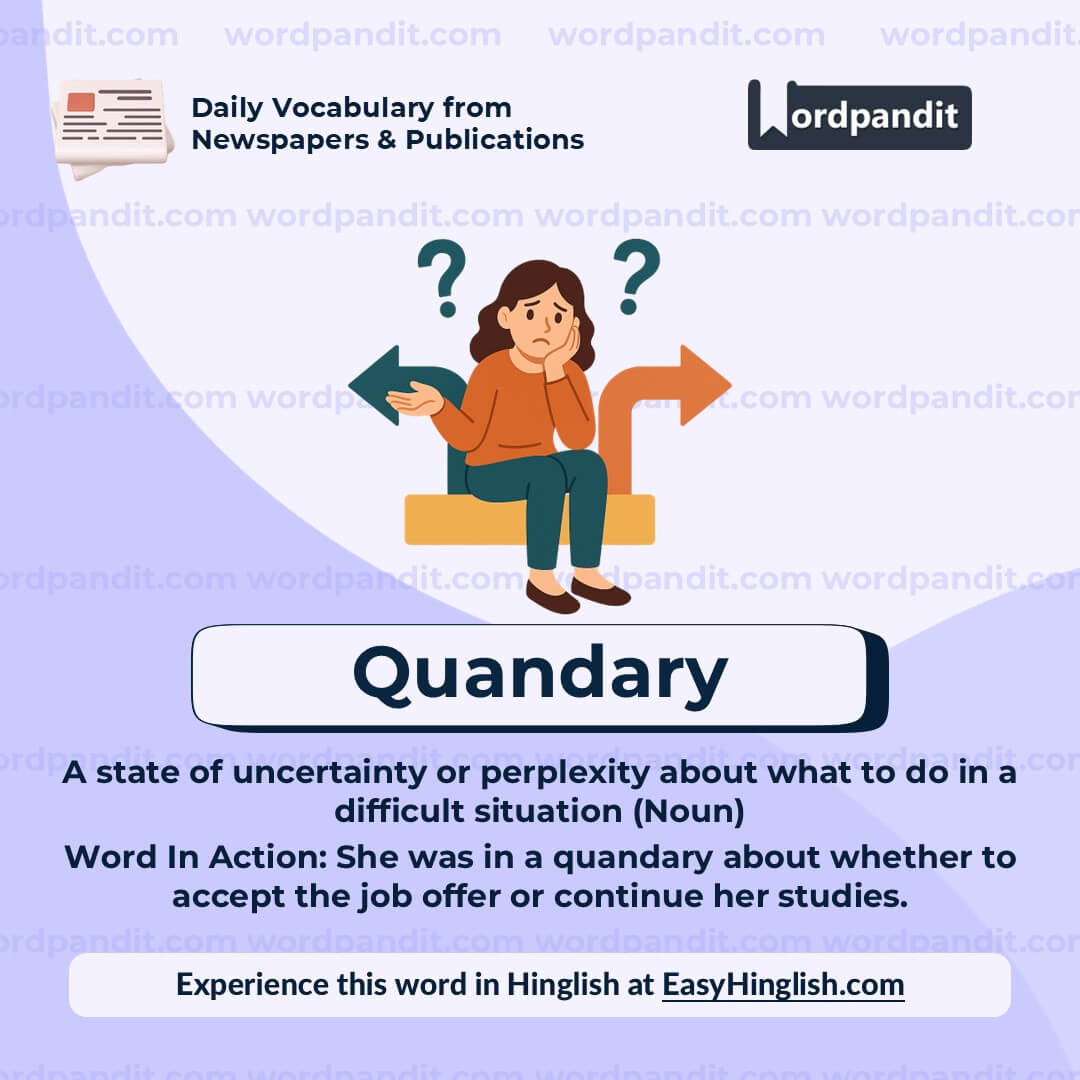
WORD-1: Quandary
Context:
"The quandary faced by Indian foreign policy strategists…" - The Hindu
Explanatory Paragraph:
Quandary meaning in English is 'a state of uncertainty or perplexity, especially about what decision to make when facing a difficult situation.' This word is used when someone finds themselves stuck between two or more equally challenging options, unable to decide which path to take. How to use quandary effectively: it commonly appears in formal writing, newspaper editorials, policy discussions, and competitive exam passages to describe complex decision-making scenarios where every choice has significant consequences.
Meaning: A state of uncertainty or perplexity about what to do in a difficult situation (Noun)
Pronunciation: KWON-duh-ree
Difficulty Level: ⭐⭐⭐ Intermediate
Etymology: Quandary emerged in English around the 16th century, possibly from Latin 'quando' meaning 'when,' reflecting the temporal aspect of being caught in a moment of indecision. The word evolved to capture that frozen moment when multiple paths seem equally problematic, and choosing between them feels impossible. Its uncertain etymology mirrors the very confusion the word describes.
Prashant Sir's Notes:
Students often ask: what is the difference between quandary and dilemma? While both describe difficult choices, quandary usage emphasizes the confusion and perplexity of not knowing what to do, whereas dilemma focuses on having to choose between two undesirable options. For CAT and GRE aspirants, quandary frequently appears in Reading Comprehension passages about policy decisions, ethical debates, and strategic challenges. In Indian newspapers, you'll often see phrases like "caught in a quandary" or "faces a quandary" when discussing government policy decisions, especially in editorials from The Hindu or Indian Express analyzing complex diplomatic or economic situations.
Synonyms & Antonyms:
Synonyms: dilemma, predicament, plight, impasse, difficulty, perplexity, puzzle, confusion, bind, fix
Antonyms: certainty, clarity, solution, resolution, decision, confidence
Usage Examples:
- The Indian government found itself in a quandary over balancing economic growth with environmental protection after the climate summit.
- Priya was in a real quandary: accept the high-paying job in Bangalore or stay in Mumbai near her aging parents.
- The selection committee faced a quandary when both Rohit and Virat performed equally well during the practice matches.
- Small business owners across Delhi are in a quandary about whether to invest in expansion given the uncertain economic climate.
Cultural Reference:
"Every Indian middle-class family faces this quandary: save for the future or spend on present needs? The answer shapes generations." - Common theme in Indian literature exploring family dynamics
Think About It:
When you face a quandary in life, is it better to make a quick decision and move forward, or take time to carefully weigh every option even if it means prolonged uncertainty?
Quick Activity:
Think of a recent quandary you faced—personal, academic, or career-related. Write two sentences describing the situation and what made the decision so difficult.
Memory Tip:
Think of 'Quandary' as "QUAN-DARE-Y"—imagine standing at a crossroads wondering "DARE I go this way?" while holding a QUANTITY of options in your hands, unable to decide which path to take. The confusion in pronunciation mirrors the confusion in making decisions.
Real-World Application:
Quandary is commonly used in editorial writing, policy analysis, and business communications to describe complex decision-making situations. Journalists use it when analyzing government policies, corporate strategists employ it in reports about market challenges, and it frequently appears in CAT and GRE Reading Comprehension passages that discuss ethical dilemmas, strategic choices, or political decision-making. In formal emails and reports, using "quandary" adds sophistication while precisely conveying the difficulty of a situation.
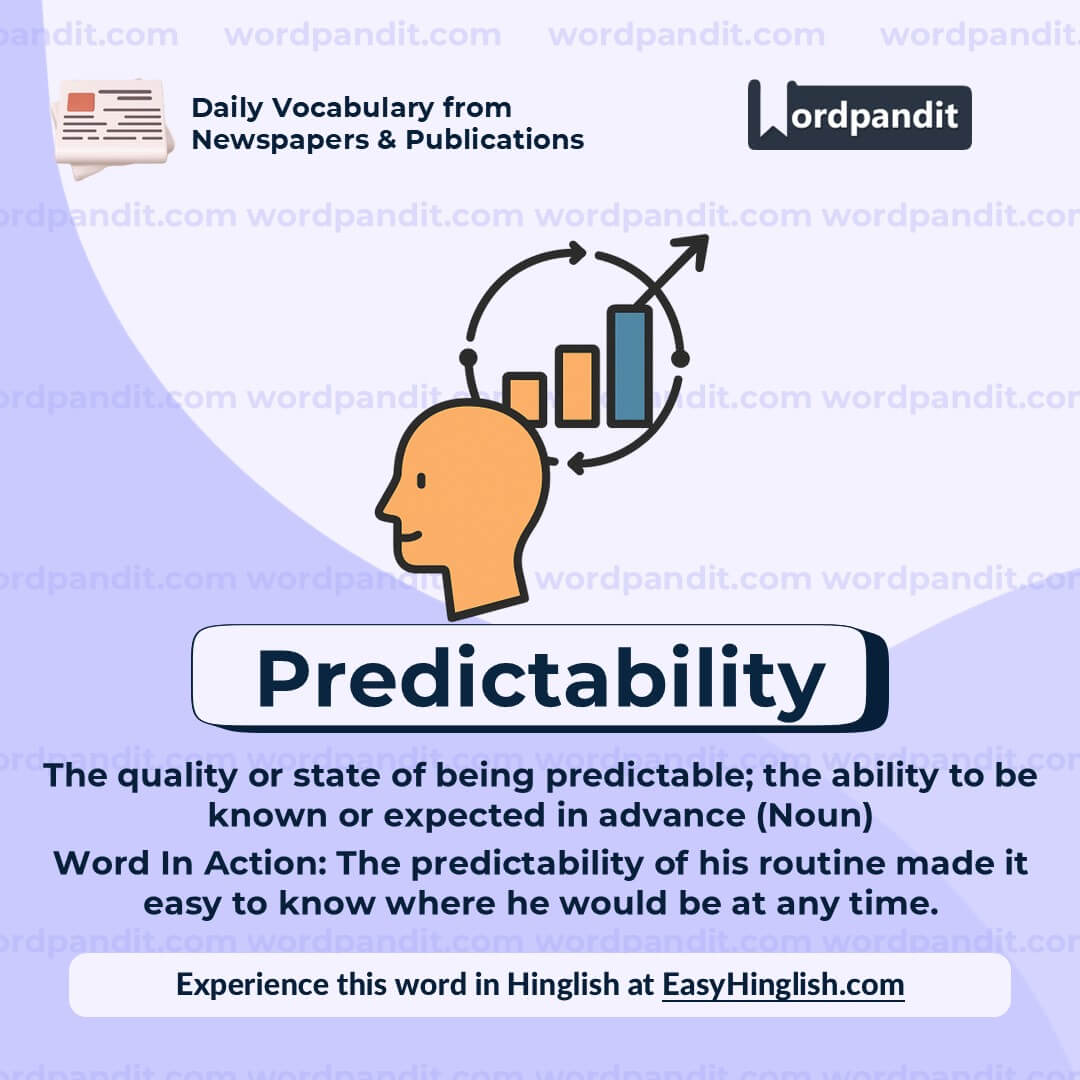
WORD-2: Predictability
Context:
"Seeking predictability in their engagements with U.S. interlocutors." - The Hindu
Explanatory Paragraph:
Predictability meaning in English is 'the quality of being able to be known, anticipated, or expected in advance with reasonable certainty.' This word is used when describing patterns, behaviors, or outcomes that follow a consistent, foreseeable course. How to use predictability: it appears frequently in formal writing, business analysis, international relations discussions, and competitive exam passages to describe stability, consistency, and the ability to forecast future actions or events based on established patterns.
Meaning: The quality or state of being predictable; the ability to be known or expected in advance (Noun)
Pronunciation: prih-dik-tuh-BIL-ih-tee
Difficulty Level: ⭐⭐ Basic to Intermediate
Etymology: Predictability derives from Latin 'praedicere' meaning 'to make known beforehand,' combining 'prae' (before) and 'dicere' (to say). The word entered English through 'predict' in the 16th century, with the noun form 'predictability' emerging later to describe the measurable quality of being foreseeable. Its evolution reflects humanity's enduring desire to understand and anticipate patterns in an uncertain world.
Prashant Sir's Notes:
Many students confuse predictability with 'prediction'—while prediction is the act of forecasting something, predictability usage refers to the inherent quality of being foreseeable. The difference between predictability and reliability is subtle but important: predictability means you can anticipate what will happen, while reliability means you can depend on consistent performance. For UPSC and CAT aspirants, predictability frequently appears in passages about international relations, economic policy, and business strategy. In Indian English newspapers, you'll often see "lack of predictability" or "seeking predictability" when discussing foreign policy, market conditions, or government decision-making, especially in contexts involving Indo-US relations or economic reforms.
Synonyms & Antonyms:
Synonyms: consistency, reliability, regularity, dependability, stability, certainty, foreseeability, pattern, uniformity, steadiness
Antonyms: unpredictability, randomness, uncertainty, volatility, inconsistency, irregularity
Usage Examples:
- Indian businesses value predictability in government policies, as sudden regulatory changes can disrupt long-term investment planning and growth strategies.
- The monsoon's predictability has decreased over recent years, making it harder for farmers in Maharashtra and Karnataka to plan their crop cycles.
- Investors prefer markets with high predictability, which explains why stable democracies attract more foreign direct investment than volatile regimes.
- Rahul's predictability in always ordering butter chicken made choosing restaurants easier, though his friends wished he'd be more adventurous.
Cultural Reference:
"In cricket, the predictability of Dhoni's helicopter shot didn't make it less effective—bowlers knew it was coming but still couldn't stop it." - Common observation in Indian cricket commentary celebrating signature moves
Think About It:
Is predictability always desirable in life, or do we need some unpredictability to keep things interesting and foster innovation and growth?
Quick Activity:
List three areas in your life where you value predictability (like class schedules or meal times) and three where you prefer unpredictability. What does this reveal about your personality?
Memory Tip:
Break 'Predictability' into "PRE-DICT-ABILITY"—imagine a dictionary (DICT) that can tell you things BEFORE (PRE) they happen, giving you the ABILITY to know the future. Think of it as having a crystal ball that shows consistent, foreseeable patterns.
Real-World Application:
Predictability is essential vocabulary in business reports, economic analysis, diplomatic communications, and policy discussions. Financial analysts use it when discussing market stability, diplomats employ it in negotiations seeking consistent engagement patterns, and project managers rely on it when planning timelines and resource allocation. In competitive exams like CAT, GRE, and UPSC, predictability appears in Reading Comprehension passages about international relations, economic theory, and organizational behavior. Understanding this word helps you grasp nuanced discussions about stability, consistency, and strategic planning in professional and academic contexts.
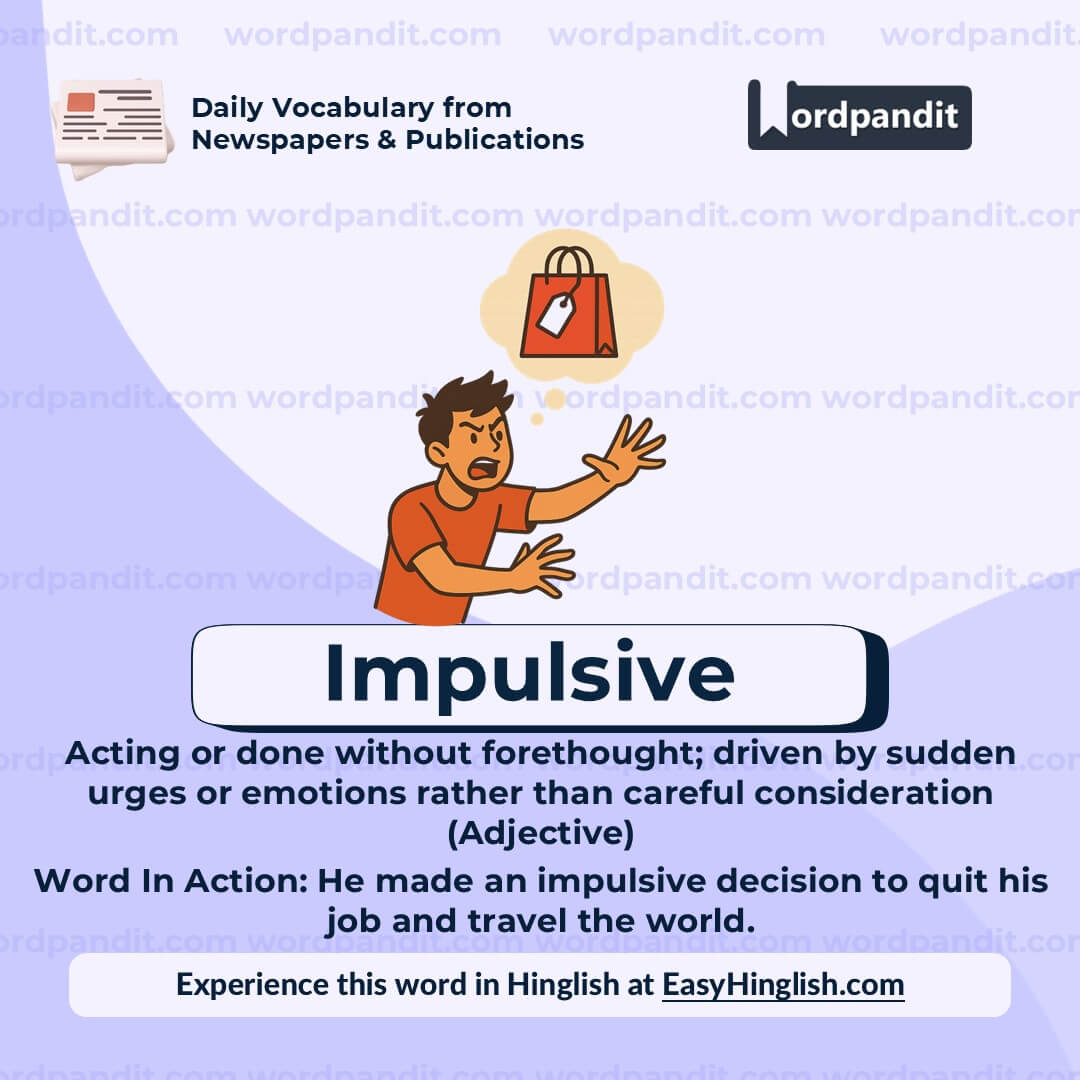
WORD-3: Impulsive
Context:
"The trait of an impulsive but popular leader on American soil." - The Hindu
Explanatory Paragraph:
Impulsive meaning in English is 'acting or done suddenly without careful thought or planning, driven by immediate emotion or desire rather than reason.' This word is used when describing actions, decisions, or behaviors that happen spontaneously without considering consequences. How to use impulsive effectively: it commonly appears in psychology discussions, personality descriptions, leadership analysis, and competitive exam passages to characterize decision-making styles that prioritize speed and emotion over deliberation and logic.
Meaning: Acting or done without forethought; driven by sudden urges or emotions rather than careful consideration (Adjective)
Pronunciation: im-PUL-siv
Difficulty Level: ⭐⭐ Basic to Intermediate
Etymology: Impulsive comes from Latin 'impulsus,' the past participle of 'impellere' meaning 'to push against' or 'drive forward,' combining 'in-' (toward) and 'pellere' (to drive). The word entered English in the 15th century, initially describing physical forces that pushed objects forward. Over time, it evolved to describe psychological forces—internal urges that push people to act without thinking, capturing that sense of being driven forward by emotion rather than reason.
Prashant Sir's Notes:
Students often ask: what is the difference between impulsive and spontaneous? While both involve unplanned actions, impulsive usage carries a negative connotation of recklessness and lack of control, whereas spontaneous is more neutral or positive, suggesting natural and authentic behavior. For CAT and GRE aspirants, impulsive frequently appears in passages about personality psychology, leadership styles, and decision-making processes. In Indian newspapers like The Hindu and Indian Express, you'll see "impulsive decision" or "impulsive behavior" when analyzing political leaders, policy announcements made without consultation, or consumer spending patterns during festival sales. Remember: impulsive suggests acting before thinking, often with regrettable consequences.
Synonyms & Antonyms:
Synonyms: rash, hasty, reckless, spontaneous, unplanned, sudden, impetuous, instinctive, snap (as in snap decision), precipitate
Antonyms: deliberate, calculated, thoughtful, cautious, planned, measured, prudent, considered
Usage Examples:
- Ramesh's impulsive decision to quit his stable job at Infosys without another offer lined up left him struggling financially for months.
- The finance minister's impulsive announcement of new tax policies without consulting experts caused market volatility and investor panic across Mumbai.
- Priya admitted she was an impulsive shopper who regularly bought clothes during online sales that she never actually wore later.
- His impulsive nature made him exciting to be around but unreliable as a business partner for long-term ventures requiring careful planning.
Cultural Reference:
"Kabir Singh's character exemplified impulsive behavior—acting on anger and desire without thinking, which Bollywood portrayed as passionate but ultimately showed its destructive consequences." - Common critique of the 2019 film's portrayal of impulsivity
Think About It:
Can impulsive decisions sometimes lead to positive outcomes, or is careful deliberation always the better approach when making important life choices?
Quick Activity:
Write about one impulsive decision you made that turned out well and one that you regretted. What was the difference between these two situations?
Memory Tip:
Think of 'Impulsive' as "IM-PULSE-IVE"—imagine your PULSE suddenly racing and making you act immediately without thinking. Picture someone's heart PULSING fast, pushing (IM = in/toward) them to make a snap decision. The word itself sounds rushed and urgent, just like impulsive behavior.
Real-World Application:
Impulsive is widely used in psychology reports, personality assessments, leadership analyses, and consumer behavior studies. HR professionals use it when evaluating candidates' decision-making styles, therapists employ it when discussing behavioral patterns, and marketing experts study impulsive buying behavior during sales and festivals. In competitive exams for CAT, GRE, and UPSC, impulsive appears in Reading Comprehension passages about personality psychology, political leadership, economic decision-making, and social behavior. Understanding this word helps you analyze character motivations in literature, assess decision-making quality in case studies, and articulate behavioral patterns in essays and interviews.

WORD-4: Mandarins
Context:
"Routinely frustrating South Block mandarins seeking predictability…" - The Hindu
Explanatory Paragraph:
Mandarins meaning in English is 'senior bureaucrats or influential government officials who wield significant administrative power.' This word is used when referring to high-ranking civil servants, particularly in contexts involving policy decisions and governmental authority. Mandarins is commonly used in formal writing, political commentary, and newspaper articles to describe the powerful administrative elite who shape government functioning, making it especially relevant for UPSC and competitive exam aspirants studying governance and polity.
Meaning: Senior bureaucrats or influential government officials in positions of administrative authority (Noun)
Pronunciation: MAN-duh-rinz
Difficulty Level: ⭐⭐⭐ Intermediate to Advanced
Etymology: Mandarins originally comes from Portuguese 'mandarim,' derived from Malay 'menteri' meaning 'minister or counselor,' which itself came from Sanskrit 'mantri' meaning 'advisor.' The term was first used to describe powerful Chinese imperial officials wearing distinctive robes, and gradually evolved in English to refer to any senior bureaucrat or influential administrator who holds significant power in government machinery.
Prashant Sir's Notes:
Many students confuse 'mandarins' with just 'government employees'—the difference between mandarins and regular bureaucrats is that mandarins specifically refers to the top-tier, influential officials who make policy decisions, not clerks or junior staff. For UPSC aspirants, understanding mandarins usage is crucial because Indian newspapers constantly use this term when discussing North Block, South Block, and Niti Aayog officials who shape national policies. In Indian English context, you'll often see phrases like "Delhi mandarins," "finance ministry mandarins," or "bureaucratic mandarins" when articles discuss the administrative elite who control India's governance machinery. How to use mandarins correctly: it carries a slightly formal, sometimes critical tone suggesting powerful officials who may be resistant to change or overly cautious in their approach.
Synonyms & Antonyms:
Synonyms: bureaucrats, administrators, officials, civil servants, government functionaries, administrative elite, power brokers, policymakers, apparatchiks (in political contexts)
Antonyms: subordinates, junior staff, field workers, common citizens, outsiders
Usage Examples:
- The finance ministry mandarins opposed the radical tax reform proposal, preferring incremental changes to maintain fiscal stability.
- Despite the new government's ambitious plans, Raisina Hill mandarins continued implementing policies with their characteristic caution and deliberation.
- Priya's research paper analyzed how Indian bureaucratic mandarins have historically influenced economic policy decisions beyond political directives.
- The startup founders found it frustrating to navigate the slow decision-making process controlled by ministry mandarins in Delhi.
Cultural Reference:
"The fate of reforms often rests not with politicians but with the mandarins who control implementation machinery." - Common observation in Indian political commentary on bureaucratic power
Think About It:
Why do senior bureaucratic mandarins often resist rapid policy changes even when political leadership demands them, and is this conservatism protective or obstructive for India's development?
Quick Activity:
Find two recent news articles from The Hindu or Indian Express that use the term "mandarins" and identify which specific government departments or officials are being referred to.
Memory Tip:
Think of 'Mandarins' as "MAN-DA-REINS"—imagine powerful men holding the reins (control) of government machinery. Just like mandarins (the fruit) sit at the top of citrus hierarchy, bureaucratic mandarins sit at the top of administrative hierarchy controlling policy decisions.
Real-World Application:
In newspaper editorials, political analysis, and UPSC essay writing, 'mandarins' is strategically used to discuss the administrative elite's role in governance. The term appears frequently in articles analyzing policy delays, bureaucratic resistance to reforms, or the power dynamics between elected politicians and permanent civil servants. Understanding this word helps decode Indian political discourse where the "steel frame" of bureaucracy often determines implementation success regardless of political intentions.
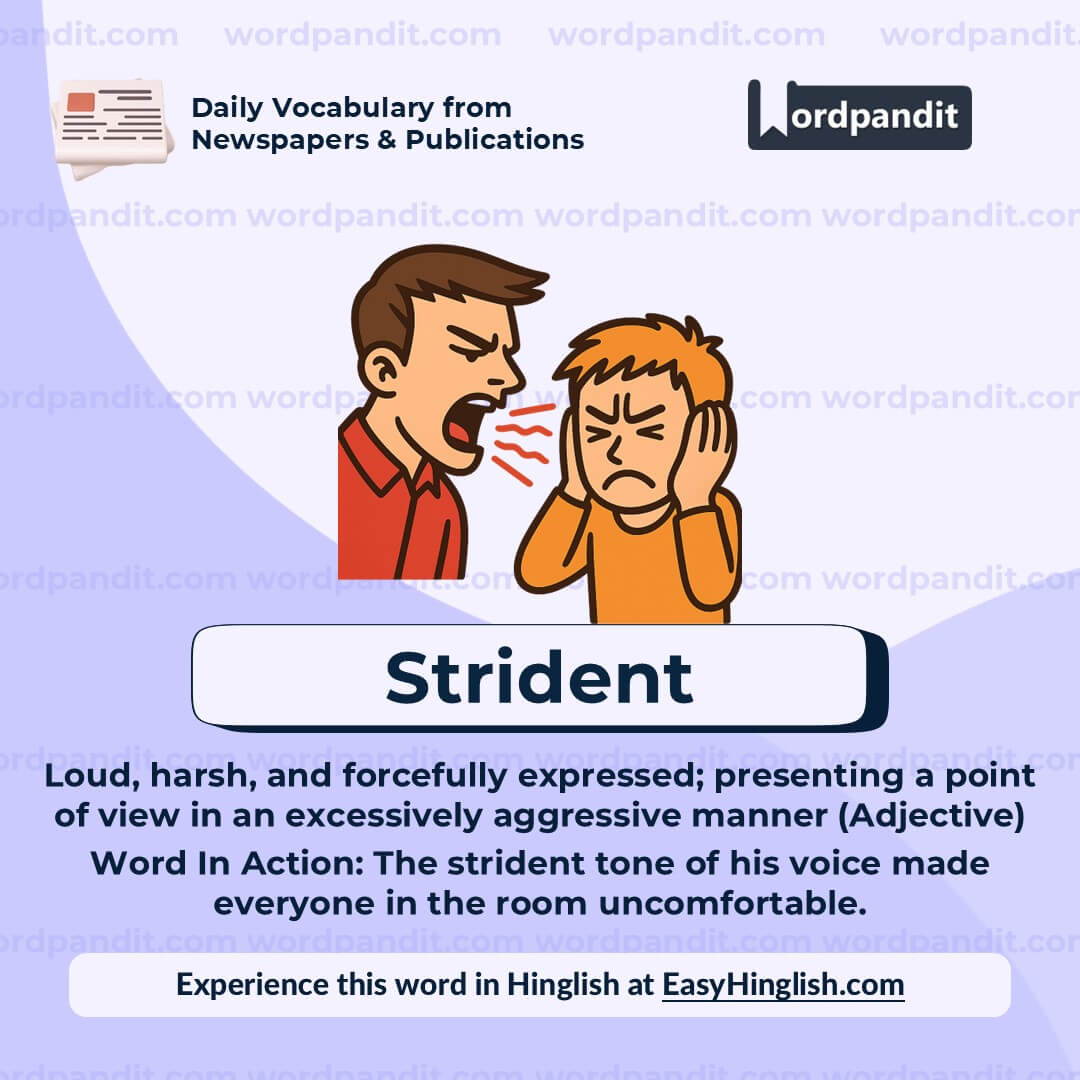
WORD-5: Strident
Context:
"It is not so much the strident voices of the North Atlantic that matter…" - The Hindu
Explanatory Paragraph:
Strident meaning in English is 'loud, harsh, and forcefully expressed in an unpleasant or grating manner.' This word is used when describing voices, opinions, or demands that are aggressively insistent and often annoying in their intensity. Strident is commonly used in formal writing, political commentary, and competitive exam passages like CAT and GRE to describe criticism, protests, or arguments that are excessively loud or harsh, making it essential vocabulary for understanding tone and author's perspective in reading comprehension.
Meaning: Loud, harsh, and forcefully expressed; presenting a point of view in an excessively aggressive manner (Adjective)
Pronunciation: STRY-dent
Difficulty Level: ⭐⭐⭐ Intermediate
Etymology: Strident comes from Latin 'stridentem,' the present participle of 'stridere' meaning 'to make a harsh noise or creak.' Originally used to describe the harsh, grating sound of metal scraping or insects buzzing, the word evolved in English to describe not just unpleasant sounds but also forceful, aggressive opinions and voices that metaphorically 'grate' on listeners' ears.
Prashant Sir's Notes:
Students often ask: what is the difference between strident and loud? While both indicate volume, strident specifically carries negative connotations of being harsh, grating, and unpleasantly aggressive. For GRE and CAT aspirants, strident frequently appears in RC passages describing protests, criticism, or demands—it's always a tone indicator suggesting the author finds something excessive or annoying. How to use strident correctly: it typically precedes words like 'voice,' 'tone,' 'criticism,' 'demands,' or 'opposition.' In Indian English newspapers, you'll see "strident protests," "strident opposition," or "strident criticism" when describing aggressive political stances. Remember, calling something strident is never a compliment—it suggests the speaker or writer finds the forceful expression off-putting or excessive.
Synonyms & Antonyms:
Synonyms: harsh, shrill, grating, piercing, raucous, discordant, vociferous, clamorous, insistent, aggressive (in tone), abrasive
Antonyms: gentle, soft, melodious, soothing, calm, moderate, measured, subdued, mild
Usage Examples:
- The opposition party's strident criticism of the government's economic policies dominated headlines throughout the budget session in Parliament.
- Meera's strident tone during the office meeting alienated potential supporters who might have agreed with her ideas if presented more diplomatically.
- Environmental activists adopted a strident approach in their campaign, demanding immediate policy changes rather than gradual reforms.
- Despite strident calls from student unions for fee reduction, the university administration maintained its position on increased educational costs.
Cultural Reference:
"The most effective social movements in India have balanced passionate advocacy with strategic diplomacy, avoiding strident rhetoric that alienates middle-ground supporters." - Analysis of India's independence movement and civil rights campaigns
Think About It:
In Indian democracy, when does strident protest become necessary for change, and when does it become counterproductive by hardening opposition and losing public sympathy?
Quick Activity:
Write two sentences comparing a measured argument versus a strident argument on the same topic, showing how tone changes the impact of similar content.
Memory Tip:
Think of 'Strident' as "STRIDE-ENT"—imagine someone striding aggressively into a room and speaking so harshly that it's like nails on a chalkboard. Or remember: "STRess + louD = STRiDent"—stressful loudness that grates on your nerves.
Real-World Application:
In editorial writing, political analysis, and CAT reading comprehension passages, 'strident' is used to indicate the author's critical perspective on how arguments are presented. Journalists use it when describing protests, opposition statements, or advocacy that they view as excessively aggressive. Understanding this word for competitive exams helps decode author bias and tone questions—when a passage describes someone's position as "strident," it signals disapproval of the manner, even if not the content, of expression.


