

Daily Vocabulary from Indian Newspapers and Publications
Welcome to Wordpandit’s Indian Vocabulary Hub
At Wordpandit, we understand the importance of staying rooted in the local context while expanding your language skills. This section focuses on enriching your vocabulary with words and phrases drawn from India’s leading newspapers and publications, ensuring you're learning vocabulary that is practical, relevant, and uniquely Indian.
Why Indian Sources Matter
We believe that the best way to master any language is by immersing yourself in local content. That’s why we carefully curate vocabulary from top Indian publications, including:
- The Hindu
- The Times of India
- The Economic Times
- Hindustan Times
- Live Mint
- The Indian Express
- And many others...
Stay Updated, Stay Relevant
With daily updates from Indian news sources, you’ll be consistently learning words that reflect the trends and shifts in Indian society and culture. Our focus is to provide vocabulary that enhances your understanding of the language in an Indian context.
How Wordpandit Supports Your Goals
Whether you’re preparing for exams, aiming to improve your professional communication, or simply want to stay connected with the latest Indian vocabulary, Wordpandit is here to guide you every step of the way.
Learn with a Practical Approach
Our interactive learning methodology includes real-world examples, engaging activities, and context-specific usage to ensure that every word becomes part of your active vocabulary.
Dive into Indian Vocabulary Today!

Why Choose Wordpandit?
Practical Learning: Focus on words you'll actually encounter in real-world reading, enhancing your comprehension and communication skills.
Diverse Content: From current affairs to scientific breakthroughs, our varied sources expose you to vocabulary across multiple domains.
Effortless Integration: Make Wordpandit a part of your daily routine. Just a few minutes each day can significantly boost your lexicon over time.
Your Path to Vocabulary Mastery
- Visit our Daily Vocabulary section regularly
- Explore new words and their usage in context
- Practice incorporating these words into your own writing and speech
- Track your progress as your vocabulary expands
Start Your Journey Today
Embark on your vocabulary enhancement journey with Wordpandit. By consistently engaging with our daily posts, you'll build a robust vocabulary that serves you well in academic, professional, and personal contexts.
Remember, a word a day keeps linguistic limitations at bay. Make Wordpandit your daily companion in the quest for vocabulary excellence!
WORD-1: Liberation
Context:
"It is easy to read this narrative as a tale of liberation." - Aeon
Explanatory Paragraph:
Liberation meaning in English is 'the act of setting someone or something free from imprisonment, oppression, or restrictions.' This word is used when describing freedom from control, whether physical, mental, social, or political. How to use liberation effectively depends on the context—it appears in discussions about independence movements, personal growth, social justice, and competitive exam passages dealing with historical or philosophical themes. Liberation is commonly used in formal writing, news articles covering social movements, and essays exploring freedom and rights.
Meaning: The act of setting free from imprisonment, slavery, oppression, or restrictive conditions (Noun)
Pronunciation: lib-uh-RAY-shun
Difficulty Level: ⭐⭐ Basic to Intermediate
Etymology: Liberation comes from Latin 'liberare' meaning 'to set free,' derived from 'liber' meaning 'free.' The word entered English through French 'libération' in the 15th century, originally used in legal contexts to describe freeing slaves or prisoners. Over time, it expanded to encompass political independence, social movements, and psychological freedom from mental constraints.
Prashant Sir's Notes:
Many students confuse liberation with 'liberty'—while both relate to freedom, the difference between liberation and liberty is crucial for competitive exams. Liberation is the process or act of becoming free, while liberty is the state of being free. For UPSC and CAT aspirants, liberation frequently appears in passages about India's independence struggle, women's rights movements, or economic reforms. How to use liberation correctly: pair it with 'from' to show what you're freed from ("liberation from poverty") or 'of' to show who is freed ("liberation of oppressed communities"). In Indian English newspapers, you'll often see "liberation movement" or "economic liberation" when discussing social progress and reforms post-1991.
Synonyms & Antonyms:
Synonyms: freedom, emancipation, release, deliverance, independence, manumission (formal), enfranchisement, discharge, rescue, salvation
Antonyms: imprisonment, captivity, enslavement, oppression, subjugation, bondage
Usage Examples:
- India's liberation from British colonial rule in 1947 marked the beginning of a new era of self-governance and democratic freedom.
- Priya found liberation in her decision to pursue art instead of engineering, finally following her passion despite family pressure.
- The economic liberalisation policies of 1991 brought liberation from restrictive trade practices, transforming India into a global market player.
- For many young professionals in Mumbai, moving out of their parents' home represents both financial independence and personal liberation.
Cultural Reference:
"The story of India's liberation is not just about freedom from foreign rule, but about millions of voices finally being heard." - Common theme in Indian historical narratives and Independence Day speeches
Think About It:
Can true liberation exist without economic independence, or does freedom remain incomplete when people still struggle for basic necessities?
Quick Activity:
Write two sentences describing a moment when you or someone you know experienced liberation—it could be from fear, social pressure, or any limiting belief.
Memory Tip:
Think of 'Liberation' as 'LIBERTY + ACTION'—it's the active process of gaining liberty or freedom. Imagine opening a cage and watching a bird fly away—that moment of release is liberation.
Real-World Application:
Liberation is commonly used in news journalism covering social justice movements, historical analysis of independence struggles, and opinion pieces discussing women's rights, caste equality, or economic reforms. In academic writing and competitive exam essays, liberation works effectively when discussing societal transformation, individual empowerment, or political freedom. Corporate communications use it when describing breaking free from traditional business models or outdated practices.
WORD-2: Constraint
Context:
"...women looking to break free of their traditional constraints." - Aeon
Explanatory Paragraph:
Constraint meaning in English is 'a limitation or restriction that controls or prevents free action or movement.' This word is used when describing factors that limit choices, behavior, or possibilities in any situation. How to use constraint effectively involves identifying what holds something back—whether physical boundaries, social rules, financial limits, or time pressures. Constraint is commonly used in formal writing, business reports, academic papers, and competitive exam passages discussing limitations, challenges, or restricted circumstances.
Meaning: A limitation or restriction that prevents freedom of action (Noun)
Pronunciation: kun-STRAYNT
Difficulty Level: ⭐⭐ Basic to Intermediate
Etymology: Constraint comes from Old French 'constrainte,' derived from Latin 'constringere' meaning 'to bind together or compress.' The word combines 'com-' (together) and 'stringere' (to bind tightly). It entered English in the 14th century initially referring to physical restraint or force, then gradually expanded to include social, economic, and psychological limitations that restrict human action and choice.
Prashant Sir's Notes:
Students often ask: what is the difference between constraint and restriction? While both limit freedom, constraint usage in sentences typically implies something that holds you back passively (budget constraints, time constraints), whereas restriction suggests active prohibition (travel restrictions, age restrictions). For CAT and GRE aspirants, constraint frequently appears in Reading Comprehension passages about business challenges, social issues, or resource management. In Indian English newspapers, you'll commonly see "financial constraints" when discussing government budgets, "infrastructural constraints" for development challenges, and "societal constraints" in articles about women's empowerment. The plural form "constraints" is more common than singular in formal writing, especially when listing multiple limiting factors.
Synonyms & Antonyms:
Synonyms: limitation, restriction, restraint, impediment, hindrance, obstacle, curb, check, control, barrier
Antonyms: freedom, liberty, flexibility, latitude, independence, leeway
Usage Examples:
- Budget constraints forced the Delhi Metro project team to prioritize essential expansions while postponing luxury additions to new stations.
- Rohan wanted to start his own business, but family responsibilities and financial constraints kept him in his corporate job.
- The company operates under several regulatory constraints that limit its ability to expand into international markets without government approval.
- Traditional social constraints prevented many talented women in rural Maharashtra from pursuing higher education until recent awareness campaigns changed mindsets.
Cultural Reference:
"In Dangal, Geeta and Babita break free from societal constraints to pursue wrestling, challenging traditional expectations of what girls should do." - Common analysis of the 2016 Bollywood film's central theme
Think About It:
Are some constraints actually beneficial for creativity and innovation, or does true excellence only emerge when all limitations are removed?
Quick Activity:
List three major constraints facing Indian startups today and think about how successful entrepreneurs have worked around these limitations to build thriving businesses.
Memory Tip:
Think of 'Constraint' as 'CON + STRAIN'—imagine being 'strained' or pulled tight by a chain (CON-nected). When you're under constraint, you're like a dog on a leash—you can move, but only within limits.
Real-World Application:
Constraint is extensively used in business writing when discussing budget limitations, resource allocation, and project management challenges. In academic essays for competitive exams, it's perfect for analyzing factors that limit development, growth, or social progress. Journalists use constraint when reporting on policy decisions, economic conditions, or social barriers. In technical and scientific writing, constraints describe the boundaries within which experiments, designs, or solutions must operate.
WORD-3: Paradigm
Context:
"...almost no one in the world currently stands entirely outside the choice-as-freedom paradigm…" - Aeon
Explanatory Paragraph:
Paradigm meaning in English is 'a typical example, pattern, or model of something; a worldview or set of assumptions that shape how we understand reality.' This word is used when describing fundamental frameworks, theories, or systems of thinking that define an era or field. How to use paradigm depends on context—it refers to dominant ways of thinking in science, philosophy, business, or society. Paradigm is commonly used in academic writing, business strategy discussions, and competitive exam passages exploring conceptual frameworks, intellectual history, or transformative change.
Meaning: A typical example or pattern; a framework of concepts, theories, or assumptions that shapes understanding (Noun)
Pronunciation: PAIR-uh-dime
Difficulty Level: ⭐⭐⭐ Intermediate
Etymology: Paradigm comes from Greek 'paradeigma' meaning 'pattern' or 'example,' formed from 'para' (beside) and 'deiknunai' (to show). It entered English through Latin 'paradigma' in the 15th century, initially used in grammar to show word inflection patterns. Philosopher Thomas Kuhn revolutionized its meaning in 1962 with "The Structure of Scientific Revolutions," where he used "paradigm shift" to describe fundamental changes in scientific thinking, making it a cornerstone term in intellectual discourse.
Prashant Sir's Notes:
Many students confuse paradigm with 'example' or 'model'—while related, the difference between paradigm and example is significant for competitive exams. A paradigm is not just one example but an entire system of thinking that determines what counts as valid or important. For CAT, GRE, and UPSC aspirants, paradigm frequently appears in RC passages about scientific revolutions, business transformations, or social change. The phrase "paradigm shift" is crucial—it means a fundamental change in approach or underlying assumptions, not just a small improvement. In Indian English usage, you'll see "educational paradigm" when discussing reforms in teaching methods, or "development paradigm" in policy discussions about moving from socialist to market-oriented economics after 1991.
Synonyms & Antonyms:
Synonyms: framework, model, pattern, archetype, prototype, standard, template, exemplar, worldview, mindset
Antonyms: anomaly, exception, deviation, irregularity, aberration
Usage Examples:
- India's shift from a license-raj paradigm to economic liberalization in 1991 represented a fundamental transformation in how the nation approached business and trade.
- The pandemic forced educational institutions across Mumbai and Bangalore to undergo a paradigm shift from traditional classroom teaching to online learning platforms.
- Ravi's startup challenged the existing e-commerce paradigm by focusing on vernacular languages and tier-2 cities rather than English-speaking urban consumers.
- The medical community operates within a scientific paradigm that requires evidence-based research before accepting new treatments, unlike alternative medicine practitioners.
Cultural Reference:
"Cricket in India represents more than a sport—it's a cultural paradigm that shapes national identity, entertainment, and even political discourse." - Common observation in sports journalism about cricket's role in Indian society
Think About It:
How many of your daily decisions are influenced by societal paradigms you've never questioned—from career choices to marriage expectations to success definitions?
Quick Activity:
Identify one paradigm shift you've witnessed in the last five years—perhaps in technology, work culture, or social attitudes—and write two sentences explaining how thinking changed fundamentally.
Memory Tip:
Think of 'Paradigm' as 'PAIR-A-DIME'—imagine two dimes (coins) that represent the two sides of a coin. A paradigm is like looking at the world from one side of the coin; a paradigm shift means flipping to see the completely different other side.
Real-World Application:
Paradigm is essential in business strategy documents when discussing fundamental changes in industry approaches, market thinking, or organizational culture. In academic essays and research papers for competitive exams, it's used to analyze theoretical frameworks, scientific revolutions, or shifts in social thinking. Management consultants and thought leaders frequently use paradigm when proposing transformative changes rather than incremental improvements. The term appears regularly in editorials discussing policy reforms, technological disruption, or cultural evolution in Indian and international contexts.
WORD-4: Emblematic
Context:
"...has become emblematic of the rejection of a larger vision of freedom rooted in personal choice." - Aeon
Explanatory Paragraph:
Emblematic meaning in English is 'serving as a symbol or perfect example of a particular quality, idea, or trend.' This word is used when something represents or typifies a broader concept, movement, or characteristic beyond itself. How to use emblematic effectively involves identifying things that symbolize larger patterns—whether a person emblematic of an era, an event emblematic of social change, or an object emblematic of values. Emblematic is commonly used in analytical writing, literary criticism, news commentary, and competitive exam passages that explore symbolic significance and representative examples.
Meaning: Serving as a symbol or typical example of something; representative (Adjective)
Pronunciation: em-bluh-MAT-ik
Difficulty Level: ⭐⭐⭐ Intermediate
Etymology: Emblematic comes from Greek 'emblema' meaning 'something inserted or inlaid,' from 'emballein' (to throw in or insert). It passed through Latin 'emblematicus' into English in the early 17th century, originally referring to symbolic pictures or designs with hidden meanings in Renaissance art. The word evolved from describing literal visual symbols to representing anything that serves as a characteristic example or symbol of abstract ideas, movements, or qualities.
Prashant Sir's Notes:
Students often ask: what is the difference between emblematic and symbolic? While both relate to representation, emblematic usage specifically emphasizes being a perfect or typical example, whereas symbolic focuses on abstract meaning. For CAT and GRE aspirants, emblematic frequently appears in RC passages analyzing cultural trends, historical significance, or literary themes. How to use emblematic correctly: it's always followed by 'of'—you can't just say something is "emblematic," you must specify what it represents ("emblematic of change"). In Indian English newspapers, you'll see "emblematic of India's diversity" when describing festivals, or "emblematic of economic progress" when discussing infrastructure projects like the bullet train. Pro tip: emblematic adds analytical depth to your essays—instead of saying "this shows corruption," write "this incident is emblematic of systemic corruption."
Synonyms & Antonyms:
Synonyms: symbolic, representative, characteristic, typical, quintessential, archetypal, indicative, illustrative, exemplary, paradigmatic
Antonyms: atypical, uncharacteristic, unrepresentative, anomalous, exceptional, unusual
Usage Examples:
- The Taj Mahal has become emblematic of India's rich cultural heritage and architectural brilliance, attracting millions of tourists annually to Agra.
- Virat Kohli's aggressive yet disciplined playing style is emblematic of modern Indian cricket's transformation from defensive to dominating approach on the field.
- The long queues outside government offices are emblematic of India's bureaucratic challenges, where citizens spend hours for simple documentation tasks.
- Kiran's success story—from a small town in Bihar to a tech entrepreneur in Bangalore—is emblematic of India's startup revolution and social mobility.
Cultural Reference:
"The Rajinikanth style of flipping sunglasses and delivering punchlines has become emblematic of South Indian cinema's larger-than-life heroism and mass appeal." - Common observation in discussions about regional cinema's cultural impact
Think About It:
What object, place, or person would you consider most emblematic of contemporary India—and does that representation capture the full complexity of the nation?
Quick Activity:
Choose any recent news event and write two sentences explaining what larger trend or issue it is emblematic of, using the word correctly in your analysis.
Memory Tip:
Think of 'Emblematic' as 'EMBLEM + AUTOMATIC'—when something is emblematic, it automatically brings to mind (like an emblem or logo does) the larger idea it represents. The Indian flag is emblematic—it automatically symbolizes the entire nation.
Real-World Application:
Emblematic is powerful in analytical essays and opinion pieces when you need to show how specific examples represent broader patterns or trends. Journalists use it extensively in feature articles to connect individual stories to larger social issues—"this case is emblematic of gender discrimination in workplaces." In business writing, leaders describe company values through emblematic stories or decisions. For competitive exam essays, using emblematic demonstrates analytical sophistication, showing you can identify what makes particular examples symbolically significant rather than just describing events.
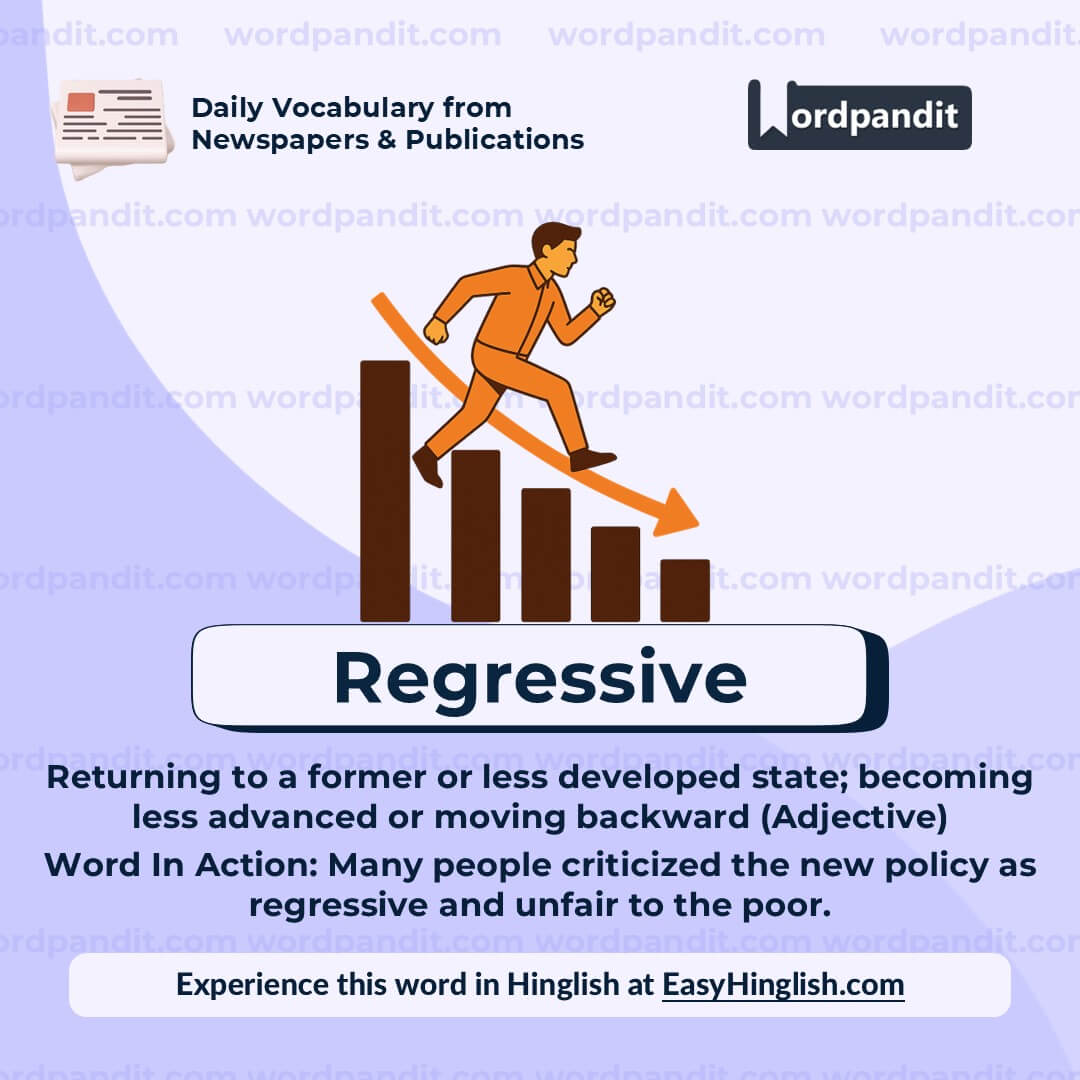
WORD-5: Regressive
Context:
"...choice can sometimes seem to be... a regressive force." - Aeon
Explanatory Paragraph:
Regressive meaning in English is 'returning to a former or less advanced state; moving backward rather than forward in development or progress.' This word is used when describing policies, behaviors, or trends that reverse positive developments or return to outdated, often harmful practices. How to use regressive involves identifying backward movement—whether in social attitudes, economic policies, or personal behavior. Regressive is commonly used in political commentary, economic analysis, social criticism, and competitive exam passages discussing development challenges, policy failures, or cultural backsliding.
Meaning: Returning to a former or less developed state; becoming less advanced or moving backward (Adjective)
Pronunciation: rih-GRES-iv
Difficulty Level: ⭐⭐⭐ Intermediate
Etymology: Regressive comes from Latin 'regressus,' past participle of 'regredi' meaning 'to go back,' formed from 're-' (back) and 'gradi' (to step or walk). It entered English in the early 17th century, initially used in astronomy to describe backward planetary motion. The word expanded into social and political vocabulary in the 19th century during debates about taxation and social reform, where "regressive taxation" described systems that burden the poor more than the rich, reversing the principle of progressive fairness.
Prashant Sir's Notes:
Many students confuse regressive with aggressive—completely different words! The difference between regressive and progressive is crucial for UPSC and CAT essays. Regressive means moving backward, while progressive means moving forward with reform and improvement. For competitive exam aspirants, regressive frequently appears in passages about taxation policy, social reform, or development economics. How to use regressive correctly: "regressive taxation" is a technical term meaning taxes that take a larger percentage from low-income earners (like GST on essential goods), while "regressive policies" means any policy reversing social progress. In Indian English newspapers, you'll often see "regressive mindset" when discussing caste discrimination, gender inequality, or religious orthodoxy. Remember: regressive always carries a negative connotation—nobody proudly calls their own ideas regressive!
Synonyms & Antonyms:
Synonyms: backward, retrograde, reactionary, retrogressive, declining, deteriorating, reversing, antiquated (in mindset)
Antonyms: progressive, forward-thinking, advanced, reformist, modern, enlightened, developmental
Usage Examples:
- The new education policy was criticized as regressive because it reduced funding for government schools while favoring private institutions accessible only to wealthy families.
- Increasing taxes on essential medicines proved to be a regressive measure that disproportionately affected low-income patients struggling with healthcare costs in rural India.
- Anjali argued that the company's decision to ban remote work was regressive, forcing employees back to outdated office-centric models despite proven productivity gains.
- Honor killings represent a deeply regressive aspect of society, where communities violently enforce outdated notions of family prestige over individual human rights.
Cultural Reference:
"In the film Article 15, the protagonist battles regressive caste attitudes in rural India, exposing how centuries-old prejudices continue to deny dignity and justice to marginalized communities." - Analysis of the 2019 social drama's central theme
Think About It:
Can a society claim to be developing economically while simultaneously becoming more regressive in its treatment of women, minorities, or environmental protection?
Quick Activity:
Identify one policy or social trend in India that you consider regressive and write two sentences explaining why it represents backward movement rather than progress.
Memory Tip:
Think of 'Regressive' as 'RE-GRESS-IVE'—breaking it into 'RE' (back) + 'GRESS' (step/move) + 'IVE' (tendency). It's the tendency to step backward. Imagine walking up stairs (progress) then suddenly walking back down (regress)—that backward movement is regressive.
Real-World Application:
Regressive is extensively used in economic journalism when analyzing tax policies, with "regressive taxation" being a standard technical term in finance and policy discussions. In editorial writing and opinion pieces, regressive describes social policies or cultural attitudes that reverse hard-won freedoms or rights. Political analysts use it to critique laws that roll back environmental protections, labor rights, or civil liberties. For competitive exam essays on development, governance, or social issues, regressive helps you articulate criticism of backward-moving policies while demonstrating understanding of progressive versus regressive frameworks in public policy.


