

Daily Vocabulary from Indian Newspapers and Publications
Welcome to Wordpandit’s Indian Vocabulary Hub
At Wordpandit, we understand the importance of staying rooted in the local context while expanding your language skills. This section focuses on enriching your vocabulary with words and phrases drawn from India’s leading newspapers and publications, ensuring you're learning vocabulary that is practical, relevant, and uniquely Indian.
Why Indian Sources Matter
We believe that the best way to master any language is by immersing yourself in local content. That’s why we carefully curate vocabulary from top Indian publications, including:
- The Hindu
- The Times of India
- The Economic Times
- Hindustan Times
- Live Mint
- The Indian Express
- And many others...
Stay Updated, Stay Relevant
With daily updates from Indian news sources, you’ll be consistently learning words that reflect the trends and shifts in Indian society and culture. Our focus is to provide vocabulary that enhances your understanding of the language in an Indian context.
How Wordpandit Supports Your Goals
Whether you’re preparing for exams, aiming to improve your professional communication, or simply want to stay connected with the latest Indian vocabulary, Wordpandit is here to guide you every step of the way.
Learn with a Practical Approach
Our interactive learning methodology includes real-world examples, engaging activities, and context-specific usage to ensure that every word becomes part of your active vocabulary.
Dive into Indian Vocabulary Today!

Why Choose Wordpandit?
Practical Learning: Focus on words you'll actually encounter in real-world reading, enhancing your comprehension and communication skills.
Diverse Content: From current affairs to scientific breakthroughs, our varied sources expose you to vocabulary across multiple domains.
Effortless Integration: Make Wordpandit a part of your daily routine. Just a few minutes each day can significantly boost your lexicon over time.
Your Path to Vocabulary Mastery
- Visit our Daily Vocabulary section regularly
- Explore new words and their usage in context
- Practice incorporating these words into your own writing and speech
- Track your progress as your vocabulary expands
Start Your Journey Today
Embark on your vocabulary enhancement journey with Wordpandit. By consistently engaging with our daily posts, you'll build a robust vocabulary that serves you well in academic, professional, and personal contexts.
Remember, a word a day keeps linguistic limitations at bay. Make Wordpandit your daily companion in the quest for vocabulary excellence!
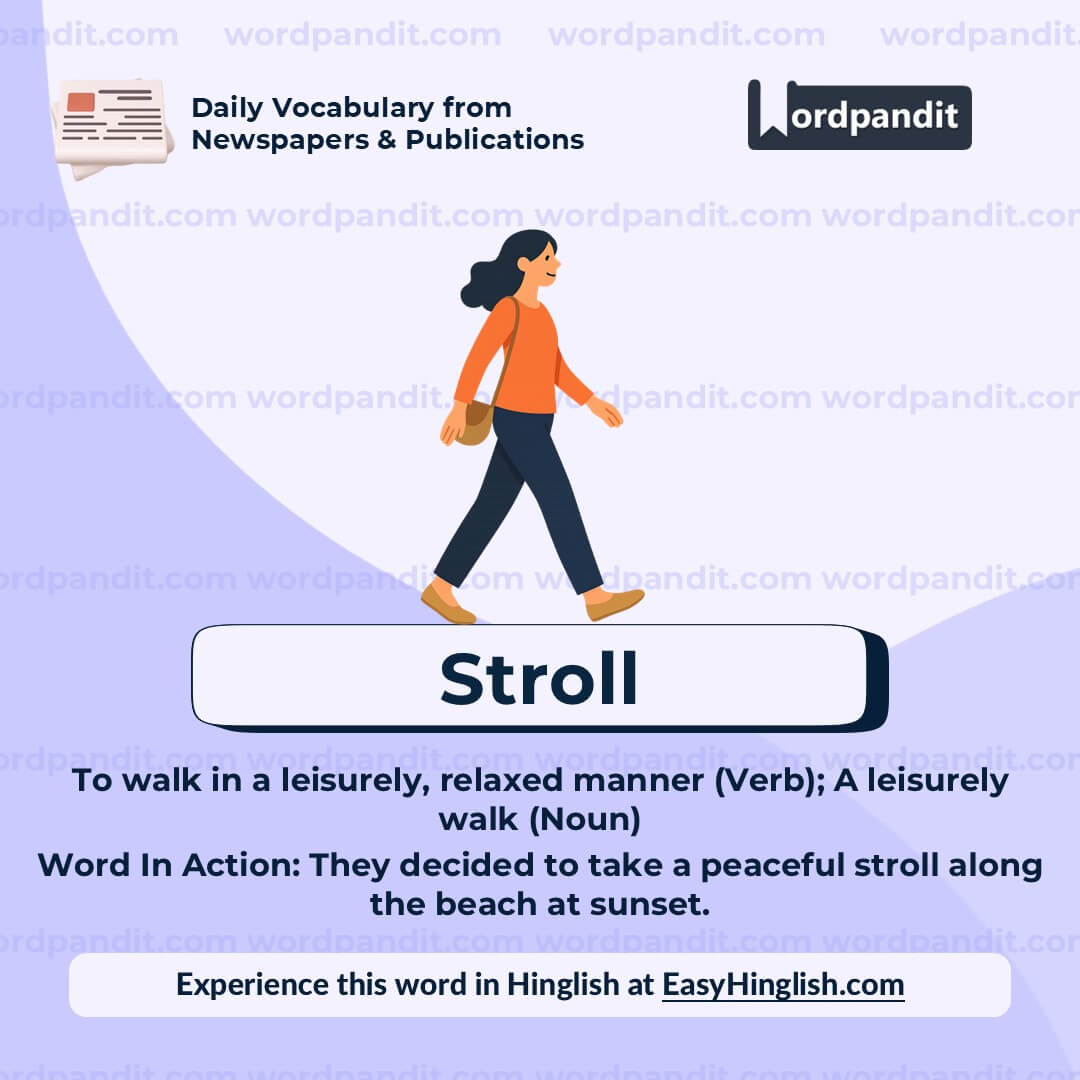
WORD-1: Stroll
Context:
"He was seen taking a stroll around the campus before heading to the auditorium for the convocation ceremony." - The Indian Express
Explanatory Paragraph:
Stroll meaning in English is 'to walk in a slow, relaxed manner without any hurry or particular destination in mind.' This word is used when describing leisurely, unhurried walking done for pleasure or relaxation rather than to reach somewhere quickly. How to use stroll effectively appears in descriptive writing, travel narratives, and everyday conversation to convey a sense of calmness and casual movement. Stroll is commonly used in newspapers, lifestyle articles, and competitive exam passages to describe peaceful, purposeless walking.
Meaning: To walk in a leisurely, relaxed manner (Verb); A leisurely walk (Noun)
Pronunciation: STROHL
Difficulty Level: ⭐ Basic
Etymology: Stroll comes from the German word 'strolchen' meaning 'to wander or roam.' It entered English in the early 17th century through traveling performers and vagabonds who would wander from town to town. Over time, the word evolved from implying aimless wandering to describing pleasant, leisurely walking that people do for enjoyment rather than necessity.
Prashant Sir's Notes:
Many students confuse stroll with walk—while both involve moving on foot, stroll usage specifically emphasizes the relaxed, unhurried nature of the movement. The difference between stroll and walk is that 'walk' is neutral about pace and purpose, while 'stroll' always suggests leisure and lack of urgency. For CAT and IELTS aspirants, recognizing 'stroll' in passages helps you identify a calm, peaceful atmosphere or a character's relaxed state of mind. In Indian English newspapers, you'll often see phrases like "evening stroll at Marine Drive" or "strolling through Lodhi Garden"—these indicate recreational, stress-free activities rather than purposeful movement.
Synonyms & Antonyms:
Synonyms: saunter, amble, wander, ramble, meander, promenade, mosey (informal), walk leisurely, take a walk, perambulate
Antonyms: rush, hurry, dash, sprint, run, race
Usage Examples:
- Every Sunday morning, Sharma ji takes a stroll along Juhu Beach to clear his mind before the busy week ahead.
- The couple decided to stroll through Connaught Place after dinner, enjoying the cool Delhi evening and window shopping.
- After hours of intense studying for the UPSC exam, Priya found that a short stroll in her neighborhood helped refresh her concentration.
- During the Jaipur Literature Festival, visitors stroll between book stalls and discussion venues, soaking in the literary atmosphere without any fixed schedule.
Cultural Reference:
"In Shah Rukh Khan's iconic film 'Dilwale Dulhania Le Jayenge,' Raj and Simran's romantic relationship blossoms during their leisurely strolls through the mustard fields of Punjab—showing how strolling represents freedom, peace, and unhurried connection."
Think About It:
In our fast-paced urban lives where everyone is rushing from one place to another, when was the last time you took a genuine stroll without checking your phone or worrying about reaching somewhere on time?
Quick Activity:
Describe your favorite place in your city for taking a stroll. Write two sentences explaining why that location is perfect for leisurely walking and what you enjoy most about strolling there.
Memory Tip:
Think of 'Stroll' as 'S-TROLL'—imagine a slow troll (like the ones in fairy tales) who never hurries and always walks at a relaxed, leisurely pace. Just like trolls in stories move slowly through forests, you stroll slowly through parks or streets.
Real-World Application:
Stroll is commonly used in travel writing, lifestyle articles, and descriptive essays to create a calm, peaceful atmosphere. In business communication, phrases like "let's stroll through the agenda" metaphorically suggest a relaxed, unhurried approach to reviewing topics. For competitive exam essays, using 'stroll' instead of just 'walk' adds descriptive richness and shows vocabulary range. Journalists use it when describing politicians, celebrities, or public figures moving casually through public spaces, distinguishing their relaxed movement from formal processions or rushed entries.
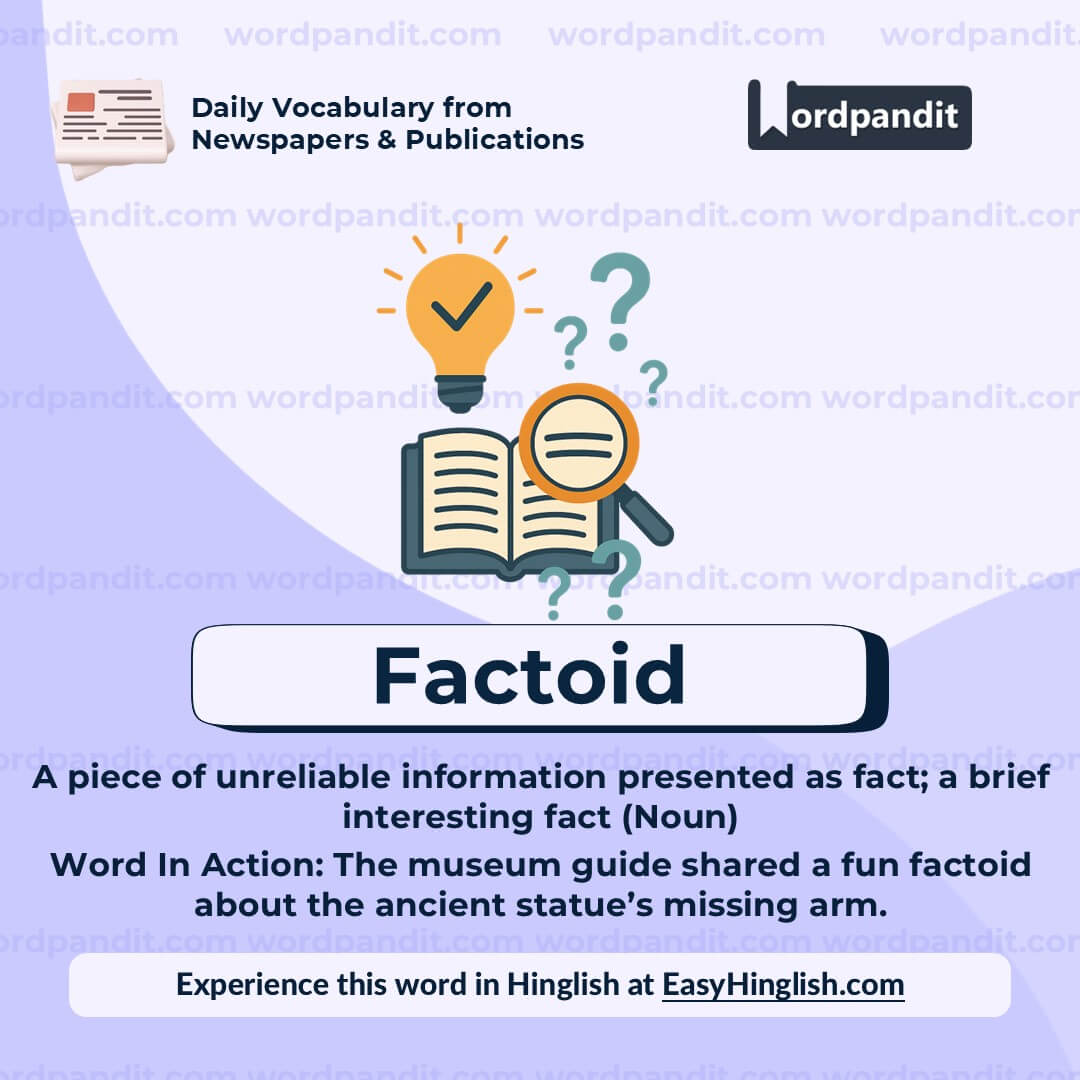
WORD-2: Factoid
Context:
"A frequently repeated factoid is that…" - The Indian Express
Explanatory Paragraph:
Factoid meaning in English is 'a brief or trivial piece of information that is presented as fact but may be unverified or false, or simply a small interesting fact.' This word is used when describing bite-sized information that spreads widely, especially through media and social networks, regardless of its accuracy. How to use factoid appears frequently in journalism, academic writing, and media criticism to distinguish between verified facts and popularly believed but questionable information. Factoid is commonly used in newspapers, competitive exam passages, and discussions about misinformation to signal skepticism about widely circulated claims.
Meaning: A piece of unreliable information presented as fact; a brief interesting fact (Noun)
Pronunciation: FAK-toyd
Difficulty Level: ⭐⭐ Basic to Intermediate
Etymology: Factoid was coined in 1973 by American author Norman Mailer, who combined 'fact' with the suffix '-oid' (meaning 'resembling but not genuine'). Mailer originally intended it to mean "facts which have no existence before appearing in a magazine or newspaper." Ironically, the word itself became a factoid—its meaning evolved in popular usage to also include trivial but true facts, the opposite of Mailer's original intent. This shows how language transforms through widespread use.
Prashant Sir's Notes:
Many students confuse factoid with fact—the crucial difference between factoid and fact is that a factoid is either questionable or trivial, while a fact is verified and substantial. Students often ask: what is the difference between factoid and trivia? Trivia refers to unimportant but true information, while factoid usage specifically carries doubt about authenticity. For CAT and GRE aspirants, when you encounter 'factoid' in RC passages, it's usually signaling the author's skepticism about commonly believed information. In Indian newspapers and WhatsApp forwards, factoids spread rapidly—claims like "we only use 10% of our brain" or "Gandhi never won the Nobel Peace Prize" are classic factoids that mix truth with misconception. Recognizing factoid in exam passages helps you identify the author's critical tone toward popular beliefs.
Synonyms & Antonyms:
Synonyms: myth, misconception, urban legend, half-truth, misinformation, trivia (in modern usage), tidbit, snippet, rumor, pseudo-fact
Antonyms: fact, truth, reality, verified information, established fact, substantiated claim
Usage Examples:
- The widely circulated factoid that Mahatma Gandhi was nominated for the Nobel Prize five times continues to appear in Indian quiz competitions despite being historically inaccurate.
- During the election campaign, social media was flooded with factoids about candidates that were designed to mislead voters rather than inform them.
- Rajesh's presentation was full of interesting factoids about Bollywood, though none of them contributed meaningfully to his business proposal about film distribution.
- The WhatsApp forward claiming that drinking hot water cures COVID-19 was a dangerous factoid that public health officials had to repeatedly debunk.
Cultural Reference:
"Indian cricket commentary is filled with factoids—like 'Sachin Tendulkar's jersey number 10 was chosen because he was born in the 10th month'—many of which sound convincing but often lack verification or are simplified versions of more complex stories."
Think About It:
How many factoids that you learned from social media or WhatsApp forwards have you shared without verifying their accuracy? What does this say about how misinformation spreads in the digital age?
Quick Activity:
Think of one popular factoid you've heard about Indian history, science, or culture. Write two sentences explaining why it might be questionable and how you could verify whether it's actually true.
Memory Tip:
Break 'Factoid' into 'FACT + VOID'—imagine a fact with a void or emptiness inside it, meaning it looks like a fact on the outside but has no solid truth within. Or think of '-oid' as in 'android' (human-like but not human)—a factoid is fact-like but not a real fact.
Real-World Application:
Factoid is commonly used in media criticism, academic writing, and journalistic analysis to challenge unverified claims that circulate widely. In competitive exam essays about misinformation or social media, using 'factoid' demonstrates sophisticated vocabulary and critical thinking. News editors use this term when discussing fact-checking protocols and distinguishing between verified reporting and viral claims. For UPSC aspirants writing on governance and public policy, 'factoid' is valuable when discussing how misconceptions influence public opinion and policy debates. In corporate communication, professionals use it to warn against basing decisions on unverified market rumors or industry gossip.
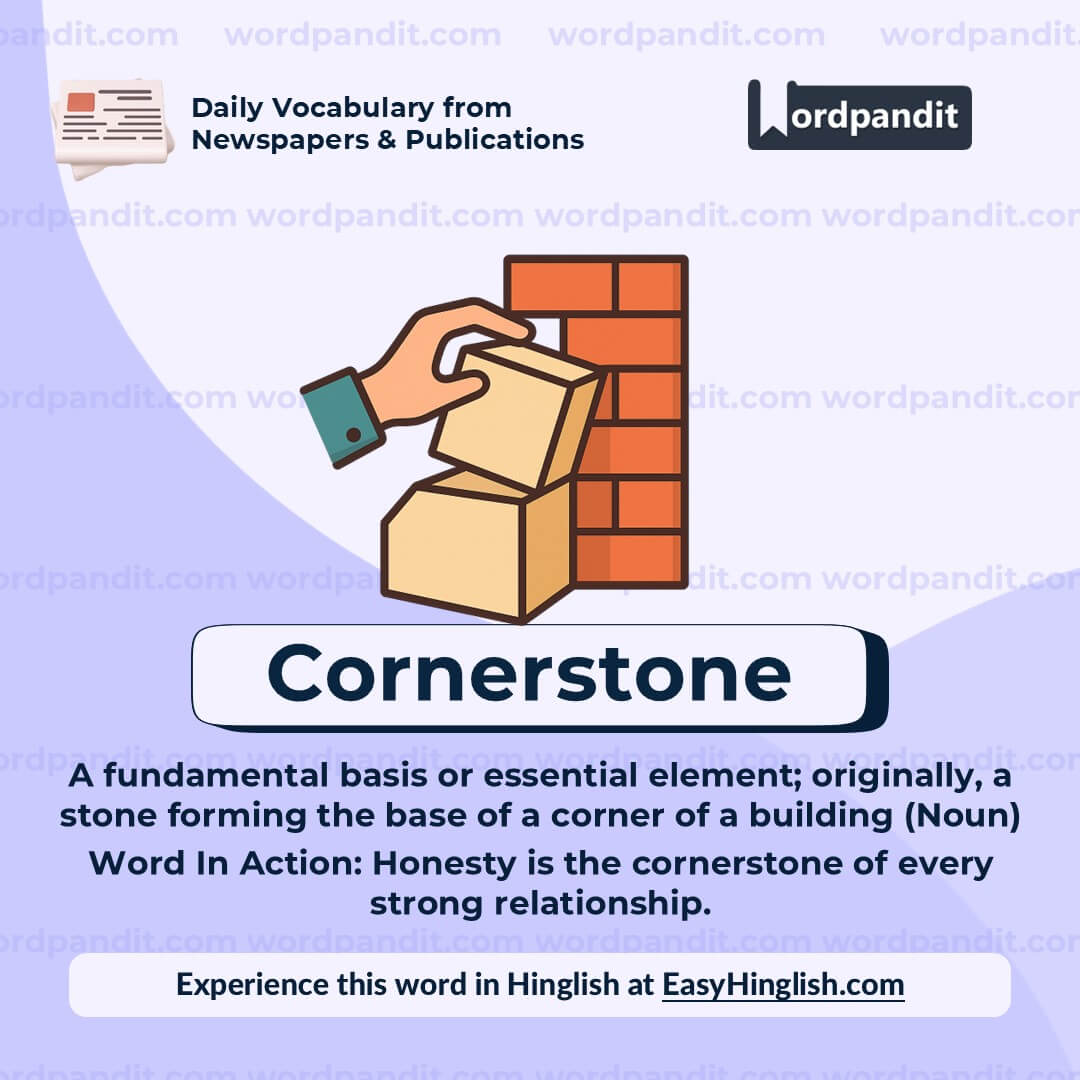
WORD-3: Cornerstone
Context:
"Education is the cornerstone of a nation's progress." - The Indian Express
Explanatory Paragraph:
Cornerstone meaning in English is 'a fundamental or essential element on which something is built or depends; the most important part of something.' This word is used when describing the foundational principle, value, or component that is crucial to the existence or success of something larger. How to use cornerstone effectively appears in formal speeches, policy documents, and academic writing to emphasize the critical importance of a particular element. Cornerstone is commonly used in newspapers, competitive exam essays, and professional communication to highlight indispensable foundations of systems, organizations, or ideologies.
Meaning: A fundamental basis or essential element; originally, a stone forming the base of a corner of a building (Noun)
Pronunciation: KOR-ner-stohn
Difficulty Level: ⭐⭐ Basic to Intermediate
Etymology: Cornerstone comes from the literal architectural practice of placing a specially important stone at the corner of a building's foundation, which joins two walls and bears significant structural weight. This practice dates back to ancient construction methods in biblical times and classical architecture. The term appears in religious texts and gradually evolved into a metaphor for any foundational or essential element. By the 16th century, 'cornerstone' was being used figuratively in English to describe fundamental principles or indispensable components of institutions, beliefs, and systems.
Prashant Sir's Notes:
Many students confuse cornerstone with foundation—while both relate to basics, the difference between cornerstone and foundation is that a foundation is the entire base, whereas cornerstone is the single most critical element. Students often ask: what is the difference between cornerstone and pillar? A pillar supports from within, but cornerstone usage specifically emphasizes the joining, stabilizing element that holds multiple parts together. For UPSC and CAT aspirants, recognizing 'cornerstone' in passages about policy, governance, or business helps you identify what the author considers absolutely essential. In Indian English newspapers, you'll frequently see phrases like "the cornerstone of India's foreign policy" or "transparency is the cornerstone of good governance"—these signal non-negotiable, fundamental principles. Understanding cornerstone for competitive exams helps you grasp the hierarchy of importance in complex arguments.
Synonyms & Antonyms:
Synonyms: foundation, bedrock, basis, keystone, linchpin, mainstay, pillar, backbone, anchor, fundamental, essential element, core principle
Antonyms: accessory, addition, supplement, optional element, peripheral aspect, non-essential, afterthought
Usage Examples:
- The Constitution of India remains the cornerstone of our democracy, guiding all laws and protecting fundamental rights for over seven decades.
- Mutual trust is the cornerstone of any successful business partnership, especially in Indian family-run enterprises where relationships matter more than contracts.
- For Infosys founder Narayana Murthy, integrity has always been the cornerstone of the company's culture and operational philosophy.
- The National Education Policy 2020 identifies multilingualism as a cornerstone of cognitive development and cultural preservation in Indian schools.
Cultural Reference:
"In Mahatma Gandhi's philosophy, non-violence (ahimsa) was not just a tactic but the cornerstone of his entire approach to social and political change—a principle that inspired civil rights movements worldwide and remains central to India's constitutional values."
Think About It:
If you had to identify one cornerstone value or principle that guides your personal or professional life, what would it be, and how does it influence your daily decisions?
Quick Activity:
Choose an institution you know well—your college, workplace, or a famous Indian company. Write two sentences explaining what you believe is the cornerstone of its success or identity, and why removing that element would fundamentally change the organization.
Memory Tip:
Think of 'Cornerstone' literally as the stone at the CORNER of a building—it's where two walls meet and hold the entire structure together. Just like removing a cricket team's cornerstone player like Virat Kohli or MS Dhoni would shake the entire team's foundation, a cornerstone is that one essential element you cannot remove without everything collapsing.
Real-World Application:
Cornerstone is commonly used in policy documents, mission statements, and strategic plans to identify core principles that cannot be compromised. In academic writing and UPSC essays, using 'cornerstone' demonstrates your ability to identify and articulate fundamental elements of complex systems—whether discussing democratic values, economic policies, or social reforms. Business leaders use this term in vision statements to communicate non-negotiable values. For GRE and CAT aspirants, recognizing 'cornerstone' in RC passages helps you identify the author's main thesis or the central argument upon which everything else depends. Journalists use it when analyzing political platforms, constitutional principles, or institutional reforms to highlight what is truly essential versus what is merely supportive.
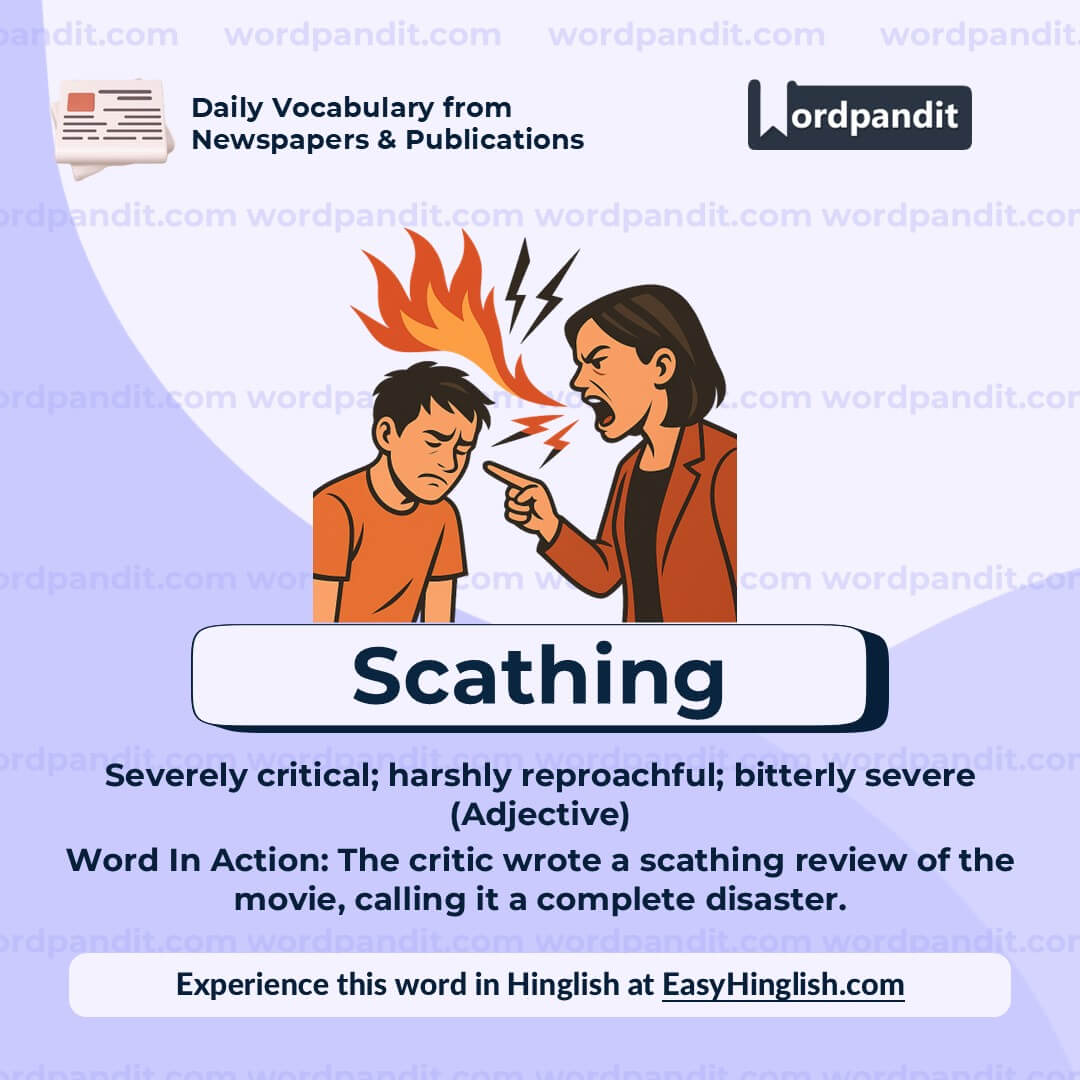
WORD-4: Scathing
Context:
"The journalist wrote a scathing article about the corruption…" - The Times of India
Explanatory Paragraph:
Scathing meaning in English is 'severely critical or harsh in a way that causes harm or damage; witheringly severe in criticism or judgment.' This word is used when describing criticism that is not just negative but devastatingly sharp and intended to damage someone's reputation or position. How to use scathing appears frequently in book reviews, political commentary, and journalistic writing where strong disapproval needs to be expressed. Scathing is commonly used in newspapers, competitive exam passages, and opinion pieces to describe criticism that is fierce, cutting, and unsparing in its intensity.
Meaning: Severely critical; harshly reproachful; bitterly severe (Adjective)
Pronunciation: SKAY-thing
Difficulty Level: ⭐⭐⭐ Intermediate
Etymology: Scathing comes from the Old Norse word 'skaða' meaning 'to hurt or injure,' which evolved into the Middle English 'scathen.' Originally, it literally meant to burn, scorch, or harm physically. By the 16th century, the word had taken on its metaphorical meaning of inflicting damage through words rather than fire—capturing the idea that harsh criticism can burn and wound just as severely as physical flames. The '-ing' form emphasizes the ongoing, active nature of this verbal assault.
Prashant Sir's Notes:
Many students confuse scathing with critical—while both involve negative judgment, scathing usage specifically implies extreme harshness and intent to damage. The difference between scathing and harsh is that 'harsh' can be unintentionally severe, but 'scathing' always carries deliberate, cutting intensity. For CAT and GRE aspirants, when you see 'scathing review' or 'scathing critique' in RC passages, it signals the strongest possible negative evaluation—this helps you understand author tone and attitude questions. In Indian English journalism, you'll often encounter phrases like "the opposition delivered a scathing attack on the government's economic policy" or "the film received scathing reviews from critics"—the word elevates ordinary criticism to devastating condemnation. Understanding scathing for competitive exams helps you differentiate between mild disapproval, criticism, and absolute demolition in tone-based questions.
Synonyms & Antonyms:
Synonyms: harsh, severe, biting, caustic, scornful, withering, devastating, brutal, cutting, savage, vitriolic, acerbic, fierce, excoriating
Antonyms: complimentary, praising, gentle, mild, laudatory, appreciative, favorable, kind, supportive
Usage Examples:
- The Supreme Court delivered a scathing judgment against the state government's handling of the pandemic, questioning their preparedness and transparency at every level.
- After the disastrous performance in the Test series, the cricket captain faced scathing criticism from former players and commentators across Indian sports media.
- Arundhati Roy's scathing commentary on social inequality in India has made her both a celebrated voice and a controversial figure in literary circles.
- The auditor's scathing report revealed massive financial irregularities in the company, leading to the immediate resignation of three senior executives.
Cultural Reference:
"Film critic Rajeev Masand is known for his scathing reviews of poorly made Bollywood films—his zero-star ratings and witty takedowns have become legendary, with filmmakers both dreading and respecting his brutally honest assessments that can significantly impact box office collections."
Think About It:
When is scathing criticism justified, and when does it cross the line from necessary accountability to personal attack? How do we balance honest evaluation with respect for human dignity?
Quick Activity:
Think of a recent public controversy where someone received scathing criticism in the media. Write two sentences explaining whether you think the criticism was justified and what impact such harsh public condemnation might have had.
Memory Tip:
Think of 'Scathing' as 'SCALDING'—both start with 'SCA' and both involve burning. Just as scalding water burns your skin painfully, scathing criticism burns someone's reputation or feelings with harsh words. Imagine a journalist's words as hot as boiling water, scalding the person being criticized.
Real-World Application:
Scathing is commonly used in film reviews, book critiques, political commentary, and investigative journalism to convey the intensity of disapproval. In competitive exam essays on media ethics or freedom of expression, using 'scathing' demonstrates nuanced understanding of criticism levels. For UPSC aspirants writing on governance and accountability, the term is valuable when discussing judicial pronouncements, CAG reports, or parliamentary debates where harsh criticism serves democratic oversight. Business journalists use 'scathing' when reporting on damaging analyst reports, shareholder critiques, or regulatory findings. In GRE and CAT reading comprehension, recognizing 'scathing' helps you accurately answer tone and attitude questions, distinguishing between merely critical and devastatingly harsh authorial stances.
WORD-5: Adduce
Context:
"The lawyer adduced many facts to support the claim…" - The Times of India
Explanatory Paragraph:
Adduce meaning in English is 'to cite as evidence or proof in support of an argument; to bring forward or present facts, examples, or reasons to support a point.' This word is used when formally presenting evidence or reasoning in legal, academic, or argumentative contexts to strengthen a claim or position. How to use adduce appears frequently in legal writing, academic papers, and formal debates where systematic presentation of supporting evidence is required. Adduce is commonly used in courtroom proceedings, scholarly articles, and competitive exam passages involving logical argumentation and evidence-based reasoning.
Meaning: To cite as evidence; to bring forward in argument or as proof (Verb)
Pronunciation: uh-DOOS or uh-DYOOS
Difficulty Level: ⭐⭐⭐ Intermediate to Advanced
Etymology: Adduce comes from the Latin word 'adducere,' which combines 'ad-' (meaning 'to' or 'toward') and 'ducere' (meaning 'to lead or bring'). Literally, it means "to lead toward" or "to bring forward." The word entered English in the 15th century through legal and scholarly Latin, maintaining its formal character. In Roman legal tradition, advocates would physically "lead forward" witnesses or documents to support their cases, and this physical act of bringing evidence became the metaphorical meaning of presenting proof through words—a practice that remains central to legal and academic discourse today.
Prashant Sir's Notes:
Many students confuse adduce with deduce—these are completely different! The difference between adduce and deduce is crucial: 'adduce' means to present evidence, while 'deduce' means to draw conclusions from evidence. Think of it this way: lawyers adduce evidence, then judges deduce verdicts. Students often ask: what is the difference between adduce and cite? While both involve referencing support, adduce usage is more formal and specifically implies bringing forth evidence in a structured argument, whereas 'cite' simply means mentioning a source. For GRE and UPSC aspirants, recognizing 'adduce' in passages about legal reasoning, scientific methodology, or philosophical arguments signals systematic evidence presentation. In Indian legal reporting, you'll see phrases like "the prosecution adduced witnesses" or "the defense adduced documentary evidence"—this indicates formal presentation of proof in court. Understanding how to use adduce correctly in your essays demonstrates advanced vocabulary and legal/academic awareness.
Synonyms & Antonyms:
Synonyms: cite, present, offer, provide, advance (as in advance evidence), produce, submit, furnish, put forward, bring forward, invoke, proffer (formal)
Antonyms: withhold, conceal, suppress, hide, retract, withdraw, omit
Usage Examples:
- During the Supreme Court hearing on electoral bonds, the petitioners adduced financial records to demonstrate potential violations of transparency laws.
- In his UPSC mains essay on climate change, Rahul adduced examples from Kerala floods and Uttarakhand glacial disasters to support his argument for urgent policy reforms.
- The historian adduced archaeological findings from Harappan sites to challenge conventional theories about ancient Indian trade networks with Mesopotamia.
- When defending her controversial research methodology, Professor Sharma adduced similar studies from international journals to establish academic precedent and credibility.
Cultural Reference:
"In the landmark Kesavananda Bharati case that established the Basic Structure doctrine, legal scholars adduced constitutional provisions, historical debates, and comparative jurisprudence from multiple democracies—this systematic presentation of evidence fundamentally shaped Indian constitutional law and judicial review powers."
Think About It:
In the age of social media arguments, how often do we actually adduce solid evidence to support our opinions versus simply stating our beliefs loudly? What would debates look like if everyone had to properly adduce their claims?
Quick Activity:
Take a common belief or opinion you hold—for example, "remote work increases productivity" or "coaching classes are essential for competitive exams." Write two sentences in which you adduce specific evidence or examples that support this belief.
Memory Tip:
Break 'Adduce' into 'ADD + USE'—when you adduce evidence, you ADD something useful to USE in your argument. Or think of it as 'AD-duce' where 'AD' means 'toward' (like in advertisement)—you're bringing evidence TOWARD your argument. Imagine a lawyer ADDing documents to PRODUCE proof in court.
Real-World Application:
Adduce is commonly used in legal documents, court proceedings, academic research papers, and formal debates where evidence must be systematically presented. In competitive exam essays, particularly for UPSC mains where evidence-based argumentation is critical, using 'adduce' demonstrates sophisticated academic vocabulary and understanding of proper argumentative structure. Legal journalists use this term when reporting on court cases, describing how prosecution or defense teams present their evidence. For GRE aspirants, recognizing 'adduce' in reading comprehension passages helps identify sections where authors are building their case through evidence rather than merely stating opinions. In professional contexts, consultants and analysts adduce data, case studies, and market research to support strategic recommendations, making this term valuable for MBA aspirants and business communication.


