

Daily Vocabulary from Indian Newspapers and Publications
Welcome to Wordpandit’s Indian Vocabulary Hub
At Wordpandit, we understand the importance of staying rooted in the local context while expanding your language skills. This section focuses on enriching your vocabulary with words and phrases drawn from India’s leading newspapers and publications, ensuring you're learning vocabulary that is practical, relevant, and uniquely Indian.
Why Indian Sources Matter
We believe that the best way to master any language is by immersing yourself in local content. That’s why we carefully curate vocabulary from top Indian publications, including:
- The Hindu
- The Times of India
- The Economic Times
- Hindustan Times
- Live Mint
- The Indian Express
- And many others...
Stay Updated, Stay Relevant
With daily updates from Indian news sources, you’ll be consistently learning words that reflect the trends and shifts in Indian society and culture. Our focus is to provide vocabulary that enhances your understanding of the language in an Indian context.
How Wordpandit Supports Your Goals
Whether you’re preparing for exams, aiming to improve your professional communication, or simply want to stay connected with the latest Indian vocabulary, Wordpandit is here to guide you every step of the way.
Learn with a Practical Approach
Our interactive learning methodology includes real-world examples, engaging activities, and context-specific usage to ensure that every word becomes part of your active vocabulary.
Dive into Indian Vocabulary Today!

Why Choose Wordpandit?
Practical Learning: Focus on words you'll actually encounter in real-world reading, enhancing your comprehension and communication skills.
Diverse Content: From current affairs to scientific breakthroughs, our varied sources expose you to vocabulary across multiple domains.
Effortless Integration: Make Wordpandit a part of your daily routine. Just a few minutes each day can significantly boost your lexicon over time.
Your Path to Vocabulary Mastery
- Visit our Daily Vocabulary section regularly
- Explore new words and their usage in context
- Practice incorporating these words into your own writing and speech
- Track your progress as your vocabulary expands
Start Your Journey Today
Embark on your vocabulary enhancement journey with Wordpandit. By consistently engaging with our daily posts, you'll build a robust vocabulary that serves you well in academic, professional, and personal contexts.
Remember, a word a day keeps linguistic limitations at bay. Make Wordpandit your daily companion in the quest for vocabulary excellence!
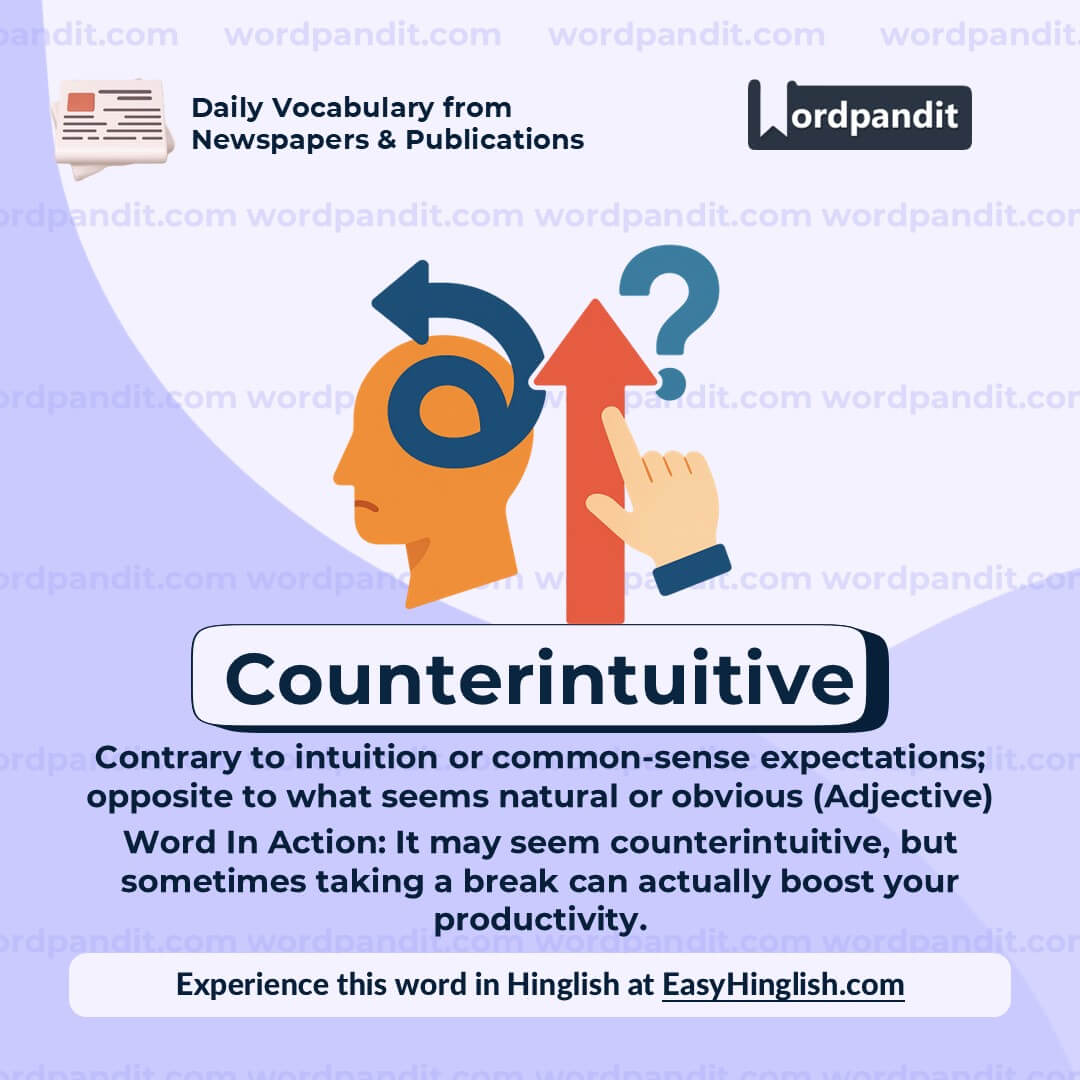
WORD-1: Counterintuitive
Context:
"The numbers are counterintuitive, given that male migration and male mortality rates in Bihar are demonstrably higher." - The Wire
Explanatory Paragraph:
Counterintuitive meaning in English is "contrary to what common sense or intuition would suggest." This word is used when data, facts, or outcomes oppose what people naturally expect or assume to be true. How to use counterintuitive becomes especially important in research analysis, data interpretation, and exam passages where students need to identify findings that challenge conventional wisdom. Counterintuitive appears frequently in CAT Reading Comprehension, GRE passages, and UPSC essay topics discussing scientific discoveries, economic policies, or social research that defies obvious expectations.
Meaning: Contrary to intuition or common-sense expectations; opposite to what seems natural or obvious (Adjective)
Pronunciation: KOWN-ter-in-TOO-ih-tiv
Difficulty Level: ⭐⭐⭐ Intermediate to Advanced
Etymology: Counterintuitive combines the prefix 'counter-' meaning 'against or opposite' with 'intuitive' from Latin 'intueri' meaning 'to look at or consider.' The word emerged in the mid-20th century as scientific research increasingly produced findings that challenged human instinct and common assumptions, requiring a specific term to describe results that went against gut feelings.
Prashant Sir's Notes:
Many students confuse counterintuitive with 'contradictory'—the key difference between counterintuitive and contradictory is that counterintuitive specifically opposes what you'd naturally expect, while contradictory simply means opposing statements. For CAT and GRE aspirants, counterintuitive usage in passages signals important turning points where authors challenge popular assumptions. In Indian English newspapers, you'll see phrases like "the counterintuitive finding that urban poverty affects health more than rural poverty"—that structure tells you research has discovered something surprising. When you spot 'counterintuitive' in RC passages, pay attention because the next lines usually explain why the unexpected result occurred, and that explanation becomes a high-probability question area.
Synonyms & Antonyms:
Synonyms: unexpected, paradoxical, contrary to expectation, illogical (in appearance), surprising, against common sense, unintuitive, contrary to reason
Antonyms: intuitive, obvious, predictable, expected, logical, natural, straightforward
Usage Examples:
- The RBI's counterintuitive decision to increase interest rates during recession actually helped control inflation and stabilize the rupee.
- Priya found it counterintuitive that working fewer hours increased her productivity, but the data from her startup proved it true.
- Research on Indian monsoon patterns revealed the counterintuitive fact that certain drought-prone areas receive more annual rainfall than coastal regions.
- It seems counterintuitive, but adding speed breakers on Chennai's highways actually reduced travel time by preventing major accidents.
Cultural Reference:
"The most counterintuitive aspect of cricket is that sometimes the best way to score quickly is to play defensively first and tire out the bowlers." - Commentary on test match strategy
Think About It:
What counterintuitive practices in Indian education or career paths have you observed that actually lead to better outcomes than conventional approaches?
Quick Activity:
Think of a counterintuitive fact about Indian society or economy that surprises people. Write one sentence explaining why this finding opposes common expectations.
Memory Tip:
Break 'Counterintuitive' into 'COUNTER-IN-TUITION'—imagine a student going COUNTER to what their TUITION (teaching) tells them, discovering something opposite to what they learned. The 'counter' prefix always signals 'against,' so counterintuitive means 'against what intuition tells you.'
Real-World Application:
Counterintuitive is commonly used in research papers, policy analysis, business reports, and news articles discussing scientific studies or data-driven findings. In competitive exam essays for UPSC, using 'counterintuitive' demonstrates analytical thinking when discussing unexpected research outcomes. Journalists frequently employ this word when reporting studies that challenge popular beliefs about health, economics, or social trends, making it essential vocabulary for understanding contemporary Indian policy debates and data journalism.
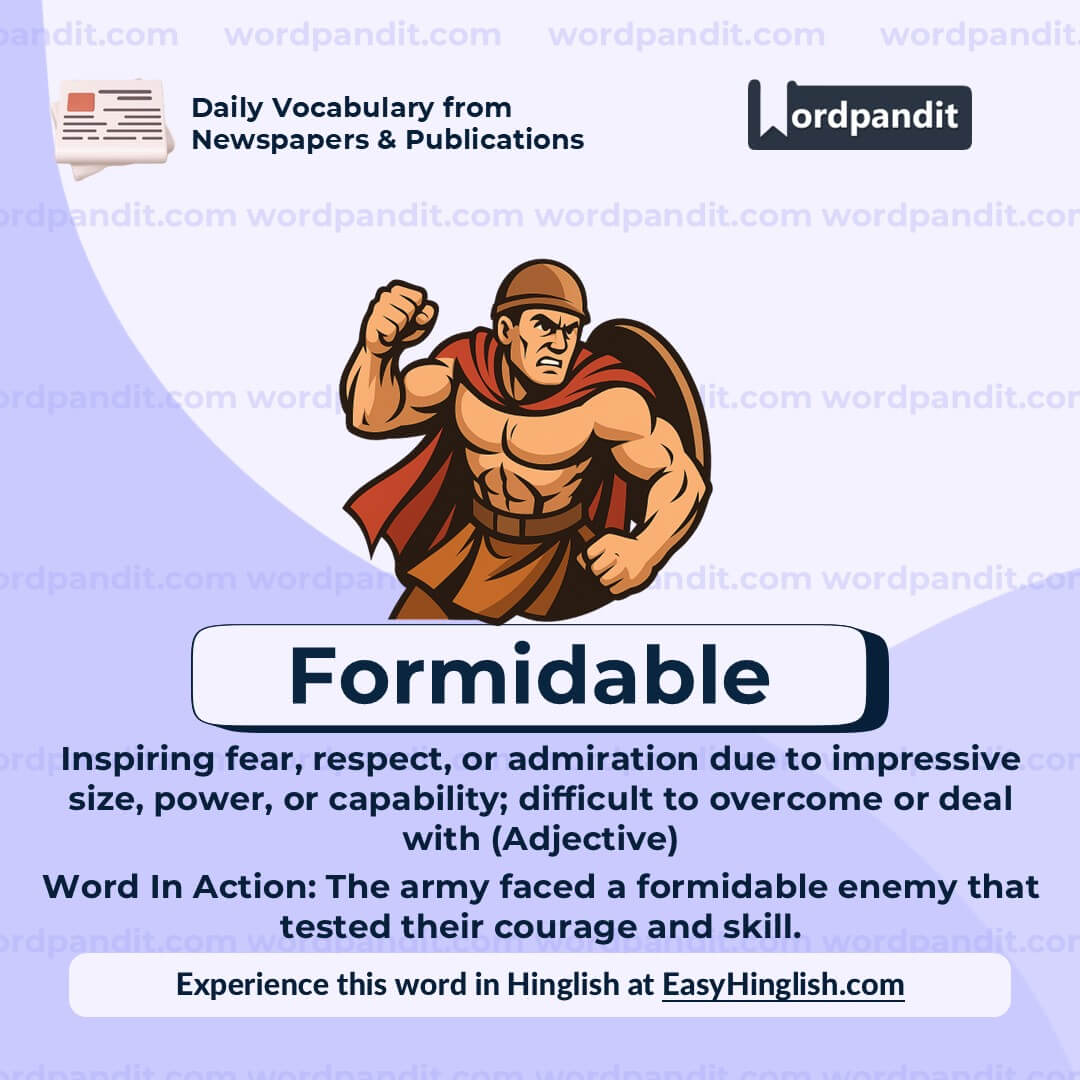
WORD-2: Formidable
Context:
"Now, combined together they formed a formidable vote bank for the party." - The Wire
Explanatory Paragraph:
Formidable meaning in English is "inspiring fear or respect through being impressively large, powerful, intense, or capable." This word is used when describing something or someone that commands attention due to their strength, skill, or challenging nature. How to use formidable correctly involves contexts where you want to convey both power and the difficulty of dealing with that power. Formidable appears frequently in CAT, GRE, and UPSC materials when discussing political forces, competitive challenges, impressive achievements, or obstacles that demand serious effort to overcome.
Meaning: Inspiring fear, respect, or admiration due to impressive size, power, or capability; difficult to overcome or deal with (Adjective)
Pronunciation: FOR-mid-uh-buhl
Difficulty Level: ⭐⭐⭐ Intermediate
Etymology: Formidable comes from Latin 'formidabilis' meaning 'causing fear,' derived from 'formidare' which means 'to fear.' The word entered English through French in the 15th century, originally emphasizing the fear aspect. Over time, its meaning evolved to include respect and admiration alongside fear, reflecting how impressive power can inspire multiple emotions simultaneously.
Prashant Sir's Notes:
Students often ask: what is the difference between formidable and difficult? While both describe challenges, formidable usage specifically emphasizes that something is impressively powerful or skilled, not just hard. A difficult exam is tough; a formidable opponent is both skilled and intimidating. For UPSC and CAT aspirants, formidable frequently appears when describing political coalitions, market competition, or intellectual challenges that combine power with complexity. In Indian newspapers, you'll see "formidable challenge," "formidable opponent," or "formidable force"—this word adds weight and seriousness that simple synonyms like 'strong' or 'tough' cannot convey. Remember: formidable always carries respect, even when describing adversaries.
Synonyms & Antonyms:
Synonyms: intimidating, daunting, impressive, powerful, fearsome, redoubtable, challenging, awe-inspiring, imposing, mighty
Antonyms: weak, unimpressive, insignificant, harmless, manageable, easy
Usage Examples:
- Virat Kohli's formidable batting record in international cricket makes him one of India's most respected athletes across all opposition teams.
- The startup faced formidable competition from established players like Flipkart and Amazon, but carved out its own niche through innovation.
- Maharashtra's formidable agricultural output contributes significantly to India's food security, making it an economic powerhouse in the western region.
- Preparing for UPSC presents a formidable challenge that requires not just intelligence but sustained dedication over several years.
Cultural Reference:
"MS Dhoni's calm demeanor masked a formidable strategic mind that could dismantle any bowling attack with precise field placements." - Cricket commentary on Indian captaincy
Think About It:
Who is the most formidable person you know in your field, and what combination of qualities makes them both respected and challenging to compete against?
Quick Activity:
Write two sentences describing a formidable challenge you've faced—one about an external obstacle and one about a competitor or opponent who impressed you.
Memory Tip:
Think of 'Formidable' as 'FORM-IDLE-ABLE'—imagine a powerful form or figure so impressive that it makes you stand IDLE (frozen) because you're ABLE to recognize its strength. Or remember: "FOR MID-level ABLE people, facing an expert seems formidable"—the gap in ability creates that sense of impressive power.
Real-World Application:
Formidable is commonly used in business reports, political analysis, sports commentary, and competitive exam essays to describe powerful forces, impressive achievements, or significant challenges. In corporate communication, describing competition as "formidable" shows respect while acknowledging difficulty. For UPSC aspirants writing about geopolitical issues, using formidable to describe nations, alliances, or obstacles demonstrates sophisticated vocabulary. Indian media frequently uses this word when analyzing electoral coalitions, economic challenges, or sporting achievements that command serious attention and respect.
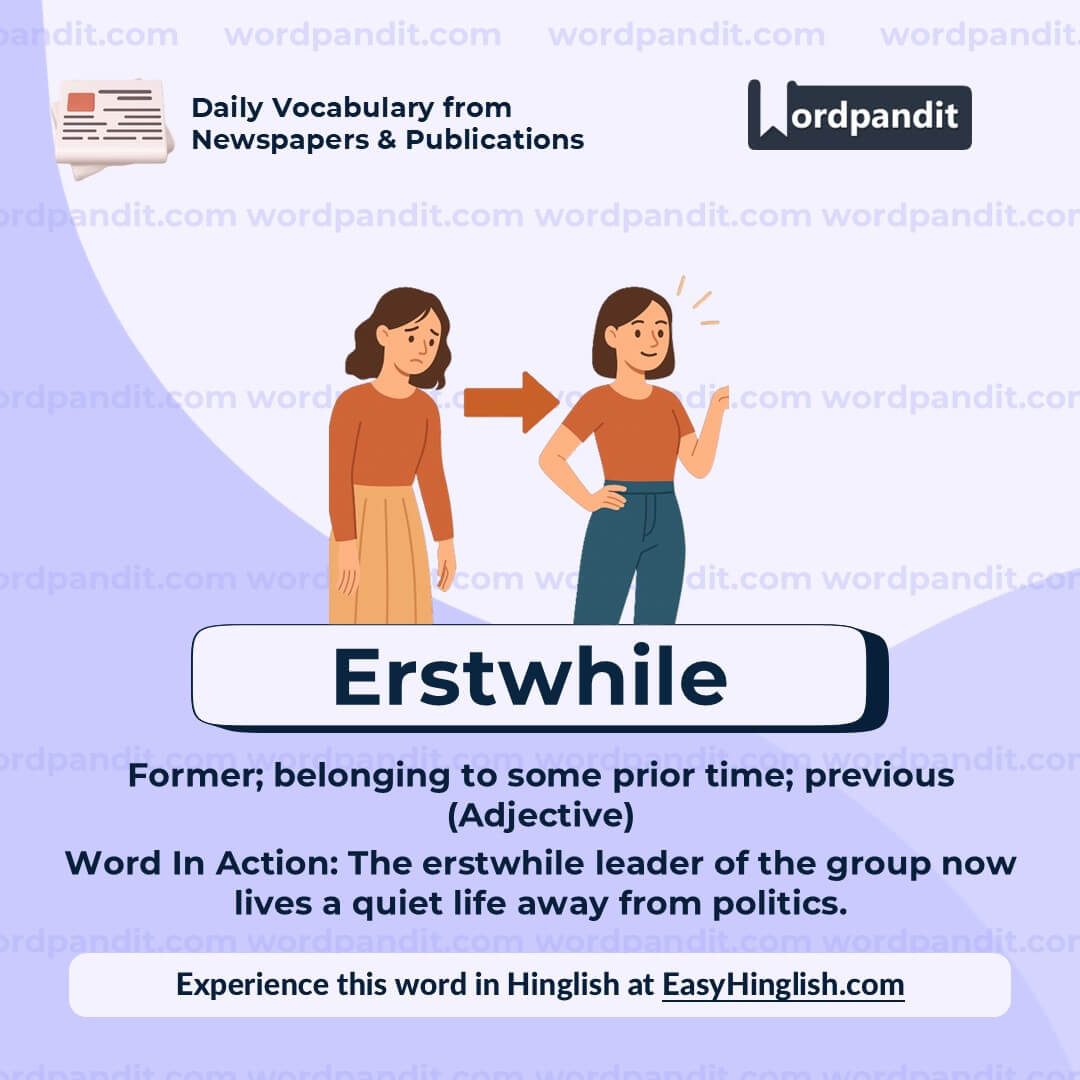
WORD-3: Erstwhile
Context:
"The 1980s and 1990s had marked a shift towards the market economy in the whole world, including in erstwhile socialist economies and left-democratic post-colonial economies." - The Wire
Explanatory Paragraph:
Erstwhile meaning in English is "former; belonging to an earlier time; previous." This word is used when referring to something or someone that once held a particular status, role, or identity but no longer does. How to use erstwhile effectively involves historical or temporal contexts where you need to emphasize that something has changed from its previous state. Erstwhile appears regularly in UPSC history and polity sections, CAT Reading Comprehension passages about historical transitions, and GRE texts discussing political or social transformations, making it essential vocabulary for understanding discussions about change over time.
Meaning: Former; belonging to some prior time; previous (Adjective)
Pronunciation: URST-wyle
Difficulty Level: ⭐⭐⭐ Intermediate to Advanced
Etymology: Erstwhile comes from Old English 'ærest' meaning 'earliest' combined with 'while' meaning 'time' or 'period.' Literally translating to 'earliest time' or 'former time,' the word has been used in English since the 16th century to refer to things from the past. Its somewhat archaic flavor makes it particularly suitable for formal historical and political discourse, which is why it appears frequently in academic and journalistic writing about historical transitions.
Prashant Sir's Notes:
Many students confuse erstwhile with 'previous' or 'former'—while they're synonyms, erstwhile usage in competitive exams carries a more formal, literary tone and often implies significant transformation. The difference between erstwhile and former is subtle: erstwhile emphasizes the passage of time and often suggests the change was substantial or noteworthy. For UPSC aspirants, erstwhile frequently appears in passages about colonial history ("erstwhile British colonies"), political transitions ("erstwhile Soviet Union"), or administrative changes ("erstwhile princely states"). In Indian English newspapers, you'll see "erstwhile Chief Minister" or "erstwhile allies"—the word signals not just a change in status but often a complete shift in relationships or political landscape. Pro tip: in RC passages, when you see erstwhile, the author is usually setting up a contrast between past and present states.
Synonyms & Antonyms:
Synonyms: former, previous, one-time, quondam, late, past, bygone, sometime, old, ex-
Antonyms: current, present, existing, contemporary, incumbent, present-day
Usage Examples:
- The erstwhile princely state of Mysore became an integral part of Karnataka after Indian independence and administrative reorganization in 1956.
- Ravi maintained cordial relations with his erstwhile business partner despite their company splitting into two separate competing entities.
- Many erstwhile public sector companies in India have undergone privatization, transforming from government-controlled entities to privately managed corporations.
- The building that now houses a modern tech startup was erstwhile a textile mill during Mumbai's industrial era.
Cultural Reference:
"The erstwhile zamindari system, once a pillar of rural power in colonial India, was abolished after independence to create a more equitable land distribution framework." - Historical analysis of agrarian reform
Think About It:
How do erstwhile political alliances in Indian democracy reveal the pragmatic nature of coalition politics, where today's opponents were yesterday's partners?
Quick Activity:
Write two sentences using 'erstwhile' to describe something from Indian history or your personal experience that has undergone significant transformation from its former state.
Memory Tip:
Break 'Erstwhile' into 'ERST-WHILE'—think "EARLIER WHILE" or "first while." Imagine saying "while this was true EARLIER, it's different now." The 'erst' sounds like 'first,' reminding you it refers to the first or former state of something before it changed.
Real-World Application:
Erstwhile is commonly used in historical writing, political analysis, legal documents, and formal journalism when discussing entities, relationships, or systems that have changed over time. In UPSC essay writing, using erstwhile demonstrates sophisticated vocabulary when analyzing historical transitions or political transformations. Indian newspapers frequently employ this word when discussing former political alliances, changed territorial boundaries, or institutions that have undergone significant transformation. It's particularly useful in business writing when describing companies that have merged, rebranded, or changed ownership, adding a formal tone that emphasizes the significance of the transformation.
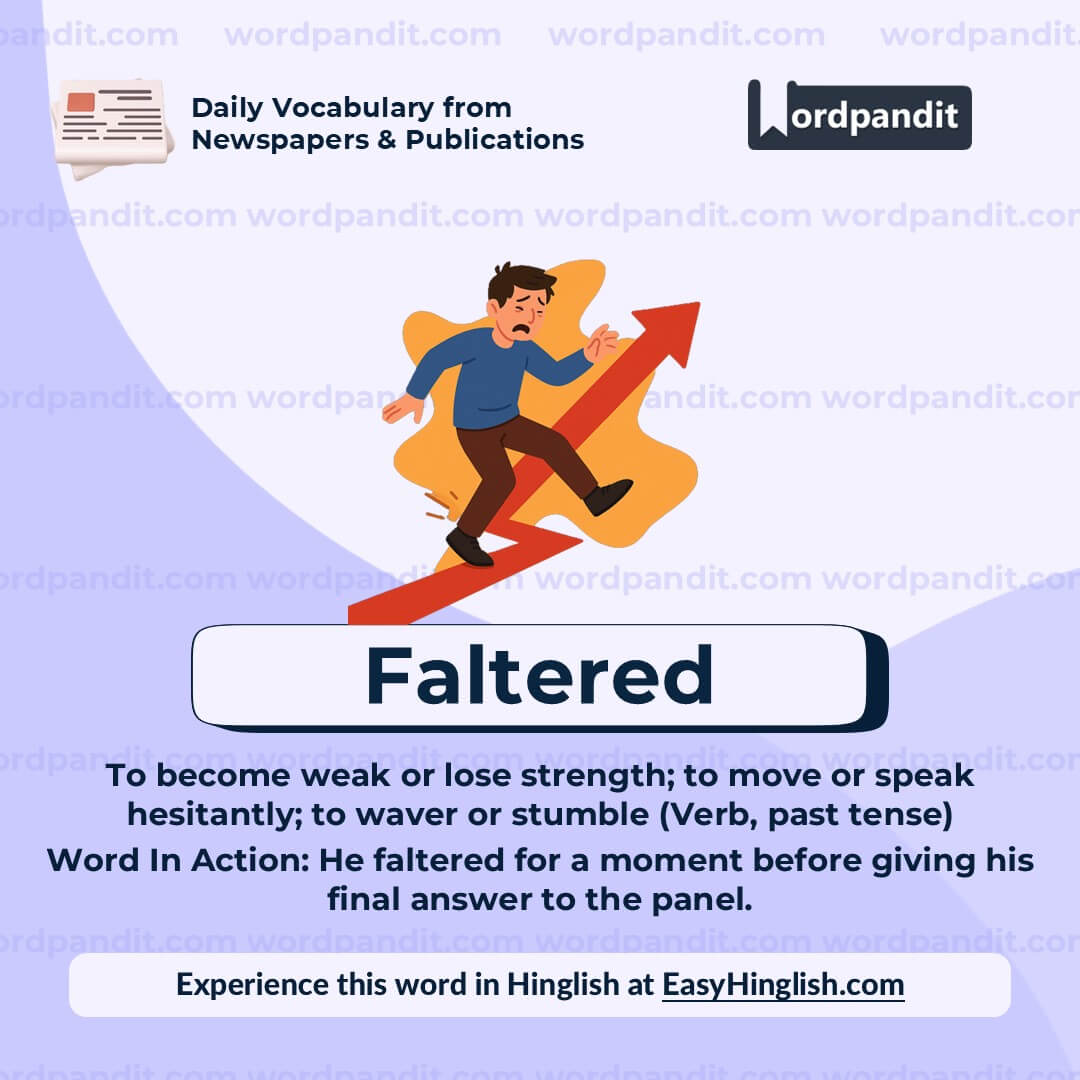
WORD-4: Faltered
Context:
"As the 20th century socialist economies faltered during the 1980s, the World Bank model based on free markets, an expansive private sector, and unrestricted global flow of capital, was presented to the world as the only alternative." - The Wire
Explanatory Paragraph:
Faltered meaning in English is "to lose strength or momentum; to become unsteady or begin to fail." This word is used when describing something that weakens, stumbles, or shows signs of breakdown after a period of stability or strength. How to use faltered becomes important in economic analysis, performance reviews, and discussions about declining systems or confidence. Faltered appears frequently in CAT Reading Comprehension passages about economic downturns, GRE texts analyzing historical events, and UPSC materials discussing policy failures, making it essential for understanding narratives about decline or weakness.
Meaning: To become weak or lose strength; to move or speak hesitantly; to waver or stumble (Verb, past tense)
Pronunciation: FAWL-terd
Difficulty Level: ⭐⭐⭐ Intermediate
Etymology: Falter comes from Middle English 'falteren' meaning 'to stumble' or 'to stagger,' possibly related to Old Norse 'faltrask' meaning 'to be burdened.' The word emerged in the 14th century initially describing physical stumbling, but gradually expanded to include metaphorical meanings of weakening confidence, economic decline, or system breakdown. Its evolution reflects how physical instability became a powerful metaphor for any kind of failure or loss of momentum.
Prashant Sir's Notes:
Students often ask: what is the difference between faltered and failed? While both indicate problems, faltered specifically describes the process of weakening or becoming unsteady, whereas failed means complete breakdown. Faltered usage in competitive exam passages signals a decline that's happening but hasn't reached complete failure yet—it's the warning stage. For UPSC and CAT aspirants, when you see "the economy faltered" or "confidence faltered," it means things are weakening but haven't collapsed entirely. In Indian newspapers, you'll find phrases like "growth faltered," "reforms faltered," or "the coalition faltered"—this word is perfect for describing systems under stress. Remember: falter is about losing momentum, not stopping completely, which makes it ideal for nuanced economic and political analysis where things rarely fail outright but often weaken gradually.
Synonyms & Antonyms:
Synonyms: weakened, stumbled, wavered, hesitated, declined, deteriorated, flagged, waned, lost momentum, became unsteady
Antonyms: strengthened, surged, thrived, flourished, advanced, persevered, steadied, recovered
Usage Examples:
- India's manufacturing sector faltered during the 2020 pandemic lockdown, with production dropping sharply before gradually recovering in subsequent quarters.
- Priya's confidence faltered momentarily during the IIM interview when asked about her career gap, but she recovered and explained her decision convincingly.
- The coalition government faltered after key allies withdrew support over disagreements on economic reforms and agricultural policies.
- Despite his strong start in the chess tournament, Arjun's performance faltered in the final rounds due to exhaustion and time pressure.
Cultural Reference:
"Even when India's run chase faltered at 31 for 4, Kohli's unbeaten innings proved that individual brilliance can overcome collective setbacks." - Cricket commentary on remarkable comeback victories
Think About It:
When have you seen a well-established institution or system falter in India, and what early warning signs indicated the decline before it became obvious to everyone?
Quick Activity:
Write one sentence describing a situation where something faltered but eventually recovered, and another where faltering led to complete failure. Notice how the word captures that critical in-between stage.
Memory Tip:
Think of 'Falter' as 'FALL-ter'—imagine someone about to FALL but not quite falling yet, stumbling and losing balance. Like a cricketer's form that's FALLING away or an economy that's starting to FALL. The '-ter' ending suggests ongoing action, so faltering is the process of beginning to fall or fail without having completely done so yet.
Real-World Application:
Faltered is commonly used in economic reports, business journalism, performance reviews, and political analysis to describe systems, economies, or individuals showing signs of weakness or decline. In UPSC essay writing, using faltered demonstrates nuanced understanding when discussing economic slowdowns, policy implementation challenges, or diplomatic relationships under strain. Indian media frequently employs this word when analyzing GDP growth rates, reform momentum, or political coalitions that are weakening but haven't collapsed. It's particularly valuable in corporate communication for discussing quarterly results or market performance that shows concerning trends without complete failure.
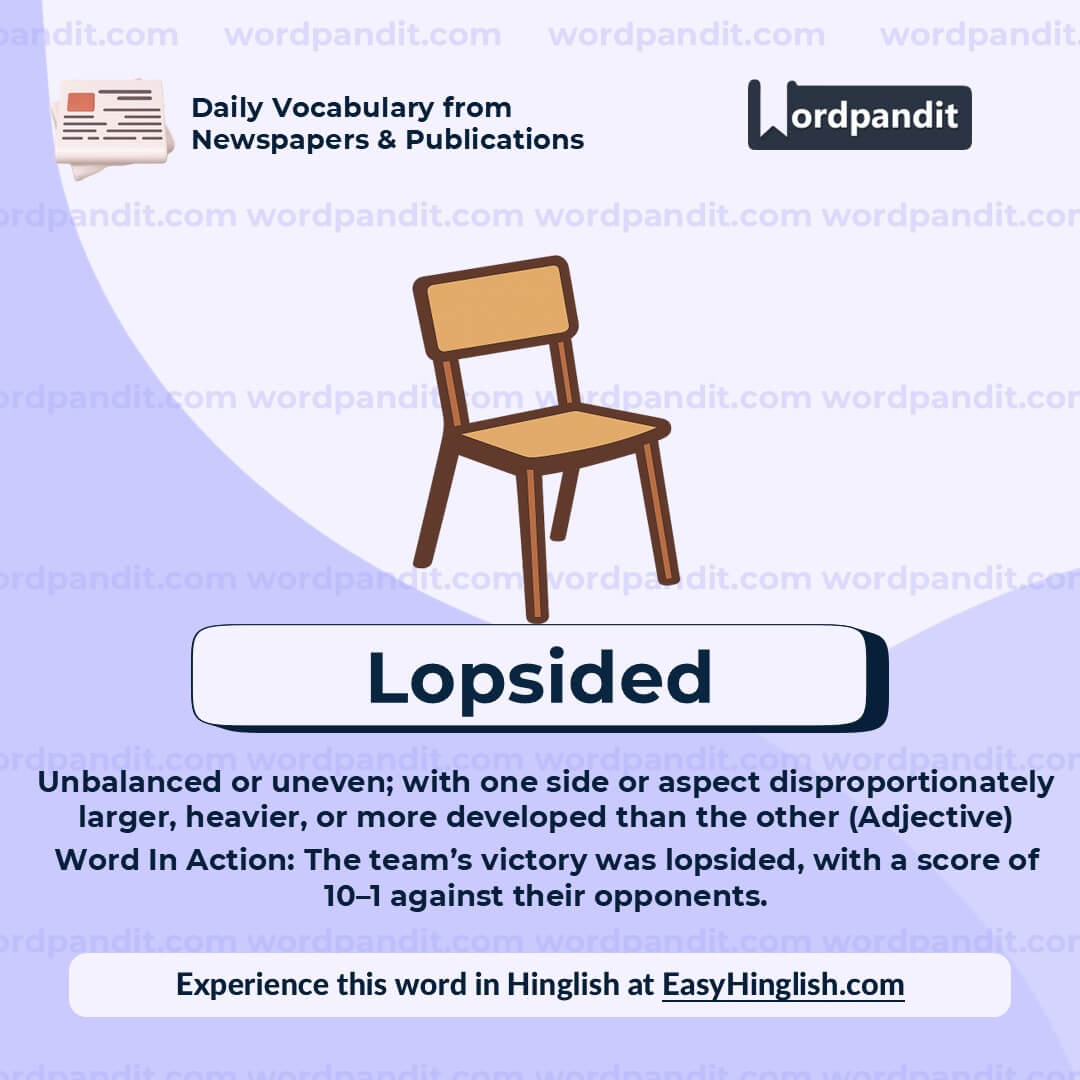
WORD-5: Lopsided
Context:
"The film provides a sharp riposte to such lopsided developmental narratives by foregrounding the experiences of grassroots leaders, their movements, and their organisations, such as the Narmada Bachao Andolan and the Machimar Adhikar Sangharsh Sangathan." - The Wire
Explanatory Paragraph:
Lopsided meaning in English is "unbalanced or uneven, with one side heavier, larger, or more developed than the other." This word is used when describing situations, perspectives, or physical objects that lack balance or fairness in their distribution. How to use lopsided effectively involves contexts where disparity, asymmetry, or unfair advantage needs to be highlighted. Lopsided appears frequently in CAT Reading Comprehension discussing economic inequality, GRE passages analyzing biased arguments, and UPSC materials examining development policies, making it crucial vocabulary for understanding discussions about imbalance and inequity.
Meaning: Unbalanced or uneven; with one side or aspect disproportionately larger, heavier, or more developed than the other (Adjective)
Pronunciation: LOP-sy-ded
Difficulty Level: ⭐⭐ Basic to Intermediate
Etymology: Lopsided is a compound word combining 'lop' (meaning 'to hang down loosely' or 'to droop,' from Middle English) with 'sided.' The word emerged in the 18th century to describe physical objects that tilted to one side due to uneven weight distribution. Over time, it evolved to include metaphorical uses describing any kind of imbalance—whether in arguments, development, competition, or representation—making it particularly useful for critiquing unfair or unequal situations.
Prashant Sir's Notes:
Many students confuse lopsided with 'biased'—the key difference between lopsided and biased is that lopsided emphasizes structural or quantitative imbalance, while biased refers to prejudiced attitudes or unfair judgment. Lopsided usage in UPSC and CAT passages often appears when discussing unequal development ("lopsided growth favoring urban areas"), unfair competition ("a lopsided match"), or unbalanced arguments ("lopsided perspective ignoring ground realities"). In Indian English newspapers, you'll see "lopsided trade balance," "lopsided development," or "lopsided victory"—the word immediately signals that something is unfairly weighted toward one side. For competitive exams, when you encounter lopsided in RC passages, it's usually part of a critique, signaling the author's disapproval of inequality or imbalance. Pro tip: lopsided often pairs with words like 'development,' 'narrative,' 'representation,' and 'victory' in exam passages.
Synonyms & Antonyms:
Synonyms: unbalanced, uneven, asymmetrical, skewed, disproportionate, one-sided, tilted, crooked, inequitable, imbalanced
Antonyms: balanced, even, symmetrical, proportionate, fair, equitable, equal, level
Usage Examples:
- India's economic growth has been criticized as lopsided, with IT and services sectors thriving while agriculture and manufacturing lag behind significantly.
- The cricket match turned into a lopsided contest when India scored 387 runs while the opposition was bowled out for just 142.
- Urban-rural infrastructure development in many Indian states remains lopsided, with cities receiving disproportionate investment compared to villages.
- Rahul presented a lopsided argument during the debate, focusing only on the benefits of the policy while completely ignoring its social costs.
Cultural Reference:
"The Narmada dam project exemplifies lopsided development—massive displacement of tribal communities while benefits flow primarily to urban and industrial areas downstream." - Analysis of development-induced displacement in India
Think About It:
Where do you see the most lopsided distribution of resources or opportunities in Indian society, and what would genuinely balanced development require?
Quick Activity:
Identify one lopsided situation in current Indian politics, economics, or society. Write two sentences explaining why the situation is unbalanced and what the consequences of this imbalance are.
Memory Tip:
Think of 'Lopsided' as 'LOP-SIDED'—imagine someone LOPPED (cut) off one side of something, making it heavier or larger on one side only. Visualize a scale that's tilted because one side has more weight—that's lopsided. Or picture a cricket match where one team LOPs (destroys) the other team—a lopsided victory where one side dominates completely.
Real-World Application:
Lopsided is commonly used in economic analysis, policy critique, sports commentary, and social justice discourse to describe unequal distribution or unfair advantage. In UPSC essays on development or social issues, using lopsided demonstrates critical thinking when analyzing regional disparities, resource allocation, or representation gaps. Indian journalists frequently employ this word when discussing trade deficits, electoral victories, gender imbalances in workplaces, or development models that favor certain groups. It's particularly effective in business writing when describing market domination, unequal partnerships, or competitive advantages that create unfair playing fields.


