Daily Vocabulary from Indian Newspapers and Publications
Welcome to Wordpandit’s Indian Vocabulary Hub
At Wordpandit, we understand the importance of staying rooted in the local context while expanding your language skills. This section focuses on enriching your vocabulary with words and phrases drawn from India’s leading newspapers and publications, ensuring you're learning vocabulary that is practical, relevant, and uniquely Indian.
Why Indian Sources Matter
We believe that the best way to master any language is by immersing yourself in local content. That’s why we carefully curate vocabulary from top Indian publications, including:
- The Hindu
- The Times of India
- The Economic Times
- Hindustan Times
- Live Mint
- The Indian Express
- And many others...
Stay Updated, Stay Relevant
With daily updates from Indian news sources, you’ll be consistently learning words that reflect the trends and shifts in Indian society and culture. Our focus is to provide vocabulary that enhances your understanding of the language in an Indian context.
How Wordpandit Supports Your Goals
Whether you’re preparing for exams, aiming to improve your professional communication, or simply want to stay connected with the latest Indian vocabulary, Wordpandit is here to guide you every step of the way.
Learn with a Practical Approach
Our interactive learning methodology includes real-world examples, engaging activities, and context-specific usage to ensure that every word becomes part of your active vocabulary.
Dive into Indian Vocabulary Today!

Why Choose Wordpandit?
Practical Learning: Focus on words you'll actually encounter in real-world reading, enhancing your comprehension and communication skills.
Diverse Content: From current affairs to scientific breakthroughs, our varied sources expose you to vocabulary across multiple domains.
Effortless Integration: Make Wordpandit a part of your daily routine. Just a few minutes each day can significantly boost your lexicon over time.
Your Path to Vocabulary Mastery
- Visit our Daily Vocabulary section regularly
- Explore new words and their usage in context
- Practice incorporating these words into your own writing and speech
- Track your progress as your vocabulary expands
Start Your Journey Today
Embark on your vocabulary enhancement journey with Wordpandit. By consistently engaging with our daily posts, you'll build a robust vocabulary that serves you well in academic, professional, and personal contexts.
Remember, a word a day keeps linguistic limitations at bay. Make Wordpandit your daily companion in the quest for vocabulary excellence!
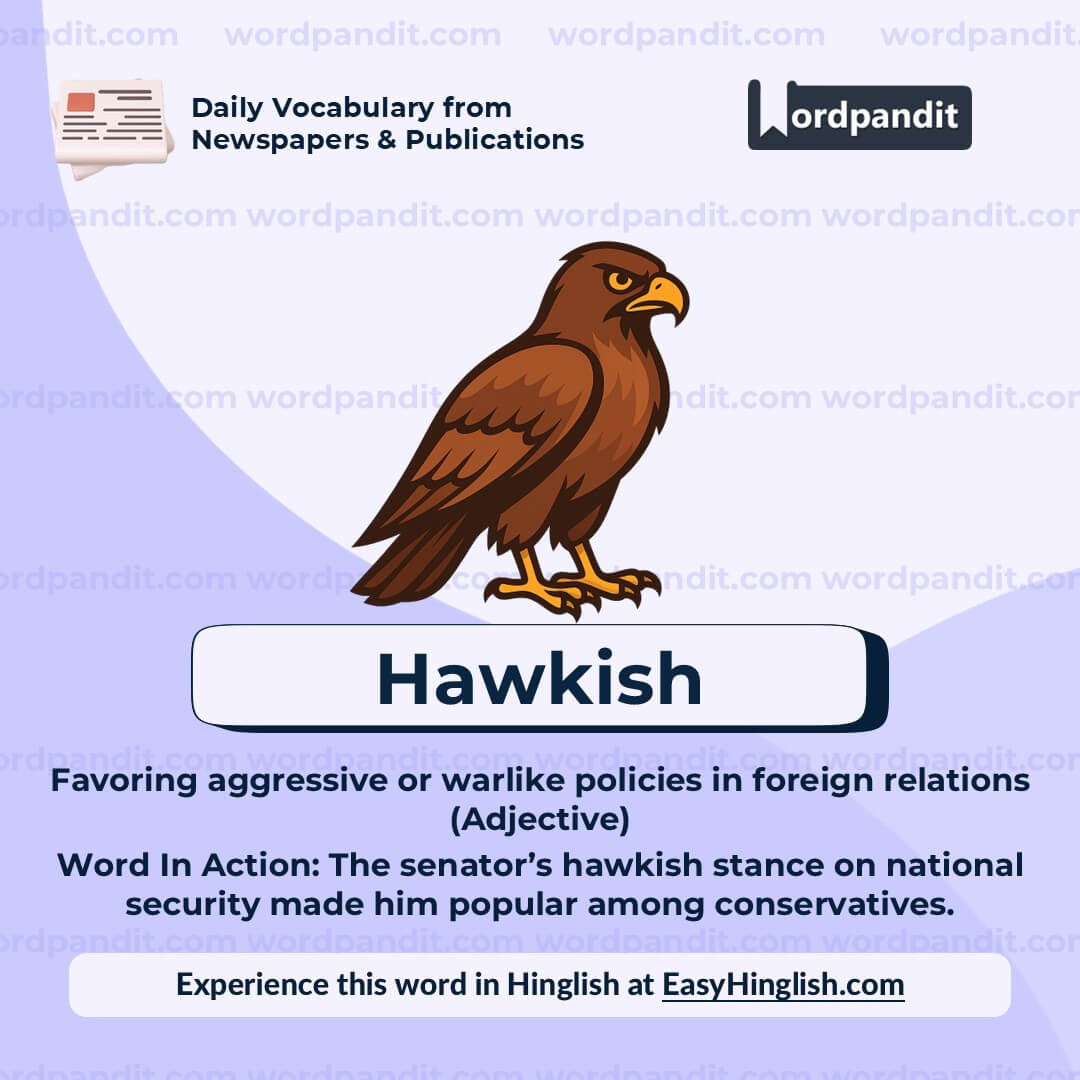
WORD-1: Hawkish
Context:
"In the first Trump administration, Taiwan policy was shaped by figures such as Secretary of State Mike Pompeo who were decidedly hawkish on China and the issue of Taiwan." - The Wire
Explanatory Paragraph:
Hawkish meaning in English is 'favoring aggressive military or political action, especially in foreign policy.' This word is used when describing politicians, policies, or positions that support confrontation, military strength, or tough stances rather than diplomatic compromise. How to use hawkish correctly depends on the context—it commonly appears in news articles about international relations, defense policy discussions, and competitive exam passages analyzing political ideologies and strategic approaches to conflict.
Meaning: Favoring aggressive or warlike policies in foreign relations (Adjective)
Pronunciation: HAW-kish
Difficulty Level: ⭐⭐⭐ Intermediate
Etymology: Hawkish derives from the metaphorical use of 'hawk'—a predatory bird known for its aggressive hunting behavior—to describe people who favor military action. The term gained prominence during the Vietnam War era in American politics, contrasting 'hawks' (those supporting war) with 'doves' (those favoring peace). The '-ish' suffix transforms the noun into an adjective describing someone exhibiting hawk-like qualities in policy positions.
Prashant Sir's Notes:
Many students confuse hawkish with simply 'aggressive'—the difference between hawkish and aggressive is that hawkish specifically relates to military or foreign policy contexts, not general behavior. For CAT and UPSC aspirants, hawkish frequently appears in reading comprehension passages about international relations and defense strategies. In Indian English newspapers, you'll often see 'hawkish stance on Pakistan' or 'hawkish approach to border disputes'—the word immediately signals a preference for military strength over diplomatic negotiation. When you encounter hawkish in exam passages, it's usually paired with its opposite 'dovish' to show contrasting political philosophies. The usage pattern is typically: '[leader/country] takes a hawkish position on [foreign policy issue].'
Synonyms & Antonyms:
Synonyms: militant, aggressive, warlike, bellicose, belligerent, combative, hard-line, confrontational, militaristic
Antonyms: dovish, peaceful, conciliatory, diplomatic, pacifist, moderate
Usage Examples:
- The Defense Minister's hawkish statements on cross-border terrorism alarmed opposition parties who preferred diplomatic channels.
- Investors worry that the new hawkish monetary policy approach will lead to higher interest rates and slower economic growth.
- During the Kargil conflict, Indian media coverage became increasingly hawkish, with anchors demanding strong military retaliation against Pakistan.
- Rajesh's hawkish approach to the business negotiation backfired when competitors simply walked away from the hostile takeover attempt.
Cultural Reference:
"In Indian foreign policy debates, the hawkish versus dovish divide often emerges during border tensions, with some leaders advocating military strength while others champion dialogue and restraint." - Common theme in Indian political discourse
Think About It:
Does India's strategic position require more hawkish policies toward neighboring countries, or would a dovish approach better serve long-term regional stability and economic cooperation?
Quick Activity:
Scan today's newspaper for articles on foreign policy or defense. Identify three politicians or commentators and classify their statements as either hawkish or dovish, explaining your reasoning.
Memory Tip:
Think of 'HAWK-ish' by visualizing a hawk—an aggressive predatory bird that attacks swiftly from above. Just as a hawk swoops down aggressively on prey, hawkish politicians favor aggressive military action rather than peaceful negotiations. Remember: Hawk = Attack = Aggressive foreign policy.
Real-World Application:
In news analysis, political commentary, and international relations articles, 'hawkish' is essential vocabulary for describing policy positions on defense and foreign affairs. Journalists use it to quickly communicate whether leaders favor military solutions or diplomatic ones. For competitive exam aspirants, understanding hawkish helps decode passages about geopolitical conflicts, arms races, and the balance between deterrence and dialogue in international relations.
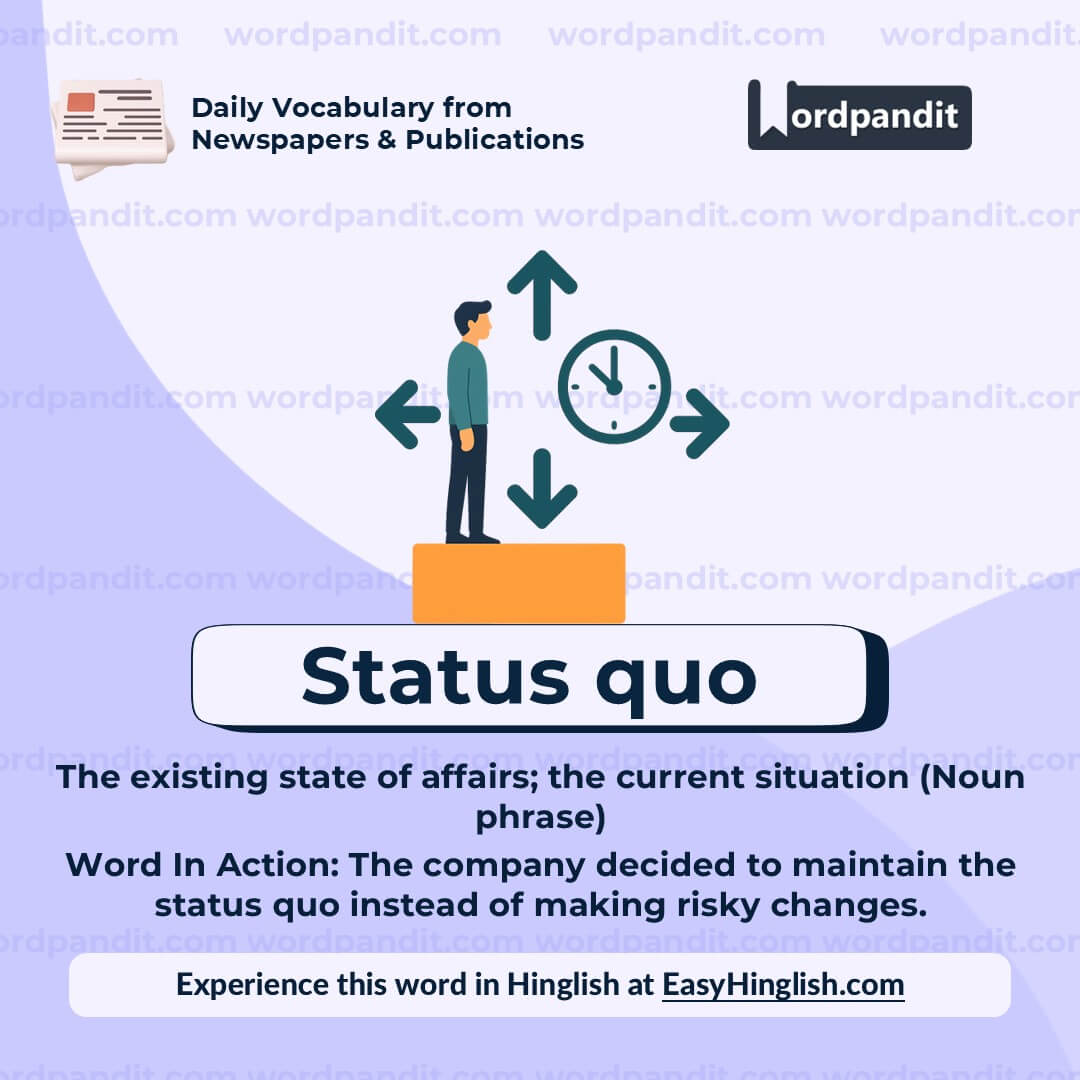
WORD-2: Status Quo
Context:
"The preferred settlement on Taiwan for the short to medium term is status quo." - The Wire
Explanatory Paragraph:
Status quo meaning in English is 'the existing state of affairs or current situation.' This Latin phrase is used when referring to maintaining things as they are, without any changes or disruptions. How to use status quo correctly is important in formal discussions—it commonly appears in political analysis, business strategy documents, news articles about conflicts, and competitive exam passages discussing policy decisions where preserving the current situation is preferred over making changes.
Meaning: The existing state of affairs; the current situation (Noun phrase)
Pronunciation: STAY-tus KWO
Difficulty Level: ⭐⭐ Basic to Intermediate
Etymology: Status quo comes directly from Latin, where 'status' means 'state' or 'condition' and 'quo' means 'in which.' The full Latin phrase is 'status quo ante,' meaning 'the state in which before.' It entered English legal and diplomatic language in the 19th century and has since become common in political, business, and social discussions to describe maintaining existing conditions rather than pursuing change or reform.
Prashant Sir's Notes:
Students often ask: what is the difference between status quo and 'current situation'? While both refer to present conditions, status quo specifically emphasizes resistance to change or deliberate maintenance of existing arrangements. For UPSC and CAT aspirants, status quo frequently appears in passages about political reforms, social movements, and international relations—whenever there's tension between change and stability. In Indian English newspapers, you'll see phrases like 'maintain the status quo on Kashmir' or 'challenge the status quo in education policy.' The usage pattern typically follows: 'maintain/preserve/challenge/disrupt the status quo.' Remember, the word carries a slightly negative connotation when reformers want change but powerful interests prefer keeping things unchanged.
Synonyms & Antonyms:
Synonyms: existing state, current situation, present conditions, established order, prevailing circumstances, things as they are, unchanged state
Antonyms: change, transformation, revolution, reform, upheaval, innovation, disruption
Usage Examples:
- The corporate board preferred maintaining the status quo rather than implementing the risky restructuring plan proposed by new management.
- Social activists in India are determined to challenge the status quo on caste discrimination through education and legal reforms.
- Both nations agreed to preserve the status quo along the Line of Actual Control while continuing diplomatic negotiations.
- Priya's innovative teaching methods disrupted the status quo in her school, where traditional rote learning had dominated for decades.
Cultural Reference:
"In the film '3 Idiots,' Rancho challenges the status quo of the education system, questioning rote learning and encouraging creative thinking—a message that resonated deeply with Indian students tired of traditional exam-focused teaching." - Bollywood's commentary on educational reform
Think About It:
When is maintaining the status quo a wise strategy for stability, and when does it become an obstacle preventing necessary progress and social justice?
Quick Activity:
Identify one area in Indian society where people are trying to challenge the status quo and one area where maintaining it seems beneficial. Write two sentences explaining your reasoning.
Memory Tip:
Remember 'STATUS QUO' by breaking it down: STATUS = how things stand, QUO sounds like 'go'—but status quo means DON'T GO anywhere, stay where you are! Think of it as "Status? No go!"—keeping the current status without going forward or backward.
Real-World Application:
In political analysis, business reports, and academic essays, 'status quo' is essential vocabulary for discussing resistance to change versus reform. Journalists use it to describe situations where powerful groups prefer existing arrangements, while reformers seek transformation. For competitive exam aspirants, understanding status quo helps analyze passages about social movements, policy debates, and international conflicts where maintaining current conditions versus pursuing change is the central tension. The phrase appears frequently in UPSC essays on governance, CAT RC passages on business strategy, and GRE arguments analyzing institutional reform.
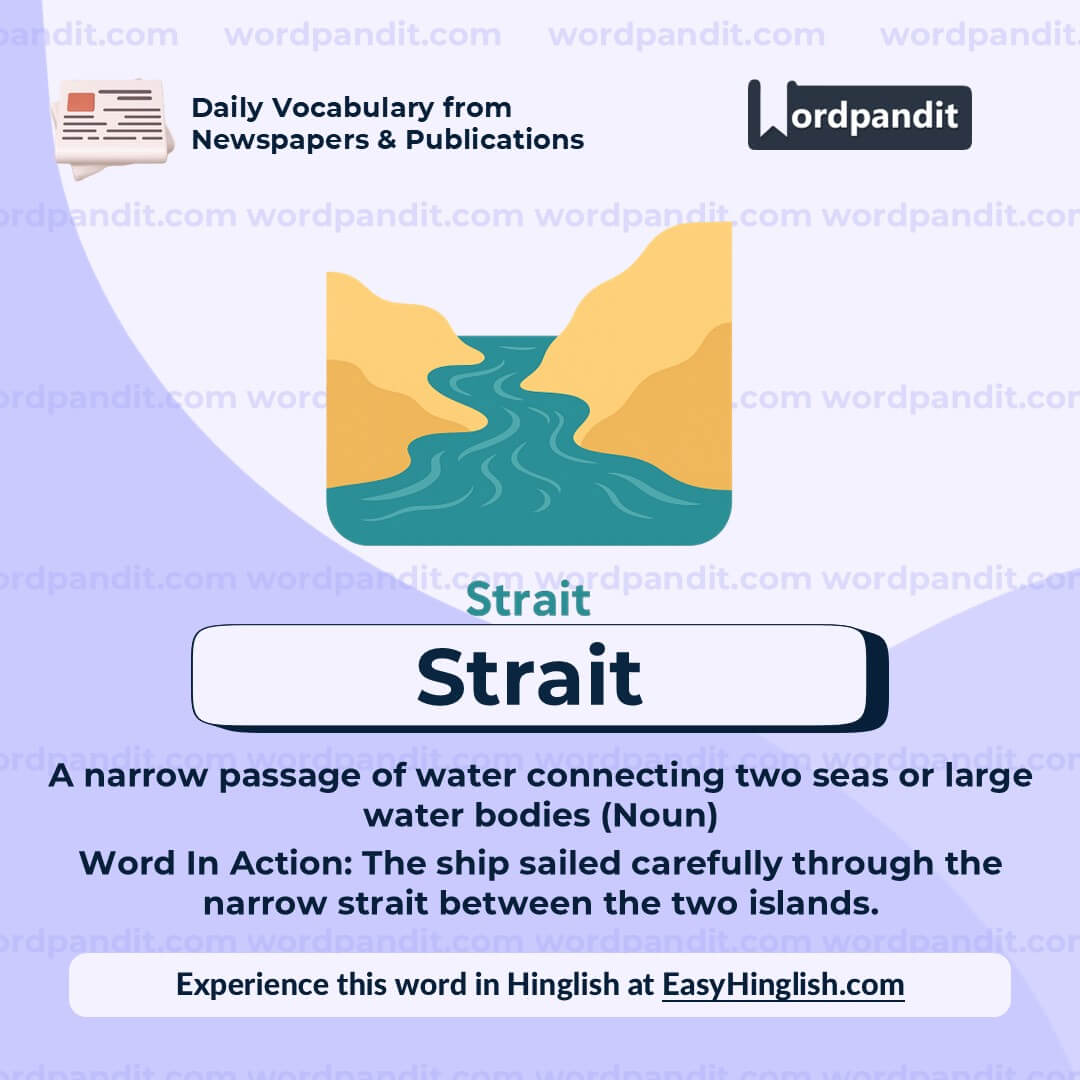
WORD-3: Strait
Context:
"During the Biden administration, the U.S. position on Taiwan was shaped by other, wider China-U.S. events, such as the spy balloon and then the controversial visit to Taiwan by then-House Speaker Nancy Pelosi – both of which damaged Washington-Beijing relations and resulted in an uptick in tensions across the Taiwan Strait." - The Wire
Explanatory Paragraph:
Strait meaning in English is 'a narrow passage of water connecting two larger bodies of water.' This geographical term is used when describing waterways that separate landmasses and often serve as strategic locations for trade and military purposes. How to use strait correctly is important in geography, international relations, and news articles—it commonly appears in discussions about maritime boundaries, naval strategies, and competitive exam passages dealing with geopolitics, particularly when such waterways become zones of territorial disputes or military tension.
Meaning: A narrow passage of water connecting two seas or large water bodies (Noun)
Pronunciation: STRAYT
Difficulty Level: ⭐⭐ Basic to Intermediate
Etymology: Strait comes from Old French 'estreit' meaning 'narrow' or 'tight,' which itself derived from Latin 'strictus' meaning 'drawn tight' or 'compressed.' The word entered English in the 14th century, initially meaning any narrow or confined space, but gradually specialized to refer specifically to narrow waterways. Famous straits like the Strait of Gibraltar and the Strait of Hormuz have made this geographical term essential in maritime and geopolitical vocabulary.
Prashant Sir's Notes:
Many students confuse 'strait' with 'straight'—the difference between strait and straight is critical: strait (narrow waterway) versus straight (not curved). For UPSC Geography and CAT Reading Comprehension, strait frequently appears in passages about maritime trade routes, naval conflicts, and strategic chokepoints. In Indian context, you'll encounter the Palk Strait (between India and Sri Lanka) and references to the Strait of Hormuz (crucial for India's oil imports). How to use strait in sentences: it's always about geography—'Taiwan Strait,' 'Malacca Strait,' or 'Bering Strait.' Remember, straits are strategically important because controlling them means controlling trade and military access between regions. In exam passages, when you see strait mentioned, expect discussions about territorial disputes, naval power, or economic dependencies.
Synonyms & Antonyms:
Synonyms: channel, waterway, sound, passage, narrows, inlet (in geographical context); difficulty, predicament (when used as 'dire straits')
Antonyms: ocean, sea, wide expanse, open water, broad channel
Usage Examples:
- The Strait of Hormuz is vital for India's energy security, as nearly 60% of our crude oil imports pass through this narrow waterway.
- Chinese naval exercises in the Taiwan Strait have increased significantly, raising concerns among neighboring countries including Japan and the Philippines.
- The Palk Strait between Tamil Nadu and Sri Lanka has been a sensitive area for fishermen's rights and maritime boundary disputes.
- Control of the Malacca Strait gives Singapore enormous strategic importance in global shipping, as over 25% of world trade passes through it.
Cultural Reference:
"The phrase 'in dire straits' appears in Mark Knopfler's famous band name 'Dire Straits,' reflecting how the geographical term evolved metaphorically to mean being in difficult circumstances—much like navigating through dangerously narrow waters." - Popular culture usage
Think About It:
Why do narrow straits often become flashpoints for international conflict, and how does India's location relative to crucial straits like Hormuz and Malacca affect our foreign policy decisions?
Quick Activity:
On a map of Asia, locate three important straits: the Taiwan Strait, Malacca Strait, and Palk Strait. Write one sentence explaining why each is strategically important.
Memory Tip:
Don't confuse STRAIT (waterway) with STRAIGHT (not curved)! Remember: STRAIT has 'AI' like WAIT—ships must WAIT to pass through narrow STRAITS. Or think: "STR-AIT" sounds like "STRAIGHT" but means the opposite—a TIGHT, narrow passage, not a wide straight one. Also remember: Palk STRAIT separates India and Sri Lanka—visualize a narrow water strip between them.
Real-World Application:
In news articles about international relations, military strategy, and geography, 'strait' is essential vocabulary for understanding geopolitical conflicts and trade routes. The term appears frequently in discussions about maritime boundaries, naval blockades, and strategic chokepoints. For UPSC aspirants, knowing major straits is crucial for Geography, International Relations, and Security Studies papers. For CAT and GRE students, passages about global trade, regional conflicts, or naval power often feature straits as central elements. Understanding straits helps decode why certain waterways become contested zones and how geography shapes international power dynamics.

WORD-4: Inglesby
Context:
"The creator Brad Inglesby might have been suggested a second season for Mare of Easttown, and we should be grateful that he's served us with Task instead." - The Wire
Explanatory Paragraph:
Inglesby is a proper noun—specifically, a surname of a person, in this context referring to Brad Inglesby, an American screenwriter and television creator. This is not a vocabulary word with a dictionary definition but rather a person's name. Proper nouns like Inglesby are used to identify specific individuals and do not have meanings in the traditional sense. Understanding how to recognize proper nouns versus common nouns is important for competitive exams, where distinguishing between general vocabulary and specific names helps with comprehension and contextual analysis.
Meaning: A surname; in this context, Brad Inglesby, American screenwriter and creator (Proper Noun)
Pronunciation: ING-gulz-bee
Difficulty Level: N/A (Proper Noun - Person's Name)
Etymology: Inglesby is an English surname with geographical origins, likely derived from a place name in Northern England. Many English surnames ending in '-by' come from Old Norse 'byr' meaning 'farm' or 'settlement,' suggesting Viking influence in medieval Britain. The prefix 'Ingles-' may relate to 'Angles' (the Germanic tribe) or a personal name. Like many surnames, it transitioned from identifying someone's place of origin to becoming a hereditary family name passed through generations.
Prashant Sir's Notes:
Students, this is an important lesson for CAT and GRE reading comprehension: not every unfamiliar word in a passage is vocabulary you need to learn. Inglesby is simply a person's name—a proper noun. When you encounter capitalized words in RC passages, first determine if they're proper nouns (names of people, places, organizations) or actual vocabulary words. For competitive exams, focus on understanding the context rather than memorizing every proper noun. In this sentence, knowing that Inglesby is the creator helps you understand the passage structure, but you don't need to define his name. This distinction saves valuable exam time and prevents confusion between what's testable vocabulary versus contextual information.
Synonyms & Antonyms:
Note: As a proper noun (person's name), Inglesby does not have synonyms or antonyms. However, related terms for the concept include:
Related terms: surname, family name, last name, patronymic, creator, writer, showrunner
Antonyms: N/A (proper nouns don't have antonyms)
Usage Examples:
- Brad Inglesby gained critical acclaim for his work on the HBO series Mare of Easttown, starring Kate Winslet.
- When reading film reviews, you'll often encounter directors' and writers' names like Inglesby, Nolan, or Anurag Kashyap as proper nouns.
- The screenplay written by Inglesby demonstrated masterful character development and authentic dialogue that resonated with audiences globally.
- In her film studies essay, Prerna analyzed how creators like Inglesby craft compelling narratives that explore small-town American life.
Cultural Reference:
"Just as Indian audiences recognize names like Zoya Akhtar or Anurag Kashyap as distinctive creative voices in cinema, Brad Inglesby has become synonymous with gripping, character-driven television dramas in Hollywood." - Contemporary television criticism
Think About It:
How do creators' names become brands in the entertainment industry, where audiences seek out new projects simply because a particular writer or director is attached?
Quick Activity:
List three Indian film directors or screenwriters whose names have become synonymous with a particular style or genre, similar to how Brad Inglesby is recognized for crime dramas.
Memory Tip:
Remember that INGLESBY is simply a PERSON'S NAME (proper noun), not vocabulary to memorize. When you see capitalized words in the middle of sentences in exam passages, ask yourself: "Is this a name or a place?" If yes, it's context, not vocabulary. Focus your energy on learning actual adjectives, verbs, and common nouns instead.
Real-World Application:
In entertainment journalism, film reviews, and media criticism, recognizing creators' names helps you follow industry trends and understand attribution. For competitive exam reading comprehension, distinguishing proper nouns from vocabulary words is crucial—it prevents wasting time trying to "define" names and helps you focus on actual testable vocabulary. When reading English newspapers or watching content with subtitles, you'll frequently encounter unfamiliar names from different cultures; understanding they're simply identifiers rather than words to learn improves reading efficiency and comprehension speed.
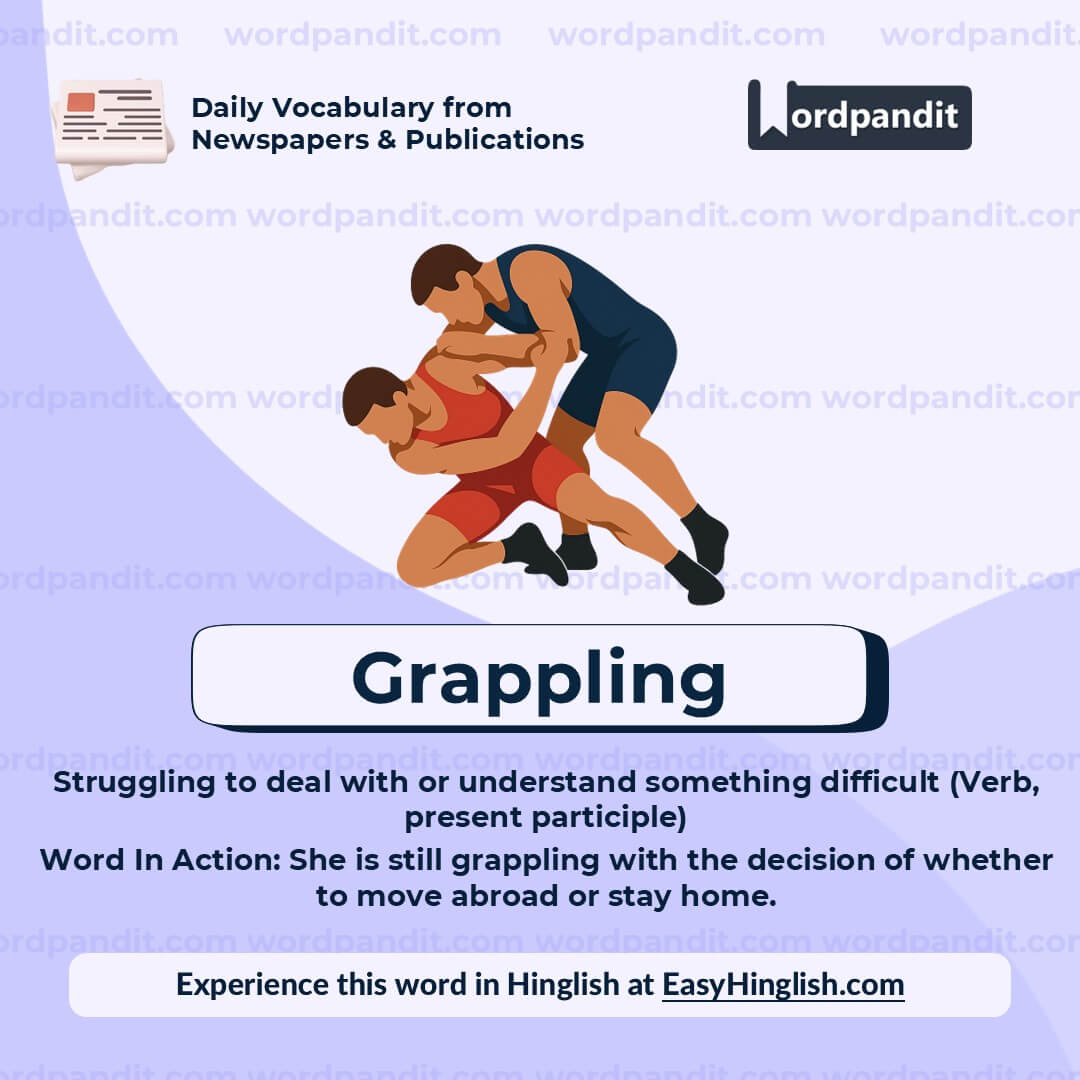
WORD-5: Grappling
Context:
"For fans of the Kate Winslet show, one might be able to identify Inglesby's fingerprints all over his latest series – set in Pennsylvania's suburbs, with a lead cop who is grappling with personal demons of their own, and consisting of a rich variety of characters that makes the world much more tactile for its viewers." - The Wire
Explanatory Paragraph:
Grappling meaning in English is 'struggling to deal with or overcome a difficult problem or challenge.' This word is used when someone is actively wrestling with complex issues, internal conflicts, or challenging situations that require effort to resolve. How to use grappling effectively appears in both literal contexts (physical wrestling) and figurative contexts (mental or emotional struggles). Grappling commonly appears in news articles, psychological discussions, and competitive exam passages describing characters or nations dealing with difficult dilemmas, personal crises, or complex policy challenges.
Meaning: Struggling to deal with or understand something difficult (Verb, present participle)
Pronunciation: GRAP-ling
Difficulty Level: ⭐⭐⭐ Intermediate
Etymology: Grappling comes from the Old French word 'grapil' meaning 'hook,' which derived from 'grape' meaning 'bunch of grapes' or 'hook.' The connection relates to how grape stems hook together in clusters. By the 14th century, 'grapple' in English meant to seize or hold firmly, particularly in hand-to-hand combat. Over time, the word expanded metaphorically to describe mental and emotional struggles, not just physical wrestling, reflecting how we "grip" difficult problems as we try to solve them.
Prashant Sir's Notes:
Students often ask: what is the difference between grappling and struggling? While both indicate difficulty, grappling specifically suggests actively wrestling with or trying to understand something complex—it's more engaged than passive suffering. For CAT and GRE reading comprehension, grappling with frequently signals character development or philosophical dilemmas in passages. In Indian English newspapers, you'll see phrases like "India grappling with unemployment" or "farmers grappling with climate change"—it shows active engagement with serious challenges. How to use grappling correctly: it's always followed by 'with' (grappling with demons, grappling with the decision). When you encounter grappling in exam passages, it indicates internal conflict or complex problem-solving, helping you identify themes of struggle, growth, or moral dilemmas in the text.
Synonyms & Antonyms:
Synonyms: wrestling with, struggling with, contending with, tackling, confronting, battling, dealing with, coming to terms with, working through
Antonyms: avoiding, ignoring, surrendering to, accepting easily, breezing through, mastering effortlessly
Usage Examples:
- Indian startups are grappling with funding challenges as global investors become more cautious about emerging markets during economic uncertainty.
- After his father's sudden death, Arjun spent months grappling with guilt over their unresolved conflicts and words left unsaid.
- The Supreme Court is grappling with the constitutional questions surrounding digital privacy rights in the age of social media.
- Many students preparing for competitive exams find themselves grappling with time management rather than the actual difficulty of the material.
Cultural Reference:
"In the film Dangal, Geeta and Babita are shown literally grappling on the wrestling mat, but metaphorically, they're grappling with societal expectations about women in sports—a powerful double meaning that resonated with Indian audiences." - Analysis of sports cinema
Think About It:
What personal demons or difficult challenges are you currently grappling with, and does naming them openly help you confront them more effectively?
Quick Activity:
Write two sentences: one using 'grappling with' to describe a physical struggle, and another using it metaphorically to describe an emotional or intellectual challenge you've faced.
Memory Tip:
Think of 'GRAPPLING' as 'GRABBING + PULLING'—when you're grappling with a problem, you're mentally grabbing it and pulling it toward you to understand it, just like wrestlers grab and pull each other. Or visualize someone in a wrestling match (grappling physically) = someone struggling with a difficult problem (grappling mentally). Both involve intense engagement and effort!
Real-World Application:
In psychological discussions, character analyses, and news articles about policy challenges, 'grappling with' is essential vocabulary for describing active engagement with difficult problems. Journalists use it to convey that individuals, organizations, or governments are actively working through complex issues rather than ignoring them. For competitive exam aspirants, recognizing 'grappling' in reading passages helps identify themes of internal conflict, moral dilemmas, or problem-solving processes. The word appears frequently in UPSC essays on governance challenges, CAT RC passages featuring character development, and GRE arguments analyzing how people or societies confront difficult questions.