

Daily Vocabulary from Indian Newspapers and Publications
Welcome to Wordpandit’s Indian Vocabulary Hub
At Wordpandit, we understand the importance of staying rooted in the local context while expanding your language skills. This section focuses on enriching your vocabulary with words and phrases drawn from India’s leading newspapers and publications, ensuring you're learning vocabulary that is practical, relevant, and uniquely Indian.
Why Indian Sources Matter
We believe that the best way to master any language is by immersing yourself in local content. That’s why we carefully curate vocabulary from top Indian publications, including:
- The Hindu
- The Times of India
- The Economic Times
- Hindustan Times
- Live Mint
- The Indian Express
- And many others...
Stay Updated, Stay Relevant
With daily updates from Indian news sources, you’ll be consistently learning words that reflect the trends and shifts in Indian society and culture. Our focus is to provide vocabulary that enhances your understanding of the language in an Indian context.
How Wordpandit Supports Your Goals
Whether you’re preparing for exams, aiming to improve your professional communication, or simply want to stay connected with the latest Indian vocabulary, Wordpandit is here to guide you every step of the way.
Learn with a Practical Approach
Our interactive learning methodology includes real-world examples, engaging activities, and context-specific usage to ensure that every word becomes part of your active vocabulary.
Dive into Indian Vocabulary Today!

Why Choose Wordpandit?
Practical Learning: Focus on words you'll actually encounter in real-world reading, enhancing your comprehension and communication skills.
Diverse Content: From current affairs to scientific breakthroughs, our varied sources expose you to vocabulary across multiple domains.
Effortless Integration: Make Wordpandit a part of your daily routine. Just a few minutes each day can significantly boost your lexicon over time.
Your Path to Vocabulary Mastery
- Visit our Daily Vocabulary section regularly
- Explore new words and their usage in context
- Practice incorporating these words into your own writing and speech
- Track your progress as your vocabulary expands
Start Your Journey Today
Embark on your vocabulary enhancement journey with Wordpandit. By consistently engaging with our daily posts, you'll build a robust vocabulary that serves you well in academic, professional, and personal contexts.
Remember, a word a day keeps linguistic limitations at bay. Make Wordpandit your daily companion in the quest for vocabulary excellence!
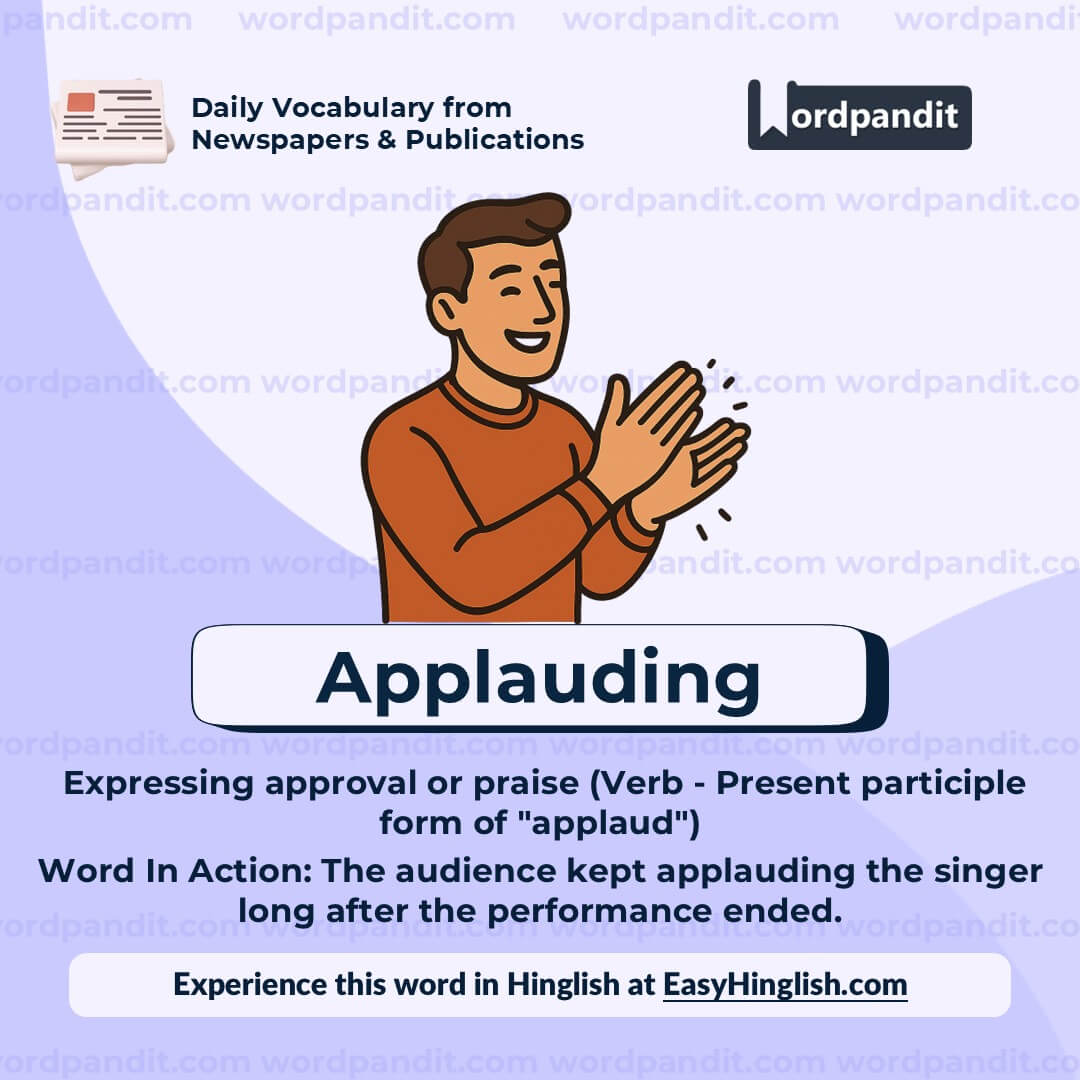
WORD-1: Applauding
Context:
"Most importantly, he took India to the high table of global governance, with every country applauding and respecting his leadership and India’s global role." - Indian Express
Explanatory Paragraph:
The word "applauding" refers to the act of showing approval, praise, or admiration, often expressed by clapping hands, but also used more broadly to mean offering support or recognition. In this context, it means that other countries were appreciating and acknowledging India’s leadership and role on the global stage.
Meaning: Expressing approval or praise (Verb - Present participle form of "applaud")
Pronunciation: uh-PLAW-ding
Difficulty Level: ⭐⭐ Beginner to Intermediate
Etymology: From Latin applaudere ("to clap, approve"), formed from "ad-" (toward) + "plaudere" (to clap). The word entered English in the 16th century.
Prashant Sir's Notes:
"Applauding" does not always mean literal clapping; it is often used metaphorically to express approval, admiration, or public support. In exams, it can appear in both literal and figurative senses.
Synonyms & Antonyms:
Synonyms: praising, commending, cheering, lauding, celebrating
Antonyms: criticizing, condemning, disapproving, booing
Usage Examples:
- The audience kept applauding long after the performance ended.
- Many people are applauding the government’s efforts to promote sustainability.
- She felt proud when her classmates were applauding her speech.
- The new policy was widely applauding for its fairness and inclusiveness.
Cultural Reference:
"A standing ovation is the highest form of applauding, often reserved for extraordinary achievements in theatre, sports, or politics." - Cultural Note
Think About It:
Do we sometimes applaud people too easily, without considering whether they truly deserve the recognition?
Quick Activity:
Write two sentences: one where "applauding" is used literally (clapping hands), and another where it is used metaphorically (showing approval without clapping).
Memory Tip:
Think of "applauding" as "adding claps" → "ap-" (towards) + "plauding" (clapping). This makes it easier to remember its meaning of showing praise.
Real-World Application:
In workplace culture, employees are often applauding their colleagues during meetings to encourage teamwork and motivation, showing that this word goes beyond physical clapping to include appreciation and recognition in professional contexts.
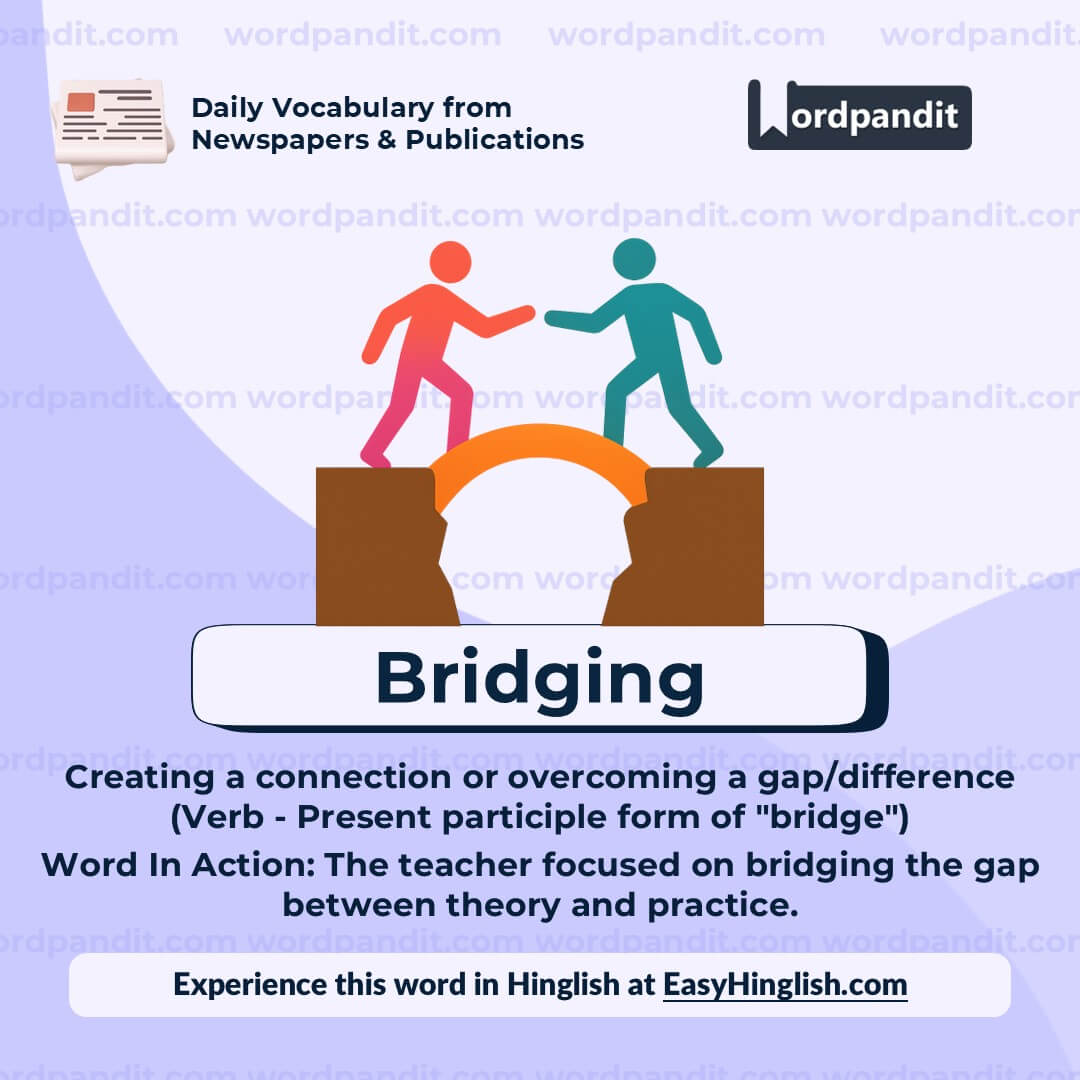
WORD-2: Bridging
Context:
"The military leadership has also shown keen interest in bridging the relationship with the US, laying the ground for the civilian government to further promote defence and economic cooperation." - Hindustan Times
Explanatory Paragraph:
The word "bridging" comes from the idea of building a bridge that connects two separate sides. Literally, it means creating a path over a gap, but in figurative usage, it means reducing differences, building connections, or bringing two sides closer together. In this context, it refers to efforts at improving and strengthening diplomatic relations between the military leadership and the United States.
Meaning: Creating a connection or overcoming a gap/difference (Verb - Present participle form of "bridge")
Pronunciation: BRIJ-ing
Difficulty Level: ⭐⭐ Beginner to Intermediate
Etymology: From Old English brycg meaning "bridge," referring to a structure that connects two places. Over time, the term came to symbolize connection or reconciliation between people or ideas.
Prashant Sir's Notes:
"Bridging" is often used metaphorically in diplomacy, business, and communication. It suggests connecting gaps — whether they are physical, cultural, emotional, or political. Remember that it implies effort and intention to unite two sides.
Synonyms & Antonyms:
Synonyms: connecting, linking, reconciling, uniting, joining
Antonyms: dividing, separating, distancing, alienating
Usage Examples:
- The new cultural exchange program is aimed at bridging differences between communities.
- Technology is bridging the gap between urban and rural education.
- She played a key role in bridging communication between the two departments.
- The peace talks focused on bridging long-standing disputes between the two nations.
Cultural Reference:
"Music is often described as a universal language, capable of bridging cultures and bringing people together." - Cultural Note
Think About It:
What is more challenging: building a bridge between two physical places or bridging differences between two communities?
Quick Activity:
Write one sentence using "bridging" in the literal sense (a physical bridge) and another in the figurative sense (connecting ideas or people).
Memory Tip:
Visualize a bridge connecting two sides of a river. "Bridging" = "connecting gaps," whether physical or emotional.
Real-World Application:
In international diplomacy, "bridging" is a key concept. Leaders often talk about bridging trust deficits, cultural gaps, or economic disparities to build stronger global partnerships.
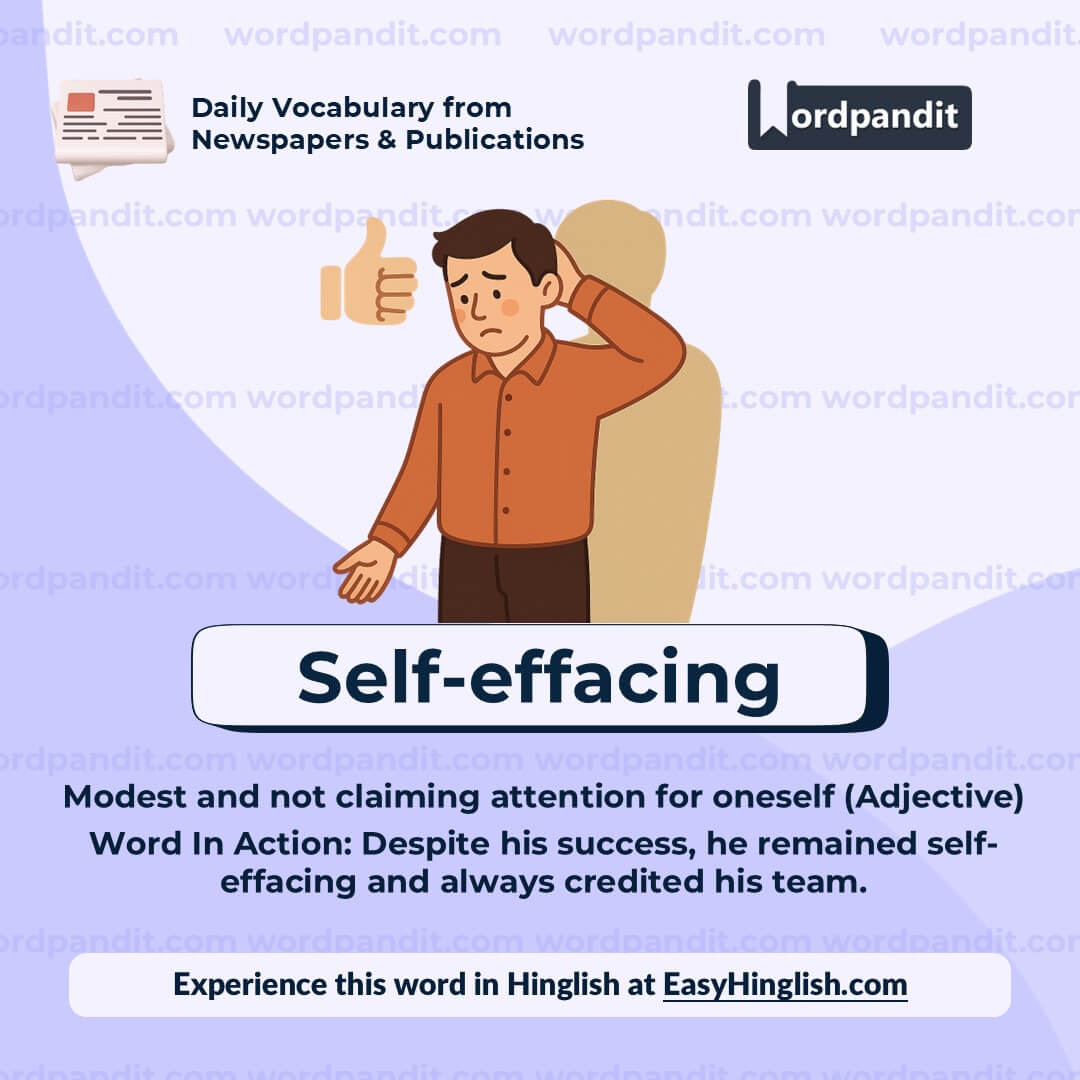
WORD-3: Self-effacing
Context:
"His cricketing career is not just a benchmark of success and excellence, but stands as a testament to his character, marked by humility and self-effacing grace, and is a symbol of hope for millions across India where cricketers once rose only from the major metropolises." - Indian Express
Explanatory Paragraph:
The word "self-effacing" describes a person who avoids drawing attention to themselves, even when they deserve it. Such people are modest, humble, and often let their work speak louder than their words. In the context of the quote, the cricketer is praised for his success combined with humility, showing that he did not seek the spotlight despite his achievements.
Meaning: Modest and not claiming attention for oneself (Adjective)
Pronunciation: self-ih-FAY-sing
Difficulty Level: ⭐⭐⭐ Intermediate to Advanced
Etymology: From "self" + "efface," meaning "to erase" or "to make oneself less noticeable." The idea is of "erasing oneself" from prominence or the spotlight.
Prashant Sir's Notes:
"Self-effacing" is often a compliment, showing respect for humility. Be careful not to confuse it with "self-deprecating," which can include making fun of oneself. Self-effacing is about modesty, not mockery.
Synonyms & Antonyms:
Synonyms: humble, modest, unassuming, unpretentious, reserved
Antonyms: boastful, arrogant, self-promoting, conceited, flamboyant
Usage Examples:
- Despite his immense talent, he remained self-effacing and preferred to give credit to his team.
- Her self-effacing nature made her beloved among colleagues who valued humility over ego.
- The professor, though world-renowned, was surprisingly self-effacing in his lectures.
- A self-effacing leader often earns deeper respect than one who constantly demands attention.
Cultural Reference:
"Mahatma Gandhi is often remembered as a self-effacing leader, choosing simplicity and humility over grandeur." - Cultural Note
Think About It:
In today’s world of social media and self-promotion, is being self-effacing still seen as a strength, or does it sometimes go unnoticed?
Quick Activity:
Write two short descriptions of the same person: one highlighting them as boastful, and another showing them as self-effacing. Compare the impact of both descriptions.
Memory Tip:
Think of "efface" as "erase." A "self-effacing" person tries to "erase themselves" from the spotlight, staying humble.
Real-World Application:
In professional settings, self-effacing individuals are often respected for their quiet competence and humility. Leaders, teachers, or mentors who are self-effacing inspire trust and loyalty, as they put collective goals above personal glory.
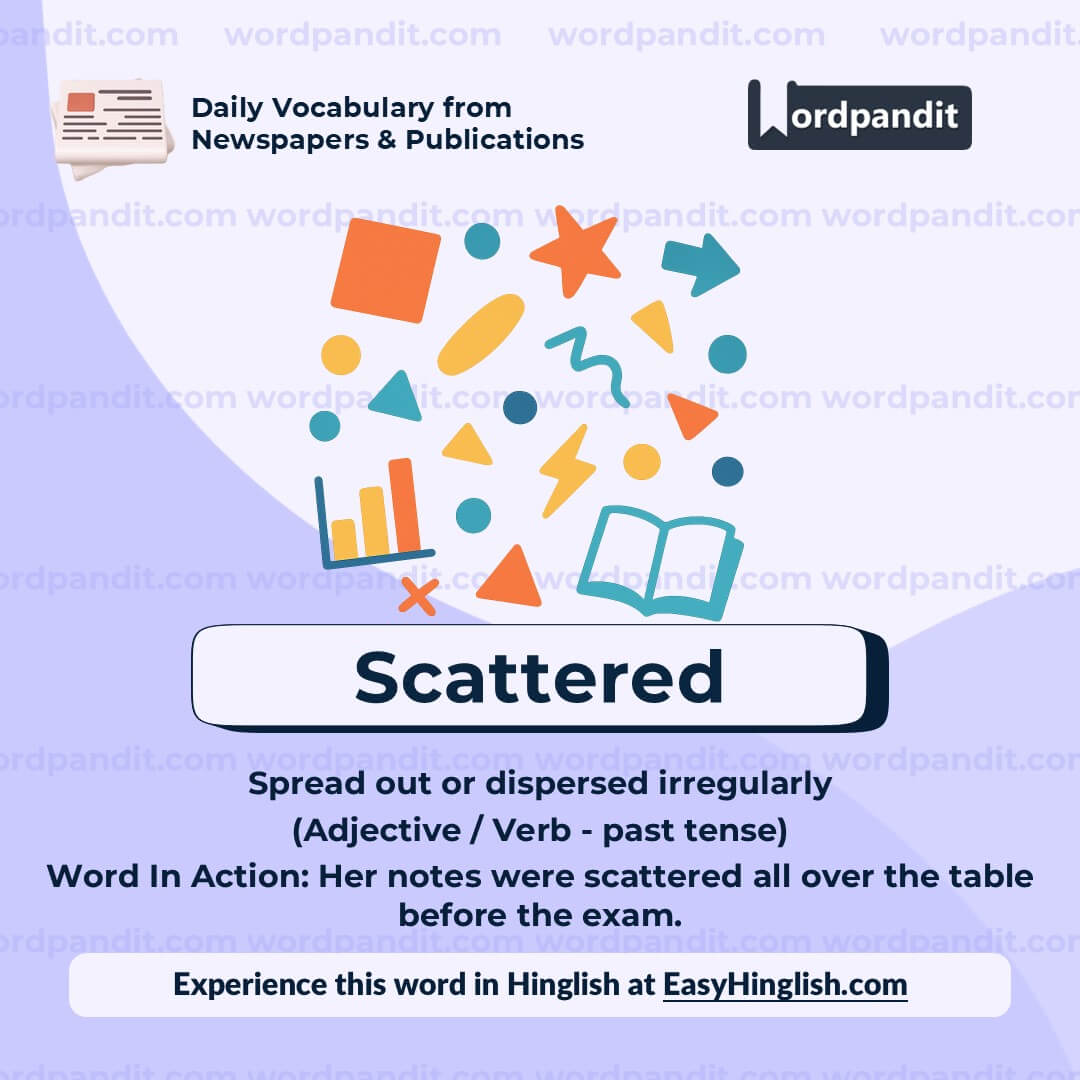
WORD-4: Scattered
Context:
"Although their relevance is scattered across various versions of the Ramayana, Sita, Kaikeyi and Mandodari exist in the shadow lines of their husbands — Ram, Dasharath and Ravan — flickering between myth-making and historicity, finally settling into a metaphor." - Indian Express
Explanatory Paragraph:
The word "scattered" means spread out over an area in a way that is not organized or concentrated. It can describe physical things (like papers scattered on a floor) or abstract ideas (like knowledge scattered across books). In this context, it means that references to these women in the Ramayana are not concentrated in one place but appear in fragments across different versions of the text.
Meaning: Spread out or dispersed irregularly (Adjective / Verb - past tense)
Pronunciation: SKA-tuhd
Difficulty Level: ⭐ Beginner
Etymology: From Old English scateren (to disperse, to throw around), related to Old Norse skathra. Over time, it came to mean anything dispersed widely.
Prashant Sir's Notes:
"Scattered" can be both literal (objects spread out) and figurative (ideas, references, emotions spread out). In literature, it often shows fragmentation and lack of unity.
Synonyms & Antonyms:
Synonyms: dispersed, spread, strewn, distributed, fragmented
Antonyms: collected, gathered, concentrated, assembled, organized
Usage Examples:
- The clothes were scattered all over the room after the storm.
- Her thoughts were scattered during the stressful exam.
- Evidence of the old civilization is scattered across the desert landscape.
- The teacher collected the scattered pages of the project from the floor.
Cultural Reference:
"The Jewish diaspora is often described as a scattered community living across the world but connected by faith and tradition." - Cultural Note
Think About It:
Do scattered pieces of knowledge across different sources make learning harder, or do they enrich our understanding by offering multiple perspectives?
Quick Activity:
Use "scattered" in one literal sentence (about objects) and one figurative sentence (about ideas or feelings).
Memory Tip:
Imagine dropping a handful of marbles on the floor — they roll away and get "scattered." That image helps fix the meaning.
Real-World Application:
In research and academics, information is often scattered across journals, books, and websites, requiring scholars to collect and organize it for meaningful insights.
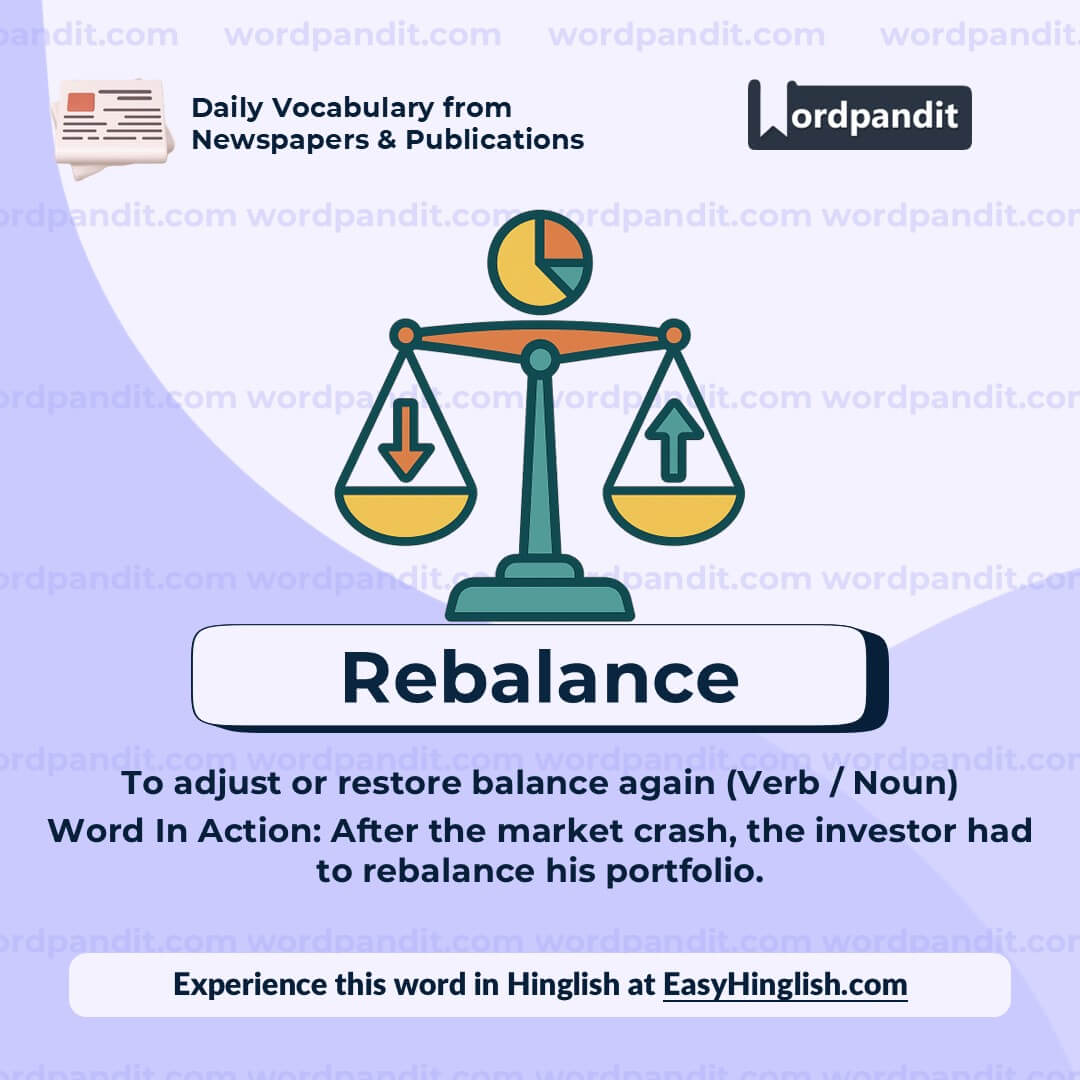
WORD-5: Rebalance
Context:
"The ruling establishments will be facing tough opposition, leading to regime changes that have the potential to influence the power rebalance in the Indo-Pacific region." - Indian Express
Explanatory Paragraph:
The word "rebalance" means to adjust or restore balance after it has shifted or changed. It suggests that conditions have become uneven and need to be corrected. In politics and global relations, "rebalance" often refers to the redistribution of power, influence, or resources among nations. In the given context, it highlights how regime changes could shift the balance of power in the Indo-Pacific region.
Meaning: To adjust or restore balance again (Verb / Noun)
Pronunciation: ree-BAL-uhns
Difficulty Level: ⭐⭐ Beginner to Intermediate
Etymology: From the prefix "re-" (again) + "balance" (from Latin bilanx, meaning "having two scales"). It literally means "to balance again."
Prashant Sir's Notes:
"Rebalance" is commonly used in economics, international relations, and investment. It shows adjustment after disruption. In essays and exams, it can be used to show policy shifts, reallocation of resources, or redistribution of power.
Synonyms & Antonyms:
Synonyms: readjust, realign, restore, redistribute, recalibrate
Antonyms: destabilize, unbalance, disarrange, disorder
Usage Examples:
- The company decided to rebalance its investment portfolio after market fluctuations.
- After a long break, she had to rebalance her routine to include work, health, and family.
- Global warming may force nations to rebalance priorities between development and sustainability.
- The new trade agreements are expected to rebalance economic power in the region.
Cultural Reference:
"In 2011, the United States announced its 'Pivot to Asia' strategy, often described as a power rebalance in the Asia-Pacific." - Cultural Note
Think About It:
Is "rebalancing" in politics a natural cycle of power shifts, or is it always influenced by deliberate strategies and policies?
Quick Activity:
Use "rebalance" in two sentences: one in the context of personal life (e.g., work-life balance) and another in the context of global politics.
Memory Tip:
Break it into "re-" (again) + "balance" (stability). Whenever something becomes uneven, you "rebalance" it to restore order.
Real-World Application:
In finance, investors often rebalance their portfolios by selling assets that have grown too much and buying those that have decreased, ensuring risk and returns remain aligned with their goals. Similarly, governments and global powers rebalance alliances and strategies to maintain influence.


