

Daily Vocabulary from Indian Newspapers and Publications
Welcome to Wordpandit’s Indian Vocabulary Hub
At Wordpandit, we understand the importance of staying rooted in the local context while expanding your language skills. This section focuses on enriching your vocabulary with words and phrases drawn from India’s leading newspapers and publications, ensuring you're learning vocabulary that is practical, relevant, and uniquely Indian.
Why Indian Sources Matter
We believe that the best way to master any language is by immersing yourself in local content. That’s why we carefully curate vocabulary from top Indian publications, including:
- The Hindu
- The Times of India
- The Economic Times
- Hindustan Times
- Live Mint
- The Indian Express
- And many others...
Stay Updated, Stay Relevant
With daily updates from Indian news sources, you’ll be consistently learning words that reflect the trends and shifts in Indian society and culture. Our focus is to provide vocabulary that enhances your understanding of the language in an Indian context.
How Wordpandit Supports Your Goals
Whether you’re preparing for exams, aiming to improve your professional communication, or simply want to stay connected with the latest Indian vocabulary, Wordpandit is here to guide you every step of the way.
Learn with a Practical Approach
Our interactive learning methodology includes real-world examples, engaging activities, and context-specific usage to ensure that every word becomes part of your active vocabulary.
Dive into Indian Vocabulary Today!

Why Choose Wordpandit?
Practical Learning: Focus on words you'll actually encounter in real-world reading, enhancing your comprehension and communication skills.
Diverse Content: From current affairs to scientific breakthroughs, our varied sources expose you to vocabulary across multiple domains.
Effortless Integration: Make Wordpandit a part of your daily routine. Just a few minutes each day can significantly boost your lexicon over time.
Your Path to Vocabulary Mastery
- Visit our Daily Vocabulary section regularly
- Explore new words and their usage in context
- Practice incorporating these words into your own writing and speech
- Track your progress as your vocabulary expands
Start Your Journey Today
Embark on your vocabulary enhancement journey with Wordpandit. By consistently engaging with our daily posts, you'll build a robust vocabulary that serves you well in academic, professional, and personal contexts.
Remember, a word a day keeps linguistic limitations at bay. Make Wordpandit your daily companion in the quest for vocabulary excellence!
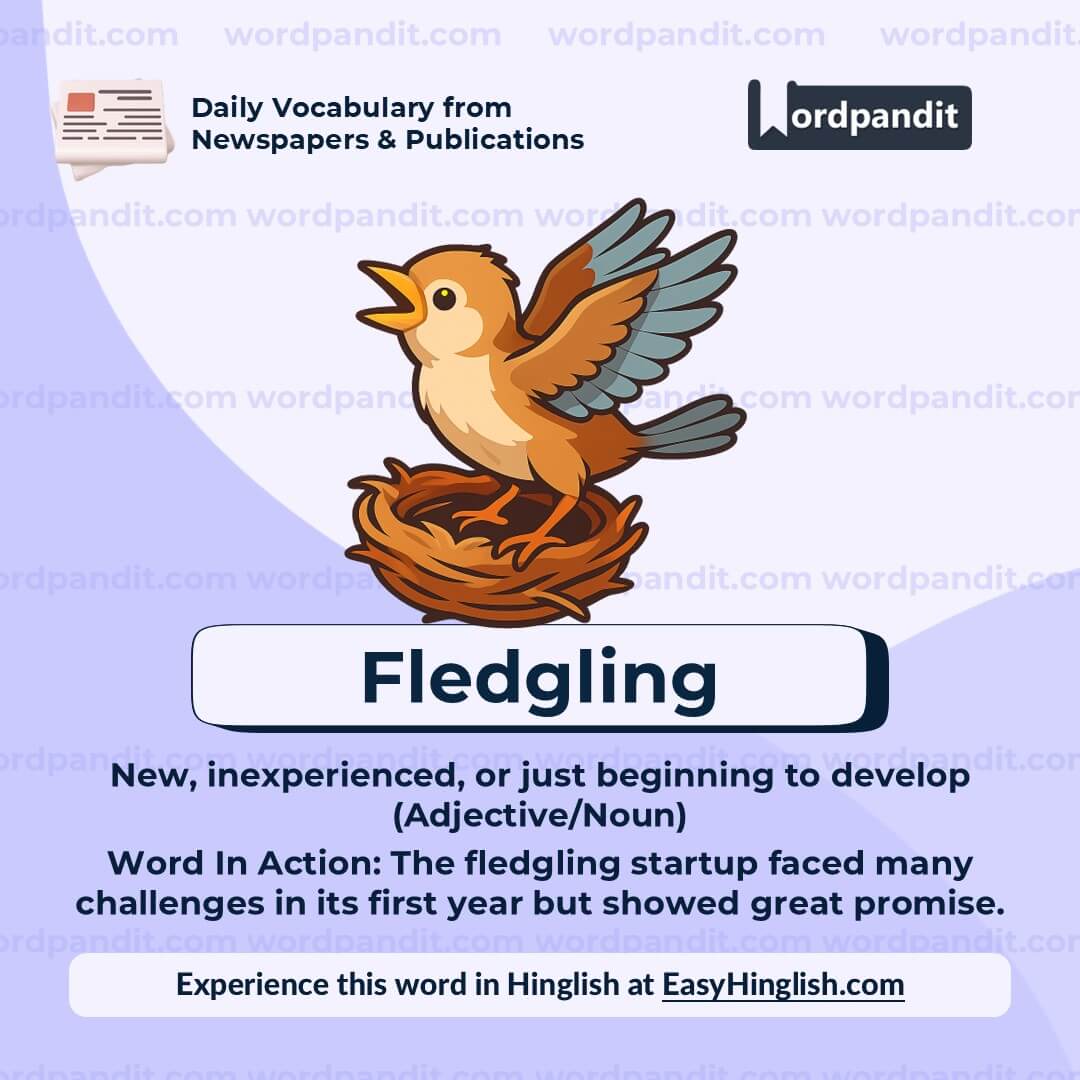
WORD-1: Fledgling
Context:
"His fledgling party polled about 3 percent votes and won four seats." - Hindustan Times
Explanatory Paragraph:
The word "fledgling" is often used to describe something that is just starting out, new, and still developing. It comes from the image of a young bird that has just grown feathers and is learning to fly. When applied to organizations, businesses, or individuals, it emphasizes their early stage of growth and the need for nurturing or experience.
Meaning: New, inexperienced, or just beginning to develop (Adjective/Noun)
Pronunciation: FLEJ-ling
Difficulty Level: ⭐⭐ (Basic-Intermediate)
Etymology: From Old English "flegeling," meaning a young bird that has just acquired its feathers, derived from "fledge" (to grow feathers).
Prashant Sir's Notes:
Remember "fledgling" as a young bird learning to fly. In the same way, when you describe a business, idea, or person as fledgling, you mean they are still in the early stages of growth and not yet mature or experienced.
Synonyms & Antonyms:
Synonyms: emerging, budding, novice, nascent, new
Antonyms: established, mature, experienced, seasoned
Usage Examples:
- The fledgling startup quickly attracted investors with its innovative idea.
- As a fledgling writer, she was still learning how to refine her style.
- The academy supports fledgling artists by giving them platforms to showcase their work.
- Though a fledgling player, his talent on the field was undeniable.
Cultural Reference:
"Every expert was once a fledgling learner, testing uncertain wings." - Adapted from a motivational saying.
Think About It:
Why do you think societies and businesses often underestimate fledgling individuals or groups? Can early inexperience sometimes be an advantage?
Quick Activity:
Write down three examples of fledgling initiatives in your city or country (startups, political parties, cultural movements). How are they growing?
Memory Tip:
Think of a "fledgling bird" trying its first flight. Just like that bird, anything fledgling is just beginning its journey.
Real-World Application:
The word "fledgling" is often used in business and politics to describe new companies, organizations, or movements that are still finding their footing.
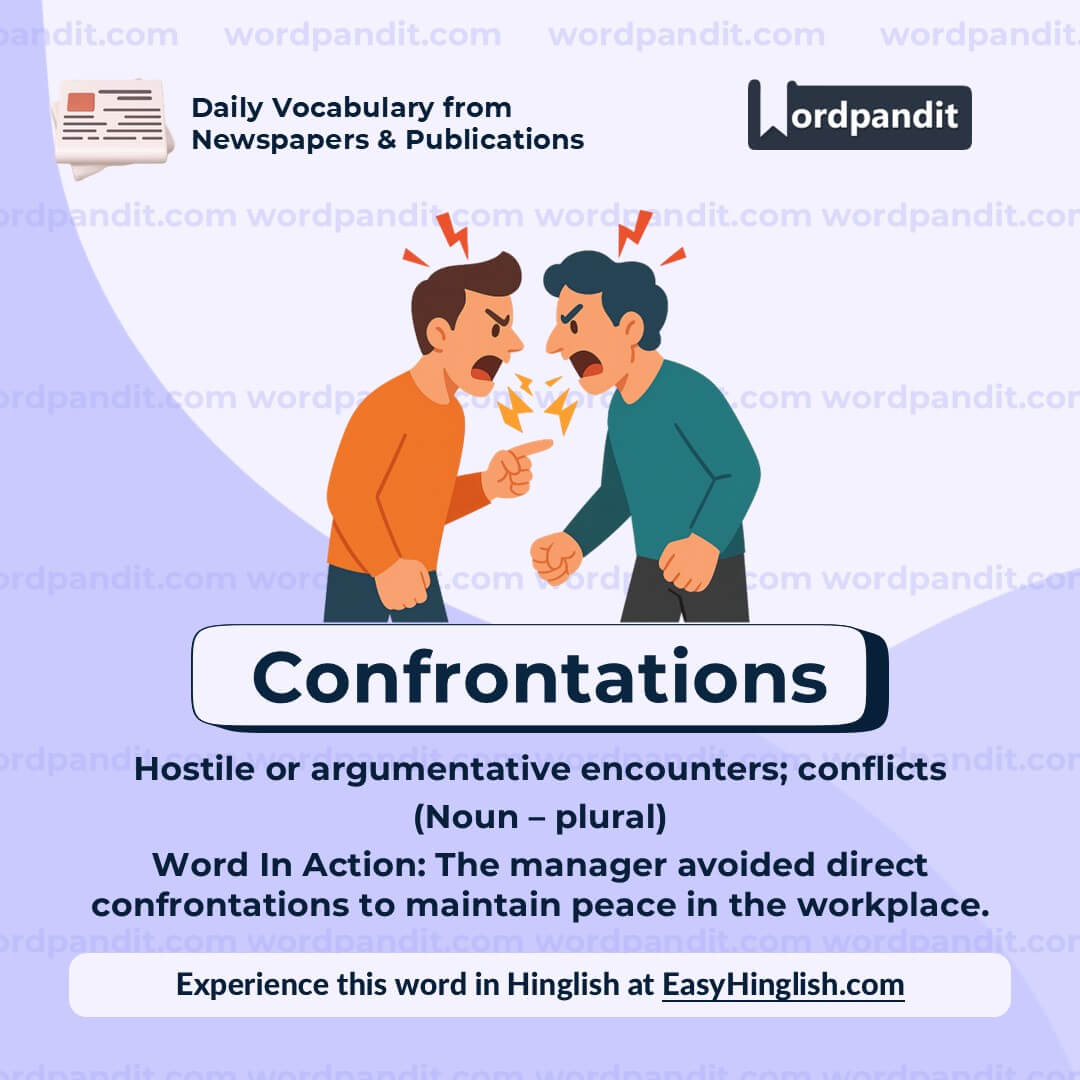
WORD-2: Confrontations
Context:
"The damaged image of the Benjamin Netanyahu government could tie up Israel’s resources in its indirect confrontations with Iran." - Hindustan Times
Explanatory Paragraph:
The word "confrontations" refers to situations where two or more parties face each other in conflict, disagreement, or opposition. It can describe physical clashes, verbal disputes, or even indirect rivalries between nations, groups, or individuals. The word conveys tension and the idea of standing face-to-face against a challenge or opponent.
Meaning: Hostile or argumentative encounters; conflicts (Noun – plural)
Pronunciation: kon-fron-TAY-shuns
Difficulty Level: ⭐⭐ (Basic-Intermediate)
Etymology: From Latin "con-" (together) + "frons" (forehead, face), meaning "to bring face-to-face," later extended to mean conflict or opposition.
Prashant Sir's Notes:
Confrontations are not always physical fights—they can also be ideological or political clashes. Think of two sides "standing face to face" with each other, unwilling to back down.
Synonyms & Antonyms:
Synonyms: clashes, conflicts, disputes, encounters, altercations
Antonyms: agreements, reconciliations, peace, harmony, cooperation
Usage Examples:
- The confrontations between the two rival gangs disrupted the neighborhood’s peace.
- Political debates sometimes turn into heated confrontations between leaders.
- The teacher helped the students resolve their confrontations calmly.
- Repeated confrontations with management led the workers to go on strike.
Cultural Reference:
"History is full of confrontations that shaped nations—sometimes through war, sometimes through dialogue." - Adapted from political commentary.
Think About It:
Do confrontations always have to be negative, or can they sometimes lead to positive change and progress?
Quick Activity:
List two personal confrontations you faced recently (small disagreements or challenges). How did you handle them, and what did you learn?
Memory Tip:
Break it down: "Con" (together) + "front" (face) = face-to-face. So, confrontations are situations where people face each other, often in conflict.
Real-World Application:
The word "confrontations" is frequently used in news reports, especially in politics, diplomacy, labor disputes, and social movements, to describe direct or indirect clashes between groups or nations.
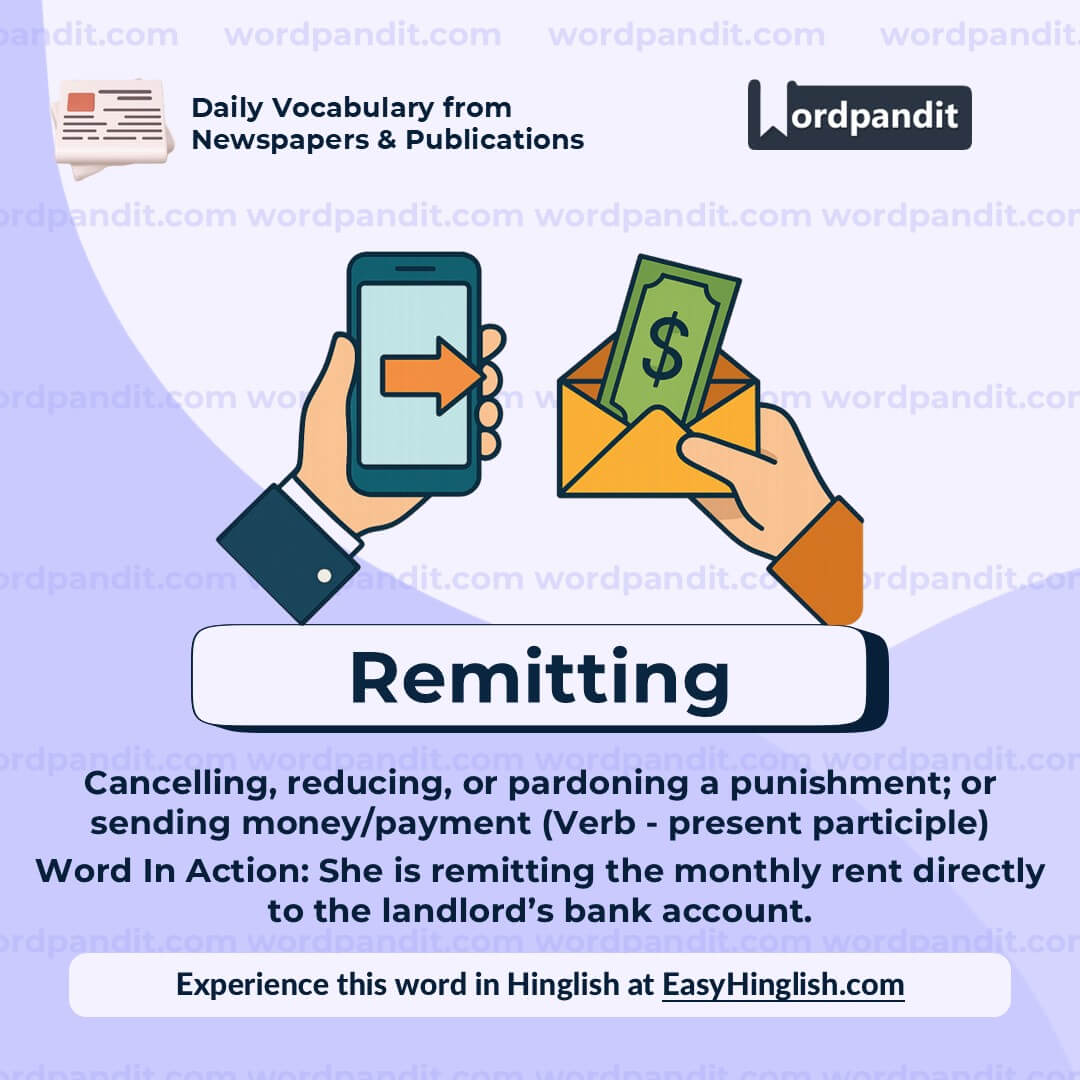
WORD-3: Remitting
Context:
"The government of Gujarat passed an order remitting their sentence, setting them free." - Hindustan Times
Explanatory Paragraph:
The word "remitting" has multiple meanings depending on context. In legal and administrative contexts, as in the given sentence, it means reducing, cancelling, or pardoning a penalty, punishment, or debt. More generally, "remitting" can also mean sending money as payment or transferring funds. The underlying sense is of "sending away" or "releasing" something, whether it is money, punishment, or responsibility.
Meaning: Cancelling, reducing, or pardoning a punishment; or sending money/payment (Verb - present participle)
Pronunciation: ree-MIT-ing
Difficulty Level: ⭐⭐⭐ (Intermediate)
Etymology: From Latin "remittere," meaning "to send back, to relax, to forgive," from "re-" (back) + "mittere" (to send).
Prashant Sir's Notes:
Think of "remit" as either "sending" something (like money) or "sending away" punishment (like reducing a sentence). In legal contexts, it almost always means cancelling or reducing punishment.
Synonyms & Antonyms:
Synonyms: cancel, pardon, forgive, reduce, transmit, transfer
Antonyms: enforce, punish, impose, retain, withhold
Usage Examples:
- The king declared an order remitting the taxes for that year.
- She is remitting money to her family abroad every month.
- The court considered remitting part of his sentence for good behavior.
- By remitting the fine, the committee showed leniency towards first-time offenders.
Cultural Reference:
"Debt remission" has been a major demand in many societies, especially for farmers, where governments remit loans to provide relief.
Think About It:
Should governments have the power to remit sentences? Can such actions strengthen justice, or do they risk weakening the rule of law?
Quick Activity:
Write two sentences: one using "remitting" in the sense of punishment, and another using it in the sense of sending money.
Memory Tip:
Break it down: "Re" (back) + "mit" (send) = send back or send away. So, remitting means either sending money or sending away punishment.
Real-World Application:
"Remitting" is commonly used in legal and governmental contexts when penalties or sentences are reduced. In everyday use, it also appears in banking and finance to describe transferring or sending money.
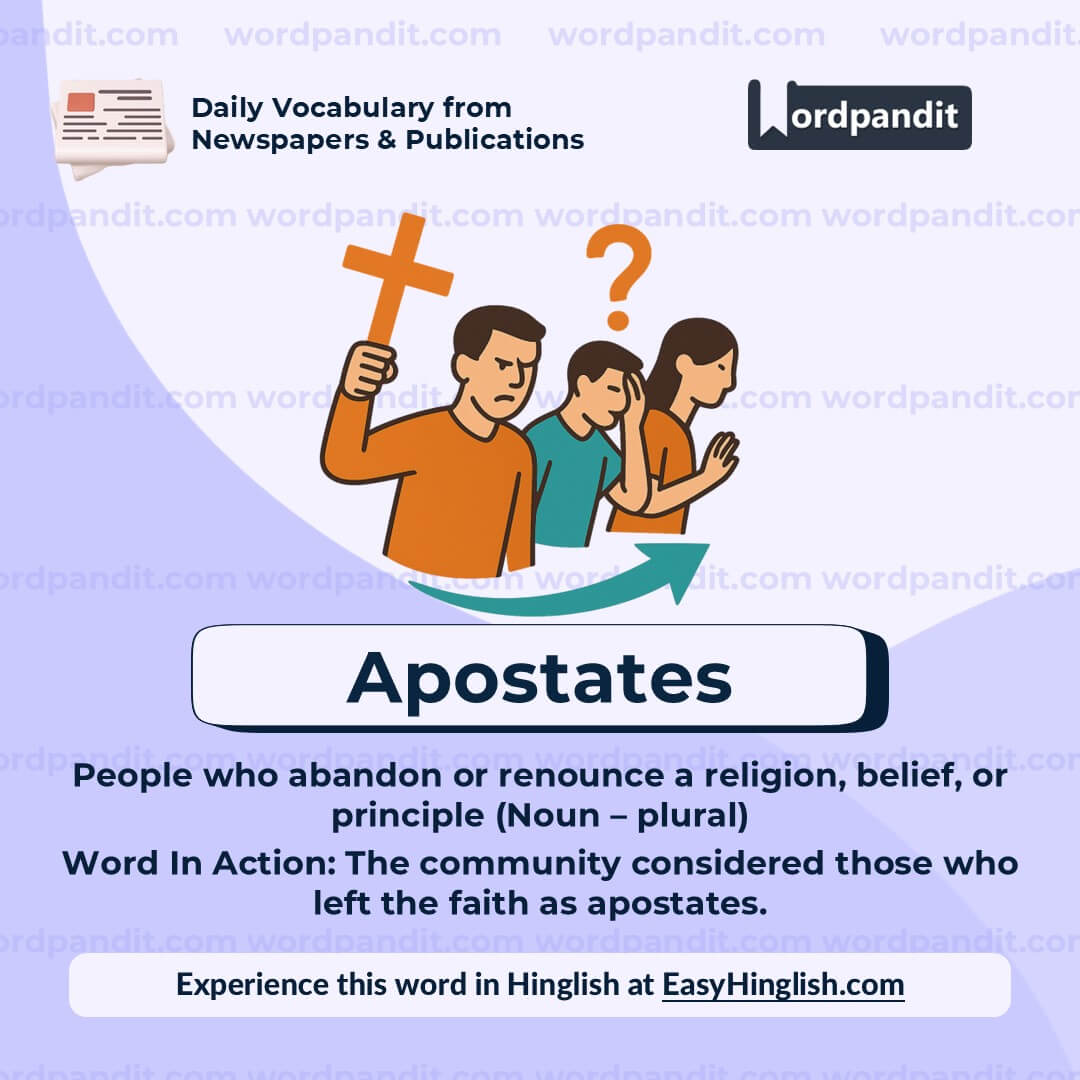
WORD-4: Apostates
Context:
"These groups bore a militant aversion to minority Shia Muslims, considered heretical apostates by Salafi and Sunni orthodoxy." - Hindustan Times
Explanatory Paragraph:
The word "apostates" refers to people who abandon, renounce, or reject a religion, belief system, or cause that they once followed. It is often used in religious contexts to describe those who leave their faith and is sometimes considered a strong, negative term by believers. Beyond religion, it can also refer to anyone who deserts an ideology, group, or set of principles they were once loyal to.
Meaning: People who abandon or renounce a religion, belief, or principle (Noun – plural)
Pronunciation: uh-PAW-stayts
Difficulty Level: ⭐⭐⭐⭐ (Advanced)
Etymology: From Greek "apostasia," meaning "defection, revolt," formed from "apo-" (away from) + "stasis" (standing, position).
Prashant Sir's Notes:
Think of "apostates" as deserters of faith or ideology. The term is heavily loaded in religious debates but can be applied more broadly to anyone who abandons a cause or belief system.
Synonyms & Antonyms:
Synonyms: deserters, defectors, renegades, heretics, nonbelievers
Antonyms: believers, loyalists, adherents, devotees, followers
Usage Examples:
- The regime branded all political defectors as apostates to the national cause.
- Throughout history, apostates from major religions have often faced harsh punishments.
- He was called an apostate after abandoning his lifelong commitment to the party’s ideology.
- Some writers proudly claim the label of apostates for leaving behind rigid belief systems.
Cultural Reference:
"Apostasy" has been a central theme in many historical conflicts, where those labeled as apostates were persecuted for rejecting dominant religious or political ideologies.
Think About It:
Is abandoning a belief system an act of betrayal, or can it be seen as an expression of freedom and personal growth?
Quick Activity:
Write one sentence using "apostates" in a religious sense and another in a political or social sense.
Memory Tip:
Think of "apo-" (away) + "state" (standing/position) = someone who stands away from their original faith or belief system.
Real-World Application:
"Apostates" is often used in political, religious, and cultural contexts to describe those who abandon their original group, sometimes facing hostility or exclusion as a result.
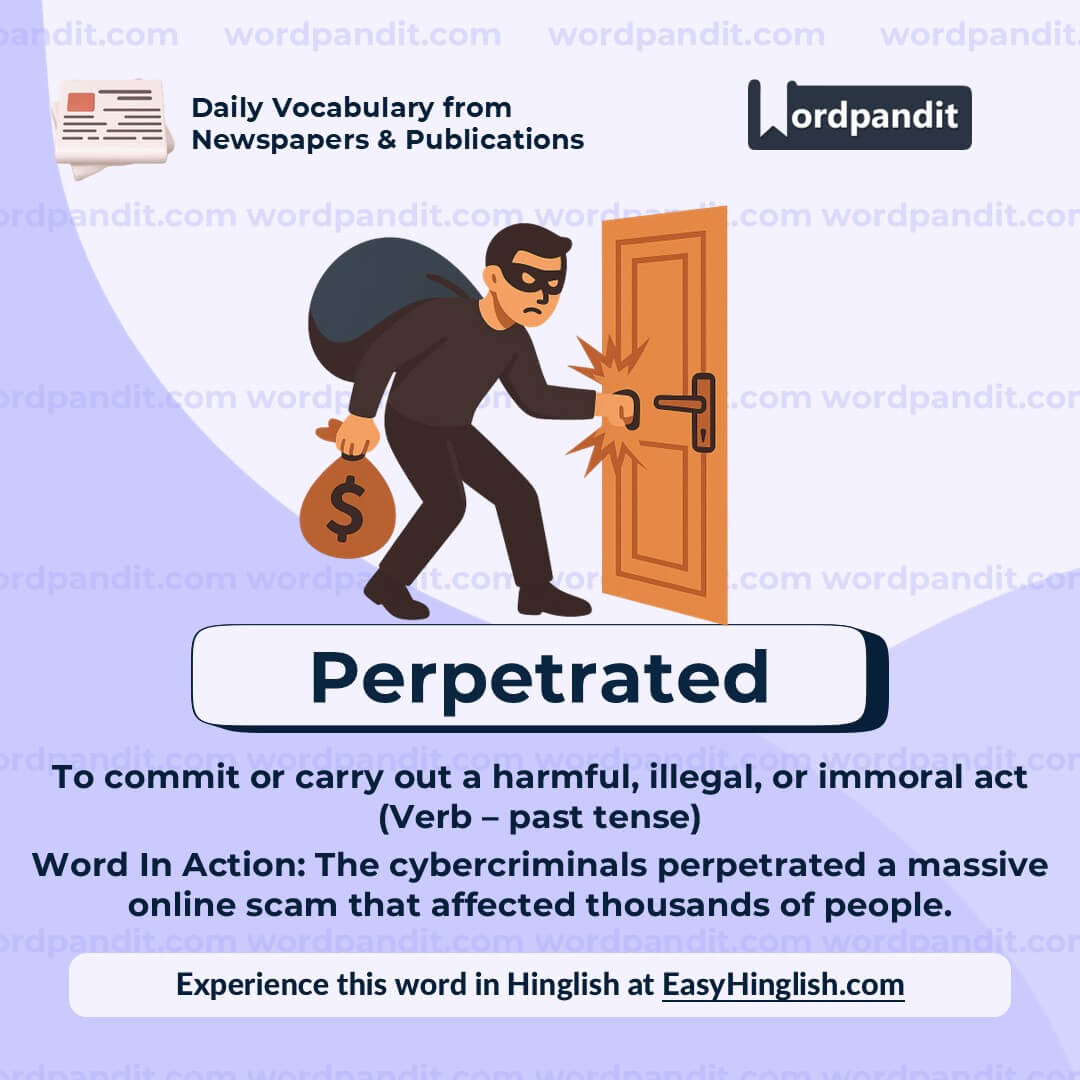
WORD-5: Perpetrated
Context:
"Although Iran-backed forces have perpetrated several crimes against Iraqi Sunnis in the past, IS displayed its sectarian ruthlessness in massacres like that of Camp Speicher in 2014." - Hindustan Times
Explanatory Paragraph:
The word "perpetrated" is used to describe the act of carrying out or committing something harmful, illegal, or morally wrong. It is often applied to crimes, frauds, violence, or injustices. The focus of the word is on the responsibility of the doer in executing a wrongful act.
Meaning: To commit or carry out a harmful, illegal, or immoral act (Verb – past tense)
Pronunciation: PUR-puh-tray-ted
Difficulty Level: ⭐⭐⭐ (Intermediate)
Etymology: From Latin "perpetrare," meaning "to accomplish, to carry out," from "per-" (through) + "patrare" (to bring about, to perform).
Prashant Sir's Notes:
Remember: one never "perpetrates" something good. The word always carries a negative sense—crimes, fraud, violence, or misdeeds are perpetrated.
Synonyms & Antonyms:
Synonyms: committed, carried out, executed, inflicted, orchestrated
Antonyms: prevented, avoided, abstained, stopped
Usage Examples:
- The hackers perpetrated a massive cyberattack on the government servers.
- He was arrested for having perpetrated fraud against dozens of investors.
- The atrocities perpetrated during the war shocked the entire world.
- The film depicts the horrors perpetrated by the regime against its own people.
Cultural Reference:
The phrase "perpetrated a crime" frequently appears in journalism and law enforcement reports, emphasizing accountability for illegal acts.
Think About It:
Do you think the word "perpetrated" shifts focus more on the crime itself or on the responsibility of the person committing it?
Quick Activity:
Write two original sentences using "perpetrated"—one in a legal context and one in a social context.
Memory Tip:
Think: "perpetrator" = the doer of the crime. If there is a perpetrator, then a crime has been perpetrated.
Real-World Application:
"Perpetrated" is widely used in law, journalism, and international relations to describe crimes, violent acts, and serious misconduct attributed to individuals, groups, or even governments.


