

Daily Vocabulary from Indian Newspapers and Publications
Welcome to Wordpandit’s Indian Vocabulary Hub
At Wordpandit, we understand the importance of staying rooted in the local context while expanding your language skills. This section focuses on enriching your vocabulary with words and phrases drawn from India’s leading newspapers and publications, ensuring you're learning vocabulary that is practical, relevant, and uniquely Indian.
Why Indian Sources Matter
We believe that the best way to master any language is by immersing yourself in local content. That’s why we carefully curate vocabulary from top Indian publications, including:
- The Hindu
- The Times of India
- The Economic Times
- Hindustan Times
- Live Mint
- The Indian Express
- And many others...
Stay Updated, Stay Relevant
With daily updates from Indian news sources, you’ll be consistently learning words that reflect the trends and shifts in Indian society and culture. Our focus is to provide vocabulary that enhances your understanding of the language in an Indian context.
How Wordpandit Supports Your Goals
Whether you’re preparing for exams, aiming to improve your professional communication, or simply want to stay connected with the latest Indian vocabulary, Wordpandit is here to guide you every step of the way.
Learn with a Practical Approach
Our interactive learning methodology includes real-world examples, engaging activities, and context-specific usage to ensure that every word becomes part of your active vocabulary.
Dive into Indian Vocabulary Today!

Why Choose Wordpandit?
Practical Learning: Focus on words you'll actually encounter in real-world reading, enhancing your comprehension and communication skills.
Diverse Content: From current affairs to scientific breakthroughs, our varied sources expose you to vocabulary across multiple domains.
Effortless Integration: Make Wordpandit a part of your daily routine. Just a few minutes each day can significantly boost your lexicon over time.
Your Path to Vocabulary Mastery
- Visit our Daily Vocabulary section regularly
- Explore new words and their usage in context
- Practice incorporating these words into your own writing and speech
- Track your progress as your vocabulary expands
Start Your Journey Today
Embark on your vocabulary enhancement journey with Wordpandit. By consistently engaging with our daily posts, you'll build a robust vocabulary that serves you well in academic, professional, and personal contexts.
Remember, a word a day keeps linguistic limitations at bay. Make Wordpandit your daily companion in the quest for vocabulary excellence!
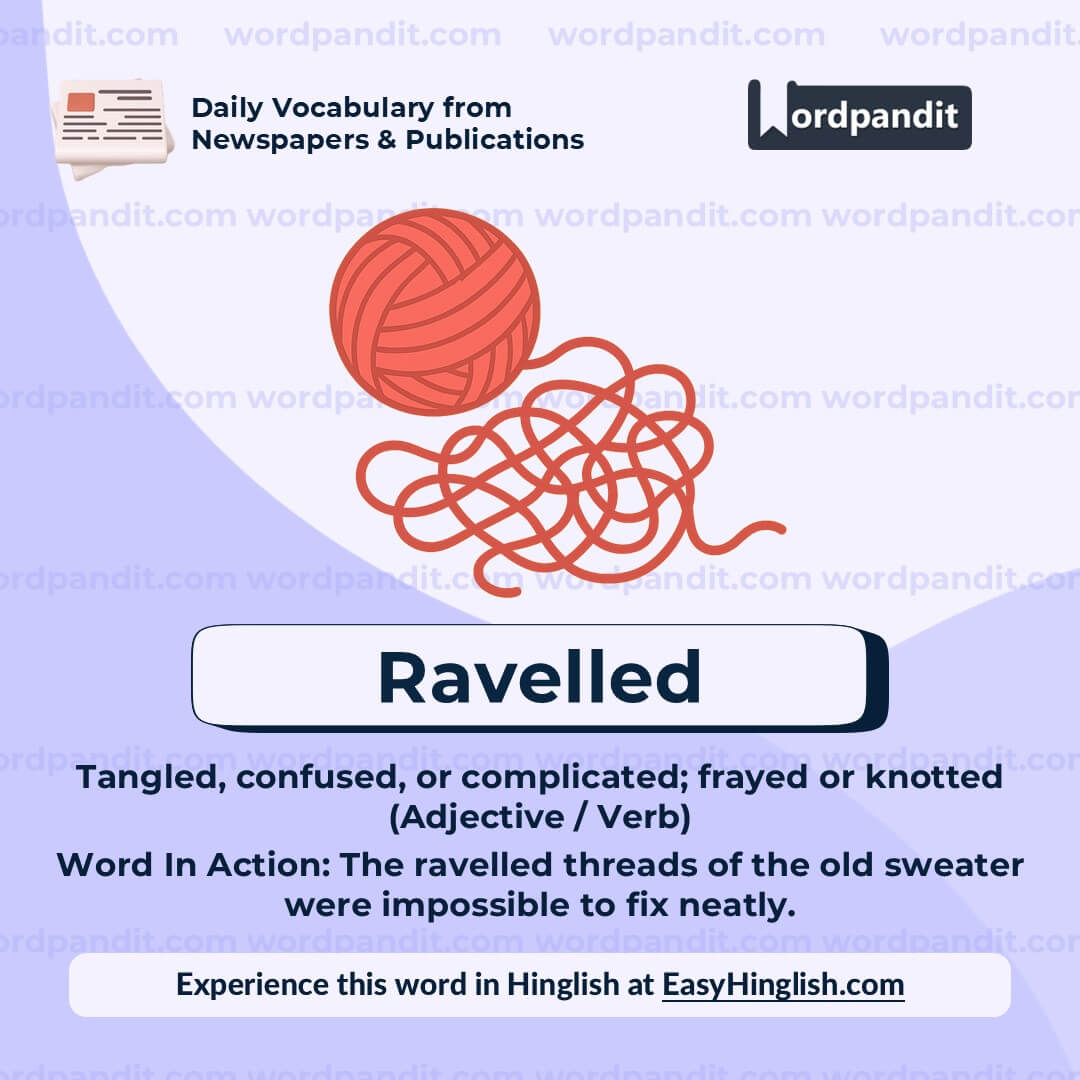
WORD-1: Ravelled
Context:
"Our ravelled sleeve of care gets no stitches from the elusive sleep and we are lucky if our 40 winks settle for 29." - Times of India
Explanatory Paragraph:
The word ravelled generally means tangled, knotted, or confused. It can also imply something that has become complicated or messy, either literally (like threads in a cloth) or figuratively (like emotions, problems, or thoughts). In the given context, it refers to the "sleeve of care" being tangled or messy, symbolizing a troubled or restless state of mind due to lack of sleep.
Meaning: Tangled, confused, or complicated; frayed or knotted (Adjective / Verb)
Pronunciation: RAV-uhld
Difficulty Level: ⭐⭐⭐ Intermediate
Etymology: From Middle Dutch ravelen, meaning "to tangle, fray," which originally referred to the unraveling of threads.
Prashant Sir's Notes:
Think of a ball of wool that gets tangled into knots. That image represents 'ravelled.' In literature, it is often used metaphorically to describe confusion, disorder, or troubled states of mind.
Synonyms & Antonyms:
Synonyms: tangled, knotted, messy, complicated, confused
Antonyms: clear, orderly, smooth, untangled, resolved
Usage Examples:
- Her ravelled thoughts kept her awake long past midnight.
- The ravelled cables under the desk made it difficult to find the right plug.
- The negotiations grew ravelled as more conditions were added to the deal.
- His mind felt ravelled with worries about the upcoming exam.
Cultural Reference:
"Sleep that knits up the ravelled sleeve of care" — William Shakespeare in Macbeth used the metaphor of ravelled fabric to describe how sleep repairs the weariness of life. - Public Domain
Think About It:
Do you think our lives become more “ravelled” because of external challenges, or is it more due to our own internal worries and overthinking?
Quick Activity:
Write a short sentence describing a situation in your own life where things felt "ravelled" and another where they became "unravelled." Notice the difference in tone.
Memory Tip:
Imagine a ball of wool "ravelling" into a messy knot. When you think of ravelled, remember “wool tangled.”
Real-World Application:
Ravelled is often used in literature, poetry, and everyday speech to describe confusion, chaos, or entangled states—whether in relationships, emotions, or even technical problems.
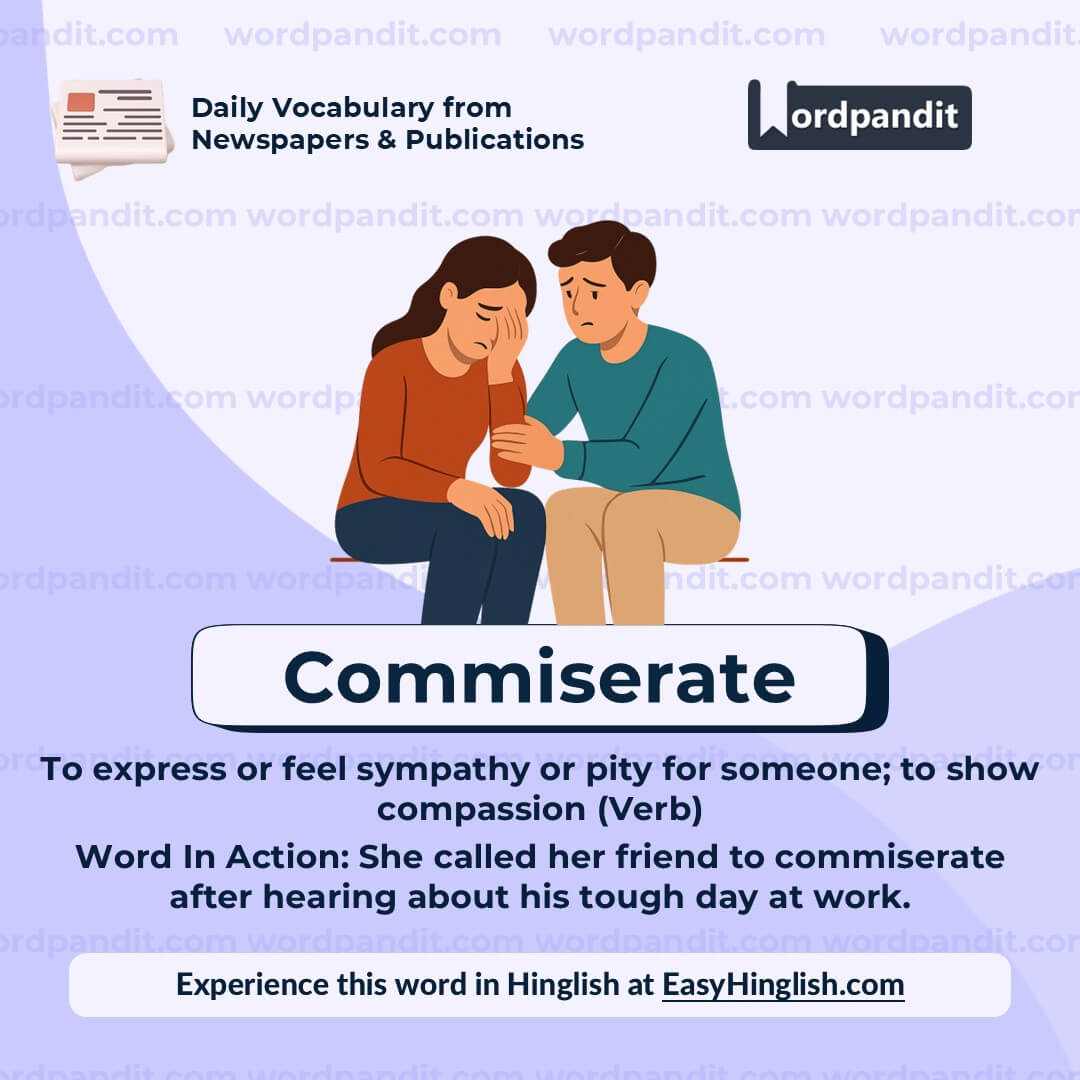
WORD-2: Commiserate
Context:
"We commiserate with others of our ilk. The sleepless are global, not just in Seattle." - Times of India
Explanatory Paragraph:
The word commiserate means to express sympathy or share in someone else’s sorrow, hardship, or misfortune. When we commiserate, we do not solve the problem but we emotionally connect by showing compassion and understanding. In the given context, the writer is highlighting how sleepless people around the world share sympathy and understanding for each other’s plight.
Meaning: To express or feel sympathy or pity for someone; to show compassion (Verb)
Pronunciation: kuh-MIZ-uh-rayt
Difficulty Level: ⭐⭐⭐ Intermediate
Etymology: From Latin commiserari, formed from "com-" (together) + "miserari" (to pity), literally meaning "to pity together."
Prashant Sir's Notes:
Think of commiserate as “co + misery.” When people share their misery together, they are commiserating. The essence is empathy and shared emotion.
Synonyms & Antonyms:
Synonyms: sympathize, console, empathize, pity, comfort
Antonyms: ignore, disregard, scorn, mock
Usage Examples:
- She called to commiserate after hearing about his job loss.
- We commiserated over the tough exam, laughing at our shared mistakes.
- Neighbors commiserated with the family after the storm damaged their house.
- Instead of advice, sometimes all we need is someone to commiserate with.
Cultural Reference:
Support groups for grief or addiction often emphasize the power of commiseration — shared pain that helps individuals feel less alone. This collective empathy forms the basis of healing communities worldwide.
Think About It:
Do you think commiserating with someone actually eases their pain, or does it risk reinforcing their sense of misery?
Quick Activity:
Write two short dialogues: one where a friend simply offers solutions, and another where a friend commiserates. Notice the difference in emotional impact.
Memory Tip:
Break it down as co + misery → sharing misery together = commiserate.
Real-World Application:
Commiserate is commonly used in personal conversations, workplace settings, and social media posts when people express shared struggles, whether about exams, workload, or larger social issues.
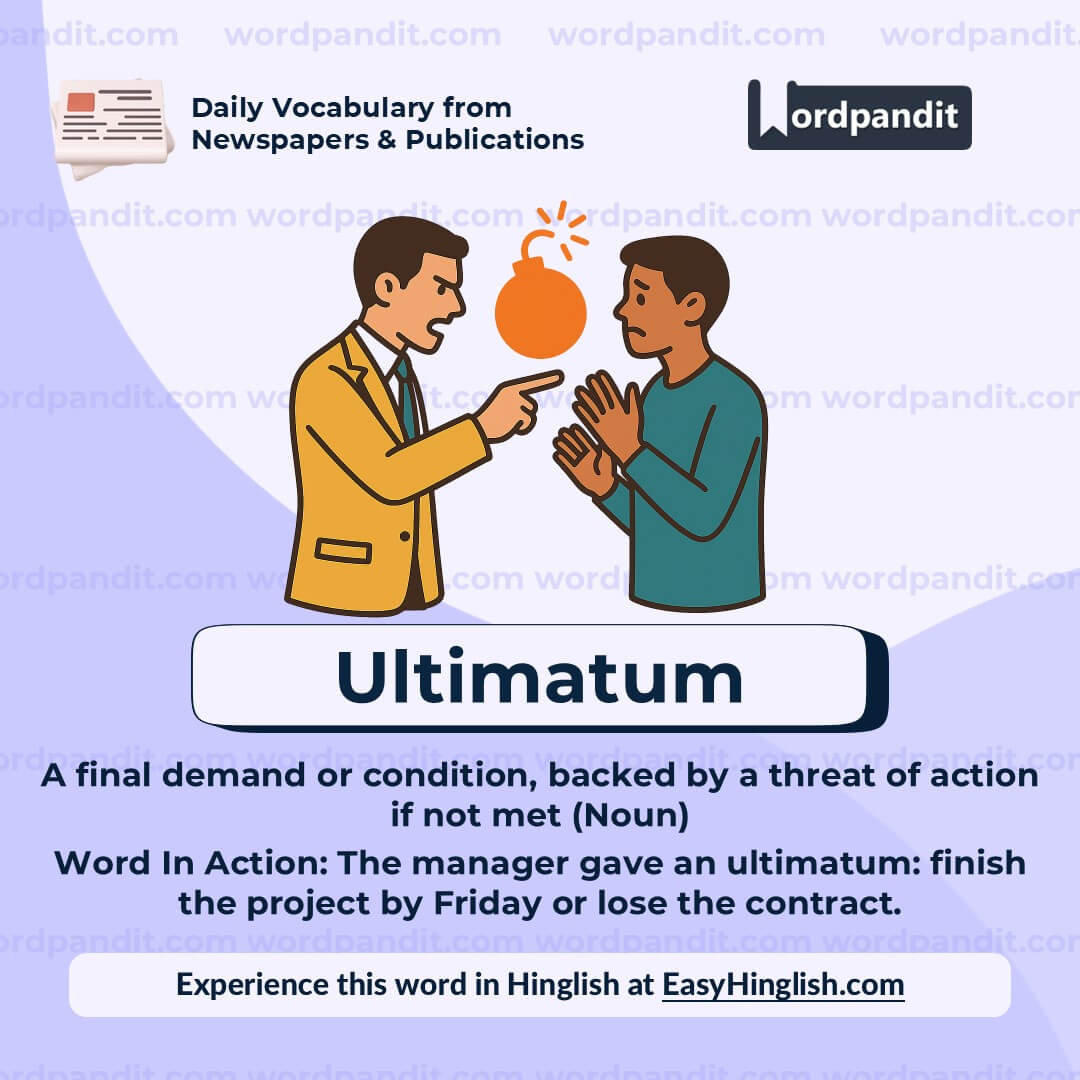
WORD-3: Ultimatum
Context:
"The boat closes in on the merchant vessel, the warship issues an ultimatum to the pirates." - Indian Express
Explanatory Paragraph:
An ultimatum is a final demand or statement of terms, the rejection of which will lead to serious consequences. It is often associated with negotiations, diplomacy, or conflicts, where one party sets strict conditions that must be accepted or else retaliation or action will follow. In the given context, the warship gives the pirates an ultimatum, implying “surrender or face the consequences.”
Meaning: A final demand or condition, backed by a threat of action if not met (Noun)
Pronunciation: uhl-tuh-MAY-tum
Difficulty Level: ⭐⭐⭐ Intermediate
Etymology: From Latin ultimatus, meaning "final, last," derived from ultimus (the farthest or ultimate).
Prashant Sir's Notes:
An ultimatum is not just a demand—it’s the last demand. It comes with consequences if ignored. Remember: it is the point where compromise ends and decision is forced.
Synonyms & Antonyms:
Synonyms: final demand, decree, condition, requirement, last word
Antonyms: request, suggestion, proposal, appeal
Usage Examples:
- The workers issued an ultimatum to the management: improve conditions or face a strike.
- He gave his roommate an ultimatum—clean the room or move out.
- The peace talks collapsed after one side presented a rigid ultimatum.
- Parents sometimes give children ultimatums to encourage discipline, such as “Finish your homework or no screen time.”
Cultural Reference:
In history, Austria-Hungary’s ultimatum to Serbia in 1914 after the assassination of Archduke Franz Ferdinand is often cited as one of the triggers of World War I, showing how ultimatums can escalate conflicts.
Think About It:
Do ultimatums help in resolving conflicts quickly, or do they increase hostility by leaving no room for negotiation?
Quick Activity:
Write down a playful ultimatum you might give to a friend (e.g., “Share your dessert or I won’t tell you the movie spoiler!”). Notice how tone changes the seriousness of an ultimatum.
Memory Tip:
Remember ultimatum as “ultimate + demand” → the last and final demand.
Real-World Application:
Ultimatum is widely used in international diplomacy, workplace disputes, and even personal relationships to describe a final, non-negotiable stance that forces a decision.
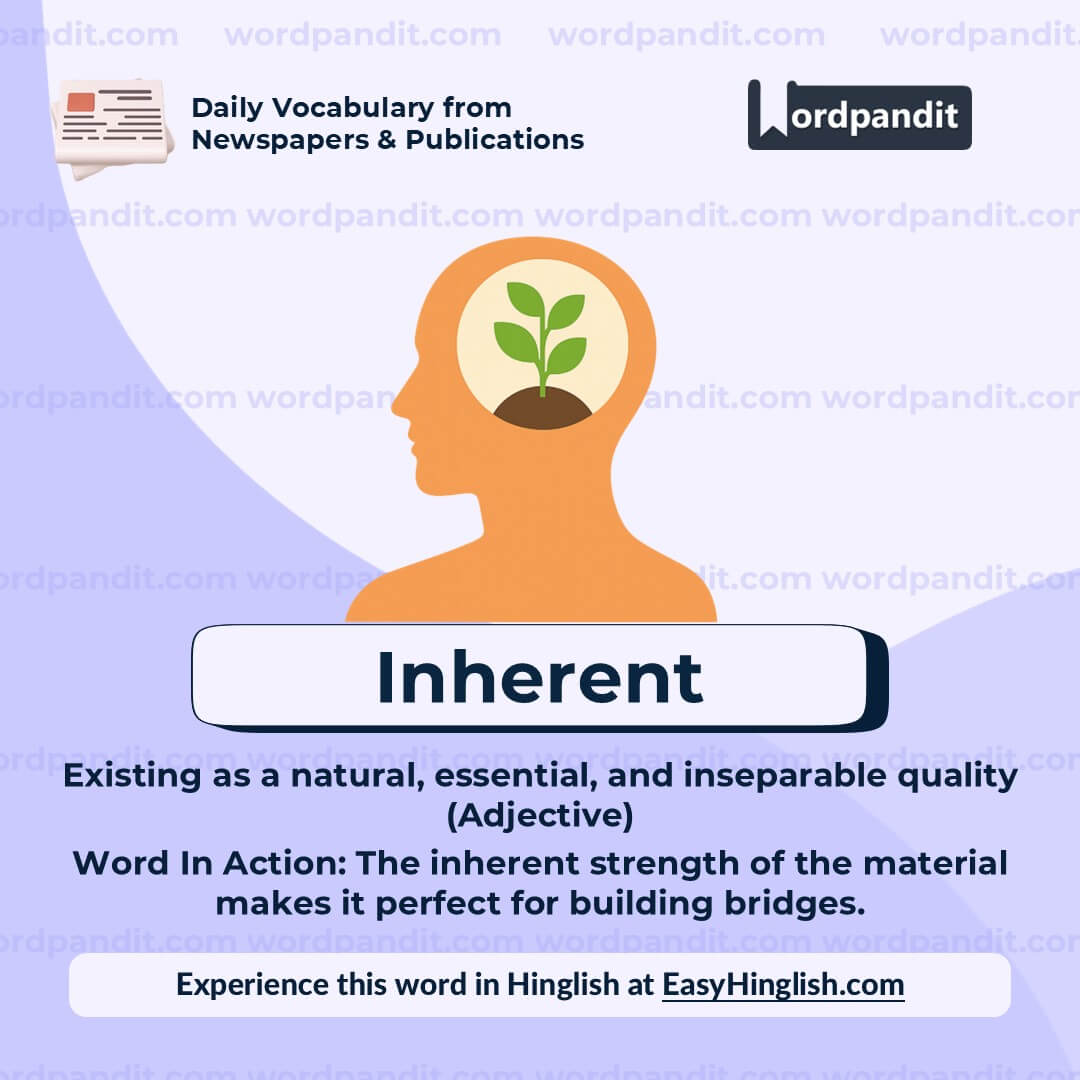
WORD-4: Inherent
Introduction:
"Inherent" ek adjective hai jo kisi cheez ki natural aur permanent quality ko describe karta hai. Jab koi characteristic kisi object, person, ya system ka essential part hoti hai aur usse alag nahi kiya ja sakta, tab hum "inherent" ka use karte hain.
Explanatory Paragraph:
The word inherent describes qualities or traits that are naturally built into something and cannot be separated from it. For example, danger is an inherent part of mountain climbing, just as kindness may be considered an inherent quality in some people. It suggests something that exists permanently and essentially within the subject.
Meaning: Existing as a natural, essential, and inseparable quality (Adjective)
Pronunciation: in-HAIR-ent
Difficulty Level: ⭐⭐ Easy to Intermediate
Etymology: From Latin inhaerentem, meaning "sticking to, resting in," from in- (in) + haerere (to stick, adhere).
Prashant Sir's Notes:
Think of “inherent” as something that lives inside a person or thing and cannot be taken away. Example: Fire’s inherent quality is to burn, water’s inherent quality is to flow.
Synonyms & Antonyms:
Synonyms: innate, intrinsic, essential, built-in, fundamental
Antonyms: external, extrinsic, acquired, added, superficial
Usage Examples:
- The inherent risks of driving fast cannot be ignored.
- Honesty was one of her most inherent qualities.
- There is an inherent beauty in simplicity.
- Conflicts are often inherent in competitive environments.
Cultural Reference:
The concept of "inherent dignity" is central to the Universal Declaration of Human Rights (1948), where it states that all humans are born with inherent dignity and equal rights. - Public Domain
Think About It:
Do you believe qualities like kindness and creativity are inherent in humans, or are they developed through experience and environment?
Quick Activity:
List three things in your life and identify one inherent quality of each (e.g., "A candle – inherent quality: to melt while giving light").
Memory Tip:
Break it down as in + hear → think of a quality that "lives inside and sticks" permanently.
Real-World Application:
Inherent is used in law, philosophy, science, and everyday speech. For example, "inherent rights" in law refer to rights that every human possesses by nature, not granted by authority.
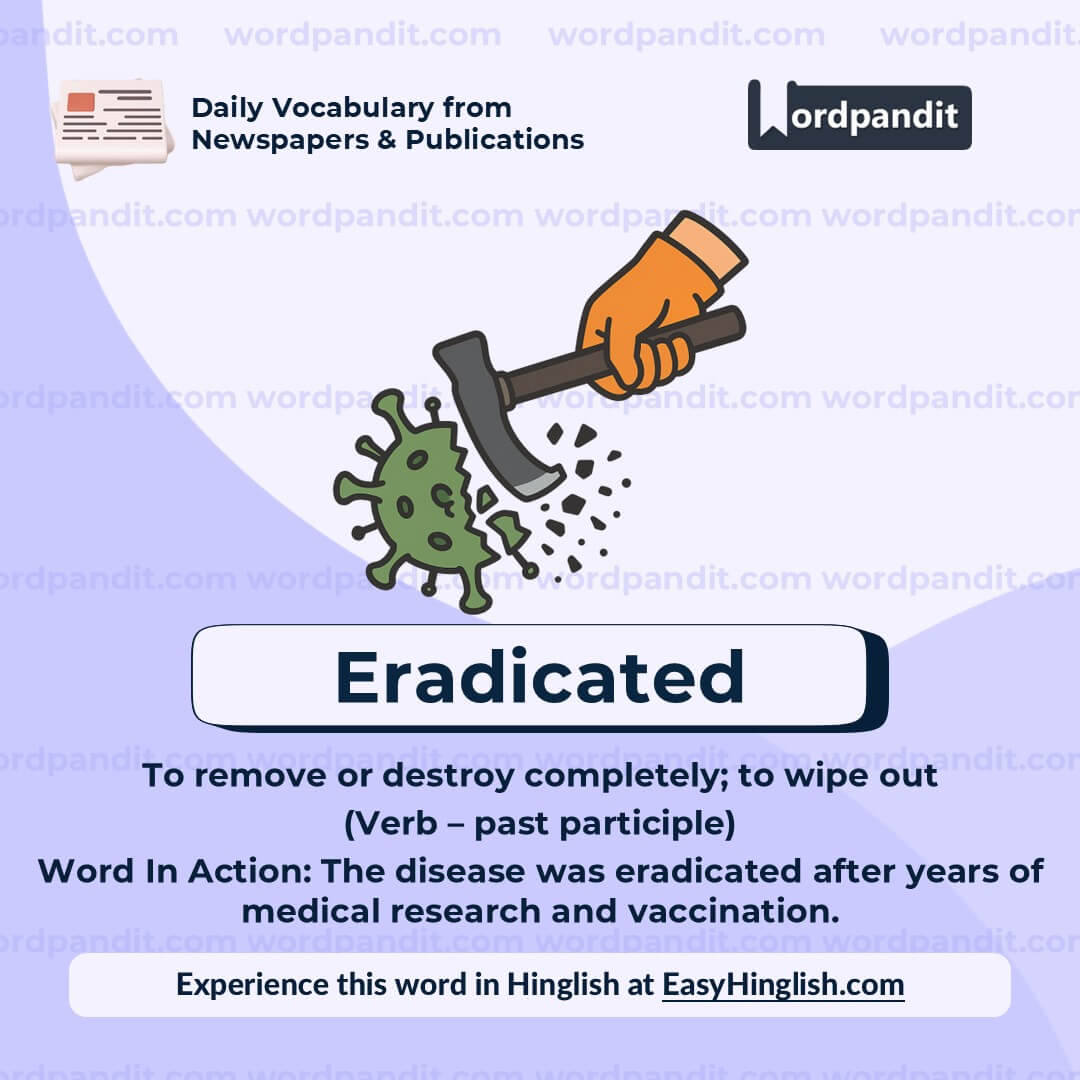
WORD-5: Eradicated
Context:
"The growing frequency of attacks in the Gulf of Aden has called into question their assumption that piracy in Somali waters stands eradicated and is unlikely to recur." - Indian Express
Explanatory Paragraph:
The word eradicated means completely destroyed, eliminated, or wiped out so that it no longer exists. It is often used for diseases, social problems, or unwanted practices. In the given context, it refers to the belief that piracy had been completely removed from Somali waters, a belief now being challenged by new attacks.
Meaning: To remove or destroy completely; to wipe out (Verb – past participle)
Pronunciation: ih-RAD-ih-kay-tid
Difficulty Level: ⭐⭐⭐ Intermediate
Etymology: From Latin eradicatus, past participle of eradicare ("to root out"), from e- (out) + radix (root).
Prashant Sir's Notes:
Think of “eradicate” as pulling out something by its roots so that it cannot grow back. Diseases, corruption, or bad habits are often said to be eradicated when they are completely removed.
Synonyms & Antonyms:
Synonyms: eliminated, destroyed, abolished, exterminated, uprooted
Antonyms: preserved, maintained, sustained, established
Usage Examples:
- Smallpox has been successfully eradicated worldwide.
- The government launched a campaign to eradicate child labor.
- Efforts are being made to eradicate poverty from rural areas.
- Weeds must be eradicated before planting new crops.
Cultural Reference:
In 1980, the World Health Organization (WHO) declared smallpox eradicated — the first disease in history to be completely eliminated through global cooperation. - Public Domain
Think About It:
Do you think problems like corruption or inequality can ever be fully eradicated, or are they simply controlled and minimized?
Quick Activity:
Write down three things you wish could be eradicated from the world (e.g., hunger, pollution, hatred). Why those three?
Memory Tip:
Think of “eradicate” as “erase + root” → completely removing something from its roots.
Real-World Application:
Eradicated is widely used in global health (eradication of diseases), social campaigns (eradication of poverty, illiteracy), and security contexts (eradication of terrorism, piracy).


