

Daily Vocabulary from Indian Newspapers and Publications
Welcome to Wordpandit’s Indian Vocabulary Hub
At Wordpandit, we understand the importance of staying rooted in the local context while expanding your language skills. This section focuses on enriching your vocabulary with words and phrases drawn from India’s leading newspapers and publications, ensuring you're learning vocabulary that is practical, relevant, and uniquely Indian.
Why Indian Sources Matter
We believe that the best way to master any language is by immersing yourself in local content. That’s why we carefully curate vocabulary from top Indian publications, including:
- The Hindu
- The Times of India
- The Economic Times
- Hindustan Times
- Live Mint
- The Indian Express
- And many others...
Stay Updated, Stay Relevant
With daily updates from Indian news sources, you’ll be consistently learning words that reflect the trends and shifts in Indian society and culture. Our focus is to provide vocabulary that enhances your understanding of the language in an Indian context.
How Wordpandit Supports Your Goals
Whether you’re preparing for exams, aiming to improve your professional communication, or simply want to stay connected with the latest Indian vocabulary, Wordpandit is here to guide you every step of the way.
Learn with a Practical Approach
Our interactive learning methodology includes real-world examples, engaging activities, and context-specific usage to ensure that every word becomes part of your active vocabulary.
Dive into Indian Vocabulary Today!

Why Choose Wordpandit?
Practical Learning: Focus on words you'll actually encounter in real-world reading, enhancing your comprehension and communication skills.
Diverse Content: From current affairs to scientific breakthroughs, our varied sources expose you to vocabulary across multiple domains.
Effortless Integration: Make Wordpandit a part of your daily routine. Just a few minutes each day can significantly boost your lexicon over time.
Your Path to Vocabulary Mastery
- Visit our Daily Vocabulary section regularly
- Explore new words and their usage in context
- Practice incorporating these words into your own writing and speech
- Track your progress as your vocabulary expands
Start Your Journey Today
Embark on your vocabulary enhancement journey with Wordpandit. By consistently engaging with our daily posts, you'll build a robust vocabulary that serves you well in academic, professional, and personal contexts.
Remember, a word a day keeps linguistic limitations at bay. Make Wordpandit your daily companion in the quest for vocabulary excellence!
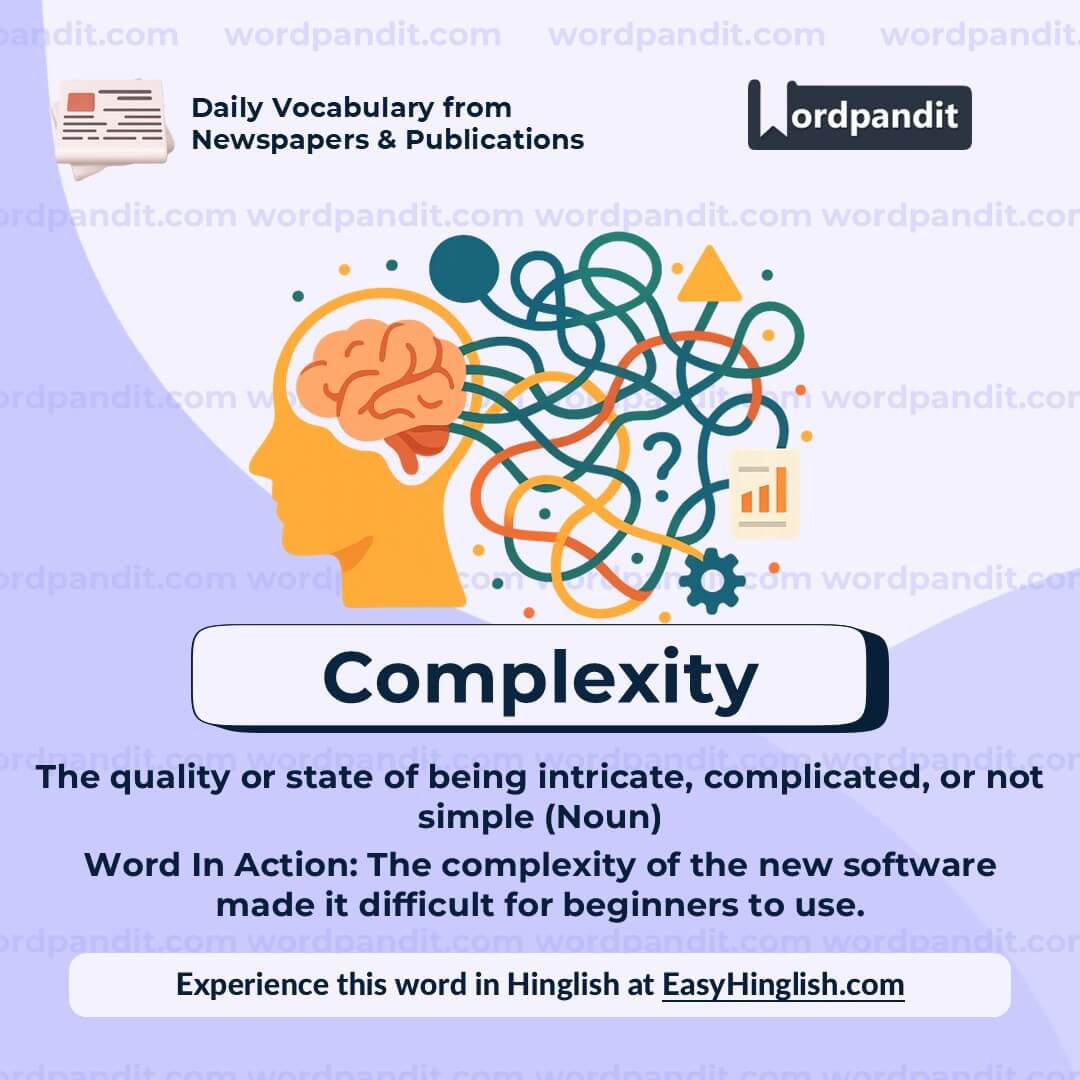
WORD-1: Complexity
Context:
"That does not detract from the complexity of piracy or the reality that no theory fully captures its essence." - Indian Express
Explanatory Paragraph:
The word complexity refers to the state of being complicated or made up of many interconnected parts. Something that has complexity is not easy to understand or solve because it involves layers, relationships, or multiple factors. It often implies depth, intricacy, and the need for careful thought to grasp fully.
Meaning: The quality or state of being intricate, complicated, or not simple (Noun)
Pronunciation: kom-plek-si-tee
Difficulty Level: ⭐⭐ Intermediate
Etymology: From Latin complexus (meaning "embraced, entwined together"), derived from com- (together) + plectere (to braid or weave).
Prashant Sir's Notes:
Think of "complexity" as the opposite of simplicity. Whenever a problem, subject, or idea requires deep understanding and analysis, it is said to have complexity. This word is often used in academics, science, technology, and human behavior studies.
Synonyms & Antonyms:
Synonyms: intricacy, complication, difficulty, sophistication, entanglement
Antonyms: simplicity, clarity, straightforwardness, plainness
Usage Examples:
- The complexity of human emotions makes them hard to predict.
- Scientists admire the complexity of nature’s ecosystems.
- Managing a multinational company requires dealing with legal and cultural complexity.
- The novel impressed readers with the complexity of its characters and plot.
Cultural Reference:
"Complexity is your enemy. Any fool can make something complicated. It is hard to keep things simple." – Richard Branson
Think About It:
Do you think the increasing complexity of technology makes our lives easier or harder in the long run?
Quick Activity:
Write down one area of your life (e.g., studies, relationships, career) and list two reasons why it feels complex. Then, try to think of one way to simplify it.
Memory Tip:
Link "complexity" with "complex." If something is a complex (like a building with many parts), it has complexity—many parts woven together.
Real-World Application:
The word "complexity" is frequently used in business, law, computer science, and philosophy to describe problems or systems that require layered thinking and detailed analysis. For example, project managers often talk about the complexity of a task to highlight the need for careful planning.
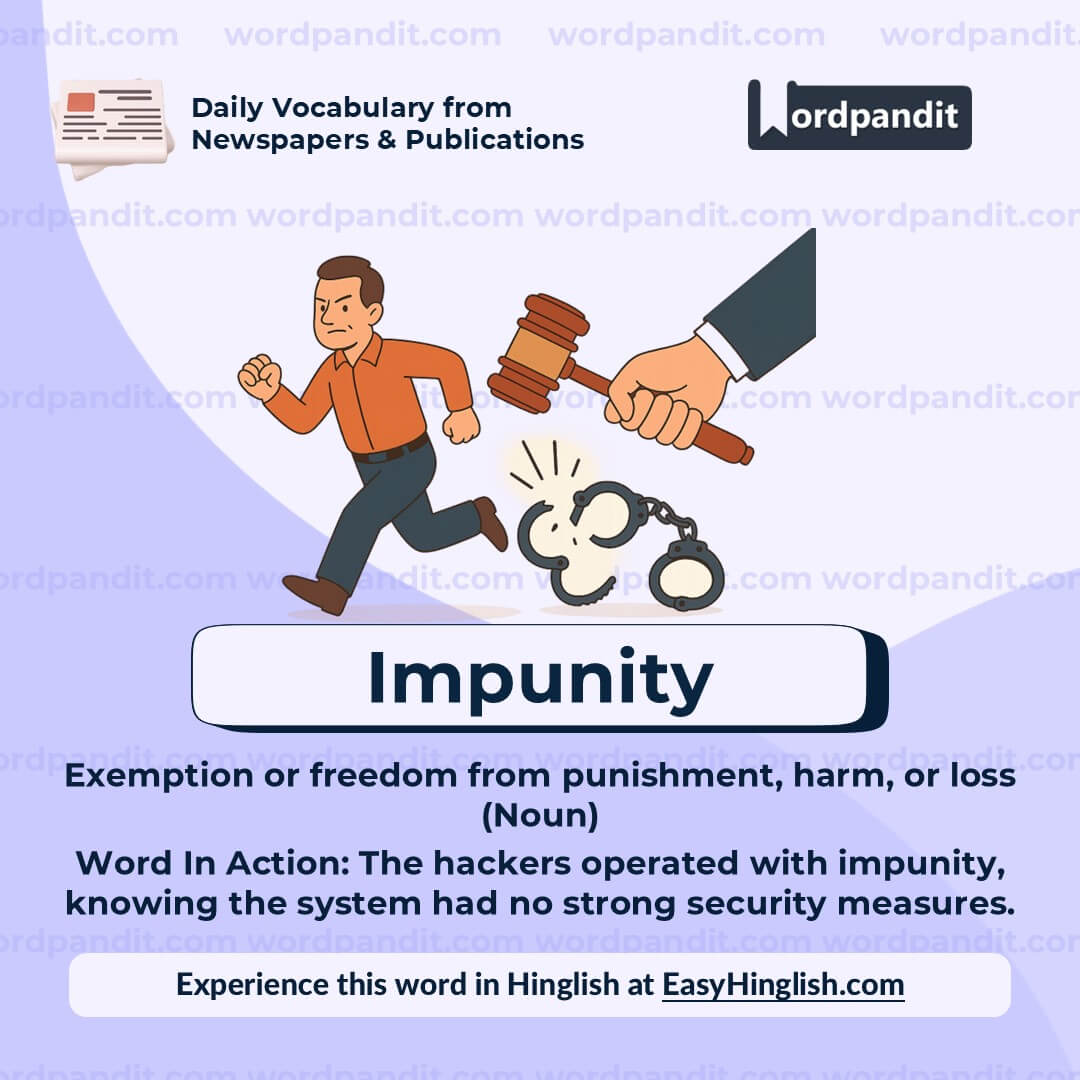
WORD-2: Impunity
Context:
"The lessons of the Bilkis Bano case are that the dignity, liberty, privacy and human rights of citizens are violated with impunity." - Indian Express
Explanatory Paragraph:
The word impunity refers to a situation where someone does something wrong or harmful and faces no punishment or consequences. It highlights a lack of accountability, suggesting that people can act unjustly without fear of legal or moral repercussions. Often, it is used in discussions about law, politics, and human rights.
Meaning: Exemption or freedom from punishment, harm, or loss (Noun)
Pronunciation: im-pyoo-ni-tee
Difficulty Level: ⭐⭐⭐ Advanced
Etymology: From Latin impunitas ("freedom from punishment"), from in- (not) + poena (penalty, punishment).
Prashant Sir's Notes:
Think of "impunity" as breaking rules without facing any consequences. In governance and law, it highlights injustice when wrongdoers are protected or not punished.
Synonyms & Antonyms:
Synonyms: exemption, immunity, freedom, license, privilege
Antonyms: accountability, liability, responsibility, punishment
Usage Examples:
- The dictator ruled with impunity, silencing anyone who opposed him.
- Cybercriminals often operate across borders with impunity due to weak international laws.
- Corruption flourishes when officials act with impunity.
- No society can thrive if crimes are committed with impunity.
Cultural Reference:
"When crimes are committed with impunity, justice itself is put on trial." – A reflection often cited in human rights discussions.
Think About It:
Do you think people in positions of power are more likely to act with impunity? Why or why not?
Quick Activity:
Write a short paragraph on a situation (real or imagined) where someone acted with impunity, and then rewrite it imagining they were held accountable. Notice the contrast.
Memory Tip:
Remember that "impunity" sounds like "immunity." Just as immunity protects you from disease, impunity protects wrongdoers from punishment.
Real-World Application:
The term "impunity" is widely used in legal, political, and social justice contexts. For example, international organizations like the UN often highlight impunity in cases of war crimes, corruption, and human rights abuses, calling for accountability.
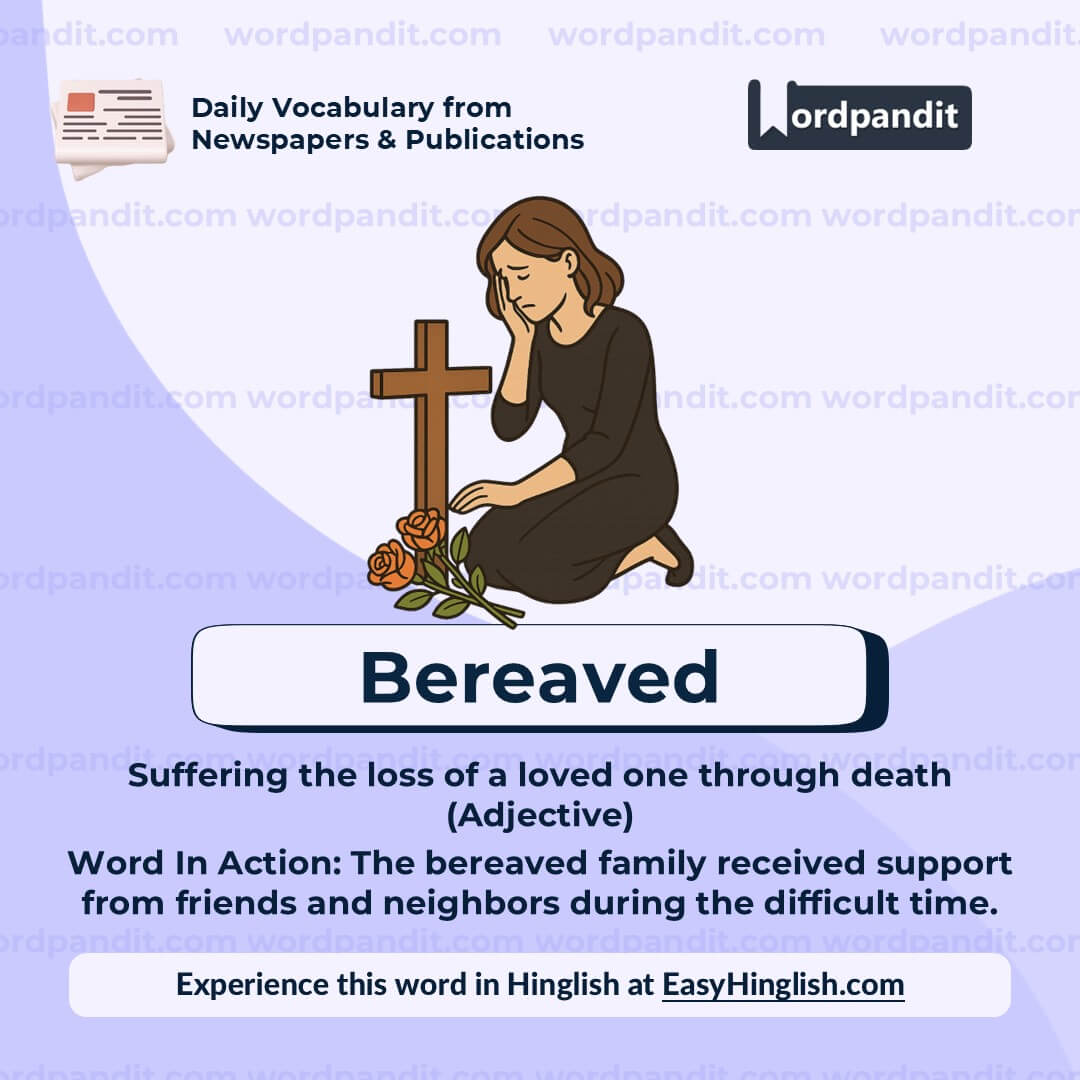
WORD-3: Bereaved
Context:
"None could have poured out the anguish of a human better than an abused, violated and bereaved mother by name Bilkis Bano." - Indian Express
Explanatory Paragraph:
The word bereaved describes a person who has lost a loved one through death. It emphasizes the deep sense of grief, sorrow, and emptiness that follows such a loss. When someone is bereaved, they are not just sad but are experiencing a profound emotional wound caused by the absence of a family member or close companion.
Meaning: Suffering the loss of a loved one through death (Adjective)
Pronunciation: bih-reevd
Difficulty Level: ⭐⭐ Intermediate
Etymology: From Old English bereafian, meaning "to deprive, to take away," from be- (completely) + reave (to rob).
Prashant Sir's Notes:
Whenever you see the word "bereaved," think of someone robbed of a loved one by death. It is a sensitive and emotional word often used in the context of condolences or human tragedy.
Synonyms & Antonyms:
Synonyms: grieving, mourning, sorrowful, heartbroken, lamenting
Antonyms: joyful, comforted, consoled, rejoicing
Usage Examples:
- The bereaved family gathered to perform the last rites.
- She offered words of comfort to her bereaved friend.
- The organization provides counseling to bereaved parents.
- Communities often come together to support the bereaved in times of tragedy.
Cultural Reference:
In many cultures, rituals and traditions are built around helping the bereaved cope with grief, such as the Indian practice of "shraddha" or the Irish tradition of a "wake."
Think About It:
Why do you think communities create rituals and ceremonies around death to support the bereaved? Do such traditions ease grief?
Quick Activity:
Write a short condolence message using the word "bereaved" as if you are addressing someone who has lost a loved one.
Memory Tip:
Think of "bereaved" as someone "robbed" by death. The connection with "reave" (to take away) can help you remember the meaning.
Real-World Application:
The word "bereaved" is often used in formal writing, obituaries, condolence messages, and counseling services. For example, many support groups are called "bereavement groups," providing help to people dealing with loss.
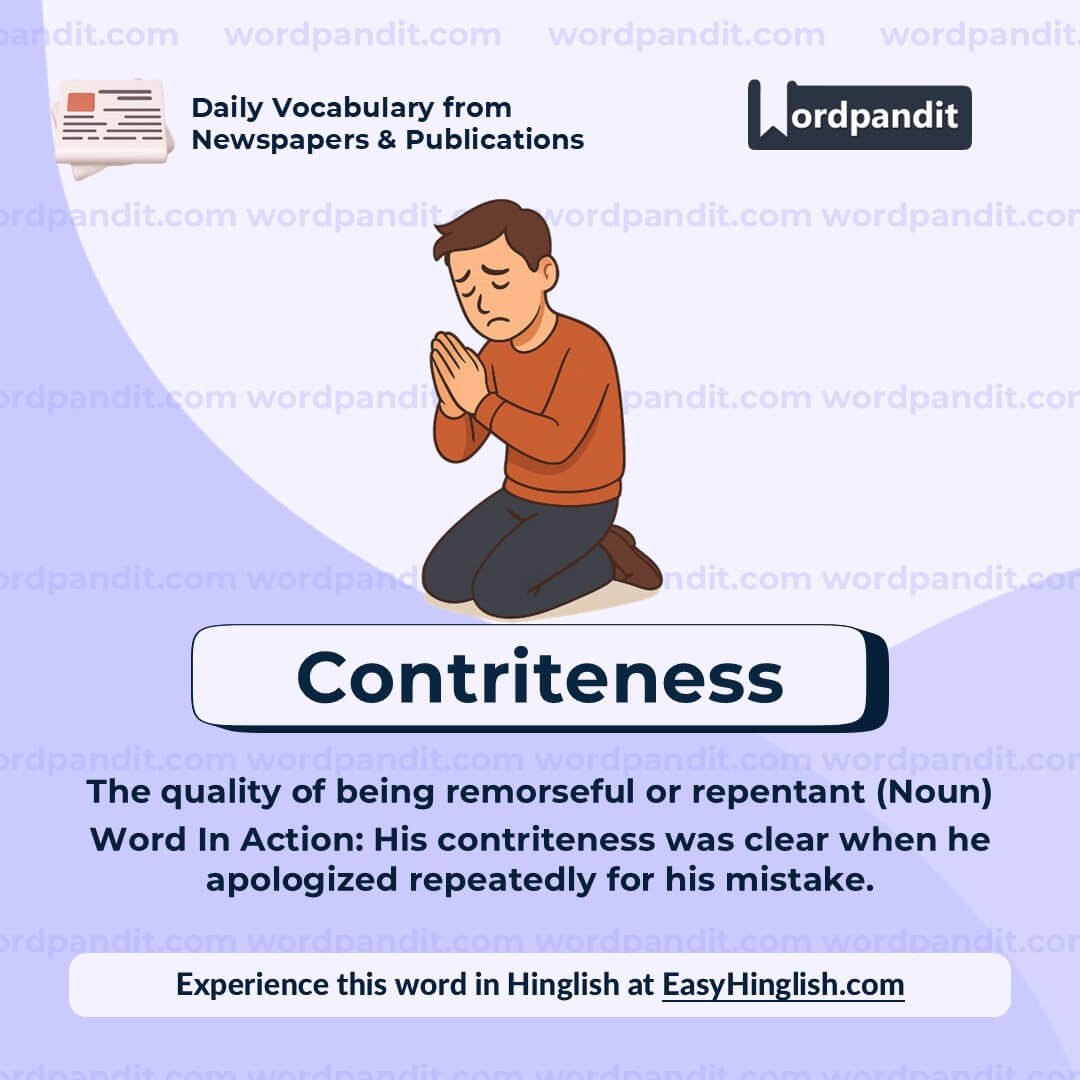
WORD-4: Contriteness
Context:
"The released convicts did not show any contriteness; nor did they walk into the sunset." - Indian Express
Explanatory Paragraph:
The word contriteness refers to the state of being genuinely sorry or remorseful for having done something wrong. When someone shows contriteness, they express deep regret and a desire to make amends for their actions. It comes from the idea of a "penitent heart" — recognizing a mistake and feeling sincere guilt.
Meaning: The quality of being remorseful or repentant (Noun)
Pronunciation: kon-tryte-ness
Difficulty Level: ⭐⭐⭐ Advanced
Etymology: From Latin contritus ("worn down, crushed"), figuratively used to mean a "crushed spirit" due to guilt or remorse.
Prashant Sir's Notes:
"Contriteness" is closely linked to moral regret. A person who acknowledges their wrongdoing with humility shows contriteness. Lack of contriteness often signals arrogance or denial of guilt.
Synonyms & Antonyms:
Synonyms: remorse, penitence, regret, repentance, sorrow
Antonyms: indifference, shamelessness, arrogance, defiance
Usage Examples:
- Her contriteness was evident when she apologized with tears in her eyes.
- The judge reduced his sentence after seeing his contriteness and willingness to reform.
- True contriteness goes beyond words; it is reflected in changed behavior.
- The lack of contriteness among the offenders shocked the community.
Cultural Reference:
In many religions, such as Christianity and Hinduism, contriteness is seen as the first step toward forgiveness and redemption, where the sinner acknowledges their wrongs before seeking absolution.
Think About It:
Do you think showing contriteness is enough to regain trust, or must actions always follow words of remorse?
Quick Activity:
Write two sentences: one showing a character expressing contriteness after a mistake, and another showing a character refusing to admit any guilt.
Memory Tip:
Think of "contrite" as "crushed by guilt." From that image, you can easily remember that contriteness means a genuine feeling of remorse.
Real-World Application:
The word "contriteness" is often used in legal, political, and religious settings to describe whether individuals show genuine regret. For example, a politician’s public apology may be judged on whether it shows real contriteness or just empty words.
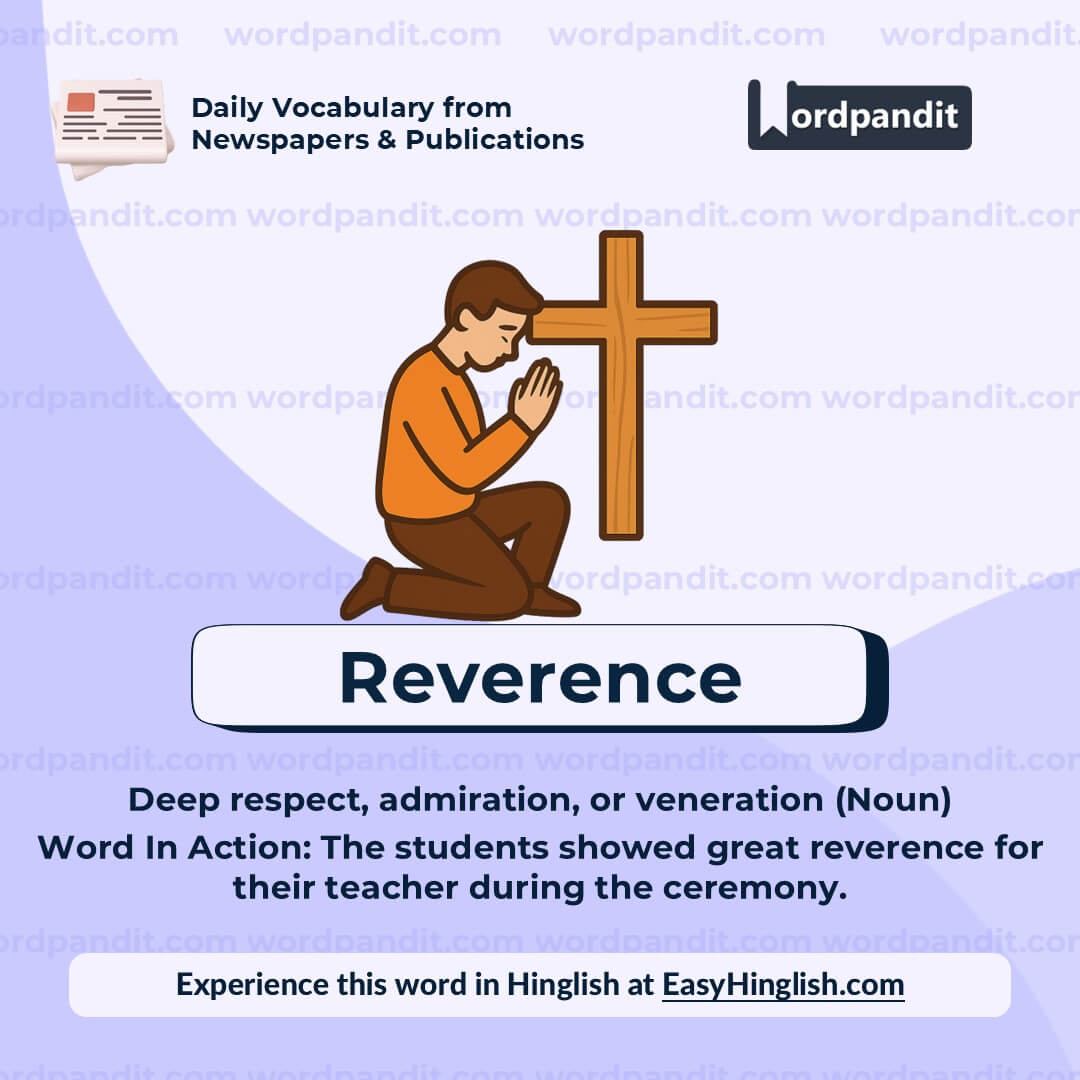
WORD-5: Reverence
Context:
"They were welcomed and feted with garlands and sweets. Some in the welcoming party touched their feet, showing reverence." - Indian Express
Explanatory Paragraph:
The word reverence refers to a deep sense of respect, admiration, or awe towards someone or something. It often goes beyond ordinary respect, carrying a feeling of honor or sacred regard. Reverence can be shown in religious worship, cultural traditions, or even in the way we treat elders, mentors, or ideals we hold dear.
Meaning: Deep respect, admiration, or veneration (Noun)
Pronunciation: rev-er-ens
Difficulty Level: ⭐⭐ Intermediate
Etymology: From Latin reverentia ("awe, respect"), from revereri ("to stand in awe of").
Prashant Sir's Notes:
"Reverence" is not just respect—it carries a spiritual or elevated quality. For example, touching elders' feet in India or bowing in Japan reflects reverence, not just ordinary politeness.
Synonyms & Antonyms:
Synonyms: veneration, admiration, honor, deference, worship
Antonyms: disrespect, disdain, contempt, irreverence
Usage Examples:
- The monk was treated with reverence by the villagers.
- Students often show reverence to teachers by standing up when they enter the room.
- She spoke of her late grandmother with deep reverence.
- In many cultures, nature is treated with reverence as a sacred force.
Cultural Reference:
In Indian tradition, bowing down to touch the feet of elders is a gesture of reverence, symbolizing humility and respect. Similarly, in Japan, bowing is a cultural act of reverence.
Think About It:
Do you think reverence should always be tied to tradition, or can it also be shown toward modern ideas, such as science or freedom?
Quick Activity:
Write three things or people you hold in reverence. Then, describe how you express that reverence in your daily life.
Memory Tip:
Think of "reverence" as "revere." If you revere someone, you hold them in reverence—deep respect and admiration.
Real-World Application:
"Reverence" is commonly used in religious, cultural, and formal contexts. For example, military personnel may salute their leaders in reverence, or citizens may stand in silence during the national anthem as a sign of reverence for their country.


