

Daily Vocabulary from Indian Newspapers and Publications
Welcome to Wordpandit’s Indian Vocabulary Hub
At Wordpandit, we understand the importance of staying rooted in the local context while expanding your language skills. This section focuses on enriching your vocabulary with words and phrases drawn from India’s leading newspapers and publications, ensuring you're learning vocabulary that is practical, relevant, and uniquely Indian.
Why Indian Sources Matter
We believe that the best way to master any language is by immersing yourself in local content. That’s why we carefully curate vocabulary from top Indian publications, including:
- The Hindu
- The Times of India
- The Economic Times
- Hindustan Times
- Live Mint
- The Indian Express
- And many others...
Stay Updated, Stay Relevant
With daily updates from Indian news sources, you’ll be consistently learning words that reflect the trends and shifts in Indian society and culture. Our focus is to provide vocabulary that enhances your understanding of the language in an Indian context.
How Wordpandit Supports Your Goals
Whether you’re preparing for exams, aiming to improve your professional communication, or simply want to stay connected with the latest Indian vocabulary, Wordpandit is here to guide you every step of the way.
Learn with a Practical Approach
Our interactive learning methodology includes real-world examples, engaging activities, and context-specific usage to ensure that every word becomes part of your active vocabulary.
Dive into Indian Vocabulary Today!

Why Choose Wordpandit?
Practical Learning: Focus on words you'll actually encounter in real-world reading, enhancing your comprehension and communication skills.
Diverse Content: From current affairs to scientific breakthroughs, our varied sources expose you to vocabulary across multiple domains.
Effortless Integration: Make Wordpandit a part of your daily routine. Just a few minutes each day can significantly boost your lexicon over time.
Your Path to Vocabulary Mastery
- Visit our Daily Vocabulary section regularly
- Explore new words and their usage in context
- Practice incorporating these words into your own writing and speech
- Track your progress as your vocabulary expands
Start Your Journey Today
Embark on your vocabulary enhancement journey with Wordpandit. By consistently engaging with our daily posts, you'll build a robust vocabulary that serves you well in academic, professional, and personal contexts.
Remember, a word a day keeps linguistic limitations at bay. Make Wordpandit your daily companion in the quest for vocabulary excellence!

WORD-1: Wandering
Context:
"If he was bent on wandering off again just before a general election, then he should have had the political sense to begin the yatra in Ayodhya so that he could have stolen some of Narendra Modi’s thunder." - Indian Express
Explanatory Paragraph:
The word wandering refers to moving about without a fixed course, purpose, or destination. It can describe physical movement—such as traveling aimlessly—or even mental movement, when thoughts drift without focus. In the given context, it conveys the idea of someone straying or diverting from a fixed political path or agenda.
Meaning: Moving or traveling aimlessly without a fixed destination (Verb/Adjective)
Pronunciation: WAHN-dur-ing
Difficulty Level: ⭐⭐ Basic-Intermediate
Etymology: From Old English wandrian meaning "move about, roam," related to the word wind (to turn or twist).
Prashant Sir's Notes:
This word is useful both literally (for travel and movement) and figuratively (for thoughts, emotions, or choices). Remember that wandering often implies a lack of fixed aim or direction, which can be positive (exploration) or negative (distraction).
Synonyms & Antonyms:
Synonyms: roaming, drifting, meandering, straying, rambling
Antonyms: focused, settled, purposeful, directed, rooted
Usage Examples:
- She spent the afternoon wandering through the old city’s narrow streets.
- His wandering mind made it hard for him to concentrate on the lecture.
- The wandering nomads moved with the seasons in search of pasture.
- During the meeting, her thoughts kept wandering to her weekend plans.
Cultural Reference:
"Not all those who wander are lost," wrote J.R.R. Tolkien in *The Lord of the Rings*, reminding us that wandering can symbolize exploration and discovery, not just aimlessness.
Think About It:
Is wandering always a sign of distraction, or can it sometimes be the source of creativity and self-discovery?
Quick Activity:
Write two sentences with the word wandering: one showing it in a negative sense (distraction or lack of focus) and another in a positive sense (exploration or discovery).
Memory Tip:
Think of the phrase "wandering without a map"—it reminds you that wandering means moving without a set direction.
Real-World Application:
In everyday life, wandering can describe travel (tourists wandering through a city), mental states (your mind wandering during a boring meeting), or even life choices (someone wandering between careers before settling down).

WORD-2: Embraced
Context:
"What stood out to me was how well the team embraced expectations." - Indian Express
Explanatory Paragraph:
The word embraced means to accept something willingly and wholeheartedly. While it literally refers to holding someone closely in one’s arms, it is often used figuratively to describe welcoming new ideas, challenges, responsibilities, or opportunities with a positive attitude. In the context provided, it highlights the team’s readiness and positivity in accepting high expectations placed on them.
Meaning: To accept or welcome something eagerly (Verb)
Pronunciation: em-BRAYST
Difficulty Level: ⭐⭐ Basic-Intermediate
Etymology: From Old French embracer, meaning "to clasp in the arms," derived from Latin bracchium (arm).
Prashant Sir's Notes:
Think of embrace not just as a hug but as a metaphorical hug for challenges, ideas, and opportunities. It shows openness and positivity, which makes it a powerful word in both personal and professional settings.
Synonyms & Antonyms:
Synonyms: accepted, welcomed, adopted, supported, endorsed
Antonyms: rejected, resisted, opposed, shunned, dismissed
Usage Examples:
- She embraced the new culture with curiosity and respect.
- Instead of fearing change, the company embraced innovation.
- The community embraced the new policy as a step toward progress.
- He embraced the opportunity to lead the project despite the challenges.
Cultural Reference:
In motivational literature, leaders are often advised to "embrace change" as a key to growth, highlighting how success depends on one’s ability to accept and adapt to new realities.
Think About It:
Why do some people naturally embrace challenges, while others hesitate or resist them?
Quick Activity:
Write two sentences using embraced: one showing acceptance of a positive opportunity and another showing acceptance of a difficult responsibility.
Memory Tip:
Picture someone giving a hug to an idea or challenge—this image will help you remember that embraced means accepting something warmly.
Real-World Application:
The word embraced is widely used in workplaces, sports, and self-development contexts to describe how individuals or teams accept responsibilities, challenges, or changes with a positive spirit.
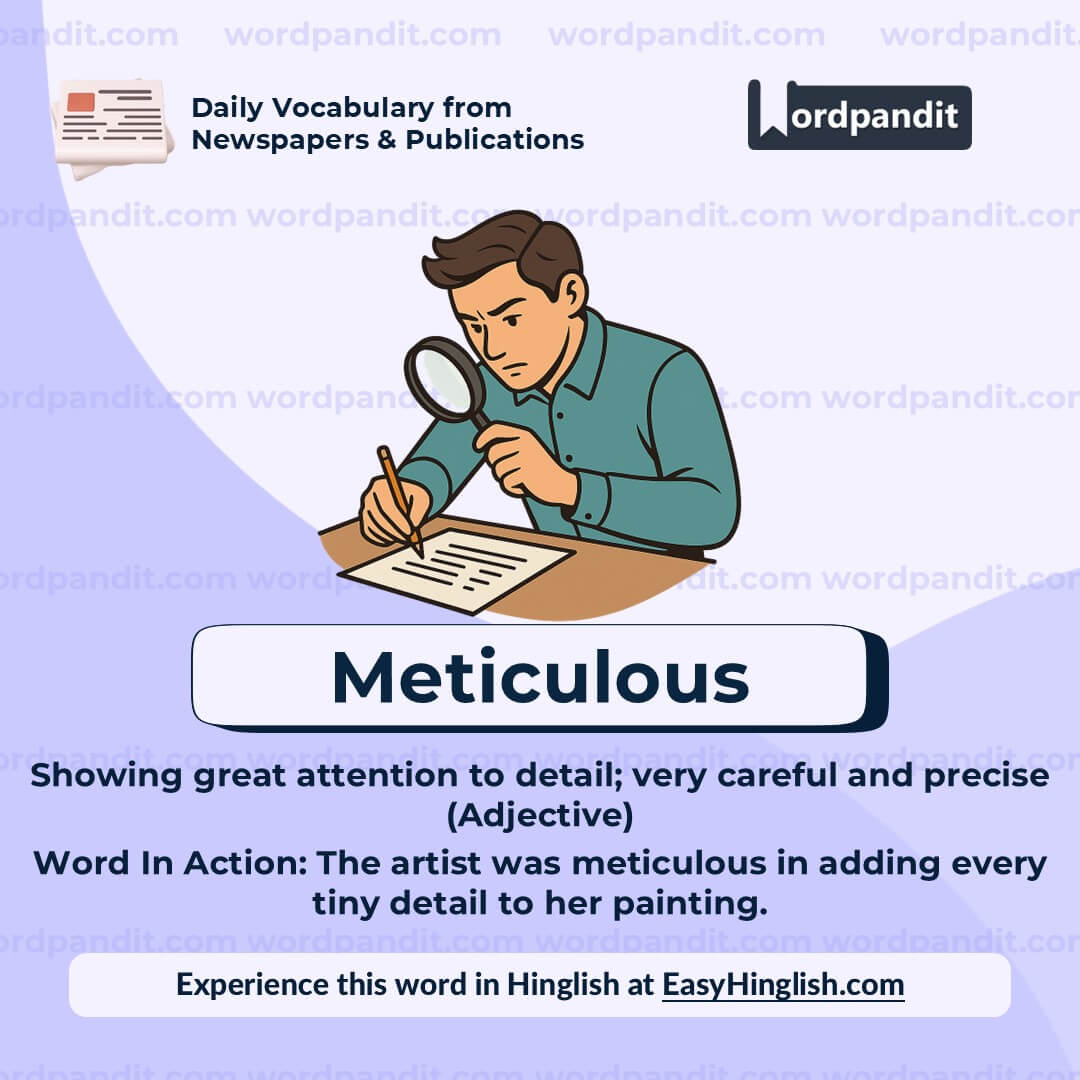
WORD-3: Meticulous
Context:
"The final result doesn’t take away all the meticulous planning which made India the team to beat — since the Asia Cup." - Indian Express
Explanatory Paragraph:
The word meticulous describes being extremely careful, precise, and paying close attention to even the smallest details. A meticulous person doesn’t overlook anything and ensures that everything is done thoroughly. In the given context, it highlights how India’s success was built on careful and detailed planning, regardless of the final outcome.
Meaning: Showing great attention to detail; very careful and precise (Adjective)
Pronunciation: meh-TIH-kyuh-lus
Difficulty Level: ⭐⭐⭐ Intermediate-Advanced
Etymology: From Latin meticulosus, meaning "fearful, timid," derived from metus (fear). Over time, the meaning shifted to imply carefulness caused by fear of making mistakes.
Prashant Sir's Notes:
Think of meticulous as being "detail-obsessed." It is often used in a positive sense for planning, preparation, or craftsmanship, but sometimes it can also suggest being overly fussy or perfectionist.
Synonyms & Antonyms:
Synonyms: precise, thorough, careful, diligent, scrupulous
Antonyms: careless, sloppy, negligent, hasty
Usage Examples:
- Her meticulous notes made studying for the exam much easier.
- The artist worked with meticulous care to capture every detail of the landscape.
- Meticulous planning ensured that the event went smoothly without delays.
- He is meticulous about his appearance and never leaves the house without checking his outfit twice.
Cultural Reference:
Steve Jobs was known for his meticulous attention to design details at Apple, from product aesthetics to packaging, setting new standards in the tech industry.
Think About It:
Can being too meticulous ever become a weakness, slowing down decision-making or progress?
Quick Activity:
Think of a task you recently completed. Rewrite one sentence describing it by adding the word meticulous to show careful attention to detail.
Memory Tip:
Remember "meticulous = minute details." The “m” sound in both words can help you recall that meticulous is about paying attention to the smallest details.
Real-World Application:
Being meticulous is highly valued in professions like surgery, law, architecture, research, and event planning, where even the smallest mistake can have big consequences.
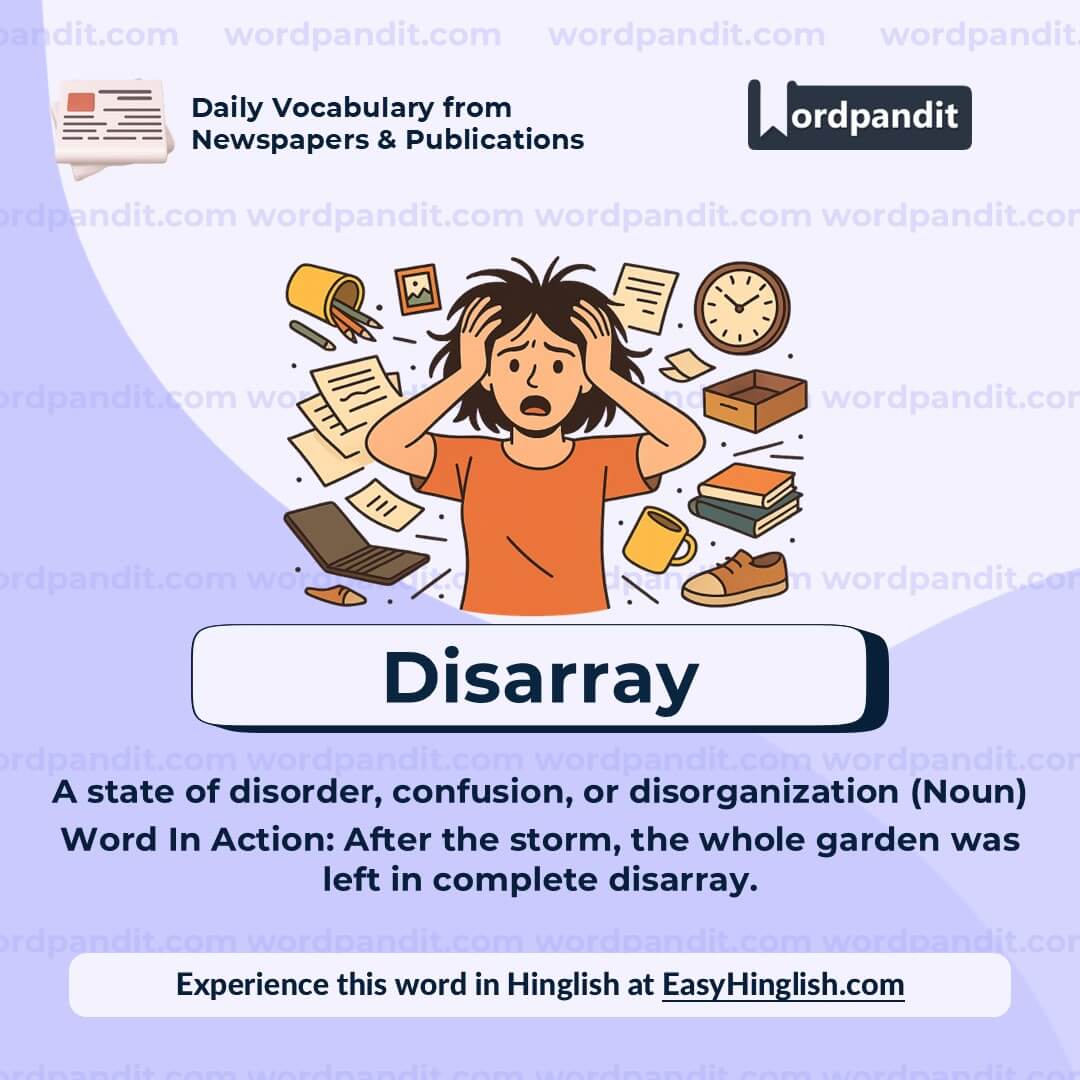
WORD-4: Disarray
Context:
"The first time at the World Cup, they threw our plans into disarray and we couldn’t counter theirs." - Indian Express
Explanatory Paragraph:
The word disarray means a state of confusion, disorder, or lack of organization. It is used when things do not go according to plan, and structures or systems fall into chaos. In the given context, the word highlights how the team’s strategy was disturbed, leaving them unprepared to respond effectively.
Meaning: A state of disorder, confusion, or disorganization (Noun)
Pronunciation: dis-uh-RAY
Difficulty Level: ⭐⭐ Basic-Intermediate
Etymology: From Old French desareer, meaning "throw into disorder," combining des- (away) and aree (order, arrangement).
Prashant Sir's Notes:
Disarray is a strong word to show complete breakdown of order—whether in plans, appearance, or situations. Use it when things are no longer structured and confusion takes over.
Synonyms & Antonyms:
Synonyms: disorder, confusion, chaos, mess, turmoil
Antonyms: order, organization, harmony, structure, system
Usage Examples:
- The sudden resignation of the CEO threw the company into disarray.
- Her room was in complete disarray after the party.
- The unexpected storm put travel schedules into disarray.
- Without proper leadership, the group quickly fell into disarray.
Cultural Reference:
During the 2008 financial crisis, global markets were described as being in "total disarray," highlighting the sense of economic chaos and instability worldwide.
Think About It:
Do moments of disarray always harm progress, or can they sometimes create opportunities for fresh solutions?
Quick Activity:
Use disarray in a sentence to describe a personal situation (like exams, work, or home) where plans went wrong and led to confusion.
Memory Tip:
Break it down: "dis-" (not) + "array" (order). So, disarray literally means "not in order."
Real-World Application:
The word disarray is often used in news reports, politics, sports, and business to describe situations of disorder, such as “plans in disarray,” “government in disarray,” or “team in disarray.”

WORD-5: Aviation
Context:
"As far as aviation is concerned, developing sustainable aviation fuel is a long way off." - Indian Express
Explanatory Paragraph:
The word aviation refers to the science, practice, and business of flying aircraft. It includes the design, development, operation, and maintenance of airplanes and other flying machines. In the given context, it refers specifically to the airline industry and the challenges it faces in creating sustainable fuel options for the future.
Meaning: The operation, development, and industry of flying aircraft (Noun)
Pronunciation: ay-vee-AY-shun
Difficulty Level: ⭐ Basic
Etymology: From French aviation, derived from Latin avis (bird) + suffix -ation, meaning “the act of flying.”
Prashant Sir's Notes:
Aviation is a technical word strongly tied to airplanes, air travel, and the airline industry. Think of it as everything related to the "world of flying." In exams, it is often seen in discussions of technology, sustainability, and global transport.
Synonyms & Antonyms:
Synonyms: aeronautics, air travel, flying, aerospace
Antonyms: none directly (but can contrast with "ground transport," "maritime shipping")
Usage Examples:
- Aviation has transformed global trade and travel by shrinking distances between countries.
- He studied aviation because he dreamed of becoming a commercial pilot.
- The aviation sector is under pressure to reduce its carbon footprint.
- Advances in aviation technology have made flying safer and faster than ever before.
Cultural Reference:
The Wright brothers are considered pioneers of aviation, credited with inventing and flying the world’s first successful motor-operated airplane in 1903.
Think About It:
Can aviation ever become fully sustainable, or will the demand for air travel always make it environmentally challenging?
Quick Activity:
Use the word aviation in two sentences: one about its role in modern travel and one about its environmental impact.
Memory Tip:
Think of "avi-" as in aviary (a place for birds). Since aviation is about flying, connect it with birds in the sky.
Real-World Application:
Aviation plays a crucial role in global connectivity, tourism, defense, and international business. Discussions about aviation often focus on safety, innovation, fuel efficiency, and sustainability.


