

Daily Vocabulary from Indian Newspapers and Publications
Welcome to Wordpandit’s Indian Vocabulary Hub
At Wordpandit, we understand the importance of staying rooted in the local context while expanding your language skills. This section focuses on enriching your vocabulary with words and phrases drawn from India’s leading newspapers and publications, ensuring you're learning vocabulary that is practical, relevant, and uniquely Indian.
Why Indian Sources Matter
We believe that the best way to master any language is by immersing yourself in local content. That’s why we carefully curate vocabulary from top Indian publications, including:
- The Hindu
- The Times of India
- The Economic Times
- Hindustan Times
- Live Mint
- The Indian Express
- And many others...
Stay Updated, Stay Relevant
With daily updates from Indian news sources, you’ll be consistently learning words that reflect the trends and shifts in Indian society and culture. Our focus is to provide vocabulary that enhances your understanding of the language in an Indian context.
How Wordpandit Supports Your Goals
Whether you’re preparing for exams, aiming to improve your professional communication, or simply want to stay connected with the latest Indian vocabulary, Wordpandit is here to guide you every step of the way.
Learn with a Practical Approach
Our interactive learning methodology includes real-world examples, engaging activities, and context-specific usage to ensure that every word becomes part of your active vocabulary.
Dive into Indian Vocabulary Today!

Why Choose Wordpandit?
Practical Learning: Focus on words you'll actually encounter in real-world reading, enhancing your comprehension and communication skills.
Diverse Content: From current affairs to scientific breakthroughs, our varied sources expose you to vocabulary across multiple domains.
Effortless Integration: Make Wordpandit a part of your daily routine. Just a few minutes each day can significantly boost your lexicon over time.
Your Path to Vocabulary Mastery
- Visit our Daily Vocabulary section regularly
- Explore new words and their usage in context
- Practice incorporating these words into your own writing and speech
- Track your progress as your vocabulary expands
Start Your Journey Today
Embark on your vocabulary enhancement journey with Wordpandit. By consistently engaging with our daily posts, you'll build a robust vocabulary that serves you well in academic, professional, and personal contexts.
Remember, a word a day keeps linguistic limitations at bay. Make Wordpandit your daily companion in the quest for vocabulary excellence!
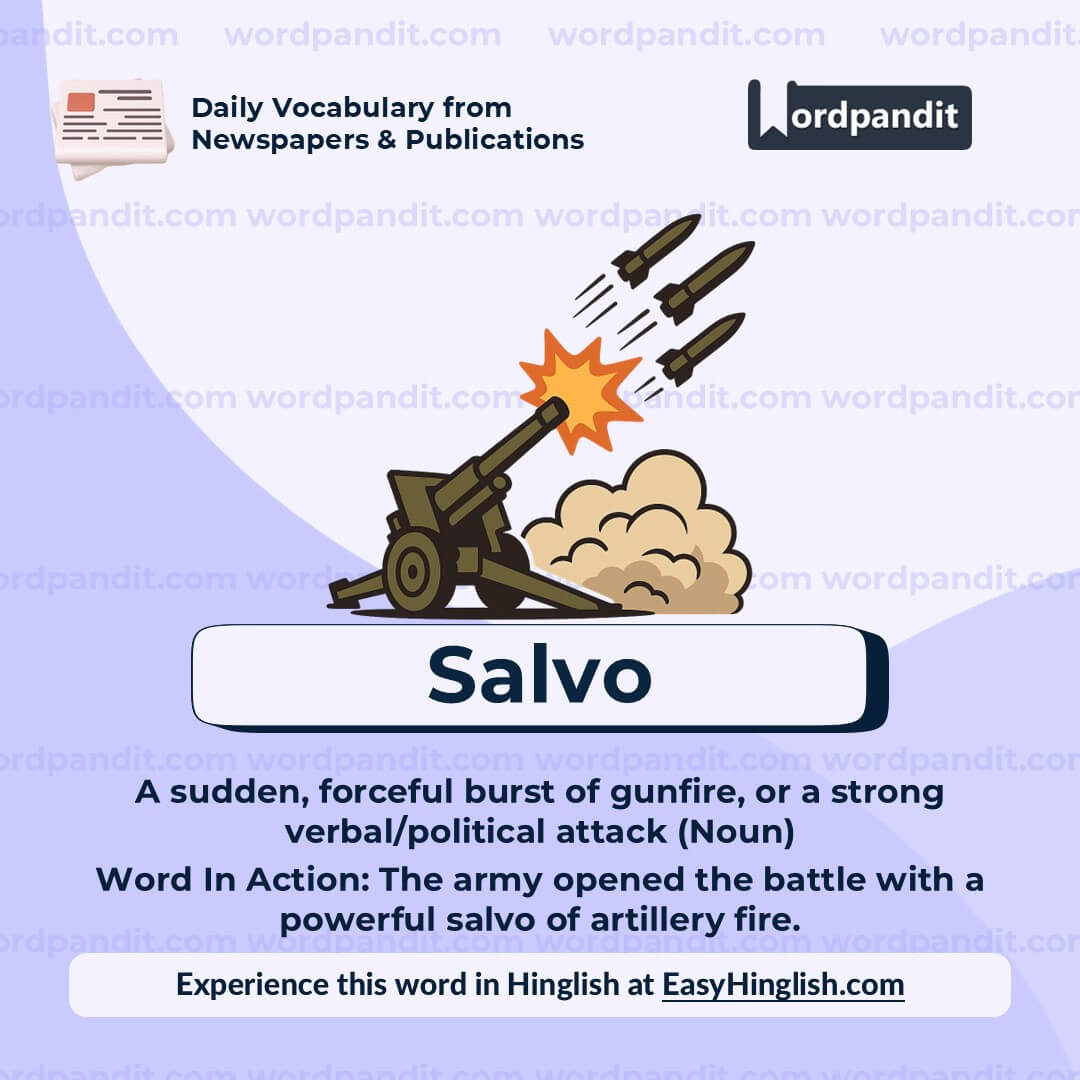
WORD-1: Salvo
Context:
"China has let loose a salvo in response to Trump’s tariff assault. Yesterday, it announced a 34% import duty on all US goods. This reciprocal tariff is at exactly the same rate as the one Trump had imposed on imports from China, on April 2." - The Times of India
Explanatory Paragraph:
The word salvo originally referred to the simultaneous firing of guns or cannons, often as a signal of power or respect. Over time, its usage has expanded beyond military contexts to describe a sudden or forceful series of actions, statements, or attacks—whether in politics, debates, or even sports. In the given context, China’s retaliatory tariffs are described as a "salvo," symbolizing a strong counterattack in the ongoing trade war.
Meaning: A sudden, forceful burst of gunfire, or a strong verbal/political attack (Noun)
Pronunciation: SAL-voh
Difficulty Level: ⭐⭐⭐ Intermediate
Etymology: Derived from Italian salva meaning "a salute of guns," which itself comes from Latin salvare ("to save")—originally connected to a greeting or signal of respect, later evolving into a term for simultaneous fire.
Prashant Sir's Notes:
Think of "salvo" as a metaphorical gunshot: it can be real (in war) or symbolic (in speeches, debates, politics, or negotiations). The word often carries a sense of intensity and suddenness.
Synonyms & Antonyms:
Synonyms: barrage, volley, burst, fusillade, outburst
Antonyms: pause, lull, silence, calm
Usage Examples:
- The politician opened his campaign with a salvo of promises aimed at winning public trust.
- The enemy launched a sudden salvo of missiles across the border.
- Her speech began with a salvo of criticisms directed at the opposition party.
- The team’s opening salvo of goals in the first ten minutes left their rivals stunned.
Cultural Reference:
"The Cold War was marked by a salvo of accusations and propaganda from both sides, creating a battlefield of words rather than weapons." - Adapted from historical commentaries
Think About It:
Why do you think military metaphors like "salvo" are so commonly used in political and economic discussions? Do they make issues sound more urgent—or more aggressive?
Quick Activity:
Fill in the blank: "Her resignation letter was not just an exit note, but a ________ aimed at exposing corruption in the company."
Memory Tip:
Think of salvo as "salve of bullets"—a sudden burst fired at once. This image helps you remember its association with forceful beginnings or attacks.
Real-World Application:
The term "salvo" is frequently used in journalism to describe the opening moves in disputes—whether in global trade wars, courtroom battles, or heated political debates. Recognizing it helps you quickly grasp the tone of confrontational news reports.

WORD-2: Reciprocal
Context:
"China has let loose a salvo in response to Trump’s tariff assault. Yesterday, it announced a 34% import duty on all US goods. This reciprocal tariff is at exactly the same rate as the one Trump had imposed on imports from China, on April 2." - The Times of India
Explanatory Paragraph:
The word reciprocal refers to something that is mutual or done in return. If one side takes an action, the other side responds with a similar one. It emphasizes balance, equality, and mutual exchange—whether in relationships, trade, or even mathematics. In the given context, China’s tariff is described as "reciprocal" because it mirrors the exact rate imposed by the U.S., creating a tit-for-tat situation.
Meaning: Given, felt, or done in return; mutual (Adjective)
Pronunciation: reh-SIP-ruh-kuhl
Difficulty Level: ⭐⭐ Easy-Intermediate
Etymology: From Latin reciprocus meaning "returning the same way," combining re- ("back") and procus ("moving forward").
Prashant Sir's Notes:
Reciprocal is often used to describe a "give-and-take" relationship. In politics, law, and business, it implies fairness and balance—sometimes as retaliation, sometimes as cooperation. In mathematics, it means "the inverse" (like the reciprocal of 5 is 1/5).
Synonyms & Antonyms:
Synonyms: mutual, corresponding, equivalent, complementary, matching
Antonyms: unilateral, one-sided, unequal, independent
Usage Examples:
- The two countries signed a reciprocal agreement on visa-free travel.
- Friendship thrives on reciprocal trust and respect.
- He offered a helping hand, expecting no reciprocal favor in return.
- In mathematics, the reciprocal of 3 is written as 1/3.
Cultural Reference:
"Do unto others as you would have them do unto you" is often cited as the Golden Rule, capturing the essence of reciprocal behavior in human relationships. - Ethical proverb
Think About It:
Do you think true kindness should always expect something reciprocal, or is the highest form of kindness selfless?
Quick Activity:
Complete the sentence: "The new trade law was a ________ measure to balance the previous restrictions imposed by the other nation."
Memory Tip:
Break the word into "re-" (back) + "cycle" (circle-like motion). Think of a circle where what goes around comes around—this is how reciprocal actions work.
Real-World Application:
"Reciprocal" is widely used in international trade, law, and diplomacy, especially in agreements where fairness or equality of treatment is expected. On a personal level, it is key in building trust-based relationships.
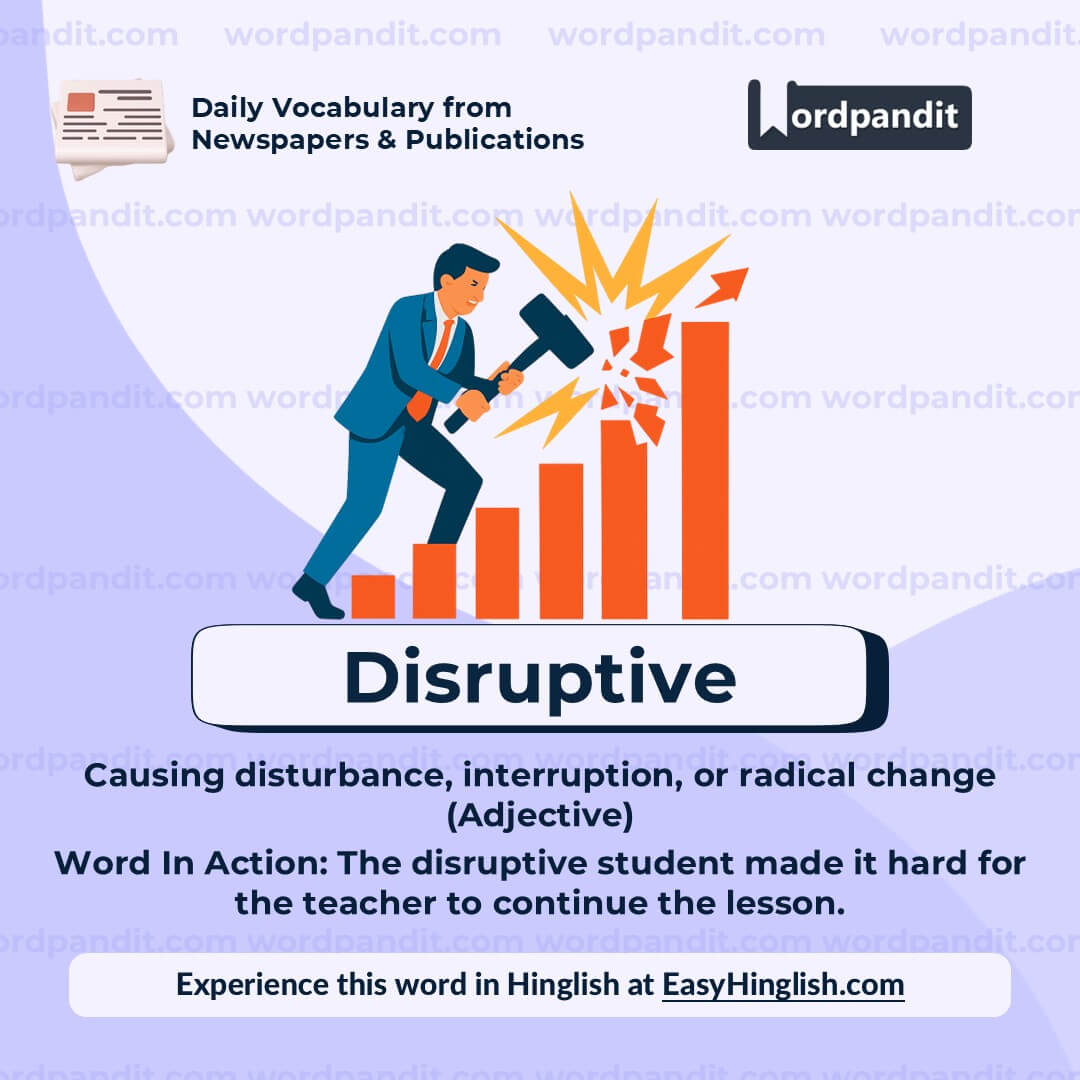
WORD-3: Disruptive
Context:
"What United States President Donald Trump did to global trade on April 2, 2025 in Washington closely mirrors a disruptive precedent set by President Richard Nixon in 1971." - The Hindu
Explanatory Paragraph:
The word disruptive refers to something that causes disturbance, interruption, or significant change in an existing system. It can be negative—like a disruptive student disturbing a class—or positive—like disruptive technology that transforms industries. In the context here, Trump’s actions in global trade are described as "disruptive" because they broke established patterns and created uncertainty, similar to a past precedent set by Nixon.
Meaning: Causing disturbance, interruption, or radical change (Adjective)
Pronunciation: dis-RUP-tiv
Difficulty Level: ⭐⭐ Easy-Intermediate
Etymology: From Latin disrumpere ("to break apart"), combining dis- ("apart") and rumpere ("to break").
Prashant Sir's Notes:
Disruptive has two shades: in everyday language, it often implies disturbance (negative); in business, it is a powerful compliment, describing innovations that "disrupt" old ways and create new markets. Always look at the context to understand which sense applies.
Synonyms & Antonyms:
Synonyms: disturbing, unsettling, revolutionary, innovative, disorderly
Antonyms: stabilizing, orderly, constructive, supportive
Usage Examples:
- The student’s disruptive behavior made it hard for the teacher to continue the lesson.
- Smartphones were a disruptive force in the technology market, replacing many older devices.
- The sudden policy change proved disruptive to international trade agreements.
- Disruptive innovation often comes from small startups challenging big corporations.
Cultural Reference:
The term "disruptive innovation," popularized by Harvard professor Clayton Christensen, describes how small companies with limited resources can challenge established businesses by introducing simpler, more affordable solutions.
Think About It:
Do you think disruption in society and business is always necessary for progress, or can it sometimes cause more harm than good?
Quick Activity:
Fill in the blank: "The arrival of online streaming platforms was a ________ change for the movie rental industry."
Memory Tip:
Think of disruptive as "dis + rupture"—something that breaks apart or shakes up the usual flow.
Real-World Application:
In education, a disruptive child can derail a classroom; in business, a disruptive technology can transform entire industries. Recognizing when disruption is harmful versus when it sparks innovation is key in real-world contexts.
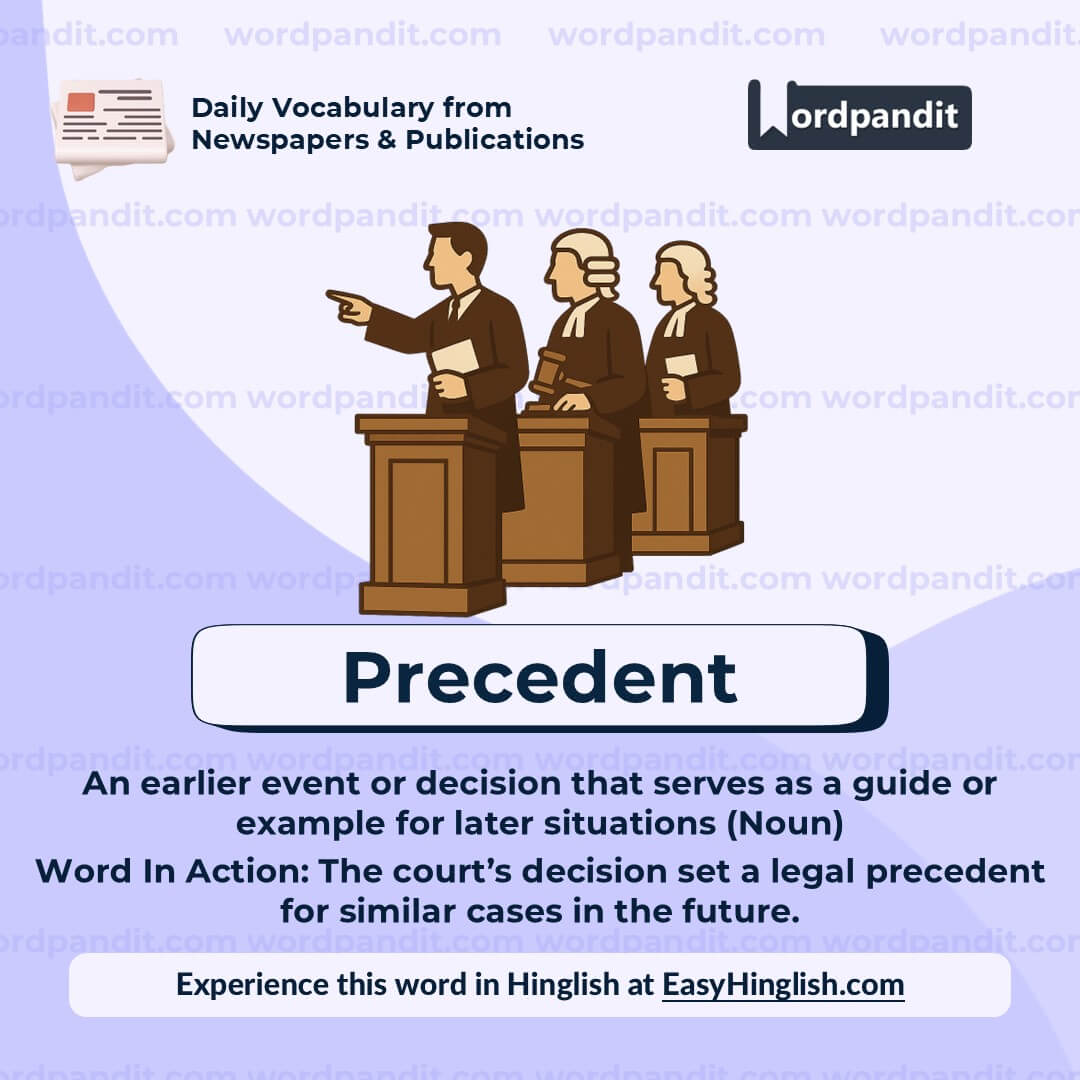
WORD-4: Precedent
Context:
"What United States President Donald Trump did to global trade on April 2, 2025 in Washington closely mirrors a disruptive precedent set by President Richard Nixon in 1971." - The Hindu
Explanatory Paragraph:
The word precedent refers to an earlier action, decision, or event that serves as an example or guide for future situations. In law, a precedent is a ruling that influences later cases. In everyday usage, it means "something that has happened before and sets the standard." In the context here, Nixon’s trade policy in 1971 is called a precedent because Trump’s decision decades later resembles it.
Meaning: An earlier event or decision that serves as a guide or example for later situations (Noun)
Pronunciation: PRESS-uh-dent
Difficulty Level: ⭐⭐ Easy-Intermediate
Etymology: From Latin praecedere ("to go before"), combining prae- ("before") and cedere ("to go").
Prashant Sir's Notes:
Precedent is heavily used in legal, political, and historical contexts. It is about "what came before." Sometimes, people set a precedent unintentionally—meaning their action creates a new standard others might follow.
Synonyms & Antonyms:
Synonyms: example, model, standard, tradition, benchmark
Antonyms: anomaly, exception, novelty, innovation
Usage Examples:
- The court’s decision set a legal precedent for future cases involving digital privacy.
- By breaking tradition, she established a new precedent in the company’s hiring practices.
- The peace treaty followed the precedent of earlier negotiations between the two countries.
- This victory was unprecedented in the history of the tournament.
Cultural Reference:
In the U.S. Supreme Court, the principle of stare decisis means "to stand by things decided," emphasizing the power of precedent in shaping legal outcomes and ensuring consistency.
Think About It:
If precedents guide future decisions, how do we balance learning from the past with making bold, unprecedented choices?
Quick Activity:
Fill in the blank: "Her promotion as the youngest CEO in the company’s history created a new ________ for leadership opportunities."
Memory Tip:
Think of "precedent" as "pre + incident" — an earlier incident that sets an example for what comes next.
Real-World Application:
"Precedent" is central in law, where past rulings influence future judgments. In business and politics, people look at precedents to justify or oppose new decisions, often asking: "Has this been done before?"
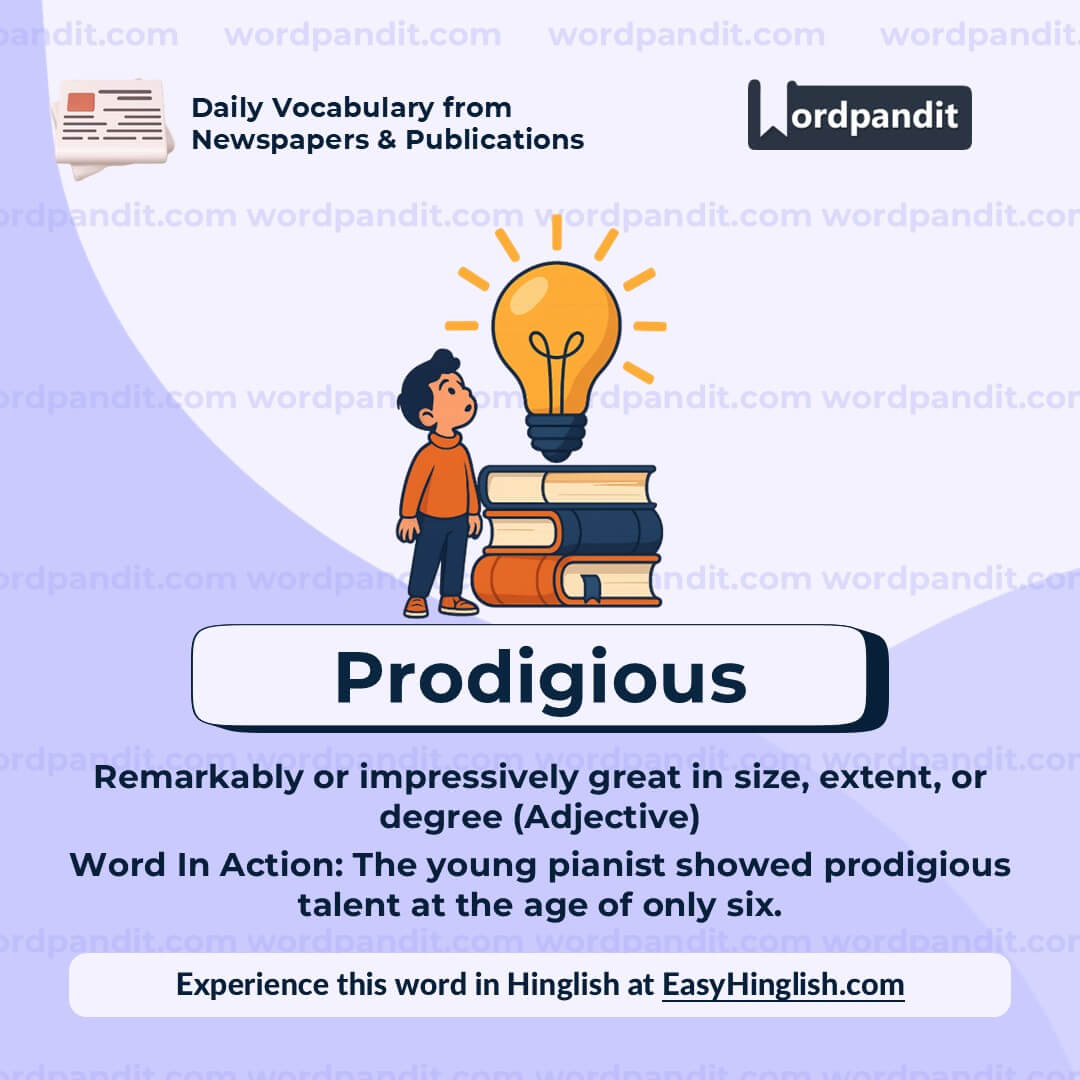
WORD-5: Prodigious
Context:
"The inventory of moons in our solar system went up by many notches in one go last month. A team of astronomers has announced the discovery of 128 new moons of Saturn, bringing its total count of moons to a prodigious number of 274." - The Indian Express
Explanatory Paragraph:
The word prodigious describes something that is remarkably large, impressive, or extraordinary in size, degree, or ability. It often conveys awe at the scale of something, whether it’s numbers, achievements, or natural phenomena. In the context here, Saturn’s "prodigious" number of moons emphasizes just how vast and surprising the discovery is.
Meaning: Remarkably or impressively great in size, extent, or degree (Adjective)
Pronunciation: pruh-DIJ-us
Difficulty Level: ⭐⭐⭐ Intermediate
Etymology: From Latin prodigiosus ("marvelous, portentous"), based on prodigium meaning "omen, marvel."
Prashant Sir's Notes:
Think of prodigious as a cousin of "prodigy." While a prodigy is a person with extraordinary ability, prodigious describes the sheer greatness, magnitude, or vastness of something. It is often used in contexts of numbers, effort, or talent.
Synonyms & Antonyms:
Synonyms: enormous, immense, colossal, gigantic, monumental
Antonyms: tiny, meager, insignificant, trivial
Usage Examples:
- The scientist made prodigious progress in the field of renewable energy within a few years.
- The athlete displayed prodigious strength, breaking multiple records in a single tournament.
- The library houses a prodigious collection of rare manuscripts and historical documents.
- He showed prodigious talent for music at the age of five, composing his first piece before most children could read.
Cultural Reference:
Shakespeare often used words like "prodigious" in his plays to express amazement at extraordinary events, such as unusual births or great feats, linking them with wonder and awe.
Think About It:
Do you think labeling something as "prodigious" adds more emotional impact than simply calling it "large" or "big"? Why do some words carry a sense of wonder while others remain plain?
Quick Activity:
Fill in the blank: "The author’s ________ imagination gave birth to a fantasy world loved by millions of readers."
Memory Tip:
Link "prodigious" to "prodigy." Just as a prodigy amazes with extraordinary talent, something prodigious amazes with extraordinary size or degree.
Real-World Application:
Journalists, scientists, and writers often use "prodigious" to describe massive numbers, efforts, or talents—for example, "prodigious energy consumption," "prodigious artistic talent," or "prodigious amounts of data."


