

Daily Vocabulary from Indian Newspapers and Publications
Welcome to Wordpandit’s Indian Vocabulary Hub
At Wordpandit, we understand the importance of staying rooted in the local context while expanding your language skills. This section focuses on enriching your vocabulary with words and phrases drawn from India’s leading newspapers and publications, ensuring you're learning vocabulary that is practical, relevant, and uniquely Indian.
Why Indian Sources Matter
We believe that the best way to master any language is by immersing yourself in local content. That’s why we carefully curate vocabulary from top Indian publications, including:
- The Hindu
- The Times of India
- The Economic Times
- Hindustan Times
- Live Mint
- The Indian Express
- And many others...
Stay Updated, Stay Relevant
With daily updates from Indian news sources, you’ll be consistently learning words that reflect the trends and shifts in Indian society and culture. Our focus is to provide vocabulary that enhances your understanding of the language in an Indian context.
How Wordpandit Supports Your Goals
Whether you’re preparing for exams, aiming to improve your professional communication, or simply want to stay connected with the latest Indian vocabulary, Wordpandit is here to guide you every step of the way.
Learn with a Practical Approach
Our interactive learning methodology includes real-world examples, engaging activities, and context-specific usage to ensure that every word becomes part of your active vocabulary.
Dive into Indian Vocabulary Today!

Why Choose Wordpandit?
Practical Learning: Focus on words you'll actually encounter in real-world reading, enhancing your comprehension and communication skills.
Diverse Content: From current affairs to scientific breakthroughs, our varied sources expose you to vocabulary across multiple domains.
Effortless Integration: Make Wordpandit a part of your daily routine. Just a few minutes each day can significantly boost your lexicon over time.
Your Path to Vocabulary Mastery
- Visit our Daily Vocabulary section regularly
- Explore new words and their usage in context
- Practice incorporating these words into your own writing and speech
- Track your progress as your vocabulary expands
Start Your Journey Today
Embark on your vocabulary enhancement journey with Wordpandit. By consistently engaging with our daily posts, you'll build a robust vocabulary that serves you well in academic, professional, and personal contexts.
Remember, a word a day keeps linguistic limitations at bay. Make Wordpandit your daily companion in the quest for vocabulary excellence!
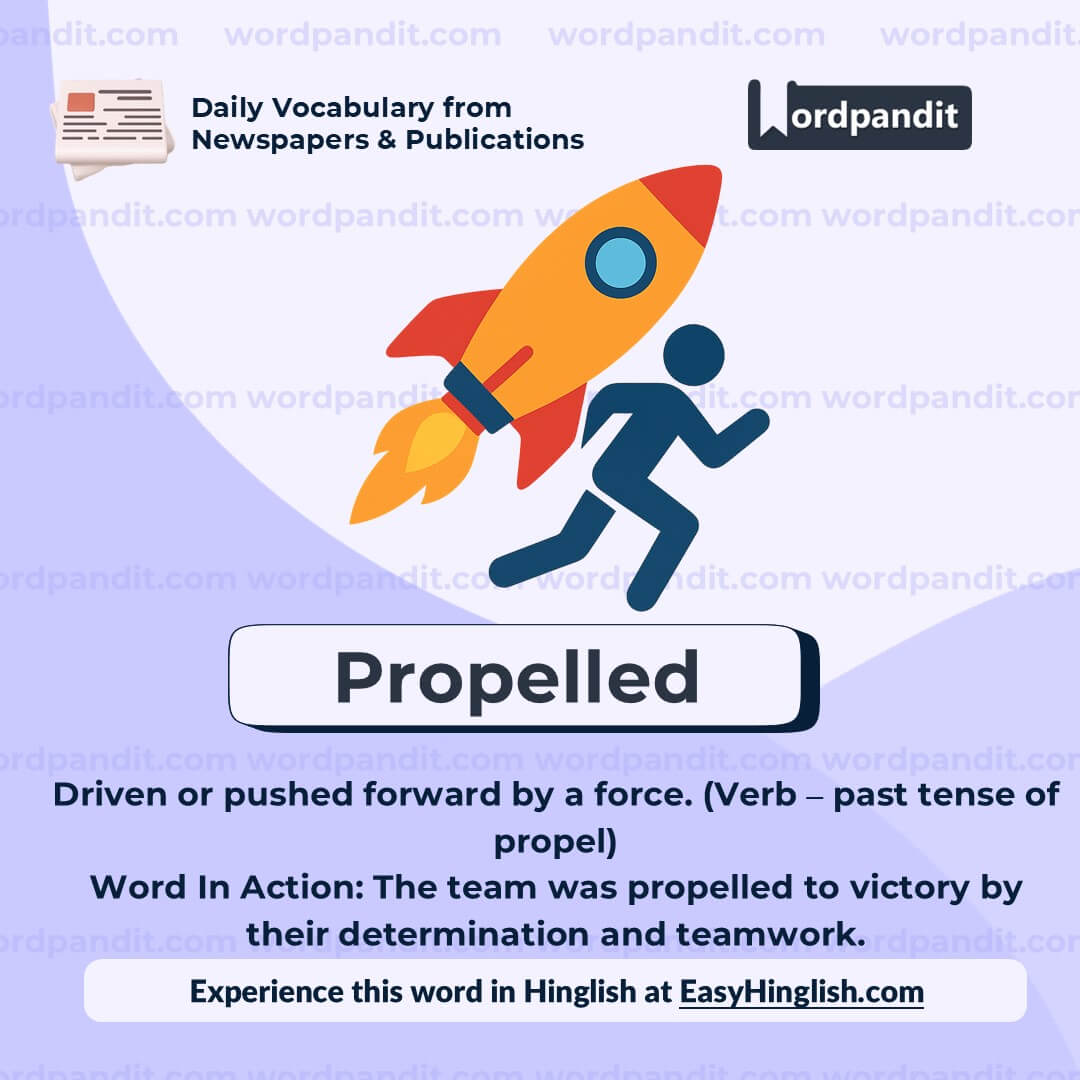
WORD-1: Propelled
Context:
"Raymond Dart’s “killer ape theory” argued that human evolution has been propelled by aggression and the ability to kill. Chimpanzees, another close cousin of Homo sapiens, are also known to employ violence both with other species as well as among themselves." - The Indian Express
Explanatory Paragraph:
The word propelled refers to being pushed, driven, or moved forward by some force or influence. In this context, it suggests that human evolution advanced or was driven forward because of aggression and violence, which acted as motivating forces in shaping our development. More generally, it can describe both physical motion (like a rocket propelled into the sky) and metaphorical progress (an idea propelled by passion).
Meaning: Driven or pushed forward by a force (Verb – past tense of "propel")
Pronunciation: pro-PELLD
Difficulty Level: ⭐⭐ (Basic to Intermediate)
Etymology: From Latin propellere, meaning "to drive forward," formed by "pro" (forward) + "pellere" (to drive).
Prashant Sir's Notes:
Remember that "propelled" always involves an external or internal force that causes movement or advancement. It can be physical (a boat propelled by oars) or abstract (a career propelled by ambition).
Synonyms & Antonyms:
Synonyms: driven, pushed, powered, motivated, advanced
Antonyms: hindered, stopped, restrained, delayed, obstructed
Usage Examples:
- The rocket was propelled into space by powerful engines.
- Her determination propelled her to the top of the corporate ladder.
- The strong winds propelled the sailboat swiftly across the lake.
- Innovation has propelled human society into the digital age.
Cultural Reference:
"Curiosity is what has propelled science throughout history." - Commonly emphasized in scientific philosophy.
Think About It:
Do you think human progress is more often propelled by positive forces like creativity and cooperation, or by negative ones like conflict and competition?
Quick Activity:
Fill in the blank: "Her passion for social justice _______ her to start her own non-profit organization." (Answer: propelled)
Memory Tip:
Think of "propel" as "pro" (forward) + "pel" (push) → to push forward.
Real-World Application:
The term "propelled" is often used in discussions about technology (AI propelled progress), business (profits propelled expansion), or sports (a strong kick propelled the ball into the goal).
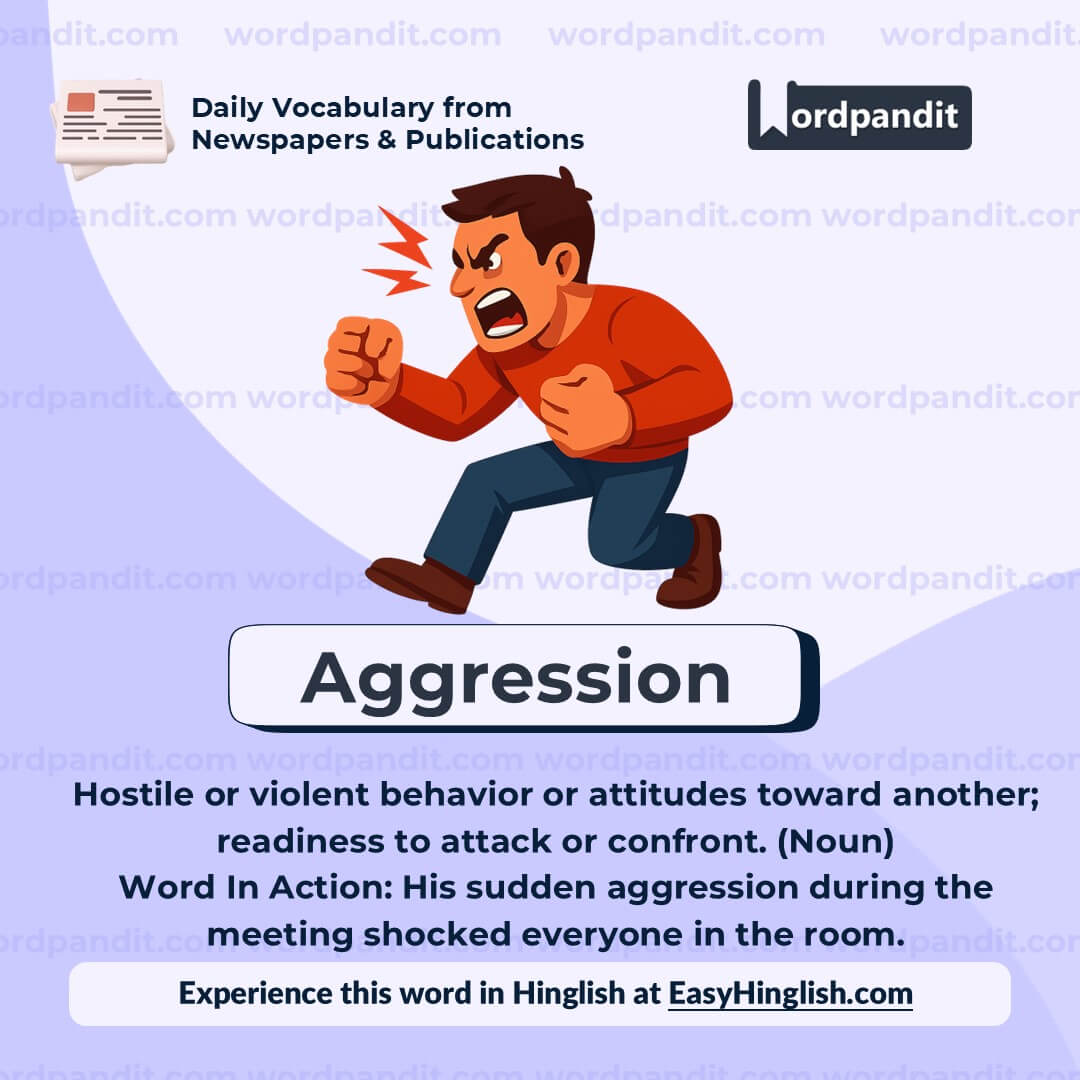
WORD-2: Aggression
Context:
"Raymond Dart’s “killer ape theory” argued that human evolution has been propelled by aggression and the ability to kill. Chimpanzees, another close cousin of Homo sapiens, are also known to employ violence both with other species as well as among themselves." - The Indian Express
Explanatory Paragraph:
The word aggression refers to hostile or violent behavior, often intended to dominate, harm, or challenge others. It can describe both physical violence and verbal hostility, as well as broader tendencies such as competitive assertiveness. In the given context, "aggression" is seen as a driving force in human evolution, suggesting that our ancestors’ survival and advancement were influenced by their readiness to fight and compete.
Meaning: Hostile, violent, or forceful behavior or attitude (Noun)
Pronunciation: uh-GRESH-un
Difficulty Level: ⭐⭐ (Basic to Intermediate)
Etymology: From Latin aggressio meaning "attack," formed by "ad-" (toward) + "gradi" (to step or go).
Prashant Sir's Notes:
Remember that "aggression" doesn’t always mean physical violence. It can also mean a bold, forceful approach in sports, business, or personal behavior. The key idea is a strong, assertive push — sometimes destructive, sometimes constructive.
Synonyms & Antonyms:
Synonyms: hostility, belligerence, violence, combativeness, assertiveness
Antonyms: peace, calmness, friendliness, passivity, restraint
Usage Examples:
- The dog showed sudden aggression toward strangers.
- His aggression on the football field made him a tough opponent.
- Diplomats tried to calm the growing aggression between the two nations.
- She approached her studies with determination and healthy aggression.
Cultural Reference:
In psychology, "aggression" is studied as both a natural human instinct and a learned behavior, often linked with theories from Freud and evolutionary biology.
Think About It:
Is aggression always harmful, or can it be channeled into positive outcomes like sports, innovation, or leadership?
Quick Activity:
Identify whether the following sentence shows aggression in a positive or negative sense: "The entrepreneur’s aggression helped her dominate the market."
Memory Tip:
Think of "aggression" as "going against" — moving forcefully toward someone or something.
Real-World Application:
The term "aggression" is commonly used in international relations (military aggression), psychology (childhood aggression), sports (aggressive play), and business (an aggressive strategy to win market share).
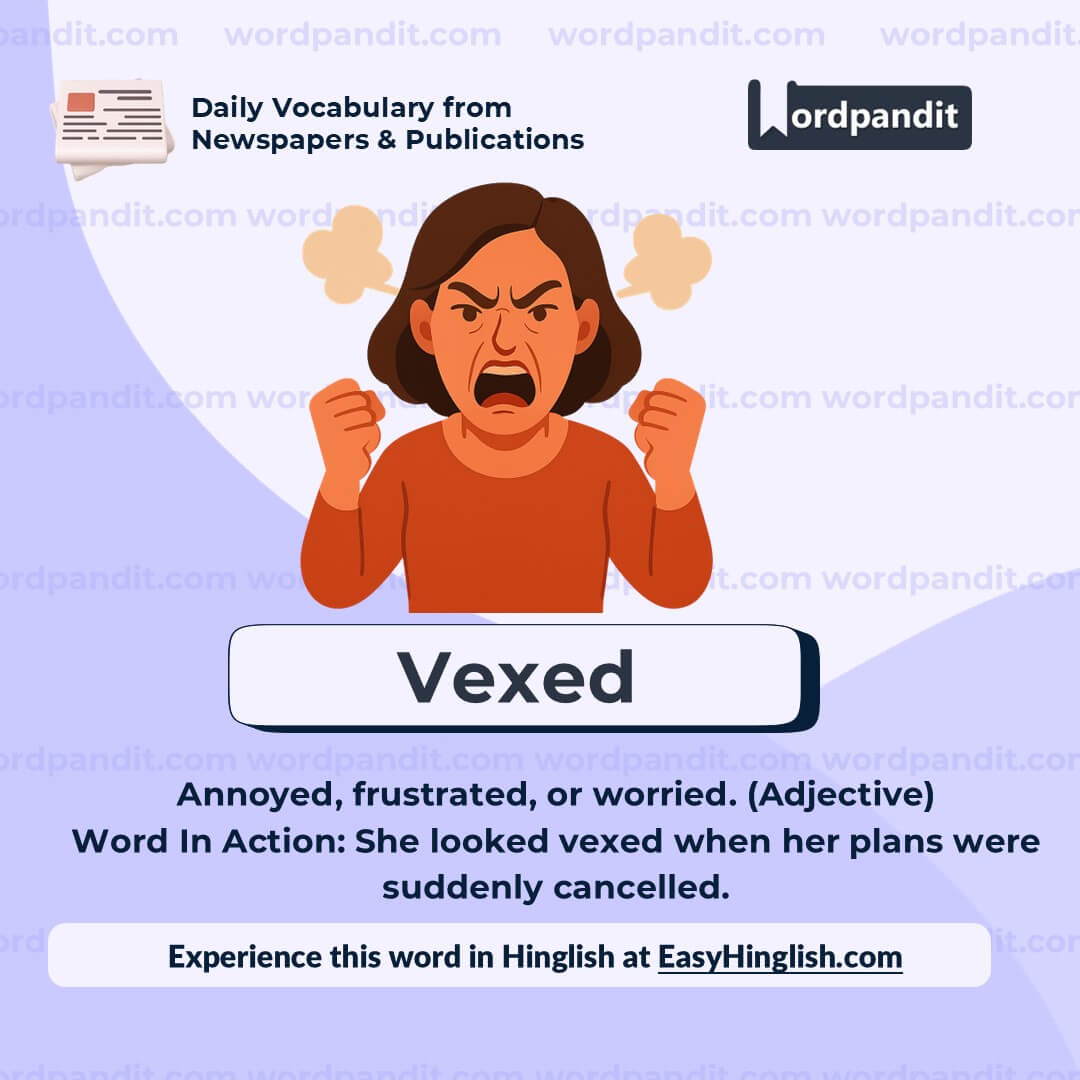
WORD-3: Vexed
Context:
"The issue of defections in Legislative Assemblies has become a vexed one in public life in recent years. Ruling parties — the Bharatiya Janata Party in particular — have adopted an unabashed approach to augment their legislative support by encouraging defections." - The Hindu
Explanatory Paragraph:
The word vexed means something that is troubling, difficult, or much debated, often causing irritation, confusion, or controversy. It can describe both a person’s emotional state (feeling annoyed or irritated) and an issue that is complicated and hard to resolve. In the given context, it refers to the problem of political defections being a highly debated and troublesome matter in public life.
Meaning: Difficult, much debated, or causing annoyance and distress (Adjective)
Pronunciation: VEKST
Difficulty Level: ⭐⭐⭐ (Intermediate)
Etymology: From Latin vexare, meaning "to shake, harass, trouble."
Prashant Sir's Notes:
"Vexed" can be used in two senses: (1) personal — when someone feels annoyed or irritated; (2) public/political — when an issue is complicated, controversial, and hard to settle. Always check the context to decide which meaning fits.
Synonyms & Antonyms:
Synonyms: troubled, annoyed, irritated, complicated, controversial
Antonyms: calm, peaceful, resolved, content, easy
Usage Examples:
- She was vexed by the constant noise outside her apartment.
- The debate over climate change remains a vexed issue worldwide.
- He gave me a vexed look when I interrupted his speech.
- The vexed relationship between the two leaders complicated the peace talks.
Cultural Reference:
In literature, characters in Shakespeare’s plays often use the word "vexed" to express deep frustration or troubling dilemmas, showing its long-standing role in English expression.
Think About It:
Why do some issues remain perpetually vexed, even after years of discussion and attempted solutions?
Quick Activity:
Replace the word troublesome in this sentence with today’s word: "The most __________ problem in the city is traffic congestion."
Memory Tip:
Think of "vexed" as "vex = hex" → a hex (curse) troubles or irritates someone.
Real-World Application:
"Vexed" is commonly used in journalism and politics to describe complicated, divisive issues — such as taxation, climate policy, or political defections — that continue to stir debate without easy solutions.
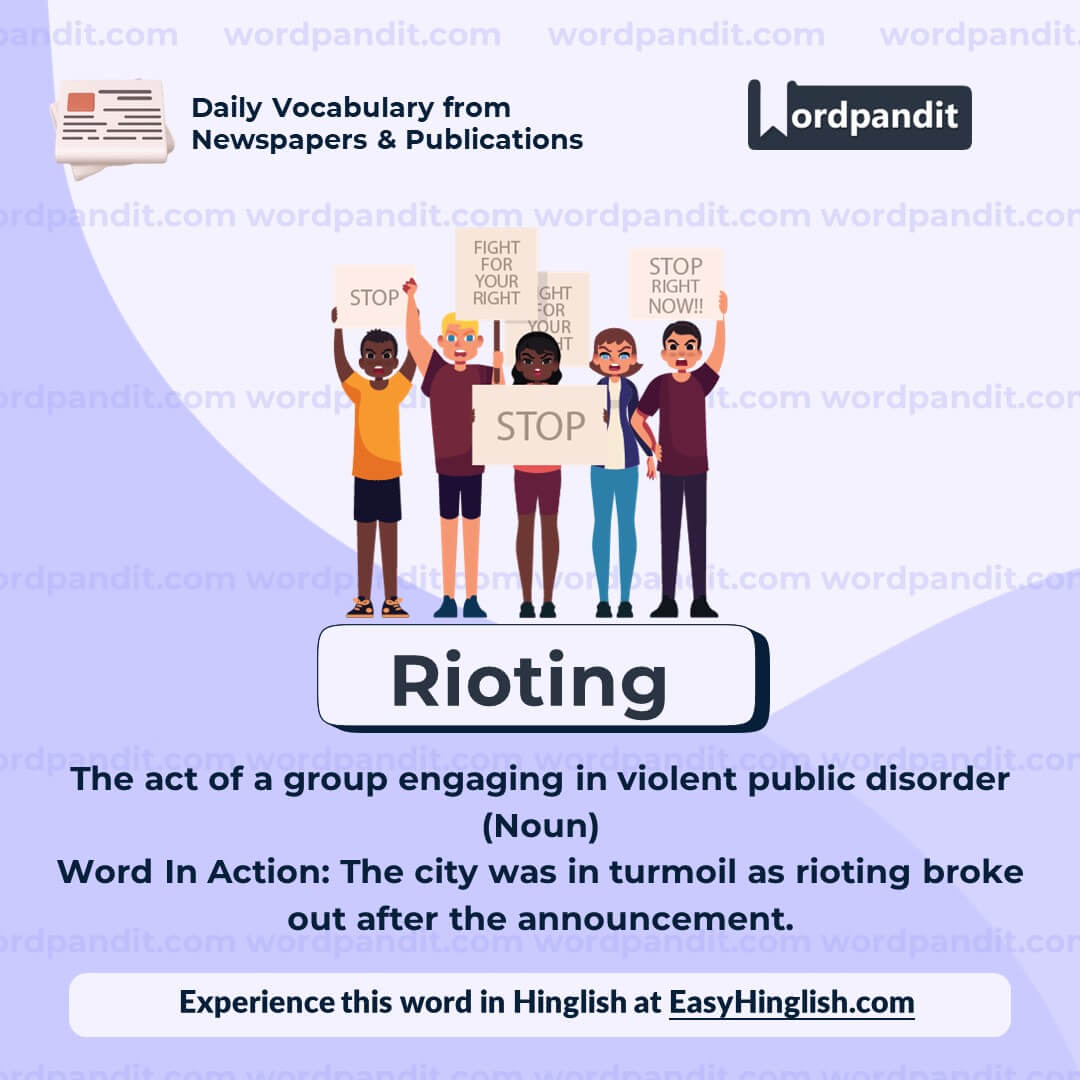
WORD-4: Rioting
Context:
"This was not a case of rioting or murder." - The Wire
Explanatory Paragraph:
"Rioting" refers to violent or chaotic public disorder involving groups of people. It usually involves damage to property, fights, and a breakdown of law and order. When people protest in an uncontrolled, aggressive, and destructive manner, it is described as rioting.
Meaning: Violent public disorder caused by a group of people (Noun)
Pronunciation: rye-oh-ting
Difficulty Level: ⭐⭐ Basic-Intermediate
Etymology: From Old French riote meaning "dispute, quarrel," which came into English in the 12th century as "riot." The verb form evolved into "rioting."
Prashant Sir's Notes:
Rioting is more than just protest; it is disorderly, violent, and uncontrolled behavior. Always connect it with chaos and destruction.
Synonyms & Antonyms:
Synonyms: uprising, revolt, disturbance, chaos, turbulence
Antonyms: peace, order, calm, harmony
Usage Examples:
- The police struggled to control the rioting that broke out after the match.
- Rioting often destroys the very community it claims to represent.
- The government imposed a curfew to prevent further rioting in the city.
- During the festival, some celebrations turned into rioting and vandalism.
Cultural Reference:
"Rioting has been a recurring feature of human history, often reflecting deep social and political unrest." - Adapted from historical commentary
Think About It:
Do you think rioting ever achieves meaningful social change, or does it always cause more harm than good?
Quick Activity:
Write two sentences: one showing a peaceful protest and one showing a protest that turns into rioting. Compare the difference in tone.
Memory Tip:
Think of "riot" as "right-out of control" → Rioting means things are completely out of control.
Real-World Application:
The word "rioting" is often used in news reports when demonstrations or gatherings escalate into violence, making it a common term in discussions about politics, law enforcement, and social movements.
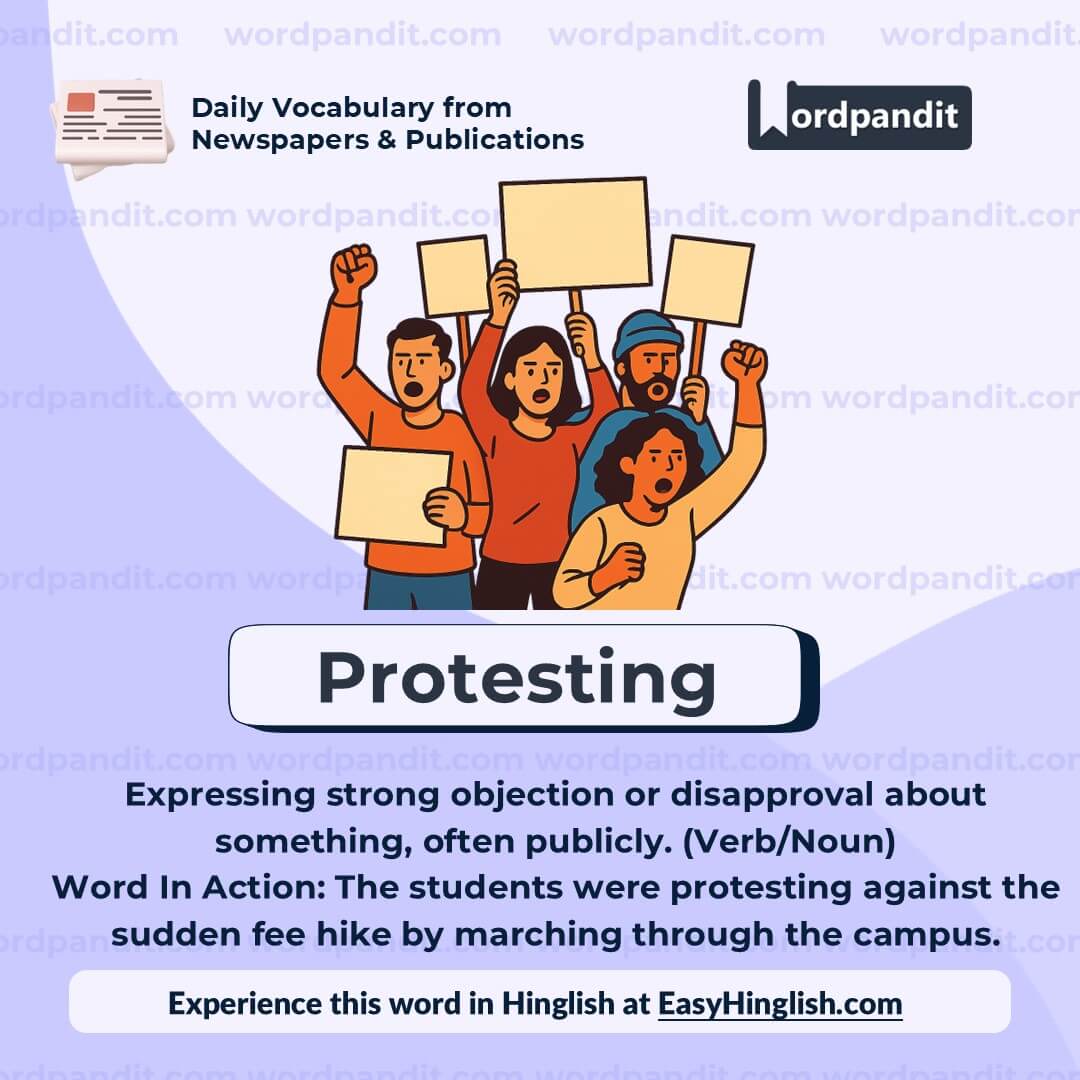
WORD-5: Protesting
Context:
"Right now, many people across India are protesting against a new law about Waqf properties (lands and buildings used for religious or charitable purposes in Islam)." - The Times of India
Explanatory Paragraph:
The word protesting refers to the act of expressing strong disagreement, disapproval, or objection to something, often publicly. Protests can take many forms — marches, demonstrations, strikes, or even symbolic acts — and they are usually aimed at drawing attention to an issue or demanding change. In the given context, people are protesting against a law, which means they are openly showing their opposition to it.
Meaning: Expressing opposition or disapproval, often publicly (Verb – present participle of "protest")
Pronunciation: PROH-tes-ting
Difficulty Level: ⭐⭐ (Basic to Intermediate)
Etymology: From Latin protestari, meaning "to declare publicly," formed by "pro" (forth) + "testari" (to testify).
Prashant Sir's Notes:
"Protesting" can be used in both formal and informal contexts. It can be active (marching, shouting slogans) or passive (silent sit-ins, hunger strikes). Remember: a protest is not always violent — it can also be peaceful and symbolic.
Synonyms & Antonyms:
Synonyms: objecting, opposing, resisting, demonstrating, challenging
Antonyms: supporting, accepting, approving, endorsing, agreeing
Usage Examples:
- Students were protesting outside the university gates for better facilities.
- The workers are protesting against unfair wages.
- Environmental groups have been protesting the cutting of trees in the city.
- She kept protesting her innocence during the trial.
Cultural Reference:
The idea of protesting is central to democracy. Movements like Gandhi’s non-violent protests against British rule in India or Martin Luther King Jr.’s civil rights marches in the U.S. are historic examples of how protests can bring change.
Think About It:
Do protests achieve more when they are peaceful, or when they show force and disruption?
Quick Activity:
Fill in the blank: "Thousands of farmers were __________ on the streets demanding fair prices for their crops." (Answer: protesting)
Memory Tip:
Break it as "pro + test" → to "test against something openly" → expressing opposition.
Real-World Application:
The word "protesting" is frequently used in news and politics, especially to describe public movements against laws, government actions, corporate policies, or social injustices. It’s a key word in understanding civic participation.


