

Daily Vocabulary from Indian Newspapers and Publications
Welcome to Wordpandit’s Indian Vocabulary Hub
At Wordpandit, we understand the importance of staying rooted in the local context while expanding your language skills. This section focuses on enriching your vocabulary with words and phrases drawn from India’s leading newspapers and publications, ensuring you're learning vocabulary that is practical, relevant, and uniquely Indian.
Why Indian Sources Matter
We believe that the best way to master any language is by immersing yourself in local content. That’s why we carefully curate vocabulary from top Indian publications, including:
- The Hindu
- The Times of India
- The Economic Times
- Hindustan Times
- Live Mint
- The Indian Express
- And many others...
Stay Updated, Stay Relevant
With daily updates from Indian news sources, you’ll be consistently learning words that reflect the trends and shifts in Indian society and culture. Our focus is to provide vocabulary that enhances your understanding of the language in an Indian context.
How Wordpandit Supports Your Goals
Whether you’re preparing for exams, aiming to improve your professional communication, or simply want to stay connected with the latest Indian vocabulary, Wordpandit is here to guide you every step of the way.
Learn with a Practical Approach
Our interactive learning methodology includes real-world examples, engaging activities, and context-specific usage to ensure that every word becomes part of your active vocabulary.
Dive into Indian Vocabulary Today!

Why Choose Wordpandit?
Practical Learning: Focus on words you'll actually encounter in real-world reading, enhancing your comprehension and communication skills.
Diverse Content: From current affairs to scientific breakthroughs, our varied sources expose you to vocabulary across multiple domains.
Effortless Integration: Make Wordpandit a part of your daily routine. Just a few minutes each day can significantly boost your lexicon over time.
Your Path to Vocabulary Mastery
- Visit our Daily Vocabulary section regularly
- Explore new words and their usage in context
- Practice incorporating these words into your own writing and speech
- Track your progress as your vocabulary expands
Start Your Journey Today
Embark on your vocabulary enhancement journey with Wordpandit. By consistently engaging with our daily posts, you'll build a robust vocabulary that serves you well in academic, professional, and personal contexts.
Remember, a word a day keeps linguistic limitations at bay. Make Wordpandit your daily companion in the quest for vocabulary excellence!
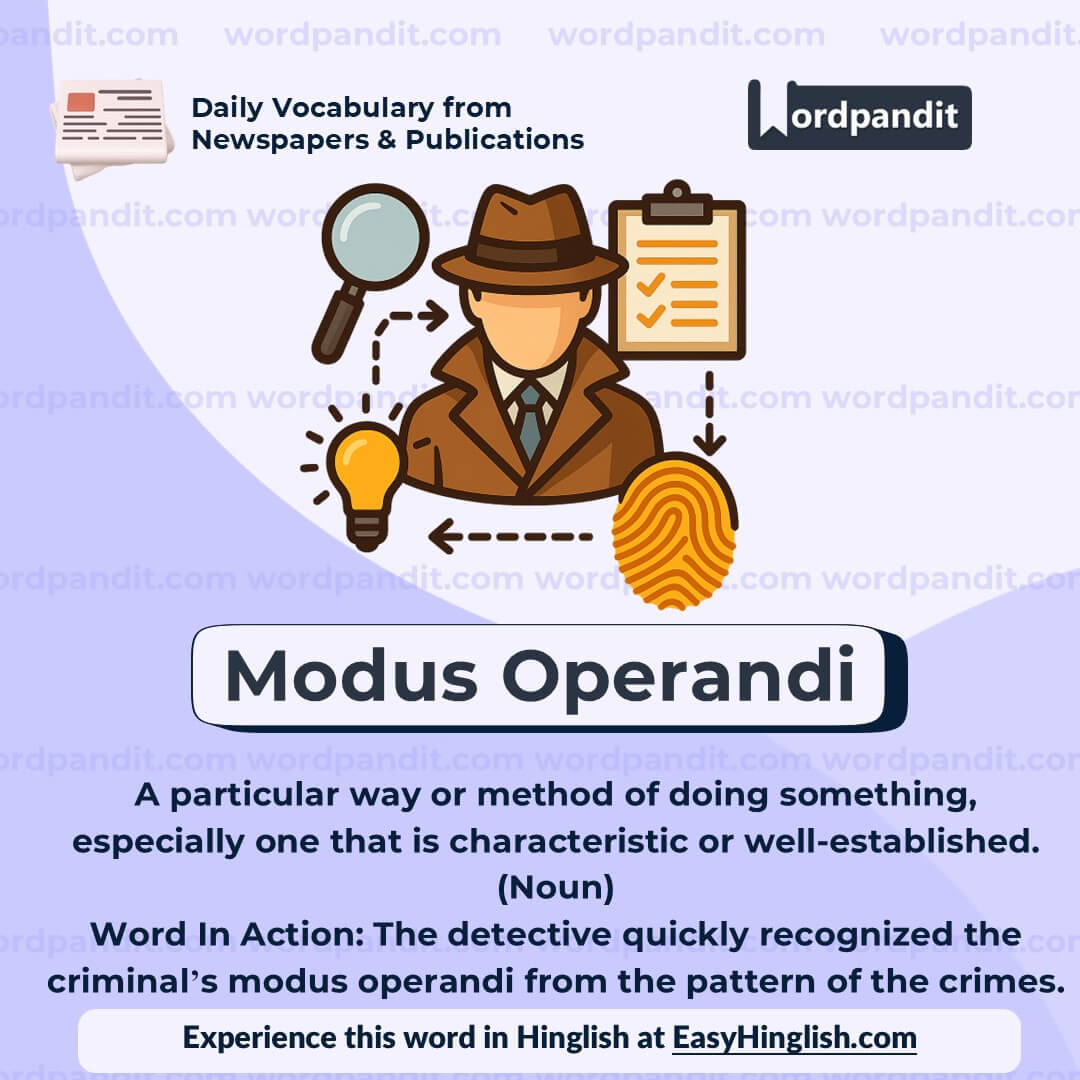
WORD-1: Modus Operandi
Context:
"A commonly used modus operandi — used egregiously in Manipur in the late 2010s and later in Maharashtra — involves the Speaker, invariably from the ruling party, sitting on disqualification petitions from Opposition parties against legislators who have defected." - The Hindu
Explanatory Paragraph:
Modus operandi is a Latin phrase meaning "method of operating." It is used to describe the usual way someone does something, especially when it is a distinctive or recognizable pattern of behavior. In legal and journalistic contexts, it often refers to the characteristic strategy or approach used in carrying out actions, whether good or bad.
Meaning: A particular way or method of doing something; a habitual practice (Noun phrase)
Pronunciation: moh-dus op-uh-ran-dee
Difficulty Level: ⭐⭐⭐ Intermediate
Etymology: From Latin: modus ("manner, method") + operandi ("of operating, working"). First used in English in the mid-17th century.
Prashant Sir's Notes:
This phrase is frequently used in political, legal, and crime reporting to point out a recurring strategy or method. Think of it as a person’s "signature style" of doing something.
Synonyms & Antonyms:
Synonyms: method, approach, procedure, technique, style, practice
Antonyms: randomness, improvisation, disorder, irregularity
Usage Examples:
- The thief’s modus operandi was to strike during power cuts when homes were left unguarded.
- Every successful company has its own modus operandi that distinguishes it from competitors.
- The detective quickly recognized the criminal’s modus operandi from earlier cases.
- In politics, delaying decisions is often a modus operandi to avoid accountability.
Cultural Reference:
"In crime thrillers, investigators often study the criminal’s modus operandi to predict their next move." - Popular crime fiction trope
Think About It:
If someone’s modus operandi defines their usual way of acting, how much of our personal "modus operandi" is shaped by habit versus conscious choice?
Quick Activity:
Write down your own "modus operandi" for studying vocabulary. What steps do you usually follow, and how could you improve them?
Memory Tip:
Think of "Modus" as "Mode" (way) and "Operandi" as "Operate." Together: "Mode of Operating" = method of doing something.
Real-World Application:
In the real world, police and investigators use "modus operandi" to identify criminals, while journalists and analysts use it to describe recurring political or corporate strategies.
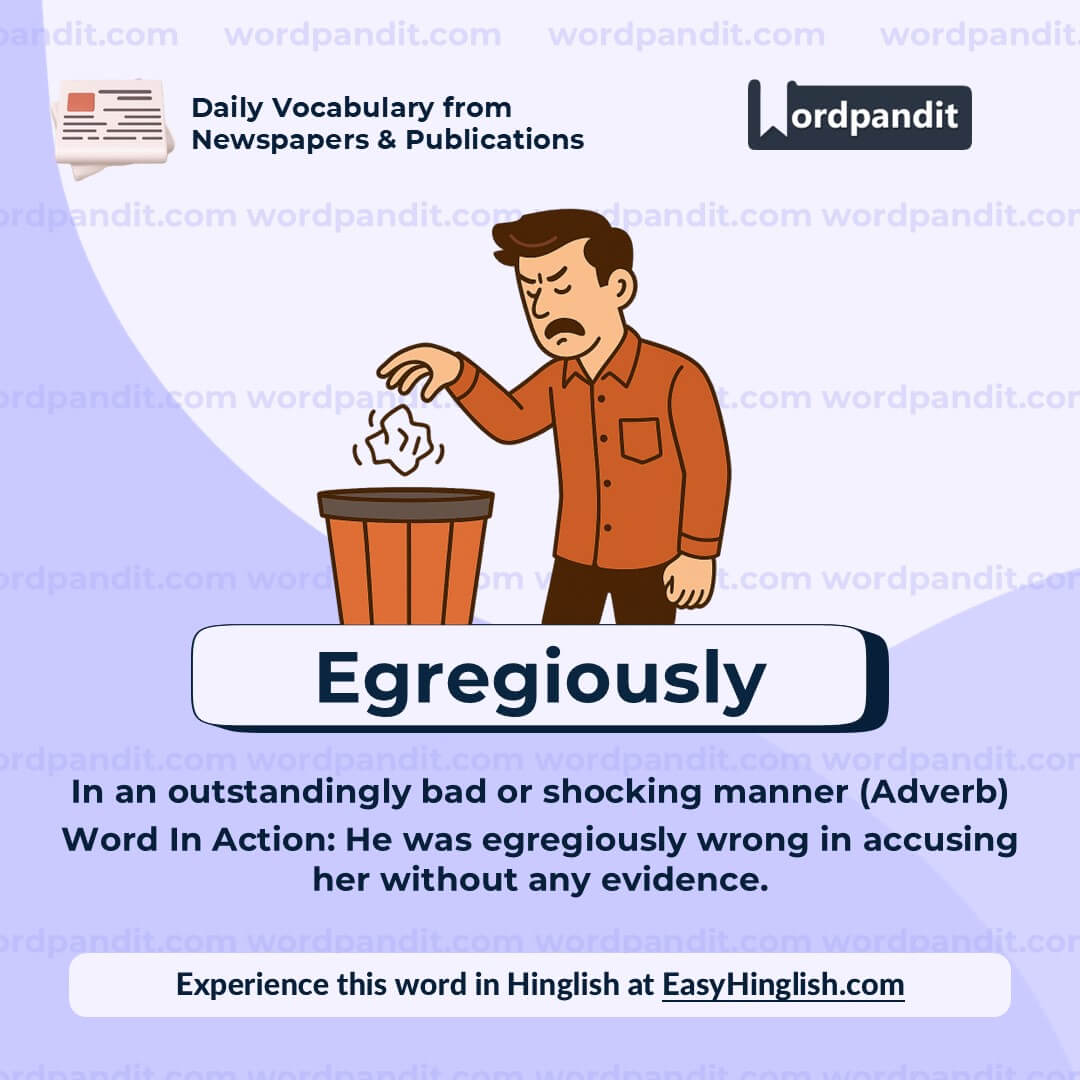
WORD-2: Egregiously
Context:
"A commonly used modus operandi — used egregiously in Manipur in the late 2010s and later in Maharashtra — involves the Speaker, invariably from the ruling party, sitting on disqualification petitions from Opposition parties against legislators who have defected." - The Hindu
Explanatory Paragraph:
Egregiously is an adverb used to describe something done in a shockingly bad, glaring, or offensive manner. When someone acts egregiously, they behave in a way that stands out for its negativity or wrongness. In political and social contexts, it often highlights conduct that is not just wrong but clearly and outrageously so.
Meaning: In an extremely bad or flagrant manner (Adverb)
Pronunciation: ih-gree-jus-lee
Difficulty Level: ⭐⭐⭐ Intermediate
Etymology: From Latin egregius meaning "distinguished, outstanding" (originally positive), but by the 16th century, it shifted to mean "conspicuously bad" in English usage.
Prashant Sir's Notes:
This word has a fascinating history — it once meant something "remarkably good" but evolved to mean "remarkably bad." Today, it almost always carries a negative tone, especially in legal, journalistic, and political commentary.
Synonyms & Antonyms:
Synonyms: outrageously, shockingly, flagrantly, grossly, glaringly
Antonyms: mildly, slightly, acceptably, tolerably
Usage Examples:
- The company acted egregiously by ignoring repeated safety warnings.
- She was egregiously late to the meeting, causing frustration among her colleagues.
- The official was criticized for behaving egregiously during the inquiry.
- In sports, a player can be penalized for egregiously breaking the rules.
Cultural Reference:
"Egregiously bad decisions by leaders can alter the fate of nations" – a recurring theme in political commentary worldwide.
Think About It:
If a word can shift from meaning "outstandingly good" to "outstandingly bad," what does this tell us about the power of language and context in shaping meaning?
Quick Activity:
Write two short sentences: one where you describe someone acting egregiously in daily life (like being rude in public) and another where you use it in a political or professional context.
Memory Tip:
Think: "Egregious = Extra Grievous." If something is egregiously done, it is grievously, shockingly bad.
Real-World Application:
Journalists and analysts often use "egregiously" to highlight actions that are not just wrong but glaringly unjustifiable, making it a powerful word in debates, legal cases, and political reporting.
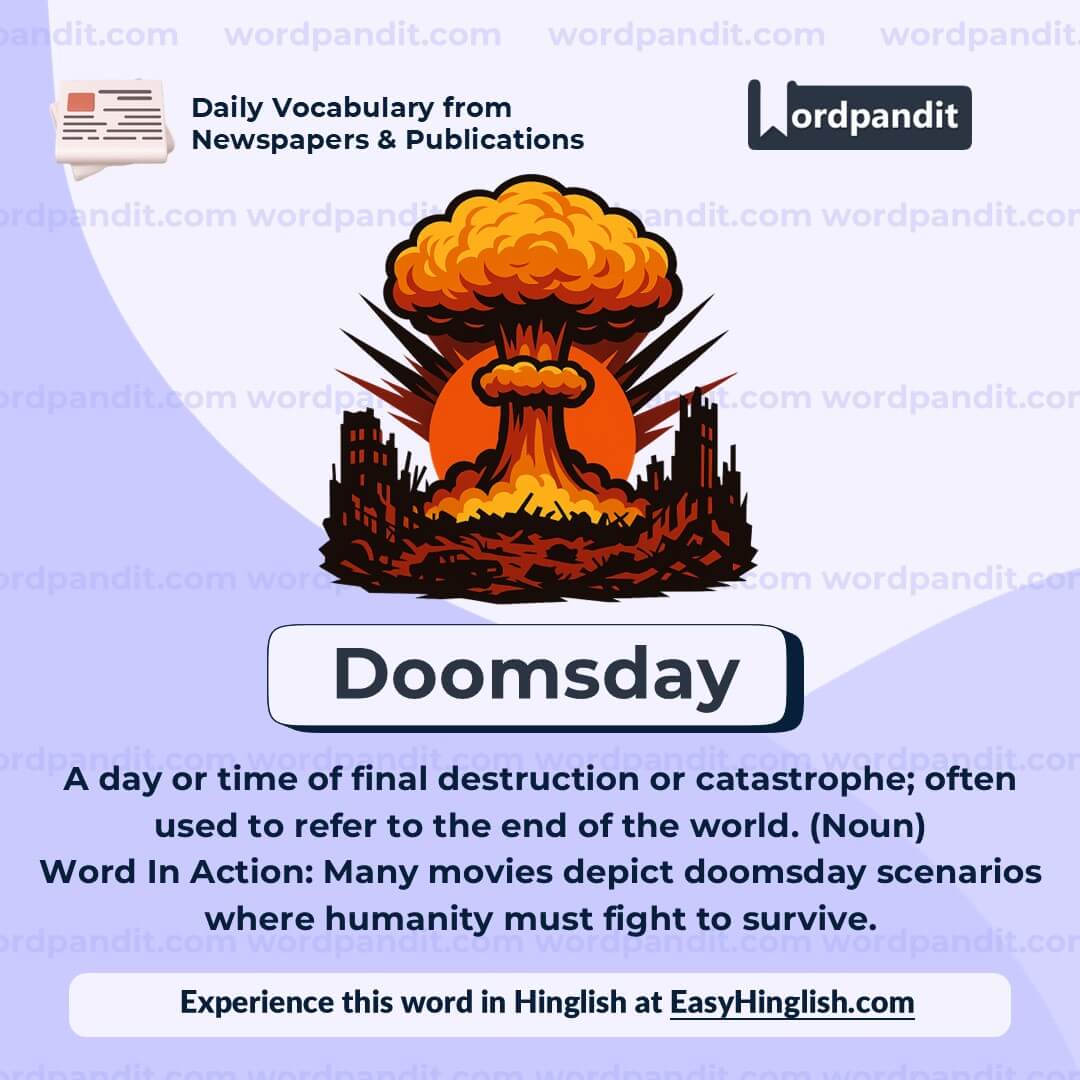
WORD-3: Doomsday
Context:
"Trump’s ‘Liberation Day’ has become doomsday for global markets. Stocks are plunging big. Apple, Nvidia, Nike and other mega companies have lost hundreds of billions in value. World leaders are reeling between retaliation and reconciliation." - The Times of India
Explanatory Paragraph:
Doomsday is a dramatic word that refers to the final day of destruction or judgment, often associated with the end of the world. In everyday language, it is also used metaphorically to describe any disastrous or catastrophic event that brings ruin, collapse, or panic. In media, it frequently emphasizes extreme economic, political, or environmental crises.
Meaning: The day of final destruction or judgment; any disastrous or catastrophic event (Noun)
Pronunciation: doomz-day
Difficulty Level: ⭐⭐ Easy
Etymology: From Old English dōmes dæg, meaning "day of judgment," combining dōm ("judgment") and dæg ("day"). Originally a religious term, it later expanded into general usage for catastrophic events.
Prashant Sir's Notes:
This is a powerful word often used metaphorically in economics, politics, and climate discourse. Always pay attention to whether the writer means literal destruction (rare) or figurative disaster (common in journalism).
Synonyms & Antonyms:
Synonyms: catastrophe, apocalypse, destruction, judgment day, collapse, ruin
Antonyms: salvation, deliverance, renewal, prosperity
Usage Examples:
- Climate activists warn that unchecked global warming could trigger a doomsday scenario for humanity.
- The sudden crash of the banking system was described as financial doomsday.
- In popular movies, superheroes often fight to prevent a doomsday from wiping out Earth.
- For farmers dependent on rain, droughts can feel like a personal doomsday.
Cultural Reference:
"Doomsday" frequently appears in science fiction and comics, such as the famous DC Comics villain Doomsday who battles Superman, symbolizing unstoppable destruction.
Think About It:
Why do humans use extreme words like "doomsday" to describe crises? Does exaggeration help in creating urgency or does it create unnecessary fear?
Quick Activity:
Write two short sentences: one using "doomsday" in a literal sense (religious/mythological) and one in a metaphorical sense (economic/environmental).
Memory Tip:
Break it into "doom" (fate, ruin) + "day." Doomsday = the day of doom or ultimate destruction.
Real-World Application:
In real life, "doomsday" is often used in discussions of climate change, nuclear threats, economic collapses, or global pandemics to stress the severity of potential consequences.
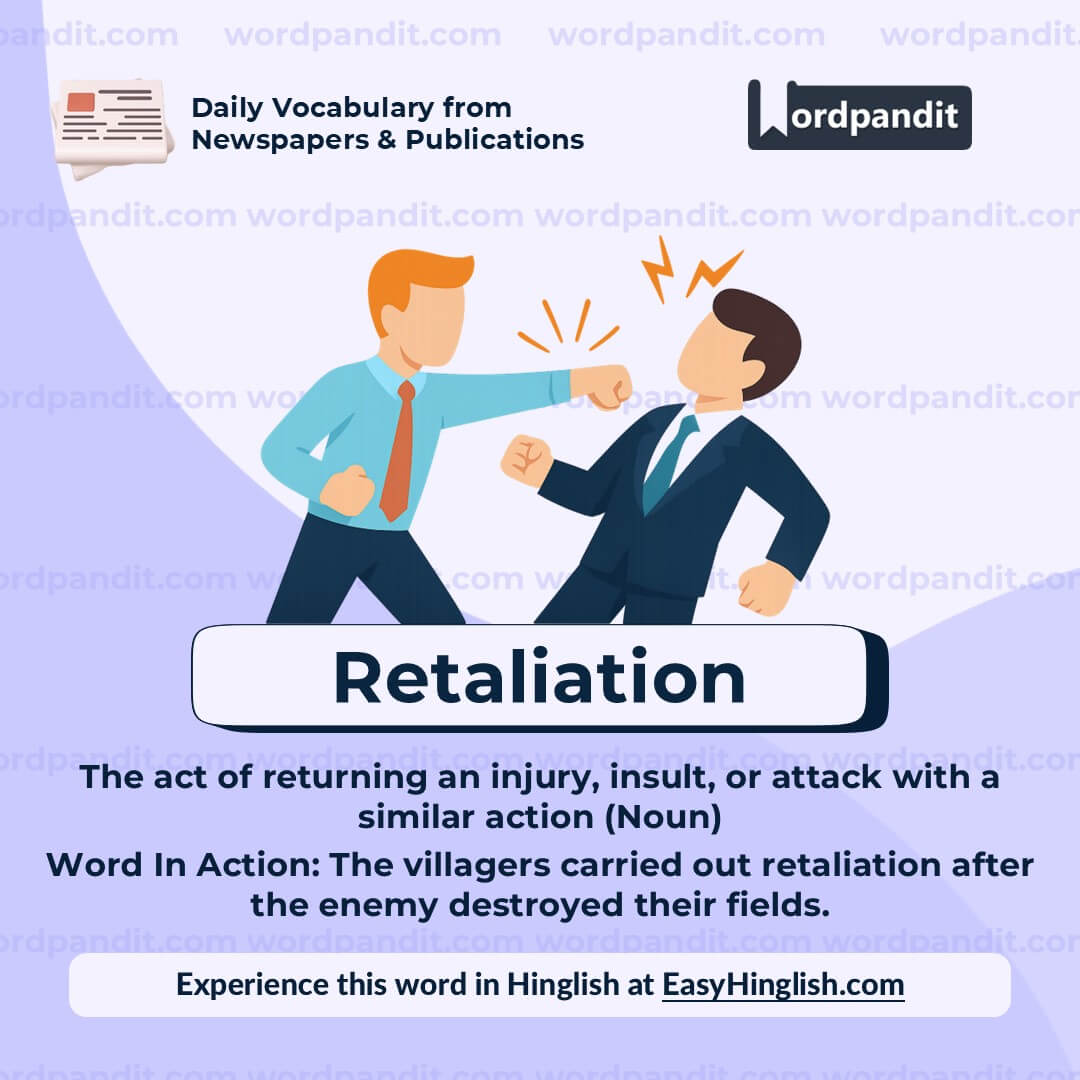
WORD-4: Retaliation
Context:
"Trump’s ‘Liberation Day’ has become doomsday for global markets. Stocks are plunging big. Apple, Nvidia, Nike and other mega companies have lost hundreds of billions in value. World leaders are reeling between retaliation and reconciliation." - The Times of India
Explanatory Paragraph:
Retaliation means responding to a harm, attack, or insult with a counter-action, often intended as revenge or punishment. It reflects the idea of "striking back" after being wronged. In global politics, retaliation usually refers to economic sanctions, military actions, or diplomatic responses. In daily life, it can be as simple as answering a harsh comment with another harsh comment.
Meaning: The act of returning an attack or wrong with a counter-attack; revenge or reprisal (Noun)
Pronunciation: reh-tal-ee-ay-shun
Difficulty Level: ⭐⭐ Easy
Etymology: From Latin retaliare, meaning "repay in kind," formed from re- (back) + talio (such punishment as one has inflicted). The root is linked to the ancient "law of retaliation," often expressed as "an eye for an eye."
Prashant Sir's Notes:
This word often carries a negative tone in diplomacy and law because retaliation can escalate conflicts. It is important to distinguish it from "response," which may not always be vengeful.
Synonyms & Antonyms:
Synonyms: revenge, reprisal, payback, retribution, counter-attack
Antonyms: forgiveness, reconciliation, pardon, peace
Usage Examples:
- The country imposed trade sanctions in retaliation for the cyberattack.
- His harsh words were simply a retaliation for years of criticism.
- Retaliation often worsens conflicts instead of resolving them.
- The striker was banned for retaliating against a foul during the match.
Cultural Reference:
In international relations, the idea of "deterrence" is often linked with retaliation — nations prepare powerful responses so that enemies fear striking first.
Think About It:
Does retaliation bring justice, or does it trap individuals and nations in a cycle of endless conflict?
Quick Activity:
Write two short sentences: one showing retaliation in personal life (friends, workplace) and one in global politics.
Memory Tip:
Think of "retaliation" as "re-" (back) + "tally" (count/match). Retaliation = giving back what was given, often in equal measure.
Real-World Application:
In global politics, countries often retaliate through tariffs, sanctions, or military strikes. In everyday life, retaliation can be seen in arguments, competitions, or even online interactions.
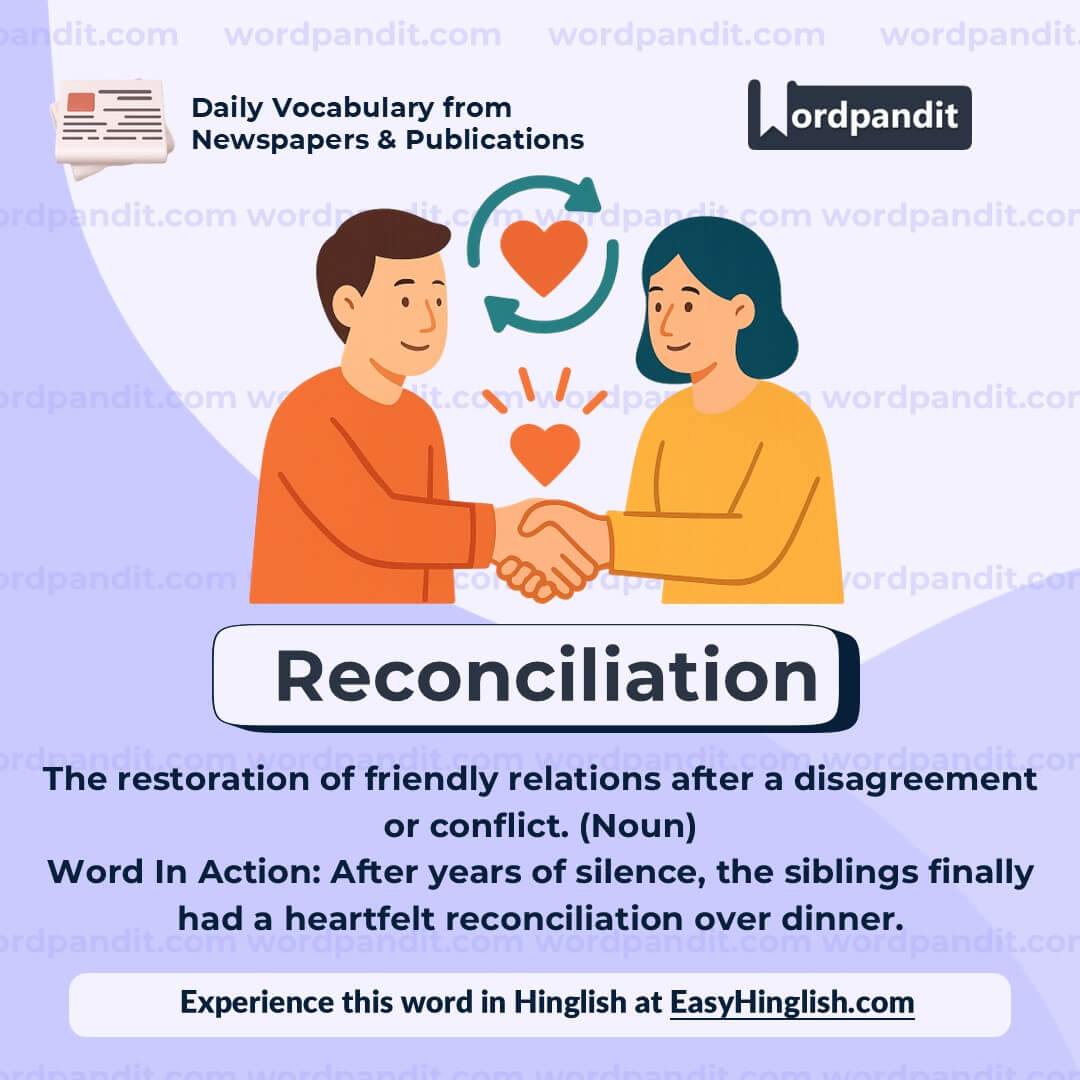
WORD-5: Reconciliation
Context:
"Trump’s ‘Liberation Day’ has become doomsday for global markets. Stocks are plunging big. Apple, Nvidia, Nike and other mega companies have lost hundreds of billions in value. World leaders are reeling between retaliation and reconciliation." - The Times of India
Explanatory Paragraph:
Reconciliation means restoring friendly or peaceful relations after a conflict, disagreement, or separation. It suggests healing wounds, overcoming hostility, and moving towards harmony. While often used in personal relationships, it is also a common term in politics, diplomacy, and economics where opposing sides try to settle disputes and build cooperation again.
Meaning: The act of restoring friendship, harmony, or peaceful relations after conflict (Noun)
Pronunciation: reh-kon-sil-ee-ay-shun
Difficulty Level: ⭐⭐ Easy
Etymology: From Latin reconciliare, meaning "to bring together again, to make friendly." It combines re- ("again") + conciliare ("make friendly, unite").
Prashant Sir's Notes:
This word is the opposite of "retaliation." Where retaliation escalates conflict, reconciliation tries to end it. It is a constructive word, often used in peace-building, diplomacy, and even financial contexts (like reconciling accounts).
Synonyms & Antonyms:
Synonyms: settlement, reunion, compromise, harmony, peace, conciliation
Antonyms: conflict, discord, hostility, division, retaliation
Usage Examples:
- The peace treaty marked a historic reconciliation between the two nations.
- After years of conflict, the siblings finally found reconciliation.
- The reconciliation process required both sides to admit mistakes and make compromises.
- In accounting, reconciliation ensures that financial records match correctly.
Cultural Reference:
South Africa’s Truth and Reconciliation Commission (1995) is one of the most famous examples, where victims and perpetrators of apartheid-era crimes came together to seek healing through truth-telling and forgiveness.
Think About It:
Is reconciliation possible without forgiveness? Or can people reconcile pragmatically without fully forgiving?
Quick Activity:
Write two short sentences: one about reconciliation in a personal context (family/friends) and one in an international or political context.
Memory Tip:
Break it as "re-" (again) + "conciliation" (harmony, agreement). Reconciliation = making peace again.
Real-World Application:
In the real world, reconciliation is used in peace processes between nations, in conflict resolution workshops, in workplaces to rebuild trust, and even in accounting to ensure books match correctly.


