

Daily Vocabulary from Indian Newspapers and Publications
Welcome to Wordpandit’s Indian Vocabulary Hub
At Wordpandit, we understand the importance of staying rooted in the local context while expanding your language skills. This section focuses on enriching your vocabulary with words and phrases drawn from India’s leading newspapers and publications, ensuring you're learning vocabulary that is practical, relevant, and uniquely Indian.
Why Indian Sources Matter
We believe that the best way to master any language is by immersing yourself in local content. That’s why we carefully curate vocabulary from top Indian publications, including:
- The Hindu
- The Times of India
- The Economic Times
- Hindustan Times
- Live Mint
- The Indian Express
- And many others...
Stay Updated, Stay Relevant
With daily updates from Indian news sources, you’ll be consistently learning words that reflect the trends and shifts in Indian society and culture. Our focus is to provide vocabulary that enhances your understanding of the language in an Indian context.
How Wordpandit Supports Your Goals
Whether you’re preparing for exams, aiming to improve your professional communication, or simply want to stay connected with the latest Indian vocabulary, Wordpandit is here to guide you every step of the way.
Learn with a Practical Approach
Our interactive learning methodology includes real-world examples, engaging activities, and context-specific usage to ensure that every word becomes part of your active vocabulary.
Dive into Indian Vocabulary Today!

Why Choose Wordpandit?
Practical Learning: Focus on words you'll actually encounter in real-world reading, enhancing your comprehension and communication skills.
Diverse Content: From current affairs to scientific breakthroughs, our varied sources expose you to vocabulary across multiple domains.
Effortless Integration: Make Wordpandit a part of your daily routine. Just a few minutes each day can significantly boost your lexicon over time.
Your Path to Vocabulary Mastery
- Visit our Daily Vocabulary section regularly
- Explore new words and their usage in context
- Practice incorporating these words into your own writing and speech
- Track your progress as your vocabulary expands
Start Your Journey Today
Embark on your vocabulary enhancement journey with Wordpandit. By consistently engaging with our daily posts, you'll build a robust vocabulary that serves you well in academic, professional, and personal contexts.
Remember, a word a day keeps linguistic limitations at bay. Make Wordpandit your daily companion in the quest for vocabulary excellence!
WORD-1: Sparse
Context:
"India still has regions where fiber optic cables have never reached and cellular towers remain sparse. SpaceX’s recent partnerships with Airtel and Jio to expand Starlink services across India could be looked at as a fundamental shift in the conceptions of connectivity, national sovereignty, and economic power in the digital age." - The Hindu
Explanatory Paragraph:
The word sparse is used to describe something that is thinly spread, scattered, or not dense. When something is sparse, it exists in small amounts and is spread out with a lot of gaps in between. For example, a sparse forest has few trees with large empty spaces, and sparse population means fewer people living in a large area.
Meaning: Thinly scattered, not dense, meager (Adjective)
Pronunciation: spahrs
Difficulty Level: ⭐⭐ (Basic-Intermediate)
Etymology: From Latin "sparsus" meaning "scattered" or "spread out".
Prashant Sir's Notes:
Think of “sparse” as the opposite of “dense.” Whenever you see gaps, emptiness, or thin distribution, the word sparse fits perfectly. Very useful in describing population, vegetation, resources, or even data.
Synonyms & Antonyms:
Synonyms: scattered, meager, thin, limited, scanty
Antonyms: dense, abundant, plentiful, crowded, rich
Usage Examples:
- The desert has sparse vegetation due to lack of water.
- Attendance at the seminar was sparse because of heavy rains.
- In rural areas, hospitals are sparse and far apart.
- The report was sparse on details, leaving many questions unanswered.
Cultural Reference:
"Astronauts often describe outer space as vast and sparse, filled with darkness and stars scattered like dust." - NASA Space Interviews
Think About It:
How does the sparsity of resources in certain regions shape the way people live, adapt, and innovate?
Quick Activity:
Fill in the blank: “The mountain village was so ______ in population that everyone knew each other personally.”
Memory Tip:
Think of “sparse” as “scarce + space” → something scarce and spread out in space.
Real-World Application:
Urban planners use the term “sparse” to describe areas with low population density, helping governments decide where to build infrastructure, schools, or hospitals.
WORD-2: Sovereignty
Context:
"India still has regions where fiber optic cables have never reached and cellular towers remain sparse. SpaceX’s recent partnerships with Airtel and Jio to expand Starlink services across India could be looked at as a fundamental shift in the conceptions of connectivity, national sovereignty, and economic power in the digital age." - The Hindu
Explanatory Paragraph:
The word sovereignty refers to the supreme power or authority of a state to govern itself without outside interference. It means having complete control over laws, policies, and decisions within one’s territory. In modern discussions, sovereignty also covers digital and economic independence, not just political borders.
Meaning: Supreme power or authority, especially of a state to govern itself (Noun)
Pronunciation: sov-rin-tee / sov-ur-en-tee
Difficulty Level: ⭐⭐⭐ (Intermediate-Advanced)
Etymology: From Old French "souveraineté", based on Latin "superanus" meaning "chief, principal, above".
Prashant Sir's Notes:
Always link “sovereignty” to independence and self-rule. In exams and current affairs, the word appears frequently in discussions about international relations, digital control, and national policies.
Synonyms & Antonyms:
Synonyms: autonomy, independence, self-rule, supremacy, jurisdiction
Antonyms: dependence, subordination, submission, colony, control
Usage Examples:
- The treaty threatened the nation’s sovereignty by giving control to foreign powers.
- Digital sovereignty has become a key issue in the age of global tech companies.
- The king ruled with absolute sovereignty over his lands.
- Protecting food sovereignty ensures that communities control how their food is produced.
Cultural Reference:
"Sovereignty is not given, it is taken." - Subhas Chandra Bose, emphasizing India's fight for independence.
Think About It:
In the digital era, does true sovereignty lie only in political borders, or also in control over data, technology, and communication?
Quick Activity:
Fill in the blank: “The debate over __________ sovereignty has intensified with the rise of global internet platforms.”
Memory Tip:
Break it into “Sovereign + ty” → Sovereign means ruler, so sovereignty is the authority of a ruler or a nation.
Real-World Application:
The concept of sovereignty is crucial in international law, trade agreements, and digital regulations, where countries strive to protect their independence while engaging in globalization.
WORD-3: Irrational
Context:
"On April 2, US President Trump announced the highest, most irrational import tariffs since 1910, declaring this was America’s ‘Liberation Day’. It would be better to call it Recession Day. Or Trade War Day. Or Economic Stupidity Day." - The Times of India
Explanatory Paragraph:
The word irrational describes something that is not logical, reasonable, or based on clear thinking. It refers to actions, beliefs, or decisions that go against common sense or sound judgment. For example, someone who fears harmless things like shadows or makes extreme decisions without considering facts is acting irrationally.
Meaning: Not logical, unreasonable, lacking clear thought (Adjective)
Pronunciation: i-rash-uh-nuhl
Difficulty Level: ⭐⭐ (Basic-Intermediate)
Etymology: From Latin "irrationalis", where "in-" means "not" and "rationalis" means "reasonable".
Prashant Sir's Notes:
Think of irrational as “illogical.” It is widely used to describe bad decisions in economics, politics, or even everyday life choices. In exams, it often appears in comprehension passages related to behavior or policies.
Synonyms & Antonyms:
Synonyms: unreasonable, illogical, absurd, senseless, foolish
Antonyms: logical, reasonable, rational, sound, wise
Usage Examples:
- Her fear of elevators is completely irrational since they are very safe.
- The company made an irrational decision to expand during a financial crisis.
- It is irrational to believe that ignoring a problem will make it disappear.
- The child was crying irrationally over a toy he had already forgotten about.
Cultural Reference:
"Humans are not always rational creatures; emotions often drive irrational decisions." - Daniel Kahneman, Nobel Prize-winning psychologist and economist.
Think About It:
Why do humans often make irrational choices even when the logical alternative is clearly better?
Quick Activity:
Identify one irrational belief or superstition in your culture. Can you explain why it persists despite being illogical?
Memory Tip:
“Irrational” = “not rational.” Just remember the prefix “ir-” means “not.”
Real-World Application:
In economics and psychology, “irrational behavior” is a key concept used to explain why people often act against their best interests, such as overspending or panic buying.
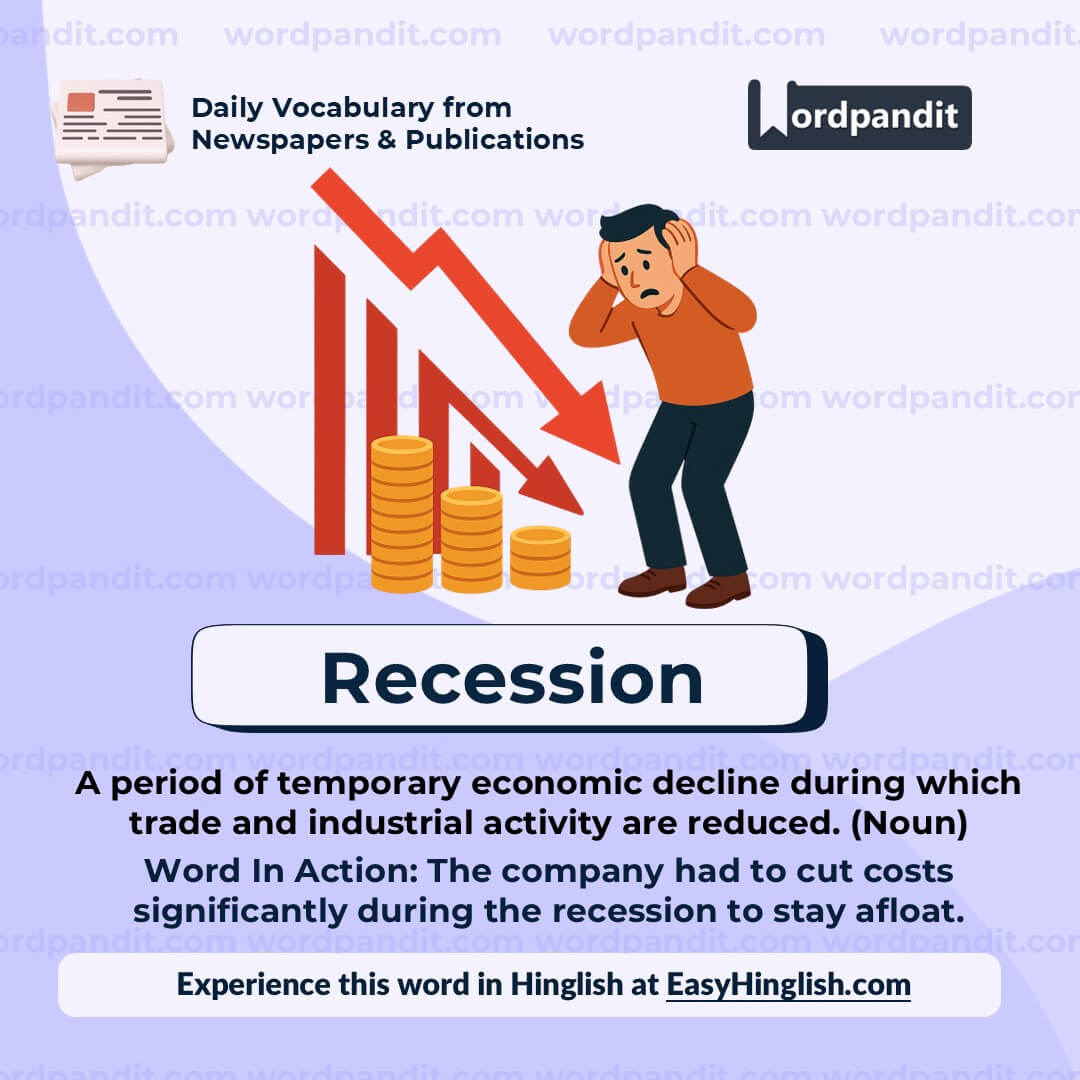
WORD-4: Recession
Context:
"On April 2, US President Trump announced the highest, most irrational import tariffs since 1910, declaring this was America’s ‘Liberation Day’. It would be better to call it Recession Day. Or Trade War Day. Or Economic Stupidity Day." - The Times of India
Explanatory Paragraph:
The word recession refers to a slowdown in economic activity, usually marked by a decline in GDP, employment, trade, and overall spending. It is often considered a shorter and less severe phase compared to a depression. For everyday understanding, a recession means jobs are harder to find, businesses earn less, and people tend to spend more cautiously.
Meaning: A period of temporary economic decline during which trade, business, and employment activities are reduced (Noun)
Pronunciation: ri-sesh-uhn
Difficulty Level: ⭐⭐⭐ (Intermediate-Advanced)
Etymology: From Latin "recessio" meaning "a going back, retreat", from "recedere" ("to recede or withdraw").
Prashant Sir's Notes:
Whenever you hear “recession,” think of economic slowdown — less demand, fewer jobs, and lower growth. It’s one of the most important words in business and current affairs vocabulary.
Synonyms & Antonyms:
Synonyms: downturn, slump, slowdown, stagnation, crisis
Antonyms: boom, growth, prosperity, expansion, upturn
Usage Examples:
- The global recession of 2008 affected millions of jobs worldwide.
- Many businesses closed during the recession due to falling demand.
- Economists warn that high inflation may push the country into a recession.
- Governments often lower taxes or increase spending to fight recession.
Cultural Reference:
During the Great Recession of 2008, terms like “housing bubble” and “financial crisis” became part of everyday conversation worldwide.
Think About It:
Is recession always harmful, or can it sometimes serve as a reset for unsustainable economic practices?
Quick Activity:
Fill in the blank: “The country is showing signs of _________ after two consecutive quarters of negative GDP growth.”
Memory Tip:
Think of “recession” as “receding economy” → the economy pulling back or shrinking.
Real-World Application:
Recession is a key concept in economics, frequently discussed in news, policy debates, and financial planning, as it affects jobs, investments, and government decisions globally.
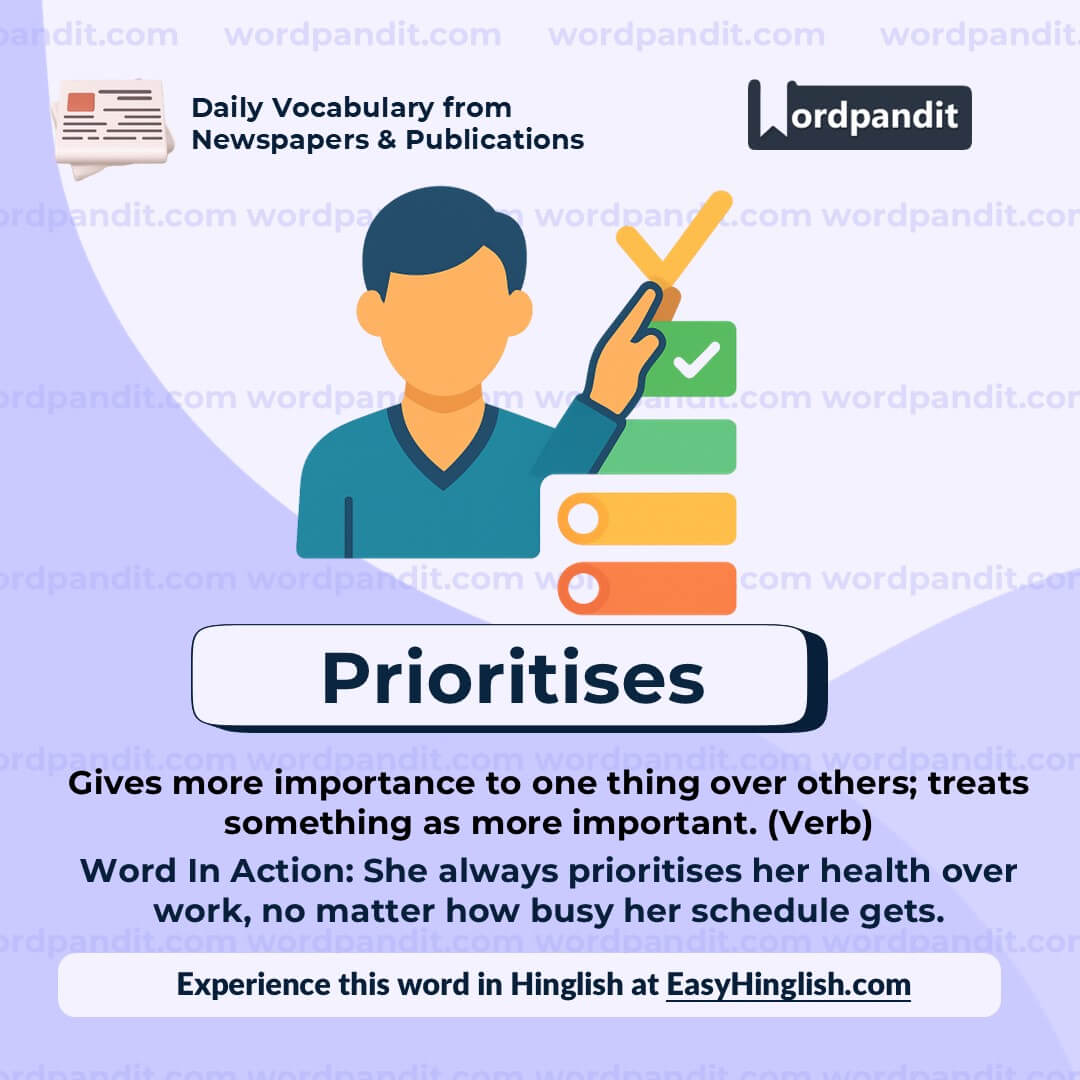
WORD-5: Prioritises
Context:
"The Supreme Court’s decision that judges should publicly declare their assets is welcome and significant, because it prioritises transparency and openness." - The Indian Express
Explanatory Paragraph:
The word prioritises means to give something greater importance over other things, often arranging tasks, values, or goals in order of significance. When we say an action prioritises something, it highlights that aspect as the main focus or top concern. In the context here, the Court is emphasizing transparency as the highest priority.
Meaning: To treat something as more important than other things; to give precedence (Verb)
Pronunciation: prai-or-i-taiz-iz
Difficulty Level: ⭐⭐ (Basic-Intermediate)
Etymology: From "priority" (Latin "prior" meaning "earlier, more important") + suffix "-ise" (to make or to act upon).
Prashant Sir's Notes:
Think of “prioritises” as making a list of what comes first. This word is often used in governance, time management, and corporate settings. In exams, it connects well with essays and comprehension themes on decision-making.
Synonyms & Antonyms:
Synonyms: emphasizes, values, favors, highlights, gives precedence
Antonyms: ignores, neglects, overlooks, sidelines, downplays
Usage Examples:
- A good manager prioritises teamwork over individual recognition.
- She prioritises her health by exercising regularly and eating well.
- The government prioritises education in its new budget plan.
- When facing deadlines, one must prioritise tasks wisely.
Cultural Reference:
Modern productivity systems, like the Eisenhower Matrix, are built on the idea of prioritising urgent and important tasks first.
Think About It:
If a society prioritises economic growth over environmental protection, what long-term consequences might it face?
Quick Activity:
Make a list of three things you prioritise most in your daily life. How do these choices reflect your values?
Memory Tip:
Think of “prioritises” as “giving priority” → what comes first on your to-do list.
Real-World Application:
In personal life, prioritising helps with time management and stress reduction. In governance and organizations, it determines where resources, money, and energy are directed.


