

Daily Vocabulary from Indian Newspapers and Publications
Welcome to Wordpandit’s Indian Vocabulary Hub
At Wordpandit, we understand the importance of staying rooted in the local context while expanding your language skills. This section focuses on enriching your vocabulary with words and phrases drawn from India’s leading newspapers and publications, ensuring you're learning vocabulary that is practical, relevant, and uniquely Indian.
Why Indian Sources Matter
We believe that the best way to master any language is by immersing yourself in local content. That’s why we carefully curate vocabulary from top Indian publications, including:
- The Hindu
- The Times of India
- The Economic Times
- Hindustan Times
- Live Mint
- The Indian Express
- And many others...
Stay Updated, Stay Relevant
With daily updates from Indian news sources, you’ll be consistently learning words that reflect the trends and shifts in Indian society and culture. Our focus is to provide vocabulary that enhances your understanding of the language in an Indian context.
How Wordpandit Supports Your Goals
Whether you’re preparing for exams, aiming to improve your professional communication, or simply want to stay connected with the latest Indian vocabulary, Wordpandit is here to guide you every step of the way.
Learn with a Practical Approach
Our interactive learning methodology includes real-world examples, engaging activities, and context-specific usage to ensure that every word becomes part of your active vocabulary.
Dive into Indian Vocabulary Today!

Why Choose Wordpandit?
Practical Learning: Focus on words you'll actually encounter in real-world reading, enhancing your comprehension and communication skills.
Diverse Content: From current affairs to scientific breakthroughs, our varied sources expose you to vocabulary across multiple domains.
Effortless Integration: Make Wordpandit a part of your daily routine. Just a few minutes each day can significantly boost your lexicon over time.
Your Path to Vocabulary Mastery
- Visit our Daily Vocabulary section regularly
- Explore new words and their usage in context
- Practice incorporating these words into your own writing and speech
- Track your progress as your vocabulary expands
Start Your Journey Today
Embark on your vocabulary enhancement journey with Wordpandit. By consistently engaging with our daily posts, you'll build a robust vocabulary that serves you well in academic, professional, and personal contexts.
Remember, a word a day keeps linguistic limitations at bay. Make Wordpandit your daily companion in the quest for vocabulary excellence!
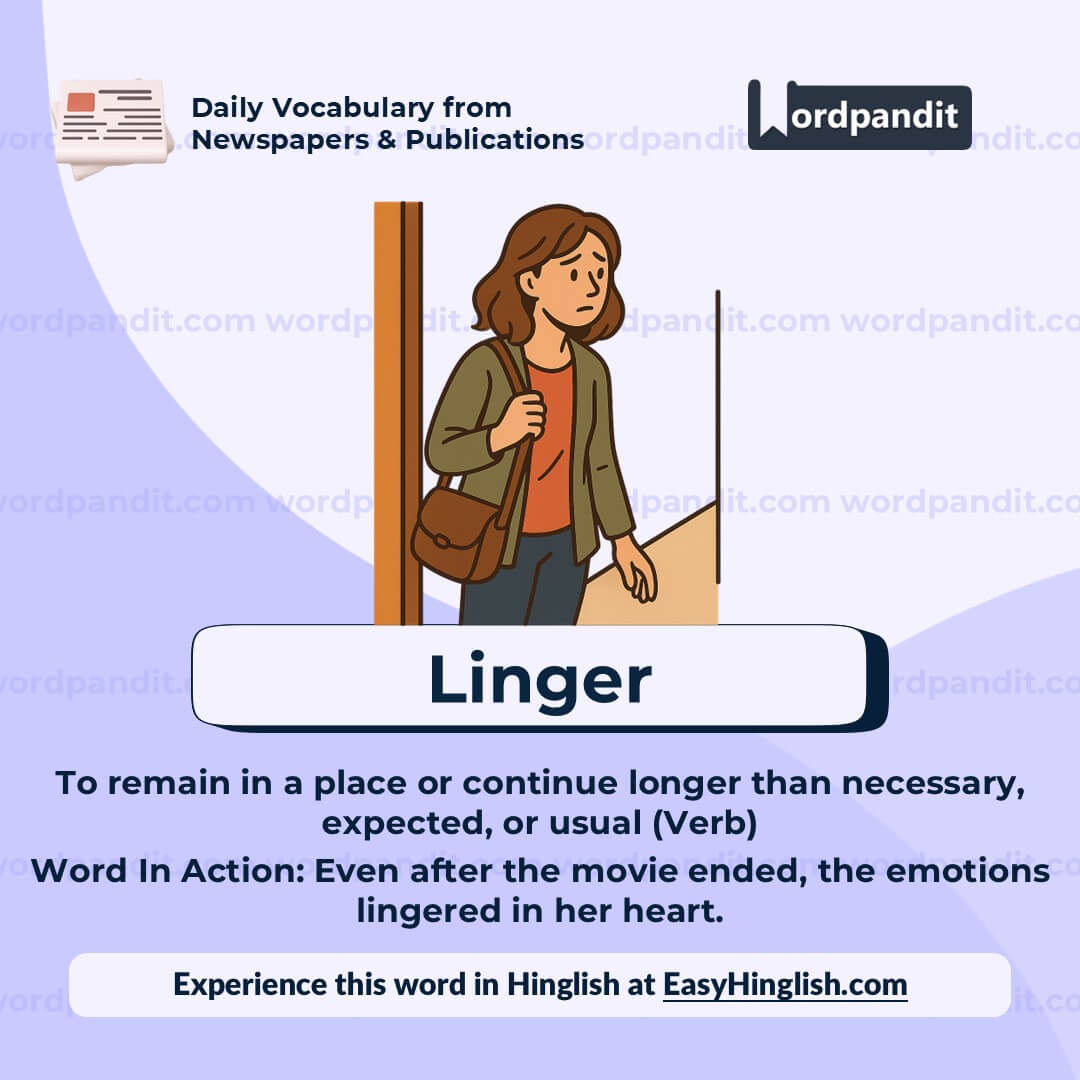
WORD-1: Linger
Context:
"A lot is discussed and debated about death and dying, and how most of us are so fearful of the end. Will it be painful? Will the end be sudden and peaceful or violent? Will I linger on, ailing in hospital, with life support?" - The Times of India
Explanatory Paragraph:
The word linger refers to staying in a place or state longer than expected or desired. It often conveys a sense of delay, slowness, or unwillingness to leave. In the given context, it suggests a prolonged, drawn-out existence, especially in a state of suffering, rather than a swift or peaceful ending.
Meaning: To remain or stay longer than necessary; to delay leaving; to persist. (Verb)
Pronunciation: LIN-ger
Difficulty Level: ⭐⭐ (Basic-Intermediate)
Etymology: From Middle English lingeren, frequentative of Old English lengan (“to prolong”), related to Old Norse lengja (“to lengthen”).
Prashant Sir's Notes:
The word "linger" often carries a slightly negative tone when used about illness, suffering, or indecision. However, it can also have a softer meaning, such as staying in a beautiful place or moment because it feels good.
Synonyms & Antonyms:
Synonyms: delay, remain, stay, tarry, loiter, dawdle
Antonyms: hurry, rush, leave, depart
Usage Examples:
- She liked to linger in the garden long after the sun had set.
- The smell of fresh paint lingered in the room for days.
- He lingered outside the office, unsure whether to go in.
- Her words lingered in his mind, making him rethink his choices.
Cultural Reference:
"Sweet is the memory of distant friends! Like the mellow rays of the departing sun, it falls tenderly, yet sadly, on the heart. Such memories linger." - Washington Irving
Think About It:
Do we linger in certain moments because they are truly valuable, or because we fear what comes next?
Quick Activity:
Write two sentences using "linger"—one in a positive sense (e.g., enjoying a moment) and one in a negative sense (e.g., prolonging suffering).
Memory Tip:
Think of "linger" as "longer." If something lingers, it stays longer than expected.
Real-World Application:
"Linger" is often used in healthcare discussions (patients lingering in illness), in hospitality (guests lingering at a party), and in daily life to describe moments, smells, or feelings that persist beyond their usual time.
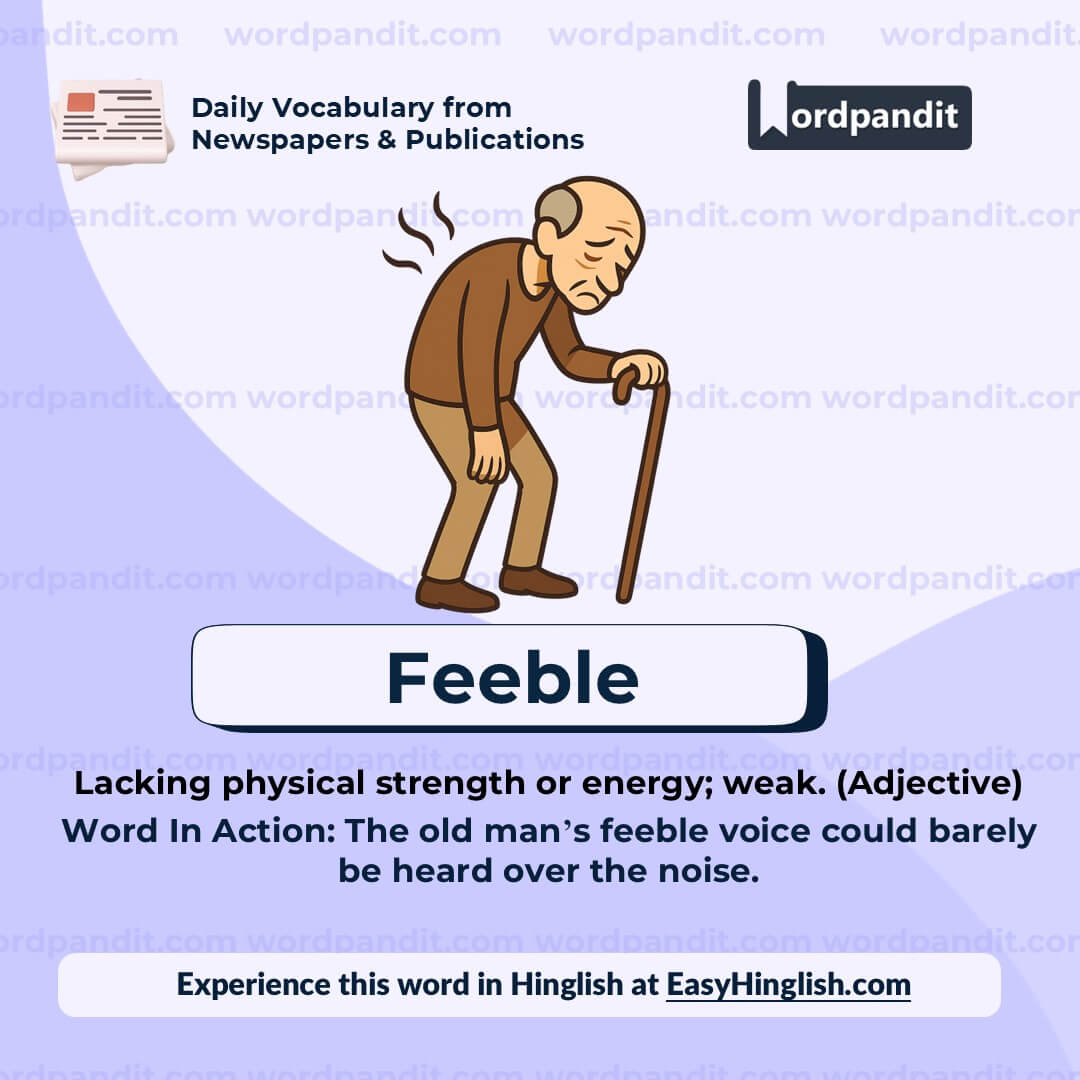
WORD-2: Feeble
Context:
"In reality, most of us are as fearful of living as we are of death. What if I live long years, turning feeble and disabled, and what if I become completely dependent on others for my sustenance and daily tasks?" - The Times of India
Explanatory Paragraph:
The word feeble describes a state of weakness, fragility, or lack of strength. It can apply to physical strength, mental energy, or even emotions and arguments. In the given context, it refers to the fear of growing old, frail, and dependent on others due to loss of physical ability.
Meaning: Weak, lacking strength or vitality; faint. (Adjective)
Pronunciation: FEE-buhl
Difficulty Level: ⭐⭐ (Basic-Intermediate)
Etymology: From Old French feble, from Latin flebilis (“lamentable, weak”), later influenced by Latin flebilis and debilis (“weak”).
Prashant Sir's Notes:
"Feeble" is often used in two ways: literally, to describe physical weakness, and metaphorically, to describe arguments, excuses, or efforts that are weak or unconvincing. Always check the tone—it can be sympathetic (as in old age) or critical (as in a feeble excuse).
Synonyms & Antonyms:
Synonyms: weak, frail, fragile, powerless, delicate
Antonyms: strong, sturdy, powerful, robust
Usage Examples:
- After the illness, he felt too feeble to walk without support.
- The student’s feeble excuse did not convince the teacher.
- A feeble light glimmered from the lantern in the distance.
- Her feeble attempt at singing still made everyone smile warmly.
Cultural Reference:
"It is not the strength of the body that counts, but the strength of the spirit." – J.R.R. Tolkien. This reflects how physical feebleness can be countered by inner resilience.
Think About It:
Is being "feeble" always a weakness, or can it also represent a stage of life that teaches humility and dependence?
Quick Activity:
Write two short sentences using "feeble": one to describe a person’s physical condition, and one to describe a weak argument or idea.
Memory Tip:
Remember "feeble" sounds like "feeble little candle flame"—small, weak, and faint.
Real-World Application:
The word "feeble" is common in medical discussions (feeble patients), in everyday life (feeble efforts), and in criticism (feeble excuses). It’s useful for describing both physical weakness and lack of strength in ideas or actions.
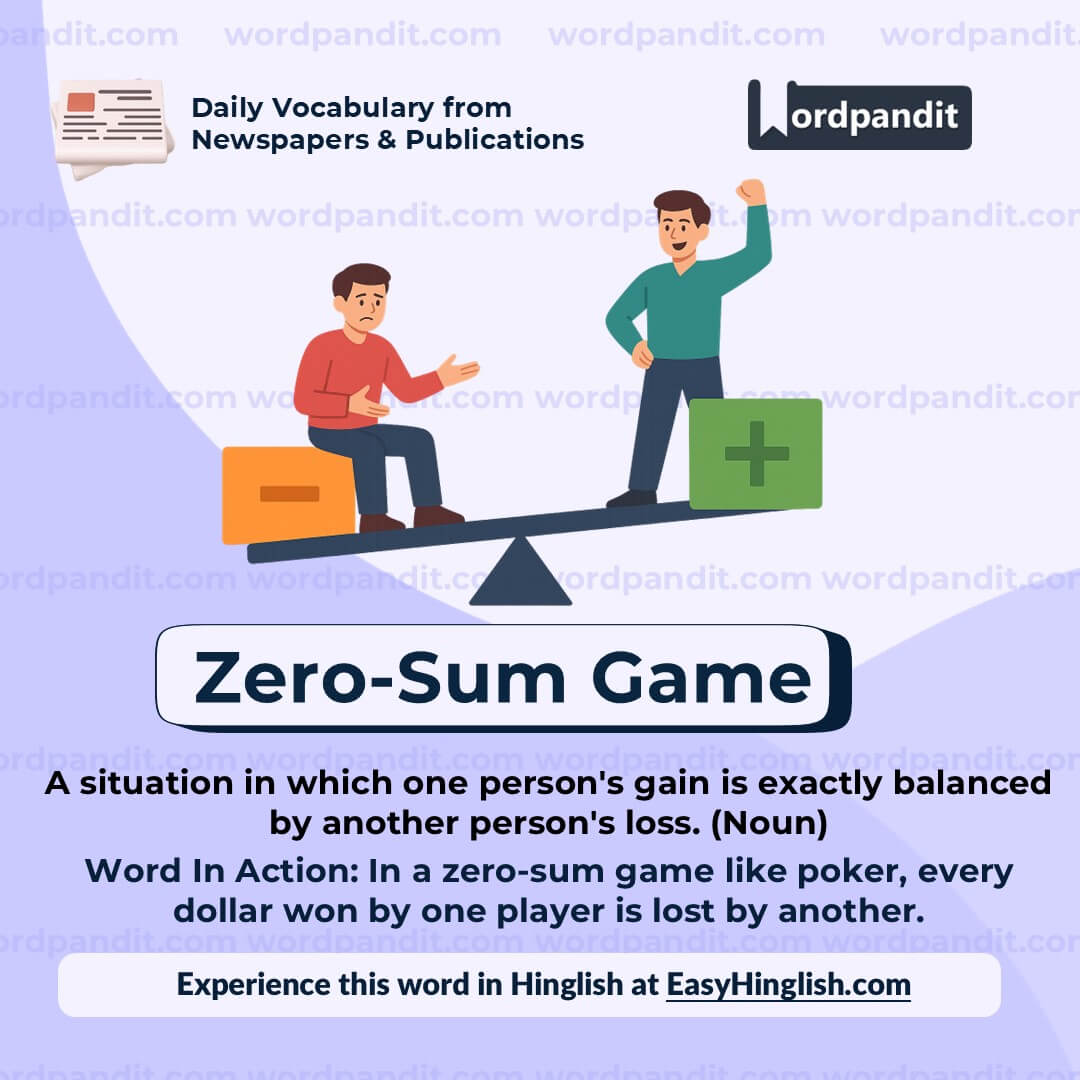
WORD-3: Zero-Sum Game
Context:
"It is not a zero-sum game for both sides. There are economic benefits for all. For Airtel and Jio, Starlink allows them to provide high-speed Internet to India’s most remote regions without the infrastructure costs of terrestrial networks. For SpaceX, the deal opens up a huge market." - The Hindu
Explanatory Paragraph:
A zero-sum game is a situation where one person’s gain is exactly equal to another person’s loss—like splitting a fixed pie. If one side takes more, the other side gets less. However, in many real-world scenarios (like business partnerships or technology collaborations), both sides can benefit, making it a "win-win" rather than a zero-sum game. The given context explains that Airtel, Jio, and SpaceX all benefit without harming each other’s interests.
Meaning: A competitive situation where one party’s gain is exactly balanced by another party’s loss. (Noun phrase)
Pronunciation: ZEE-roh-sum game
Difficulty Level: ⭐⭐⭐ (Intermediate-Advanced, especially in economics and strategy)
Etymology: From game theory and mathematics, where the "sum" of wins and losses equals zero, meaning total wealth or advantage is fixed.
Prashant Sir's Notes:
Students should note that "zero-sum game" is widely used beyond mathematics—in economics, politics, sports, and even daily life. Whenever you think gains must come at someone else’s cost, that is a zero-sum mindset. But life often offers positive-sum outcomes where all sides can benefit.
Synonyms & Antonyms:
Synonyms: cutthroat competition, fixed-pie situation
Antonyms: win-win situation, positive-sum game, collaboration
Usage Examples:
- Negotiating trade is not always a zero-sum game—both countries can gain from cooperation.
- He viewed relationships as a zero-sum game, always worried that someone else’s success meant his loss.
- In sports, winning the match is a zero-sum game—one team’s victory is another’s defeat.
- The manager explained that teamwork should not be treated like a zero-sum game; everyone can grow together.
Cultural Reference:
In game theory, John von Neumann’s work (1944, *Theory of Games and Economic Behavior*) formally introduced the idea of zero-sum games, which later influenced economics, politics, and even military strategy.
Think About It:
Do we miss opportunities for growth because we assume life is a zero-sum game, instead of seeking win-win outcomes?
Quick Activity:
Think of two examples in daily life: one that is truly a zero-sum game (like dividing a cake) and one that is not (like sharing knowledge). Write them down.
Memory Tip:
Remember it as a "zero pie"—the pie size never changes. If you take a bigger slice, someone else’s slice becomes smaller.
Real-World Application:
"Zero-sum game" is widely used in economics, politics, and business. For example, elections are zero-sum (one winner, one loser), but business deals or innovations can be positive-sum, where everyone gains. Recognizing this distinction helps in better decision-making.

WORD-4: Terrestrial
Context:
"It is not a zero-sum game for both sides. There are economic benefits for all. For Airtel and Jio, Starlink allows them to provide high-speed Internet to India’s most remote regions without the infrastructure costs of terrestrial networks. For SpaceX, the deal opens up a huge market." - The Hindu
Explanatory Paragraph:
The word terrestrial relates to the Earth or land, as opposed to the sea, air, or outer space. In the given context, "terrestrial networks" refers to communication systems built on Earth using cables, towers, and ground-based infrastructure, unlike satellite-based systems. More broadly, the word is used in science, geography, and everyday language to describe anything that belongs to or is located on the Earth’s surface.
Meaning: Of, on, or relating to the Earth or land, as opposed to the sky or space. (Adjective)
Pronunciation: tuh-RES-tree-uhl
Difficulty Level: ⭐⭐⭐ (Intermediate)
Etymology: From Latin terrestris, derived from terra meaning "earth, land".
Prashant Sir's Notes:
Remember that "terrestrial" is often contrasted with "extraterrestrial" (beyond Earth). In technology, it usually refers to ground-based systems, while in biology, it refers to land-living organisms. Context decides the exact meaning.
Synonyms & Antonyms:
Synonyms: earthly, land-based, ground-based
Antonyms: extraterrestrial, celestial, space-based
Usage Examples:
- The Amazon rainforest is home to countless terrestrial species.
- Unlike terrestrial radio, satellite radio can broadcast across entire continents.
- Many terrestrial plants cannot survive underwater for long.
- Space exploration often compares terrestrial life with the possibility of extraterrestrial life.
Cultural Reference:
In popular culture, the word appears in the term "extraterrestrial," famously used in the movie E.T. the Extra-Terrestrial (1982), which portrays a life form from beyond Earth.
Think About It:
How does the distinction between terrestrial and extraterrestrial shape our understanding of life and technology?
Quick Activity:
Write two sentences: one using "terrestrial" to describe technology (like networks), and another using it to describe living organisms.
Memory Tip:
Think of "terra" = Earth. Anything "terrestrial" is rooted in the Earth.
Real-World Application:
"Terrestrial" is used in technology (terrestrial networks, terrestrial TV), biology (terrestrial animals), and astronomy (terrestrial planets like Earth, Mars, Venus). Its meaning shifts slightly depending on the field, but always connects back to Earth or land.

WORD-5: Zeal
Context:
"Manoj Kumar’s nationalistic zeal came forward at a time when India had undergone the trauma of fighting a war with China in 1962, and with Pakistan in 1965 and in 1971." - The Indian Express
Explanatory Paragraph:
The word zeal refers to passionate enthusiasm, energy, or devotion toward a cause, belief, or activity. It conveys an intense desire to achieve or support something wholeheartedly. In the given context, it describes the strong patriotic passion expressed by actor Manoj Kumar through his films, which resonated with a nation recovering from war and seeking unity and inspiration.
Meaning: Great energy or enthusiasm in pursuit of a cause or objective. (Noun)
Pronunciation: ZEEL
Difficulty Level: ⭐⭐ (Basic-Intermediate)
Etymology: From Late Latin zelus ("ardor, emulation"), from Greek zēlos meaning "zeal, rivalry, eager pursuit."
Prashant Sir's Notes:
Zeal has a positive tone when used for dedication and passion, but it can take on a negative shade when it becomes excessive or fanatical (as in "overzealous"). Balance is key to understanding this word’s use in different contexts.
Synonyms & Antonyms:
Synonyms: passion, fervor, enthusiasm, devotion, eagerness
Antonyms: apathy, indifference, lethargy, disinterest
Usage Examples:
- She pursued her studies with such zeal that her teachers were deeply impressed.
- The volunteers worked with zeal to help flood-affected families.
- His religious zeal sometimes made others uncomfortable.
- The young athlete trained with zeal, determined to make it to the national team.
Cultural Reference:
In Indian cinema, Manoj Kumar was nicknamed "Bharat Kumar" because of his patriotic zeal reflected in films like Upkar (1967), which strongly resonated with audiences after national conflicts.
Think About It:
When does "zeal" become an inspiring force, and when does it risk turning into dangerous fanaticism?
Quick Activity:
Fill in the blank:
1) She approached her new job with great ________.
2) His ________ for environmental issues inspired the whole community.
Memory Tip:
Think of "zeal" as "seal" of energy—you put a seal of passion and enthusiasm on whatever you do.
Real-World Application:
"Zeal" is often used in politics (nationalistic zeal), religion (religious zeal), academics (zeal for learning), and activism (zeal for social justice). It highlights human passion and drive, but its intensity can be both constructive and destructive.


