

Daily Vocabulary from Indian Newspapers and Publications
Welcome to Wordpandit’s Indian Vocabulary Hub
At Wordpandit, we understand the importance of staying rooted in the local context while expanding your language skills. This section focuses on enriching your vocabulary with words and phrases drawn from India’s leading newspapers and publications, ensuring you're learning vocabulary that is practical, relevant, and uniquely Indian.
Why Indian Sources Matter
We believe that the best way to master any language is by immersing yourself in local content. That’s why we carefully curate vocabulary from top Indian publications, including:
- The Hindu
- The Times of India
- The Economic Times
- Hindustan Times
- Live Mint
- The Indian Express
- And many others...
Stay Updated, Stay Relevant
With daily updates from Indian news sources, you’ll be consistently learning words that reflect the trends and shifts in Indian society and culture. Our focus is to provide vocabulary that enhances your understanding of the language in an Indian context.
How Wordpandit Supports Your Goals
Whether you’re preparing for exams, aiming to improve your professional communication, or simply want to stay connected with the latest Indian vocabulary, Wordpandit is here to guide you every step of the way.
Learn with a Practical Approach
Our interactive learning methodology includes real-world examples, engaging activities, and context-specific usage to ensure that every word becomes part of your active vocabulary.
Dive into Indian Vocabulary Today!

Why Choose Wordpandit?
Practical Learning: Focus on words you'll actually encounter in real-world reading, enhancing your comprehension and communication skills.
Diverse Content: From current affairs to scientific breakthroughs, our varied sources expose you to vocabulary across multiple domains.
Effortless Integration: Make Wordpandit a part of your daily routine. Just a few minutes each day can significantly boost your lexicon over time.
Your Path to Vocabulary Mastery
- Visit our Daily Vocabulary section regularly
- Explore new words and their usage in context
- Practice incorporating these words into your own writing and speech
- Track your progress as your vocabulary expands
Start Your Journey Today
Embark on your vocabulary enhancement journey with Wordpandit. By consistently engaging with our daily posts, you'll build a robust vocabulary that serves you well in academic, professional, and personal contexts.
Remember, a word a day keeps linguistic limitations at bay. Make Wordpandit your daily companion in the quest for vocabulary excellence!

WORD-1: Ostensibly
Context:
"Among the assortment of colourful characters on season 3 of the trending show The White Lotus are three long-term girlfriends — ostensibly unwinding at a luxurious Koh Samui hotel but actually well in the throes of agonising mid-life crises." - The Indian Express
Explanatory Paragraph:
The word ostensibly is used when something appears to be true or seems to be a certain way, but the reality may be different. It often introduces a contrast between surface appearances and deeper truths. For example, someone may be "ostensibly working" at their desk while actually browsing social media.
Meaning: Apparently or seemingly, but not necessarily so (Adverb)
Pronunciation: uh-STEN-suh-blee
Difficulty Level: ⭐⭐⭐ Intermediate
Etymology: From Latin ostendere meaning "to show", through French ostensible, giving the sense of "outwardly shown".
Prashant Sir's Notes:
Think of "ostensibly" as what is shown on the outside but may not be the truth inside. It signals a gap between appearance and reality.
Synonyms & Antonyms:
Synonyms: apparently, seemingly, purportedly, outwardly
Antonyms: actually, truly, really, genuinely
Usage Examples:
- He was ostensibly on a business trip, but his colleagues knew he was on vacation.
- The plan was ostensibly designed to reduce costs, yet it ended up increasing expenses.
- Ostensibly, the meeting was about project updates, but the real motive was to assess team loyalty.
- She was ostensibly calm, though her trembling hands gave her away.
Cultural Reference:
"In politics, leaders are ostensibly working for the people, though personal interests often shape decisions." - Common commentary on governance
Think About It:
Why do people and institutions often present things ostensibly one way while hiding the true intention?
Quick Activity:
Write two sentences: one describing something as it ostensibly appears, and another revealing the hidden reality.
Memory Tip:
Break it as "O-STAND-SEE": What you see standing outside may not be what’s really happening inside.
Real-World Application:
In news, business, or politics, the word "ostensibly" is useful to highlight when appearances are misleading — for example, when a policy is ostensibly for public benefit but actually serves corporate interests.

WORD-2: Agonising
Context:
"Among the assortment of colourful characters on season 3 of the trending show The White Lotus are three long-term girlfriends — ostensibly unwinding at a luxurious Koh Samui hotel but actually well in the throes of agonising mid-life crises." - The Indian Express
Explanatory Paragraph:
Agonising meaning in English is 'causing extreme physical or mental pain and distress.' This word is used when describing situations, decisions, or experiences that involve intense suffering or difficulty. How to use agonising effectively is important for CAT, GRE, and UPSC aspirants, as it frequently appears in formal writing, news articles, and competitive exam passages to convey deep emotional or physical torment, making it stronger than simply saying 'painful' or 'difficult.'
Meaning: Causing extreme physical or mental pain; involving great distress or suffering (Adjective)
Pronunciation: AG-uh-ny-zing
Difficulty Level: ⭐⭐ Basic to Intermediate
Etymology: Agonising comes from the Greek word 'agonizesthai' meaning 'to contend for a prize' or 'to struggle,' derived from 'agon' (contest). The word evolved through Latin 'agonizare' to describe intense struggle and eventually came to mean experiencing or causing extreme pain or distress, reflecting the mental and physical anguish of a difficult struggle.
Prashant Sir's Notes:
Many students confuse agonising with simply 'painful'—but the difference between agonising and painful is intensity. Agonising usage in sentences implies extreme, prolonged suffering that's almost unbearable, while painful can be mild. For CAT and GRE aspirants, agonising frequently appears in RC passages describing emotional dilemmas or difficult decisions. In Indian English newspapers, you'll often see 'agonising wait' or 'agonising choice'—this word signals that someone is experiencing profound mental torture. How to use agonising correctly: pair it with decisions, waits, processes, or experiences that involve real torment, not just inconvenience.
Synonyms & Antonyms:
Synonyms: excruciating, torturous, tormenting, harrowing, painful, distressing, gut-wrenching, unbearable, anguishing, racking
Antonyms: pleasant, comfortable, painless, easy, soothing, enjoyable
Usage Examples:
- After the Mumbai terror attacks, families faced an agonising wait for news about their loved ones trapped inside the Taj Hotel.
- Priya spent three agonising hours in the interview, answering technical questions that tested the limits of her preparation and patience.
- The selection committee faced an agonising decision between two equally deserving candidates for the single scholarship to Oxford University.
- Watching his father's health deteriorate slowly was an agonising experience that Rajesh wouldn't wish on anyone.
Cultural Reference:
"The agonising final over of the 2019 World Cup, where England won on boundary count against New Zealand, remains one of cricket's most dramatic moments." - Cricket commentary on heartbreaking finishes
Think About It:
Why do some of life's most important decisions—choosing a career path, moving to a new city, or ending a relationship—feel so agonising even when we know what the right choice is?
Quick Activity:
Think of a difficult decision you've had to make recently. Write two sentences describing why it was agonising, using the word naturally in your description.
Memory Tip:
Remember 'Agonising' by connecting it to 'AGONY-RISING'—imagine pain or suffering rising to an extreme level. Think of Dhoni's agonising moment when he got run out in the 2019 World Cup semi-final, watching India's hopes fade while he walked back slowly in extreme mental anguish.
Real-World Application:
In news journalism and feature writing, 'agonising' is commonly used to describe emotionally charged situations—from families waiting for exam results to businesses making difficult layoff decisions. Corporate emails and formal reports use it to convey the seriousness of tough choices. For competitive exam essays, using 'agonising' instead of just 'difficult' demonstrates vocabulary sophistication and helps you express emotional intensity more precisely.
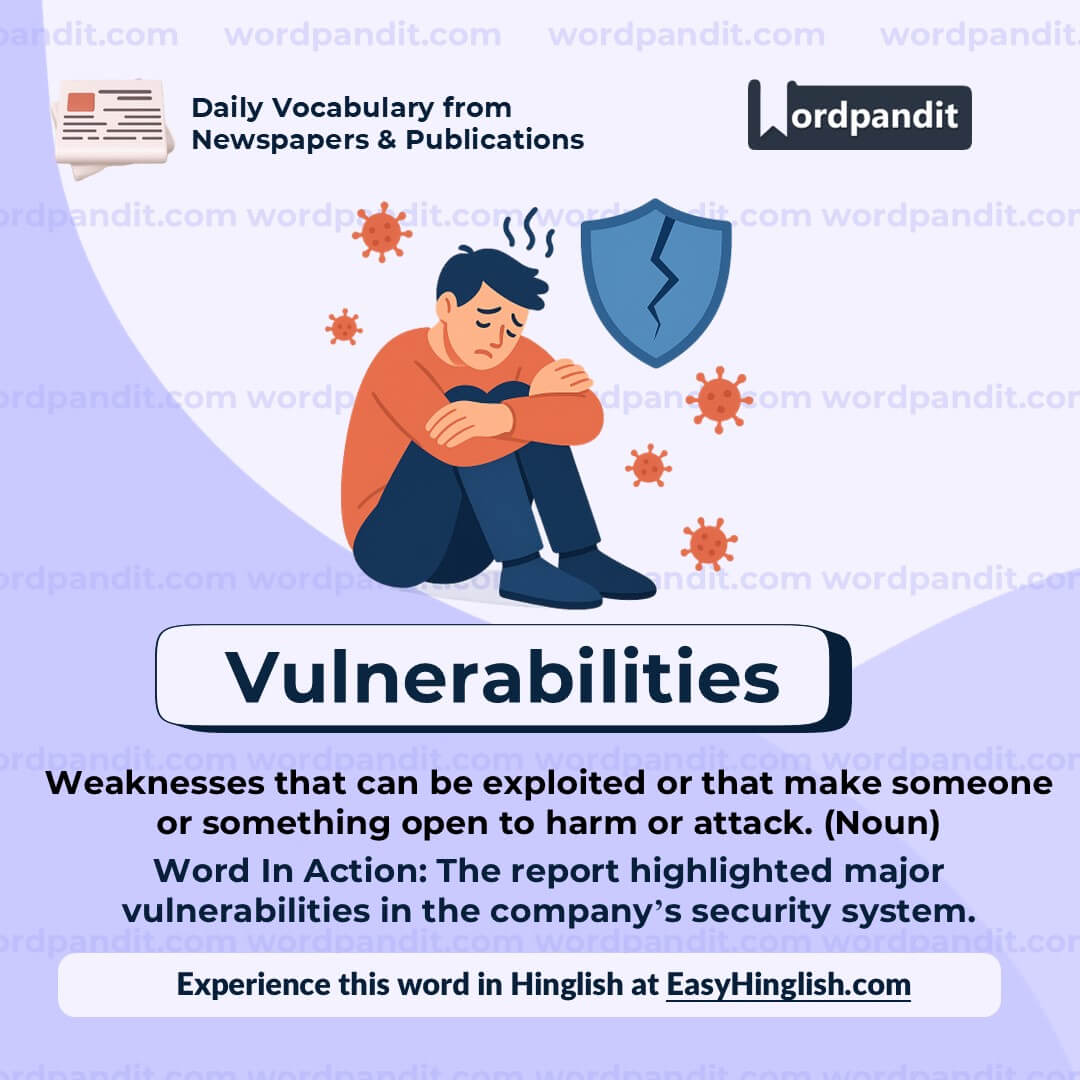
WORD-3: Vulnerabilities
Context:
"Personal data is central to digital economies, enabling access to a range of services while also creating vulnerabilities. Data protection laws have been seen as safeguards against misuse." - The Hindu
Explanatory Paragraph:
The word vulnerabilities refers to weaknesses or points of exposure that can be exploited, causing harm or damage. These weaknesses may be physical, emotional, or digital. In the context of technology, "vulnerabilities" often refer to security flaws that hackers can exploit. In life, it can also mean the emotional openness that leaves someone susceptible to hurt.
Meaning: Weaknesses or susceptibilities that make someone or something open to harm, attack, or exploitation (Noun – plural)
Pronunciation: vul-nuh-ruh-BIL-uh-tees
Difficulty Level: ⭐⭐⭐ Intermediate
Etymology: From Latin vulnerare meaning "to wound" (from vulnus, "wound"). The word evolved through Old French vulnerable into English, gaining the sense of being "open to injury or attack."
Prashant Sir's Notes:
Think of "vulnerabilities" as cracks in armor — areas where one is exposed to harm, whether in digital systems, organizations, or human emotions.
Synonyms & Antonyms:
Synonyms: weaknesses, susceptibilities, exposures, risks, frailties
Antonyms: strengths, defenses, safeguards, protections
Usage Examples:
- The audit revealed serious vulnerabilities in the company’s security system.
- Sharing personal feelings can sometimes expose our emotional vulnerabilities.
- The government is working to address vulnerabilities in critical infrastructure.
- Cybercriminals often exploit vulnerabilities in outdated software.
Cultural Reference:
"Brené Brown, in her research on human connection, highlights how embracing our vulnerabilities can actually be a source of strength." - Popular psychology literature
Think About It:
Do vulnerabilities always represent weaknesses, or can they also lead to growth and deeper connections?
Quick Activity:
List two types of vulnerabilities you encounter in daily life — one digital (like weak passwords) and one personal (like fear of rejection).
Memory Tip:
Break it into "vulner" (wound) + "ability" (capacity) → the capacity to be wounded = vulnerability.
Real-World Application:
In cybersecurity, identifying vulnerabilities is crucial to protecting data. In leadership or relationships, acknowledging personal vulnerabilities can build trust and authenticity.
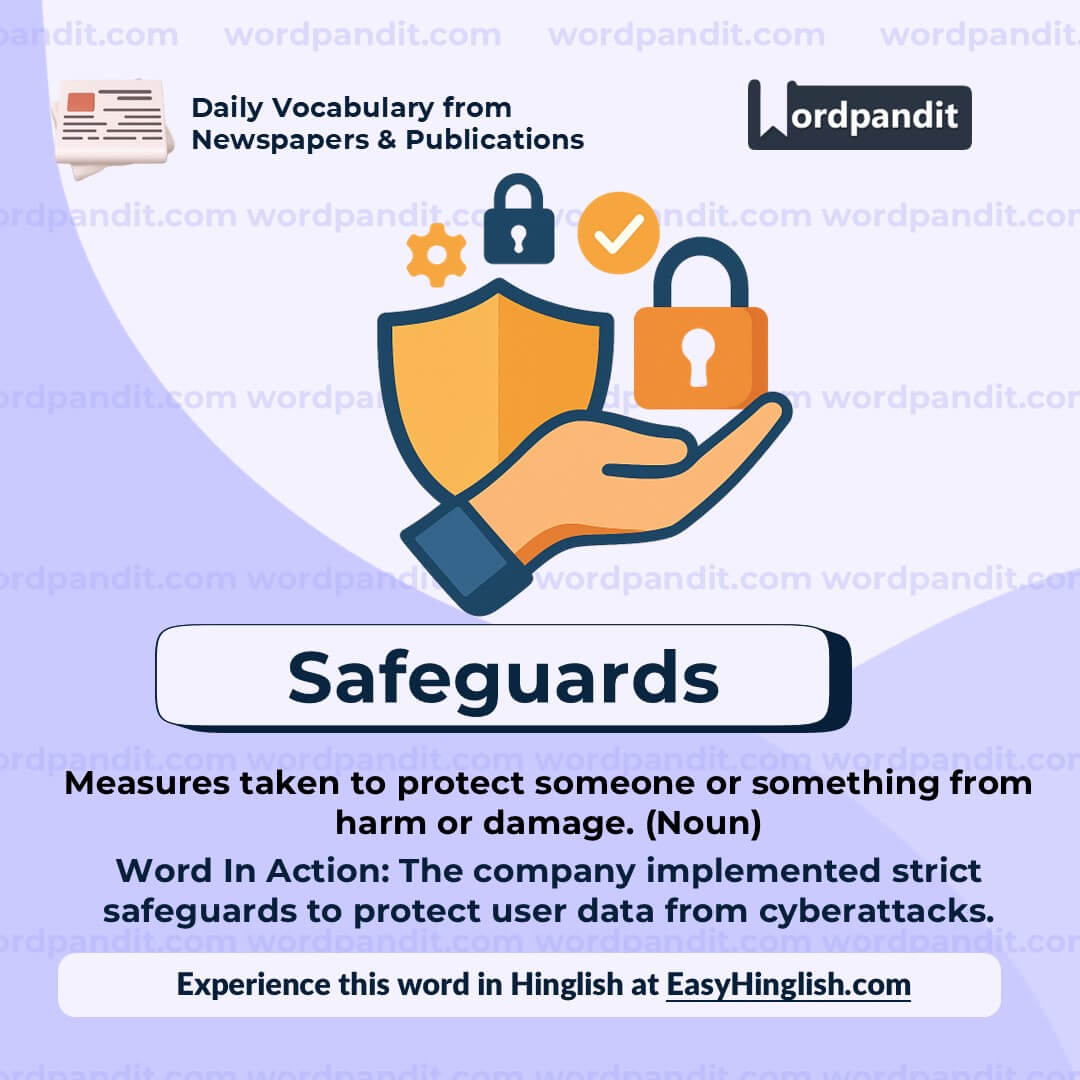
WORD-4: Safeguards
Context:
"Personal data is central to digital economies, enabling access to a range of services while also creating vulnerabilities. Data protection laws have been seen as safeguards against misuse." - The Hindu
Explanatory Paragraph:
The word safeguards refers to protective measures or actions put in place to prevent harm, danger, or misuse. They act like shields — reducing risks and providing security. For example, seat belts are safeguards against car accidents, while data protection laws act as safeguards against privacy violations.
Meaning: Measures or protections that prevent harm, danger, or misuse (Noun – plural)
Pronunciation: SAFE-guards
Difficulty Level: ⭐⭐ Basic to Intermediate
Etymology: From Middle English safe (free from danger) + guard (to protect). The term developed into "safeguard" meaning a protective measure.
Prashant Sir's Notes:
Safeguards are like security nets — they don’t stop the activity but ensure safety if something goes wrong. Always think of them as precautionary shields.
Synonyms & Antonyms:
Synonyms: protections, defenses, precautions, measures, shields
Antonyms: risks, dangers, threats, hazards
Usage Examples:
- The new policy introduced safeguards to protect consumer rights.
- Safety drills in schools act as safeguards against emergencies.
- Strong passwords are simple safeguards against hacking.
- The treaty included safeguards to prevent future conflicts between the nations.
Cultural Reference:
"Constitutions are designed as safeguards for citizens’ rights, ensuring no authority can misuse power." - Civic education perspective
Think About It:
Do too many safeguards protect freedom, or can they sometimes limit innovation and growth?
Quick Activity:
Write down three safeguards you use daily (for example: helmet, passwords, bank OTPs) and explain what risks they protect you from.
Memory Tip:
Split it as “SAFE + GUARD” → A guard that keeps you safe.
Real-World Application:
In everyday life, safeguards range from physical ones like airbags in cars to legal ones like consumer protection laws, all ensuring that people are shielded from harm or misuse.
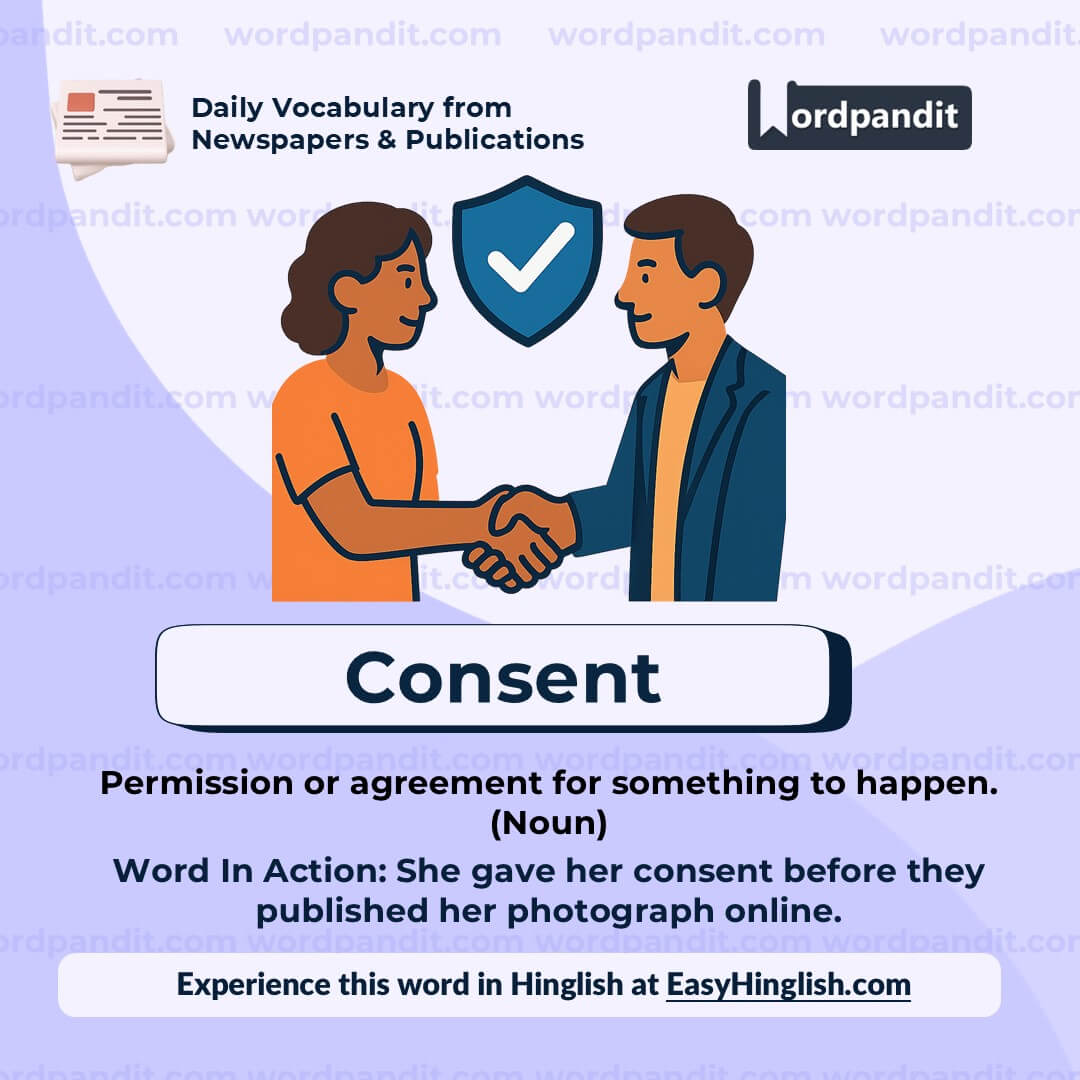
WORD-5: Consent
Context:
"Unlike global practices which allow greater flexibility, Draft Rule 10 of the DPDP Act outlines only two methods for obtaining parental consent on digital platforms." - The Hindu
Explanatory Paragraph:
The word consent refers to giving permission or approval for something to happen. It represents agreement that is given freely, often after understanding the situation or consequences. In legal, medical, and digital contexts, consent is crucial to ensure that actions taken are ethical and authorized. For example, a patient gives consent before surgery, and users give consent before their data is collected online.
Meaning: Permission or agreement for something to happen (Noun/Verb)
Pronunciation: kuhn-SENT
Difficulty Level: ⭐⭐ Basic
Etymology: From Latin consentire meaning "to agree, feel together," formed by con- (together) + sentire (to feel).
Prashant Sir's Notes:
Consent is not just a legal requirement; it’s about respect. Always connect it with the idea of free will — true consent means informed and voluntary agreement.
Synonyms & Antonyms:
Synonyms: permission, approval, agreement, authorization, assent
Antonyms: refusal, denial, objection, dissent
Usage Examples:
- The doctor asked for the patient’s written consent before performing the operation.
- Children cannot create accounts on certain platforms without parental consent.
- She gave her consent to participate in the research study.
- Without proper consent, the use of personal photos online may be unlawful.
Cultural Reference:
"In modern discussions about relationships, the phrase 'consent is key' emphasizes the importance of mutual agreement and respect." - Contemporary social discourse
Think About It:
Why is consent considered a cornerstone of trust in both personal relationships and digital interactions?
Quick Activity:
Write two situations where you must give consent — one legal (e.g., signing a contract) and one personal (e.g., lending your belongings).
Memory Tip:
Think of "consent" as "con" (together) + "sent" (to feel) → to feel together, i.e., to agree.
Real-World Application:
Consent is widely used in healthcare, education, business, and online platforms — ensuring that no action is taken without proper approval or authorization.


