

Daily Vocabulary from Indian Newspapers and Publications
Welcome to Wordpandit’s Indian Vocabulary Hub
At Wordpandit, we understand the importance of staying rooted in the local context while expanding your language skills. This section focuses on enriching your vocabulary with words and phrases drawn from India’s leading newspapers and publications, ensuring you're learning vocabulary that is practical, relevant, and uniquely Indian.
Why Indian Sources Matter
We believe that the best way to master any language is by immersing yourself in local content. That’s why we carefully curate vocabulary from top Indian publications, including:
- The Hindu
- The Times of India
- The Economic Times
- Hindustan Times
- Live Mint
- The Indian Express
- And many others...
Stay Updated, Stay Relevant
With daily updates from Indian news sources, you’ll be consistently learning words that reflect the trends and shifts in Indian society and culture. Our focus is to provide vocabulary that enhances your understanding of the language in an Indian context.
How Wordpandit Supports Your Goals
Whether you’re preparing for exams, aiming to improve your professional communication, or simply want to stay connected with the latest Indian vocabulary, Wordpandit is here to guide you every step of the way.
Learn with a Practical Approach
Our interactive learning methodology includes real-world examples, engaging activities, and context-specific usage to ensure that every word becomes part of your active vocabulary.
Dive into Indian Vocabulary Today!

Why Choose Wordpandit?
Practical Learning: Focus on words you'll actually encounter in real-world reading, enhancing your comprehension and communication skills.
Diverse Content: From current affairs to scientific breakthroughs, our varied sources expose you to vocabulary across multiple domains.
Effortless Integration: Make Wordpandit a part of your daily routine. Just a few minutes each day can significantly boost your lexicon over time.
Your Path to Vocabulary Mastery
- Visit our Daily Vocabulary section regularly
- Explore new words and their usage in context
- Practice incorporating these words into your own writing and speech
- Track your progress as your vocabulary expands
Start Your Journey Today
Embark on your vocabulary enhancement journey with Wordpandit. By consistently engaging with our daily posts, you'll build a robust vocabulary that serves you well in academic, professional, and personal contexts.
Remember, a word a day keeps linguistic limitations at bay. Make Wordpandit your daily companion in the quest for vocabulary excellence!
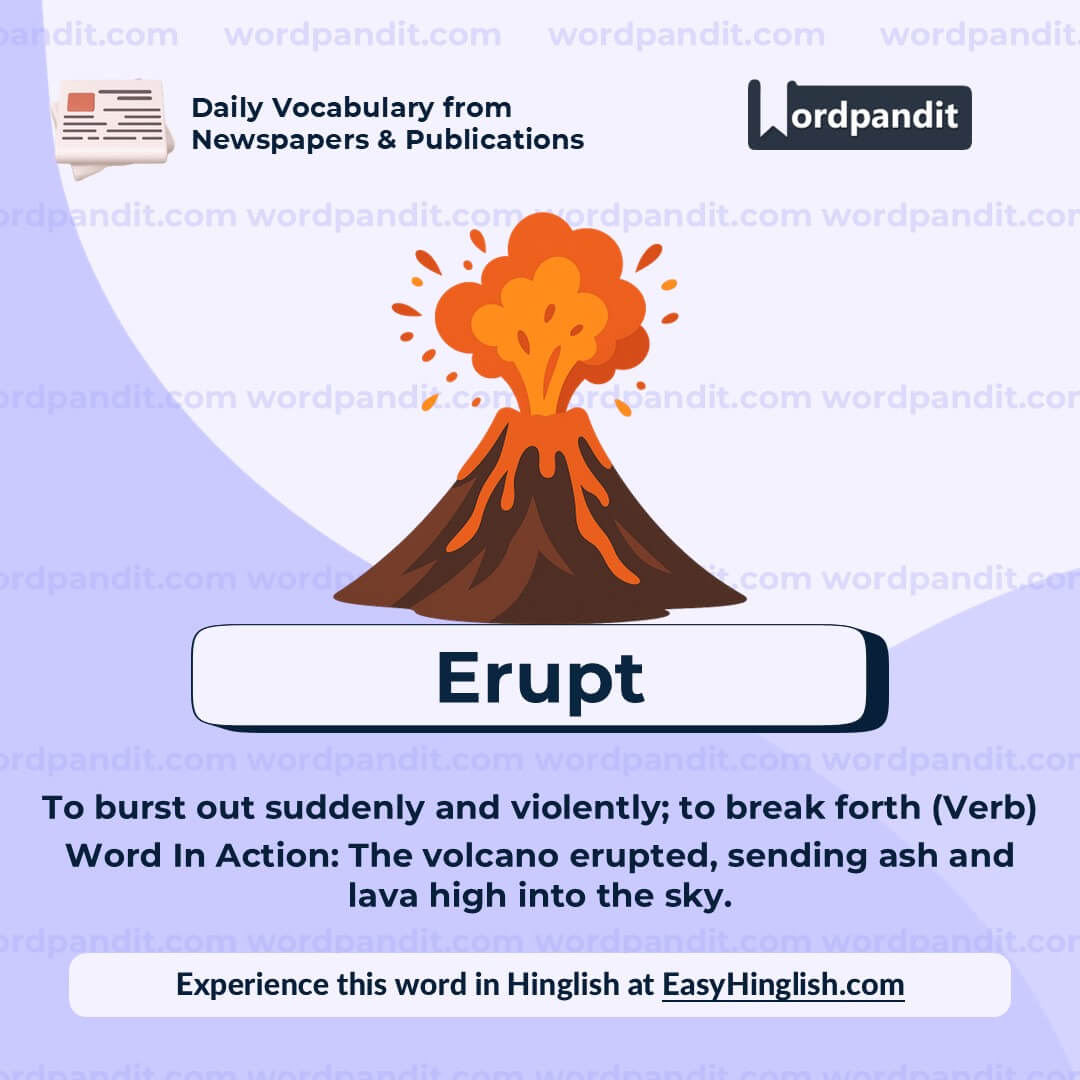
WORD-1: Erupt
Context:
"Truckers’ ‘steering chhodo andolan’ – parking their trucks to clog highways and choke supply – did not suddenly erupt flash-mob style. It followed a letter written end-December to GOI by All India Motor Transport Congress (AIMTC) requesting a review of the maximum 10-year jail term and ₹7 lakh fine for hit-and-run accidents in India’s new penal code BNS." - Times of India
Explanatory Paragraph:
The word erupt means to burst out suddenly and with force. It is often used to describe natural events like volcanoes spewing lava, but it is also used for emotions, protests, violence, or situations that break out suddenly and uncontrollably. In the given context, it refers to the truckers’ protest not happening spontaneously like a flash mob, but rather as a planned reaction to a prior event.
Meaning: To burst out suddenly and violently; to break forth (Verb)
Pronunciation: ih-RUHPT
Difficulty Level: ⭐⭐ (Basic-Intermediate)
Etymology: From Latin erumpere, meaning "to break out, burst forth," from e- (out) + rumpere (to break).
Prashant Sir's Notes:
Think of a volcano "erupting." The word captures sudden force, surprise, and intensity. Extend it to emotions, protests, or laughter, and you get its broader figurative use.
Synonyms & Antonyms:
Synonyms: explode, burst, break out, flare up, detonate
Antonyms: subside, calm, settle, suppress, quieten
Usage Examples:
- The volcano erupted after lying dormant for decades.
- Anger erupted among the workers when their salaries were delayed again.
- Laughter erupted in the classroom at the teacher’s funny comment.
- A sudden storm erupted in the middle of the cricket match.
Cultural Reference:
"Mount Vesuvius erupted in 79 AD, burying the city of Pompeii under ash and preserving it for centuries." - A famous historical event.
Think About It:
Why do you think people often describe laughter, protests, or anger as “erupting” instead of just “starting”? What imagery does it create?
Quick Activity:
Fill in the blank with the correct form of "erupt": "The students suddenly ______ into applause when the results were announced."
Memory Tip:
Think of a volcano “erupting.” Just as lava bursts out, emotions or protests can also erupt suddenly.
Real-World Application:
Use “erupt” when describing sudden events in news, literature, or conversations—whether it’s political protests erupting in a city, applause erupting in a hall, or tempers erupting in a heated debate.
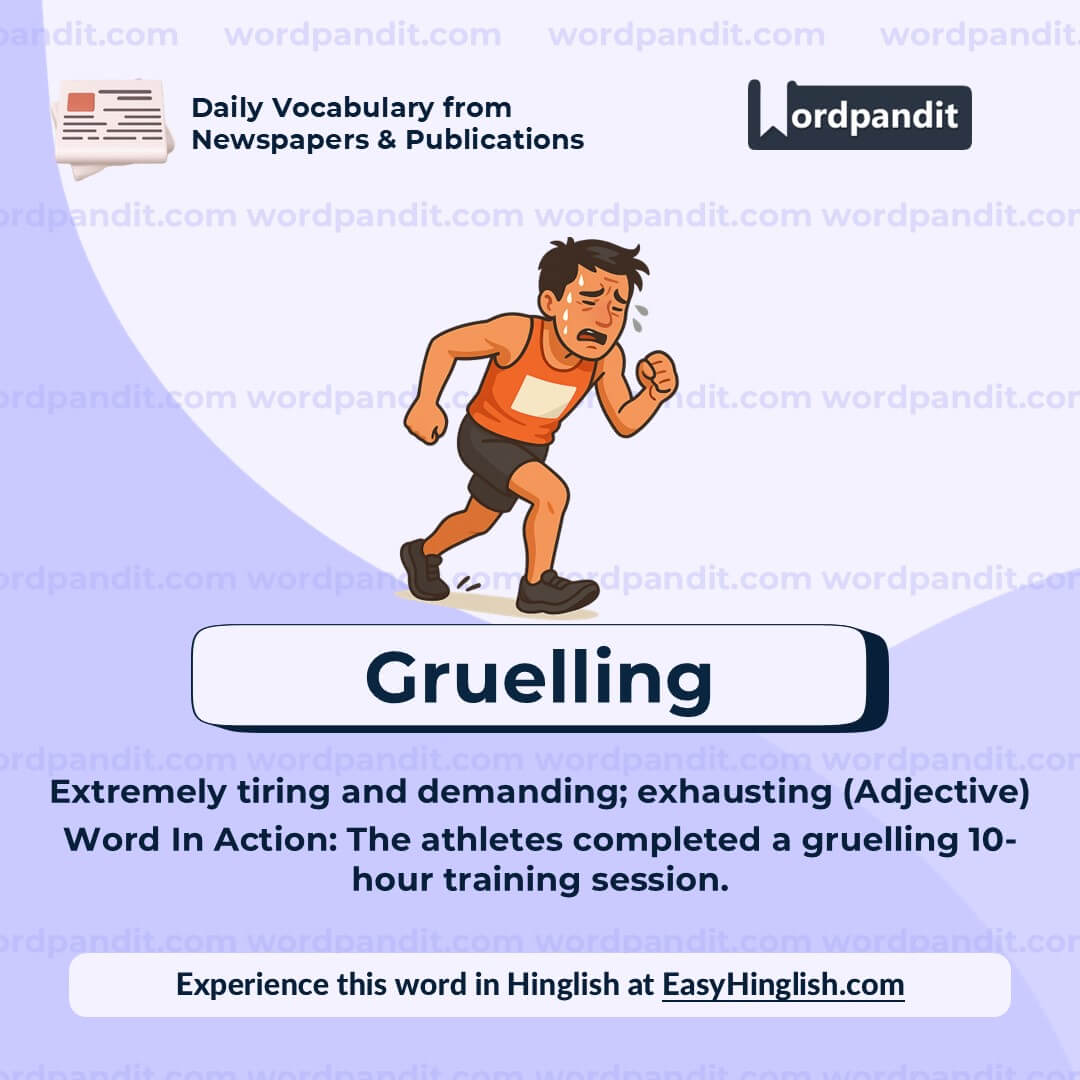
WORD-2: Gruelling
Context:
"The association believes the 10-year jail term will act as a deterrent to men joining the gruelling transportation sector, which already suffers a 27% shortage of drivers. The lifeline of India’s supply chain stood disrupted." - Times of India
Explanatory Paragraph:
The word gruelling describes something that is extremely tiring, demanding, and exhausting, both physically and mentally. It is often used for tasks, jobs, or journeys that require intense effort and stamina. In the context above, it highlights how difficult and punishing the transportation sector already is, making it less appealing to potential drivers.
Meaning: Extremely tiring and demanding; exhausting (Adjective)
Pronunciation: GROO-ling
Difficulty Level: ⭐⭐⭐ (Intermediate)
Etymology: From the word "gruel" (meaning to exhaust or punish), originating in the late 19th century to describe something that severely tests endurance.
Prashant Sir's Notes:
Think of “gruelling” as a situation that drains every bit of your energy—like a marathon, exam preparation, or a relentless workday. It’s not just tough, it’s exhausting to the core.
Synonyms & Antonyms:
Synonyms: exhausting, punishing, demanding, strenuous, backbreaking
Antonyms: easy, effortless, relaxing, gentle, refreshing
Usage Examples:
- The climbers faced a gruelling trek through snow and high winds.
- Medical interns often work gruelling hours with little rest.
- Preparing for competitive exams can be a gruelling journey for students.
- He completed the gruelling training program and finally became a soldier.
Cultural Reference:
"The Tour de France is one of the most gruelling sporting events in the world, testing both stamina and spirit." - A popular reference in sports journalism.
Think About It:
Do gruelling challenges build resilience, or do they push people away from certain professions and opportunities? Where is the balance?
Quick Activity:
Fill in the blank: "After a _______ week at work, all she wanted was a peaceful weekend at home."
Memory Tip:
Link “gruelling” to “gruel” (a thin porridge once fed to prisoners)—if you only had that to eat, you’d feel exhausted and weak. That’s the feeling of something gruelling.
Real-World Application:
“Gruelling” is commonly used in media, workplaces, and sports reporting to emphasize extreme effort—such as a gruelling schedule, gruelling workout, or gruelling political campaign.
WORD-3: Fatalities
Context:
"In 2022, almost 59,000 people died in hit-and-run cases, about 30% of all road fatalities. A person died in a highway accident every hour in Maharashtra in 2022, up 14% from the previous year. Indians can be callous drivers, with little care for rules or regulations." - Times of India
Explanatory Paragraph:
The word fatalities refers to deaths that occur as a result of accidents, disasters, violence, or disease. It emphasizes the tragic outcome rather than the event itself. In the given context, it highlights the alarming number of people who lost their lives in road accidents across India, drawing attention to the severity of the issue.
Meaning: Deaths caused by accidents, disasters, violence, or illness (Noun, plural)
Pronunciation: fuh-TAL-uh-teez
Difficulty Level: ⭐⭐ (Basic-Intermediate)
Etymology: From Latin fatalis (“ordained by fate, deadly”), which comes from fatum (“fate”). The word developed into “fatal” (deadly) and later “fatality” (a death resulting from something).
Prashant Sir's Notes:
When you hear “fatalities,” think of headlines reporting death counts after accidents or disasters. It is a formal, statistical word, often used by media or officials instead of simply saying “deaths.”
Synonyms & Antonyms:
Synonyms: deaths, casualties, losses, mortalities
Antonyms: survivals, recoveries, rescues
Usage Examples:
- The train derailment resulted in several fatalities and many injuries.
- Authorities are working to reduce road fatalities through stricter traffic laws.
- The earthquake caused thousands of fatalities across the region.
- Thanks to safety measures, the factory reported no fatalities during the fire.
Cultural Reference:
"During World War II, civilian and military fatalities reached unimaginable numbers, changing the course of human history." - A historical context widely discussed in literature and education.
Think About It:
Why do media and governments often use the word “fatalities” instead of “deaths”? Does it change the emotional impact of the news?
Quick Activity:
Replace the underlined word with “fatalities”: "The accident on the expressway resulted in five deaths and several injuries."
Memory Tip:
Connect “fatalities” with “fatal” (deadly). If something is fatal, it causes death; if there are fatalities, there are deaths.
Real-World Application:
“Fatalities” is commonly used in official reports, newspapers, and research to quantify deaths in accidents, wars, pandemics, and natural disasters. It is a neutral, formal way of reporting tragic numbers.
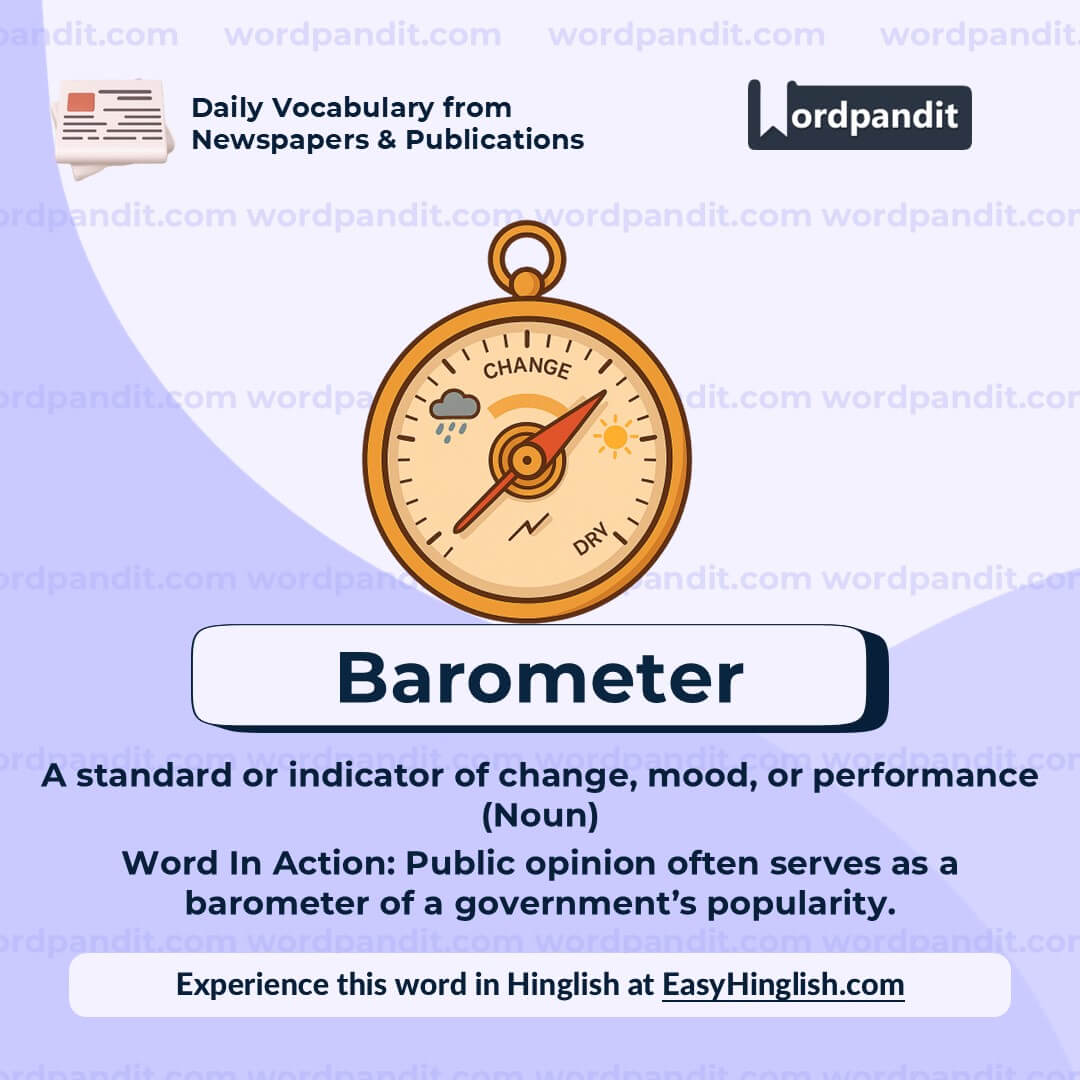
WORD-4: Barometer
Context:
"For India, which aims to rise on the global tourism charts, they are a handy barometer of how good it’s got at playing host. Unfortunately, the country’s capital performed particularly poorly." - Times of India
Explanatory Paragraph:
The word barometer originally refers to a scientific instrument that measures air pressure and helps predict weather. Figuratively, it is used to describe something that indicates or reflects trends, standards, or conditions. In this context, it means that certain indicators (such as reviews or rankings) serve as a measure of how well India is doing in tourism.
Meaning: 1) An instrument for measuring atmospheric pressure; 2) A standard or indicator of change, mood, or performance (Noun)
Pronunciation: buh-ROM-uh-ter
Difficulty Level: ⭐⭐⭐ (Intermediate)
Etymology: From Greek baros (“weight”) + metron (“measure”), coined in the 17th century to describe the device invented to measure air pressure.
Prashant Sir's Notes:
Think of a barometer as a “measuring stick.” Beyond weather, it’s now used metaphorically: stock markets are a barometer of economic health, student grades are a barometer of learning, and public opinion is a barometer of leadership success.
Synonyms & Antonyms:
Synonyms: indicator, gauge, standard, benchmark, measure
Antonyms: misindicator, distraction, illusion (figurative)
Usage Examples:
- The stock market often serves as a barometer of investor confidence.
- Public opinion polls act as a barometer of the people’s trust in government.
- The level of attendance at cultural events can be a barometer of a city’s vibrancy.
- In science, a barometer is used to forecast weather by measuring air pressure.
Cultural Reference:
"Consumer confidence is widely seen as a barometer of a nation’s economic strength." - A phrase frequently used in economic commentary.
Think About It:
Do you think using figurative “barometers” (like rankings, surveys, or polls) gives us an accurate picture of reality, or are they sometimes misleading?
Quick Activity:
Fill in the blank: "The increasing number of climate protests can be seen as a ________ of rising global concern."
Memory Tip:
Break it into “baro” (weight/pressure) + “meter” (measure). A barometer measures pressure—but figuratively, it measures the “pressure” of situations like public mood or economic health.
Real-World Application:
“Barometer” is widely used in journalism, economics, politics, and education to describe an indicator of trends—whether it’s consumer spending as a barometer of economic growth, or exam results as a barometer of teaching quality.
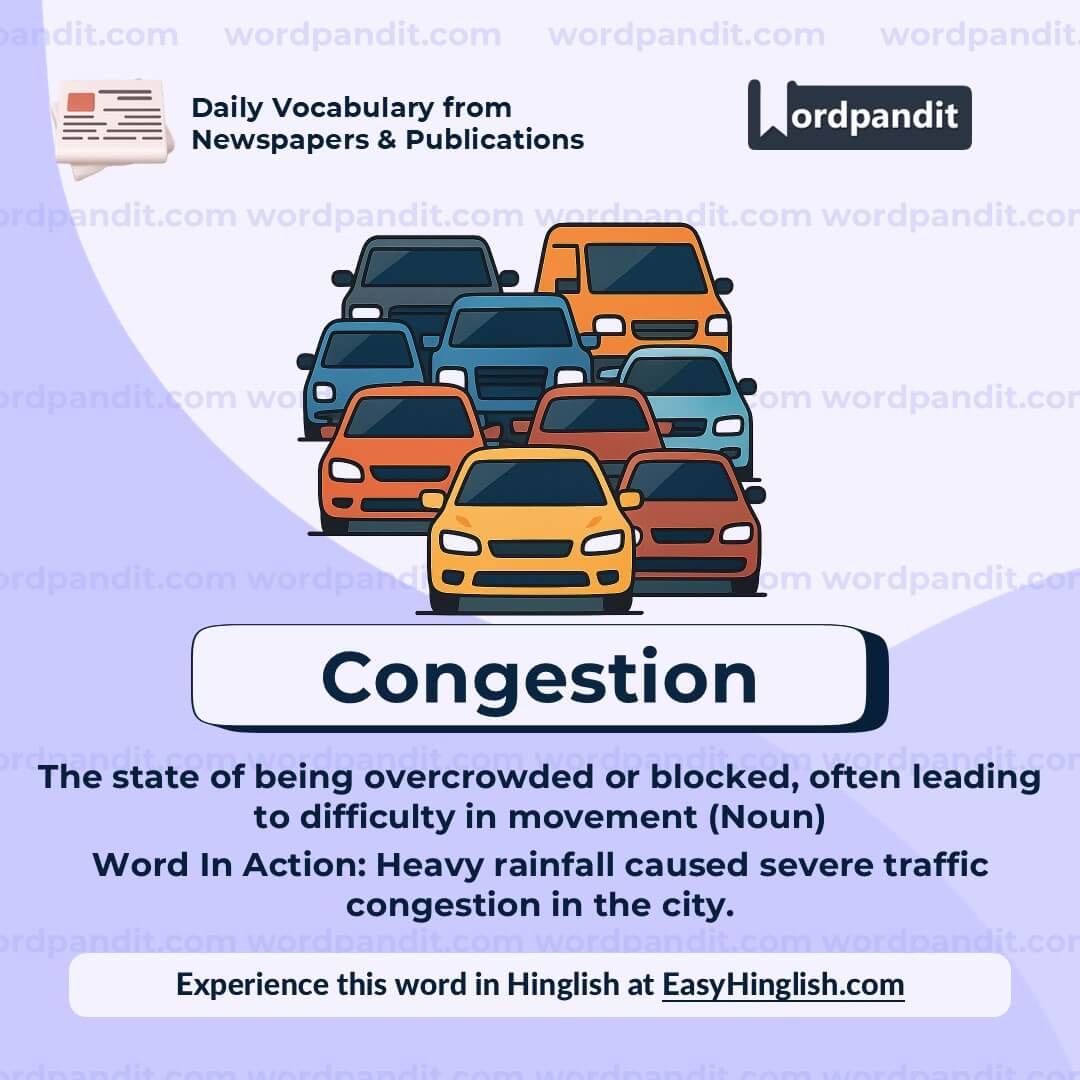
WORD-5: Congestion
Context:
"A better run city would have increased the Metro frequency suitably, enforced special pedestrian and parking zones, and put out constant congestion alerts on social media." - Times of India
Explanatory Paragraph:
The word congestion refers to a state of overcrowding or blockage. It can describe heavy traffic on roads, blocked airways in the human body, or any situation where movement is slowed or obstructed due to too many things being packed into one space. In the given context, it highlights traffic jams in the city, which could be reduced by better management and planning.
Meaning: The state of being overcrowded or blocked, often leading to difficulty in movement (Noun)
Pronunciation: kun-JES-chun
Difficulty Level: ⭐⭐ (Basic-Intermediate)
Etymology: From Latin congestio (“a piling up, crowding”), from congerere (“to heap up”). The word developed into English in the 15th century to describe overcrowding and blockage.
Prashant Sir's Notes:
Think of congestion as “too many things in too little space.” It could be traffic jams, crowded markets, or even a blocked nose. The common idea: something is stuck and cannot flow smoothly.
Synonyms & Antonyms:
Synonyms: overcrowding, blockage, jam, crowding, clogging
Antonyms: clearance, openness, emptiness, free flow, space
Usage Examples:
- The city suffers from severe traffic congestion during rush hours.
- Cold medicine helps relieve nasal congestion and makes breathing easier.
- The stadium experienced congestion at the entry gates before the match started.
- Building flyovers is one way to reduce road congestion in urban areas.
Cultural Reference:
"Bangkok has long been infamous for its traffic congestion, often ranking among the worst cities in the world for commuters." - A common reference in travel and urban studies.
Think About It:
Do you think congestion is mainly a result of poor planning, or is it an inevitable outcome of rapid urban growth and population increase?
Quick Activity:
Choose the correct usage: a) "The doctor prescribed medicine for chest _______." b) "There was massive traffic _______ in the city center."
Memory Tip:
Associate “congestion” with “congested nose” when you have a cold—blocked and difficult to breathe. Extend that to roads: blocked and difficult to move.
Real-World Application:
“Congestion” is widely used in urban planning, health, and technology: traffic congestion in cities, nasal congestion in medicine, and network congestion in the internet world.


