

Daily Vocabulary from Indian Newspapers and Publications
Welcome to Wordpandit’s Indian Vocabulary Hub
At Wordpandit, we understand the importance of staying rooted in the local context while expanding your language skills. This section focuses on enriching your vocabulary with words and phrases drawn from India’s leading newspapers and publications, ensuring you're learning vocabulary that is practical, relevant, and uniquely Indian.
Why Indian Sources Matter
We believe that the best way to master any language is by immersing yourself in local content. That’s why we carefully curate vocabulary from top Indian publications, including:
- The Hindu
- The Times of India
- The Economic Times
- Hindustan Times
- Live Mint
- The Indian Express
- And many others...
Stay Updated, Stay Relevant
With daily updates from Indian news sources, you’ll be consistently learning words that reflect the trends and shifts in Indian society and culture. Our focus is to provide vocabulary that enhances your understanding of the language in an Indian context.
How Wordpandit Supports Your Goals
Whether you’re preparing for exams, aiming to improve your professional communication, or simply want to stay connected with the latest Indian vocabulary, Wordpandit is here to guide you every step of the way.
Learn with a Practical Approach
Our interactive learning methodology includes real-world examples, engaging activities, and context-specific usage to ensure that every word becomes part of your active vocabulary.
Dive into Indian Vocabulary Today!

Why Choose Wordpandit?
Practical Learning: Focus on words you'll actually encounter in real-world reading, enhancing your comprehension and communication skills.
Diverse Content: From current affairs to scientific breakthroughs, our varied sources expose you to vocabulary across multiple domains.
Effortless Integration: Make Wordpandit a part of your daily routine. Just a few minutes each day can significantly boost your lexicon over time.
Your Path to Vocabulary Mastery
- Visit our Daily Vocabulary section regularly
- Explore new words and their usage in context
- Practice incorporating these words into your own writing and speech
- Track your progress as your vocabulary expands
Start Your Journey Today
Embark on your vocabulary enhancement journey with Wordpandit. By consistently engaging with our daily posts, you'll build a robust vocabulary that serves you well in academic, professional, and personal contexts.
Remember, a word a day keeps linguistic limitations at bay. Make Wordpandit your daily companion in the quest for vocabulary excellence!
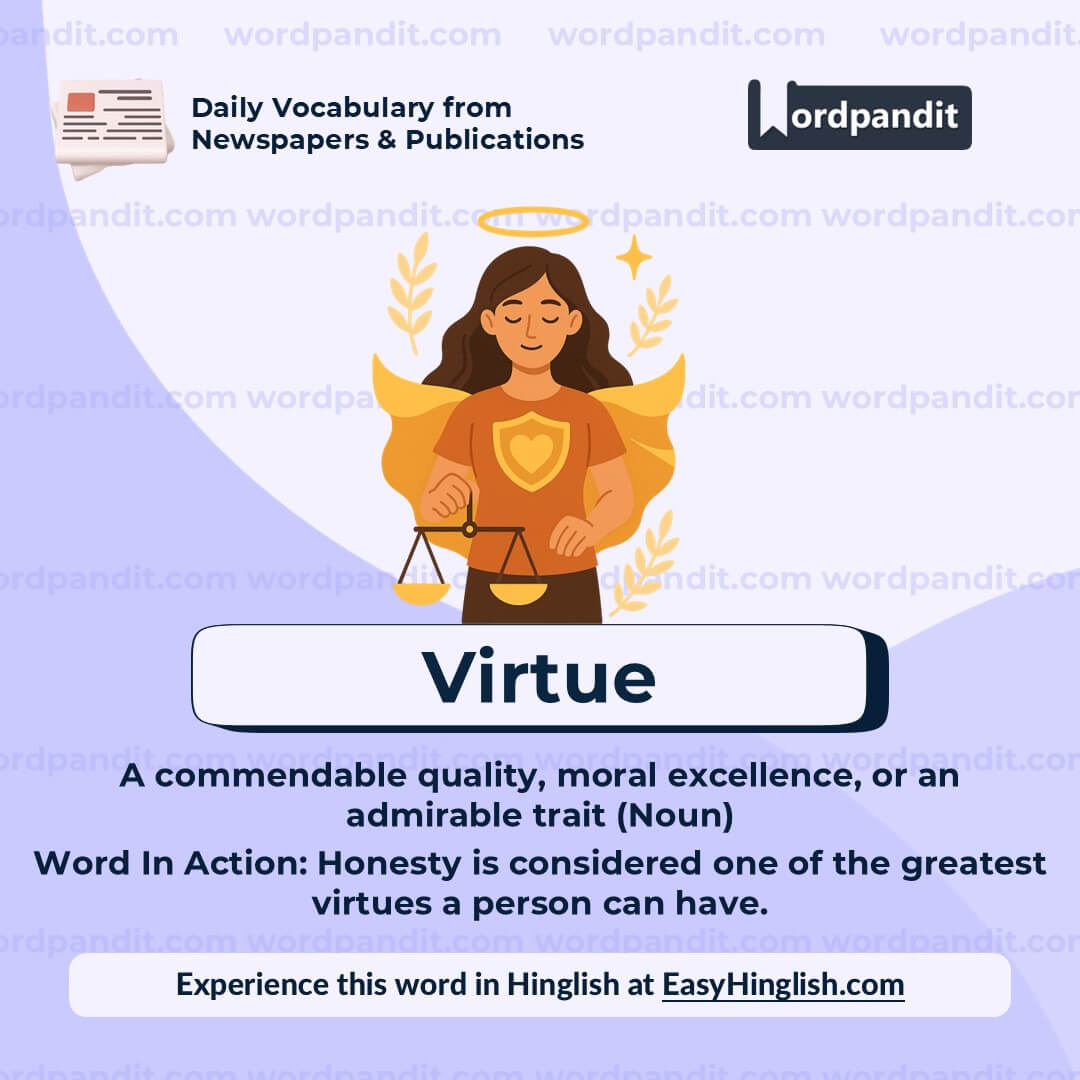
WORD-1: Virtue
Context:
"Indians, according to several studies over the past decade, are unable to unplug from work. Worse, this is considered a virtue." - Economic Times
Explanatory Paragraph:
The word virtue refers to a positive quality, moral goodness, or a behavior that is considered admirable and worthy of respect. It often suggests qualities like honesty, discipline, kindness, or dedication. In the given context, working endlessly without breaks is ironically seen as a virtue, though it may not be truly beneficial for well-being.
Meaning: A commendable quality, moral excellence, or an admirable trait (Noun)
Pronunciation: vur-choo
Difficulty Level: ⭐⭐ (Basic-Intermediate)
Etymology: From Old French vertu, derived from Latin virtus, meaning "moral strength, manliness, excellence".
Prashant Sir's Notes:
Virtue is often contrasted with vice. When preparing for exams, remember that virtue stands for positive qualities of character, while vice denotes negative ones.
Synonyms & Antonyms:
Synonyms: goodness, morality, integrity, righteousness, merit
Antonyms: vice, immorality, corruption, wickedness
Usage Examples:
- Patience is considered a great virtue in leadership.
- She believed honesty was the highest virtue a person could possess.
- In some workplaces, working long hours is treated as a virtue, even if it leads to burnout.
- Forgiveness is a virtue that strengthens human relationships.
Cultural Reference:
"Virtue is bold, and goodness never fearful." – William Shakespeare
Think About It:
Do you think society sometimes mislabels harmful behaviors (like overworking) as virtues? How does that affect people's choices?
Quick Activity:
List three personal qualities you consider virtues in your own life. Compare them with what society considers virtues. Are they the same or different?
Memory Tip:
Think of “virtue” as the opposite of “vice.” If vice is a bad habit, virtue is a good habit.
Real-World Application:
In professional settings, virtues like integrity, punctuality, and honesty are highly valued, often influencing hiring decisions and career growth.
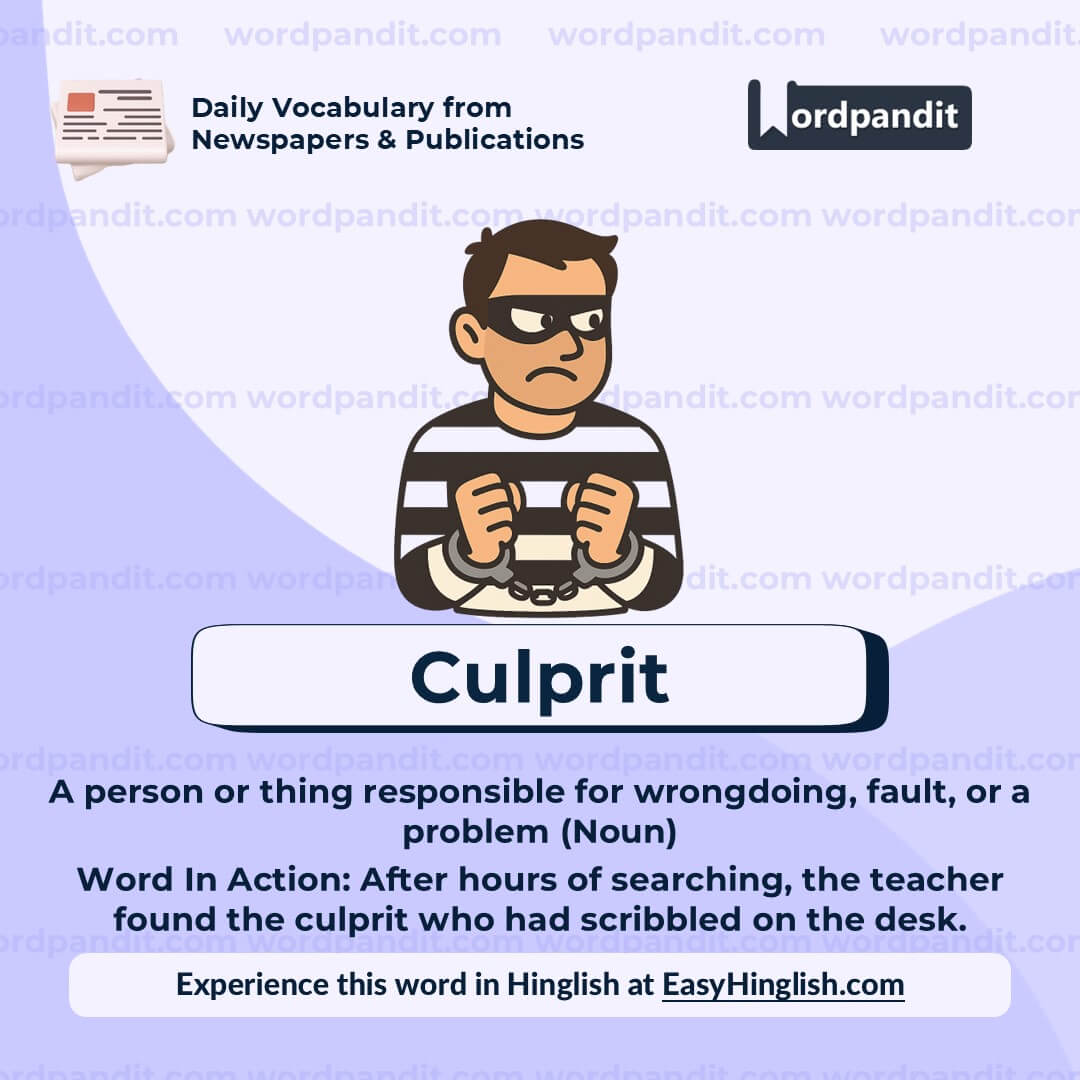
WORD-2: Culprit
Context:
"But the real culprit is the Indian workplace. Despite the legal requirement of paid vacation time, it is not onboard with the idea of vacations." - Economic Times
Explanatory Paragraph:
The word culprit refers to a person, group, or thing responsible for a problem, mistake, or crime. In everyday language, it can mean the guilty party or the cause of an issue. In the given context, the "Indian workplace" is called the culprit because it prevents employees from taking vacations, despite laws allowing them.
Meaning: A person or thing responsible for wrongdoing, fault, or a problem (Noun)
Pronunciation: kul-prit
Difficulty Level: ⭐⭐ (Basic-Intermediate)
Etymology: From Anglo-French legal phrase culprit (17th century), short for "culpable: prest" meaning "guilty: ready to prove", used in court proceedings.
Prashant Sir's Notes:
Think of "culprit" as the "doer of wrong." It can be a person or even an abstract cause. The word is commonly used in both legal and casual settings.
Synonyms & Antonyms:
Synonyms: offender, wrongdoer, criminal, perpetrator, cause
Antonyms: victim, innocent, benefactor
Usage Examples:
- The police quickly caught the culprit behind the robbery.
- Too much sugar is often the real culprit behind obesity.
- In this case, poor planning was the culprit for the failed project.
- At first, everyone blamed John, but later it turned out he wasn’t the culprit.
Cultural Reference:
In detective novels and crime shows, the suspense often lies in discovering who the "real culprit" is, keeping audiences hooked until the end.
Think About It:
Do you think society sometimes blames the wrong "culprit" when problems arise? How does misplaced blame affect real solutions?
Quick Activity:
Fill in the blank: "The real culprit behind climate change is _______." Write your answer and justify it in one line.
Memory Tip:
Break "culprit" into "Culp-" (blame) + "rit" (ritual/legal term). Think: the one blamed in court is the culprit.
Real-World Application:
The term "culprit" is widely used in journalism, workplaces, and legal settings to identify the source of a problem, whether it’s a person, an organization, or a cause.
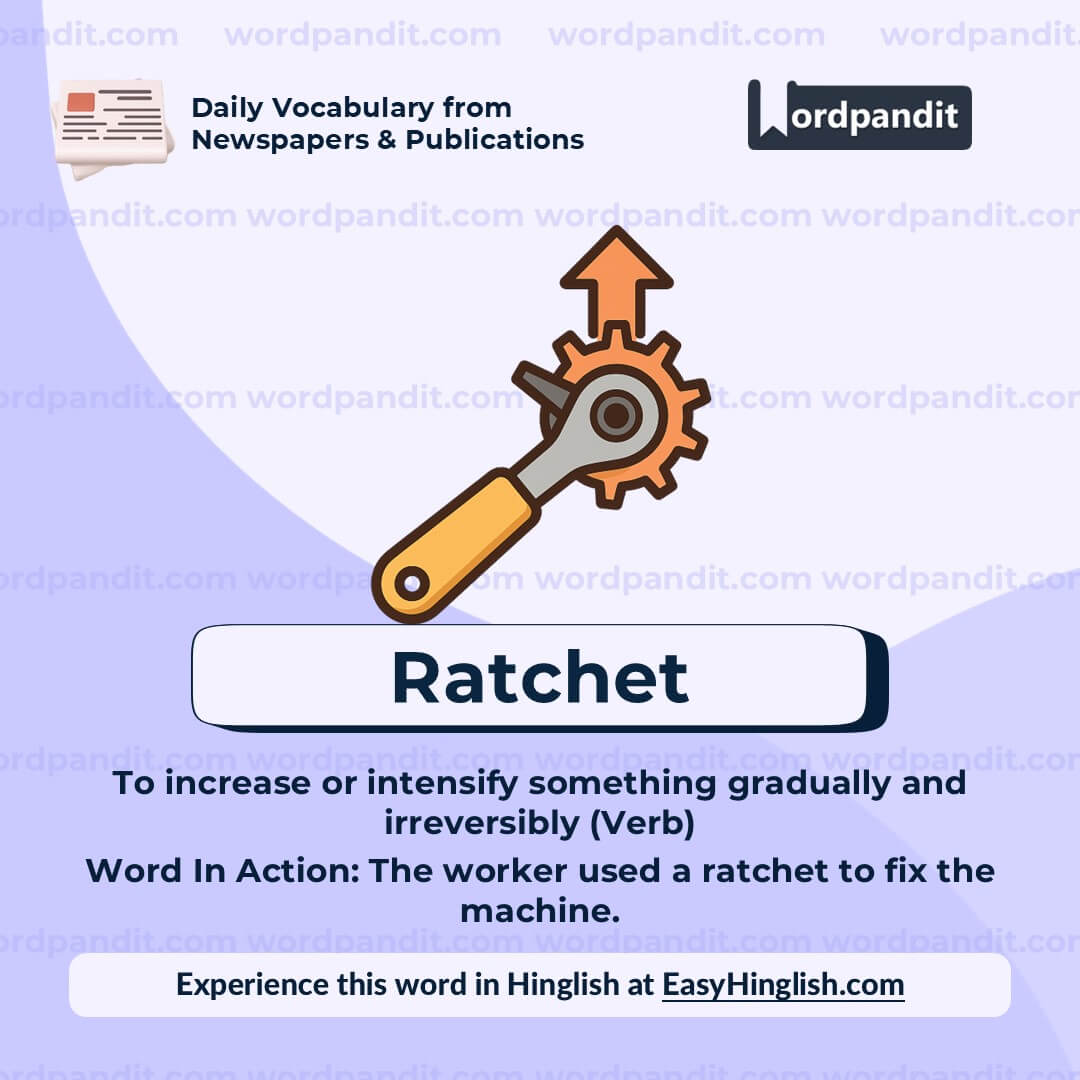
WORD-3: Ratchet
Context:
"To avoid the middle-income economy trap, India will require similar manufacturing capacity. The country will have to ratchet up its charm for foreign investors." - Economic Times
Explanatory Paragraph:
The word ratchet originally refers to a mechanical device with a toothed wheel that allows motion in one direction only. Figuratively, the phrase “ratchet up” means to increase something step by step, often in intensity, strength, or level. In the given context, “ratchet up its charm” means India must steadily and significantly increase its appeal to foreign investors.
Meaning: To increase or intensify something gradually and irreversibly (Verb)
Pronunciation: ra-chit
Difficulty Level: ⭐⭐⭐ (Intermediate)
Etymology: From Old French rochet meaning "little wheel," related to mechanical devices allowing motion in one direction; later extended to figurative usage in English.
Prashant Sir's Notes:
Remember that in economics, diplomacy, or business contexts, “ratchet up” almost always means “step up” or “intensify.” It carries the sense of controlled but irreversible movement forward.
Synonyms & Antonyms:
Synonyms: increase, boost, escalate, amplify, intensify
Antonyms: reduce, decrease, lessen, ease, diminish
Usage Examples:
- The government decided to ratchet up security after the recent incidents.
- Marketing teams often ratchet up their campaigns before festive seasons.
- Tensions ratcheted up between the two countries after the border dispute.
- The company ratcheted up production to meet the growing demand for electric cars.
Cultural Reference:
The phrase "ratchet up" became common in international diplomacy during the Cold War, often used to describe the step-by-step escalation of tensions between superpowers.
Think About It:
Is it always good to "ratchet up" efforts, or can too much intensification sometimes cause stress or instability?
Quick Activity:
Write two sentences using "ratchet up"—one in a positive sense (e.g., efforts, charm) and one in a negative sense (e.g., conflict, tension).
Memory Tip:
Think of a ratchet tool that turns only one way—when you "ratchet up," you’re steadily moving in one direction: upward.
Real-World Application:
In business, politics, and economics, “ratchet up” is widely used to describe increases in investment, tension, or effort, making it a useful phrase in professional and academic contexts.
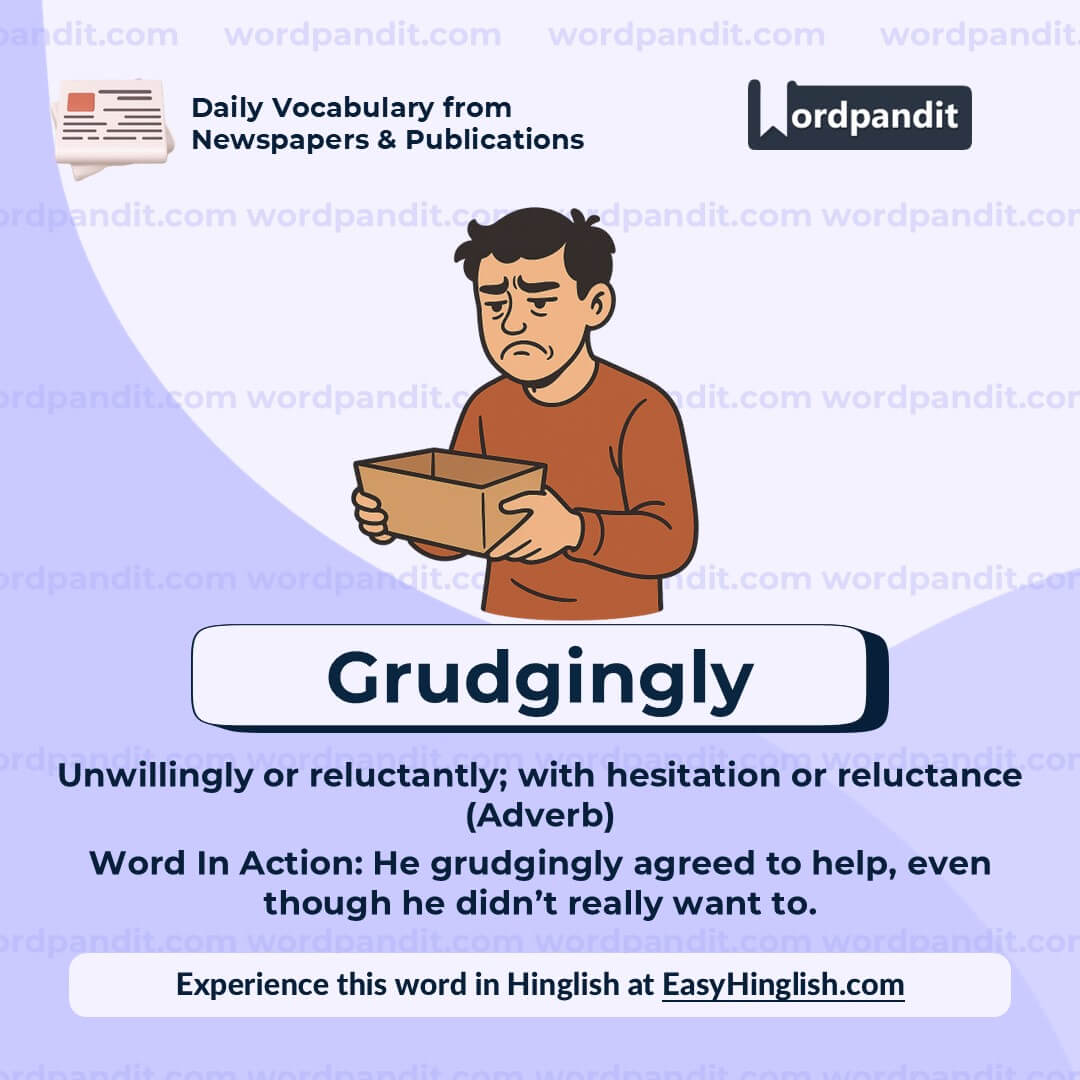
WORD-4: Grudgingly
Context:
"States grudgingly relinquish their resource-raising capacity and resent any loss of agency over expenditure." - Economic Times
Explanatory Paragraph:
The word grudgingly describes doing something unwillingly, reluctantly, or with hesitation, often because one feels forced to do it rather than truly wanting to. It implies a lack of enthusiasm and sometimes even hidden resentment. In the given context, states give up some financial power grudgingly, meaning they do so reluctantly and with displeasure.
Meaning: Unwillingly or reluctantly; with hesitation or reluctance (Adverb)
Pronunciation: gruh-jing-lee
Difficulty Level: ⭐⭐ (Basic-Intermediate)
Etymology: From Middle English grudgen (to murmur, complain), which comes from Old French grogner meaning "to grumble."
Prashant Sir's Notes:
Grudgingly carries a negative undertone. Remember: someone who does something grudgingly is not doing it wholeheartedly—they may even be forced by circumstances.
Synonyms & Antonyms:
Synonyms: reluctantly, unwillingly, hesitantly, resentfully
Antonyms: willingly, gladly, eagerly, enthusiastically
Usage Examples:
- She grudgingly admitted that her rival had done a good job.
- He grudgingly paid the fine, muttering under his breath.
- The manager gave grudging approval to the new project.
- They grudgingly accepted the terms of the agreement, though they were unhappy with them.
Cultural Reference:
In many classic novels, characters often act grudgingly when forced into social obligations, highlighting the tension between personal desire and societal pressure.
Think About It:
Is it better to do something grudgingly for the sake of peace, or to openly refuse if you don’t agree with it?
Quick Activity:
Write a short sentence describing a time you did something grudgingly. Then rewrite it showing the opposite—doing it willingly.
Memory Tip:
Think of “grudge” (resentment). When you do something grudgingly, you do it with a grudge in your heart.
Real-World Application:
The word is commonly used in workplaces, negotiations, or politics when people agree to something not out of desire but out of compulsion or pressure.
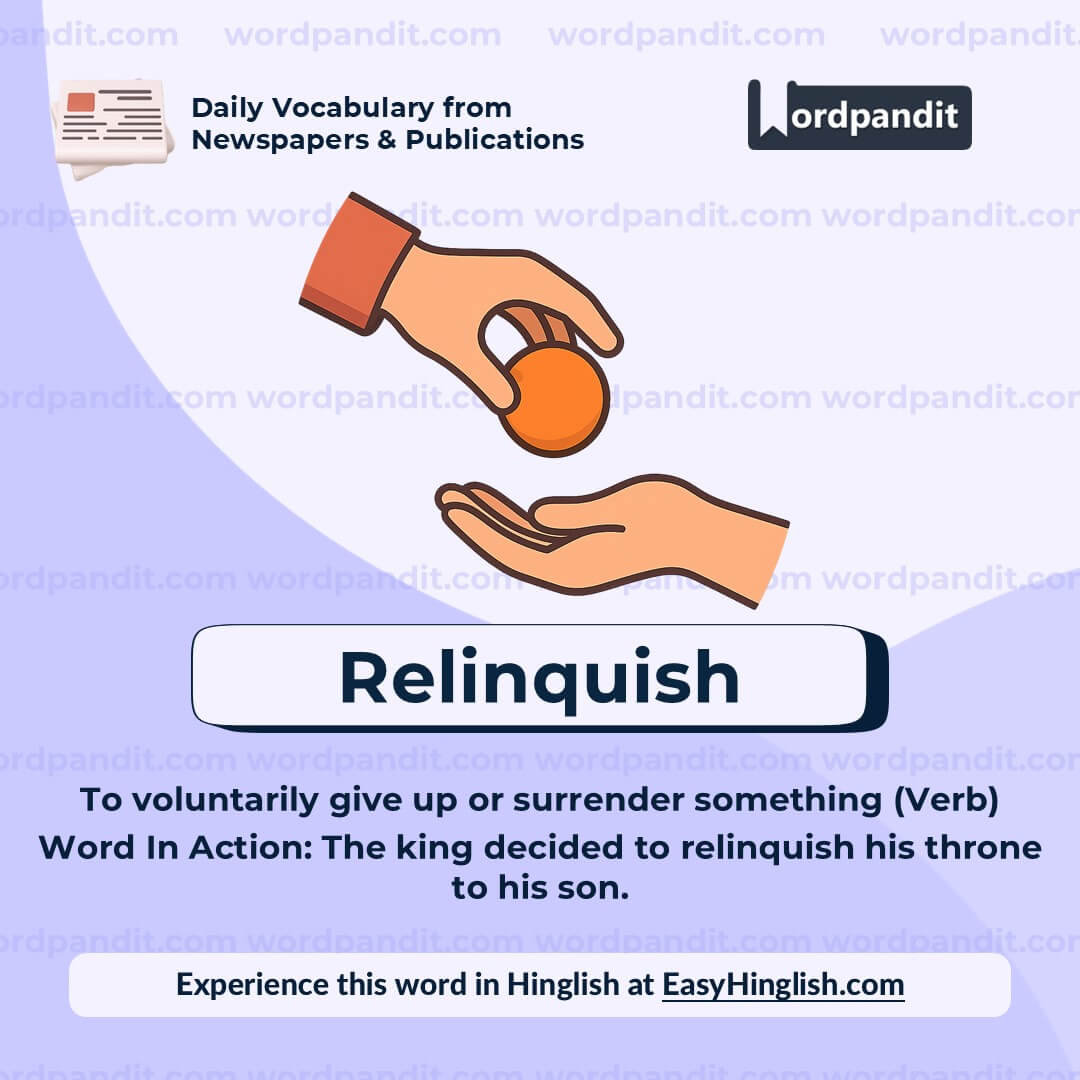
WORD-5: Relinquish
Context:
"States grudgingly relinquish their resource-raising capacity and resent any loss of agency over expenditure." - Economic Times
Explanatory Paragraph:
The word relinquish means to give up, surrender, or let go of something—whether it is power, control, possession, or a right. It usually implies doing so unwillingly or with difficulty. In the given context, states relinquish their ability to raise financial resources, meaning they give up or surrender this authority, often reluctantly.
Meaning: To voluntarily give up or surrender something (Verb)
Pronunciation: ri-ling-kwish
Difficulty Level: ⭐⭐⭐ (Intermediate)
Etymology: From Latin relinquere, meaning "to leave behind," formed from re- (back) + linquere (to leave).
Prashant Sir's Notes:
Relinquish is a formal word often used in legal, political, and official contexts. Remember: it does not just mean “give,” but specifically to give up control or rights, often reluctantly.
Synonyms & Antonyms:
Synonyms: surrender, abandon, renounce, cede, forgo, yield
Antonyms: retain, keep, hold, maintain, preserve
Usage Examples:
- The king was forced to relinquish his throne after the revolution.
- She relinquished control of the company to her successor.
- The soldier reluctantly relinquished his weapon to the authorities.
- He decided to relinquish his claim on the disputed property.
Cultural Reference:
In history, leaders often had to relinquish power during revolutions or peace treaties—for example, Napoleon was forced to relinquish his rule after his defeat at Waterloo.
Think About It:
Is it harder to relinquish power or to relinquish personal possessions? Why do people resist letting go, even when it might benefit them?
Quick Activity:
Fill in the blank: "She had to relinquish her dream of becoming a _______ because of family responsibilities." Choose a word that makes sense and explain why.
Memory Tip:
Break it into "re" (back) + "linquish" (leave). When you relinquish something, you leave it back or give it away.
Real-World Application:
Relinquish is widely used in legal, financial, and political documents—such as when someone relinquishes property rights, citizenship, or official authority.


