

Daily Vocabulary from Indian Newspapers and Publications
Welcome to Wordpandit’s Indian Vocabulary Hub
At Wordpandit, we understand the importance of staying rooted in the local context while expanding your language skills. This section focuses on enriching your vocabulary with words and phrases drawn from India’s leading newspapers and publications, ensuring you're learning vocabulary that is practical, relevant, and uniquely Indian.
Why Indian Sources Matter
We believe that the best way to master any language is by immersing yourself in local content. That’s why we carefully curate vocabulary from top Indian publications, including:
- The Hindu
- The Times of India
- The Economic Times
- Hindustan Times
- Live Mint
- The Indian Express
- And many others...
Stay Updated, Stay Relevant
With daily updates from Indian news sources, you’ll be consistently learning words that reflect the trends and shifts in Indian society and culture. Our focus is to provide vocabulary that enhances your understanding of the language in an Indian context.
How Wordpandit Supports Your Goals
Whether you’re preparing for exams, aiming to improve your professional communication, or simply want to stay connected with the latest Indian vocabulary, Wordpandit is here to guide you every step of the way.
Learn with a Practical Approach
Our interactive learning methodology includes real-world examples, engaging activities, and context-specific usage to ensure that every word becomes part of your active vocabulary.
Dive into Indian Vocabulary Today!

Why Choose Wordpandit?
Practical Learning: Focus on words you'll actually encounter in real-world reading, enhancing your comprehension and communication skills.
Diverse Content: From current affairs to scientific breakthroughs, our varied sources expose you to vocabulary across multiple domains.
Effortless Integration: Make Wordpandit a part of your daily routine. Just a few minutes each day can significantly boost your lexicon over time.
Your Path to Vocabulary Mastery
- Visit our Daily Vocabulary section regularly
- Explore new words and their usage in context
- Practice incorporating these words into your own writing and speech
- Track your progress as your vocabulary expands
Start Your Journey Today
Embark on your vocabulary enhancement journey with Wordpandit. By consistently engaging with our daily posts, you'll build a robust vocabulary that serves you well in academic, professional, and personal contexts.
Remember, a word a day keeps linguistic limitations at bay. Make Wordpandit your daily companion in the quest for vocabulary excellence!
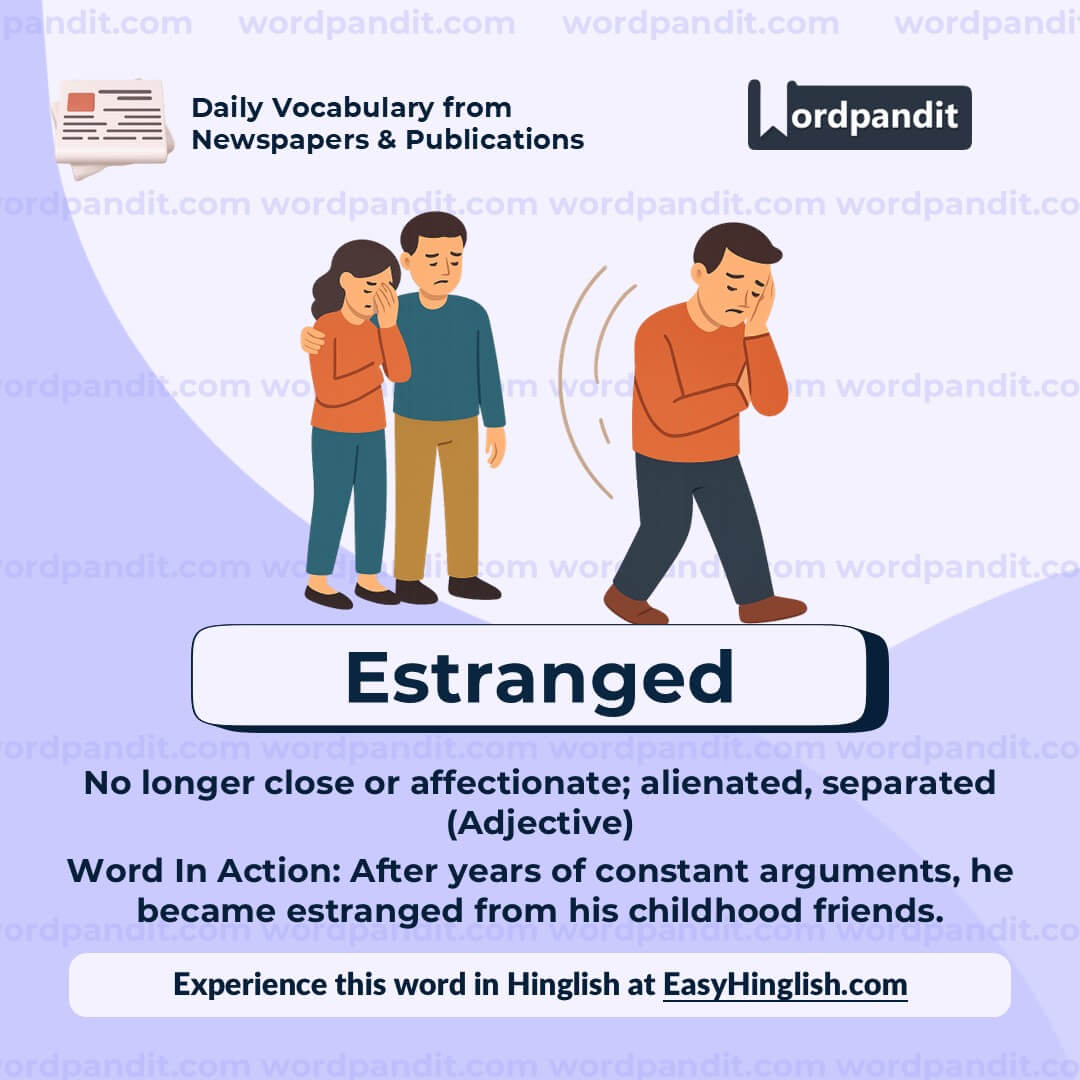
WORD-1: Estranged
Context:
"It is important to understand that Bangladesh chose democracy, unlike its estranged twin Pakistan." - Indian Express
Explanatory Paragraph:
The word estranged is used to describe a relationship that was once close but has now grown distant, hostile, or disconnected. It often applies to family members, friends, or nations that have lost their bond due to conflict, misunderstanding, or separation. In the given context, "estranged twin Pakistan" highlights how Bangladesh and Pakistan, once united, have grown apart in their political and cultural paths.
Meaning: No longer close or affectionate; alienated, separated (Adjective)
Pronunciation: eh-STRAYNJD
Difficulty Level: ⭐⭐⭐ Intermediate
Etymology: From Old French estranger meaning "to treat as a stranger," derived from Latin extraneare, from extraneus meaning "foreign" or "external."
Prashant Sir's Notes:
Think of estranged as "made a stranger." Relationships that were once warm become distant, cold, or broken—just like countries, friends, or even spouses who grow apart over time.
Synonyms & Antonyms:
Synonyms: alienated, separated, detached, distant, divided
Antonyms: united, close, reconciled, connected, friendly
Usage Examples:
- After years of conflict, he became estranged from his childhood friends.
- The estranged couple decided to live separately until they could resolve their issues.
- Her estranged brother surprised everyone by attending the family reunion.
- The two nations, once allies, are now estranged over border disputes.
Cultural Reference:
"Estranged" is also the title of a famous song by the rock band Guns N' Roses, where it reflects feelings of isolation and emotional distance. - Music Culture
Think About It:
What factors—political, personal, or cultural—cause people or nations to become estranged, and can such estrangement ever be fully healed?
Quick Activity:
Write down two situations: one where people became estranged, and another where estranged individuals reconciled. Compare the emotions involved in both cases.
Memory Tip:
Think of "estranged" as "made a stranger." When someone becomes estranged, they are treated like a stranger despite once being close.
Real-World Application:
Understanding the word "estranged" is useful in discussions about relationships, family conflicts, diplomacy, and history, where once-close bonds become distant or broken.

WORD-2: Apprenticed
Context:
"He apprenticed at a workshop, learning to sculpt bodies in motion, the folds of drapery, the harmonies of geometry." - Times of India
Explanatory Paragraph:
The word apprenticed refers to the act of working under a skilled person to learn a trade, craft, or profession. Traditionally, apprentices were young learners bound to a master craftsman to gain hands-on experience and practical knowledge. In the context given, the subject learned the art of sculpture by apprenticing at a workshop, observing and practicing the techniques of skilled masters.
Meaning: To work as a trainee under a skilled professional to learn a trade or craft (Verb)
Pronunciation: uh-PREN-tist
Difficulty Level: ⭐⭐ Basic to Intermediate
Etymology: From Old French aprentiz meaning "someone learning," derived from Latin apprehendere meaning "to grasp, to learn."
Prashant Sir's Notes:
Think of apprenticed as "learning by doing." Unlike classroom study, apprenticeship means gaining real-world, practical skills by working under a master. Many of the world’s greatest artists and inventors began as apprentices.
Synonyms & Antonyms:
Synonyms: trained, studied, practiced, interned, mentored
Antonyms: mastered, taught, led, instructed
Usage Examples:
- He apprenticed with a famous chef to master French cuisine.
- During the summer, she apprenticed at a local design studio.
- Many engineers in the past apprenticed before attending formal schools.
- The young painter apprenticed under a master artist to perfect his technique.
Cultural Reference:
In medieval Europe, guilds required young people to be apprenticed to craftsmen before they could become journeymen or masters, shaping the foundation of professional training. - Historical Studies
Think About It:
In a world focused on formal education, do you think apprenticeship-based learning is undervalued despite its practical benefits?
Quick Activity:
List three professions today where people still learn most effectively by being apprenticed to experts. Compare them with careers where classroom learning dominates.
Memory Tip:
Break the word: "apprenticed" sounds like "approach and practice." An apprentice approaches a master to practice skills under guidance.
Real-World Application:
The idea of being "apprenticed" is still alive today in internships, training programs, and mentorships, where learning by doing under expert supervision helps build real expertise.
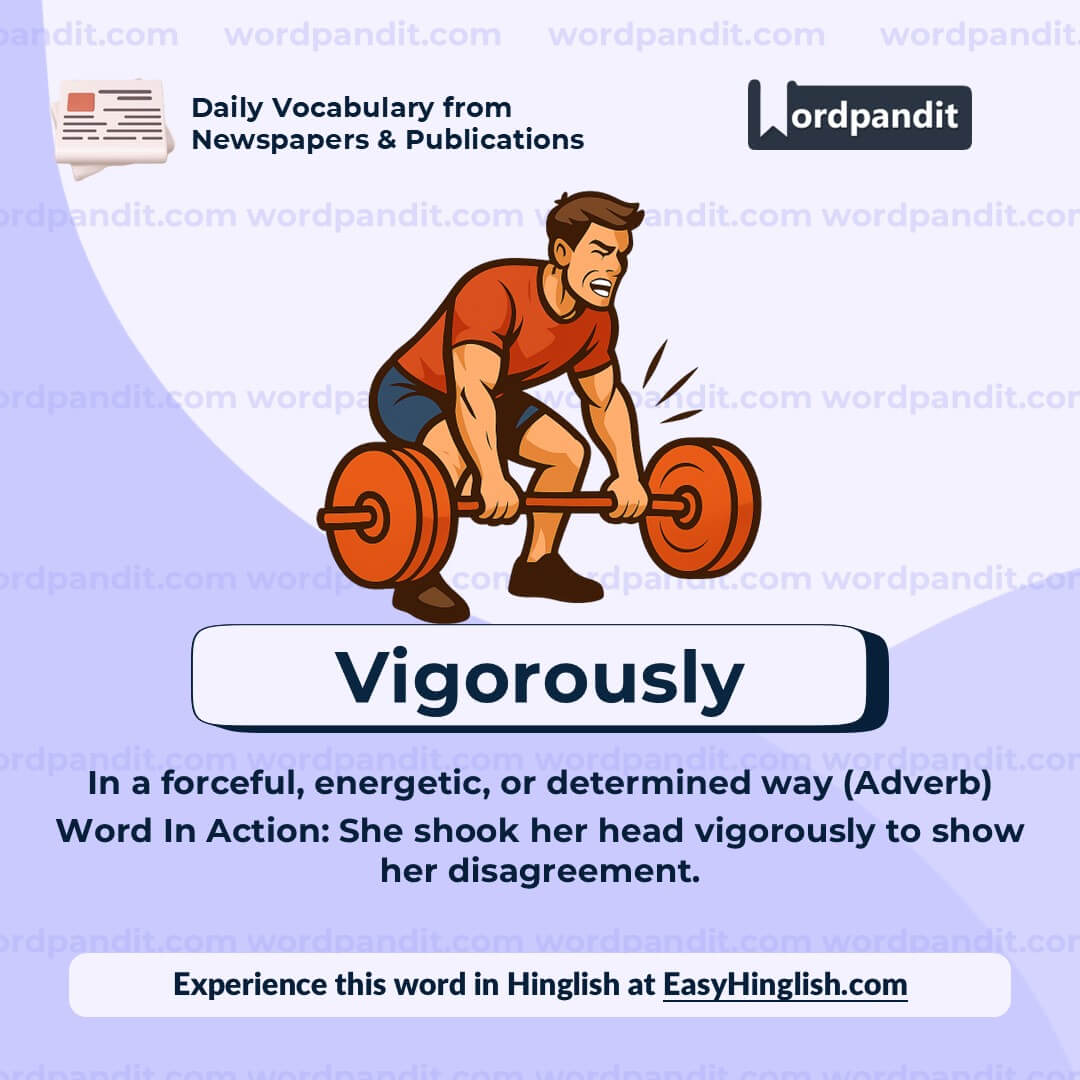
WORD-3: Vigorously
Context:
"The Opposition campaigned vigorously for a caretaker government, failing which it threatened to boycott the polls." - Indian Express
Explanatory Paragraph:
The word vigorously describes doing something with strong energy, force, or determination. It suggests not just action, but action that is lively, intense, and persistent. In the given context, the Opposition campaigned vigorously, meaning they pushed their agenda with great effort and intensity, leaving no doubt about their seriousness.
Meaning: In a forceful, energetic, or determined way (Adverb)
Pronunciation: VIG-uh-rus-lee
Difficulty Level: ⭐⭐ Basic to Intermediate
Etymology: From Middle English vigour, via Old French, from Latin vigor meaning "liveliness, activity, force."
Prashant Sir's Notes:
Link vigorously with "vitality." When something is done vigorously, it is done with life, energy, and persistence. Imagine a person exercising vigorously—they’re not casual, they’re intense and committed.
Synonyms & Antonyms:
Synonyms: energetically, forcefully, powerfully, strongly, intensely
Antonyms: weakly, feebly, passively, sluggishly
Usage Examples:
- She argued vigorously for the protection of the environment.
- The team trained vigorously in preparation for the championship.
- He shook his head vigorously to disagree with the proposal.
- The company has been vigorously expanding into international markets.
Cultural Reference:
Mahatma Gandhi, though known for his non-violence, vigorously pursued truth and justice through peaceful protests, demonstrating that vigor can also come through persistence rather than aggression. - Historical Reference
Think About It:
Is it always good to act vigorously, or are there situations where calm and restraint may be more effective?
Quick Activity:
Write three sentences where you replace “vigorously” with a synonym (like “forcefully” or “energetically”) to see how the meaning shifts slightly.
Memory Tip:
Think of "vigorously" as "with vigor." If you remember that vigor means energy and strength, the adverb form becomes easy to recall.
Real-World Application:
People often use “vigorously” to describe campaigning, exercising, debating, or protesting. It signals commitment and intensity in real-life actions, whether political, social, or personal.
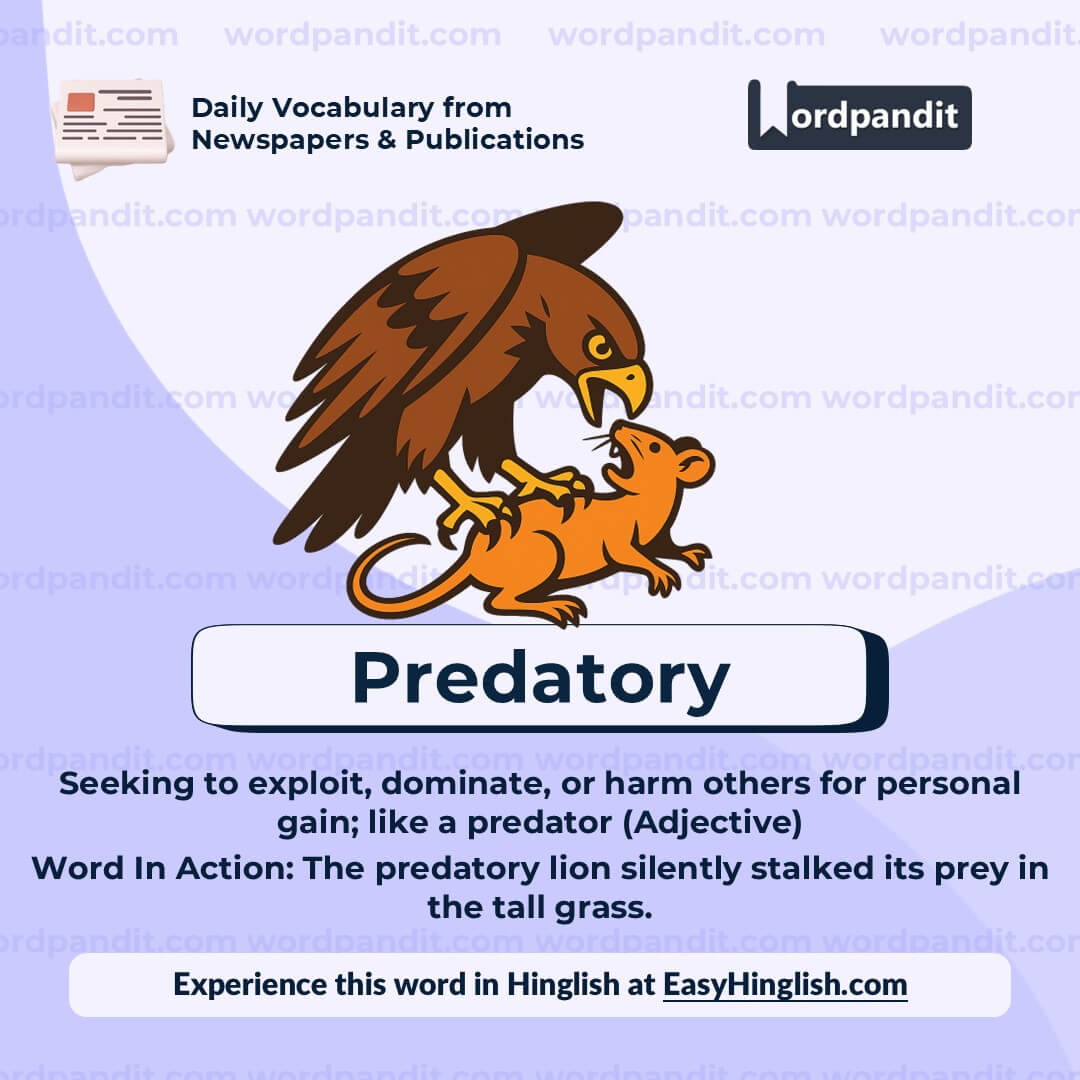
WORD-4: Predatory
Context:
"She chose not to escape through the backdoor with Hanuman only to establish that a man must fight for a woman’s honour in such a demonstrable manner that predatory men would think twice before making women the spoils of war." - Indian Express
Explanatory Paragraph:
The word predatory literally relates to animals that hunt and feed on others. Figuratively, it describes people who exploit, harm, or take advantage of others, often aggressively or selfishly. In the given context, "predatory men" refers to men who behave like predators—treating women as objects to be conquered or exploited, just as a predator treats its prey.
Meaning: Seeking to exploit, dominate, or harm others for personal gain; like a predator (Adjective)
Pronunciation: PREH-duh-tor-ee
Difficulty Level: ⭐⭐⭐ Intermediate
Etymology: From Latin praedatorius, derived from praedari meaning "to plunder," related to praeda meaning "prey."
Prashant Sir's Notes:
Think of predatory as "acting like a predator." Whether in nature, business, or society, it describes those who attack, exploit, or overpower the weaker. The metaphor extends far beyond the jungle into human behavior.
Synonyms & Antonyms:
Synonyms: exploitative, aggressive, rapacious, greedy, harmful
Antonyms: protective, nurturing, supportive, harmless
Usage Examples:
- The predatory lion stalked its prey silently through the grasslands.
- She warned her friends about predatory individuals who manipulate others for personal gain.
- Some companies adopt predatory pricing strategies to drive competitors out of business.
- The novel depicted a predatory society where the weak were constantly exploited by the powerful.
Cultural Reference:
The term “predatory capitalism” is often used in economic debates to describe ruthless business practices where profit is prioritized over ethics or human well-being. - Economic Discourse
Think About It:
Do you think “predatory” behavior in humans is purely a result of social conditioning, or does it stem from instincts inherited from the animal world?
Quick Activity:
Write two sentences: one using “predatory” in its literal animal sense, and another using it in a figurative sense about human behavior.
Memory Tip:
Remember that “predatory” comes from “predator.” If a predator hunts and harms its prey, predatory behavior in people means exploiting others.
Real-World Application:
“Predatory” is a powerful word used in discussions about wildlife, human rights, corporate malpractices, and even cybercrimes, where stronger forces exploit weaker ones.
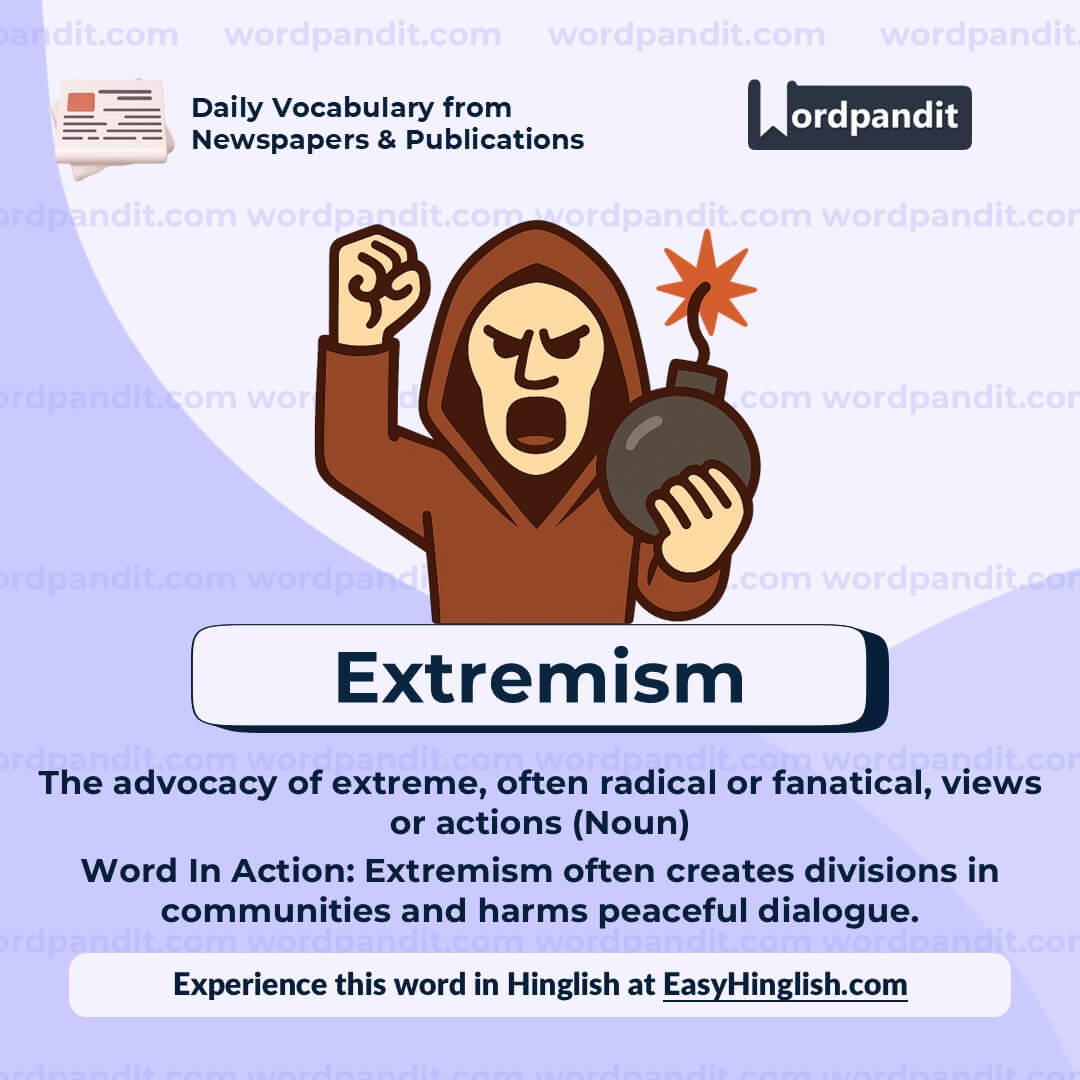
WORD-5: Extremism
Context:
"The outcome of this struggle now will impact society and polity, with the possibility of political unrest and the export of extremism, if society falls prey to religious fundamentalism and sponsors of terrorism." - Indian Express
Explanatory Paragraph:
The word extremism refers to holding extreme political, religious, or social views that go far beyond what most people consider reasonable. It often involves rigid, uncompromising beliefs and, at times, violent actions taken in the name of those beliefs. In the given context, "export of extremism" warns about radical ideologies spreading across borders and influencing other societies negatively.
Meaning: The advocacy of extreme, often radical or fanatical, views or actions (Noun)
Pronunciation: ik-STREE-mizm
Difficulty Level: ⭐⭐⭐ Intermediate
Etymology: From the word extreme, derived from Latin extremus meaning "outermost, utmost," evolving into a term for views that go beyond the accepted norm.
Prashant Sir's Notes:
Extremism is about going to the farthest ends of belief without balance or moderation. Whether in politics, religion, or ideology, extremism thrives on absolutes and intolerance. Always contrast it with the value of moderation.
Synonyms & Antonyms:
Synonyms: radicalism, fanaticism, militancy, zealotry, intolerance
Antonyms: moderation, balance, tolerance, centrism
Usage Examples:
- The government has taken strict measures to combat religious extremism.
- Extremism often thrives in conditions of poverty and social injustice.
- Her views were so marked by extremism that even her allies distanced themselves.
- History shows how extremism can destabilize entire nations.
Cultural Reference:
Global events like the 9/11 attacks are often cited as tragic outcomes of extremism, showing how radical ideologies can influence violent actions with worldwide consequences. - Contemporary History
Think About It:
Can extremism ever be justified as a tool for social change, or does it always end up causing harm to society?
Quick Activity:
Write down two examples of extremism—one political and one religious—and then suggest a moderate alternative response to each.
Memory Tip:
Remember that “extremism” comes from “extreme.” Just think: extremism = extreme ideas taken to dangerous levels.
Real-World Application:
The concept of extremism is crucial in discussions on terrorism, global security, and even local politics. Understanding it helps identify when ideas cross from passionate belief into harmful rigidity.


