

Daily Vocabulary from International Newspapers and Publications
Expand Your Vocabulary with Wordpandit’s Global Vocabulary Hub
At Wordpandit, we are committed to helping you develop a truly global vocabulary by drawing from some of the most respected international publications. This section is designed to keep you ahead of the curve by introducing you to words that define global conversations and trends.
The Power of Global Sources
To help you think and communicate on a global scale, we curate vocabulary from renowned international sources, such as:
- The New York Times
- The Washington Post
- BBC
- The Guardian
- The Economist
- Scientific American
- Psychology Today
- And many more...
Stay Global, Stay Competitive
Our daily updates from international publications ensure you are consistently exposed to new words that reflect global news and developments, making sure your vocabulary is not only current but also globally relevant.
Enhance Your Global Perspective
Whether you’re preparing for international exams, aiming to excel in global business communication, or want to enhance your language skills for personal growth, Wordpandit offers the resources you need to thrive in a global context.
Effective Learning, Global Reach
Our learning methodology combines global examples, memory aids, and interactive activities, allowing you to internalize new words effectively and apply them in real-world scenarios.
Begin Your Global Vocabulary Journey Now!

Why Choose Wordpandit?
Practical Learning: Focus on words you'll actually encounter in real-world reading, enhancing your comprehension and communication skills.
Diverse Content: From current affairs to scientific breakthroughs, our varied sources expose you to vocabulary across multiple domains.
Effortless Integration: Make Wordpandit a part of your daily routine. Just a few minutes each day can significantly boost your lexicon over time.
Your Path to Vocabulary Mastery
- Visit our Daily Vocabulary section regularly
- Explore new words and their usage in context
- Practice incorporating these words into your own writing and speech
- Track your progress as your vocabulary expands
Start Your Journey Today
Embark on your vocabulary enhancement journey with Wordpandit. By consistently engaging with our daily posts, you'll build a robust vocabulary that serves you well in academic, professional, and personal contexts.
Remember, a word a day keeps linguistic limitations at bay. Make Wordpandit your daily companion in the quest for vocabulary excellence!
WORD-1: Profound
Context:
"To lump or to split? Deciding whether an animal is a species or subspecies profoundly influences our conservation priorities." - Aeon
Explanatory Paragraph:
The word "profound" is often used to describe something that is deep, intense, or highly significant. In the context of decision-making, such as conservation efforts, a "profound influence" suggests a serious and far-reaching impact. It's not just about surface-level changes; it's about consequences that go deep and affect the core of an issue or situation.
Meaning: Deep, intense, or far-reaching in effect or understanding (Adjective)
Pronunciation: proh-fownd
Difficulty Level: ⭐⭐⭐ Intermediate
Etymology: From Latin *profundus*, meaning "deep" (*pro-* meaning "forward" + *fundus* meaning "bottom")
Prashant Sir's Notes:
Use "profound" to describe anything that has deep significance or emotional intensity—whether it's a thought, feeling, or impact. It’s more than just "important"; it’s deeply meaningful or powerful.
Synonyms & Antonyms:
Synonyms: deep, intense, significant, weighty, insightful
Antonyms: superficial, shallow, trivial, insignificant
Usage Examples:
- The professor’s lecture had a profound effect on how I see the world.
- She felt a profound sense of peace while meditating by the lake.
- Climate change will have profound consequences for future generations.
- The novel explores profound themes such as loss, identity, and redemption.
Cultural Reference:
"The most profound statements are often said in silence." – Lynn Johnston
Think About It:
Can a single decision ever be so profound that it alters the course of history? What makes something truly profound?
Quick Activity:
List three moments from your life that you would describe as profound. What made them so impactful?
Memory Tip:
Think of a "profound" idea as one that goes “pro” (forward) and “found” (to the bottom)—it digs deep beneath the surface.
Real-World Application:
In fields like psychology, philosophy, and policymaking, "profound" is used to describe ideas or decisions that carry deep meaning or significant consequences. It’s also useful in everyday discussions about emotions, events, and insights.
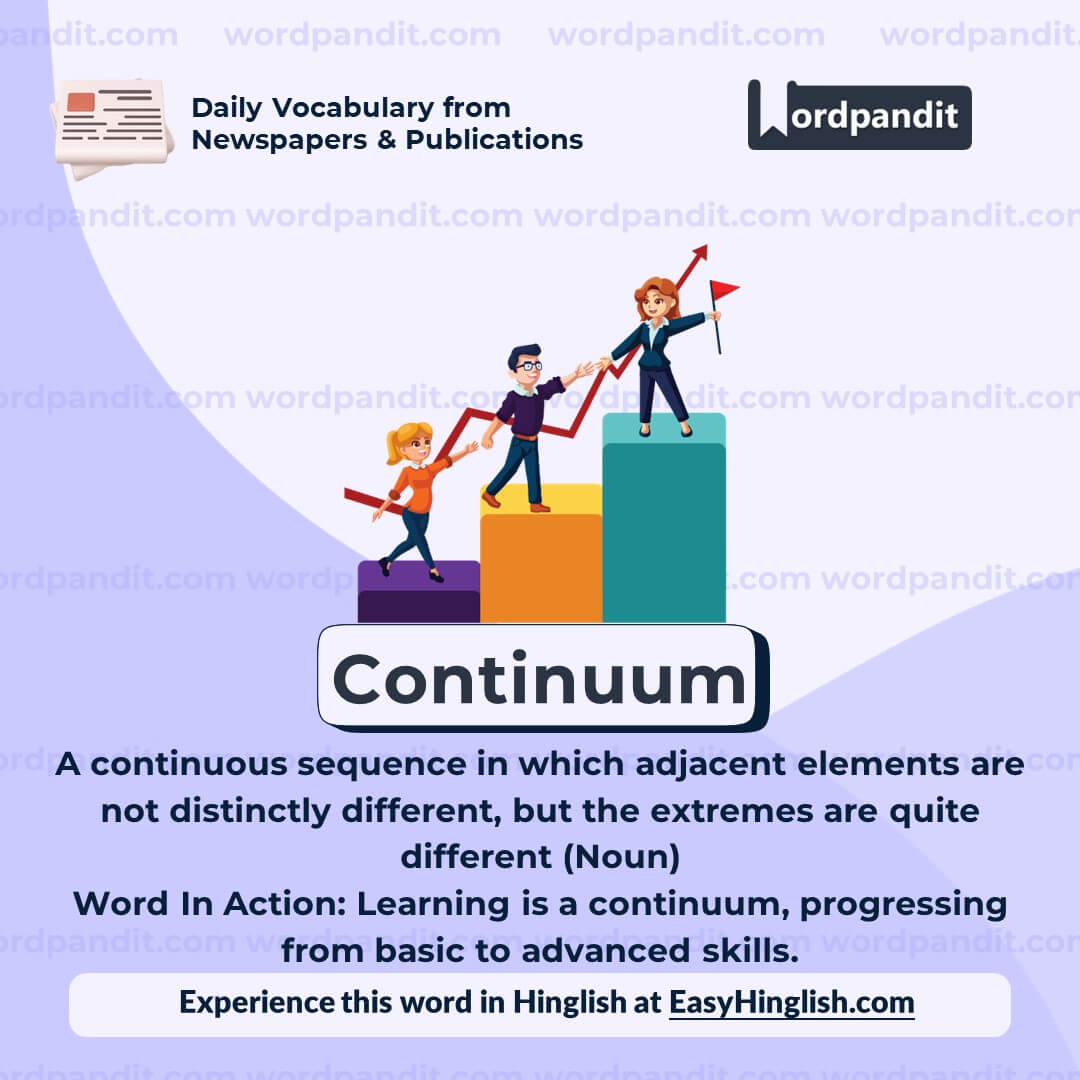
WORD-2: Continuum
Context:
"The same attitudes that propel a horrific continuum of colonial violence in the Global South propel it on a smaller scale in the Global North." - The Wire
Explanatory Paragraph:
The word "continuum" refers to something that is continuous and does not have clearly marked boundaries or divisions. In this context, it is used to describe how acts of colonial violence are not isolated or separate incidents, but rather part of a continuous thread or sequence—an ongoing pattern. The term emphasizes how certain behaviors or ideologies stretch across time and space without a clear beginning or end.
Meaning: A continuous sequence or range in which adjacent elements are not perceptibly different from each other, although the extremes are quite distinct (Noun)
Pronunciation: kun-TIN-yoo-um
Difficulty Level: ⭐⭐⭐⭐ Advanced
Etymology: From Latin *continuum*, meaning "a continuous thing," from *continuus* ("uninterrupted")
Prashant Sir's Notes:
"Continuum" is often used in academic, philosophical, or scientific contexts to describe a range that doesn't break—like a line of thought, behavior, or experience. Think of it as something that evolves gradually without sudden changes.
Synonyms & Antonyms:
Synonyms: sequence, range, span, spectrum, progression
Antonyms: interruption, break, gap, disconnection
Usage Examples:
- Learning is a lifelong process that exists on a continuum of growth and development.
- The emotional continuum ranges from joy to sorrow, with many shades in between.
- Social inequality exists along a continuum that reflects centuries of systemic oppression.
- In physics, light is often discussed as part of the electromagnetic continuum.
Cultural Reference:
"Life and death are not opposites but rather points on the same continuum." – Paraphrased from various philosophical views
Think About It:
Can positive and negative human behaviors be seen as part of the same moral continuum? Where do we draw the line?
Quick Activity:
Create your own "continuum" by choosing two opposites (e.g., calm and angry) and identifying at least three emotions or states that might fall between them.
Memory Tip:
Think of “continuum” as “continue + umm”—something that just keeps going without an obvious stop or break.
Real-World Application:
"Continuum" is commonly used in sociology, medicine, physics, and psychology to describe gradual change or range—such as the autism spectrum, political ideologies, or stages of grief. It helps capture complexity without forcing binary thinking.
WORD-3: Amateurs
Context:
"The financial arrangements soon proved inadequate. Set sales were disappointing as amateurs made their own receivers and listeners bought rival unlicensed sets." - Aeon
Explanatory Paragraph:
The word "amateurs" refers to people who engage in an activity for the love of it, rather than as a profession. In the context above, it implies that regular individuals—non-professionals—were building their own radio receivers instead of buying the commercially available ones. The implication is not necessarily of poor skill, but of non-professional or informal involvement that undercut the formal market.
Meaning: People who engage in a pursuit, especially a sport or hobby, without professional or formal training (Noun, plural)
Pronunciation: AM-uh-churz
Difficulty Level: ⭐⭐ Basic
Etymology: From French *amateur*, meaning “lover of,” and Latin *amator* from *amare* (to love); originally referred to someone who did something out of love, not for profit
Prashant Sir's Notes:
“Amateur” isn’t always a negative term. While it can imply inexperience, it also suggests passion and initiative—doing something out of genuine interest, not just for money or fame.
Synonyms & Antonyms:
Synonyms: hobbyist, novice, non-professional, dabbler, layperson
Antonyms: professional, expert, specialist, veteran
Usage Examples:
- Despite being amateurs, the group created an impressive short film that went viral.
- Many scientific discoveries were made by curious amateurs who followed their passion.
- She may be an amateur in painting, but her work shows great promise.
- The competition is open to both professionals and amateurs alike.
Cultural Reference:
"Every professional was once an amateur." – An inspirational quote often shared in creative and sports communities.
Think About It:
Can amateurs sometimes outperform professionals? What role does passion play compared to formal training?
Quick Activity:
List three fields or hobbies where amateurs have made notable contributions. What do these examples teach us?
Memory Tip:
Amateur = “ama” (love) + “teur” (doer) → someone who does something for the love of it.
Real-World Application:
The word "amateur" is frequently used in sports, arts, science, and technology. Today, with online platforms and open-source tools, amateurs can contribute meaningfully to fields once limited to professionals—from astronomy to filmmaking to coding.
WORD-4: Correspond
Context:
"Kind,’ they argue, is a Biblical classification that corresponds to the modern ‘family’, and not, as you might imagine, to the modern concept of ‘species’. If Noah had accessed a modern taxonomic catalogue, he might have found himself with a cargo of up to 30,000 varieties of mammal, bird and reptile." - Aeon
Explanatory Paragraph:
The word "correspond" is used to describe a situation where one thing matches, aligns, or is equivalent to another in some way. In the context above, the biblical term "kind" is said to correspond—that is, roughly match or equate—to the scientific classification "family" rather than the more specific term "species". This means that even though the words come from different contexts (religious vs. scientific), they refer to similar levels of grouping.
Meaning: To be equivalent or similar in form, function, or meaning; to match or align with something (Verb)
Pronunciation: kor-uh-SPOND
Difficulty Level: ⭐⭐⭐ Intermediate
Etymology: From Latin *correspondere*, meaning "to answer together," from *com-* (together) + *respondere* (to answer)
Prashant Sir's Notes:
“Correspond” is often used to show relationships—when one concept, item, or fact matches or aligns with another. It’s also used in communication: “corresponding via letters or emails.” Pay attention to context!
Synonyms & Antonyms:
Synonyms: match, align, relate, equate, coincide
Antonyms: differ, mismatch, contradict, conflict
Usage Examples:
- The map coordinates correspond to real-world locations.
- The results correspond closely with previous research findings.
- Her actions did not correspond with her promises.
- In ancient times, people would correspond through handwritten letters.
Cultural Reference:
"Correspondence chess" is a form of chess where players compete by sending moves to each other via mail or email—demonstrating the secondary meaning of the word related to written communication.
Think About It:
How often do your intentions correspond with your actions? What does it take to keep them aligned?
Quick Activity:
Match these historical terms with their modern counterparts (e.g., “alchemy” corresponds to “chemistry”). Try creating three pairs on your own.
Memory Tip:
Think of “correspond” as “co-respond” — when two things respond or relate to each other in a matching way.
Real-World Application:
"Correspond" is used widely in academic, scientific, and everyday contexts—to show relationships between data, ideas, or people. It helps in making comparisons, interpreting research, or even just staying in touch through letters or emails.
WORD-5: Taxonomy
Context:
"If Noah had accessed a modern taxonomic catalogue, he might have found himself with a cargo of up to 30,000 varieties of mammal, bird and reptile." - Aeon
Explanatory Paragraph:
The word "taxonomy" refers to the science of classifying and naming living organisms. It helps organize the vast diversity of life into categories like kingdom, phylum, class, order, family, genus, and species. In the context of the quote, a "taxonomic catalogue" would be a modern list based on this system, potentially overwhelming Noah with the sheer number of animal varieties recognized today under modern scientific classification.
Meaning: The scientific process or system of classifying organisms into structured categories (Noun)
Pronunciation: tak-SAW-nuh-mee
Difficulty Level: ⭐⭐⭐⭐ Advanced
Etymology: From Greek *taxis* (arrangement) + *nomia* (method or system)
Prashant Sir's Notes:
Taxonomy is not just about biology—it also applies to any organized system of classification, including digital files, academic subjects, or even personality traits. But in scientific contexts, it’s most commonly used to classify living things.
Synonyms & Antonyms:
Synonyms: classification, categorization, systematics, nomenclature
Antonyms: disorganization, chaos, randomness (in context)
Usage Examples:
- Modern taxonomy allows scientists to identify relationships between different species.
- The taxonomy of plants has changed significantly with the advent of genetic research.
- She studied taxonomy in order to better understand animal biodiversity.
- Good taxonomy in a website helps users find content more easily.
Cultural Reference:
Swedish botanist Carl Linnaeus is known as the father of modern taxonomy; he developed the binomial nomenclature system still used today (e.g., *Homo sapiens* for humans).
Think About It:
Why do humans feel the need to classify and categorize everything? Is taxonomy a reflection of our desire to control and understand the world?
Quick Activity:
Choose any common animal (e.g., a cat or a crow) and research its full taxonomic classification from kingdom to species. Can you write it out?
Memory Tip:
Think of “taxonomy” as a “system of naming” (tax + nomy = arrange + name). It helps sort and label life’s variety.
Real-World Application:
Taxonomy is essential in biology, medicine, agriculture, and conservation. By classifying organisms, scientists can track diseases, study evolution, and protect endangered species more effectively. In digital spaces, taxonomy helps organize content and improve searchability.


