

Daily Vocabulary from International Newspapers and Publications
Expand Your Vocabulary with Wordpandit’s Global Vocabulary Hub
At Wordpandit, we are committed to helping you develop a truly global vocabulary by drawing from some of the most respected international publications. This section is designed to keep you ahead of the curve by introducing you to words that define global conversations and trends.
The Power of Global Sources
To help you think and communicate on a global scale, we curate vocabulary from renowned international sources, such as:
- The New York Times
- The Washington Post
- BBC
- The Guardian
- The Economist
- Scientific American
- Psychology Today
- And many more...
Stay Global, Stay Competitive
Our daily updates from international publications ensure you are consistently exposed to new words that reflect global news and developments, making sure your vocabulary is not only current but also globally relevant.
Enhance Your Global Perspective
Whether you’re preparing for international exams, aiming to excel in global business communication, or want to enhance your language skills for personal growth, Wordpandit offers the resources you need to thrive in a global context.
Effective Learning, Global Reach
Our learning methodology combines global examples, memory aids, and interactive activities, allowing you to internalize new words effectively and apply them in real-world scenarios.
Begin Your Global Vocabulary Journey Now!

Why Choose Wordpandit?
Practical Learning: Focus on words you'll actually encounter in real-world reading, enhancing your comprehension and communication skills.
Diverse Content: From current affairs to scientific breakthroughs, our varied sources expose you to vocabulary across multiple domains.
Effortless Integration: Make Wordpandit a part of your daily routine. Just a few minutes each day can significantly boost your lexicon over time.
Your Path to Vocabulary Mastery
- Visit our Daily Vocabulary section regularly
- Explore new words and their usage in context
- Practice incorporating these words into your own writing and speech
- Track your progress as your vocabulary expands
Start Your Journey Today
Embark on your vocabulary enhancement journey with Wordpandit. By consistently engaging with our daily posts, you'll build a robust vocabulary that serves you well in academic, professional, and personal contexts.
Remember, a word a day keeps linguistic limitations at bay. Make Wordpandit your daily companion in the quest for vocabulary excellence!
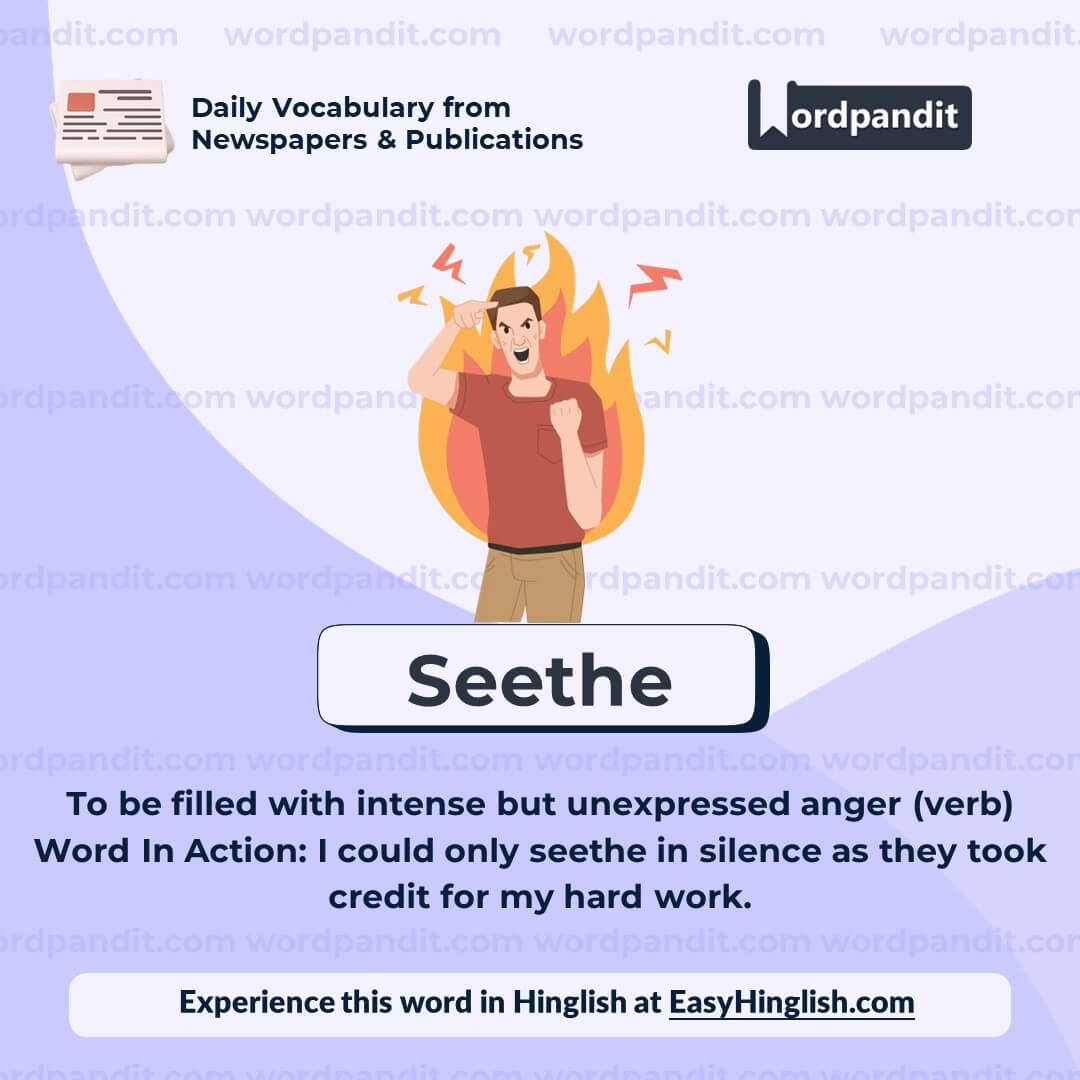
WORD-1: Seethe
Context:
"The rest of the class positively seethed with indignation when Julia won the award." - The Guardian
Explanatory Paragraph:
The word "seethe" refers to the intense and often suppressed emotion, typically anger or frustration, that bubbles up inside a person. It can be used to describe someone who is visibly agitated or boiling over with emotions, without necessarily expressing them outwardly.
Meaning: To be filled with intense anger or agitation, often without openly expressing it. (Verb)
Pronunciation: /seeth/
Difficulty Level: ⭐⭐⭐ Intermediate
Etymology: The word "seethe" comes from the Old English word "siðian," meaning "to boil." It originally referred to liquids that were boiling, but over time, it became associated with the idea of a person's emotions being in a state of intense agitation.
Prashant Sir's Notes:
The word "seethe" is often used in contexts where emotions are tightly controlled, but the person is clearly upset. Think of a boiling pot of water where the steam is contained, much like a person trying to suppress their anger.
Synonyms & Antonyms:
Synonyms: Fume, boil, rage, smolder, seethe with anger
Antonyms: Calm, relax, soothe, appease
Usage Examples:
- He continued to seethe quietly in the corner, unable to control his rage after the unfair criticism.
- She could hardly speak without seething with frustration at the situation.
- The crowd began to seethe with excitement as the concert started.
- John tried to seethe with patience, waiting for his turn, but it was evident he was becoming more agitated.
Cultural Reference:
"The anger was seething beneath the surface, like a volcano ready to erupt." - A phrase often used in literature and movies to describe characters on the brink of losing control over their emotions.
Think About It:
How often do we suppress our emotions, letting them "seethe" inside us? What might be the consequences of holding onto anger rather than expressing it?
Quick Activity:
Think of a time when you "seethed" with anger or frustration. How did you deal with it? Could you have handled the situation differently?
Memory Tip:
Imagine a kettle of water boiling over – the bubbling heat and steam are like the seething emotions that build up inside a person. This image will help you remember the word "seethe" and its meaning.
Real-World Application:
"Seethe" can describe situations where people are simmering with anger in personal relationships, at work, or in competitive environments. Recognizing this emotion can help in resolving conflicts or preventing further escalation.
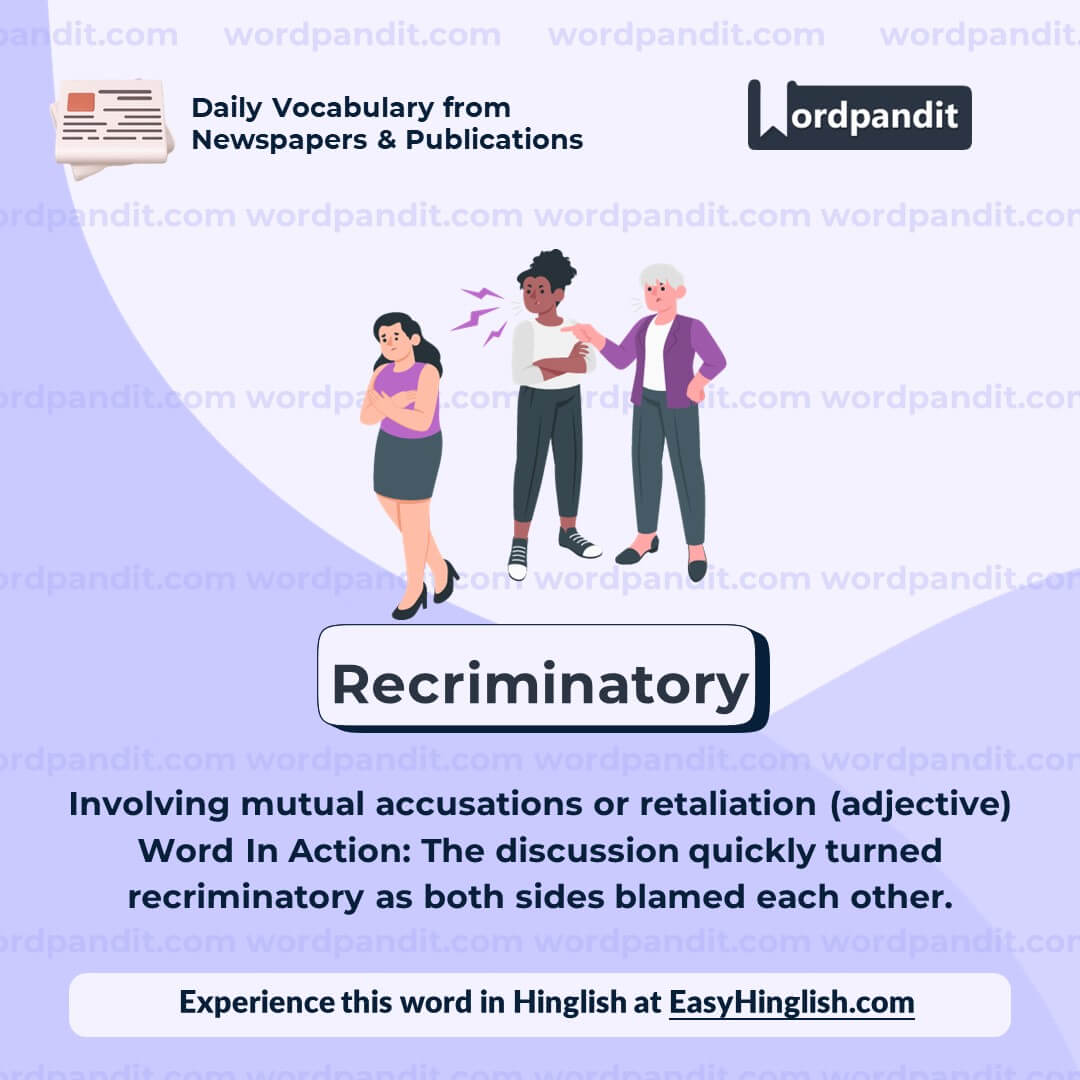
WORD-2: Recriminatory
Context:
"The militant group's statement is the latest in a series of recriminatory actions between the two sides." - BBC
Explanatory Paragraph:
The word "recriminatory" refers to actions, comments, or behavior that involve blaming or accusing someone in return. It often suggests a back-and-forth exchange of blame or accusations, usually in response to some wrongdoing or perceived offense.
Meaning: Involving accusations or the act of blaming someone in return, typically as a response to an accusation. (Adjective)
Pronunciation: /rɪˈkrɪməˌnɛtəri/
Difficulty Level: ⭐⭐⭐ Intermediate
Etymology: Derived from the Latin word "recriminari," meaning "to accuse in return." The prefix "re-" suggests "back" or "again," indicating the reciprocal nature of the accusation.
Prashant Sir's Notes:
Recriminatory actions often occur in situations of conflict, where instead of resolving issues, both parties start blaming each other. In relationships, whether personal or political, this leads to an escalation rather than a solution.
Synonyms & Antonyms:
Synonyms: Accusatory, blaming, retaliatory, recriminative
Antonyms: Forgiving, reconciling, appeasing
Usage Examples:
- The conversation quickly turned into a recriminatory exchange, with each side blaming the other for the failure.
- The recriminatory statements from both leaders only served to heighten tensions between the two countries.
- Instead of resolving the issue, the meeting became a recriminatory session, with accusations flying in every direction.
- The recriminatory tone of the argument made it clear that neither party was willing to accept responsibility for the breakdown in communication.
Cultural Reference:
"The recriminatory nature of the political debates often reflects the inability to reach a common ground." - A common observation in modern-day political discourse, where blame becomes central to discussions rather than solutions.
Think About It:
How do recriminatory actions affect the possibility of resolving conflicts? Can a situation improve when both sides are focused on blaming each other instead of finding common ground?
Quick Activity:
Think of a recent disagreement you had. Did you or the other person engage in recriminatory behavior? How might the situation have changed if both parties focused on finding a solution instead of blaming one another?
Memory Tip:
To remember "recriminatory," think of the word "re-" meaning "back" and "accusatory" meaning to blame. Together, they describe a situation where blame is thrown back and forth.
Real-World Application:
Recriminatory actions often occur in legal disputes, political conflicts, and personal relationships. Recognizing and avoiding this behavior can help in resolving issues more peacefully and productively.
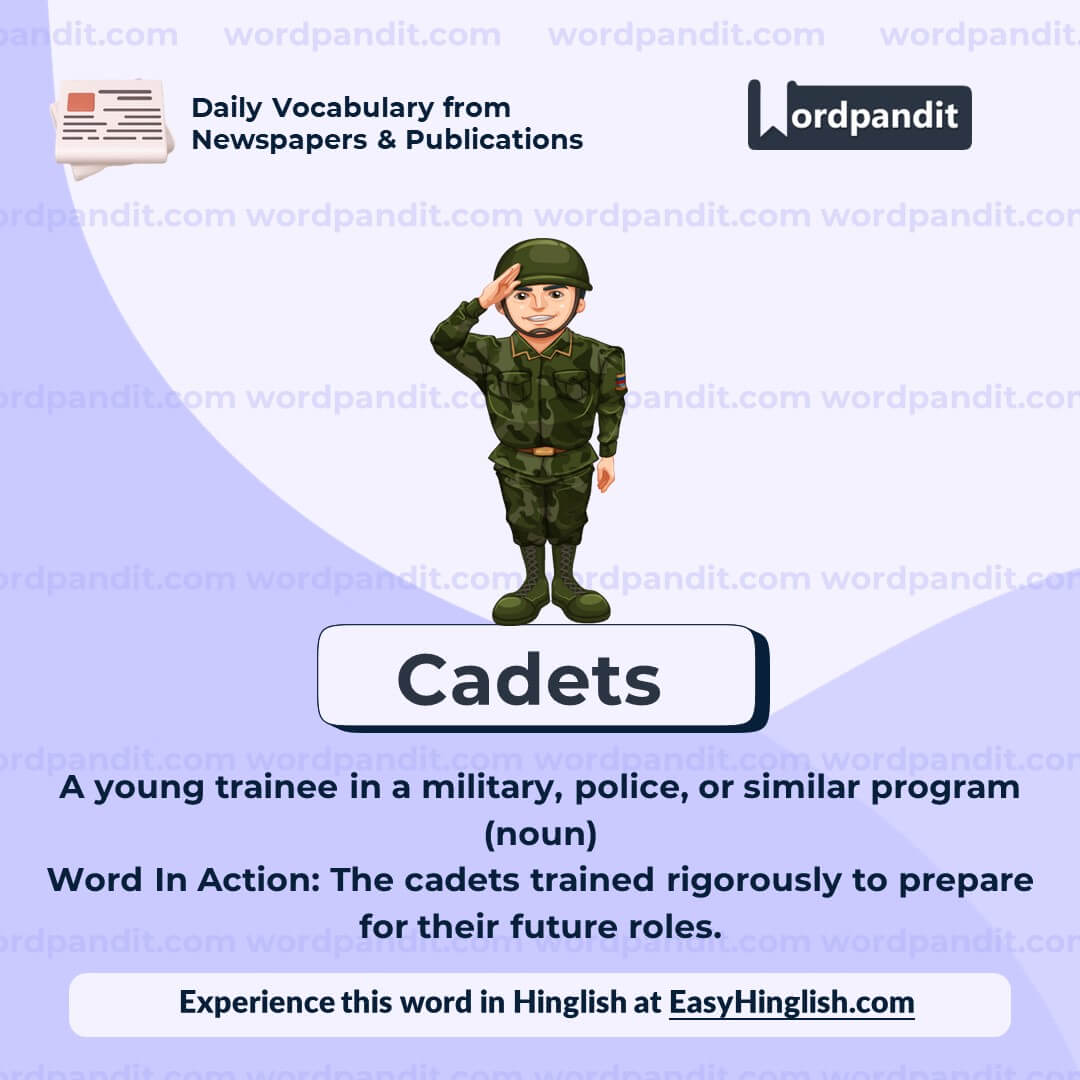
WORD-3: Cadets
Context:
"The cadets have two minutes to get dressed and run to their bomb shelter: the boarding school is considered a military target." - The Guardian
Explanatory Paragraph:
The word "cadets" refers to young individuals, typically in a military or police training program, who are undergoing training to become officers. They are often in the early stages of their career and are usually still learning the skills required for their roles. The term is most commonly associated with military schools or academies.
Meaning: Young trainees in a military, naval, or police academy, preparing for a career as officers. (Noun, plural)
Pronunciation: /kəˈdɛt/
Difficulty Level: ⭐⭐ Basic
Etymology: The word "cadet" comes from the French word "cadet," meaning "younger son" or "junior," originally referring to a younger person training for a military role.
Prashant Sir's Notes:
Cadets are often seen as disciplined individuals who undergo rigorous training, which can be both physically and mentally challenging. The term is widely used in military and paramilitary contexts but can also be applied to those training for other leadership positions.
Synonyms & Antonyms:
Synonyms: Trainee, recruit, apprentice, novice
Antonyms: Officer, veteran, expert, leader
Usage Examples:
- The cadets marched in formation, showing their discipline and attention to detail.
- During their training, the cadets were tested on various military skills, from strategy to physical endurance.
- The cadets were assigned to different posts in the training facility, each under the supervision of an officer.
- After months of hard work, the cadets finally graduated and were promoted to officers in the army.
Cultural Reference:
"The young cadets, eager and determined, are seen as the future of military leadership." - This idea is often portrayed in films and books where cadets undergo intense training to take on leadership roles, representing a legacy of strength and discipline.
Think About It:
What qualities do you think make a cadet successful in their training? How does the experience of being a cadet shape their future leadership roles?
Quick Activity:
Imagine you are a cadet preparing for a leadership role. Write a short reflection on how the training would help you grow as a leader and what challenges you might face.
Memory Tip:
To remember "cadet," think of the word "candidate," as cadets are candidates for military leadership. Both words share the idea of preparation for a future role.
Real-World Application:
Cadets are often involved in training programs at military academies, police academies, or other institutions where they develop the skills needed to serve in leadership roles. Their training is critical in shaping their careers in law enforcement or military service.
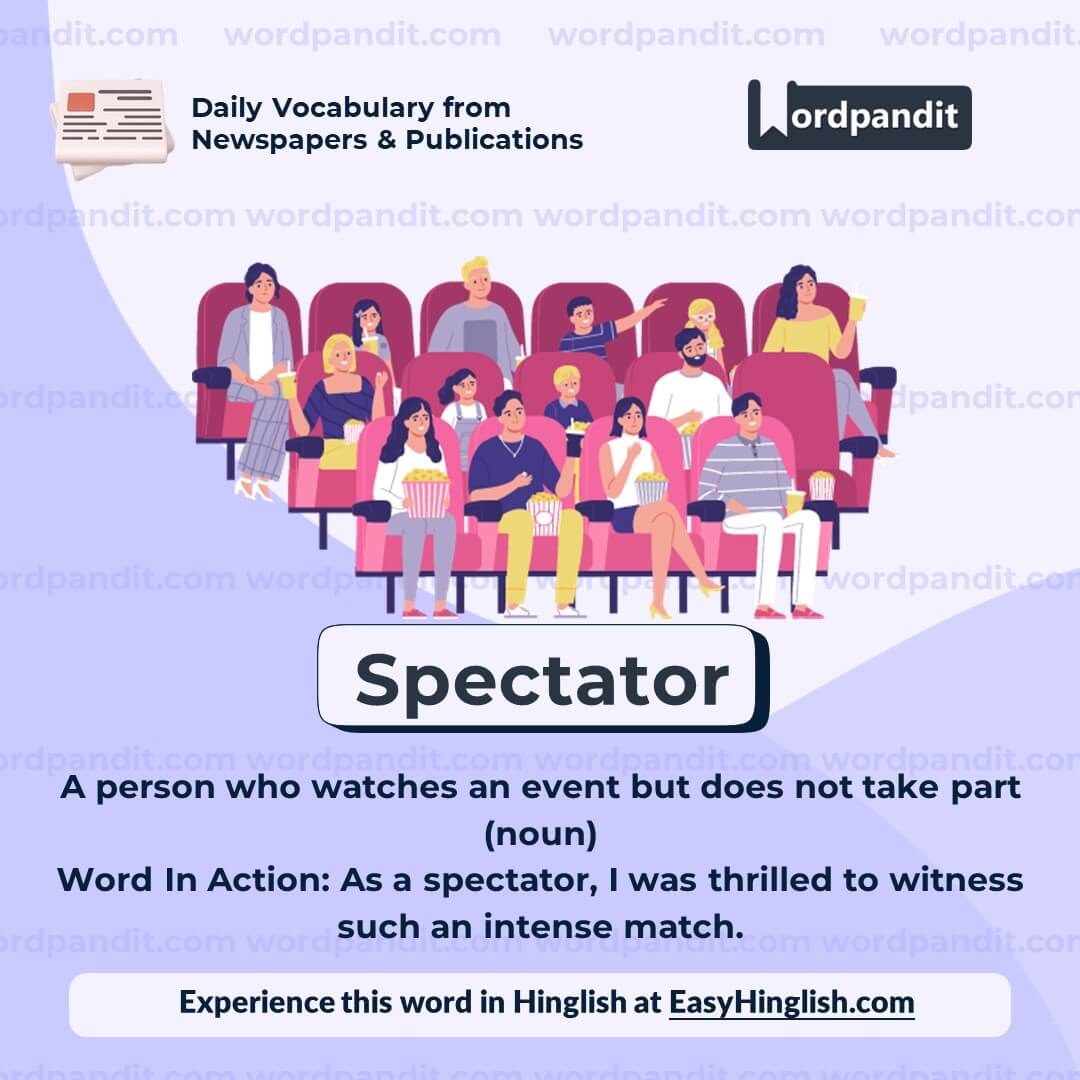
WORD-4: Spectator
Context:
"Israel also recently briefly delayed buses taking Palestinian prisoners to be released into the occupied West Bank, after expressing anger over the way in which hostages were released through crowds of spectators in Gaza hours earlier." - BBC
Explanatory Paragraph:
The word "spectator" refers to a person who watches an event or activity without actively participating. It is commonly used to describe individuals who observe sports events, public demonstrations, or any situation where people gather to watch rather than engage directly.
Meaning: A person who observes or watches an event or activity, especially without participating in it. (Noun)
Pronunciation: /ˈspektāˌtôr/
Difficulty Level: ⭐ Basic
Etymology: The word "spectator" comes from the Latin "spectator," meaning "watcher" or "observer," derived from "spectare," which means "to look at" or "to observe."
Prashant Sir's Notes:
Spectators are passive participants in the sense that they are present at an event but are not involved in the action. In many contexts, spectators can influence the atmosphere, as their reactions can affect the mood and dynamics of the event.
Synonyms & Antonyms:
Synonyms: Observer, onlooker, viewer, bystander, witness
Antonyms: Participant, player, actor, engager
Usage Examples:
- The spectators cheered as the athletes crossed the finish line.
- At the concert, the spectators were captivated by the stunning performance.
- The game was intense, with spectators anxiously awaiting the final play.
- Although the spectators were watching from a distance, their presence was a crucial part of the event's energy.
Cultural Reference:
"The role of the spectator is often seen as passive, yet their reactions can shape the experience of an event." - A common concept in discussions of art, sports, and public performances, emphasizing the impact that the audience's engagement can have on the overall atmosphere.
Think About It:
Can a spectator's presence influence the outcome of an event? In what ways do the actions or reactions of spectators impact the participants in sports, politics, or even everyday situations?
Quick Activity:
Imagine you're a spectator at a major event. How would your reaction change if you were more emotionally involved? Reflect on a time when your involvement as an observer influenced your perspective or experience.
Memory Tip:
To remember "spectator," think of the word "spectacle" (something you watch) — a spectator is someone who watches a spectacle from the sidelines.
Real-World Application:
In various contexts, such as sports, political events, or performances, spectators play a key role by providing feedback, energy, and atmosphere. They contribute to the overall experience, even though they aren't actively involved in the event itself.
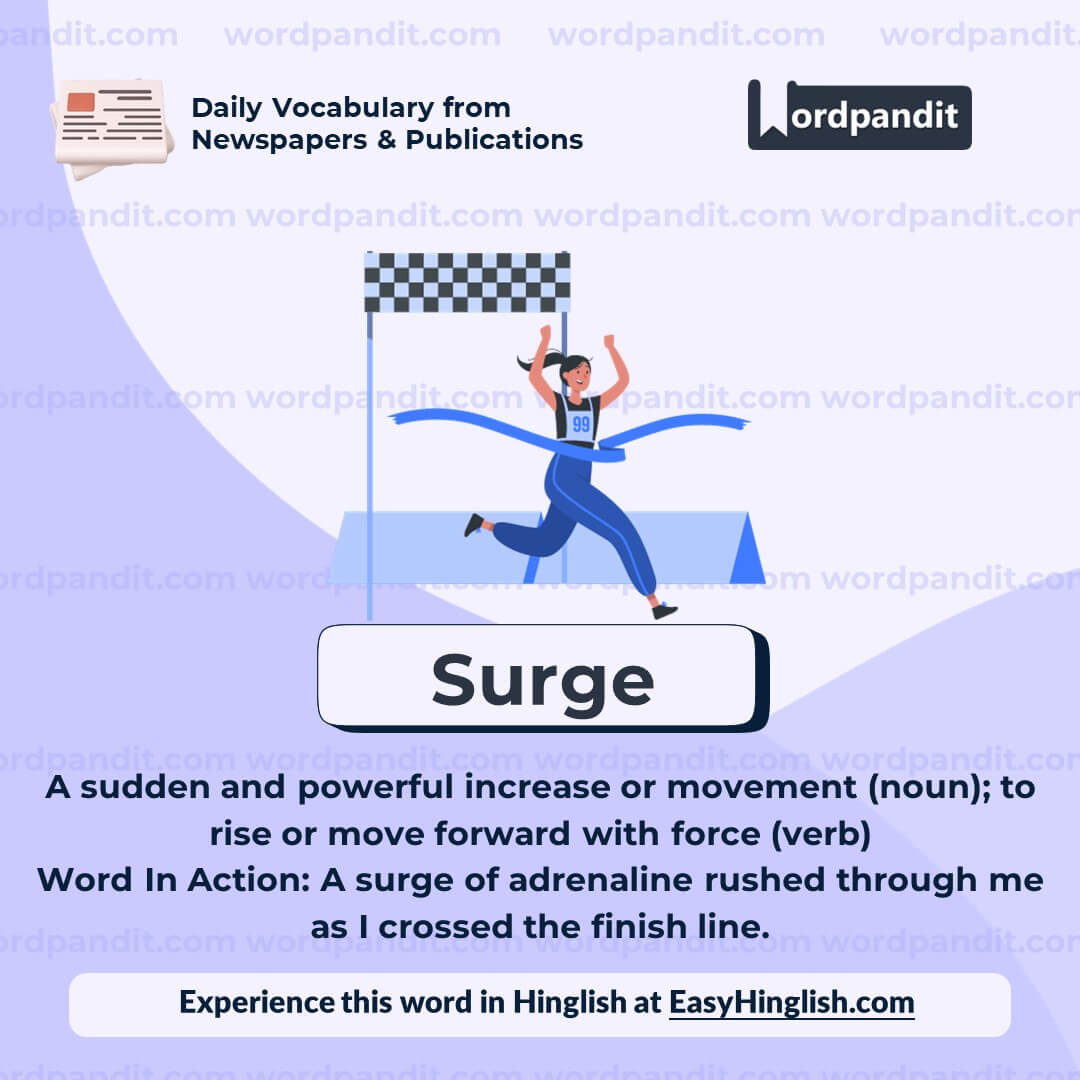
WORD-5: Surge
Context:
"This came after it accused Israel of failing to abide by its commitment to boost the amount of humanitarian aid allowed into Gaza – contradicting what had been described by the UN's humanitarian chief as a 'massive surge'." - BBC
Explanatory Paragraph:
The word "surge" refers to a sudden and powerful increase or rise in something, such as a flow of water, a number of people, or an amount of something. It is often used to describe rapid changes or movements, especially when they are large or unexpected.
Meaning: A sudden, powerful forward or upward movement; an increase or rise in something. (Noun, verb)
Pronunciation: /sɜːrdʒ/
Difficulty Level: ⭐⭐ Basic
Etymology: "Surge" comes from the Latin "surgere," meaning "to rise" or "to lift." It originally referred to a swelling or rising movement, like the surge of a wave in the ocean.
Prashant Sir's Notes:
Surges are typically sudden and strong, often unpredictable. The term is commonly used in contexts such as electricity (a power surge), crowds (a surge of people), or in economics (a surge in demand). Think of the powerful push of a wave in the sea to remember this word.
Synonyms & Antonyms:
Synonyms: Increase, rise, swell, flood, burst, escalation
Antonyms: Decline, drop, decrease, dip, fall
Usage Examples:
- The surge of energy from the crowd was felt all the way to the stage.
- There was a surge in online shopping as the holiday season approached.
- After the storm, the river surged over its banks, flooding the nearby roads.
- The company experienced a surge in demand following the release of their new product.
Cultural Reference:
"The surge of emotions after winning the championship was overwhelming." - Often used in sports contexts to describe the rush of feelings that follow a victory or achievement, capturing the intensity of the moment.
Think About It:
What are some examples of "surges" you might experience in your daily life? How do you handle moments when things suddenly increase or escalate quickly, either physically, emotionally, or professionally?
Quick Activity:
Think of a time when you experienced a "surge" of energy or emotion. Write about what triggered it and how you managed or responded to it.
Memory Tip:
To remember "surge," think of a wave in the ocean that suddenly rises up. The wave “surges” forward, just as a sudden increase or burst in something happens when we use the word.
Real-World Application:
In the world of business and economics, "surges" can indicate periods of rapid growth or demand, such as in stock prices, sales, or customer interest. Recognizing these surges can help businesses respond quickly to changes in the market.


