

Daily Vocabulary from International Newspapers and Publications
Expand Your Vocabulary with Wordpandit’s Global Vocabulary Hub
At Wordpandit, we are committed to helping you develop a truly global vocabulary by drawing from some of the most respected international publications. This section is designed to keep you ahead of the curve by introducing you to words that define global conversations and trends.
The Power of Global Sources
To help you think and communicate on a global scale, we curate vocabulary from renowned international sources, such as:
- The New York Times
- The Washington Post
- BBC
- The Guardian
- The Economist
- Scientific American
- Psychology Today
- And many more...
Stay Global, Stay Competitive
Our daily updates from international publications ensure you are consistently exposed to new words that reflect global news and developments, making sure your vocabulary is not only current but also globally relevant.
Enhance Your Global Perspective
Whether you’re preparing for international exams, aiming to excel in global business communication, or want to enhance your language skills for personal growth, Wordpandit offers the resources you need to thrive in a global context.
Effective Learning, Global Reach
Our learning methodology combines global examples, memory aids, and interactive activities, allowing you to internalize new words effectively and apply them in real-world scenarios.
Begin Your Global Vocabulary Journey Now!

Why Choose Wordpandit?
Practical Learning: Focus on words you'll actually encounter in real-world reading, enhancing your comprehension and communication skills.
Diverse Content: From current affairs to scientific breakthroughs, our varied sources expose you to vocabulary across multiple domains.
Effortless Integration: Make Wordpandit a part of your daily routine. Just a few minutes each day can significantly boost your lexicon over time.
Your Path to Vocabulary Mastery
- Visit our Daily Vocabulary section regularly
- Explore new words and their usage in context
- Practice incorporating these words into your own writing and speech
- Track your progress as your vocabulary expands
Start Your Journey Today
Embark on your vocabulary enhancement journey with Wordpandit. By consistently engaging with our daily posts, you'll build a robust vocabulary that serves you well in academic, professional, and personal contexts.
Remember, a word a day keeps linguistic limitations at bay. Make Wordpandit your daily companion in the quest for vocabulary excellence!
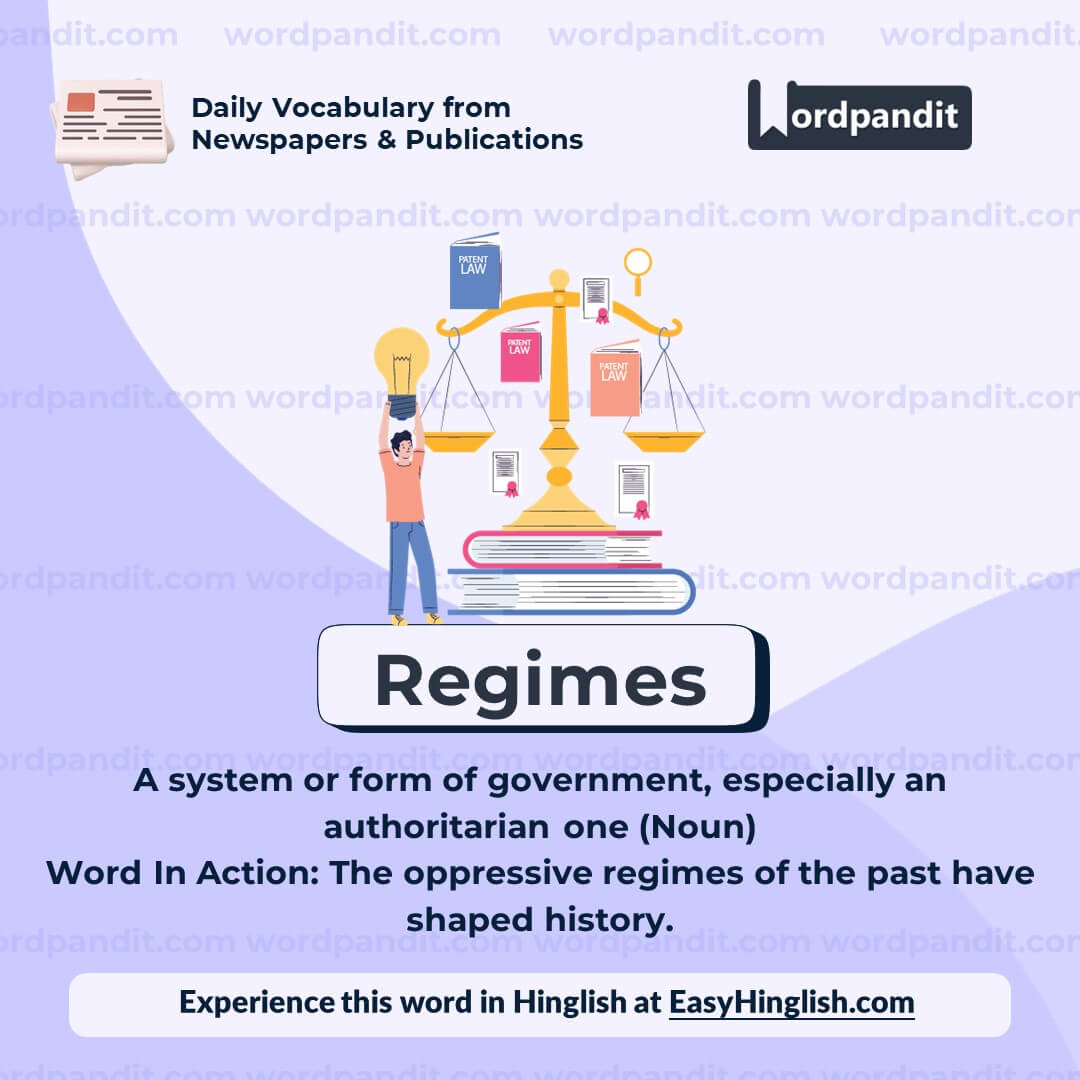
WORD-1: Regimes
Context:
"Throughout most of human history, people lived under oppressive non-democratic regimes." - BBC
Explanatory Paragraph:
The word "regimes" refers to systems or methods of government, often associated with authoritarian rule. While the term can neutrally describe any type of governing system, it frequently carries a negative tone when used in modern discourse, especially to describe governments that suppress freedom or rule with strict control. In the context of history, it highlights periods where people had limited or no voice in political decisions.
Meaning: A system or planned way of doing things, especially one imposed from above (noun)
Pronunciation: ruh-ZHEEMS
Difficulty Level: ⭐⭐ Beginner to Intermediate
Etymology: From French *régime*, from Latin *regimen* meaning "rule" or "direction"
Prashant Sir's Notes:
Focus on the tone—while "regime" can be neutral, in contemporary usage, it often implies authoritarian or rigid control. Think of historical or military governments when you hear this word.
Synonyms & Antonyms:
Synonyms: government, administration, rule, authority, system
Antonyms: anarchy, chaos, disorganization, democracy (in contrast when "regime" is used negatively)
Usage Examples:
- The dictator ruled the country with an iron-fisted regime for over two decades.
- Many citizens fled the oppressive regime in search of freedom abroad.
- The new regime introduced sweeping reforms to modernize the economy.
- Journalists were often censored under the previous regime's strict media laws.
Cultural Reference:
"George Orwell’s *1984* presents a dystopian society under a totalitarian regime where surveillance and control are omnipresent." - Literature Analysis
Think About It:
Can a regime be considered effective if it provides stability, even at the cost of personal freedoms?
Quick Activity:
List three countries from history or current events that have been described as operating under a regime. Briefly explain why.
Memory Tip:
Think of "regime" as "rule-gym" — a strict set of rules or structure, much like how a gym routine is structured and imposed.
Real-World Application:
The word "regime" is often used in political discussions, news reports, and historical analysis to describe governments, especially those that limit personal freedom or follow rigid systems of control.
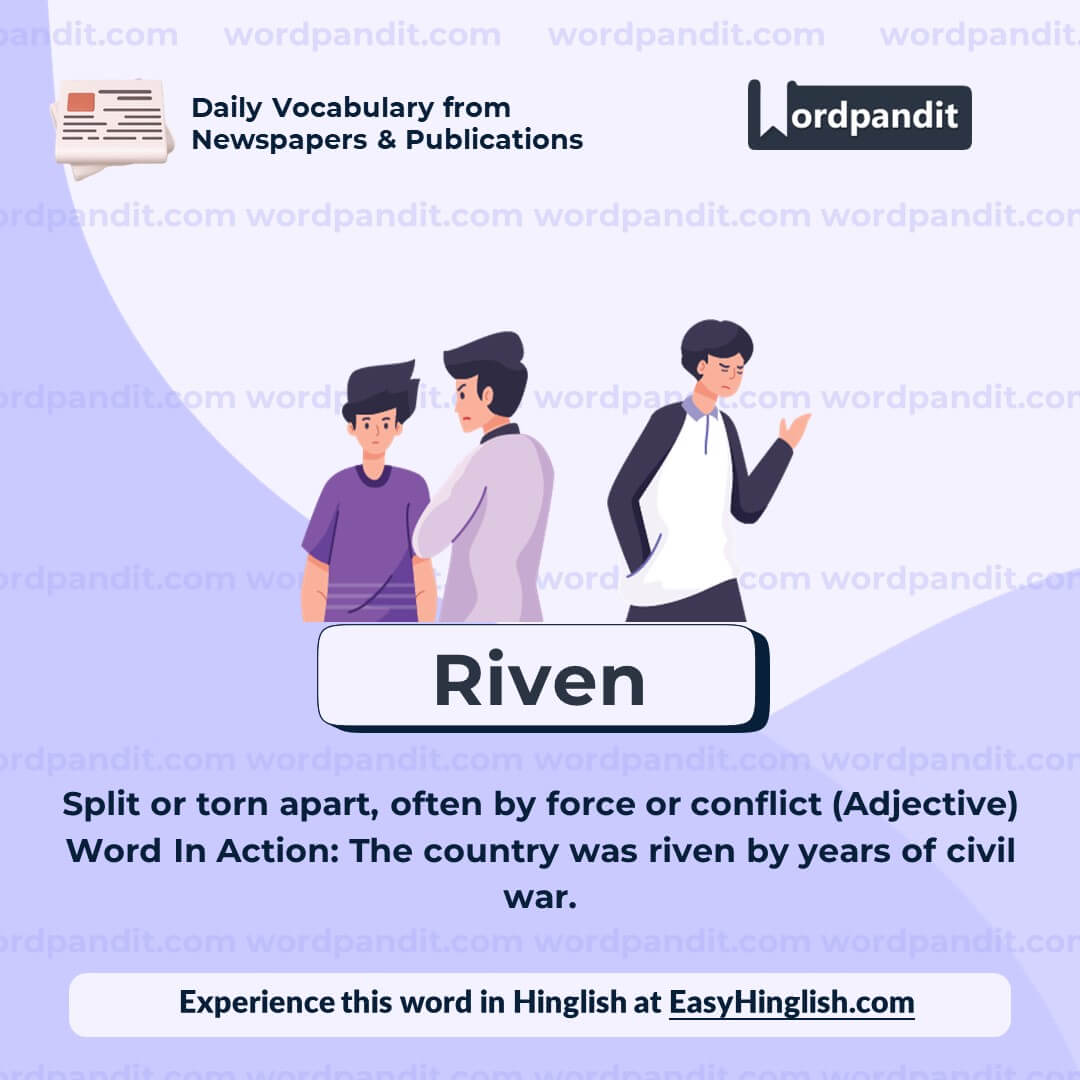
WORD-2: Riven
Context:
"Throughout history, the world has been riven by conflict." - BBC
Explanatory Paragraph:
"Riven" is a vivid word that means torn apart or deeply divided, often by force or intense disagreement. It is typically used to describe things that are metaphorically or literally split—such as societies, relationships, or landscapes. In the given context, it highlights how conflict has continually fractured the world, leaving divisions in its wake.
Meaning: Torn apart; split or divided violently (adjective or past participle of "rive")
Pronunciation: RIH-vuhn
Difficulty Level: ⭐⭐⭐ Intermediate
Etymology: From Old Norse *rífa* meaning "to tear or rip"
Prashant Sir's Notes:
This word paints a strong emotional picture. It is often used to describe division caused by conflict—social, political, emotional. Think of "riven" as something violently split with lingering pain or damage.
Synonyms & Antonyms:
Synonyms: torn, split, divided, fractured, shattered
Antonyms: united, whole, connected, mended, reconciled
Usage Examples:
- The country was riven by decades of civil war and sectarian violence.
- His heart was riven with grief after the loss of his closest friend.
- The political party is riven with internal disagreements and power struggles.
- Earthquakes left the valley riven with deep, jagged cracks.
Cultural Reference:
"The American Civil War left the nation riven between North and South, a divide that echoed for generations." - History Channel Documentary
Think About It:
What modern issues have left societies riven today, and what could help heal those divides?
Quick Activity:
Think of a movie or book where a family, community, or nation is riven by internal conflict. Describe the source of the division in one sentence.
Memory Tip:
Remember: “Riven” sounds like “rip in,” as in a rip in the fabric of unity—something torn apart from within.
Real-World Application:
“Riven” is often used in journalism, literature, and political commentary to describe societies, governments, or relationships that are torn by deep divisions or conflict.
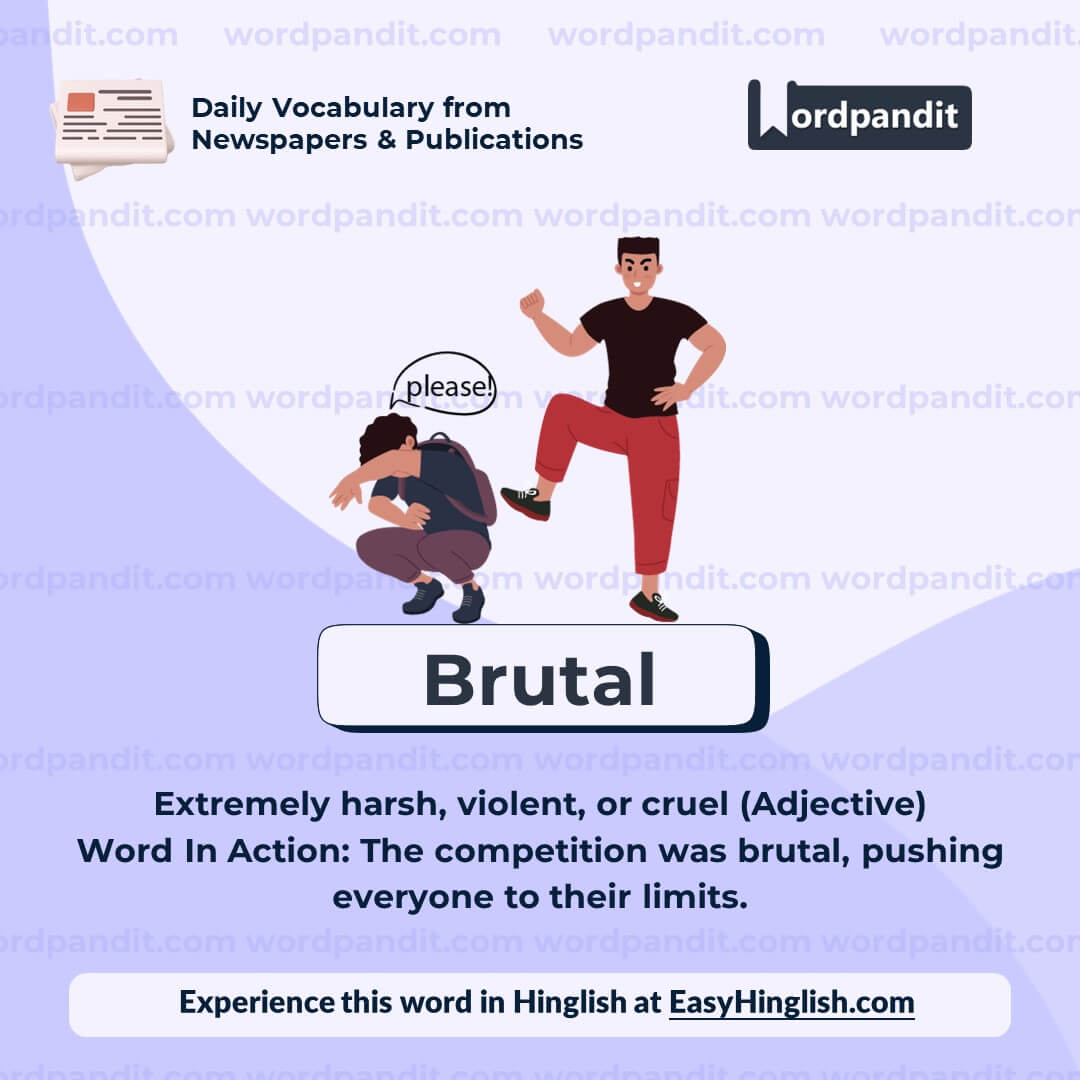
WORD-3: Brutal
Context:
"While the early 20th Century was especially brutal with two world wars in rapid succession, the post-war period has been very peaceful." - BBC
Explanatory Paragraph:
"Brutal" refers to something extremely harsh, violent, or cruel. It can describe physical actions, such as violent acts during war, or emotional and social situations that are unkind or severely difficult. In the context of the world wars, the word captures the intense suffering, destruction, and cruelty experienced by millions. The term conveys a sense of relentless harshness that leaves lasting scars.
Meaning: Extremely cruel, harsh, or violent (adjective)
Pronunciation: BROO-tuhl
Difficulty Level: ⭐⭐ Beginner to Intermediate
Etymology: From Latin *brutalis*, meaning "dull, stupid, like a brute"
Prashant Sir's Notes:
This is a common but powerful word. Use it to describe situations that are not just tough but harsh to the point of being cruel or dehumanizing—like war, abuse, or violence. The emotional impact of the word is very strong.
Synonyms & Antonyms:
Synonyms: savage, cruel, harsh, violent, ruthless
Antonyms: gentle, kind, humane, compassionate, tender
Usage Examples:
- The prisoners spoke of the brutal conditions they endured in the camp.
- That was a brutal winter — temperatures dropped below freezing for weeks.
- The soldiers faced brutal combat in the trenches during the war.
- Her boss gave her a brutal critique, leaving her demoralized.
Cultural Reference:
"Brutal honesty" is a phrase often used in popular culture to describe someone who is direct and unfiltered to the point of being hurtful — like Simon Cowell on *American Idol*.
Think About It:
Is brutal truth always better than a kinder lie? Where do we draw the line between honesty and cruelty?
Quick Activity:
Write down three situations—real or fictional—where the word "brutal" could be accurately applied. Try to vary them across emotional, physical, and social contexts.
Memory Tip:
Think of “brutal” as coming from “brute” — like a wild beast, uncaring and violent. Brutal = like a brute.
Real-World Application:
"Brutal" is frequently used in news reports, crime stories, sports commentaries, and even weather forecasts to emphasize extremity—be it in violence, conditions, or behavior.
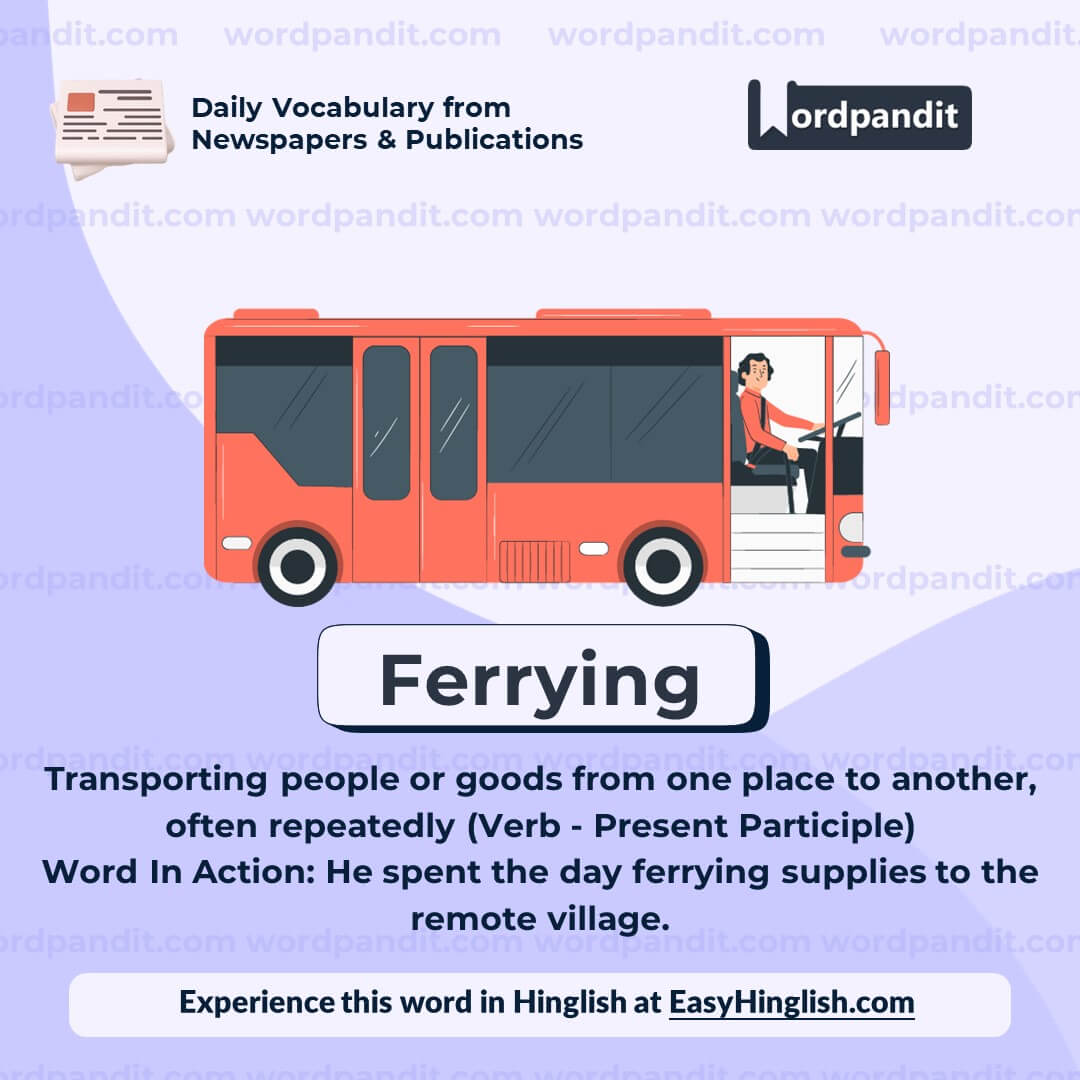
WORD-4: Ferrying
Context:
"As a succession of ambulances ferrying victims of the war between Israel and Hamas pull up outside the facility in the central town of Deir al-Balah, Zakaria clears a way through the crowds to retrieve newly arrived patients and rush them inside for treatment." - BBC
Explanatory Paragraph:
"Ferrying" refers to the act of transporting people or goods from one place to another, usually repeatedly or over short distances. In this context, ambulances are ferrying (carrying and delivering) injured people to the hospital. The word conveys not just movement but also urgency, care, and often repetition, especially in emergency or service scenarios.
Meaning: Transporting someone or something from one place to another, especially repeatedly (verb - present participle of “ferry”)
Pronunciation: FEH-ree-ing
Difficulty Level: ⭐⭐ Beginner to Intermediate
Etymology: From Old English *ferian*, meaning "to carry or transport"
Prashant Sir's Notes:
Ferrying doesn't only refer to boats—it can mean transporting by any vehicle. It’s useful in describing logistical operations, especially in rescue, transport, or military contexts.
Synonyms & Antonyms:
Synonyms: transporting, shuttling, conveying, carrying, delivering
Antonyms: staying, halting, retaining
Usage Examples:
- Helicopters were ferrying supplies to the flood-hit villages.
- The shuttle bus kept ferrying students between the hostel and campus.
- She spent the afternoon ferrying her children to their various classes.
- The rescue boats were busy ferrying stranded tourists to safety.
Cultural Reference:
In Greek mythology, Charon was the ferryman who ferried souls across the river Styx into the underworld—an early and symbolic use of the word "ferrying." - Myth Encyclopedia
Think About It:
How does the act of ferrying, especially in emergencies, reflect both urgency and compassion?
Quick Activity:
Use the word "ferrying" in a sentence related to: 1) nature, 2) healthcare, and 3) daily life. Compare how the tone or urgency changes.
Memory Tip:
Think of a “ferry” boat going back and forth—it helps you remember that “ferrying” means repeated or essential transportation.
Real-World Application:
“Ferrying” is often used in contexts involving emergency services, logistics, military operations, or even parenting—whenever people or goods are being moved regularly from one place to another.
WORD-5: Scandalous
Context:
"To most, Midgley’s attempt to discuss the relationship status of our most cherished philosophers would have been discarded as irrelevant, even scandalous." - Aeon
Explanatory Paragraph:
The word "scandalous" describes something that shocks people because it goes against accepted moral standards or social expectations. It’s often used when behavior is considered improper, disgraceful, or offensive to public decency. In this context, discussing the private lives of revered philosophers might be seen as inappropriate or disrespectful—thus “scandalous”—because it touches on matters traditionally kept private or considered irrelevant to their intellectual legacy.
Meaning: Causing general public outrage or shock due to perceived immorality or impropriety (adjective)
Pronunciation: SKAN-duh-luhs
Difficulty Level: ⭐⭐⭐ Intermediate
Etymology: From Late Latin *scandalosus*, from Greek *skandalon* meaning "a trap, offense, or stumbling block"
Prashant Sir's Notes:
This word blends morality and drama. It's useful when describing events that trigger shock or controversy, especially in public or media contexts. Watch out for its tone—it can imply strong judgment or sensationalism.
Synonyms & Antonyms:
Synonyms: shocking, disgraceful, outrageous, immoral, improper
Antonyms: respectable, decent, proper, appropriate, admirable
Usage Examples:
- The politician’s scandalous behavior led to his resignation.
- It was considered scandalous at the time for a woman to speak so boldly in public.
- The tabloids are always eager to uncover scandalous celebrity gossip.
- Her book offered a scandalous view of life inside the royal palace.
Cultural Reference:
"The release of the Pentagon Papers in the 1970s was considered scandalous by many, as it exposed hidden truths about the Vietnam War." - U.S. National Archives
Think About It:
Why are certain truths labeled as 'scandalous'? Who decides what crosses the line between honesty and impropriety?
Quick Activity:
Write a short sentence using the word “scandalous” to describe a situation from history, literature, or pop culture. Identify what made it scandalous.
Memory Tip:
Think of “scandalous” as “scandal + us”—a scandal that shocks all of us!
Real-World Application:
“Scandalous” is commonly used in media reports, biographies, and social commentary to describe behavior or revelations that challenge social norms or provoke public outrage.


