

Daily Vocabulary from International Newspapers and Publications
Expand Your Vocabulary with Wordpandit’s Global Vocabulary Hub
At Wordpandit, we are committed to helping you develop a truly global vocabulary by drawing from some of the most respected international publications. This section is designed to keep you ahead of the curve by introducing you to words that define global conversations and trends.
The Power of Global Sources
To help you think and communicate on a global scale, we curate vocabulary from renowned international sources, such as:
- The New York Times
- The Washington Post
- BBC
- The Guardian
- The Economist
- Scientific American
- Psychology Today
- And many more...
Stay Global, Stay Competitive
Our daily updates from international publications ensure you are consistently exposed to new words that reflect global news and developments, making sure your vocabulary is not only current but also globally relevant.
Enhance Your Global Perspective
Whether you’re preparing for international exams, aiming to excel in global business communication, or want to enhance your language skills for personal growth, Wordpandit offers the resources you need to thrive in a global context.
Effective Learning, Global Reach
Our learning methodology combines global examples, memory aids, and interactive activities, allowing you to internalize new words effectively and apply them in real-world scenarios.
Begin Your Global Vocabulary Journey Now!

Why Choose Wordpandit?
Practical Learning: Focus on words you'll actually encounter in real-world reading, enhancing your comprehension and communication skills.
Diverse Content: From current affairs to scientific breakthroughs, our varied sources expose you to vocabulary across multiple domains.
Effortless Integration: Make Wordpandit a part of your daily routine. Just a few minutes each day can significantly boost your lexicon over time.
Your Path to Vocabulary Mastery
- Visit our Daily Vocabulary section regularly
- Explore new words and their usage in context
- Practice incorporating these words into your own writing and speech
- Track your progress as your vocabulary expands
Start Your Journey Today
Embark on your vocabulary enhancement journey with Wordpandit. By consistently engaging with our daily posts, you'll build a robust vocabulary that serves you well in academic, professional, and personal contexts.
Remember, a word a day keeps linguistic limitations at bay. Make Wordpandit your daily companion in the quest for vocabulary excellence!
WORD-1: Alliance
Context:
"There's profound realisation that the old 'transatlantic partnership', the solid alliance between Europe and America, is broken." - BBC
Explanatory Paragraph:
The word "alliance" refers to a formal agreement or partnership between two or more parties, often countries or organizations, to work together for mutual benefit. In political or military contexts, alliances are formed to strengthen each side’s position, share resources, or achieve common goals. The word can also be used in business or personal relationships when groups or individuals decide to cooperate. In the sentence from the BBC, it conveys the idea that the historically strong relationship between Europe and America has weakened or collapsed.
Meaning: A formal agreement or union between groups to achieve common goals (Noun)
Pronunciation: uh-LY-uhns
Difficulty Level: ⭐⭐ Beginner
Etymology: From Old French 'aliance', from 'alier' meaning ‘to combine or unite’
Prashant Sir's Notes:
Focus on how "alliance" represents strategic cooperation. It's a critical word in international relations, business mergers, and even team collaborations. Note that alliances can be both formal (treaties) and informal (mutual understanding).
Synonyms & Antonyms:
Synonyms: partnership, union, coalition, association, confederation
Antonyms: rivalry, conflict, opposition, discord, enmity
Usage Examples:
- The countries formed an alliance to combat climate change together.
- Through a business alliance, both companies expanded their global reach.
- The military alliance helped secure peace in the region.
- They entered into an alliance to support each other’s political campaigns.
Cultural Reference:
"NATO, the North Atlantic Treaty Organization, is perhaps the most well-known military alliance in modern history, formed in 1949 to provide collective defense against aggression." - Encyclopedia Britannica
Think About It:
Can alliances between nations ever be truly equal, or does one side always hold more influence?
Quick Activity:
List 3 alliances (political, business, or personal) that have impacted global or local history. Briefly write how each alliance changed the course of events.
Memory Tip:
Think of “alliance” as "all lions" coming together to form a strong pride — a united front!
Real-World Application:
Understanding the concept of alliance is essential in global politics, international business, and team dynamics. Whether you’re forming a startup or negotiating treaties, building alliances is key to success.
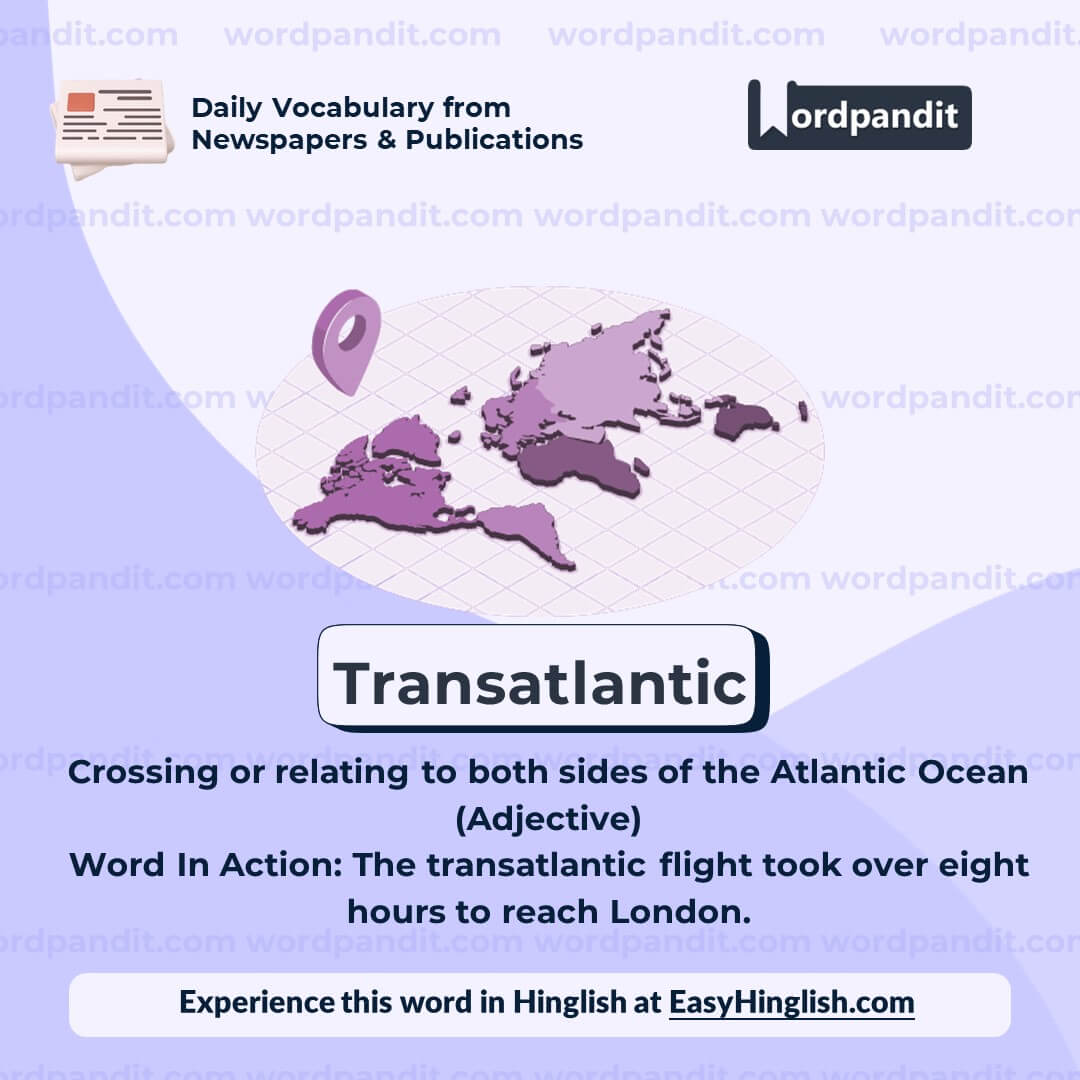
WORD-2: Transatlantic
Context:
"There's profound realisation that the old 'transatlantic partnership', the solid alliance between Europe and America, is broken." - BBC
Explanatory Paragraph:
The word "transatlantic" is used to describe something that crosses or spans the Atlantic Ocean. It is often used to talk about connections, relationships, or travel between Europe and North America, especially the United States. In the context of politics or diplomacy, a "transatlantic partnership" typically refers to the close ties between Europe and America. The BBC sentence uses this word to reflect on the weakening of this historically strong relationship.
Meaning: Spanning or involving countries on both sides of the Atlantic Ocean, especially Europe and North America (Adjective)
Pronunciation: trans-at-LAN-tik
Difficulty Level: ⭐⭐ Beginner
Etymology: From Latin 'trans-' meaning "across" + 'Atlantic', referring to the Atlantic Ocean
Prashant Sir's Notes:
This is a compound word: "trans" (across) + "Atlantic" (the ocean). It often pops up in geopolitical discussions, especially around diplomacy, trade, and defense between Europe and the U.S. Understanding this word gives insight into global alliances and international cooperation.
Synonyms & Antonyms:
Synonyms: intercontinental, ocean-spanning, cross-Atlantic
Antonyms: domestic, regional, local
Usage Examples:
- The transatlantic flight from London to New York took eight hours.
- They maintain strong transatlantic business ties with clients in the U.S.
- Transatlantic diplomacy has shaped global politics for decades.
- She works for a company with transatlantic operations and travels frequently.
Cultural Reference:
"The transatlantic slave trade was one of the darkest chapters in human history, involving the forced migration of millions of Africans to the Americas." - National Geographic
Think About It:
How have transatlantic relationships shaped the modern world, and what challenges do they face in today’s geopolitical climate?
Quick Activity:
List three industries that heavily depend on transatlantic cooperation (e.g., aviation, trade, defense). Briefly explain how each benefits from this connection.
Memory Tip:
Break it down: “Trans” = across, “Atlantic” = the ocean — so transatlantic means “across the Atlantic.” Easy to picture a plane or ship going from Europe to the U.S.!
Real-World Application:
The word "transatlantic" is widely used in news, international business, and travel. Understanding it helps when reading about global politics, airline routes, or international agreements between Europe and America.
WORD-3: Forged
Context:
"A new relationship with Washington must be forged, and fast." - BBC
Explanatory Paragraph:
The word "forged" in this context does not refer to something fake or counterfeit (as it does in other uses), but rather to the act of building, shaping, or creating something strong—often through effort and determination. When the BBC says a new relationship must be "forged," it implies that it must be intentionally created and solidified, especially under pressure or urgency. The term draws from the image of metal being shaped through heat and hammering—symbolizing strength built through effort.
Meaning: To form or develop something strong, especially through effort (Verb – past tense)
Pronunciation: forjd
Difficulty Level: ⭐⭐⭐ Intermediate
Etymology: From Latin ‘fabricare’ (to make), via Old French 'forger' meaning "to form by heating and hammering"
Prashant Sir's Notes:
Be mindful that “forged” has two major meanings: 1) to build/create with strength, and 2) to fake or copy something illegally (like a forged signature). Context is key. In diplomacy or business, "forging" relationships means building them thoughtfully and intentionally.
Synonyms & Antonyms:
Synonyms: build, establish, create, form, construct
Antonyms: destroy, dissolve, neglect, dismantle, abandon
Usage Examples:
- The two leaders forged a strong alliance after months of negotiation.
- She forged a successful career in the tech industry through persistence.
- A sense of trust was forged over years of working together.
- During the war, nations forged bonds that lasted for generations.
Cultural Reference:
"What we do in life echoes in eternity." – from the movie *Gladiator*, where warriors forged their legacy through action and honor.
Think About It:
What does it take to forge a meaningful relationship—in politics, business, or personal life? Is effort always enough?
Quick Activity:
Write down 2 examples of relationships or achievements in your life that you have "forged." What made them strong or successful?
Memory Tip:
Think of a blacksmith forging a sword—hammering it into shape with fire and force. Likewise, “forging” a bond means working hard to build something strong and lasting.
Real-World Application:
"Forged" is often used in news, politics, and leadership contexts to describe how partnerships, strategies, or identities are built. It's useful for expressing strength, intentionality, and development under pressure.
WORD-4: Munitions
Context:
"The Ukrainians estimate 156,000 sq km (60,232 sq miles) are contaminated by landmines or other explosive munitions." - BBC
Explanatory Paragraph:
"Munitions" refers to military weapons, ammunition, equipment, and supplies used in combat. This includes bullets, bombs, landmines, grenades, and artillery shells. In the BBC context, the word highlights the dangers left behind in war-torn areas, where unexploded munitions like landmines remain a serious threat to civilians and the environment long after conflicts have ended. It’s a term that often appears in military reports and war news coverage.
Meaning: Military weapons, ammunition, and equipment used in warfare (Noun - usually plural)
Pronunciation: myoo-NISH-uhnz
Difficulty Level: ⭐⭐⭐ Intermediate
Etymology: From French 'munitions' (supplies) and Latin 'munitionem' meaning "a fortifying or defense"
Prashant Sir's Notes:
This word is almost always used in plural form—“munitions.” It’s broader than just “ammunition” as it includes weapons and military gear too. It's critical in understanding war vocabulary, defense policies, and peacekeeping operations.
Synonyms & Antonyms:
Synonyms: ammunition, weaponry, arms, ordnance, explosives
Antonyms: peace tools, nonviolence, disarmament, demilitarization
Usage Examples:
- The soldiers transported crates of munitions to the front lines.
- Unexploded munitions were discovered near the village after the battle.
- International treaties aim to ban certain types of deadly munitions.
- The warehouse stored munitions used in the military training exercises.
Cultural Reference:
"The world is over-armed and peace is under-funded." – Ban Ki-moon, former UN Secretary-General, referring to global spending on munitions vs peacebuilding.
Think About It:
What responsibilities do governments have in cleaning up munitions after war ends, especially when civilian lives are at risk?
Quick Activity:
Research and list 2 types of munitions commonly used in modern warfare. Identify one risk associated with each when left unexploded.
Memory Tip:
Link “munitions” with “ammunition” — both are related to weapons and war. Think of "munition" as the full military package: ammo + weapons + gear.
Real-World Application:
Understanding the term "munitions" is essential when reading news about wars, defense budgets, disarmament treaties, or humanitarian efforts like demining war zones.
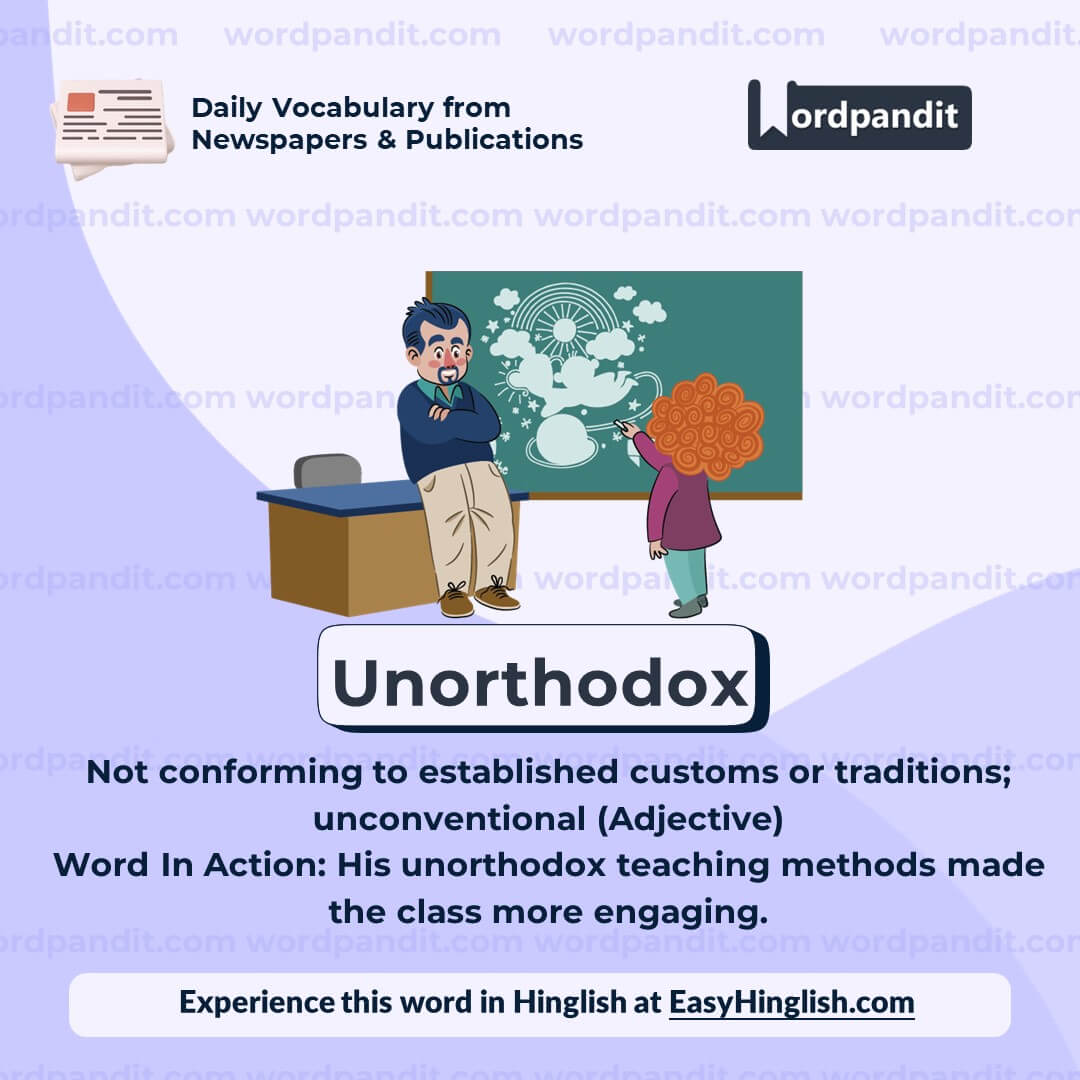
WORD-5: Unorthodox
Context:
"They are unorthodox, but we wish them luck." - BBC
Explanatory Paragraph:
"Unorthodox" is used to describe ideas, methods, or behaviors that are different from what is traditionally accepted or expected. It often implies innovation, originality, or boldness in doing things differently. In the BBC context, the word suggests that the people being referred to are taking a path or approach that doesn’t follow conventional standards, but despite that, they are still being supported or encouraged. It is not necessarily negative—it can often carry a sense of admiration for thinking outside the box.
Meaning: Not conforming to traditional rules, methods, or beliefs; unconventional (Adjective)
Pronunciation: un-OR-thuh-doks
Difficulty Level: ⭐⭐⭐ Intermediate
Etymology: From Greek 'orthodoxos' meaning "having the right opinion", with 'un-' meaning "not"; thus, "not following accepted beliefs or practices"
Prashant Sir's Notes:
This is a high-utility adjective, especially in discussions around creativity, leadership, innovation, or religion. "Unorthodox" doesn't always imply wrong—it often signals daring or non-traditional thinking. Try using it when someone breaks the mold successfully.
Synonyms & Antonyms:
Synonyms: unconventional, unusual, nontraditional, offbeat, radical
Antonyms: conventional, traditional, orthodox, mainstream, customary
Usage Examples:
- Her unorthodox teaching methods made the classes more engaging and memorable.
- The startup's unorthodox strategy shocked the market but yielded great results.
- He had an unorthodox approach to solving complex problems.
- Though his ideas were unorthodox, they sparked important conversations.
Cultural Reference:
“Unorthodox” is also the title of a Netflix series based on a true story, where a woman leaves her strict religious community to find her own path—symbolizing unorthodox choices in pursuit of freedom.
Think About It:
Is being unorthodox always a strength, or can it sometimes lead to unnecessary risks or misunderstandings?
Quick Activity:
Think of a famous person (entrepreneur, artist, leader) known for their unorthodox style. Write one sentence describing how their approach broke the norm.
Memory Tip:
Break it down: “un” (not) + “orthodox” (traditional). So, unorthodox = not orthodox or not traditional. Think of someone taking the road less traveled.
Real-World Application:
“Unorthodox” is often used in workplaces, media, politics, and art to describe innovation or non-conformity. Recognizing unorthodox methods can help you appreciate diverse perspectives and original thinking.


