

Daily Vocabulary from International Newspapers and Publications
Expand Your Vocabulary with Wordpandit’s Global Vocabulary Hub
At Wordpandit, we are committed to helping you develop a truly global vocabulary by drawing from some of the most respected international publications. This section is designed to keep you ahead of the curve by introducing you to words that define global conversations and trends.
The Power of Global Sources
To help you think and communicate on a global scale, we curate vocabulary from renowned international sources, such as:
- The New York Times
- The Washington Post
- BBC
- The Guardian
- The Economist
- Scientific American
- Psychology Today
- And many more...
Stay Global, Stay Competitive
Our daily updates from international publications ensure you are consistently exposed to new words that reflect global news and developments, making sure your vocabulary is not only current but also globally relevant.
Enhance Your Global Perspective
Whether you’re preparing for international exams, aiming to excel in global business communication, or want to enhance your language skills for personal growth, Wordpandit offers the resources you need to thrive in a global context.
Effective Learning, Global Reach
Our learning methodology combines global examples, memory aids, and interactive activities, allowing you to internalize new words effectively and apply them in real-world scenarios.
Begin Your Global Vocabulary Journey Now!

Why Choose Wordpandit?
Practical Learning: Focus on words you'll actually encounter in real-world reading, enhancing your comprehension and communication skills.
Diverse Content: From current affairs to scientific breakthroughs, our varied sources expose you to vocabulary across multiple domains.
Effortless Integration: Make Wordpandit a part of your daily routine. Just a few minutes each day can significantly boost your lexicon over time.
Your Path to Vocabulary Mastery
- Visit our Daily Vocabulary section regularly
- Explore new words and their usage in context
- Practice incorporating these words into your own writing and speech
- Track your progress as your vocabulary expands
Start Your Journey Today
Embark on your vocabulary enhancement journey with Wordpandit. By consistently engaging with our daily posts, you'll build a robust vocabulary that serves you well in academic, professional, and personal contexts.
Remember, a word a day keeps linguistic limitations at bay. Make Wordpandit your daily companion in the quest for vocabulary excellence!
WORD-1: Arachnids
Context:
"If he had factored in the insects and arachnids, his Ark would soon have been foundering under the weight of about 1.1 million different species." - Aeon
Explanatory Paragraph:
Arachnids are a class of joint-legged invertebrates that include spiders, scorpions, ticks, and mites. Unlike insects, arachnids typically have eight legs and lack antennae or wings. The word is often used in scientific or zoological contexts to categorize these creatures, which play various roles in ecosystems—from pest control to disease transmission.
Meaning: A group of arthropods that includes spiders, scorpions, mites, and ticks (Noun)
Pronunciation: uh-RAK-nidz
Difficulty Level: ⭐⭐ Beginner
Etymology: Derived from Greek "aráchnē," meaning spider.
Prashant Sir's Notes:
This word helps distinguish spiders and their relatives from insects. A helpful classification term in biology and environmental science. Focus on the "eight-legged" trait when recalling this.
Synonyms & Antonyms:
Synonyms: spider-like creatures, eight-legged arthropods
Antonyms: insects, vertebrates
Usage Examples:
- Many arachnids, such as spiders and scorpions, are nocturnal hunters.
- The desert is home to several unique species of arachnids.
- Arachnids play a crucial role in controlling insect populations.
- Unlike insects, arachnids do not possess antennae.
Cultural Reference:
"In Greek mythology, Arachne was a weaver turned into a spider by the goddess Athena—hence the word 'arachnid'." - Myth Encyclopedia
Think About It:
Why do you think spiders and other arachnids evoke such strong fear in many cultures despite their ecological importance?
Quick Activity:
List three animals that belong to the arachnid class and write one sentence describing each.
Memory Tip:
Think of “arachnid” as “Arachne” from mythology + “id” like in creature-ID. A myth-born creature with eight legs!
Real-World Application:
Understanding arachnids is essential in biology, pest control, and even medicine (e.g., dealing with tick-borne diseases). Knowing the distinction helps in both academic and everyday contexts.
WORD-2: Trinomial
Context:
"The trinomial – the subspecies, described by a Latin name that adds a third classifying component, as in, say, Passer domesticus biblicus, the Palestine house sparrow – further inflates Noah’s hypothetical menagerie." - Aeon
Explanatory Paragraph:
A trinomial is a scientific naming system used in biology to identify subspecies. It consists of three parts: the genus, the species, and the subspecies. For example, in the name Passer domesticus biblicus, “Passer” is the genus, “domesticus” the species, and “biblicus” the subspecies. Trinomials help biologists distinguish subtle differences within a species, often based on geography or physical traits.
Meaning: A name composed of three terms used in the biological classification of a subspecies (Noun)
Pronunciation: try-NOH-mee-uhl
Difficulty Level: ⭐⭐⭐ Intermediate
Etymology: From Latin "tri-" meaning three and "nomen" meaning name
Prashant Sir's Notes:
Trinomial is mostly used in biological taxonomy. If a species is further divided into subspecies, we use a third name – making it 'tri-nomial'. Think of it as a deeper layer of classification.
Synonyms & Antonyms:
Synonyms: three-part name, scientific subspecies name, trinomial nomenclature
Antonyms: binomial (two-part name), common name
Usage Examples:
- The trinomial Panthera tigris altaica refers specifically to the Siberian tiger.
- Trinomial names are essential when documenting subtle variations in species across regions.
- Some textbooks list only the binomial name, leaving out the trinomial details of subspecies.
- Taxonomists use trinomial nomenclature to reflect evolutionary distinctions within a species.
Cultural Reference:
"Darwin’s theory of evolution led to the increasing use of trinomial nomenclature to capture biodiversity more precisely." - National Geographic (paraphrased)
Think About It:
How might using trinomial names affect conservation efforts or environmental policy decisions?
Quick Activity:
Find and write down the trinomial of any animal subspecies native to your region. Research what makes it a distinct subspecies.
Memory Tip:
“Tri” means three — so think of “trinomial” as a name with three parts, like a full name with first, middle, and last.
Real-World Application:
Trinomial names are used by scientists, conservationists, and researchers to track subspecies and understand biodiversity—especially when certain subspecies are endangered or need protection.
WORD-3: Inflate
Context:
"The trinomial – the subspecies, described by a Latin name that adds a third classifying component, as in, say, Passer domesticus biblicus, the Palestine house sparrow – further inflates Noah’s hypothetical menagerie." - Aeon
Explanatory Paragraph:
To inflate something means to make it larger, more important, or more exaggerated than it actually is. In the context of the quote, "inflates" refers to how the addition of subspecies names (trinomials) makes Noah’s list of animals seem more extensive or overwhelming than it would be with just species names. This use of "inflate" is metaphorical, implying an artificial or exaggerated increase.
Meaning: To enlarge, exaggerate, or expand something beyond its actual or natural size or scope (Verb)
Pronunciation: in-FLAYT
Difficulty Level: ⭐⭐ Beginner
Etymology: From Latin “inflare,” meaning "to blow into or puff up"
Prashant Sir's Notes:
"Inflate" can be both literal (blowing air into a balloon) and figurative (inflating numbers or ideas). The key idea is expansion — real or exaggerated. Pay attention to context!
Synonyms & Antonyms:
Synonyms: enlarge, exaggerate, magnify, overstate
Antonyms: deflate, reduce, downplay, minimize
Usage Examples:
- The company was accused of inflating its sales figures to impress investors.
- He inflated the importance of his role in the project.
- The balloon quickly inflated with helium before the party began.
- Trinomial naming can inflate the perceived number of species.
Cultural Reference:
"In times of economic crisis, governments often struggle to control rapidly inflating prices." – Common economic discussion
Think About It:
When does inflating something (like a story or idea) become misleading rather than just enthusiastic?
Quick Activity:
Write two sentences — one where "inflate" is used literally and another where it is used figuratively.
Memory Tip:
Think of "inflate" as "in + flat(e)" — to make something flat become full or puffed up — like a balloon being filled with air or an ego being puffed up!
Real-World Application:
"Inflate" is commonly used in economics (inflated prices), in everyday speech (inflated ego), and in physical contexts (inflating tires or balloons). Recognizing the difference between literal and figurative uses is essential.
WORD-4: Hypothetical
Context:
"The trinomial – the subspecies, described by a Latin name that adds a third classifying component, as in, say, Passer domesticus biblicus, the Palestine house sparrow – further inflates Noah’s hypothetical menagerie." - Aeon
Explanatory Paragraph:
“Hypothetical” refers to something that is imagined or assumed for the sake of discussion, rather than something real or proven. In the quoted sentence, “Noah’s hypothetical menagerie” means an imagined collection of animals that Noah might have taken on the Ark — not something factual, but rather a mental or illustrative example. The word often appears in academic, philosophical, and scientific discussions where ideas are explored in theory.
Meaning: Based on a suggested idea or theory; imagined for the purpose of argument or explanation (Adjective)
Pronunciation: hy-puh-THET-ih-kuhl
Difficulty Level: ⭐⭐⭐ Intermediate
Etymology: From Greek "hypothetikos" meaning "pertaining to a hypothesis"
Prashant Sir's Notes:
This is a key word in analytical writing. Use "hypothetical" when discussing ideas that are not yet tested or real but are assumed for reasoning or debate. It often shows up in exams and critical thinking contexts.
Synonyms & Antonyms:
Synonyms: imagined, supposed, theoretical, assumed
Antonyms: real, factual, actual, proven
Usage Examples:
- Let’s consider a hypothetical situation where time travel is possible.
- The scientist proposed a hypothetical model to explain the observed behavior.
- Her argument was built around a hypothetical example, not a real case.
- In a hypothetical world without money, how would society function?
Cultural Reference:
"In philosophy, thought experiments like Schrödinger’s cat are classic hypothetical scenarios used to explore complex ideas." - Philosophy Now
Think About It:
Why do you think hypothetical scenarios are so useful in discussions, especially in science and ethics?
Quick Activity:
Create your own hypothetical situation involving a time machine. What problem would it solve or create?
Memory Tip:
Think of “hypo” (under) + “thetical” (theory) = an idea that’s “under” or beneath reality — not proven, just proposed.
Real-World Application:
"Hypothetical" is often used in academic writing, courtroom arguments, policy simulations, and even job interviews (e.g., “How would you respond in this hypothetical situation?”). It’s a great word to demonstrate critical thinking.
WORD-5: Menagerie
Context:
"The trinomial – the subspecies, described by a Latin name that adds a third classifying component, as in, say, Passer domesticus biblicus, the Palestine house sparrow – further inflates Noah’s hypothetical menagerie." - Aeon
Explanatory Paragraph:
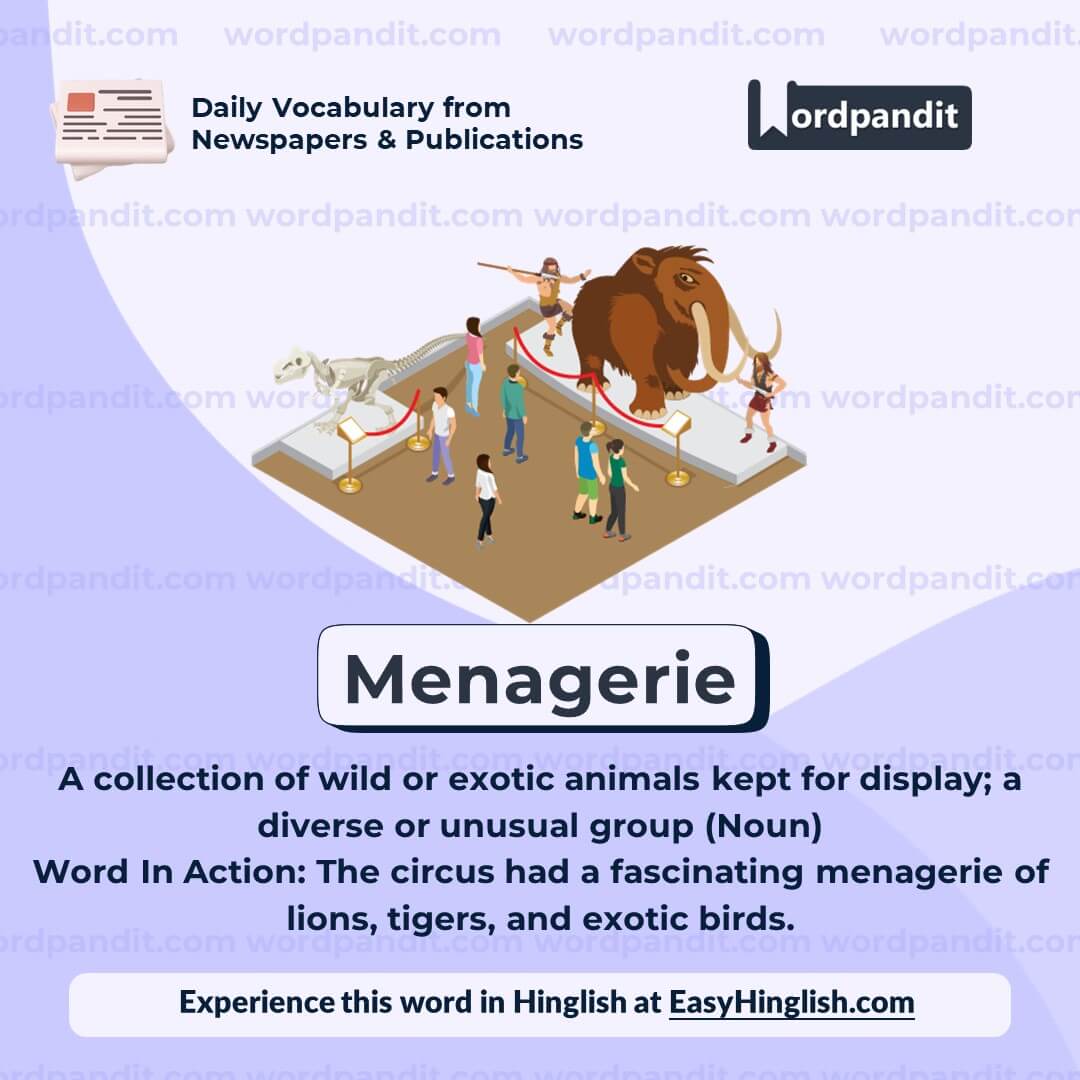
A “menagerie” is a collection of animals, often unusual or exotic, kept for exhibition or display. Historically, royal courts and circuses maintained menageries to showcase rare animals from around the world. In the context of Noah’s Ark, “menagerie” is used metaphorically to describe the vast, diverse group of animals he would have had on board. Today, the word can also be used figuratively to describe any diverse or chaotic group of things or people.
Meaning: A collection of wild or unusual animals kept for exhibition; a diverse or varied group (Noun)
Pronunciation: muh-NAJ-uh-ree
Difficulty Level: ⭐⭐⭐ Intermediate
Etymology: From French "ménagerie," originally meaning “household management,” later evolving to refer to animal collections
Prashant Sir's Notes:
This word originally referred to royal animal collections, but it now has broader uses. It’s great for describing a mix of unusual or chaotic elements, not just animals. Keep this dual use in mind — literal and metaphorical.
Synonyms & Antonyms:
Synonyms: zoo, collection, assortment, hodgepodge, array
Antonyms: order, uniformity, simplicity, organization
Usage Examples:
- The traveling circus had a menagerie of exotic animals, including lions, elephants, and zebras.
- Her apartment was a menagerie of vintage trinkets, mismatched furniture, and bold colors.
- The novel introduces a menagerie of eccentric characters, each with a unique backstory.
- Noah’s Ark is often imagined as a giant menagerie of every species on Earth.
Cultural Reference:
"The Glass Menagerie" by Tennessee Williams is a famous play that uses the idea of a fragile animal collection as a metaphor for memory, family, and illusion.
Think About It:
What does the idea of a 'menagerie' suggest about how humans view and try to control nature and diversity?
Quick Activity:
List five animals you would include in your imaginary menagerie and explain why.
Memory Tip:
“Menagerie” sounds like “manage” + “zoo” — imagine trying to manage a chaotic zoo full of exotic animals!
Real-World Application:
“Menagerie” is useful in both literal and creative writing. You might use it to describe a physical zoo, or metaphorically, to depict a chaotic group — like a “menagerie of emotions” or “a menagerie of political opinions.”


