

Daily Vocabulary from International Newspapers and Publications
Expand Your Vocabulary with Wordpandit’s Global Vocabulary Hub
At Wordpandit, we are committed to helping you develop a truly global vocabulary by drawing from some of the most respected international publications. This section is designed to keep you ahead of the curve by introducing you to words that define global conversations and trends.
The Power of Global Sources
To help you think and communicate on a global scale, we curate vocabulary from renowned international sources, such as:
- The New York Times
- The Washington Post
- BBC
- The Guardian
- The Economist
- Scientific American
- Psychology Today
- And many more...
Stay Global, Stay Competitive
Our daily updates from international publications ensure you are consistently exposed to new words that reflect global news and developments, making sure your vocabulary is not only current but also globally relevant.
Enhance Your Global Perspective
Whether you’re preparing for international exams, aiming to excel in global business communication, or want to enhance your language skills for personal growth, Wordpandit offers the resources you need to thrive in a global context.
Effective Learning, Global Reach
Our learning methodology combines global examples, memory aids, and interactive activities, allowing you to internalize new words effectively and apply them in real-world scenarios.
Begin Your Global Vocabulary Journey Now!

Why Choose Wordpandit?
Practical Learning: Focus on words you'll actually encounter in real-world reading, enhancing your comprehension and communication skills.
Diverse Content: From current affairs to scientific breakthroughs, our varied sources expose you to vocabulary across multiple domains.
Effortless Integration: Make Wordpandit a part of your daily routine. Just a few minutes each day can significantly boost your lexicon over time.
Your Path to Vocabulary Mastery
- Visit our Daily Vocabulary section regularly
- Explore new words and their usage in context
- Practice incorporating these words into your own writing and speech
- Track your progress as your vocabulary expands
Start Your Journey Today
Embark on your vocabulary enhancement journey with Wordpandit. By consistently engaging with our daily posts, you'll build a robust vocabulary that serves you well in academic, professional, and personal contexts.
Remember, a word a day keeps linguistic limitations at bay. Make Wordpandit your daily companion in the quest for vocabulary excellence!
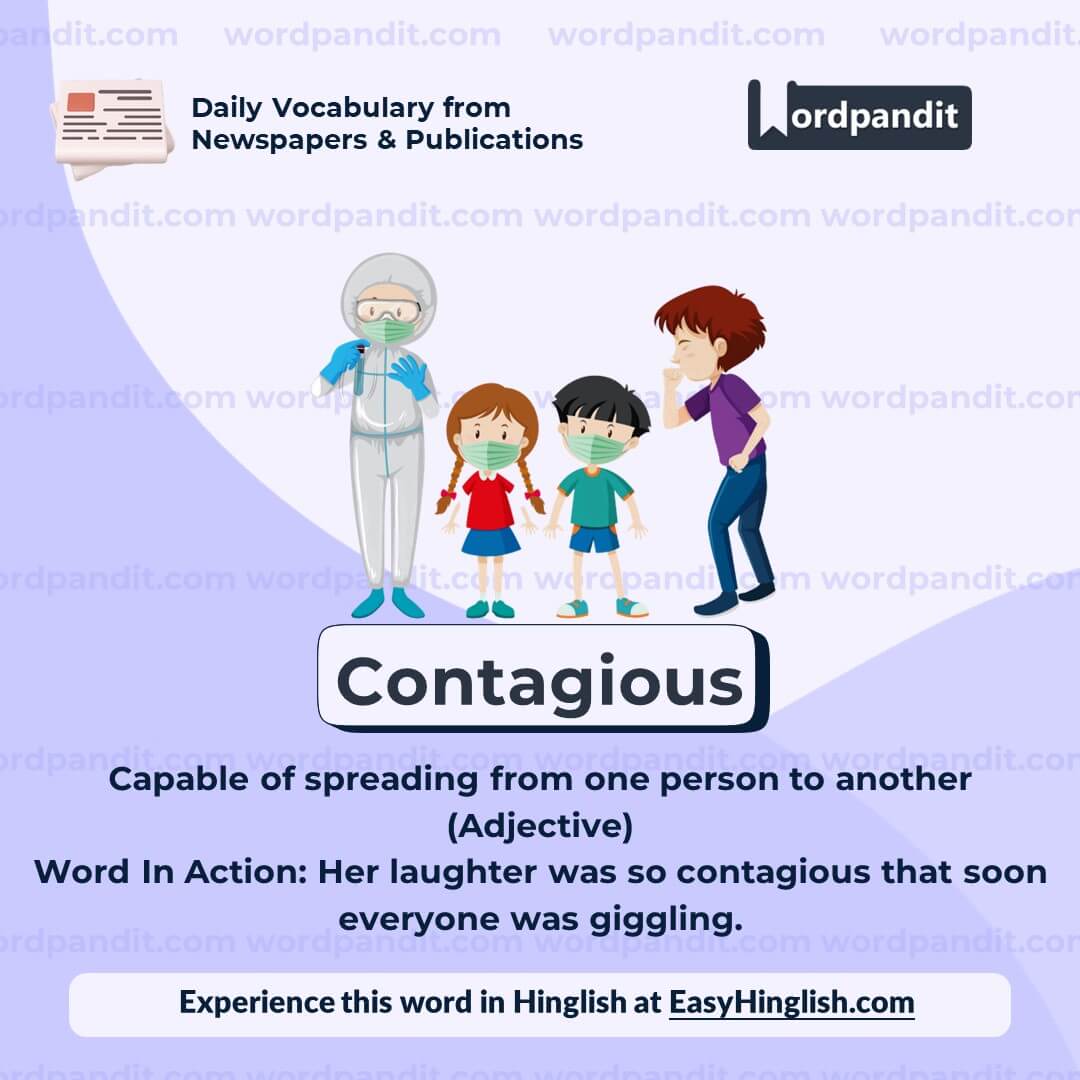
WORD-1: Contagious
Context:
"Yawning can be contagious." - Aeon
Explanatory Paragraph:
The word "contagious" describes something that spreads easily from one person to another. While it's often used for diseases, it can also apply to emotions or behaviors, such as laughter, yawning, or enthusiasm. If something is contagious, being near someone who has it might cause you to “catch” it too—whether it’s a virus or a mood.
Meaning: Able to be transmitted from one person to another; easily spread (Adjective)
Pronunciation: kun-TAY-jus
Difficulty Level: ⭐⭐ Beginner
Etymology: From Latin *contagiosus*, from *contagio* meaning "contact, touch"
Prashant Sir's Notes:
Contagious is a very commonly used word not just in medical contexts but also in emotional and social situations. Think of contagious laughter or contagious energy—these expressions show how "spreading" doesn’t have to be negative.
Synonyms & Antonyms:
Synonyms: infectious, communicable, transmissible, catching
Antonyms: non-infectious, non-communicable, immune
Usage Examples:
- Her smile was so contagious that everyone in the room began to grin.
- During flu season, doctors warn that the virus is highly contagious.
- He spoke with such contagious enthusiasm that the entire team felt motivated.
- Yawning in a meeting is oddly contagious—one person starts, and soon everyone’s at it.
Cultural Reference:
"Laughter is contagious, and when it bubbles up freely, it can heal even the deepest wounds." - Anonymous popular saying
Think About It:
Why do you think some emotions or behaviors, like yawning or laughter, become contagious while others do not?
Quick Activity:
List 5 things (other than illnesses) that you think are contagious in human behavior. Reflect on how they affect group dynamics.
Memory Tip:
Think of "contagious" as "contact + spread" — when you're in contact with someone, it spreads to you. “Contagious contact spreads stuff!”
Real-World Application:
The word "contagious" is frequently used in health advisories, motivational speeches, and social media discussions. Understanding it helps in both medical awareness and in interpreting social behavior dynamics.
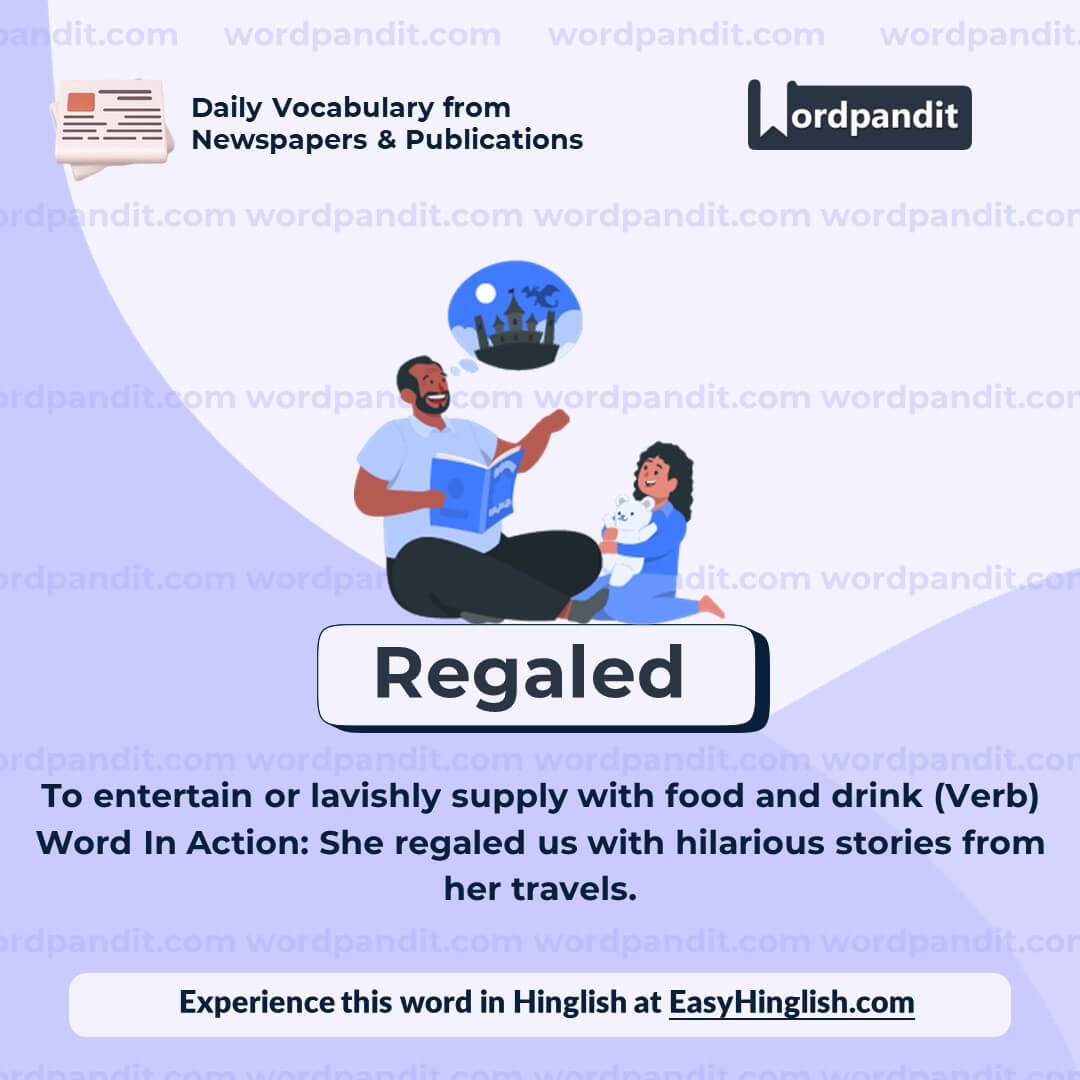
WORD-2: Regaled
Context:
"Regaled with champagne and Marmite sandwiches, the audience had no idea that they were about to be read the riot act." - Aeon
Explanatory Paragraph:
"Regaled" means to entertain or delight someone, especially with food, drink, or stories. It’s often used when someone is treated generously or lavishly, making the experience memorable and enjoyable. In the context above, the audience was generously entertained with food and drink before receiving a stern warning—making for an ironic twist.
Meaning: To entertain or amuse someone with lavish food, drink, or stories (Verb)
Pronunciation: ree-GAYLD
Difficulty Level: ⭐⭐⭐ Intermediate
Etymology: From Old French *regaler*, meaning “to entertain or delight,” which itself comes from the root *galer*, meaning “to make merry”
Prashant Sir's Notes:
Regaled is one of those words that adds richness to your writing. It often paints a vivid picture—whether someone is being entertained with a tale, or fed with abundance. Notice that it usually has a positive or generous connotation.
Synonyms & Antonyms:
Synonyms: entertain, amuse, delight, feast, treat
Antonyms: bore, neglect, disappoint, ignore
Usage Examples:
- She regaled us with hilarious stories from her travels in South America.
- The guests were regaled with an elaborate six-course meal.
- He regaled the children with tales of dragons and ancient kingdoms.
- They were regaled with fine wine and gourmet cheese before the awards ceremony began.
Cultural Reference:
"In medieval courts, jesters regaled kings and queens with songs, jokes, and clever wordplay." - Historical Folklore Archives
Think About It:
Why do you think food, stories, and entertainment have been central to hospitality across cultures throughout history?
Quick Activity:
Write a 2–3 sentence mini-story where a character regales others. Use sensory language to describe the scene (taste, sound, visuals).
Memory Tip:
Think of "regaled" as "royally entertained" — both begin with “re-” and make you think of something grand or luxurious.
Real-World Application:
"Regaled" is a great word to use when describing hospitality, storytelling, or events in writing—be it in novels, blogs, or speeches. It adds color and implies richness in the experience.
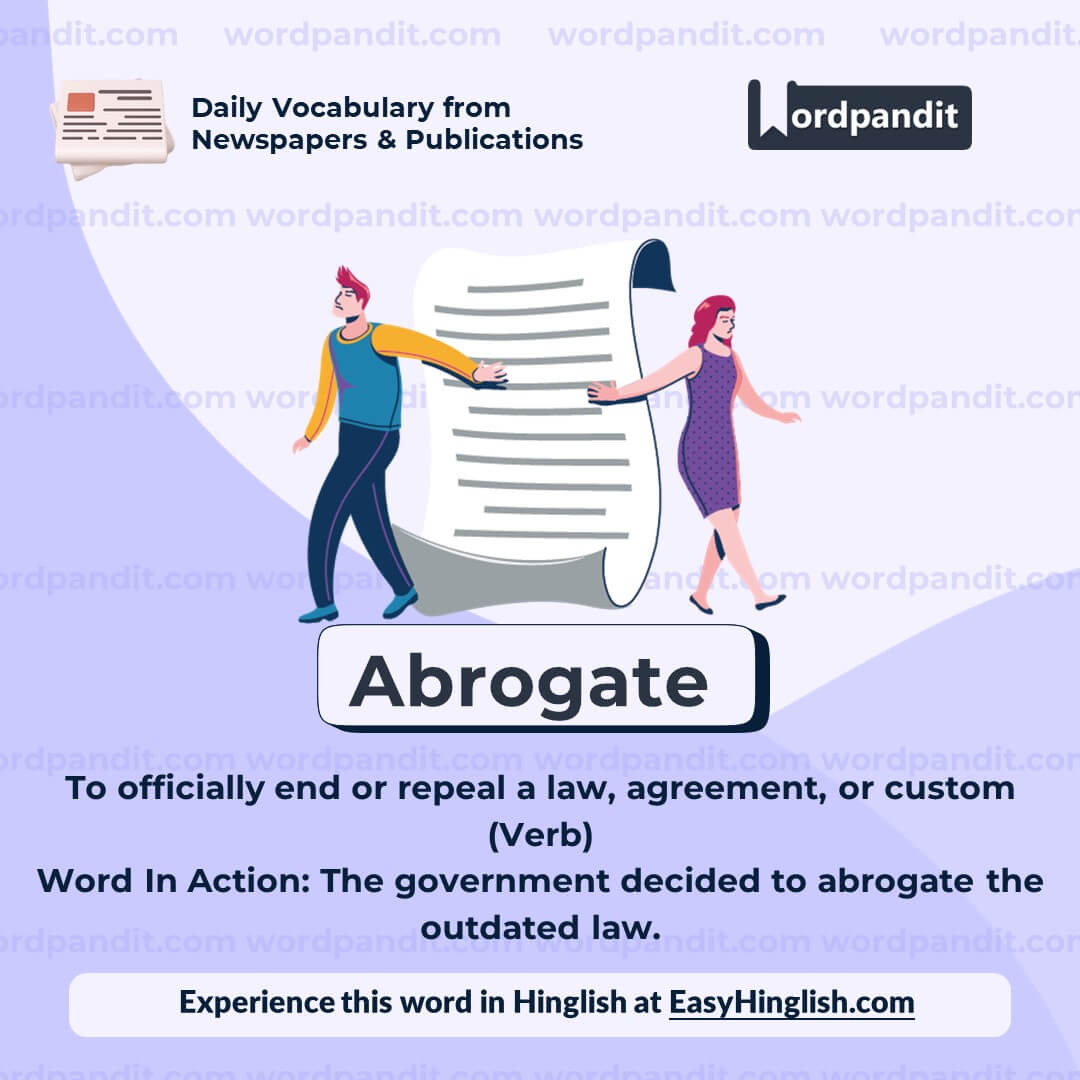
WORD-3: Abrogate
Context:
"Citizens voted to abrogate the antiquated law." - Aeon
Explanatory Paragraph:
"Abrogate" means to formally put an end to a law, agreement, or custom. It is typically used in legal or political contexts where a rule or regulation is officially abolished. In the sentence above, the citizens took action to eliminate a law that was outdated and no longer relevant, highlighting their power in democratic decision-making.
Meaning: To repeal or abolish a law, agreement, or custom formally and officially (Verb)
Pronunciation: AB-roh-gate
Difficulty Level: ⭐⭐⭐ Intermediate
Etymology: From Latin *abrogare*, meaning "to repeal, cancel," from *ab-* (away) + *rogare* (to ask, propose a law)
Prashant Sir's Notes:
Abrogate is a powerful verb, used mainly in legal or formal settings. Think of governments, courts, or official bodies deciding that something no longer applies. It’s not casual—it implies authority and finality.
Synonyms & Antonyms:
Synonyms: repeal, annul, revoke, rescind, nullify
Antonyms: enact, establish, institute, approve
Usage Examples:
- The treaty was abrogated by mutual consent between the two nations.
- The new government moved quickly to abrogate the previous regime’s censorship laws.
- Activists campaigned to abrogate a rule that restricted land ownership by minorities.
- A court ruling can sometimes abrogate existing laws deemed unconstitutional.
Cultural Reference:
"The United States abrogated the 1972 Anti-Ballistic Missile Treaty in 2002, citing changing global security needs." - U.S. Department of State Archives
Think About It:
Should outdated laws always be abrogated, or can they serve as historical reminders and lessons for the present?
Quick Activity:
Find one law from history that has been abrogated. Write one sentence explaining why it was removed or repealed.
Memory Tip:
Think of *abrogate* as “a-broken-gate” — when something (like a law) is broken or no longer useful, it gets abrogated (abolished).
Real-World Application:
Understanding the term "abrogate" is crucial for reading news about legal reforms, international treaties, or civil rights movements. It empowers you to follow and interpret major policy changes intelligently.
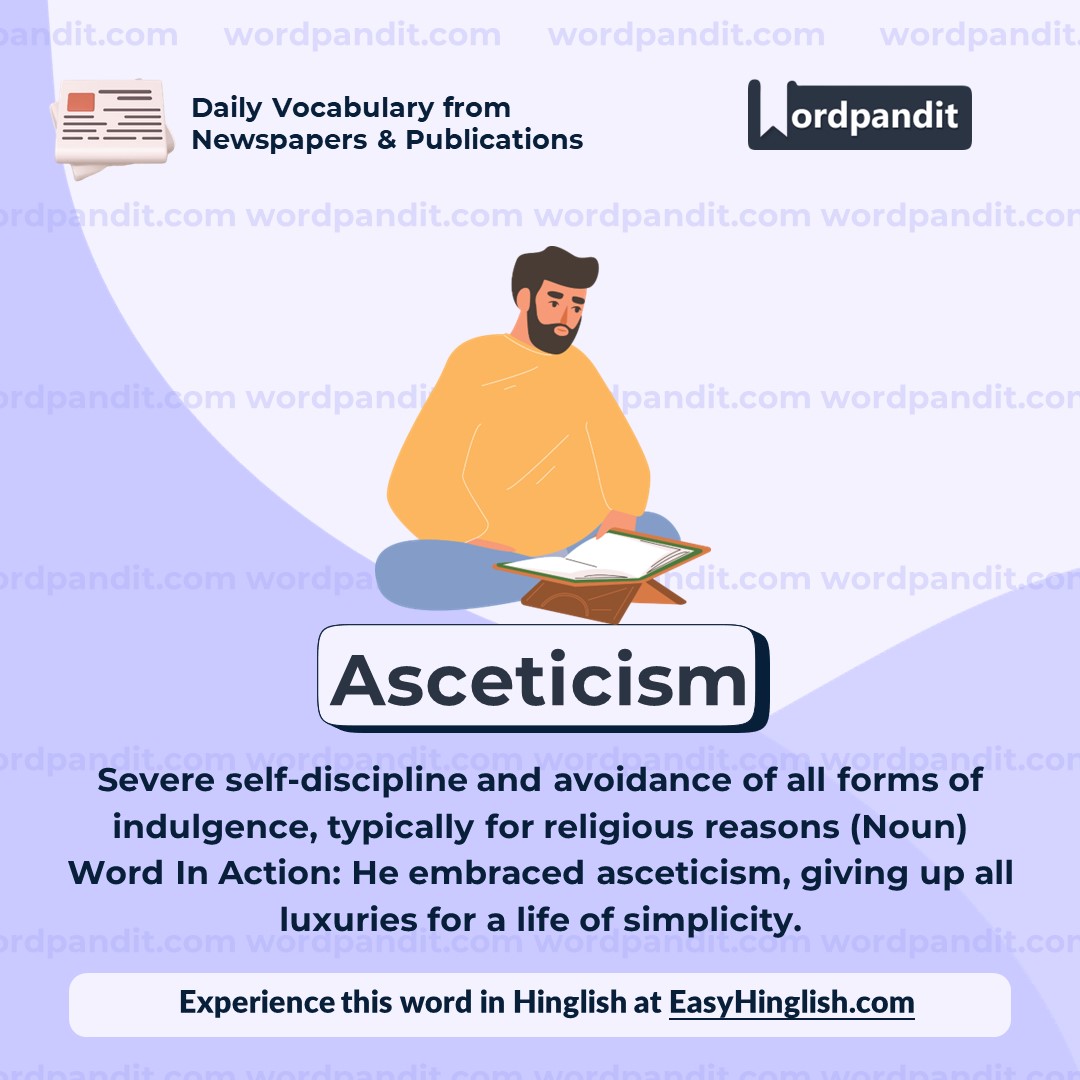
WORD-4: Asceticism
Context:
"Ascetics often practice to become closer to their concept of divinity through the purification of their soul." - Aeon
Explanatory Paragraph:
"Asceticism" refers to a lifestyle of self-discipline and avoidance of indulgence, often for spiritual or religious reasons. People who practice asceticism—called ascetics—typically give up material comforts, luxury, and sensual pleasures to focus on personal or spiritual growth. This concept is present in many religious traditions, where simplicity and self-denial are seen as paths to enlightenment or closeness with the divine.
Meaning: A way of life characterized by self-denial, discipline, and abstention from indulgence, usually for spiritual goals (Noun)
Pronunciation: uh-SET-uh-siz-um
Difficulty Level: ⭐⭐⭐⭐ Advanced
Etymology: From Greek *askētismos*, from *askētēs* meaning "monk, hermit," originally "one who exercises or trains"
Prashant Sir's Notes:
This is a word with deep spiritual and philosophical roots. Asceticism isn’t just about giving things up—it’s about gaining something higher, often wisdom, purity, or connection to the divine. Think of monks, yogis, or even minimalist lifestyles inspired by this principle.
Synonyms & Antonyms:
Synonyms: self-denial, austerity, abstinence, simplicity
Antonyms: indulgence, luxury, extravagance, hedonism
Usage Examples:
- His asceticism shocked his friends, who were used to a life of comfort and entertainment.
- The monastery promoted asceticism as a path to inner peace and divine connection.
- Her commitment to asceticism was evident in her plain clothing and simple diet.
- Throughout history, asceticism has played a central role in religious devotion and discipline.
Cultural Reference:
"Gautama Buddha practiced extreme asceticism before realizing the 'Middle Way'—a balanced approach between indulgence and denial." - Buddhist Philosophy Texts
Think About It:
Can the practice of asceticism in a modern world dominated by materialism still hold value? If so, how?
Quick Activity:
List three things you could temporarily give up for a week to experience a touch of asceticism. Reflect on how it might affect your mindset or productivity.
Memory Tip:
Think of “asceticism” as “aesthetic minus excess”—living with beauty in simplicity, without indulgence.
Real-World Application:
Understanding asceticism is useful in philosophy, religious studies, wellness practices, and even modern minimalist lifestyles. It helps one appreciate values like discipline, simplicity, and intentional living.
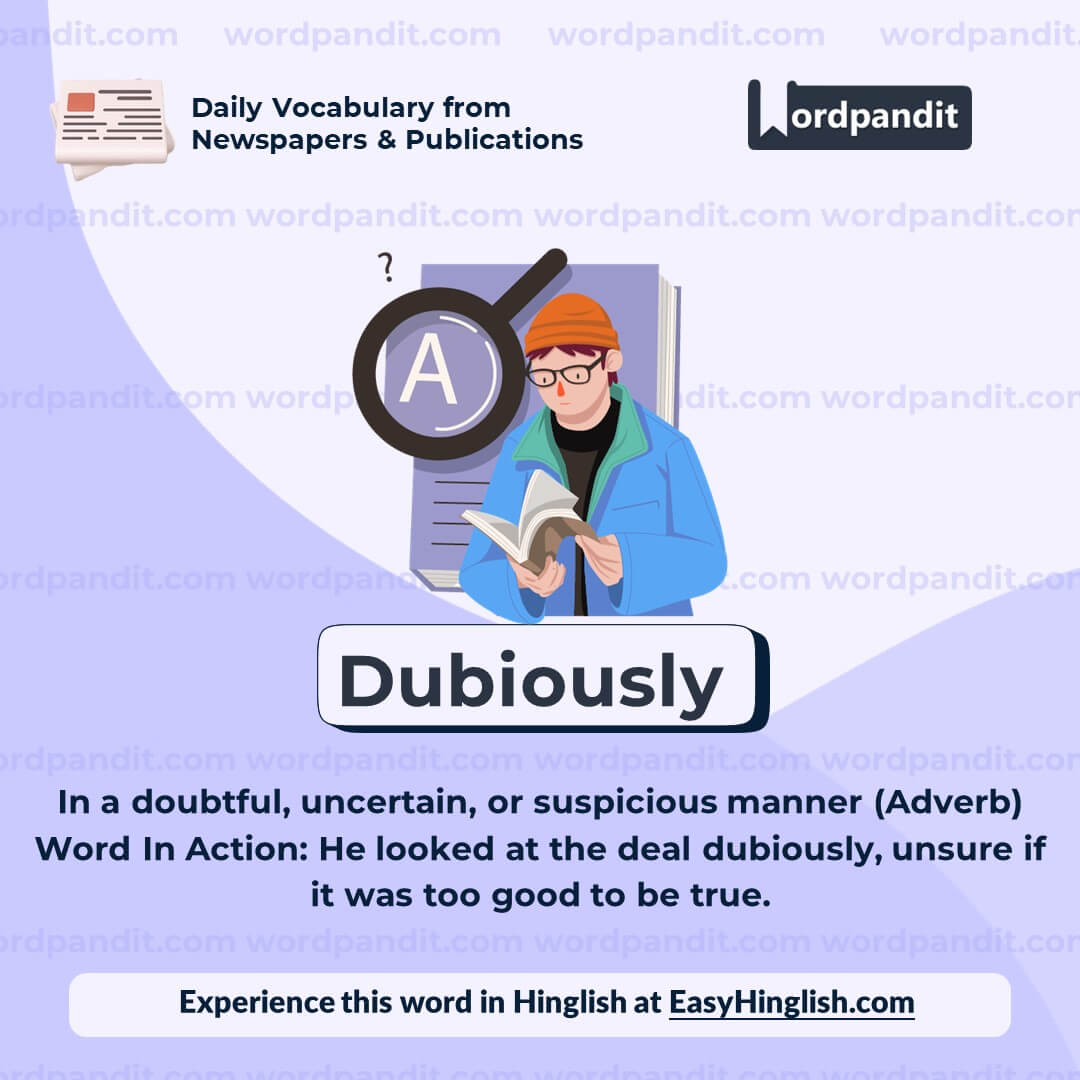
WORD-5: Dubiously
Context:
"And he told of brilliant scientific minds who might know a lot about the second law but were barely up to the task of reading Charles Dickens, let alone an 'esoteric, tangled and dubiously rewarding writer...like Rainer Maria Rilke.'" - Aeon
Explanatory Paragraph:
“Dubiously” is used to cast doubt or express skepticism about the value, truth, or quality of something. In this context, it suggests that Rainer Maria Rilke might be considered by some as a writer whose work is not clearly rewarding or beneficial — perhaps too abstract or difficult to justify the effort required. The term adds a tone of hesitation or disbelief about the potential benefits or worth of engaging with such work.
Meaning: With doubt or suspicion; in a questionable or uncertain manner (Adverb)
Pronunciation: DOO-bee-uhs-lee
Difficulty Level: ⭐⭐ Beginner to Intermediate
Etymology: From Latin "dubiosus" (doubtful), derived from "dubium" meaning "doubt".
Prashant Sir's Notes:
Focus on how “dubiously” adds a skeptical tone. It's often used to subtly question the merit or authenticity of something. Useful for both literary critique and everyday doubt.
Synonyms & Antonyms:
Synonyms: suspiciously, skeptically, questionably, hesitantly
Antonyms: confidently, undoubtedly, certainly, assuredly
Usage Examples:
- She looked at the strange dish dubiously before taking a cautious bite.
- He dubiously agreed to the deal, unsure of the terms and motives.
- The committee received the new proposal dubiously, questioning its feasibility.
- The artifact’s origins were dubiously claimed to be from the 12th century.
Cultural Reference:
"‘A dubiously titled film doesn’t always mean a bad one, but it sure sets the bar lower.’ – From a movie review blog"
Think About It:
How does using a word like “dubiously” change the tone of a sentence compared to using neutral language?
Quick Activity:
Write two sentences using the word “dubiously” — one describing a person and the other describing an action or decision.
Memory Tip:
Think of “dubiously” as “Do you believe this?” — it captures the doubtful nature of the word.
Real-World Application:
“Dubiously” is useful when evaluating information, news sources, or decisions — especially in discussions that require critical thinking or express doubt about reliability.


