

Daily Vocabulary from International Newspapers and Publications
Expand Your Vocabulary with Wordpandit’s Global Vocabulary Hub
At Wordpandit, we are committed to helping you develop a truly global vocabulary by drawing from some of the most respected international publications. This section is designed to keep you ahead of the curve by introducing you to words that define global conversations and trends.
The Power of Global Sources
To help you think and communicate on a global scale, we curate vocabulary from renowned international sources, such as:
- The New York Times
- The Washington Post
- BBC
- The Guardian
- The Economist
- Scientific American
- Psychology Today
- And many more...
Stay Global, Stay Competitive
Our daily updates from international publications ensure you are consistently exposed to new words that reflect global news and developments, making sure your vocabulary is not only current but also globally relevant.
Enhance Your Global Perspective
Whether you’re preparing for international exams, aiming to excel in global business communication, or want to enhance your language skills for personal growth, Wordpandit offers the resources you need to thrive in a global context.
Effective Learning, Global Reach
Our learning methodology combines global examples, memory aids, and interactive activities, allowing you to internalize new words effectively and apply them in real-world scenarios.
Begin Your Global Vocabulary Journey Now!

Why Choose Wordpandit?
Practical Learning: Focus on words you'll actually encounter in real-world reading, enhancing your comprehension and communication skills.
Diverse Content: From current affairs to scientific breakthroughs, our varied sources expose you to vocabulary across multiple domains.
Effortless Integration: Make Wordpandit a part of your daily routine. Just a few minutes each day can significantly boost your lexicon over time.
Your Path to Vocabulary Mastery
- Visit our Daily Vocabulary section regularly
- Explore new words and their usage in context
- Practice incorporating these words into your own writing and speech
- Track your progress as your vocabulary expands
Start Your Journey Today
Embark on your vocabulary enhancement journey with Wordpandit. By consistently engaging with our daily posts, you'll build a robust vocabulary that serves you well in academic, professional, and personal contexts.
Remember, a word a day keeps linguistic limitations at bay. Make Wordpandit your daily companion in the quest for vocabulary excellence!

WORD-1: Gaffe
Context:
"The politician's gaffe during the interview was replayed on news channels for days." - Aeon
Explanatory Paragraph:
The word "gaffe" refers to a blunder or a mistake, especially one that causes embarrassment in public or social settings. It's often used when someone, like a public figure or speaker, says or does something inappropriate without intending to. These moments usually go viral because they're unexpected, awkward, or socially unacceptable, making them memorable and sometimes damaging.
Meaning: A clumsy social or verbal mistake (Noun)
Pronunciation: gaf
Difficulty Level: ⭐⭐ Beginner
Etymology: From French "gaffe" meaning a blunder or clumsy remark, dating back to the 19th century.
Prashant Sir's Notes:
Remember that a "gaffe" isn't just any mistake—it's a public or social blunder that reveals a lapse in judgment or sensitivity. Politicians and celebrities are often in the spotlight for their gaffes because they speak so often under pressure.
Synonyms & Antonyms:
Synonyms: blunder, slip, mistake, faux pas, misstep
Antonyms: tact, diplomacy, finesse, discretion
Usage Examples:
- The CEO’s gaffe during the product launch overshadowed the entire event.
- She quickly apologized for the gaffe she made at the dinner party.
- The comedian’s gaffe offended many in the audience and led to a public backlash.
- His latest gaffe on social media showed a lack of awareness about the issue.
Cultural Reference:
"A gaffe in politics is when a politician accidentally tells the truth." – Michael Kinsley
Think About It:
Why do you think gaffes by public figures attract more attention than their achievements?
Quick Activity:
Think of a time when someone made a gaffe in your presence. How was it handled? Write a short paragraph describing the situation and its impact.
Memory Tip:
Think of "gaffe" as a "goof" with more embarrassment—both start with "g" and imply mistakes, but a gaffe often makes headlines.
Real-World Application:
In journalism and media, recognizing a gaffe is crucial because it can change public opinion. Learning this word helps you better understand political discourse and media narratives.
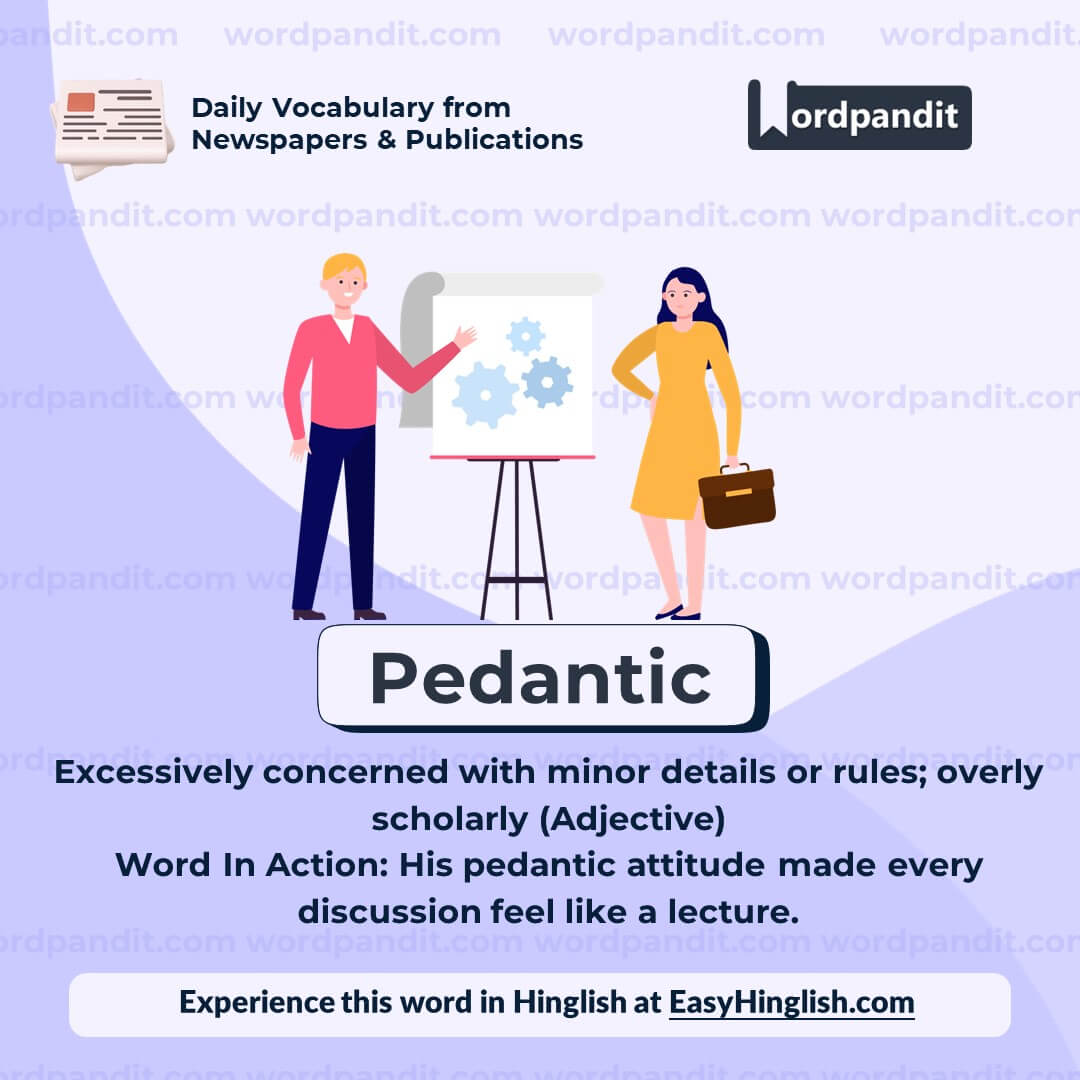
WORD-2: Pedantic
Context:
"Meanwhile, many humanities scholars see scientists as pedantic surveyors of nature, who may produce practical and useful results." - Aeon
Explanatory Paragraph:
The word "pedantic" describes someone who is overly concerned with formal rules, minor details, or academic learning to the point that it becomes annoying or unnecessary. A pedantic person might focus more on correcting grammar than understanding the meaning behind a conversation. While knowledge is valuable, being pedantic often implies showing off intelligence in a way that feels rigid, narrow-minded, or lacking in broader insight.
Meaning: Excessively concerned with formal rules or book learning; showing off academic knowledge (Adjective)
Pronunciation: puh-DAN-tik
Difficulty Level: ⭐⭐⭐ Intermediate
Etymology: From French "pédantique", based on "pédant" (schoolmaster), originally from Italian "pedante" in the 16th century.
Prashant Sir's Notes:
"Pedantic" is often used negatively to describe people who are more interested in being right than being kind or helpful. It’s a useful word for describing dry academic behavior or someone who misses the forest for the trees.
Synonyms & Antonyms:
Synonyms: nitpicky, over-scrupulous, academic, bookish, doctrinaire
Antonyms: broad-minded, flexible, intuitive, practical
Usage Examples:
- The professor’s pedantic lectures often bored students who wanted practical examples.
- She can be a bit pedantic about grammar, correcting even the smallest mistakes.
- His pedantic approach to the project delayed progress and frustrated the team.
- Rather than being helpful, his pedantic comments just made everyone uncomfortable.
Cultural Reference:
"Pedantry is the dotage of knowledge." – Holbrook Jackson
Think About It:
Can focusing too much on being correct or precise actually harm communication or relationships? Where should we draw the line?
Quick Activity:
Write two short sentences—one showing someone being helpfully informative, and another showing someone being pedantic. Compare the tone and impact.
Memory Tip:
Remember: a “pedantic” person is like a “pedal-stuck” teacher—always going on and on with rules and theories, even when no one’s listening.
Real-World Application:
The term is especially relevant in education, writing, and professional communication. Recognizing pedantic behavior helps you adjust your style to be more engaging and empathetic in group settings or public speaking.
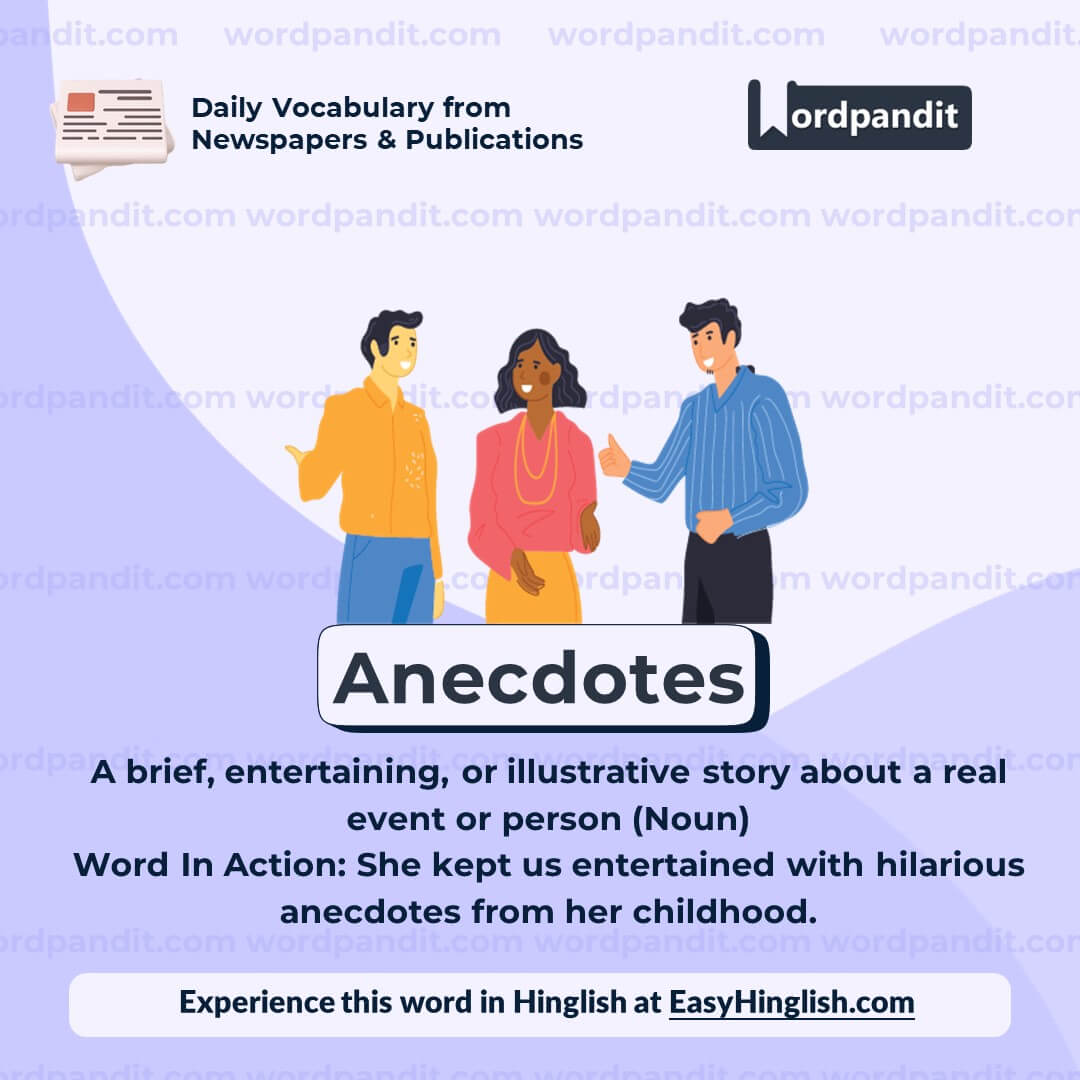
WORD-3: Anecdotes
Context:
"Snow substantiated his diagnosis with anecdotes of respected literary intellectuals who complained about the illiteracy of the scientists but who themselves had never heard of such a fundamental statement as the second law of thermodynamics." - Aeon
Explanatory Paragraph:
"Anecdotes" are short, interesting, or amusing stories about real events or people. They're often used to illustrate a point, support an argument, or entertain. In academic or persuasive writing, anecdotes add a personal or relatable touch that connects with readers. Though not always scientifically rigorous, anecdotes can offer powerful insights and emotional resonance.
Meaning: Short and interesting stories about real incidents or people (Noun – plural)
Pronunciation: AN-ik-dohts
Difficulty Level: ⭐ Beginner
Etymology: From Greek "anekdota" meaning "things unpublished", derived from "an-" (not) + "ekdidonai" (to publish).
Prashant Sir's Notes:
Anecdotes are powerful tools in writing and speaking—they make abstract ideas feel real. But remember: anecdotes are personal and limited in scope, so they shouldn't be treated as universal truth.
Synonyms & Antonyms:
Synonyms: story, tale, narrative, episode, recollection
Antonyms: data, statistics, report, analysis
Usage Examples:
- The speaker used personal anecdotes to illustrate the importance of resilience.
- Her book is full of humorous anecdotes from her travels around the world.
- Though the theory lacked strong data, it was supported by numerous anecdotes.
- He always starts meetings with anecdotes to lighten the mood.
Cultural Reference:
"Anecdotes don’t make data." – Barack Obama, emphasizing the need for evidence-based decision-making.
Think About It:
Why do personal stories often feel more convincing than scientific data, even when the data is stronger?
Quick Activity:
Write a short anecdote (3-4 sentences) about a funny or surprising moment in your life. Then explain what lesson or idea it could represent.
Memory Tip:
“Anecdote” sounds like “an-echoed note”—like a little story that echoes in your mind. Easy to remember because it’s short but memorable.
Real-World Application:
In presentations, teaching, or leadership, anecdotes help build emotional connection and clarify abstract points. They’re especially effective in interviews, speeches, and marketing pitches.
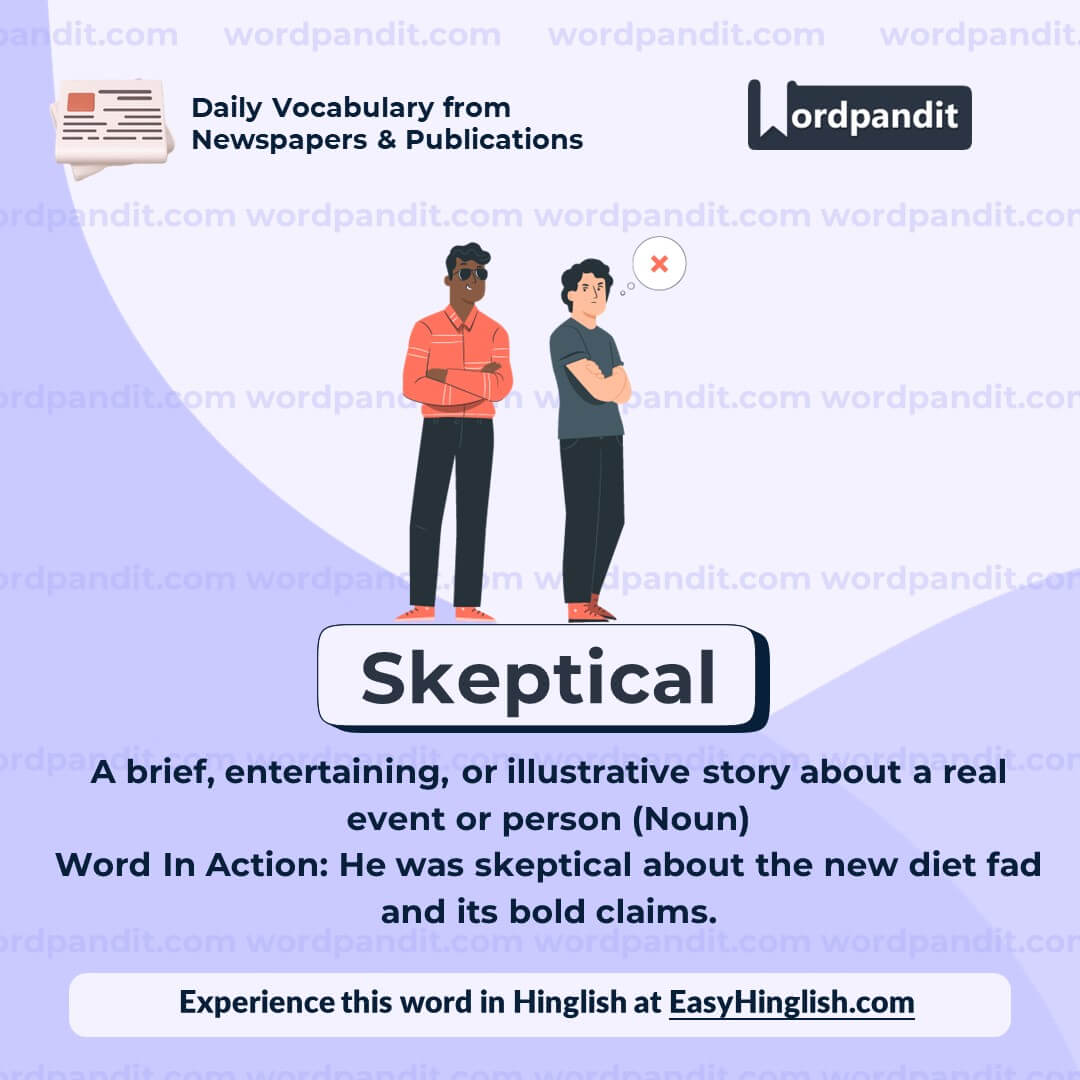
WORD-4: Skeptical
Context:
"She was skeptical of the new policy because previous attempts had failed to deliver the promised results." - Aeon
Explanatory Paragraph:
The word "skeptical" describes a mindset of doubt or questioning. When someone is skeptical, they don’t easily accept information, ideas, or claims without evidence. This attitude can be healthy, especially in situations that require critical thinking or when past experiences suggest caution. However, excessive skepticism can also lead to cynicism or resistance to change.
Meaning: Doubtful or not easily convinced; questioning the truth or validity of something (Adjective)
Pronunciation: SKEP-ti-kuhl
Difficulty Level: ⭐⭐ Beginner
Etymology: From Greek "skeptikos" meaning “inquiring” or “to reflect,” related to the practice of philosophical doubt.
Prashant Sir's Notes:
It’s important to distinguish between being skeptical and being negative. A skeptical person asks questions and demands evidence—not because they reject everything, but because they want to be sure. This trait is essential for scientific and rational thinking.
Synonyms & Antonyms:
Synonyms: doubtful, suspicious, wary, unconvinced, hesitant
Antonyms: trusting, convinced, gullible, credulous, accepting
Usage Examples:
- The journalist remained skeptical of the government’s official explanation.
- He gave her a skeptical look when she claimed she had finished the task in ten minutes.
- Many investors were skeptical about the startup’s claims of rapid growth.
- She approached the online reviews with a skeptical mindset, knowing some might be fake.
Cultural Reference:
"Extraordinary claims require extraordinary evidence." – Carl Sagan, advocating for a skeptical, scientific approach to evaluating information.
Think About It:
In what situations is skepticism useful, and when can it become a barrier to progress or trust?
Quick Activity:
Think of a time when you were skeptical about something but were later proven wrong. Write two sentences describing that experience.
Memory Tip:
“Skeptical” sounds like “suspicious”—both start with an “s” and reflect doubt. Think of a skeptical face: raised eyebrows and cautious eyes.
Real-World Application:
Being skeptical is vital in today’s digital world—when reading news, evaluating products, or making decisions. It helps you avoid scams, misinformation, and hasty conclusions.
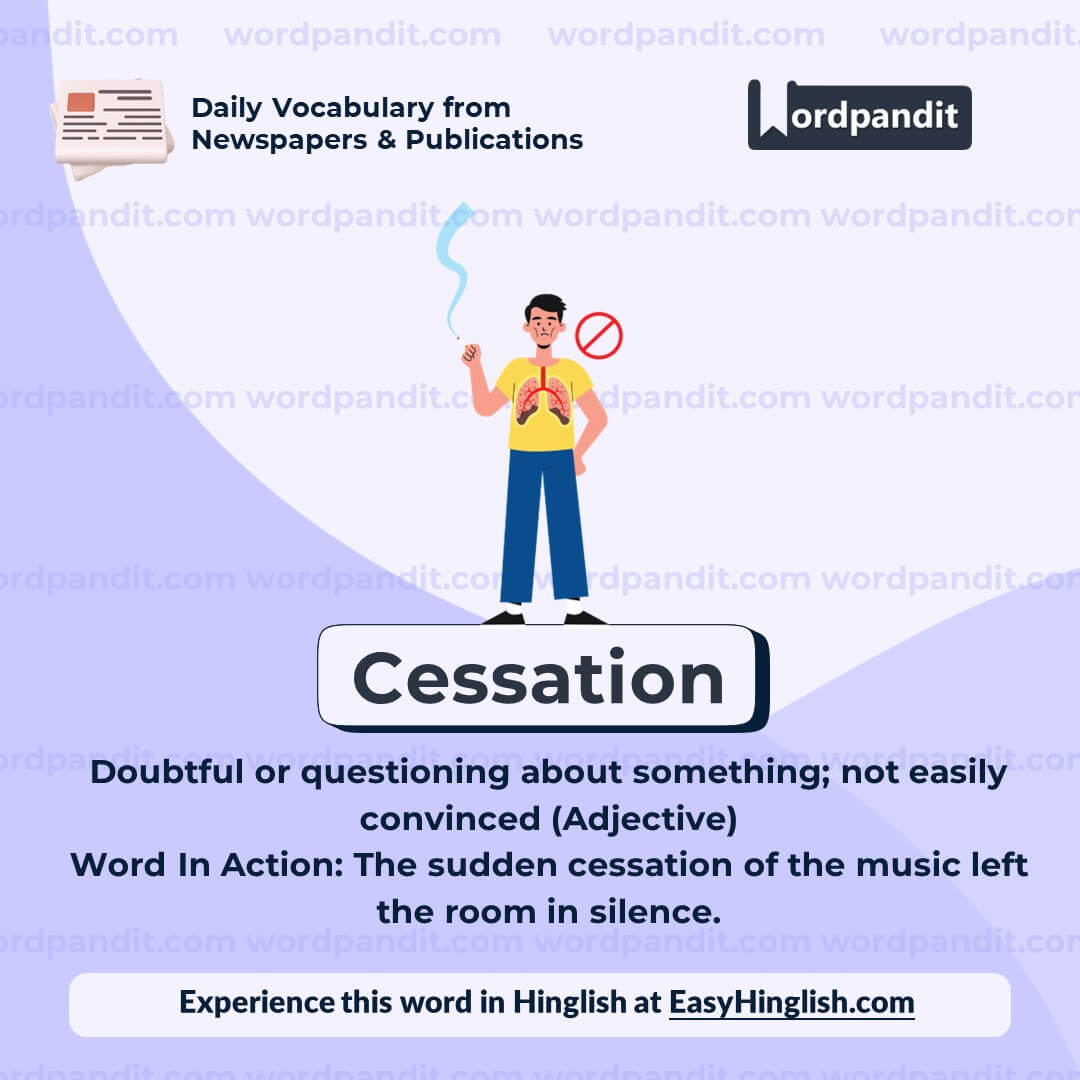
WORD-5: Cessation
Context:
"The government announced a cessation of hostilities to negotiate peace." - BBC
Explanatory Paragraph:
"Cessation" refers to the process of bringing something to an end, especially something that has been ongoing or continuous. It is often used in formal or official contexts, such as war, conflict, negotiations, or medical treatment. When there is a cessation of something, it means there has been a pause, a stop, or a complete termination of that activity or condition—usually with the hope of creating space for resolution, peace, or change.
Meaning: The act of stopping something; a halt or pause (Noun)
Pronunciation: seh-SAY-shuhn
Difficulty Level: ⭐⭐⭐ Intermediate
Etymology: From Latin "cessatio", from "cessare" meaning "to cease or stop."
Prashant Sir's Notes:
“Cessation” is a formal word—often found in political, military, or medical contexts. It’s not just about stopping something randomly; it usually involves deliberate action or official agreement. Think of it as a “calculated stop.”
Synonyms & Antonyms:
Synonyms: halt, pause, termination, stoppage, break
Antonyms: continuation, resumption, persistence, renewal
Usage Examples:
- There was a temporary cessation of fighting to allow humanitarian aid to reach civilians.
- Doctors recommended the complete cessation of smoking to improve his health.
- The union called for a cessation of work until their demands were met.
- Negotiators hoped the cessation of violence would lead to a lasting peace agreement.
Cultural Reference:
The "Christmas Truce" during World War I was a famous moment of cessation when soldiers from both sides paused hostilities to celebrate together on the battlefield.
Think About It:
Can a temporary cessation lead to long-term change, or does lasting peace require more than just a pause in conflict?
Quick Activity:
List three situations in life (personal, political, or environmental) where a cessation could lead to improvement or healing. Briefly explain why.
Memory Tip:
“Cessation” comes from “cease”—so think of it as the noun form of stopping. When you see “cessation,” picture a giant red STOP button being pressed.
Real-World Application:
"Cessation" is frequently used in news, medical guidance (e.g., smoking cessation), peace treaties, and workplace negotiations. Understanding this word helps in interpreting formal announcements and policy decisions.


