

Daily Vocabulary from International Newspapers and Publications
Expand Your Vocabulary with Wordpandit’s Global Vocabulary Hub
At Wordpandit, we are committed to helping you develop a truly global vocabulary by drawing from some of the most respected international publications. This section is designed to keep you ahead of the curve by introducing you to words that define global conversations and trends.
The Power of Global Sources
To help you think and communicate on a global scale, we curate vocabulary from renowned international sources, such as:
- The New York Times
- The Washington Post
- BBC
- The Guardian
- The Economist
- Scientific American
- Psychology Today
- And many more...
Stay Global, Stay Competitive
Our daily updates from international publications ensure you are consistently exposed to new words that reflect global news and developments, making sure your vocabulary is not only current but also globally relevant.
Enhance Your Global Perspective
Whether you’re preparing for international exams, aiming to excel in global business communication, or want to enhance your language skills for personal growth, Wordpandit offers the resources you need to thrive in a global context.
Effective Learning, Global Reach
Our learning methodology combines global examples, memory aids, and interactive activities, allowing you to internalize new words effectively and apply them in real-world scenarios.
Begin Your Global Vocabulary Journey Now!

Why Choose Wordpandit?
Practical Learning: Focus on words you'll actually encounter in real-world reading, enhancing your comprehension and communication skills.
Diverse Content: From current affairs to scientific breakthroughs, our varied sources expose you to vocabulary across multiple domains.
Effortless Integration: Make Wordpandit a part of your daily routine. Just a few minutes each day can significantly boost your lexicon over time.
Your Path to Vocabulary Mastery
- Visit our Daily Vocabulary section regularly
- Explore new words and their usage in context
- Practice incorporating these words into your own writing and speech
- Track your progress as your vocabulary expands
Start Your Journey Today
Embark on your vocabulary enhancement journey with Wordpandit. By consistently engaging with our daily posts, you'll build a robust vocabulary that serves you well in academic, professional, and personal contexts.
Remember, a word a day keeps linguistic limitations at bay. Make Wordpandit your daily companion in the quest for vocabulary excellence!
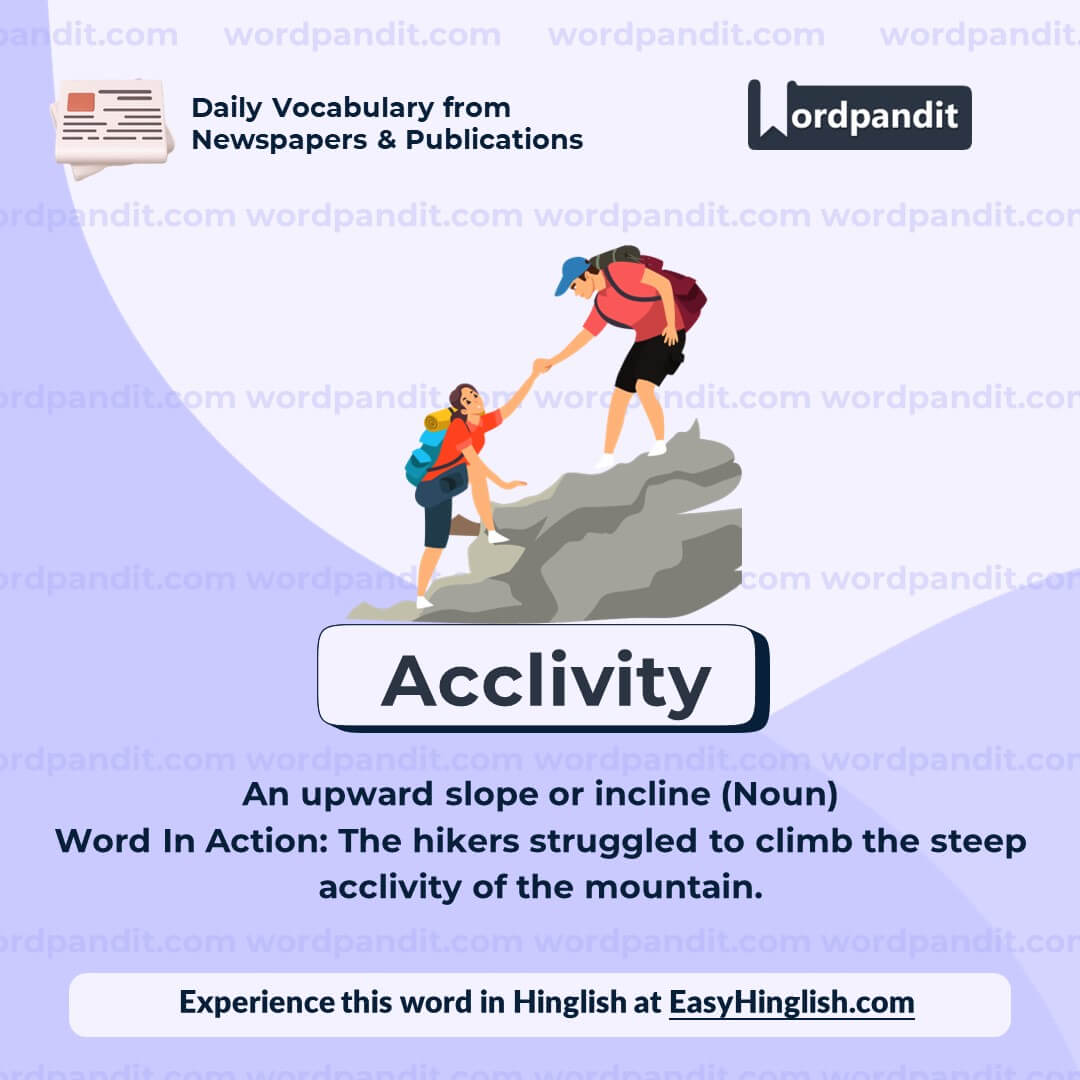
WORD-1: Acclivity
Context:
"The traveler then threads his way up the acclivity, amidst stupendous masses of rock, until he reaches the lofty ridge." - Aeon
Explanatory Paragraph:
“Acclivity” refers to an upward slope or incline. It’s often used in geographical or poetic descriptions to highlight a rising stretch of ground or terrain. In the context of a journey or travel narrative, it paints the image of climbing or ascending—a steady, sometimes challenging upward movement. The term contrasts with “declivity,” which means a downward slope. Knowing this word adds depth when describing landscapes or metaphorically referring to life's uphill challenges.
Meaning: An upward slope or incline (Noun)
Pronunciation: uh-KLIV-ih-tee
Difficulty Level: ⭐⭐⭐ Intermediate
Etymology: From Latin acclivitas, from acclivis meaning “uphill,” from ad- (toward) + clivus (slope).
Prashant Sir's Notes:
A classic example of a word used more in formal, literary, or descriptive writing than in everyday conversation. It's helpful for geographical descriptions, metaphorical usage (e.g., climbing toward goals), and essay writing. Pairs well with “declivity” and “precipice.”
Synonyms & Antonyms:
Synonyms: ascent, incline, rise, upgrade, upward slope
Antonyms: decline, descent, dip, downgrade, downward slope
Usage Examples:
- The road curved sharply along the steep acclivity of the mountain pass.
- They paused to catch their breath midway up the grassy acclivity.
- The castle was strategically built atop an acclivity, giving it a clear view of the valley below.
- Symbolically, the protagonist’s journey up the acclivity mirrored his personal growth and struggles.
Cultural Reference:
"The hill, though not very steep, had a long and gradual acclivity, reminiscent of the ancient roads leading up to Roman fortresses." - Travel Channel documentary on Roman ruins
Think About It:
Can an “acclivity” represent more than just a physical slope? How might it symbolize personal or societal challenges?
Quick Activity:
Write a short paragraph describing a location (real or imagined) that includes at least three vocabulary words: “acclivity,” “precipice,” and “summit.”
Memory Tip:
Think of “acclivity” as “a climb-vity”—you’re climbing or going up a slope.
Real-World Application:
Useful in geography, literature, and travel writing, the word “acclivity” allows you to vividly describe terrains, especially in hiking, military strategy, or even metaphoric upward progress.
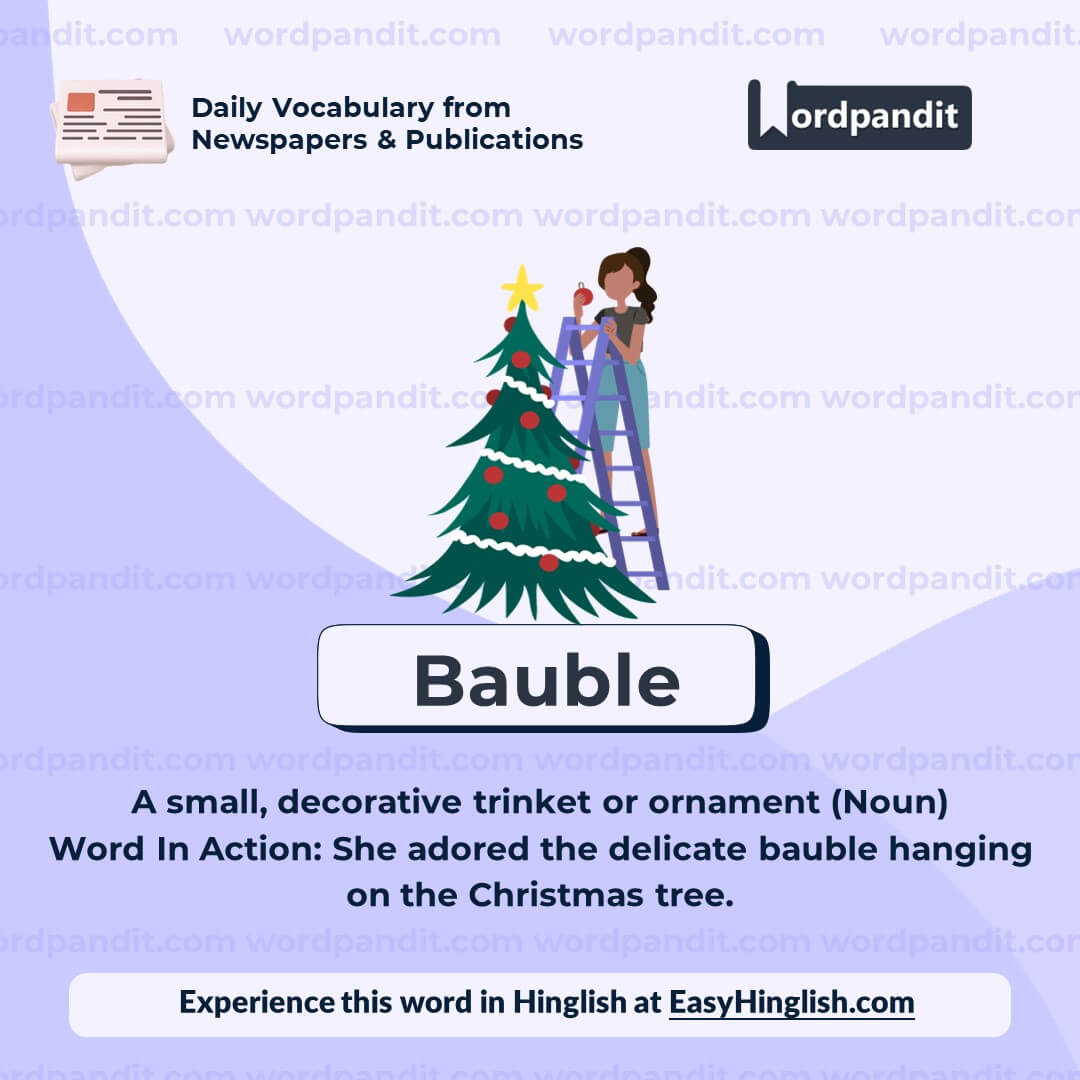
WORD-2: Bauble
Context:
"Our tree was decorated, most tastefully, with apt baubles bought from Georg Jensen." - Aeon
Explanatory Paragraph:
The word “bauble” refers to a small, decorative object that is usually showy but of little value. Often used in the context of ornaments—like Christmas tree decorations—it can also refer to flashy trinkets or jewelry that appear fancy but aren’t necessarily expensive or meaningful. While “bauble” usually has a playful or whimsical tone, it can sometimes carry a hint of criticism when describing something that looks impressive but lacks substance.
Meaning: A small, decorative, often inexpensive ornament or trinket (Noun)
Pronunciation: BAW-buhl
Difficulty Level: ⭐⭐ Beginner
Etymology: From Middle English bawble, from Old French baubel meaning “trinket, child's toy,” of uncertain origin.
Prashant Sir's Notes:
This is a great word to describe ornamental excess or superficial charm. It’s useful for both literal and metaphorical usage—use it to describe shiny things with little real worth or to poke fun at something that looks important but isn’t.
Synonyms & Antonyms:
Synonyms: trinket, knickknack, ornament, doodad, gewgaw, curio
Antonyms: treasure, heirloom, valuable, essential
Usage Examples:
- She filled the gift box with colorful baubles and tiny surprises.
- The shop was packed with cheap baubles meant to catch tourists’ eyes.
- Despite its golden frame, the award was just a meaningless bauble to him.
- They hung delicate glass baubles on each branch of the fir tree.
Cultural Reference:
In Shakespeare’s *Twelfth Night*, the character Feste refers to himself with jest as “a bauble,” highlighting his role as a fool—entertaining yet underestimated. - Classic Literature
Think About It:
Why do we often place so much value on baubles—objects that are beautiful but essentially valueless? What does this say about human nature?
Quick Activity:
Find three items around you that could be described as “baubles.” Write one sentence for each explaining why.
Memory Tip:
“Bauble” sounds like “bubble”—light, pretty, but it pops easily. Baubles may sparkle, but they’re mostly for show.
Real-World Application:
“Bauble” is commonly used during holiday seasons to describe Christmas tree ornaments, but can also be applied metaphorically in writing and conversation to critique superficial things—like fashion fads, flashy gadgets, or empty awards.
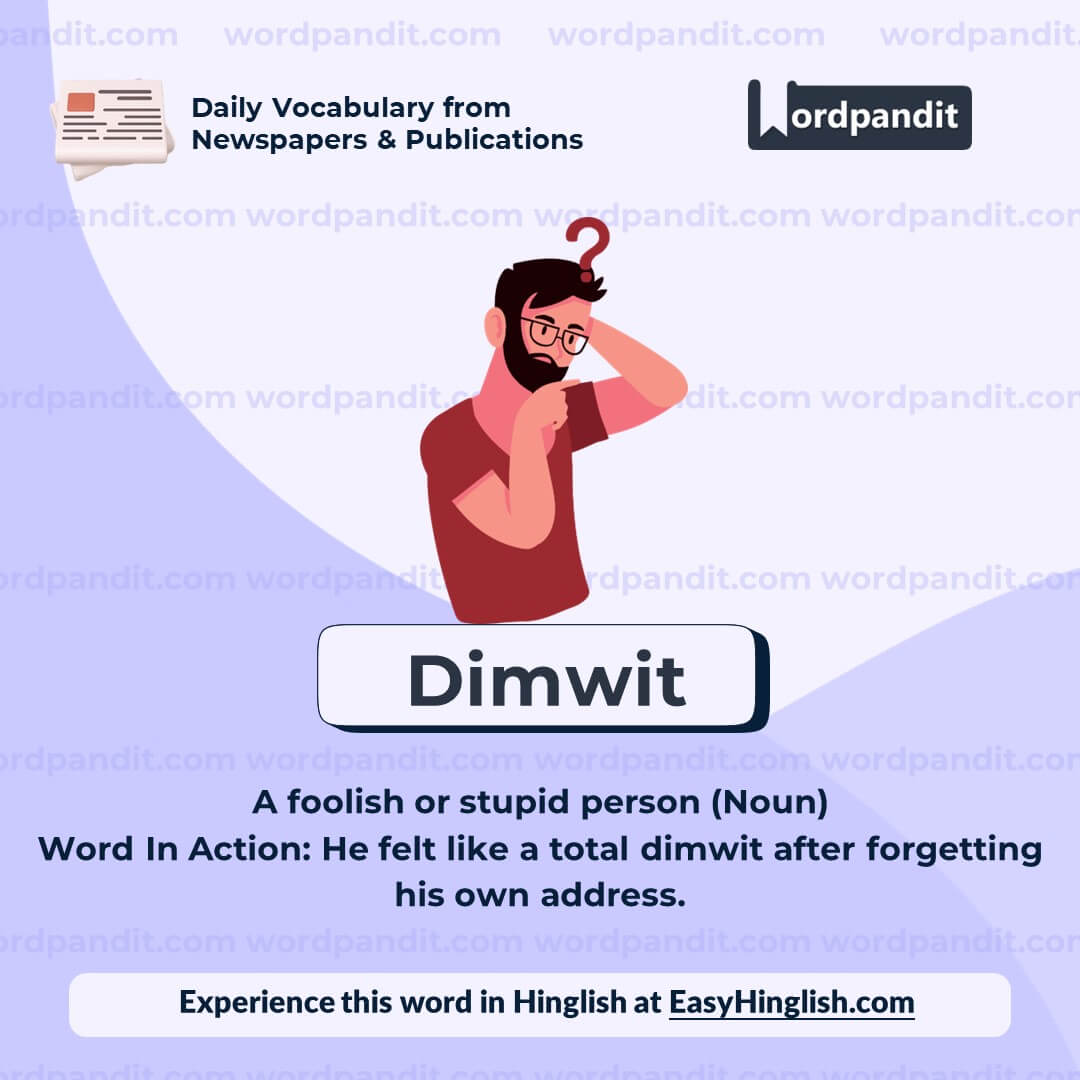
WORD-3: Dimwit
Context:
"You're a dimwit if you think I'll sell my house for that price." - Aeon
Explanatory Paragraph:
The word "dimwit" is a blunt and often humorous way to refer to someone who lacks intelligence or common sense. It's typically used in casual or informal speech to describe someone who makes a foolish remark or decision. In the context given, the speaker is expressing strong disagreement with an offer they consider absurd, and they’re using "dimwit" to emphasize how foolish they think the other person is being.
Meaning: A person who is not very intelligent; a fool or simpleton (Noun)
Pronunciation: DIM-wit
Difficulty Level: ⭐ Basic
Etymology: First recorded in the early 20th century, "dimwit" is a compound of "dim" (meaning dull or not bright) and "wit" (meaning mental sharpness or intelligence).
Prashant Sir's Notes:
This is a great word to remember for informal conversations where you're describing someone's silly or unintelligent behavior—just be cautious, as it can come off as rude or insulting if used in the wrong context.
Synonyms & Antonyms:
Synonyms: fool, idiot, dunce, blockhead, numbskull
Antonyms: genius, intellect, sage, brainiac
Usage Examples:
- Only a dimwit would try to microwave a metal bowl.
- He played the role of the lovable dimwit in the comedy film.
- Stop acting like a dimwit and think before you speak.
- The plan was so poorly thought out, it could have only come from a dimwit.
Cultural Reference:
"In classic sitcoms like *The Three Stooges*, the dimwit character was often the source of physical comedy and silly misunderstandings." - Television History Archives
Think About It:
Is it ever acceptable to call someone a "dimwit," or does it always come across as disrespectful—even when used jokingly?
Quick Activity:
Write two short dialogues: one where "dimwit" is used playfully between friends, and one where it's used in anger. Notice the difference in tone and impact.
Memory Tip:
Think of "dim" as low light and "wit" as intelligence—so a "dimwit" is someone whose brain isn’t shining too brightly!
Real-World Application:
While "dimwit" is mostly used in casual speech or humor, it's best avoided in professional or formal settings, as it can be offensive. Use it carefully in storytelling, comedy writing, or light banter with close friends.

WORD-4: Gavel
Context:
"Speakers of the House pass the gavel to the next speaker to indicate a change in leadership." - BBC
Explanatory Paragraph:
The word “gavel” refers to a small wooden hammer used by a person in authority—typically a judge, an auctioneer, or a parliamentary speaker—to call for order, signal decisions, or mark the beginning or end of a session. Symbolically, the gavel represents authority, control, and the power to enforce rules. In the context of legislative or governmental settings, passing the gavel is a ceremonial act that signifies the peaceful transfer of leadership or responsibility from one official to another.
Meaning: A small mallet used by a judge or person in authority to signal attention or order (Noun)
Pronunciation: GAV-uhl
Difficulty Level: ⭐⭐ Beginner
Etymology: Possibly from Middle English gafol (a tribute or token), though the exact origin is uncertain; became widely used in U.S. courts and legislatures in the 19th century.
Prashant Sir's Notes:
This is a great symbolic word. Beyond the courtroom or legislature, the term “gavel” can also be used metaphorically to refer to authority or control in any organized group or meeting. Remember that it’s a physical object, but also represents a broader concept of decision-making power.
Synonyms & Antonyms:
Synonyms: mallet, hammer (in a symbolic context), judge’s hammer
Antonyms: (No direct antonym, but conceptually): disorder, chaos, anarchy
Usage Examples:
- The judge banged the gavel to restore order in the courtroom.
- With a final strike of the gavel, the auctioneer closed the bidding.
- The new chairwoman accepted the gavel and began the meeting.
- Passing the gavel symbolized a smooth transition of leadership in the council.
Cultural Reference:
In the U.S. Congress, when a new Speaker of the House is elected, a ceremonial "passing of the gavel" takes place, marking the peaceful transition of legislative authority. - U.S. Government Traditions
Think About It:
Why do we place so much symbolic power in simple objects like a gavel? What does it say about how we structure authority?
Quick Activity:
Imagine you're the judge in a mock trial. Write three things you would say while using your gavel during the session.
Memory Tip:
Think “gavel = give order.” The person holding the gavel is giving commands and ensuring order in a session.
Real-World Application:
Understanding the word “gavel” is useful in legal, political, and organizational contexts. It helps you interpret news, courtroom dramas, or procedural meetings where order, leadership, and decision-making are central.
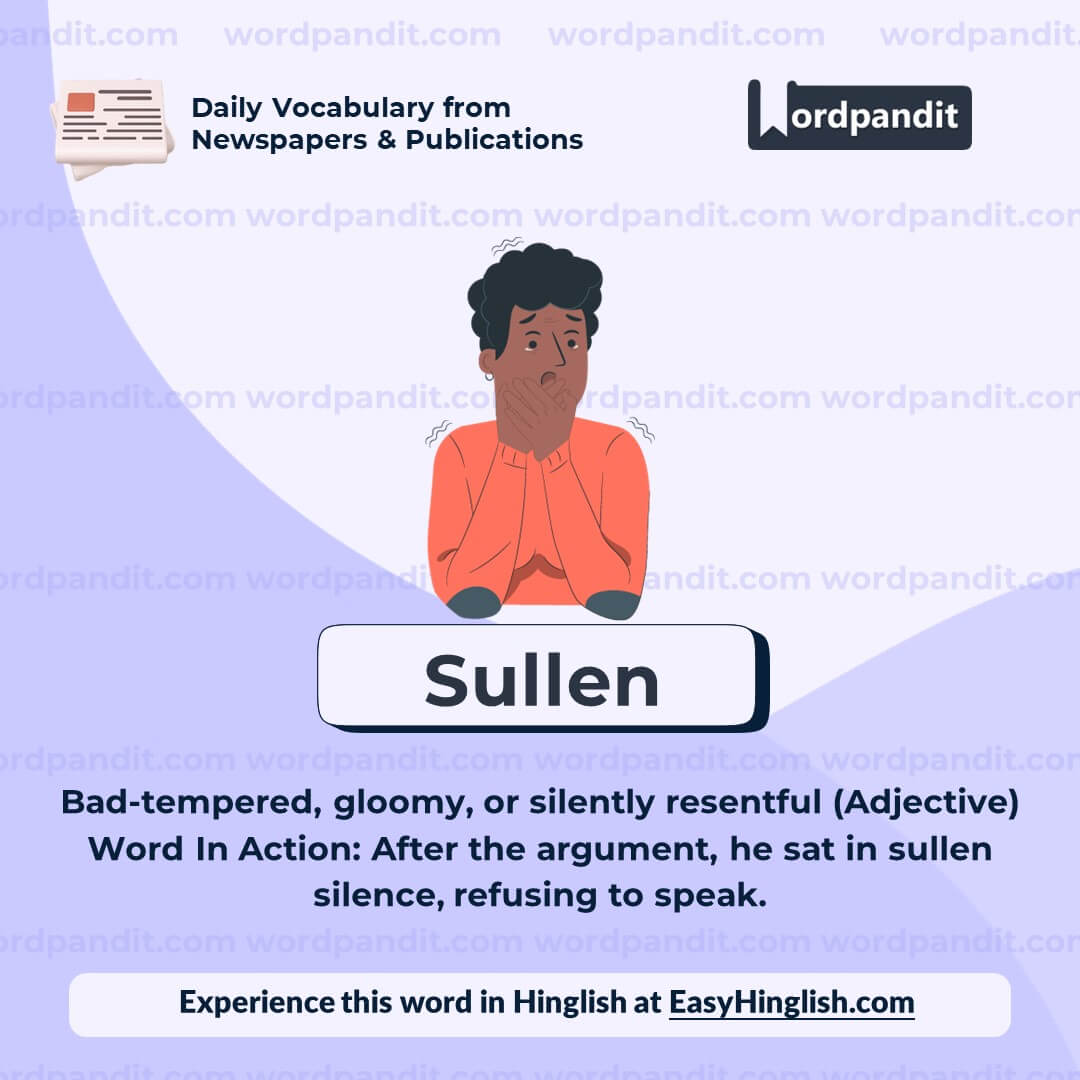
WORD-5: Sullen
Context:
"The atmosphere in the apartment is sullen and empty." - BBC
Explanatory Paragraph:
“Sullen” describes a mood or expression that is gloomy, silent, and sulky—often the result of being upset, angry, or disappointed. It’s not the kind of anger that’s loud or explosive; instead, it’s a quiet, brooding unhappiness. A person can be sullen, but so can a place or an atmosphere, especially if it feels emotionally heavy or joyless. In the given sentence, “sullen” effectively conveys a feeling of emotional emptiness or unresolved sadness within the apartment.
Meaning: Gloomy, silent, and withdrawn due to anger or unhappiness (Adjective)
Pronunciation: SUHL-en
Difficulty Level: ⭐⭐ Beginner
Etymology: From Middle English solein meaning solitary or morose, from Anglo-French, based on Latin solus (alone).
Prashant Sir's Notes:
“Sullen” is a useful word to describe mood or tone—especially when it's dark, withdrawn, or silently angry. It’s subtle, not dramatic. Use it to enhance writing that deals with emotional or atmospheric descriptions.
Synonyms & Antonyms:
Synonyms: moody, glum, morose, brooding, gloomy, surly
Antonyms: cheerful, lively, upbeat, bright, sociable
Usage Examples:
- He sat in the corner with a sullen look, refusing to join the conversation.
- The sky was a sullen gray, reflecting her mood perfectly.
- Her sullen silence made everyone in the room uncomfortable.
- The teenager gave a sullen shrug and walked away without answering.
Cultural Reference:
In classic literature, characters like Heathcliff from *Wuthering Heights* are often described as sullen—quietly intense, emotionally withdrawn, and hard to approach. - English Literature
Think About It:
Why do people sometimes choose to be sullen rather than express their emotions openly? What might they be protecting?
Quick Activity:
Describe a room using the word “sullen” without directly mentioning a person. Focus on mood and setting.
Memory Tip:
Think of “sullen” as “soul in”—when your soul is turned inward, you appear moody and quiet.
Real-World Application:
“Sullen” is useful in emotional storytelling, character development, and descriptive writing. It captures a very specific kind of quiet, internal mood that’s especially helpful for narrative or psychological contexts.


