

Daily Vocabulary from International Newspapers and Publications
Expand Your Vocabulary with Wordpandit’s Global Vocabulary Hub
At Wordpandit, we are committed to helping you develop a truly global vocabulary by drawing from some of the most respected international publications. This section is designed to keep you ahead of the curve by introducing you to words that define global conversations and trends.
The Power of Global Sources
To help you think and communicate on a global scale, we curate vocabulary from renowned international sources, such as:
- The New York Times
- The Washington Post
- BBC
- The Guardian
- The Economist
- Scientific American
- Psychology Today
- And many more...
Stay Global, Stay Competitive
Our daily updates from international publications ensure you are consistently exposed to new words that reflect global news and developments, making sure your vocabulary is not only current but also globally relevant.
Enhance Your Global Perspective
Whether you’re preparing for international exams, aiming to excel in global business communication, or want to enhance your language skills for personal growth, Wordpandit offers the resources you need to thrive in a global context.
Effective Learning, Global Reach
Our learning methodology combines global examples, memory aids, and interactive activities, allowing you to internalize new words effectively and apply them in real-world scenarios.
Begin Your Global Vocabulary Journey Now!

Why Choose Wordpandit?
Practical Learning: Focus on words you'll actually encounter in real-world reading, enhancing your comprehension and communication skills.
Diverse Content: From current affairs to scientific breakthroughs, our varied sources expose you to vocabulary across multiple domains.
Effortless Integration: Make Wordpandit a part of your daily routine. Just a few minutes each day can significantly boost your lexicon over time.
Your Path to Vocabulary Mastery
- Visit our Daily Vocabulary section regularly
- Explore new words and their usage in context
- Practice incorporating these words into your own writing and speech
- Track your progress as your vocabulary expands
Start Your Journey Today
Embark on your vocabulary enhancement journey with Wordpandit. By consistently engaging with our daily posts, you'll build a robust vocabulary that serves you well in academic, professional, and personal contexts.
Remember, a word a day keeps linguistic limitations at bay. Make Wordpandit your daily companion in the quest for vocabulary excellence!
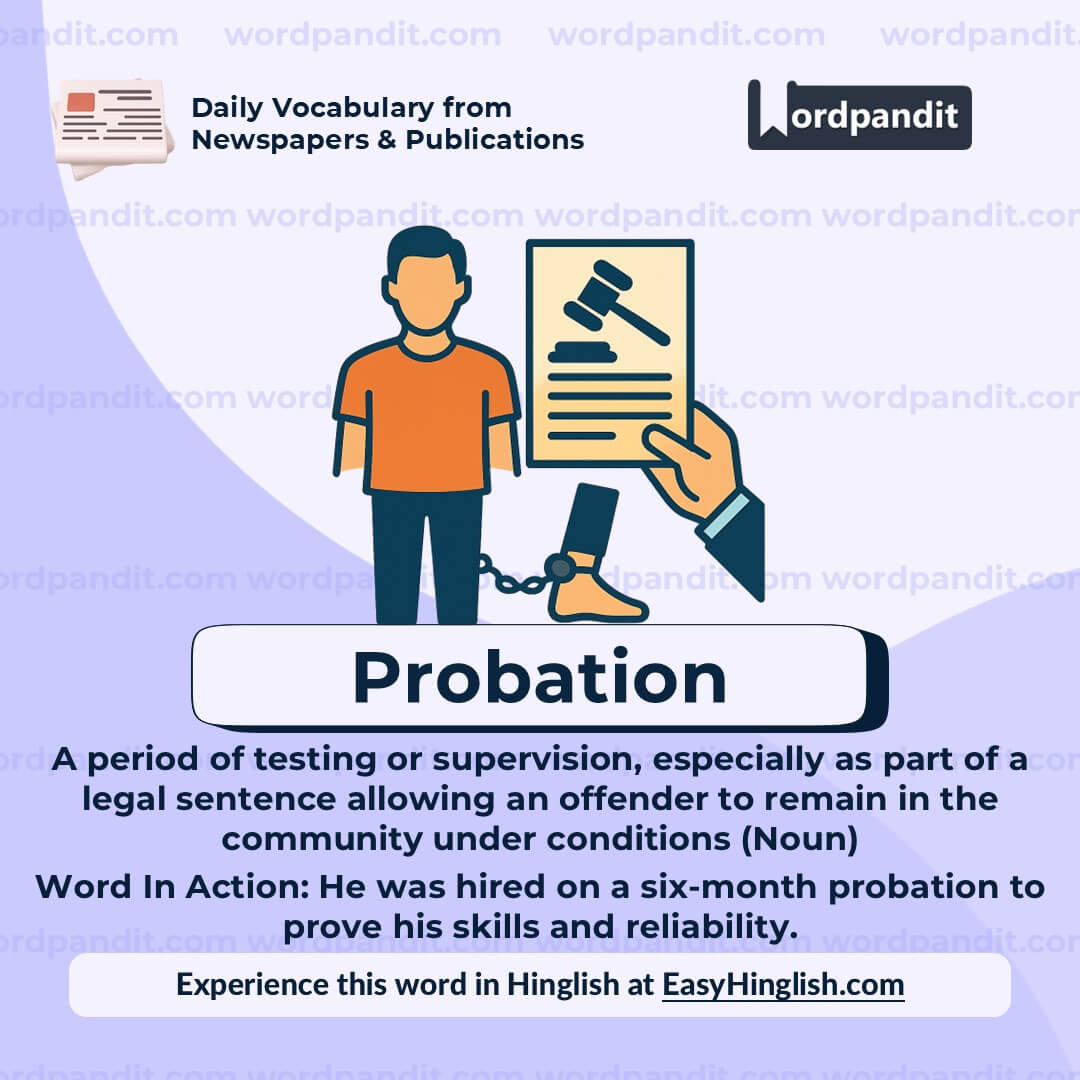
WORD-1: Probation
Context:
"But Pennsatucky’s teeth aren’t just ‘meth teeth.’ They are the teeth of poor folk, of the young grandma who helped to raise me and for decades worked from diner to factory line to a desk job as a probation officer for the county court system in Wichita, Kansas." - Aeon
Explanatory Paragraph:
Probation is a legal term that refers to a period of supervision given instead of or following a prison sentence. When someone is placed on probation, they are allowed to live in the community but must follow certain rules and report regularly to a probation officer. In a broader sense, the word can also mean a trial period during which someone is tested, such as in a new job. Essentially, probation is about giving someone a chance to prove themselves while under observation.
Meaning: A period of testing or supervision, especially as part of a legal sentence allowing an offender to remain in the community under conditions. (Noun)
Pronunciation: pro-bay-shun
Difficulty Level: ⭐⭐ Beginner–Intermediate
Etymology: From Latin probatio meaning "a proving, a trial," derived from probare, "to test or prove."
Prashant Sir's Notes:
The key to understanding "probation" is the idea of being on trial or under supervision. Whether in a legal or professional context, probation always implies a testing period before full trust or acceptance is given.
Synonyms & Antonyms:
Synonyms: supervision, trial period, testing phase, conditional release
Antonyms: freedom, acquittal, permanence, release
Usage Examples:
- The judge sentenced him to one year of probation instead of jail time.
- She is still on probation at her new job and must complete a six-month trial period.
- The probation officer visited the offender weekly to ensure he was following the court’s conditions.
- After his probation ended successfully, he was offered a permanent position.
Cultural Reference:
"Probation is often dramatized in crime and legal TV shows, where characters are given a second chance but must prove they can stay out of trouble." - Popular culture depiction
Think About It:
Do you think probation is more effective than imprisonment for reforming offenders, and why?
Quick Activity:
Write two sentences: one using "probation" in a legal sense and another in a workplace sense (e.g., probation period for a new employee).
Memory Tip:
Think of "probation" as a period to "prove" yourself — both words share the root prob meaning "to test."
Real-World Application:
Probation is widely used in legal systems as an alternative to imprisonment, and in workplaces as a trial period to evaluate new employees before making their employment permanent.
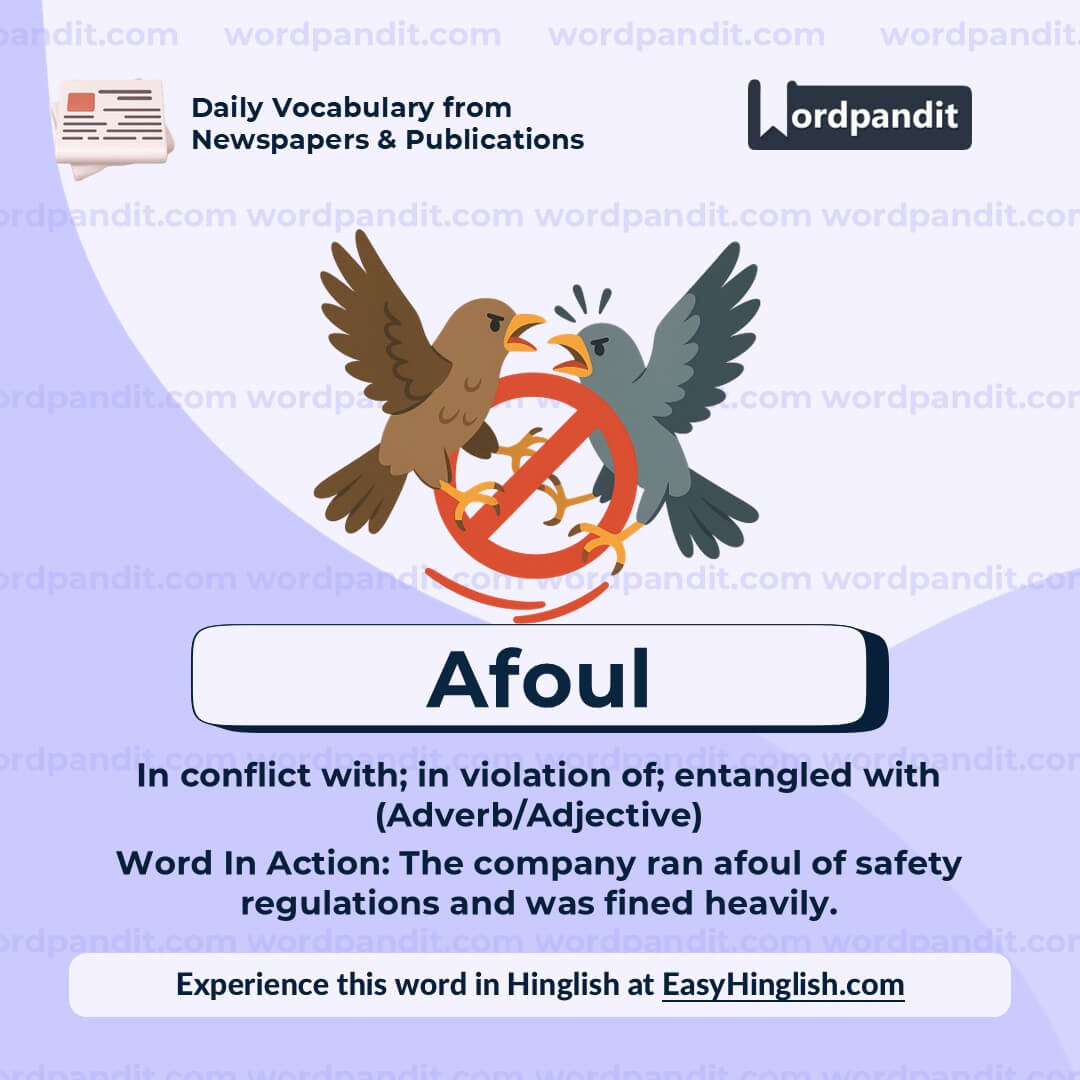
WORD-2: Afoul
Context:
"Monarez, who was confirmed by the Senate just last month, appeared to have run afoul of Robert F Kennedy Jr, the US health secretary, after she declined to support sweeping changes to US vaccine policies, according to reporting from the Washington Post and the New York Times." - Aeon
Explanatory Paragraph:
"Afoul" means being in conflict with, violating, or coming into opposition to something or someone. The phrase “run afoul of” is commonly used to describe situations where a person or group breaks a rule, law, or expectation, or offends someone in authority. It paints a picture of someone getting tangled up in trouble or clashing with established norms.
Meaning: In conflict with; in violation of; entangled with. (Adverb/Adjective)
Pronunciation: uh-fowl
Difficulty Level: ⭐⭐⭐ Intermediate
Etymology: From Middle English afoul, meaning "in a tangled state," originally used in nautical contexts to describe ships' rigging or lines getting caught or entangled.
Prashant Sir's Notes:
The phrase “run afoul of” is an idiomatic expression. Imagine a bird flying into a net and getting stuck — that is the sense of "afoul." When you run afoul of rules or authority, you get caught up in trouble.
Synonyms & Antonyms:
Synonyms: clash, conflict, violate, offend, oppose
Antonyms: comply, align, agree, conform, respect
Usage Examples:
- The company ran afoul of environmental regulations and was fined heavily.
- She ran afoul of her manager after questioning the new policy in public.
- The ship came afoul of another vessel during the storm.
- He avoided running afoul of the law by carefully following the rules.
Cultural Reference:
"The phrase 'run afoul of' is frequently used in journalism and politics to describe when a leader, company, or official gets into conflict with authority or regulations." - Media usage
Think About It:
Why do you think phrases like “run afoul of” survive in modern English, even though their literal nautical origins are mostly forgotten?
Quick Activity:
Fill in the blank: "The politician ran afoul of ______ when he refused to follow their new guidelines." (Think of an authority figure, group, or institution.)
Memory Tip:
Think of "afoul" as “a-foul-up.” When you run afoul, you’ve messed up or tangled yourself in trouble.
Real-World Application:
The expression "run afoul of" is often used in news and workplace contexts to describe clashes with rules, laws, or authority — whether it’s a company breaking environmental laws or an employee violating workplace policies.

WORD-3: Liminal
Context:
"What is grief if not living in the liminal space between mourning and coping, of life and death itself?" - Economist
Explanatory Paragraph:
"Liminal" describes something that exists at a threshold, in-between two states, stages, or conditions. It often refers to transitional phases — moments where something is neither one thing nor the other but somewhere in the middle. The word is commonly used in psychology, anthropology, and literature to describe ambiguous spaces or experiences that feel like transitions, such as adolescence, twilight, or the grieving process.
Meaning: At or relating to a transitional or initial stage; occupying a position at a boundary or threshold. (Adjective)
Pronunciation: lim-uh-nuhl
Difficulty Level: ⭐⭐⭐ Intermediate–Advanced
Etymology: From Latin limen meaning "threshold." First used in anthropology to describe the transitional stage of rituals where participants are between their previous and new status.
Prashant Sir's Notes:
Liminal is a powerful word because it captures the idea of being "in-between." Think of doorways, crossroads, or moments of transformation — these are all liminal spaces. It’s widely used in literature and philosophy to describe transitions that are both unsettling and full of potential.
Synonyms & Antonyms:
Synonyms: transitional, in-between, intermediate, threshold, borderline
Antonyms: definite, fixed, established, clear-cut
Usage Examples:
- Graduation is a liminal moment between student life and adulthood.
- The misty dawn created a liminal atmosphere, caught between night and day.
- She felt liminal, suspended between her old life and the possibilities of a new beginning.
- Anthropologists often study liminal stages in cultural rituals, such as rites of passage.
Cultural Reference:
"Liminal spaces" has become an internet aesthetic, referring to eerie photographs of empty hallways, stairwells, or transitional spaces that evoke feelings of being ‘in-between’ worlds.
Think About It:
Why do you think humans often associate liminal spaces — like doorways or twilight — with mystery, transformation, or even fear?
Quick Activity:
Write a short sentence describing a liminal moment in your own life — a time when you felt “in-between” two stages, places, or decisions.
Memory Tip:
Link "liminal" to "limit" — both share the idea of a boundary or edge. Liminal means standing right at that edge.
Real-World Application:
The concept of liminality is used in psychology (transitional phases like adolescence), anthropology (rituals and rites of passage), and even design and art (spaces that evoke feelings of transition or ambiguity).
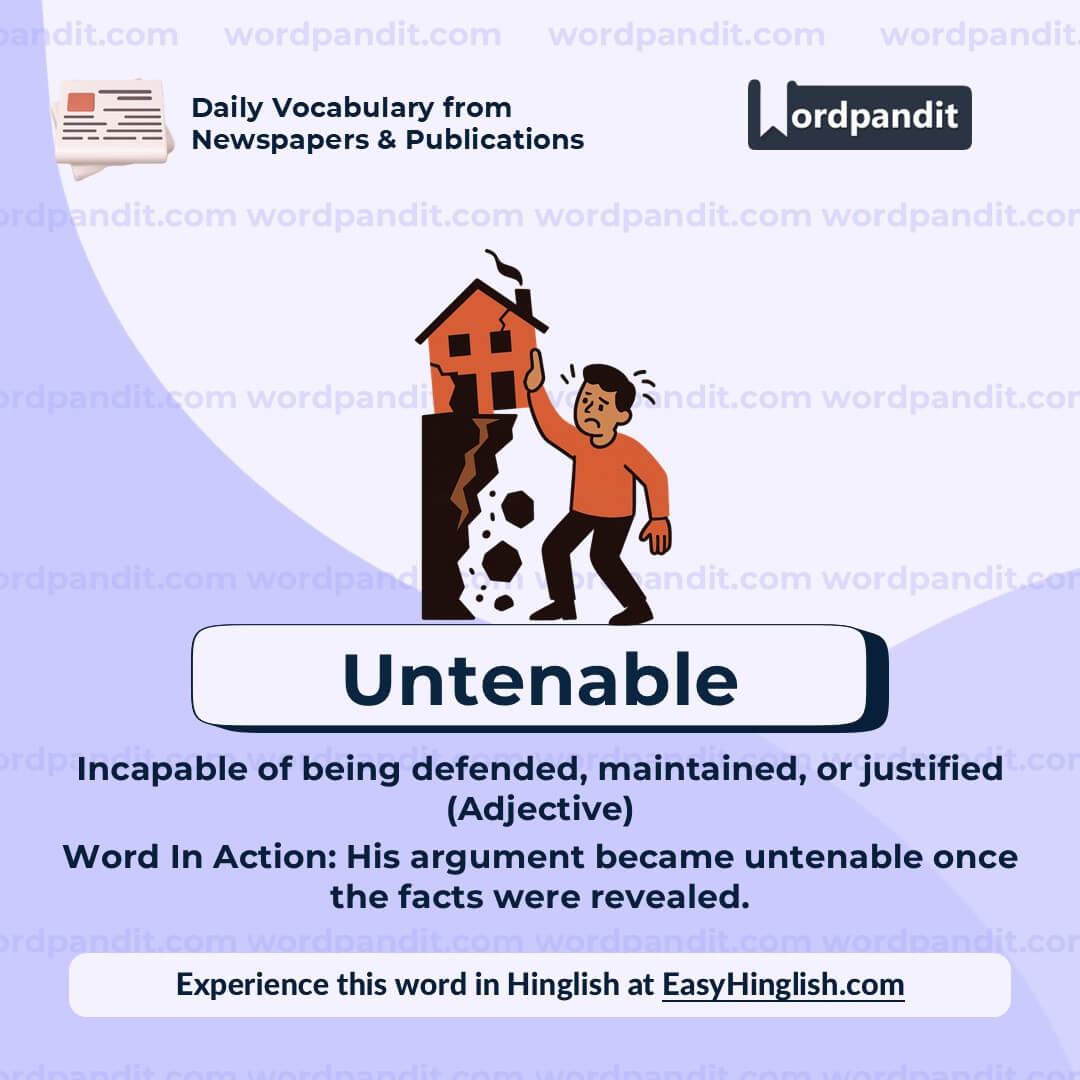
WORD-4: Untenable
Context:
"Whereas many researchers once assumed it took a chance event within a very long timescale for Earth’s biosphere to emerge, that increasingly looks untenable." - Aeon
Explanatory Paragraph:
"Untenable" describes a position, belief, or situation that cannot be defended, justified, or maintained. It is often used in academic, legal, and everyday contexts to express that an argument or viewpoint has become too weak, illogical, or impractical to continue supporting. If something is untenable, it collapses under scrutiny.
Meaning: Incapable of being defended, maintained, or justified. (Adjective)
Pronunciation: un-ten-uh-bul
Difficulty Level: ⭐⭐⭐ Intermediate–Advanced
Etymology: From French intenable, from Latin in ("not") + tenere ("to hold"), literally meaning "unable to be held."
Prashant Sir's Notes:
Think of "untenable" as an argument or belief that you cannot "hold on to" because it falls apart under questioning. It’s especially useful for academic writing, debates, or describing situations where logic fails.
Synonyms & Antonyms:
Synonyms: indefensible, unsustainable, illogical, baseless, weak
Antonyms: defensible, justified, sustainable, logical, valid
Usage Examples:
- The politician’s claim became untenable after new evidence was revealed.
- As the costs skyrocketed, the business model proved untenable in the long run.
- His position in the debate was untenable once the opposing side presented clear data.
- The castle was strategically untenable and had to be abandoned.
Cultural Reference:
In philosophy and science, ideas are often tested until they are either validated or deemed "untenable" — a term frequently used in academic journals to signal the collapse of outdated theories.
Think About It:
What is an idea, belief, or practice in modern society that you think has become untenable, and why?
Quick Activity:
Fill in the blank: "The argument that ______ is becoming increasingly untenable in today’s world." (Think of a social, political, or environmental example.)
Memory Tip:
Remember: "Un + tenable" = "cannot be held." If you can’t hold it, you can’t defend it.
Real-World Application:
Untenable is often used in academic writing, business strategy, politics, and debates to describe arguments, positions, or policies that cannot be maintained under scrutiny or in practice.
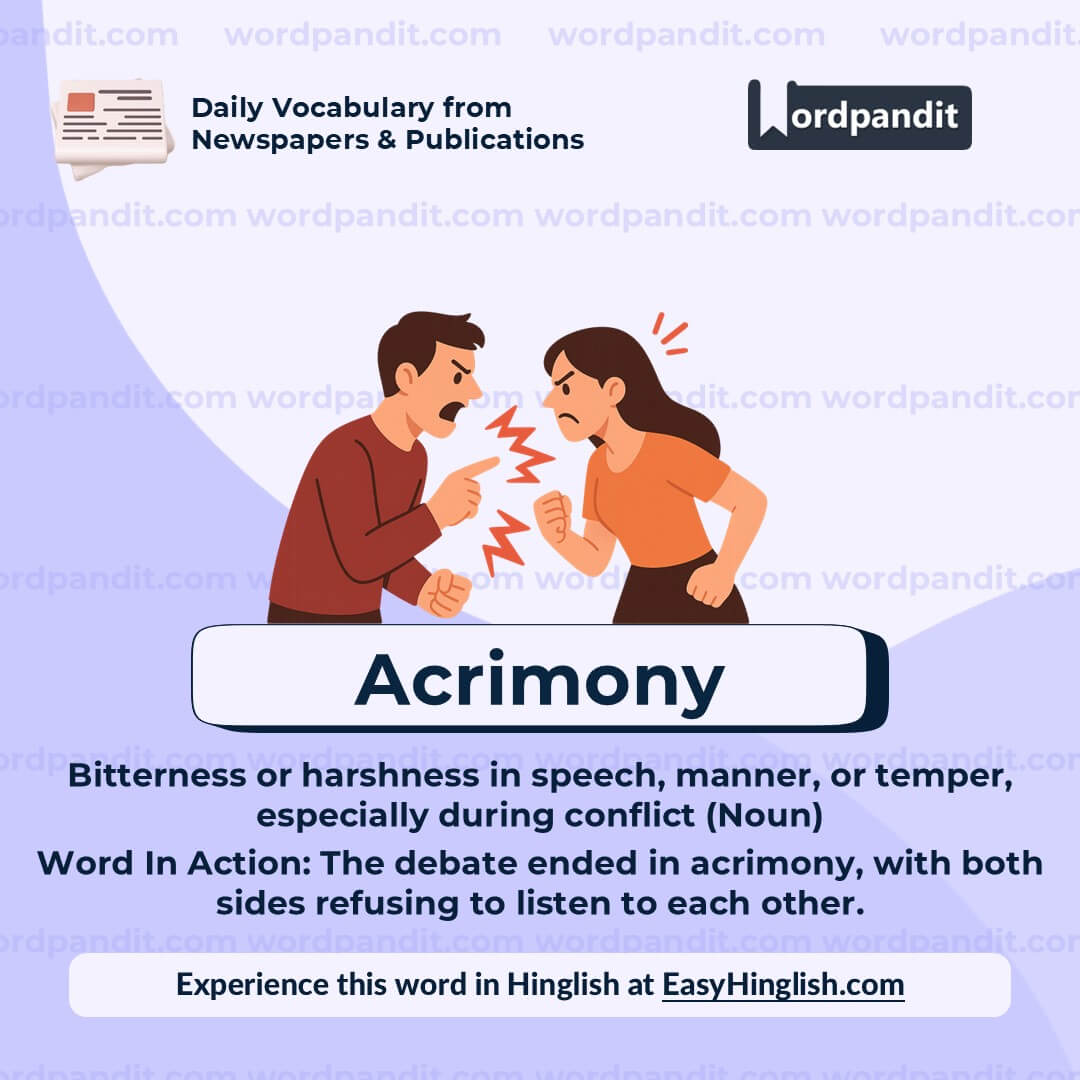
WORD-5: Acrimony
Context:
"The debate in Parliament was marked by unusual acrimony, with opposition leaders accusing the government of ignoring pressing economic concerns." - Washington Post
Explanatory Paragraph:
"Acrimony" refers to bitterness or sharpness in speech, behavior, or feelings, especially during arguments or disagreements. It captures the sense of hostility, harshness, and resentment that often arises in heated debates or conflicts. Acrimony is not just disagreement — it is disagreement laced with personal bitterness or hostility.
Meaning: Bitterness or harshness in speech, manner, or temper, especially during conflict. (Noun)
Pronunciation: ak-ruh-moh-nee
Difficulty Level: ⭐⭐⭐ Intermediate–Advanced
Etymology: From Latin acrimonia meaning "sharpness," derived from acer ("sharp, bitter"). Originally used to describe sharpness of taste, later applied to tone and manner.
Prashant Sir's Notes:
Acrimony is all about *sharpness* in tone or attitude. Think of it as a debate or quarrel where words sting like needles. Always associate it with hostility and bitterness in human interactions.
Synonyms & Antonyms:
Synonyms: bitterness, hostility, resentment, rancor, animosity
Antonyms: harmony, goodwill, kindness, amity, friendliness
Usage Examples:
- The divorce proceedings were filled with acrimony, making cooperation nearly impossible.
- The acrimony between the two rival leaders was evident in every public exchange.
- What began as a simple disagreement quickly escalated into acrimony.
- She decided to leave the meeting early to avoid further acrimony.
Cultural Reference:
"Acrimony" is often used in political journalism to describe the bitterness and hostility that frequently emerge during election debates and parliamentary sessions.
Think About It:
Do you think acrimony in debates leads to stronger discussions, or does it prevent constructive problem-solving?
Quick Activity:
Write a short sentence using "acrimony" to describe a workplace or family situation where tension is high.
Memory Tip:
Remember: "Acri-" means sharp (like acid). Acrimony = sharpness of words or attitude.
Real-World Application:
Acrimony is commonly seen in political debates, legal battles, workplace rivalries, or personal disputes where hostility overshadows calm discussion.


