

Daily Vocabulary from International Newspapers and Publications
Expand Your Vocabulary with Wordpandit’s Global Vocabulary Hub
At Wordpandit, we are committed to helping you develop a truly global vocabulary by drawing from some of the most respected international publications. This section is designed to keep you ahead of the curve by introducing you to words that define global conversations and trends.
The Power of Global Sources
To help you think and communicate on a global scale, we curate vocabulary from renowned international sources, such as:
- The New York Times
- The Washington Post
- BBC
- The Guardian
- The Economist
- Scientific American
- Psychology Today
- And many more...
Stay Global, Stay Competitive
Our daily updates from international publications ensure you are consistently exposed to new words that reflect global news and developments, making sure your vocabulary is not only current but also globally relevant.
Enhance Your Global Perspective
Whether you’re preparing for international exams, aiming to excel in global business communication, or want to enhance your language skills for personal growth, Wordpandit offers the resources you need to thrive in a global context.
Effective Learning, Global Reach
Our learning methodology combines global examples, memory aids, and interactive activities, allowing you to internalize new words effectively and apply them in real-world scenarios.
Begin Your Global Vocabulary Journey Now!

Why Choose Wordpandit?
Practical Learning: Focus on words you'll actually encounter in real-world reading, enhancing your comprehension and communication skills.
Diverse Content: From current affairs to scientific breakthroughs, our varied sources expose you to vocabulary across multiple domains.
Effortless Integration: Make Wordpandit a part of your daily routine. Just a few minutes each day can significantly boost your lexicon over time.
Your Path to Vocabulary Mastery
- Visit our Daily Vocabulary section regularly
- Explore new words and their usage in context
- Practice incorporating these words into your own writing and speech
- Track your progress as your vocabulary expands
Start Your Journey Today
Embark on your vocabulary enhancement journey with Wordpandit. By consistently engaging with our daily posts, you'll build a robust vocabulary that serves you well in academic, professional, and personal contexts.
Remember, a word a day keeps linguistic limitations at bay. Make Wordpandit your daily companion in the quest for vocabulary excellence!
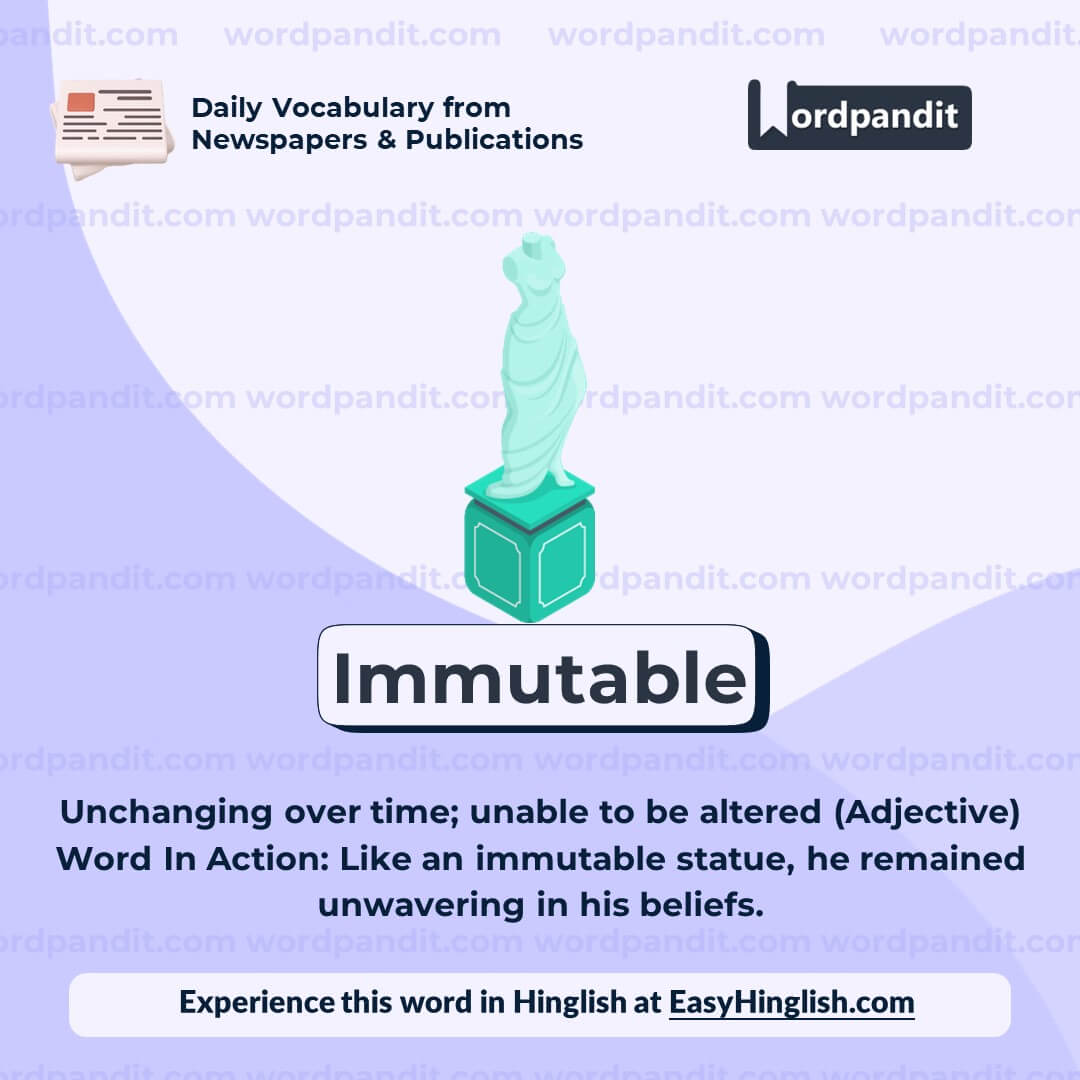
WORD-1: Immutable
Context:
"The dawning of Darwinism led to the slow realisation that the species was not an immutable form, but rather an evolutionary happenstance. It showed that nature was a work in progress, and that the Grey Area was alive and well and living among us." - Aeon
Explanatory Paragraph:
The word "immutable" refers to something that cannot be changed or altered over time. In the context of the quote, it suggests that before Darwin's theory, people believed species were fixed and unchanging. However, Darwinism revealed that life is dynamic and subject to evolution. So, "immutable" emphasizes permanence and resistance to transformation, often used in philosophical, scientific, or even emotional discussions to signify unchangeability.
Meaning: Unchanging over time or unable to be changed (Adjective)
Pronunciation: ih-MYOO-tuh-buhl
Difficulty Level: ⭐⭐⭐ Intermediate
Etymology: From Latin *immutabilis*, from *in-* ‘not’ + *mutabilis* ‘able to change’, from *mutare* ‘to change’
Prashant Sir's Notes:
“Immutable” is a great word to describe anything perceived as permanent—laws, truths, or values. Especially useful in philosophical debates or when discussing beliefs that resist change.
Synonyms & Antonyms:
Synonyms: unchangeable, fixed, permanent, invariable, inalterable
Antonyms: changeable, variable, alterable, flexible, inconsistent
Usage Examples:
- The Constitution is often treated as an immutable document, though amendments prove otherwise.
- Her love for music remained immutable despite the chaos of daily life.
- Some people mistakenly view tradition as something immutable and sacred.
- The laws of physics are often described as immutable truths of the universe.
Cultural Reference:
"Truth is by nature self-evident. As soon as you remove the cobwebs of ignorance, it shines clear." - Mahatma Gandhi (referring to immutable truths in human values)
Think About It:
Can any belief or system truly be considered immutable, or is everything subject to evolution over time?
Quick Activity:
Think of three things in your life you believe are "immutable." Now, challenge each one with a hypothetical scenario that forces change. Reflect on how "immutable" they really are.
Memory Tip:
“Immutable” sounds like “im-mutate”—and if you can’t mutate (change), you’re unchangeable!
Real-World Application:
"Immutable" is often used in law (immutable rights), software development (immutable data structures), and philosophy (immutable truths), making it useful for academic, technical, and conversational settings.
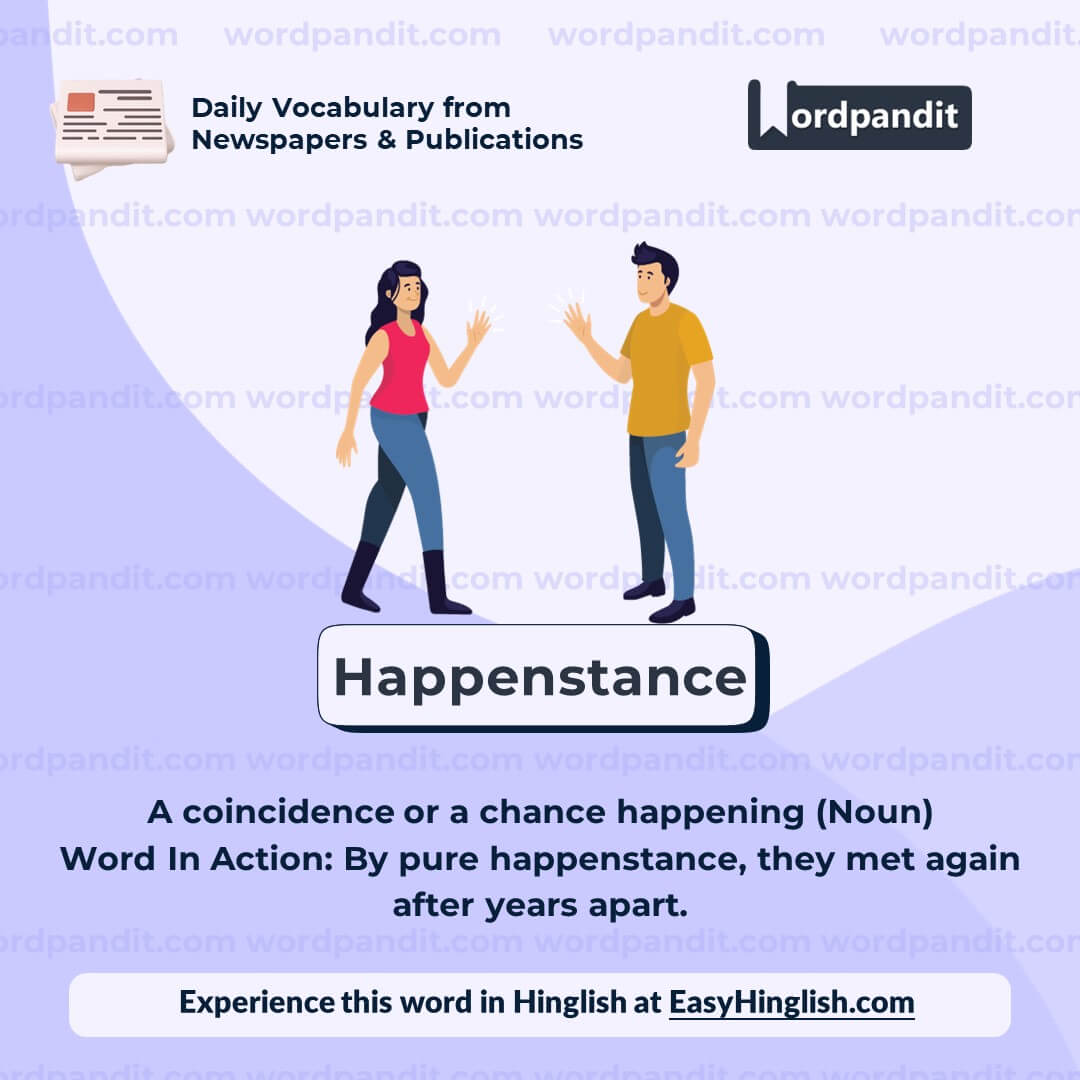
WORD-2: Happenstance
Context:
"The dawning of Darwinism led to the slow realisation that the species was not an immutable form, but rather an evolutionary happenstance. It showed that nature was a work in progress, and that the Grey Area was alive and well and living among us." - Aeon
Explanatory Paragraph:
"Happenstance" refers to something that happens by chance—an unplanned or coincidental event. In the context of evolution, calling species an “evolutionary happenstance” implies they are the result of random, natural occurrences rather than a fixed, predetermined design. The word combines the ideas of "happening" and "circumstance," suggesting a fusion of randomness and context in producing a certain outcome.
Meaning: A coincidence or a chance occurrence (Noun)
Pronunciation: HAP-uhn-stanss
Difficulty Level: ⭐⭐ Basic
Etymology: Blend of "happening" and "circumstance," first recorded in early 20th-century American English
Prashant Sir's Notes:
Think of “happenstance” as the elegant cousin of “coincidence.” It’s often used in storytelling, science, and philosophy when talking about how things unfold unexpectedly. It's a useful word to bring subtlety to casual chance.
Synonyms & Antonyms:
Synonyms: coincidence, fluke, accident, chance event, twist of fate
Antonyms: plan, certainty, design, intention, purpose
Usage Examples:
- It was pure happenstance that they met again in a café halfway across the world.
- The discovery of penicillin was a fortunate happenstance in medical history.
- Sometimes, life's best opportunities arise from simple happenstance.
- The entire chain of events seemed like a series of lucky happenstances.
Cultural Reference:
"Serendipity" (2001), a romantic comedy film, revolves entirely around happenstance—the idea that fate or chance brings two people together in unexpected ways.
Think About It:
To what extent do you believe your life has been shaped by happenstance rather than deliberate choice?
Quick Activity:
Write a two-sentence story that begins with a happenstance and ends with a surprising outcome. Try using the word in your story.
Memory Tip:
Break it down: “Happen” + “Circumstance” = Happenstance → Something that just happens by circumstance or chance!
Real-World Application:
"Happenstance" is a useful word in storytelling, journalism, and everyday conversations to describe events that occur unexpectedly or by coincidence, often with surprising consequences.
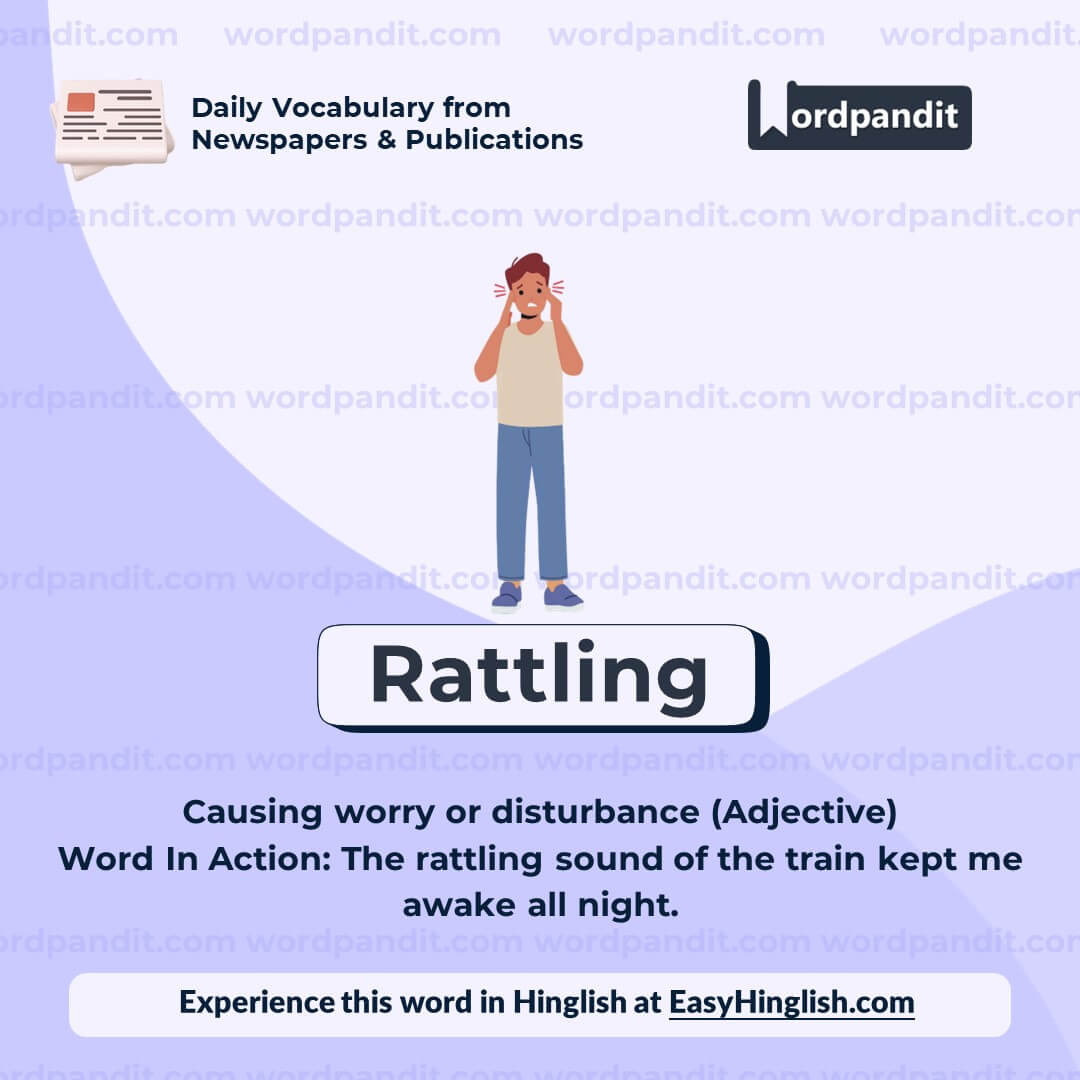
WORD-3: Rattling
Context:
"And it brought to life a debate that has been rattling on ever since. Where do we draw our lines?" - Aeon
Explanatory Paragraph:
In this context, "rattling" is used as a verb meaning "to continue noisily or persistently." The phrase "rattling on" implies that the debate has been ongoing for a long time, possibly in a loud, energetic, or slightly annoying manner. While "rattling" can also refer to physical shaking or making a clattering sound, here it metaphorically captures the sound and motion of continuous, unsettled discussion.
Meaning: Continuing in a persistent or noisy way; making a rapid series of short, sharp sounds (Verb / Adjective depending on use)
Pronunciation: RAT-ling
Difficulty Level: ⭐⭐ Basic
Etymology: From Middle English *ratelen*, imitative of a quick, repetitive sound, likely of Germanic origin
Prashant Sir's Notes:
“Rattling” often shows up in idiomatic expressions like “rattling on” (talking continuously) or “rattled” (disturbed or unnerved). In writing, it can be used to animate debate, motion, or emotion. Always check whether it's being used literally (noise) or figuratively (persistence or disturbance).
Synonyms & Antonyms:
Synonyms: clattering, echoing, chattering, droning, continuing
Antonyms: quieting, silencing, calming, halting
Usage Examples:
- The windows were rattling in the wind during the storm.
- She kept rattling on about her weekend, not noticing he had tuned out.
- The train rattled along the tracks at full speed.
- That question really rattled him during the interview.
Cultural Reference:
In J.K. Rowling's *Harry Potter* series, the "rattling" of the Knight Bus is described as a chaotic and humorous experience, reflecting the unpredictable nature of magical transportation.
Think About It:
Can a conversation or debate that “rattles on” still be productive, or does its persistence imply a lack of resolution?
Quick Activity:
Identify two situations—one where “rattling” is used literally and one metaphorically. Write a sentence for each.
Memory Tip:
Think of a baby’s rattle—it makes continuous noise when shaken. “Rattling on” is like someone who keeps shaking their ideas without pause!
Real-World Application:
"Rattling" is commonly used in both literal (mechanical noise, physical disturbance) and figurative (ongoing speech, emotional unrest) ways in news, literature, and conversation—especially when describing persistent noise or unease.
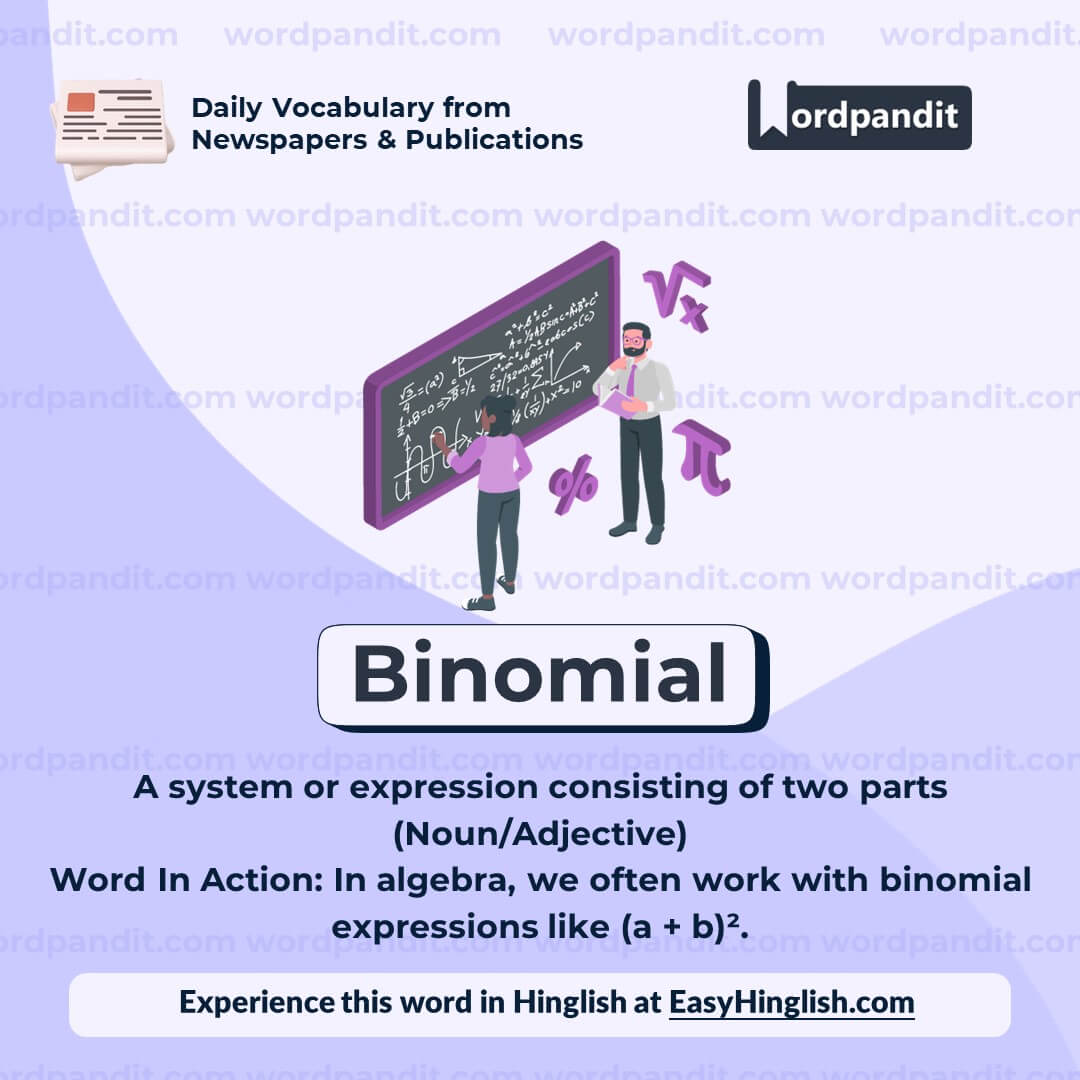
WORD-4: Binomial
Context:
"What even are subspecies, these neither-this-nor-that intermediates, these creatures caught between binomials, like actors surprised mid-costume change?" - Aeon
Explanatory Paragraph:
The term "binomial" in this context refers to the binomial nomenclature system used in biology, where each species is given a two-part Latin name (e.g., *Homo sapiens*). The quote uses "binomials" metaphorically, suggesting that subspecies are difficult to categorize because they don't fit neatly into these defined two-name categories. It captures the discomfort of classifying living things into rigid systems when nature is far more fluid and transitional.
Meaning: A two-part name or expression, especially in biology or mathematics (Noun)
Pronunciation: bye-NOH-mee-uhl
Difficulty Level: ⭐⭐⭐ Intermediate
Etymology: From Latin *bi-* meaning "two" + *nomen* meaning "name" — literally "two names"
Prashant Sir's Notes:
Binomial is most commonly used in two fields: biology and mathematics. In biology, it's the formal two-word naming of a species; in math, it refers to an algebraic expression with two terms (like x + y). Understanding context is key to grasping the intended use.
Synonyms & Antonyms:
Synonyms: two-part name, species designation, taxonomic label (in biology); two-term expression (in math)
Antonyms: single name, monomial, undefined label
Usage Examples:
- In biology, humans are identified by the binomial *Homo sapiens*.
- The binomial expression (x + 2)² is commonly used in algebra.
- She struggled to classify the organism—it didn’t fit cleanly into a known binomial.
- Scientists often debate how strict the binomial system should be when classifying life forms.
Cultural Reference:
Binomial nomenclature was formalized by Swedish botanist Carl Linnaeus in the 18th century, revolutionizing biological classification and influencing how we understand and organize life on Earth.
Think About It:
Is it possible that rigid naming systems like binomials oversimplify the complexity and fluidity of life and identity?
Quick Activity:
Pick an animal and look up its binomial name. Then try to break it down: What does each part of the name mean in Latin or Greek?
Memory Tip:
“Bi-” means two, and “-nomial” comes from “name” → Binomial = Two Names. Think of *Homo sapiens* as a classic example.
Real-World Application:
Binomials are critical in biology for scientific naming, ensuring every species has a unique and universally recognized label. They're also vital in mathematics when working with algebraic formulas.
WORD-5: Brisk
Context:
"You might think that these kinds of controversy would have been cleared up for good by the brisk, progressive scientism of the later 20th century." - Aeon
Explanatory Paragraph:
“Brisk” in this context suggests something done quickly, efficiently, and energetically. When referring to the “brisk, progressive scientism,” the author implies that scientific thinking in the late 20th century was assertive, fast-moving, and confidently forward-looking. The word often carries connotations of liveliness or sharpness—whether it's a brisk walk, a brisk tone, or brisk progress—making it ideal for describing purposeful momentum.
Meaning: Quick, energetic, and efficient in movement or action (Adjective)
Pronunciation: brísk
Difficulty Level: ⭐⭐ Basic
Etymology: Probably from Middle French *brusque* meaning "lively, fierce," and possibly of Italian or Germanic origin
Prashant Sir's Notes:
“Brisk” is a small word with strong energy. It's commonly used for pace (a brisk walk), weather (a brisk breeze), or attitude (a brisk reply). In academic or intellectual contexts, it can describe a sharp, forward-moving tone or mindset.
Synonyms & Antonyms:
Synonyms: energetic, quick, lively, efficient, sharp
Antonyms: sluggish, slow, lazy, lethargic, dull
Usage Examples:
- She took a brisk walk to clear her mind before the meeting.
- The professor delivered his lecture in a brisk and confident tone.
- The wind was brisk, making the morning feel colder than it was.
- Market activity was brisk after the announcement of the merger.
Cultural Reference:
In business, "brisk sales" often describes periods of high demand, especially during holidays or after product launches—highlighting economic liveliness.
Think About It:
Is being "brisk" always a sign of efficiency, or can it sometimes overlook depth and reflection?
Quick Activity:
Use “brisk” in a sentence about weather, a business transaction, and a conversation. Observe how the tone shifts slightly in each use.
Memory Tip:
Think “brisk = brisket sandwich on the go”—something done quickly and with energy!
Real-World Application:
“Brisk” is frequently used in business, weather forecasts, health (e.g., brisk walking), and conversation to describe fast-paced, efficient activity or tone—making it a practical word for both formal and informal contexts.


