

Daily Vocabulary from International Newspapers and Publications
Expand Your Vocabulary with Wordpandit’s Global Vocabulary Hub
At Wordpandit, we are committed to helping you develop a truly global vocabulary by drawing from some of the most respected international publications. This section is designed to keep you ahead of the curve by introducing you to words that define global conversations and trends.
The Power of Global Sources
To help you think and communicate on a global scale, we curate vocabulary from renowned international sources, such as:
- The New York Times
- The Washington Post
- BBC
- The Guardian
- The Economist
- Scientific American
- Psychology Today
- And many more...
Stay Global, Stay Competitive
Our daily updates from international publications ensure you are consistently exposed to new words that reflect global news and developments, making sure your vocabulary is not only current but also globally relevant.
Enhance Your Global Perspective
Whether you’re preparing for international exams, aiming to excel in global business communication, or want to enhance your language skills for personal growth, Wordpandit offers the resources you need to thrive in a global context.
Effective Learning, Global Reach
Our learning methodology combines global examples, memory aids, and interactive activities, allowing you to internalize new words effectively and apply them in real-world scenarios.
Begin Your Global Vocabulary Journey Now!

Why Choose Wordpandit?
Practical Learning: Focus on words you'll actually encounter in real-world reading, enhancing your comprehension and communication skills.
Diverse Content: From current affairs to scientific breakthroughs, our varied sources expose you to vocabulary across multiple domains.
Effortless Integration: Make Wordpandit a part of your daily routine. Just a few minutes each day can significantly boost your lexicon over time.
Your Path to Vocabulary Mastery
- Visit our Daily Vocabulary section regularly
- Explore new words and their usage in context
- Practice incorporating these words into your own writing and speech
- Track your progress as your vocabulary expands
Start Your Journey Today
Embark on your vocabulary enhancement journey with Wordpandit. By consistently engaging with our daily posts, you'll build a robust vocabulary that serves you well in academic, professional, and personal contexts.
Remember, a word a day keeps linguistic limitations at bay. Make Wordpandit your daily companion in the quest for vocabulary excellence!
WORD-1: Concessional
Context:
"Centre-state dynamics: Fashioning new tools to stimulate cooperation between the Union and states is exemplified by the range of challenge grants and concessional funding in areas such as urban investment and intra-state electricity reform." - BBC
Explanatory Paragraph:
The term "concessional" refers to something offered on more generous or favorable terms than usual. In the context of funding or loans, it means financial assistance provided at below-market rates or with lenient repayment conditions. Such funding is often used to promote development, cooperation, or reform by making resources more accessible to those who might otherwise struggle to afford them.
Meaning: Offered on favorable or lenient terms, often below market rates (Adjective)
Pronunciation: kun-SESH-uh-nuhl
Difficulty Level: ⭐⭐⭐ Intermediate
Etymology: Derived from "concession," which originates from Latin *concessio*, meaning "a granting or yielding."
Prashant Sir's Notes:
Concessional is often seen in policy or financial discussions—especially where governments, banks, or international organizations provide support at easier terms. It’s a crucial word for understanding development economics, public policy, and governance.
Synonyms & Antonyms:
Synonyms: favorable, lenient, discounted, preferential, subsidized
Antonyms: strict, market-rate, uncompromising, harsh
Usage Examples:
- The government offered concessional loans to farmers affected by the drought.
- Students from low-income families are eligible for concessional fares on public transport.
- International agencies often provide concessional funding to promote infrastructure in developing countries.
- The concessional interest rate made it easier for startups to access capital.
Cultural Reference:
"The World Bank frequently uses concessional lending to support reforms in lower-income nations, especially in health and education sectors." - Development Economics Review
Think About It:
How do concessional policies shape the balance between equity and economic efficiency in society?
Quick Activity:
List three areas (education, health, transport, etc.) where concessional support could help improve access and outcomes. Justify your choices in one sentence each.
Memory Tip:
Think of “concessional” as “concession-al”—it gives a concession or benefit, like getting a discount or a lenient deal.
Real-World Application:
Understanding "concessional" is important in contexts like international aid, public policy, and government schemes—where decisions about who gets easier access to resources can shape entire economies and communities.
WORD-2: Heightened
Context:
"Our senses are heightened, and there are things you see at night that you don't see any other time, so everything feels exciting and new." - BBC
Explanatory Paragraph:
"Heightened" means increased or made more intense. It often refers to emotions, awareness, or physical senses becoming more alert or sensitive than usual. For example, in the dark, our senses may become heightened to help us perceive our surroundings better. This word is frequently used in both emotional and sensory contexts to express intensity or amplification.
Meaning: Made more intense, increased, or elevated (Verb – past participle/adjective)
Pronunciation: HITE-uhnd
Difficulty Level: ⭐⭐ Basic
Etymology: From the verb "heighten," derived from Middle English *heighthen*, related to "high" + the suffix "-en" (to make).
Prashant Sir's Notes:
Use "heightened" when you want to describe an increase in awareness, tension, emotion, or alertness. It works well in both emotional (e.g., heightened anxiety) and sensory (e.g., heightened senses) contexts. A common word in literature and media.
Synonyms & Antonyms:
Synonyms: intensified, increased, amplified, elevated, sharpened
Antonyms: reduced, diminished, lessened, weakened
Usage Examples:
- The movie created a heightened sense of suspense that kept the audience on edge.
- During exams, students often experience heightened levels of stress.
- Her heightened sensitivity to noise made it difficult to concentrate in crowded places.
- In times of crisis, people’s awareness and reactions are naturally heightened.
Cultural Reference:
"In times of war or conflict, societies often operate under heightened security measures." - International Affairs Review
Think About It:
Can heightened awareness sometimes lead to anxiety or stress rather than better decision-making?
Quick Activity:
Write a short paragraph describing a moment when your senses or emotions were heightened—such as during a speech, performance, or emergency situation.
Memory Tip:
Link "heightened" to “high”—when something is heightened, it is taken to a higher level of intensity or awareness.
Real-World Application:
“Heightened” is frequently used in news reports, psychology, and storytelling to describe intense emotions, increased risks, or alertness. Recognizing its use helps in better interpreting media and emotional language.
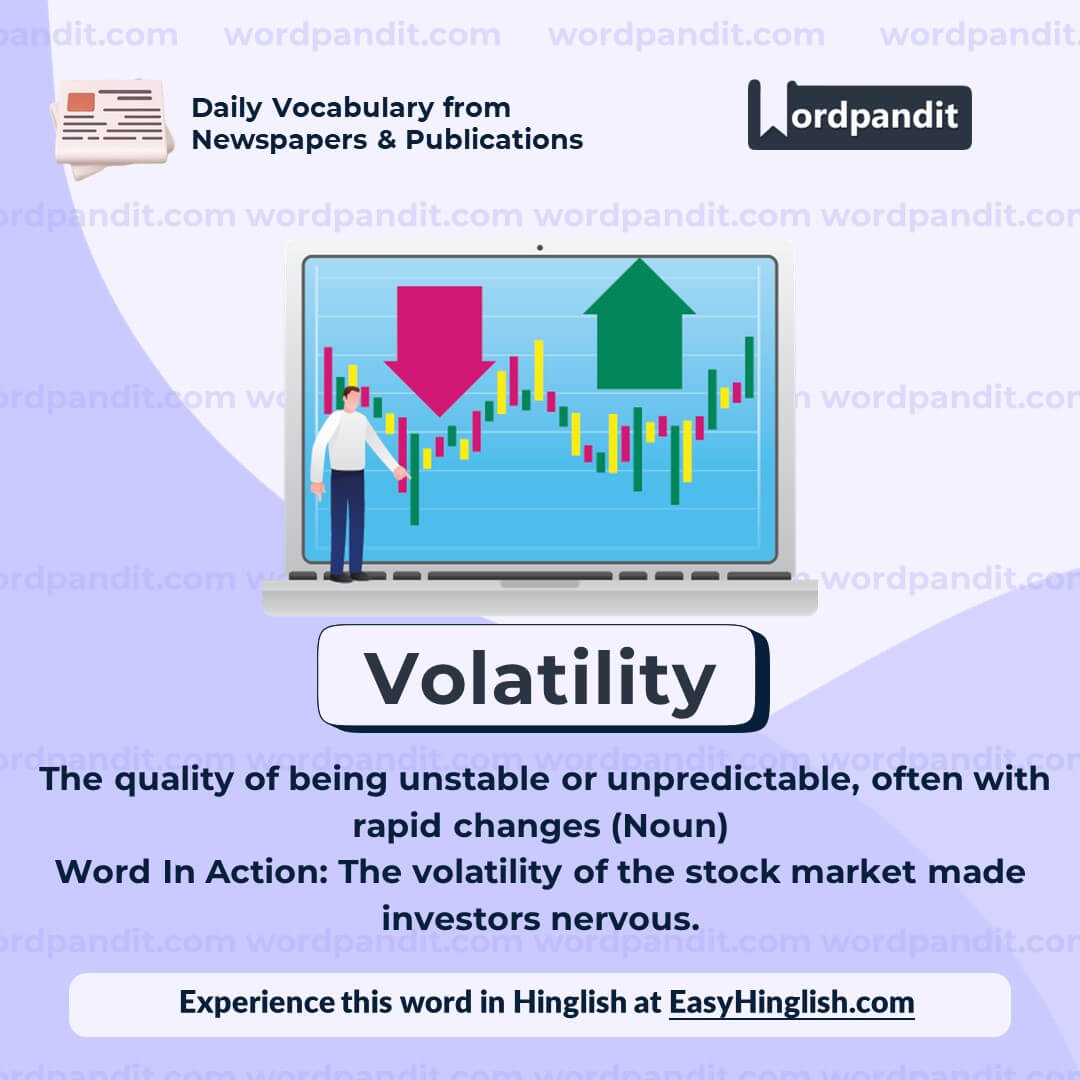
WORD-3: Volatility
Context:
"Heightened volatility in emerging markets feeds into forex reserve management." - The Guardian
Explanatory Paragraph:
Volatility refers to the tendency of something—often prices, emotions, or situations—to change rapidly and unpredictably. In financial contexts, it specifically denotes the degree of variation in the price of a financial instrument over time. High volatility means prices fluctuate greatly, often due to uncertainty or external shocks. Outside finance, it can also describe unstable behavior or conditions.
Meaning: The quality of being subject to rapid or unpredictable changes, especially in price or emotion (Noun)
Pronunciation: voh-LA-tih-lih-tee
Difficulty Level: ⭐⭐⭐⭐ Advanced
Etymology: From Latin *volatilis*, meaning "flying" or "swift," related to "volare" (to fly), indicating unpredictability or quick movement.
Prashant Sir's Notes:
Volatility is a crucial concept in economics and finance. It helps assess the risk involved in markets or assets. However, the term is equally powerful in describing emotional or political instability. Always consider the context—finance, psychology, or social behavior.
Synonyms & Antonyms:
Synonyms: instability, unpredictability, turbulence, fluctuation, inconsistency
Antonyms: stability, steadiness, predictability, consistency
Usage Examples:
- The stock market's volatility has made investors more cautious.
- Political volatility in the region has deterred foreign investments.
- Her emotional volatility made it difficult to have calm discussions.
- Energy prices show seasonal volatility due to changes in demand.
Cultural Reference:
"The volatility of global oil prices has long shaped the geopolitical strategies of nations." - Energy Policy Journal
Think About It:
Is volatility always negative, or can it sometimes lead to opportunity and innovation?
Quick Activity:
Match each scenario below with “High Volatility” or “Low Volatility”:
1. A stable job market with little change over years
2. A tech stock that swings up and down daily
3. A country with frequent government changes
4. A bank account with fixed interest earnings
Memory Tip:
Think of “volatility” as something that can “fly off” in any direction—just like its Latin root *volare* (to fly). Unpredictable and unstable.
Real-World Application:
In finance, understanding volatility helps investors manage risk. In daily life, recognizing emotional or political volatility can help individuals and leaders respond more thoughtfully during uncertain times.
WORD-4: Attorney
Context:
"More lawsuits are coming,” said Jonathan Mitchell, an attorney for the plaintiffs." - Washington Post
Explanatory Paragraph:
An attorney is a professional who is legally qualified to represent clients in legal matters, especially in court. While the term is commonly used in the United States to mean a lawyer, in other countries the term "lawyer" is more broadly used. Attorneys can provide legal advice, draft legal documents, and act on behalf of individuals or organizations in legal proceedings.
Meaning: A person appointed or legally qualified to act for another in legal matters; a lawyer (Noun)
Pronunciation: uh-TUR-nee
Difficulty Level: ⭐⭐ Basic
Etymology: From Old French *atorné* meaning "appointed," from the verb *atorner* ("to assign, to appoint").
Prashant Sir's Notes:
In American English, “attorney” and “lawyer” are often used interchangeably. However, "attorney" tends to imply someone actively practicing law or representing a client in legal matters. It's a core term in understanding legal professions and court proceedings.
Synonyms & Antonyms:
Synonyms: lawyer, counsel, legal representative, advocate, barrister (UK)
Antonyms: client, layperson, defendant (contextual)
Usage Examples:
- She hired an experienced attorney to handle her divorce proceedings.
- The attorney argued the case confidently before the judge.
- As an attorney, he specializes in corporate law and mergers.
- It's wise to consult an attorney before signing any major contract.
Cultural Reference:
"Atticus Finch, the fictional attorney in *To Kill a Mockingbird*, is a symbol of justice and integrity in American literature." - Literary Classics Review
Think About It:
Should attorneys always prioritize winning a case, or should they focus more on moral justice—even if it means losing?
Quick Activity:
Match the legal term to its definition:
1. Attorney
2. Defendant
3. Plaintiff
4. Judge
A. Person being accused in court
B. Person bringing the case
C. Legal representative
D. Official who oversees the case
Memory Tip:
Think of “attorney” as someone who is “appointed to turn things” in your favor in a court of law.
Real-World Application:
Understanding the role of an attorney is essential for anyone involved in legal issues, whether it's writing a will, buying property, or dealing with a lawsuit. Knowing when to seek legal counsel can prevent costly mistakes.
WORD-5: Affiliated
Context:
"That letter advised anyone currently or formerly affiliated with the university to keep records and communications related to faculty hiring and law-review decisions." - Washington Post
Explanatory Paragraph:
“Affiliated” means officially connected or associated with an organization, group, or institution. When someone is affiliated with a university, for example, they may be a student, staff member, professor, or even an alumnus. The term is used to show a formal or recognized relationship, usually in a professional, academic, or corporate context.
Meaning: Officially attached or connected to an organization or group (Adjective – past participle of a verb)
Pronunciation: uh-FILL-ee-ay-tid
Difficulty Level: ⭐⭐ Basic
Etymology: From Medieval Latin *affiliare*, meaning "to adopt as a son" and later "to bring into close connection." The root *filius* means "son."
Prashant Sir's Notes:
Affiliated is commonly used in academic, corporate, and political settings. It signals a formal link or association. Don’t confuse it with casual association; affiliation implies an official connection, often with responsibilities or benefits.
Synonyms & Antonyms:
Synonyms: connected, associated, linked, allied, related
Antonyms: unrelated, unaffiliated, independent, detached
Usage Examples:
- She is affiliated with a prestigious international law firm.
- The researchers are affiliated with several top universities around the world.
- All employees affiliated with the organization must follow its code of ethics.
- Though no longer affiliated, he still donates generously to his alma mater.
Cultural Reference:
"Many influential think tanks are affiliated with major political parties or ideologies, shaping public opinion and policy." - Political Science Quarterly
Think About It:
Should individuals be judged by the organizations they are affiliated with, even if they no longer actively participate?
Quick Activity:
Fill in the blanks with “affiliated” or “unaffiliated”:
1. She is __________ with the National Council for Education.
2. The charity operates independently and is __________ with any religious group.
Memory Tip:
Remember “affiliated” as someone officially “filed in” or “filed with” a group or institution—like filing your name into a group list.
Real-World Application:
Whether in job applications, academic resumes, or professional networking, stating who or what you are affiliated with can add credibility and context to your profile. It’s especially important in sectors like research, media, law, and politics.


