

Daily Vocabulary from International Newspapers and Publications
Expand Your Vocabulary with Wordpandit’s Global Vocabulary Hub
At Wordpandit, we are committed to helping you develop a truly global vocabulary by drawing from some of the most respected international publications. This section is designed to keep you ahead of the curve by introducing you to words that define global conversations and trends.
The Power of Global Sources
To help you think and communicate on a global scale, we curate vocabulary from renowned international sources, such as:
- The New York Times
- The Washington Post
- BBC
- The Guardian
- The Economist
- Scientific American
- Psychology Today
- And many more...
Stay Global, Stay Competitive
Our daily updates from international publications ensure you are consistently exposed to new words that reflect global news and developments, making sure your vocabulary is not only current but also globally relevant.
Enhance Your Global Perspective
Whether you’re preparing for international exams, aiming to excel in global business communication, or want to enhance your language skills for personal growth, Wordpandit offers the resources you need to thrive in a global context.
Effective Learning, Global Reach
Our learning methodology combines global examples, memory aids, and interactive activities, allowing you to internalize new words effectively and apply them in real-world scenarios.
Begin Your Global Vocabulary Journey Now!

Why Choose Wordpandit?
Practical Learning: Focus on words you'll actually encounter in real-world reading, enhancing your comprehension and communication skills.
Diverse Content: From current affairs to scientific breakthroughs, our varied sources expose you to vocabulary across multiple domains.
Effortless Integration: Make Wordpandit a part of your daily routine. Just a few minutes each day can significantly boost your lexicon over time.
Your Path to Vocabulary Mastery
- Visit our Daily Vocabulary section regularly
- Explore new words and their usage in context
- Practice incorporating these words into your own writing and speech
- Track your progress as your vocabulary expands
Start Your Journey Today
Embark on your vocabulary enhancement journey with Wordpandit. By consistently engaging with our daily posts, you'll build a robust vocabulary that serves you well in academic, professional, and personal contexts.
Remember, a word a day keeps linguistic limitations at bay. Make Wordpandit your daily companion in the quest for vocabulary excellence!
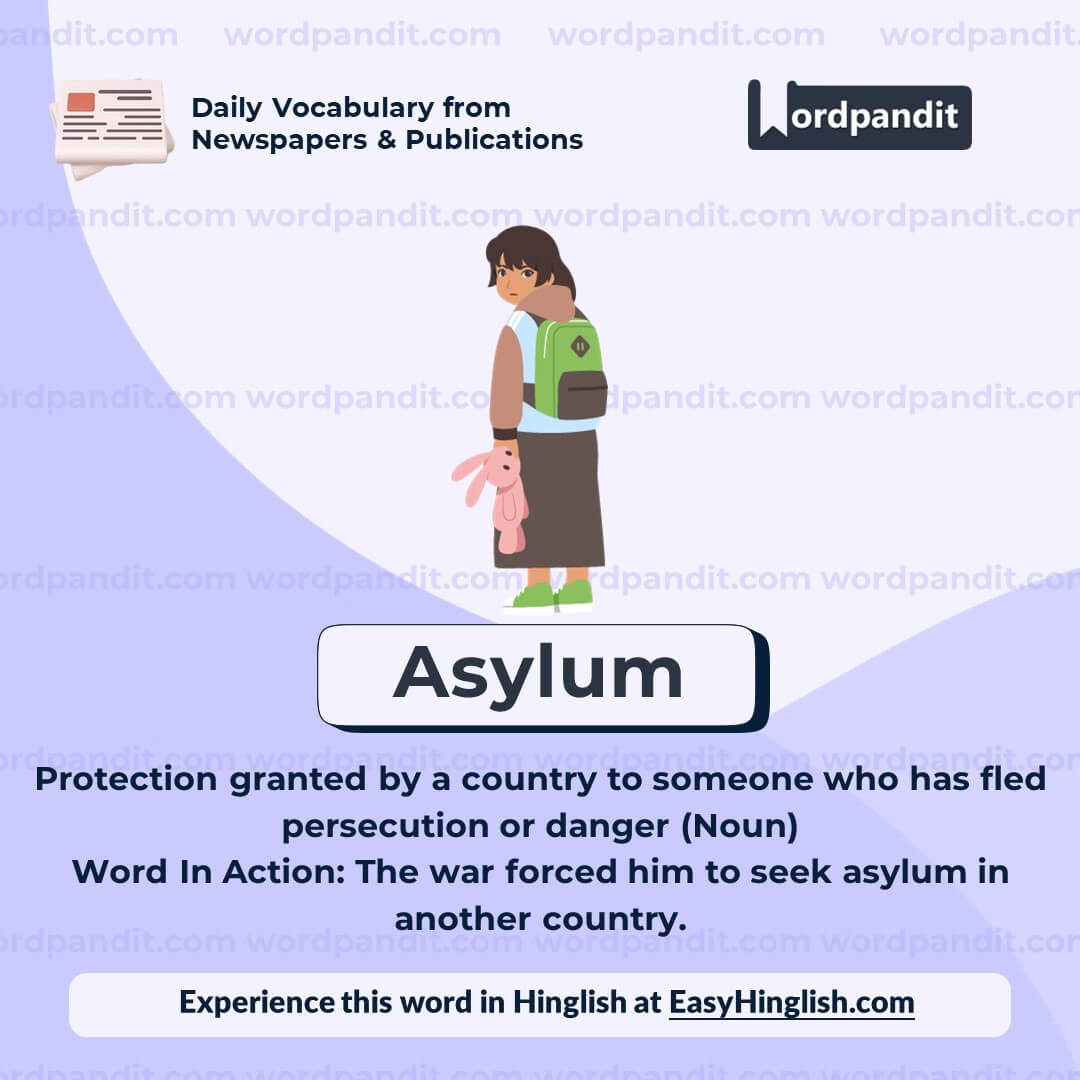
WORD-1: Asylum
Context:
"The apparent movement comes after a turbulent week in German politics, which focused on migration and asylum, with critics accusing the CDU/CSU of breaking the political ‘firewall’ by passing a non-binding motion with the far-right Alternative für Deutschland." - The Guardian
Explanatory Paragraph:
“Asylum” refers to protection granted by a country to someone who has fled their home country due to danger, persecution, or fear for their safety. Often used in political and legal contexts, seeking asylum is a right recognized under international law for those escaping war, oppression, or human rights violations. In the context of migration, asylum is a key term that shapes immigration policies and humanitarian responses.
Meaning: Protection granted by a nation to someone who has left their native country as a political refugee (Noun)
Pronunciation: uh-SY-lum
Difficulty Level: ⭐⭐ Basic
Etymology: From Latin asylum via Greek asylon, meaning "refuge" or "inviolable place"
Prashant Sir's Notes:
“Asylum” is a crucial term in both international law and humanitarian discourse. Think of it as a legal shield granted by a state to those escaping danger—especially political or religious persecution. It often comes up in current affairs and is essential for understanding debates around immigration and human rights.
Synonyms & Antonyms:
Synonyms: refuge, sanctuary, haven, shelter, protection
Antonyms: expulsion, deportation, danger, exposure
Usage Examples:
- The journalist sought asylum in Sweden after facing threats in her home country.
- Thousands of people apply for asylum in Europe every year due to ongoing conflicts.
- The law grants asylum to individuals persecuted for their religious beliefs.
- He lived in an embassy for seven years while seeking political asylum.
Cultural Reference:
"Give me your tired, your poor, your huddled masses yearning to breathe free..." — from the poem inscribed at the Statue of Liberty, symbolizing the U.S. as a refuge or asylum for immigrants. - Emma Lazarus
Think About It:
How does the concept of asylum challenge or reinforce a nation’s idea of sovereignty and responsibility?
Quick Activity:
Write a short paragraph (3–4 lines) imagining you are someone seeking asylum. Describe why you are leaving and what you hope for in your new country.
Memory Tip:
Think of "a safe ‘room’ in a hostile world"—asy(lum) = safe room. It’s a place of escape and protection.
Real-World Application:
Understanding the term “asylum” is essential in contexts like immigration policy, international law, and global news. When hearing about border crises or refugee movements, the word often explains why individuals are leaving and what legal status they seek.
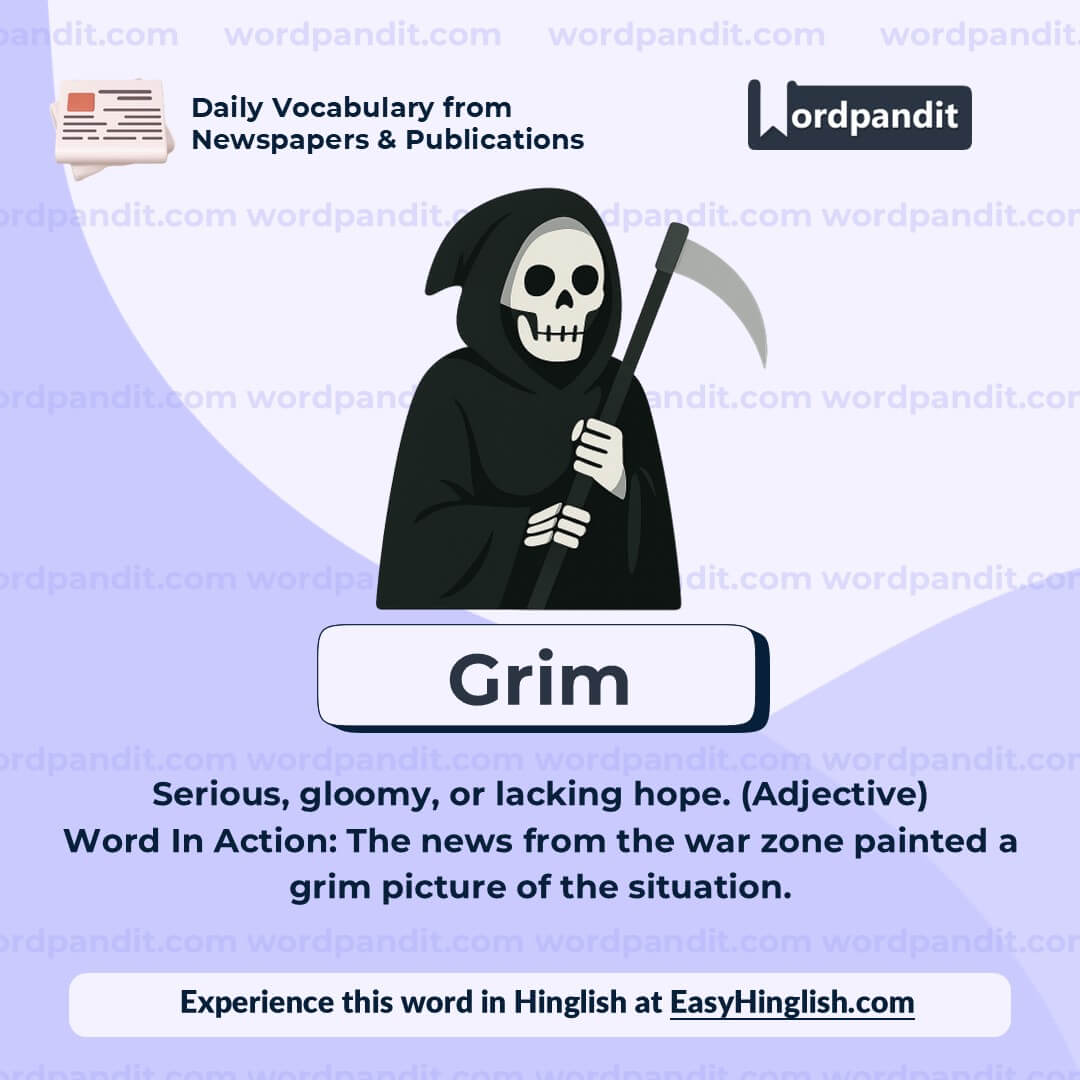
WORD-2: Grim
Context:
"Ukraine’s president Volodymyr Zelenskyy said he would agree to direct talks with Vladimir Putin to end the war that will reach a grim three-year milestone later this month." - The Guardian
Explanatory Paragraph:
The word “grim” is used to describe something that is very serious, bleak, or depressing. It often conveys a mood of sadness, fear, or hopelessness. In the context of war, “grim” highlights the harsh reality, losses, and emotional weight associated with the ongoing conflict. It can also imply a lack of hope or a very difficult situation.
Meaning: Harsh, gloomy, or depressing; without hope (Adjective)
Pronunciation: grim
Difficulty Level: ⭐⭐ Basic
Etymology: From Old English grim meaning “fierce, cruel, savage”
Prashant Sir's Notes:
“Grim” is a word that quickly conveys emotional seriousness—often used in news reporting, literature, or conversation when describing bleak outcomes, tough realities, or heavy moods. It's simple, powerful, and useful for emotional description.
Synonyms & Antonyms:
Synonyms: bleak, dire, gloomy, harsh, somber, dismal
Antonyms: cheerful, hopeful, bright, optimistic, pleasant
Usage Examples:
- The doctor gave her a grim prognosis after reviewing the test results.
- His face turned grim as he read the tragic news.
- The report painted a grim picture of the country's economic future.
- Despite the grim weather, they continued their journey through the mountains.
Cultural Reference:
The "Grim Reaper" is a symbolic figure representing death in Western culture, typically depicted as a skeletal figure in a dark cloak with a scythe.
Think About It:
Why do you think grim imagery is often used in news and literature to create emotional impact?
Quick Activity:
Write three short sentences using “grim” to describe different situations—one personal, one historical, and one fictional.
Memory Tip:
Think of “grim” as the opposite of “grin.” When there's no grin, the mood is likely grim.
Real-World Application:
“Grim” is commonly used in journalism, politics, and health reporting. Understanding its tone helps interpret the seriousness or severity of the situation being described, especially in headlines or urgent updates.
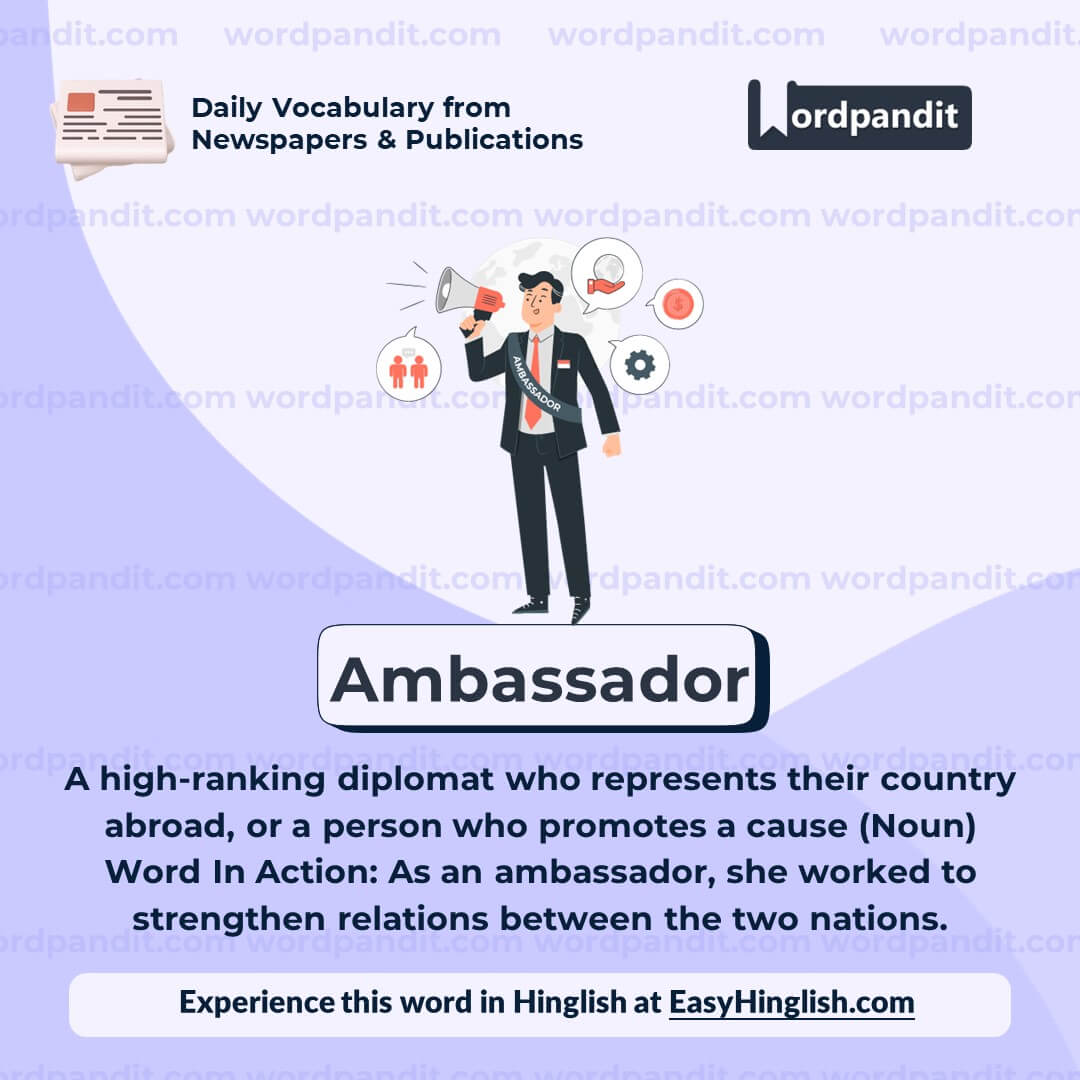
WORD-3: Ambassador
Context:
"Jordan and Egypt reject the idea of Palestinians being resettled - while the Palestinian ambassador to the UN says 'our homeland is our homeland'." - BBC
Explanatory Paragraph:
An ambassador is an official representative of a country who lives in another country to maintain diplomatic relations, promote their home nation's interests, and engage in negotiations. Beyond politics, the term can also be used for someone who represents or promotes a cause, organization, or brand in a positive way.
Meaning: An accredited diplomat sent by a state as its official representative to a foreign country (noun)
Pronunciation: am-BAS-uh-der
Difficulty Level: ⭐⭐ Basic-Intermediate
Etymology: From Middle English ambassadour, via Old French from Italian ambasciatore, based on Latin ambactus meaning "servant" or "minister".
Prashant Sir's Notes:
The word is rooted in diplomacy but has evolved to include non-political uses. Think of "brand ambassadors" in advertising. It’s about representation with authority and trust.
Synonyms & Antonyms:
Synonyms: envoy, diplomat, emissary, representative
Antonyms: opponent, adversary, detractor
Usage Examples:
- The ambassador met with local leaders to discuss trade agreements.
- She served as a cultural ambassador, promoting art from her homeland abroad.
- He was appointed ambassador to strengthen ties between the two nations.
- As a brand ambassador, he attended events and represented the company's values.
Cultural Reference:
"In international relations, an ambassador is more than a messenger—they are the face and voice of a nation abroad." - Adapted from diplomatic training materials
Think About It:
In an era of instant communication, do ambassadors still play the same crucial role they once did?
Quick Activity:
Write a short paragraph imagining you are the ambassador of your country to a distant, newly discovered island nation. What would be your first message to them?
Memory Tip:
Think of "ambassador" as someone who "ambles" across borders to speak on behalf of their homeland.
Real-World Application:
Ambassadors are critical in building alliances, solving disputes peacefully, and fostering economic and cultural exchanges between nations.
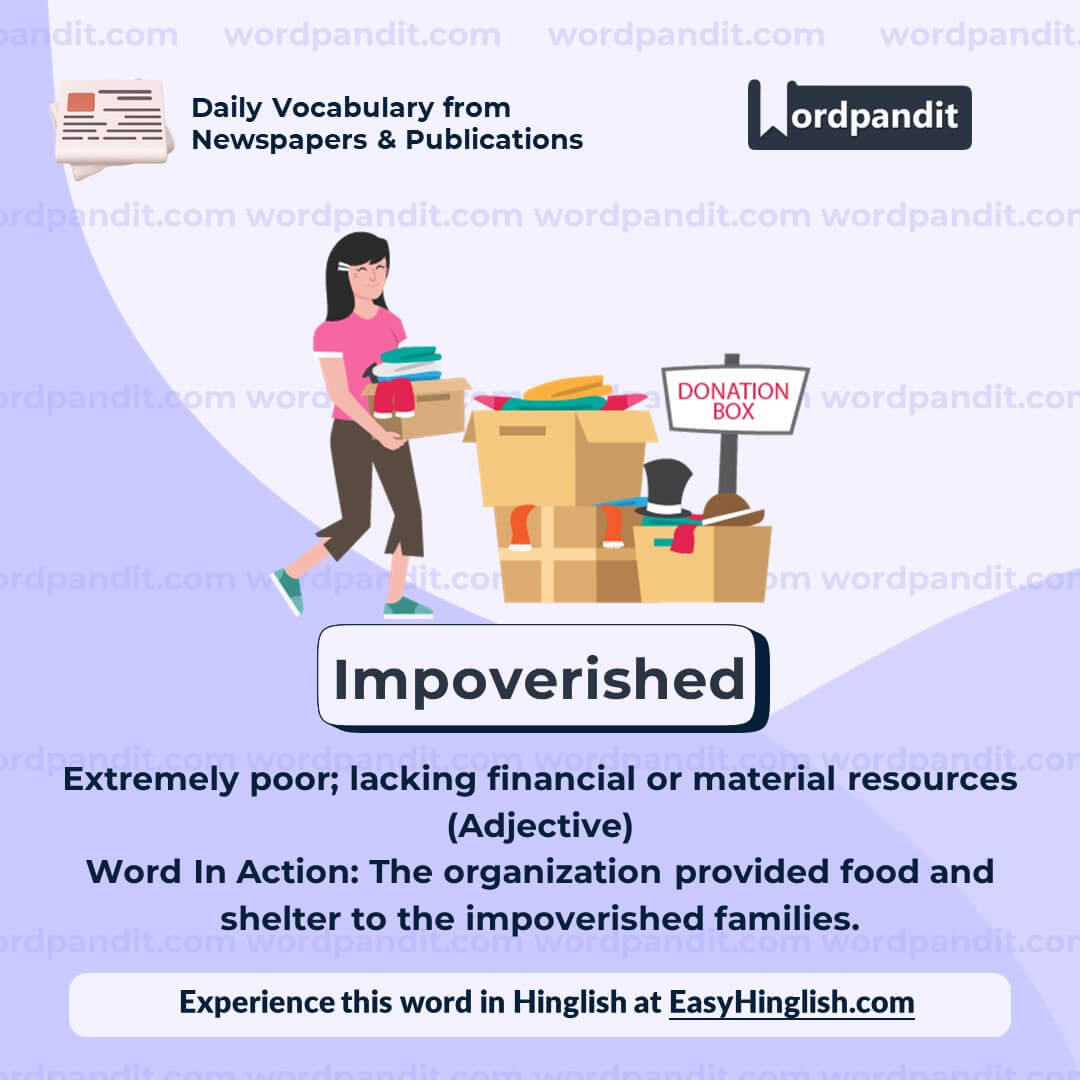
WORD-4: Impoverished
Context:
"Speaking to BBC Radio 4’s Today programme, Dennis Ross says: ‘I really think he seems to intend this more as: ‘We’re gonna transform an area that has always been impoverished’.’" - BBC
Explanatory Paragraph:
“Impoverished” describes a state of being extremely poor or lacking basic resources, whether economically, culturally, or socially. Most commonly, it refers to people or places suffering from financial hardship or underdevelopment. The word paints a picture of scarcity, struggle, and lack of opportunity, and is often used in discussions about global inequality, social justice, and development work.
Meaning: Extremely poor; lacking in wealth, resources, or development (Adjective)
Pronunciation: im-POV-er-isht
Difficulty Level: ⭐⭐⭐ Intermediate
Etymology: From the Middle English impoverishen, from Old French empovrir, from Latin pauper meaning “poor”
Prashant Sir's Notes:
“Impoverished” is a strong descriptive word used not only for economic conditions but also metaphorically for cultural or emotional lack (e.g., “an impoverished imagination”). It’s helpful to know this word both for academic writing and understanding news about development, poverty, or humanitarian issues.
Synonyms & Antonyms:
Synonyms: destitute, needy, underprivileged, indigent, deprived
Antonyms: wealthy, affluent, prosperous, rich, well-off
Usage Examples:
- The charity works to provide clean water to impoverished communities in rural areas.
- Years of war have left the country impoverished and unstable.
- She grew up in an impoverished neighborhood but rose to become a successful entrepreneur.
- Some critics argue that the arts have become culturally impoverished in recent decades.
Cultural Reference:
In Charles Dickens’ novels like Oliver Twist, the harsh realities of impoverished London are vividly depicted, offering a social critique of 19th-century England's class divide.
Think About It:
Is poverty purely an economic condition, or can a society be considered impoverished in other ways—like in values, culture, or education?
Quick Activity:
Write two sentences: one using “impoverished” to describe a place, and the other to describe a non-material concept like imagination or spirit.
Memory Tip:
Think of “im-POOR-ished”—the word has “poor” inside it, reminding you it's related to poverty or lack.
Real-World Application:
“Impoverished” is a key word in development studies, economics, and global news. Recognizing its meaning helps in understanding reports about international aid, economic inequality, and humanitarian crises.
WORD-5: Biblical
Context:
"Under international law, the West Bank is a Palestinian territory, however many Israelis believe the land to be part of their biblical homeland and want Israeli sovereignty over it." - BBC
Explanatory Paragraph:
The word “biblical” refers to anything related to the Bible, the sacred text of Christianity and Judaism. It can describe locations, stories, events, or even behaviors and values that are rooted in or reminiscent of the Bible. In broader usage, “biblical” is sometimes used metaphorically to describe something massive, epic, or ancient, especially in reference to scale or impact, such as a “biblical flood.” In this context, it emphasizes a deep historical and religious connection to the land.
Meaning: Relating to or contained in the Bible; having the character or authority of the Bible (Adjective)
Pronunciation: BIB-li-kuhl
Difficulty Level: ⭐⭐ Basic
Etymology: From Latin biblicus, from Greek biblion meaning “book” (a reference to the Bible as ‘The Book’)
Prashant Sir's Notes:
“Biblical” is a word deeply tied to culture, history, and religion. While its primary meaning is religious, it’s also commonly used metaphorically. Be aware of both uses—literal (e.g., “biblical text”) and figurative (e.g., “biblical proportions”). It’s frequently encountered in historical, theological, and geopolitical discussions.
Synonyms & Antonyms:
Synonyms: scriptural, religious, sacred, theological, divine
Antonyms: secular, worldly, profane, irreligious
Usage Examples:
- The site is considered a biblical landmark by both Jews and Christians.
- They spoke of a drought of biblical proportions that devastated the region.
- The artwork was inspired by biblical themes and imagery.
- His belief in the land’s biblical significance drives his political stance.
Cultural Reference:
“The Ten Commandments,” a 1956 film, brought biblical stories to cinematic life and became a classic representation of religious epic storytelling in Hollywood.
Think About It:
How does belief in the biblical significance of a place influence modern political or territorial claims?
Quick Activity:
List three modern expressions or phrases that have biblical origins (e.g., “eye for an eye”) and explain their meanings.
Memory Tip:
“Biblical” comes from “Bible”—if something is biblical, it either comes from or resembles something in the Bible. Think: old, epic, or sacred.
Real-World Application:
Understanding the term “biblical” is important for interpreting religious texts, analyzing political narratives rooted in faith, and recognizing cultural references in literature, film, and news.


