

Daily Vocabulary from International Newspapers and Publications
Expand Your Vocabulary with Wordpandit’s Global Vocabulary Hub
At Wordpandit, we are committed to helping you develop a truly global vocabulary by drawing from some of the most respected international publications. This section is designed to keep you ahead of the curve by introducing you to words that define global conversations and trends.
The Power of Global Sources
To help you think and communicate on a global scale, we curate vocabulary from renowned international sources, such as:
- The New York Times
- The Washington Post
- BBC
- The Guardian
- The Economist
- Scientific American
- Psychology Today
- And many more...
Stay Global, Stay Competitive
Our daily updates from international publications ensure you are consistently exposed to new words that reflect global news and developments, making sure your vocabulary is not only current but also globally relevant.
Enhance Your Global Perspective
Whether you’re preparing for international exams, aiming to excel in global business communication, or want to enhance your language skills for personal growth, Wordpandit offers the resources you need to thrive in a global context.
Effective Learning, Global Reach
Our learning methodology combines global examples, memory aids, and interactive activities, allowing you to internalize new words effectively and apply them in real-world scenarios.
Begin Your Global Vocabulary Journey Now!
Why Choose Wordpandit?
Practical Learning: Focus on words you'll actually encounter in real-world reading, enhancing your comprehension and communication skills.
Diverse Content: From current affairs to scientific breakthroughs, our varied sources expose you to vocabulary across multiple domains.
Effortless Integration: Make Wordpandit a part of your daily routine. Just a few minutes each day can significantly boost your lexicon over time.
Your Path to Vocabulary Mastery
- Visit our Daily Vocabulary section regularly
- Explore new words and their usage in context
- Practice incorporating these words into your own writing and speech
- Track your progress as your vocabulary expands
Start Your Journey Today
Embark on your vocabulary enhancement journey with Wordpandit. By consistently engaging with our daily posts, you'll build a robust vocabulary that serves you well in academic, professional, and personal contexts.
Remember, a word a day keeps linguistic limitations at bay. Make Wordpandit your daily companion in the quest for vocabulary excellence!
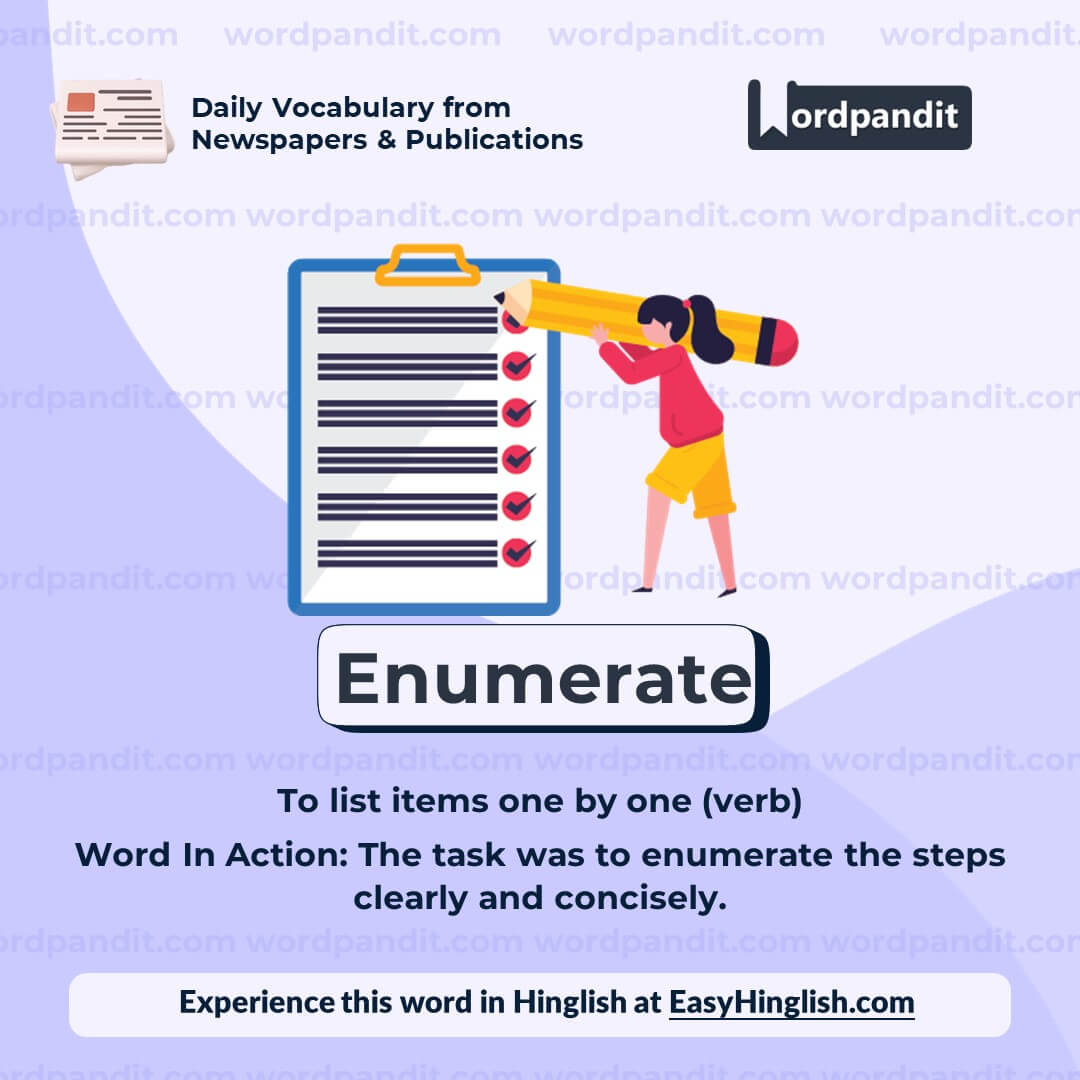
WORD-1: Enumerate
Context:
"That has never stopped people from trying. Scientists still enumerate a method that has anywhere from three to a dozen steps. Some philosophers generalise experiments further as ‘interventions’:" - Aeon
Explanatory Paragraph:
The word "enumerate" refers to the action of listing or counting things one by one. In the context of scientific methods, it implies clearly stating or identifying each step involved in a process. When scientists enumerate steps, they are making the methodology precise, structured, and easy to replicate or critique. It’s an important practice in logical and analytical work where clarity is key.
Meaning: To list or count items one by one (Verb)
Pronunciation: eh-NOO-muh-rayt
Difficulty Level: ⭐⭐⭐ Intermediate
Etymology: From Latin "enumerare" — "e-" (out) + "numerare" (to count)
Prashant Sir's Notes:
"Enumerate" is often used in formal or academic contexts where a list or detailed breakdown is expected. It's a great alternative to "list" when writing essays or reports to show command over precise vocabulary. Think of it as making things clear step by step.
Synonyms & Antonyms:
Synonyms: list, count, itemize, detail, number
Antonyms: generalize, summarize, overlook, ignore
Usage Examples:
- The professor asked the students to enumerate the key stages of the water cycle.
- He began to enumerate all the reasons why the project had failed.
- The manual carefully enumerates each safety precaution.
- During the debate, she enumerated her opponent’s inconsistencies one by one.
Cultural Reference:
"Enumerate the possibilities" is a common phrase in Sherlock Holmes stories, where deduction often begins with a clear listing of facts or scenarios. - Adapted from Arthur Conan Doyle’s style
Think About It:
Why might it be important in science and philosophy to enumerate steps instead of simply describing them in general terms?
Quick Activity:
Think of your morning routine and enumerate at least five steps in sequence. Try to be as detailed and specific as possible.
Memory Tip:
Think of "numerate" in the word — it relates to numbers. "Enumerate" is like numbering your points!
Real-World Application:
Enumerating steps is crucial in fields like law, medicine, coding, and engineering where clarity and sequence determine the success of an operation or argument. It’s also common in job interviews when asked to outline processes or achievements.
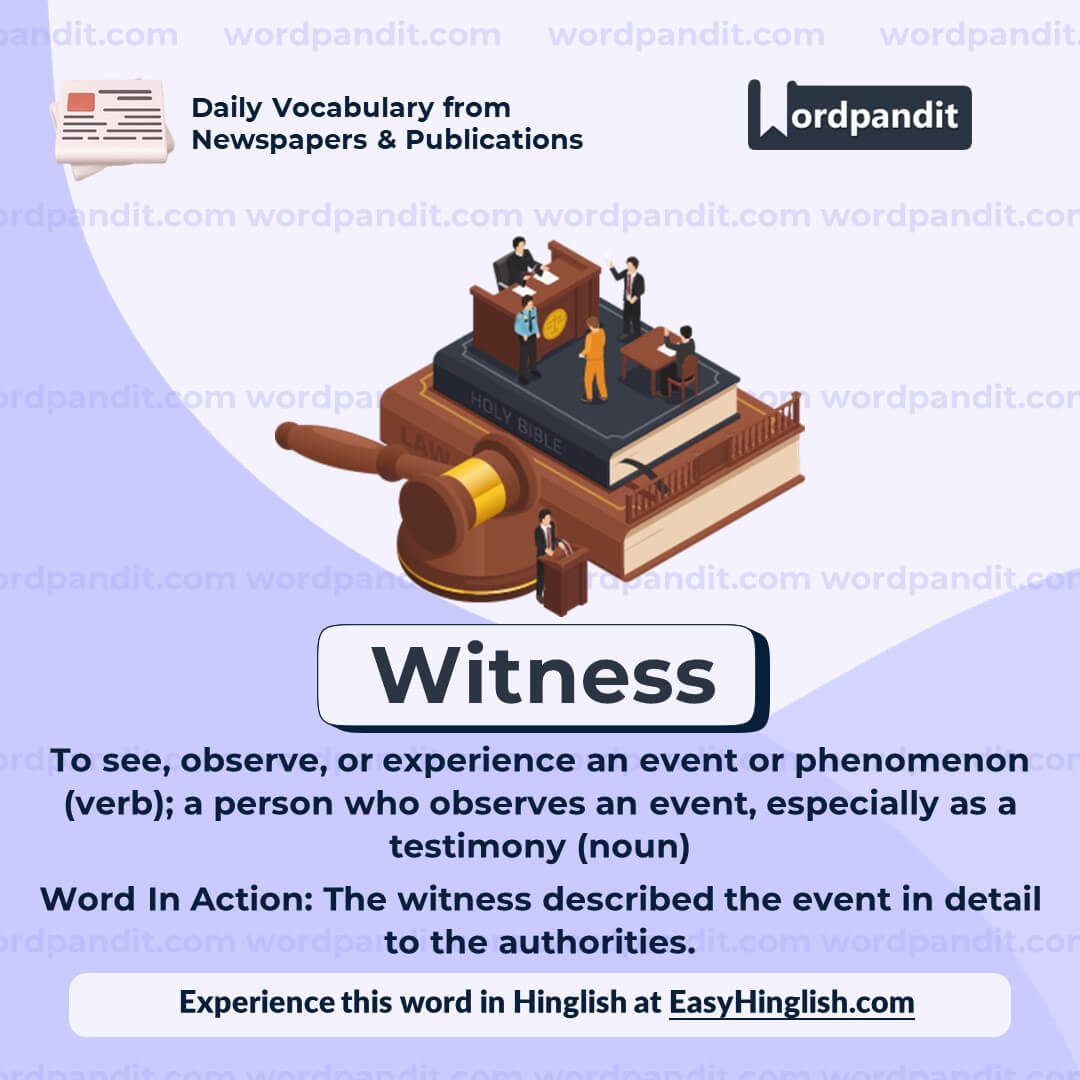
WORD-2: Witness
Context:
"At two degrees above absolute zero, we witnessed helium molecules abruptly huddle into a quantum whole greater than its parts." - Aeon
Explanatory Paragraph:
The word "witness" in this context means to see or observe an event take place, especially something remarkable or significant. It emphasizes personal experience or direct observation. In scientific narratives, “witness” often adds a sense of awe or wonder at a phenomenon that’s not just measured, but truly seen or felt by the observers.
Meaning: To see, observe, or experience an event or situation (Verb)
Pronunciation: WIT-ness
Difficulty Level: ⭐⭐ Basic
Etymology: From Old English "witnes" (attestation of fact, testimony)
Prashant Sir's Notes:
“Witness” is a powerful verb when describing firsthand experiences. Whether in literature, science, or daily life, using "witness" gives your sentence a sense of presence and authority. It's not just about seeing—it’s about being part of the moment.
Synonyms & Antonyms:
Synonyms: observe, see, behold, experience, perceive
Antonyms: ignore, overlook, miss, disregard
Usage Examples:
- We witnessed a breathtaking sunrise over the Himalayan peaks.
- The villagers witnessed the rare eclipse with awe and curiosity.
- In court, she testified as an eyewitness to the incident.
- They witnessed history being made as the rover landed on Mars.
Cultural Reference:
“You are about to witness the strength of street knowledge.” — opening line from N.W.A’s *Straight Outta Compton*, using “witness” as an invitation to observe raw reality. - Hip Hop Culture
Think About It:
Is witnessing something enough to fully understand it, or does true understanding require more than just observation?
Quick Activity:
Write a short paragraph describing something amazing you’ve witnessed—real or fictional. Try to capture what made the experience memorable.
Memory Tip:
Think: “With-ness” — when you witness something, you are “with” it as it happens.
Real-World Application:
The verb "witness" is commonly used in journalism, science reporting, courtroom settings, and even in everyday storytelling when recounting something you personally saw or experienced. It adds credibility and emotional weight to the narrative.

WORD-3: Abruptly
Context:
"At two degrees above absolute zero, we witnessed helium molecules abruptly huddle into a quantum whole greater than its parts." - Aeon
Explanatory Paragraph:
"Abruptly" describes an action that happens suddenly, without warning, or with a jarring speed. It often conveys surprise or a lack of gradual buildup. In the scientific context above, it highlights how the behavior of helium molecules changed instantly — a dramatic shift from one state to another without any smooth or slow transition.
Meaning: Suddenly and unexpectedly (Adverb)
Pronunciation: uh-BRUPT-lee
Difficulty Level: ⭐⭐ Basic
Etymology: From Latin "abruptus," meaning "broken off" or "steep"
Prashant Sir's Notes:
"Abruptly" is an adverb you can use to describe sudden changes—be it in behavior, weather, or movement. It creates a sharp and impactful tone in writing. Use it when you want your reader to feel surprise or immediacy.
Synonyms & Antonyms:
Synonyms: suddenly, unexpectedly, sharply, instantly, quickly
Antonyms: gradually, slowly, gently, smoothly
Usage Examples:
- The train stopped abruptly, jolting the passengers forward.
- She ended the conversation abruptly and walked away.
- The weather shifted abruptly from sunny to stormy.
- He woke up abruptly from the nightmare, drenched in sweat.
Cultural Reference:
In Alfred Hitchcock's films, suspense often builds slowly before the plot shifts abruptly, creating shock and tension — a technique that has influenced thriller storytelling for decades.
Think About It:
Why do abrupt changes in life or nature feel more impactful than gradual ones? How does "abruptly" change the mood of a sentence?
Quick Activity:
List three things that could happen abruptly in daily life. Now use one of them in a sentence with “abruptly.”
Memory Tip:
Think of “abrupt” as a “break” or “snap” — something that doesn’t ease in but just *happens*. “Abruptly” means it happens that way.
Real-World Application:
"Abruptly" is often used in news reports, scientific descriptions, and personal storytelling to emphasize rapid changes—like stock market crashes, natural disasters, emotional shifts, or even sudden decisions.
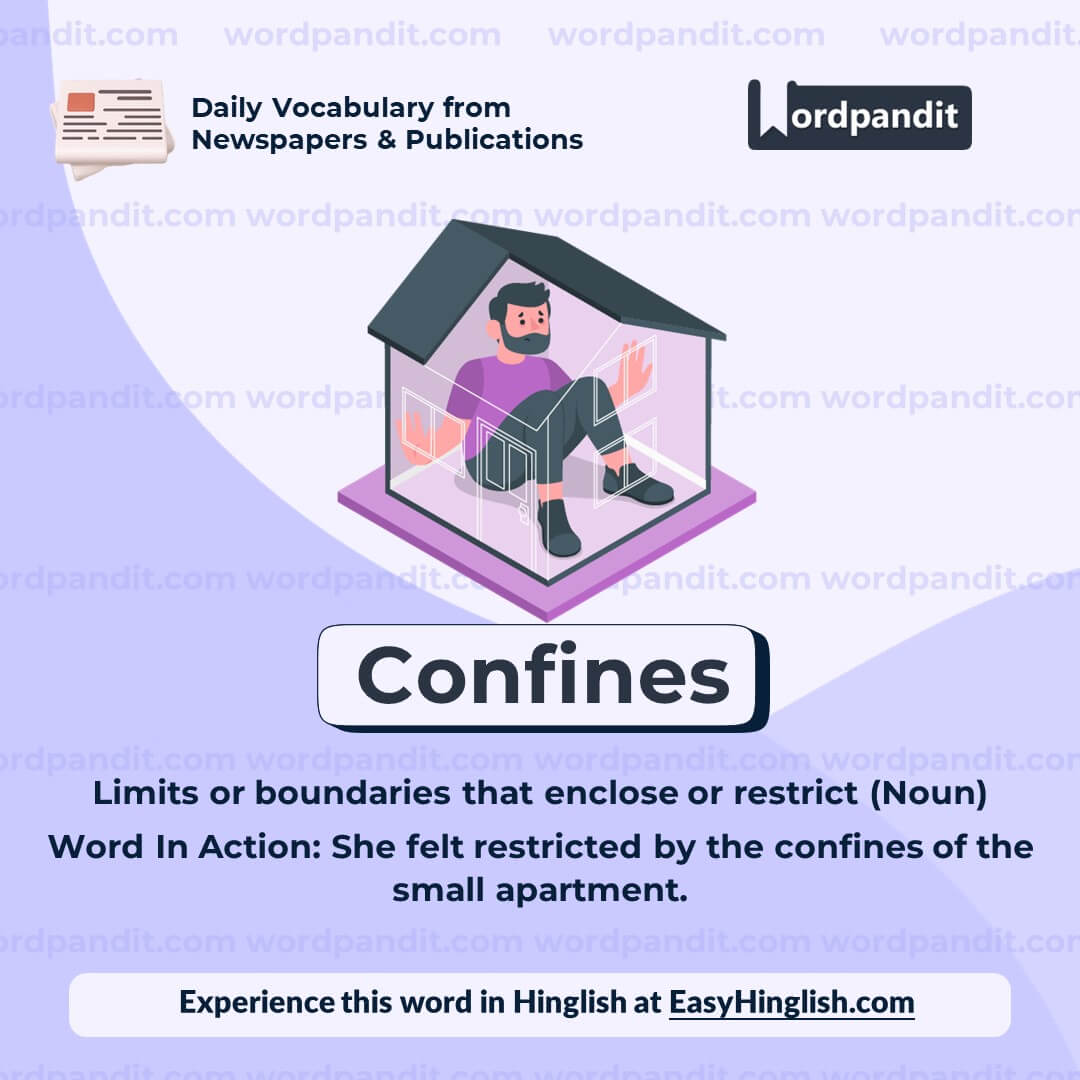
WORD-4: Confines
Context:
"This placid superfluid then transitioned into a fountain as the molecules charged from their confines, moved as if by collective will." - Aeon
Explanatory Paragraph:
The word "confines" refers to boundaries or limits that restrict movement or freedom. In this scientific context, it likely points to the space or container that previously held the helium molecules in place. When they "charged from their confines," it implies they broke free from a restricted area, emphasizing a sudden release or expansion beyond limits. This word often carries a sense of restriction or enclosure—whether physical, emotional, or intellectual.
Meaning: Limits or boundaries that restrict movement or activity (Noun, usually plural)
Pronunciation: KON-fynz
Difficulty Level: ⭐⭐⭐ Intermediate
Etymology: From Latin "confinis" meaning "bordering" or "adjacent," related to "confine" (to enclose or restrain)
Prashant Sir's Notes:
“Confines” is often used metaphorically to describe any sort of limitation—whether physical (walls, rooms) or abstract (confines of thought, society, emotion). It's a good word for advanced writing when discussing boundaries, restrictions, or containment.
Synonyms & Antonyms:
Synonyms: boundaries, limits, enclosures, restrictions, borders
Antonyms: freedom, openness, vastness, expanse, liberty
Usage Examples:
- The prisoners were kept within the strict confines of the high-security facility.
- Her creativity couldn't be contained by the traditional confines of academic writing.
- The city is expanding beyond the confines of its original walls.
- He lived most of his life within the emotional confines of fear and doubt.
Cultural Reference:
In Shakespeare's *Hamlet*, the line “Denmark’s a prison” reflects Hamlet’s feeling of being trapped — a classic metaphor for the psychological confines imposed by circumstance. - *Hamlet*, Act II, Scene II
Think About It:
Are the most challenging confines we face physical, social, or mental? Which types are easier to break free from, and why?
Quick Activity:
List three things in your life (real or metaphorical) that you feel are "confines." Now reframe one of them as an opportunity instead of a limitation.
Memory Tip:
Think: "confine = can’t find freedom." Confines are where your freedom ends and restriction begins.
Real-World Application:
"Confines" is a useful word in writing essays, research papers, or literature analyses, especially when discussing the limits of ideas, spaces, or conditions. It's also relevant in law, politics, and science where constraints and boundaries matter deeply.
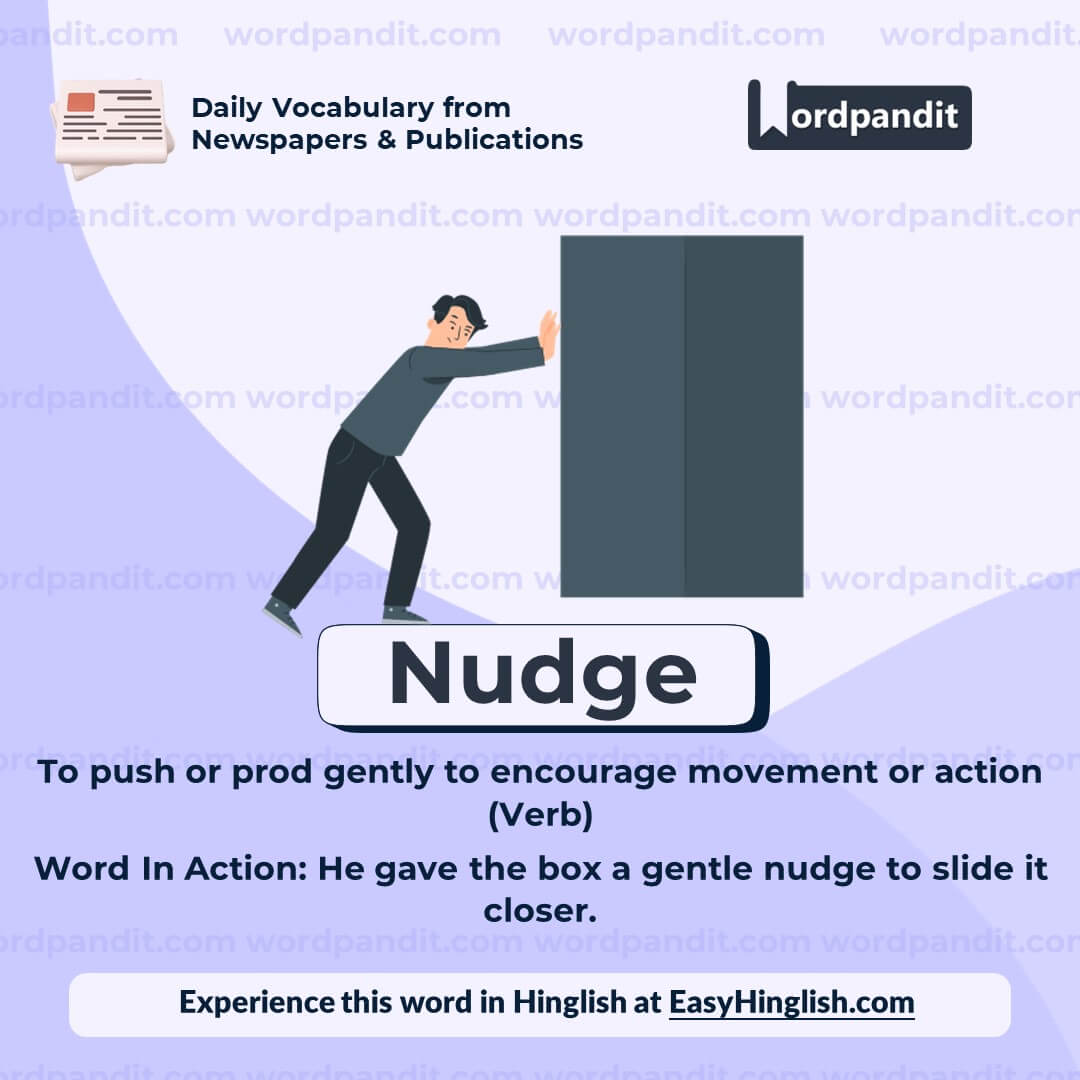
WORD-5: Nudge
Context:
"We nudged these particles into resonance, using a radio wave tuned to their spins, as one might excite children to twirl in unison with a song." - Aeon
Explanatory Paragraph:
The word "nudge" typically means to push something gently, either physically or metaphorically. In this scientific context, it refers to the careful, controlled stimulation of particles to trigger a specific behavior—in this case, resonance. The idea is not of forcing, but of encouraging a reaction with a light, precise influence. "Nudge" often conveys subtle persuasion or influence rather than direct control.
Meaning: To push or prod gently; to coax or encourage subtly (Verb/Noun)
Pronunciation: nuhj
Difficulty Level: ⭐⭐ Basic
Etymology: Possibly of Scandinavian origin, akin to Norwegian "nugga" (to push)
Prashant Sir's Notes:
“Nudge” is a brilliant word for describing gentle influence—perfect in contexts ranging from social behavior to physics. In behavioral economics, a "nudge" is a small policy tweak that influences decisions without restricting choice. Use this word when describing subtle changes or encouragements.
Synonyms & Antonyms:
Synonyms: prod, push, poke, prompt, encourage
Antonyms: ignore, discourage, restrain, hinder
Usage Examples:
- She gently nudged him to speak up during the meeting.
- The app sends daily reminders to nudge users toward healthier habits.
- He nudged the cup closer to her, inviting her to take a sip.
- Scientists nudged the atoms into alignment using a carefully tuned laser.
Cultural Reference:
Behavioral economist Richard Thaler popularized the term "nudge" in his book *Nudge: Improving Decisions About Health, Wealth, and Happiness*, which explores how subtle cues can influence human behavior without restricting freedom. - 2008, Thaler & Sunstein
Think About It:
When is a nudge more powerful than a command? How can subtle influence create lasting change?
Quick Activity:
Think of one habit you'd like to build. Write a sentence describing how you could nudge yourself into doing it daily.
Memory Tip:
Think: “Nudge = Not a push, just a gentle nuzzle.” It’s a small, kind push in the right direction.
Real-World Application:
"Nudge" is widely used in psychology, economics, education, and marketing. It refers to small cues or design choices that encourage better decisions—like placing fruit at eye level in cafeterias to promote healthy eating.


