

Daily Vocabulary from International Newspapers and Publications
Expand Your Vocabulary with Wordpandit’s Global Vocabulary Hub
At Wordpandit, we are committed to helping you develop a truly global vocabulary by drawing from some of the most respected international publications. This section is designed to keep you ahead of the curve by introducing you to words that define global conversations and trends.
The Power of Global Sources
To help you think and communicate on a global scale, we curate vocabulary from renowned international sources, such as:
- The New York Times
- The Washington Post
- BBC
- The Guardian
- The Economist
- Scientific American
- Psychology Today
- And many more...
Stay Global, Stay Competitive
Our daily updates from international publications ensure you are consistently exposed to new words that reflect global news and developments, making sure your vocabulary is not only current but also globally relevant.
Enhance Your Global Perspective
Whether you’re preparing for international exams, aiming to excel in global business communication, or want to enhance your language skills for personal growth, Wordpandit offers the resources you need to thrive in a global context.
Effective Learning, Global Reach
Our learning methodology combines global examples, memory aids, and interactive activities, allowing you to internalize new words effectively and apply them in real-world scenarios.
Begin Your Global Vocabulary Journey Now!
Why Choose Wordpandit?
Practical Learning: Focus on words you'll actually encounter in real-world reading, enhancing your comprehension and communication skills.
Diverse Content: From current affairs to scientific breakthroughs, our varied sources expose you to vocabulary across multiple domains.
Effortless Integration: Make Wordpandit a part of your daily routine. Just a few minutes each day can significantly boost your lexicon over time.
Your Path to Vocabulary Mastery
- Visit our Daily Vocabulary section regularly
- Explore new words and their usage in context
- Practice incorporating these words into your own writing and speech
- Track your progress as your vocabulary expands
Start Your Journey Today
Embark on your vocabulary enhancement journey with Wordpandit. By consistently engaging with our daily posts, you'll build a robust vocabulary that serves you well in academic, professional, and personal contexts.
Remember, a word a day keeps linguistic limitations at bay. Make Wordpandit your daily companion in the quest for vocabulary excellence!
WORD-1: Transcendence
Context:
"Alcock saw the ‘universal absence of luxury’ as a kind of transcendence, reading into it a liberation from the materialistic rat-race of Western consumerism." - Aeon
Explanatory Paragraph:
Transcendence refers to the act of rising above ordinary limits or surpassing typical experiences, especially those that are material, emotional, or intellectual. In the given context, it implies going beyond worldly desires and the superficial pull of consumer culture, achieving a sense of freedom and deeper meaning. The idea is that by detaching from luxury and material pursuits, one can attain a higher, more liberated state of being.
Meaning: The state of going beyond normal limits or surpassing physical or worldly concerns (Noun)
Pronunciation: tran-SEN-dens
Difficulty Level: ⭐⭐⭐ Intermediate
Etymology: From Latin transcendere, meaning "to climb over" or "rise above"
Prashant Sir's Notes:
This word often comes up in philosophy, spirituality, and literature. It's key to understanding concepts where something or someone moves beyond usual experiences or limitations — a vital term when discussing enlightenment, minimalism, or even genius.
Synonyms & Antonyms:
Synonyms: elevation, enlightenment, surpassing, liberation, spiritual awakening
Antonyms: limitation, confinement, materialism, mundanity
Usage Examples:
- His art aims to express a feeling of transcendence over worldly concerns.
- Many meditators seek transcendence through stillness and inner silence.
- The novel explores themes of human suffering and the potential for transcendence through love.
- Choosing a simpler lifestyle led her to a personal sense of transcendence and peace.
Cultural Reference:
"Transcendence is not about denying the world but seeing it clearly and not being caught by it." - Thich Nhat Hanh
Think About It:
Can a society that is heavily driven by consumerism ever collectively achieve transcendence?
Quick Activity:
List three things in your daily life you could let go of to experience a small sense of transcendence. Reflect on how that might feel.
Memory Tip:
Think of "transcendence" as "transcending existence" — rising above everyday life into something deeper or more meaningful.
Real-World Application:
Transcendence is often used in conversations around mental wellness, minimalism, art, and spirituality — whenever someone is aiming to go beyond the ordinary and touch something greater.
WORD-2: Consumerism
Context:
"Alcock saw the ‘universal absence of luxury’ as a kind of transcendence, reading into it a liberation from the materialistic rat-race of Western consumerism." - Aeon
Explanatory Paragraph:
Consumerism is the belief or practice that encourages the acquisition of goods and services in ever-increasing amounts. In this context, it represents a lifestyle dominated by material possessions, where personal happiness is equated with buying and owning things. The sentence suggests that moving away from this mindset—one driven by constant consumption—can be seen as a path to freedom or deeper meaning.
Meaning: The ideology that encourages the acquisition of goods and services as a primary path to happiness (Noun)
Pronunciation: kun-SOO-mer-iz-um
Difficulty Level: ⭐⭐ Basic to Intermediate
Etymology: Derived from "consume" + "-ism", popularized in the 20th century alongside the rise of mass production and advertising
Prashant Sir's Notes:
This is a concept you’ll often encounter in economics, sociology, and cultural discussions. It’s important to recognize both its practical implications (spending habits) and its philosophical critiques (meaning of life through consumption).
Synonyms & Antonyms:
Synonyms: materialism, commercialism, acquisitiveness, buying culture
Antonyms: minimalism, frugality, simplicity, anti-materialism
Usage Examples:
- Modern advertising often fuels consumerism by creating artificial needs.
- Many environmentalists argue that consumerism contributes heavily to climate change.
- She rejected consumerism in favor of a minimalist lifestyle.
- Consumerism has reshaped festivals into shopping events rather than cultural celebrations.
Cultural Reference:
"We are not consumers, we are human beings." — Quote attributed to Vandana Shiva, criticizing the reduction of identity to consumer roles.
Think About It:
Is consumerism inherently harmful, or can it be balanced with sustainability and ethical choices?
Quick Activity:
Write down five items you've purchased in the last month. For each, ask: Did I really need this, or was it driven by consumerism?
Memory Tip:
Remember: "Consumerism" comes from "consume" — think of it as "ism" (a belief system) around nonstop buying.
Real-World Application:
Understanding consumerism helps in fields like marketing, economics, and environmental studies. It's also relevant for personal choices, such as adopting minimalism or evaluating spending habits.
WORD-3: Picaresque
Context:
"The Life of Little Lázaro of Tormes, invented the picaresque form of storytelling through the adventures of an antihero, little Lázaro." - Aeon
Explanatory Paragraph:
The word "picaresque" refers to a genre of fiction that follows the adventures of a roguish but appealing protagonist—often someone from a low social class—who relies on their wit to survive in a corrupt society. These stories are typically episodic and satirical in nature, shedding light on social inequalities and human behavior. In the given context, the character Lázaro is an early example of a “picaro” or rogue who navigates the world through cunning and trickery, making the story a foundational work in this literary tradition.
Meaning: Relating to a genre of prose fiction depicting the adventures of a clever, lower-class hero who lives by their wits in a corrupt society (Adjective)
Pronunciation: pik-uh-RESK
Difficulty Level: ⭐⭐⭐⭐ Advanced
Etymology: From Spanish picaresco, from pícaro meaning “rogue” or “rascal”; first used in the 17th century to describe a type of Spanish novel
Prashant Sir's Notes:
This is a term you'll see in literary studies, especially when analyzing narrative structures. Think of it as a storytelling style with a scrappy underdog hero, full of satire, realism, and social commentary. Classic, yet surprisingly modern in its outlook.
Synonyms & Antonyms:
Synonyms: roguish, satirical, episodic, mischievous
Antonyms: heroic, idealistic, noble, structured
Usage Examples:
- The novel adopts a picaresque tone, following the misadventures of a street-smart orphan in 18th-century London.
- Don Quixote is often considered part of the picaresque tradition, though it also parodies chivalric tales.
- Her memoir reads like a picaresque journey through the chaos of post-war Europe.
- He crafted a picaresque narrative full of quirky characters and morally ambiguous choices.
Cultural Reference:
"The picaresque novel is the forerunner of the modern realist novel." — Ian Watt, literary historian
Think About It:
Why do readers often find flawed, roguish characters in picaresque stories more relatable than idealized heroes?
Quick Activity:
Think of a movie or TV series where the main character survives by wit and charm rather than strength or honor. Would you classify it as picaresque? Why?
Memory Tip:
“Picaresque” sounds like “picaro's quest”—imagine a clever rogue on an unpredictable adventure through society’s underbelly.
Real-World Application:
Picaresque elements are often found in modern media—think of shows like *Breaking Bad* or *Fleabag*—where antiheroes use wit to navigate flawed worlds, offering both entertainment and social critique.
WORD-4: Condescending
Context:
"By turns reverential and condescending, ideas of Japan’s enlightened design sensibilities swept Western society. In 1882, the Vanderbilts installed an ostentatious Japanese parlour." - Aeon
Explanatory Paragraph:
The word "condescending" describes an attitude where someone speaks or behaves toward others as if they are inferior or less intelligent. It often carries a subtle or overt tone of superiority, even if not intentional. In the context above, Western admiration for Japanese design was sometimes mixed with a patronizing tone, as if appreciating the culture while simultaneously viewing it through a lens of superiority or exoticism.
Meaning: Showing a feeling of superiority; treating others as if they are less important or intelligent (Adjective)
Pronunciation: kon-duh-SEND-ing
Difficulty Level: ⭐⭐ Basic to Intermediate
Etymology: From Latin condescendere meaning "to stoop" or "descend together"; evolved to imply speaking or acting from a higher position
Prashant Sir's Notes:
This is a great word to recognize in both tone and behavior—especially in conversations involving power dynamics, cultural attitudes, or emotional intelligence. Watch for it in speeches, customer service interactions, and even comedy!
Synonyms & Antonyms:
Synonyms: patronizing, snobbish, disdainful, arrogant, superior
Antonyms: respectful, humble, considerate, egalitarian
Usage Examples:
- Her condescending tone made it clear she didn’t value his opinion.
- The manager’s condescending remark upset the entire team.
- He offered help in such a condescending way that it felt more like an insult.
- Tourists sometimes adopt a condescending view of local customs, without realizing it.
Cultural Reference:
"I love being patronized. Said no one ever." – A common sarcastic remark on social media, highlighting how condescension is universally disliked.
Think About It:
Can someone be condescending even when they believe they’re being helpful? How can you recognize and avoid it?
Quick Activity:
Rewrite this sentence in a non-condescending tone: "Wow, I’m surprised you actually understood that."
Memory Tip:
Think: "Condescending = talking down." If someone is being condescending, imagine them literally speaking from a step above you.
Real-World Application:
Understanding condescending behavior is useful in leadership, communication, teaching, and cross-cultural interactions. It helps maintain respectful and effective relationships.
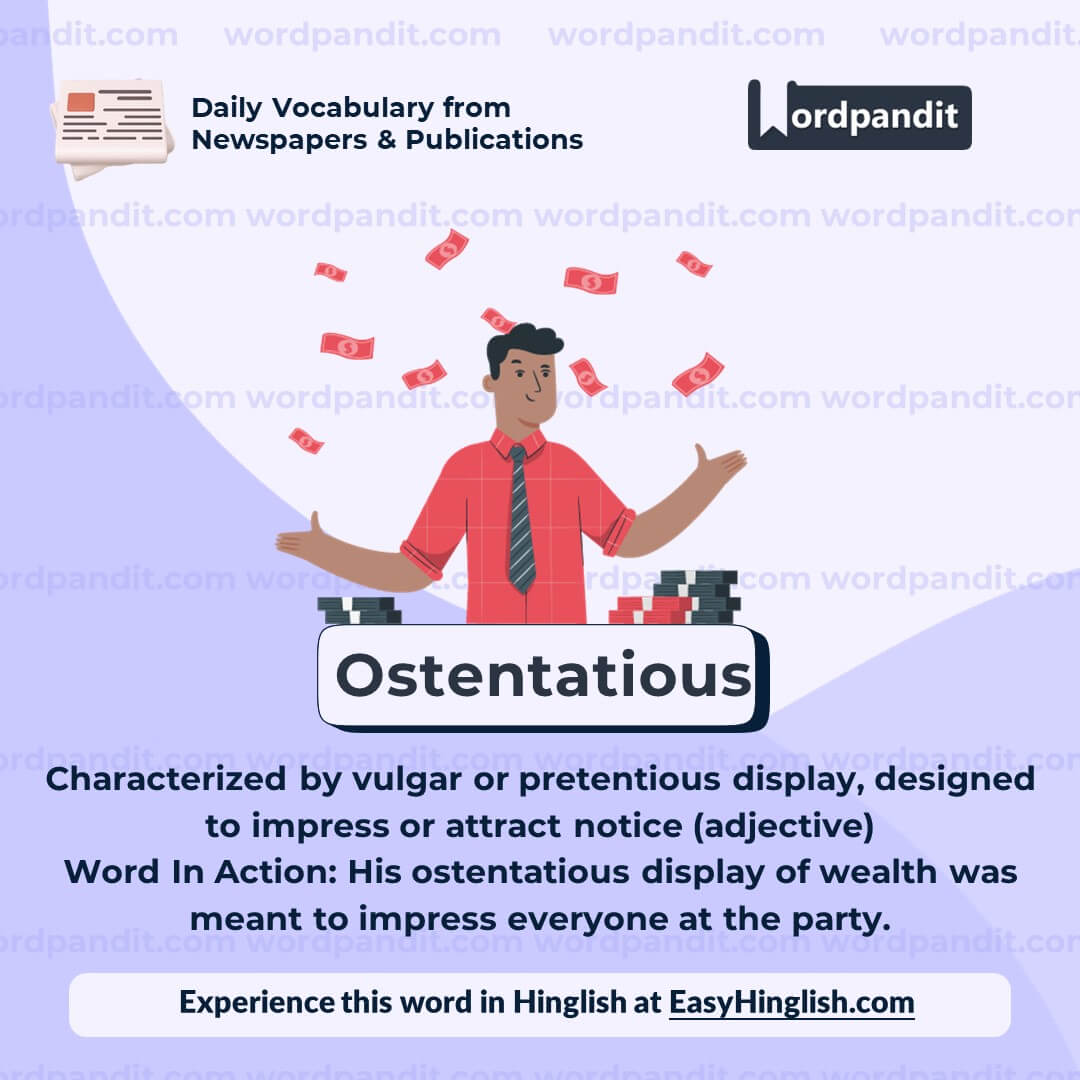
WORD-5: Ostentatious
Context:
"By turns reverential and condescending, ideas of Japan’s enlightened design sensibilities swept Western society. In 1882, the Vanderbilts installed an ostentatious Japanese parlour." - Aeon
Explanatory Paragraph:
"Ostentatious" describes something designed to impress or attract notice, often in a showy or exaggerated way. It usually implies excessive display of wealth, taste, or style for the sake of attention. In the context provided, the word suggests that the Vanderbilts' Japanese parlour was lavish and meant to be admired, but perhaps lacked subtlety or cultural authenticity, favoring spectacle over substance.
Meaning: Characterized by vulgar or pretentious display; designed to impress or attract notice (Adjective)
Pronunciation: os-ten-TAY-shus
Difficulty Level: ⭐⭐⭐ Intermediate
Etymology: From Latin ostentare, meaning "to show or display"
Prashant Sir's Notes:
This word is a staple in describing fashion, architecture, events, or personalities that lean toward flashy and showy. Use it when you want to describe something that tries too hard to impress—especially when it lacks taste or sincerity.
Synonyms & Antonyms:
Synonyms: showy, flamboyant, gaudy, flashy, pretentious
Antonyms: modest, understated, simple, restrained
Usage Examples:
- His ostentatious display of wealth made everyone in the room uncomfortable.
- The hotel lobby was decorated in an ostentatious blend of gold and velvet.
- She wore an ostentatious diamond necklace to the charity gala.
- He criticized the politician’s ostentatious lifestyle in contrast to the poverty of the region.
Cultural Reference:
"Keeping up with the Joneses" is a phrase often associated with ostentatious living—where people spend to impress rather than to fulfill real needs.
Think About It:
Can something be both beautiful and ostentatious, or does the latter always imply a lack of true taste?
Quick Activity:
Look around your room or house. Identify one item that could be described as ostentatious. Would you still keep it if no one else could see it?
Memory Tip:
Think of “Ostentatious” as “Oh, so TENT-showy!”—like putting up a flashy circus tent just to get attention.
Real-World Application:
This word is useful when discussing architecture, interior design, celebrity lifestyles, fashion, and even marketing strategies that aim for visual overkill to draw attention.


