

Daily Vocabulary from International Newspapers and Publications
Expand Your Vocabulary with Wordpandit’s Global Vocabulary Hub
At Wordpandit, we are committed to helping you develop a truly global vocabulary by drawing from some of the most respected international publications. This section is designed to keep you ahead of the curve by introducing you to words that define global conversations and trends.
The Power of Global Sources
To help you think and communicate on a global scale, we curate vocabulary from renowned international sources, such as:
- The New York Times
- The Washington Post
- BBC
- The Guardian
- The Economist
- Scientific American
- Psychology Today
- And many more...
Stay Global, Stay Competitive
Our daily updates from international publications ensure you are consistently exposed to new words that reflect global news and developments, making sure your vocabulary is not only current but also globally relevant.
Enhance Your Global Perspective
Whether you’re preparing for international exams, aiming to excel in global business communication, or want to enhance your language skills for personal growth, Wordpandit offers the resources you need to thrive in a global context.
Effective Learning, Global Reach
Our learning methodology combines global examples, memory aids, and interactive activities, allowing you to internalize new words effectively and apply them in real-world scenarios.
Begin Your Global Vocabulary Journey Now!
Why Choose Wordpandit?
Practical Learning: Focus on words you'll actually encounter in real-world reading, enhancing your comprehension and communication skills.
Diverse Content: From current affairs to scientific breakthroughs, our varied sources expose you to vocabulary across multiple domains.
Effortless Integration: Make Wordpandit a part of your daily routine. Just a few minutes each day can significantly boost your lexicon over time.
Your Path to Vocabulary Mastery
- Visit our Daily Vocabulary section regularly
- Explore new words and their usage in context
- Practice incorporating these words into your own writing and speech
- Track your progress as your vocabulary expands
Start Your Journey Today
Embark on your vocabulary enhancement journey with Wordpandit. By consistently engaging with our daily posts, you'll build a robust vocabulary that serves you well in academic, professional, and personal contexts.
Remember, a word a day keeps linguistic limitations at bay. Make Wordpandit your daily companion in the quest for vocabulary excellence!
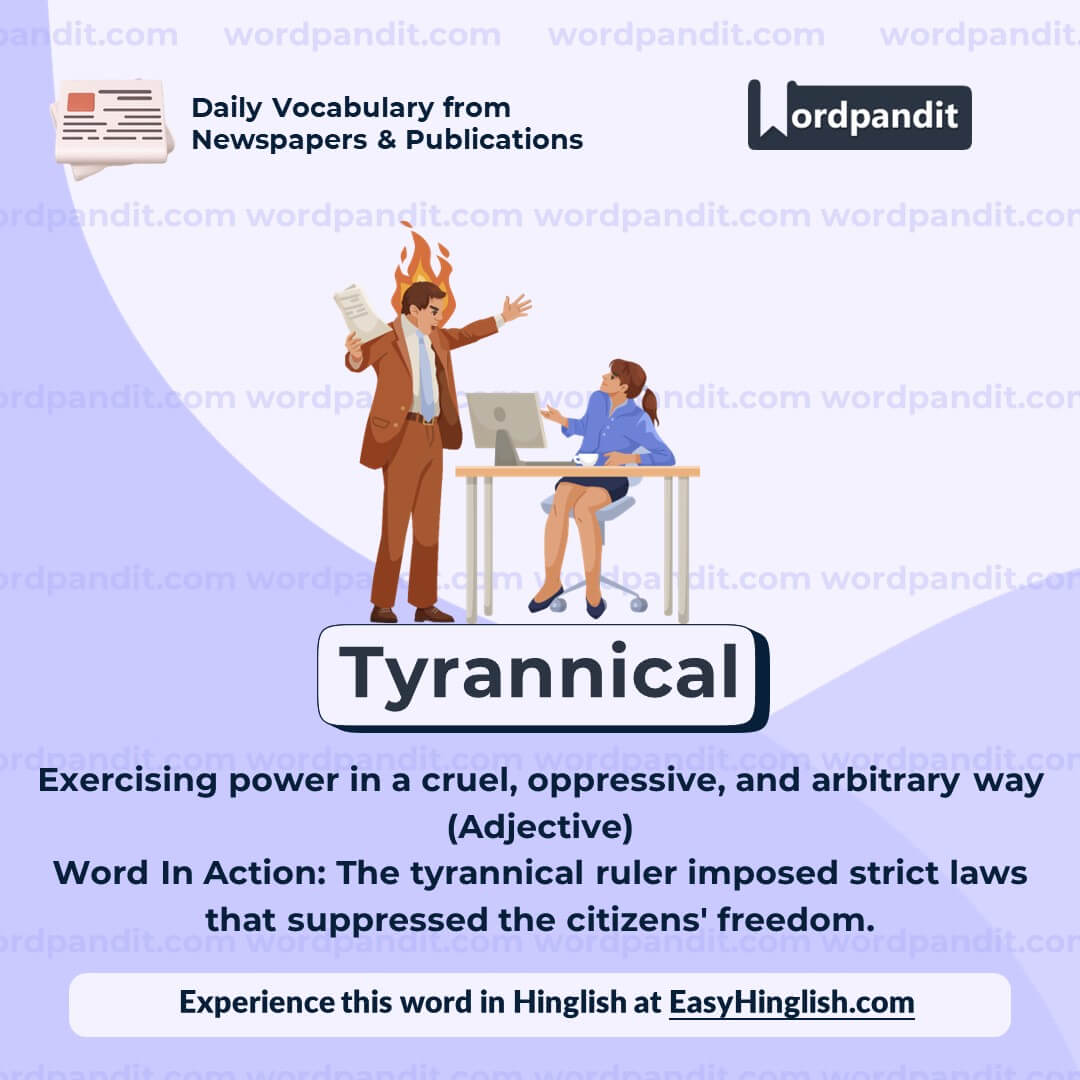
WORD-1: Tyrannical
Context:
"Meanwhile, the tyrannical one-man band in my head kept on going. I was determined the panel should see none of it. But then I found myself blinking madly and caught the head of department eyeing me. I was rumbled." - Aeon
Explanatory Paragraph:
"Tyrannical" describes a person, system, or inner voice that exerts oppressive control or behaves in an overbearing, dictatorial way. In the given context, the speaker refers metaphorically to their inner critic or anxious thoughts as "tyrannical," suggesting that it feels harsh, unrelenting, and dominating. The term can apply to rulers, leaders, parents, or even personal mindsets that impose strict and often cruel authority over others—or oneself.
Meaning: Exercising power in a cruel or arbitrary way (Adjective)
Pronunciation: tih-RAN-ih-kuhl
Difficulty Level: ⭐⭐⭐ Intermediate
Etymology: Derived from the Greek word "tyrannos," meaning "absolute ruler," and later adopted into Latin as "tyrannicus."
Prashant Sir's Notes:
This is a strong word that conveys not just control, but *oppressive* and *unjust* control. It’s commonly used in political contexts, but here, it's being applied metaphorically to inner mental struggle—an insightful usage that adds emotional depth.
Synonyms & Antonyms:
Synonyms: oppressive, dictatorial, authoritarian, despotic, overbearing
Antonyms: democratic, lenient, permissive, fair, tolerant
Usage Examples:
- The manager's tyrannical behavior led to high employee turnover.
- She fought against the tyrannical regime that had ruled her country for decades.
- His inner voice became tyrannical, criticizing every small mistake he made.
- Under her tyrannical rule, the household followed strict, joyless routines.
Cultural Reference:
"The creatures outside looked from pig to man, and from man to pig... but already it was impossible to say which was which." – George Orwell’s *Animal Farm*, a famous critique of tyrannical leadership and power corruption.
Think About It:
Can someone be tyrannical without realizing it, especially in personal relationships or self-talk?
Quick Activity:
Write a short paragraph describing a tyrannical character—real or fictional. What makes their behavior oppressive?
Memory Tip:
Think of “tyrant” + “mechanical” = "tyrannical" — a robotic, unfeeling dictator who controls without care or emotion.
Real-World Application:
"Tyrannical" is often used in political commentary to describe oppressive governments, but it’s also useful in psychology, literature, and even daily life when referring to overly controlling behaviors—whether from others or within ourselves.
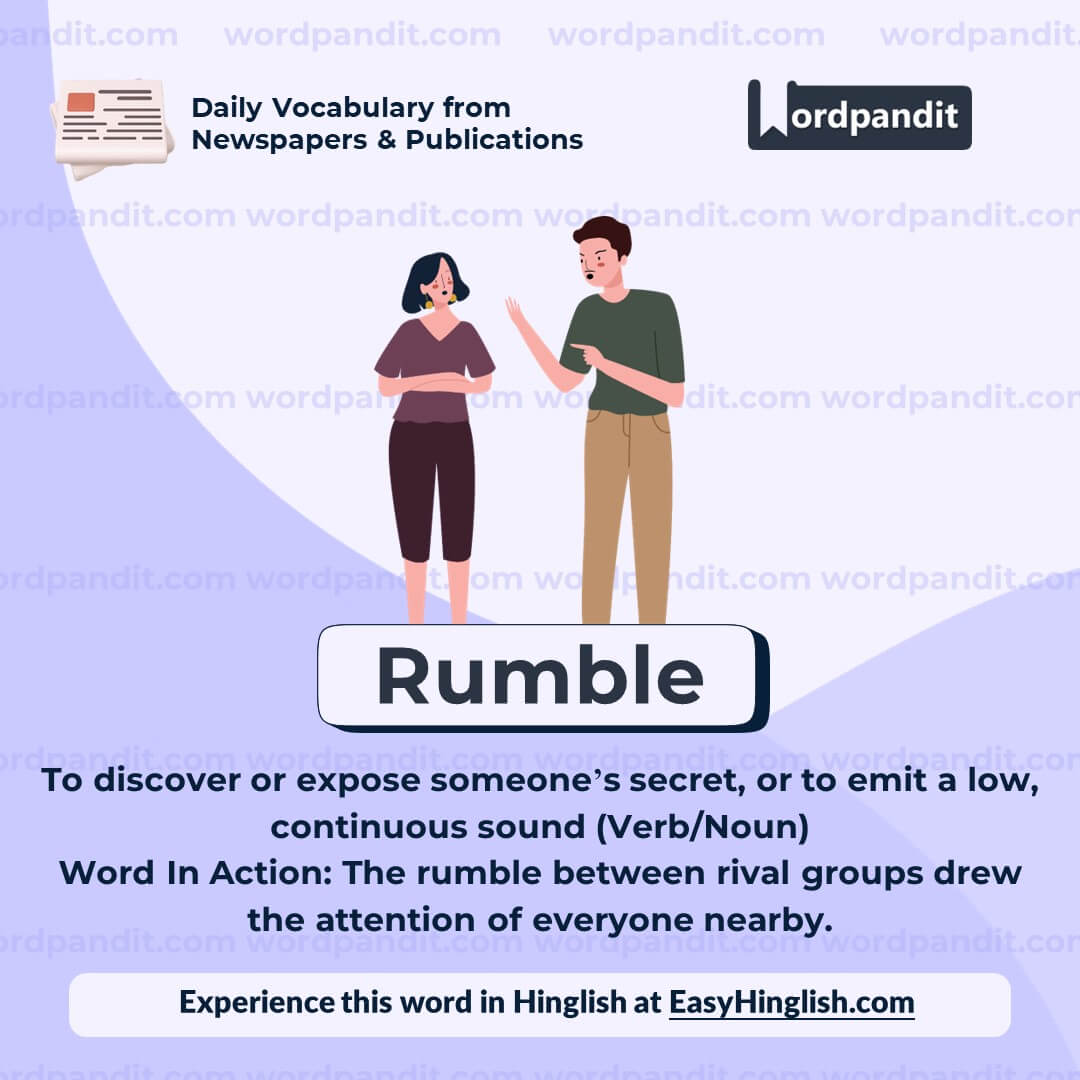
WORD-2: Rumble
Context:
"Meanwhile, the tyrannical one-man band in my head kept on going. I was determined the panel should see none of it. But then I found myself blinking madly and caught the head of department eyeing me. I was rumbled." - Aeon
Explanatory Paragraph:
In this context, "rumbled" is a British informal expression meaning "to be discovered" or "found out," especially when one is trying to hide something. The speaker was trying to conceal their anxiety or internal struggle, but a slip in behavior gave them away. While "rumble" can also refer to a low, deep sound (like thunder or stomach growling), in this usage it refers to the moment someone realizes your hidden truth.
Meaning: To discover someone's secret or hidden behavior (Verb - informal, chiefly British)
Pronunciation: RUM-buhl
Difficulty Level: ⭐⭐ Basic to Intermediate
Etymology: Possibly from the 19th-century slang "rumble" used in thieves’ cant, meaning to detect or uncover.
Prashant Sir's Notes:
This is a very British term and is great for adding local flavor to your English. In American English, you'd use "caught" or "busted." It’s important to understand regional differences when expanding your vocabulary!
Synonyms & Antonyms:
Synonyms: uncover, expose, discover, catch out, detect
Antonyms: conceal, hide, cover up, mask
Usage Examples:
- She thought she could cheat on the test, but the teacher rumbled her halfway through.
- His lies were finally rumbled when someone checked the CCTV footage.
- I tried to sneak in late, but Mum rumbled me the moment I opened the door.
- He wore a calm face, but his trembling hands rumbled his inner panic.
Cultural Reference:
In British detective shows like *Sherlock* or *Line of Duty*, suspects are often "rumbled" by sharp observation and clever deduction—classic examples of this informal usage.
Think About It:
Why do we often try to hide our vulnerabilities, and how do others “rumble” the truth despite our efforts?
Quick Activity:
Write a dialogue where one character tries to keep a secret, and another character "rumbles" them through observation.
Memory Tip:
Imagine trying to quietly sneak candy from a jar, but it makes a loud *rumble*—and you’re caught! Rumble = busted!
Real-World Application:
"Rumble" is useful in informal conversation or storytelling, especially in British English. It adds a colorful, colloquial touch to narratives involving secrets, deceptions, or surprise discoveries.
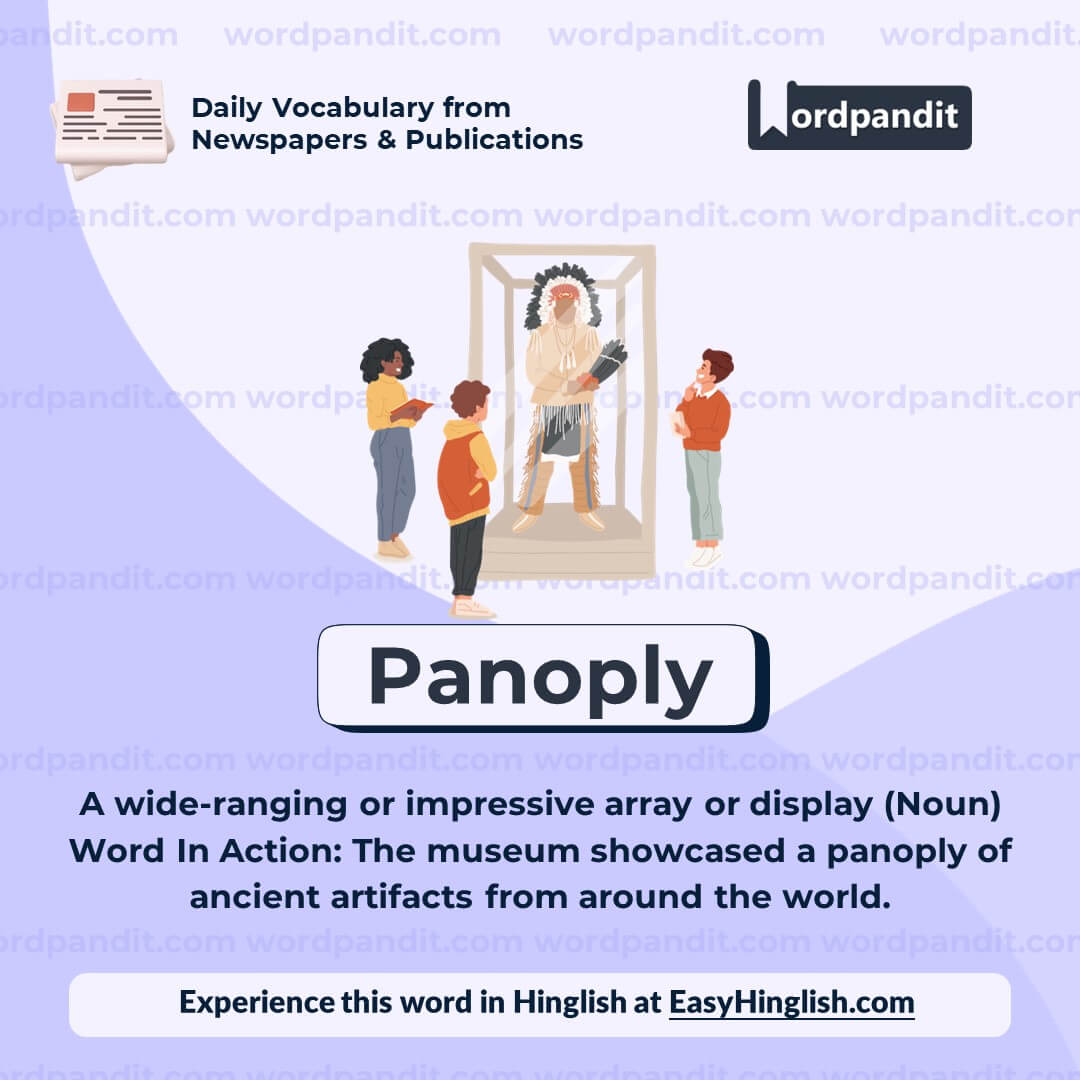
WORD-3: Panoply
Context:
"My obsessive-compulsive disorder (OCD) has manifested in a panoply of painful and punitive habits. Scraping my tongue over my teeth, performing complex eye movements, peeling the skin off my lips until they bleed." - Aeon
Explanatory Paragraph:
"Panoply" refers to a wide and impressive array or collection of things. Originally used to describe a complete suit of armor, the word has evolved to represent a broad range of items, experiences, or qualities—often striking or overwhelming in number. In the context provided, the author uses "panoply" to emphasize the extensive and varied nature of their OCD-driven habits, highlighting how diverse and distressing these compulsions can be.
Meaning: A wide-ranging and impressive display or collection (Noun)
Pronunciation: PAN-uh-plee
Difficulty Level: ⭐⭐⭐⭐ Advanced
Etymology: From Greek "panoplia," meaning "complete suit of armor" ("pan" = all + "hopla" = arms/armor), later broadened in English to refer to any full or impressive array.
Prashant Sir's Notes:
This is a beautiful word for writing and speaking—use it when you want to show richness, variety, or a complete range. It carries a slightly formal or literary tone, making it ideal for essays or analytical writing.
Synonyms & Antonyms:
Synonyms: array, assortment, collection, range, display
Antonyms: limitation, scarcity, deficiency, paucity
Usage Examples:
- The museum features a panoply of ancient artifacts from around the world.
- The festival offered a panoply of cuisines, performances, and cultural showcases.
- Her wardrobe included a panoply of colors and styles, reflecting her vibrant personality.
- The documentary explores the panoply of emotions tied to childhood trauma.
Cultural Reference:
In classical literature and modern political rhetoric, "panoply" is often used to describe the full range of symbolic or institutional powers—for example, "the panoply of state power" in speeches or articles discussing authority.
Think About It:
When does a "panoply" of options become overwhelming rather than empowering? Can abundance be a burden?
Quick Activity:
List five things you’ve encountered today that could form a "panoply" of experiences, sights, or thoughts.
Memory Tip:
Think: *"Pan" = all + "play" (like a display)* → A panoply is like a full display of everything available.
Real-World Application:
Use "panoply" in formal writing, speeches, or critiques when describing a comprehensive variety—whether it's a panoply of policies, emotions, symptoms, or creative works.
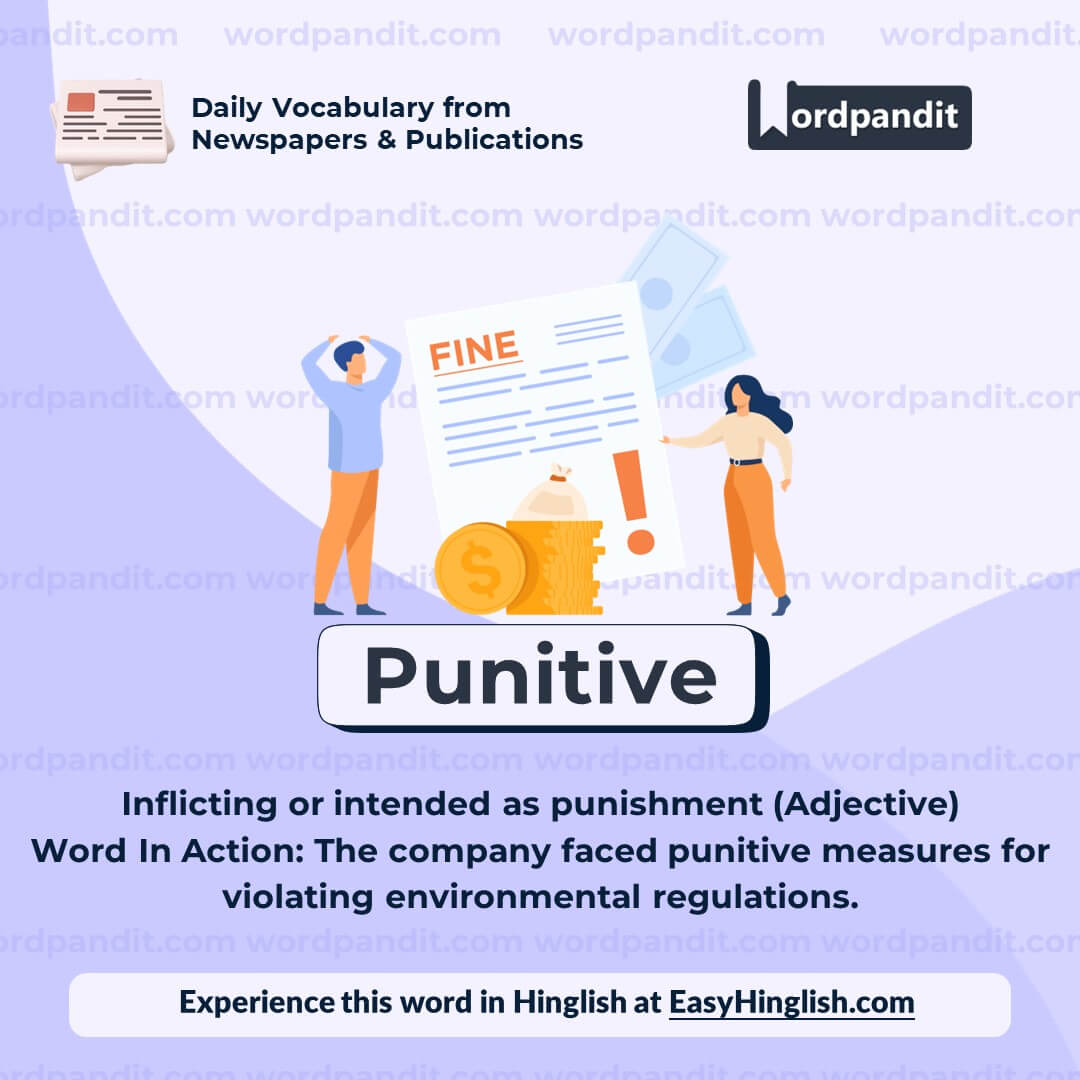
WORD-4: Punitive
Context:
"My obsessive-compulsive disorder (OCD) has manifested in a panoply of painful and punitive habits. Scraping my tongue over my teeth, performing complex eye movements, peeling the skin off my lips until they bleed." - Aeon
Explanatory Paragraph:
"Punitive" refers to something intended as punishment or carrying a harsh, disciplinary nature. In the context of the sentence, the author describes their compulsive habits not only as painful but also as self-punishing—acts that feel like a form of internal discipline or retribution. While the word is often used in legal or disciplinary contexts (like "punitive damages"), it can also apply to emotional or psychological self-inflicted punishment, as it does here.
Meaning: Intended to punish or inflict a penalty (Adjective)
Pronunciation: PYOO-nih-tiv
Difficulty Level: ⭐⭐⭐ Intermediate
Etymology: From Latin "punitivus," from "punire" meaning "to punish."
Prashant Sir's Notes:
“Punitive” is a precise and impactful word—especially in legal, academic, and psychological writing. It helps express the idea of harsh consequences or self-imposed suffering with gravity and clarity.
Synonyms & Antonyms:
Synonyms: disciplinary, penal, harsh, retributive, corrective
Antonyms: lenient, forgiving, rewarding, permissive, rehabilitative
Usage Examples:
- The judge imposed punitive fines on the company for violating environmental laws.
- Her self-talk became increasingly punitive, blaming herself for every small mistake.
- The school’s overly punitive policies discouraged students from taking creative risks.
- He viewed exercise not as a healthy routine but as a punitive ritual to correct his perceived flaws.
Cultural Reference:
In the legal drama *Suits*, the term “punitive damages” often comes up in high-stakes cases—used to describe financial penalties meant to punish corporations for wrongdoing rather than just compensate victims.
Think About It:
Can punitive actions lead to long-term behavioral change, or do they simply reinforce fear and guilt?
Quick Activity:
Think of a rule or habit in your life. Is it helpful and encouraging—or is it punitive in nature? Write one sentence reflecting on it.
Memory Tip:
“Punitive” sounds like “punish”—both start with “pun,” and both deal with consequences or discipline.
Real-World Application:
"Punitive" is especially relevant in discussions of justice systems, parenting styles, corporate policies, and personal psychology—anywhere consequences and discipline are at play.
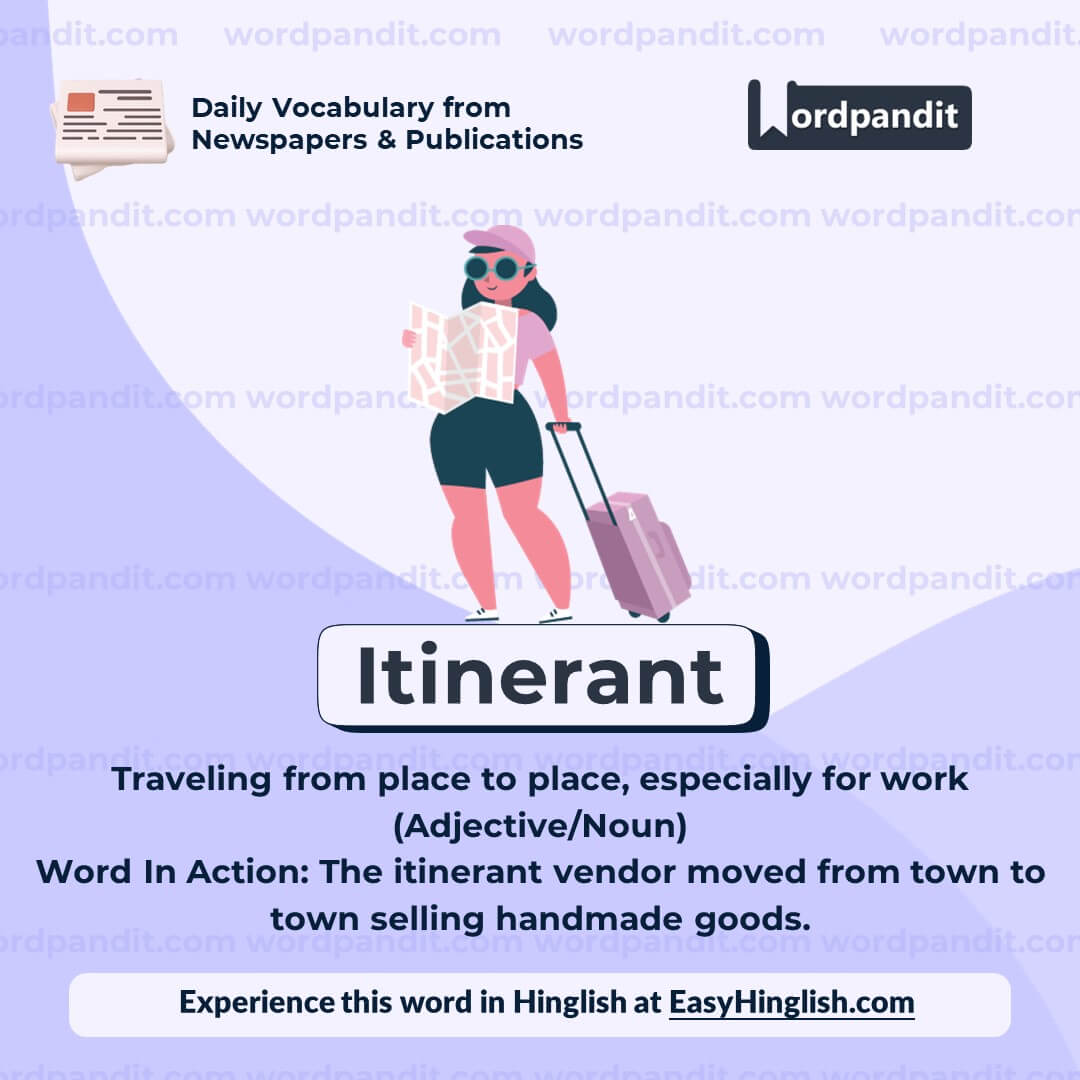
WORD-5: Itinerant
Context:
"This makes them the itinerant ‘travel writers’ of the rock world, returning to tell us about the restless, animate, hidden nature of the solid Earth." - Aeon
Explanatory Paragraph:
"Itinerant" refers to someone who travels from place to place, usually for work or exploration rather than leisure. In the given context, the author uses it metaphorically to describe scientists or observers who explore the Earth's layers and movements—like travel writers chronicling hidden geographies. The word captures the spirit of movement, observation, and returning with stories or knowledge gained from different locations.
Meaning: Traveling from place to place, especially to perform a job or duty (Adjective / Noun)
Pronunciation: eye-TIN-uh-ruhnt
Difficulty Level: ⭐⭐⭐ Intermediate
Etymology: From Latin "itinerantem," meaning "to travel," rooted in "iter," which means "journey" or "road."
Prashant Sir's Notes:
“Itinerant” is a great word for describing people whose lives or work involve constant movement—journalists, geologists, performers, or even freelancers today. Use it to add nuance to the idea of purposeful travel.
Synonyms & Antonyms:
Synonyms: wandering, nomadic, roaming, traveling, peripatetic
Antonyms: stationary, settled, resident, rooted
Usage Examples:
- The itinerant teacher visited several rural schools each month to provide specialized lessons.
- During the summer, she lived an itinerant lifestyle, moving from one festival to another.
- Itinerant traders were once the backbone of cross-country commerce.
- His career as an itinerant musician took him across five continents.
Cultural Reference:
In ancient times, philosophers like Socrates and Diogenes lived itinerant lives—traveling, speaking, and sharing ideas without permanent homes, much like modern digital nomads or field researchers today.
Think About It:
How does an itinerant lifestyle shape a person’s perspective compared to someone who stays rooted in one place?
Quick Activity:
List three professions where an itinerant lifestyle is common. Write one sentence for each explaining why travel is essential to the role.
Memory Tip:
Think: *Itinerary = travel plan → Itinerant = person who follows that travel plan*. Both share the same root!
Real-World Application:
"Itinerant" is useful when discussing careers, lifestyles, or roles that involve frequent travel—such as consultants, aid workers, researchers, or artists. It gives a formal edge to describing mobility with purpose.


