

Daily Vocabulary from International Newspapers and Publications
Expand Your Vocabulary with Wordpandit’s Global Vocabulary Hub
At Wordpandit, we are committed to helping you develop a truly global vocabulary by drawing from some of the most respected international publications. This section is designed to keep you ahead of the curve by introducing you to words that define global conversations and trends.
The Power of Global Sources
To help you think and communicate on a global scale, we curate vocabulary from renowned international sources, such as:
- The New York Times
- The Washington Post
- BBC
- The Guardian
- The Economist
- Scientific American
- Psychology Today
- And many more...
Stay Global, Stay Competitive
Our daily updates from international publications ensure you are consistently exposed to new words that reflect global news and developments, making sure your vocabulary is not only current but also globally relevant.
Enhance Your Global Perspective
Whether you’re preparing for international exams, aiming to excel in global business communication, or want to enhance your language skills for personal growth, Wordpandit offers the resources you need to thrive in a global context.
Effective Learning, Global Reach
Our learning methodology combines global examples, memory aids, and interactive activities, allowing you to internalize new words effectively and apply them in real-world scenarios.
Begin Your Global Vocabulary Journey Now!
Why Choose Wordpandit?
Practical Learning: Focus on words you'll actually encounter in real-world reading, enhancing your comprehension and communication skills.
Diverse Content: From current affairs to scientific breakthroughs, our varied sources expose you to vocabulary across multiple domains.
Effortless Integration: Make Wordpandit a part of your daily routine. Just a few minutes each day can significantly boost your lexicon over time.
Your Path to Vocabulary Mastery
- Visit our Daily Vocabulary section regularly
- Explore new words and their usage in context
- Practice incorporating these words into your own writing and speech
- Track your progress as your vocabulary expands
Start Your Journey Today
Embark on your vocabulary enhancement journey with Wordpandit. By consistently engaging with our daily posts, you'll build a robust vocabulary that serves you well in academic, professional, and personal contexts.
Remember, a word a day keeps linguistic limitations at bay. Make Wordpandit your daily companion in the quest for vocabulary excellence!
WORD-1: Deferring
Context:
"Sabotage is about deferring our stated goals and – when we are given a shot – blowing it, or subtly hindering our chances. The puzzle is why so many of us perpetually find ourselves getting in our own way and disrupting our best-laid plans." - Aeon
Explanatory Paragraph:
“Deferring” refers to postponing or delaying something to a later time. In the context above, it reflects how people sometimes hold off on pursuing their goals—not because they aren’t important, but often due to internal fears, self-doubt, or procrastination. The word hints at hesitation, avoidance, or putting things off that may otherwise deserve immediate attention.
Meaning: To delay or postpone something (Verb)
Pronunciation: dih-FUR-ing
Difficulty Level: ⭐⭐ Beginner to Intermediate
Etymology: From Latin *differre*, meaning “to delay, put off”
Prashant Sir's Notes:
“Deferring” is often seen in academic, corporate, or emotional contexts—people defer exams, decisions, or even emotions. It’s a subtle but powerful word for recognizing avoidance patterns. Spot this verb when someone delays action or makes excuses for not moving forward.
Synonyms & Antonyms:
Synonyms: postpone, delay, put off, stall, suspend
Antonyms: advance, expedite, hasten, continue, proceed
Usage Examples:
- She kept deferring her job application until the deadline finally passed.
- The board decided to defer the decision on budget cuts until next month.
- He was deferring his dream of traveling the world because of family obligations.
- By deferring our goals repeatedly, we sometimes become our own worst enemies.
Cultural Reference:
"A goal without a timeline is just a dream — deferring action keeps success at arm’s length." - Inspired by motivational speaker Tony Robbins
Think About It:
What important goal in your life have you been deferring, and why?
Quick Activity:
Write down three tasks you’ve been deferring this week. Now commit to completing one by the end of today—and set a clear time for it.
Memory Tip:
Think: “Deferring = Delaying Decisions” — both start with “D” and involve waiting or pushing something away.
Real-World Application:
In real life, deferring can show up in everything from procrastinating on career moves to putting off difficult conversations. Recognizing when you're deferring—and why—can help you take timely, effective action.
WORD-2: Disrupting
Context:
"Sabotage is about deferring our stated goals and – when we are given a shot – blowing it, or subtly hindering our chances. The puzzle is why so many of us perpetually find ourselves getting in our own way and disrupting our best-laid plans." - Aeon
Explanatory Paragraph:
“Disrupting” means to interrupt, disturb, or throw something into disorder. In this context, it refers to how we unintentionally interfere with our own progress by causing interruptions or chaos in our carefully made plans. This kind of disruption is often subtle and self-inflicted, showing up as procrastination, negative self-talk, or poor decision-making. The word highlights how internal obstacles can be just as damaging as external ones.
Meaning: To interrupt the normal course or flow of something (Verb)
Pronunciation: dis-RUPT-ing
Difficulty Level: ⭐⭐ Beginner to Intermediate
Etymology: From Latin *disrumpere*, meaning “to break apart”
Prashant Sir's Notes:
“Disrupting” is a power word. It can have both negative and positive implications. While it often suggests something being thrown off course (like a plan or a system), it’s also used positively in innovation and business (think “disruptive technology”). Understanding the tone of the context is key.
Synonyms & Antonyms:
Synonyms: interrupt, interfere with, disturb, derail, unsettle
Antonyms: continue, maintain, sustain, preserve, stabilize
Usage Examples:
- The unexpected power outage disrupted the entire day’s schedule.
- He kept disrupting the meeting with off-topic comments.
- Negative thoughts can be powerful forces, often disrupting our mental clarity.
- The rise of smartphones has been disrupting traditional media industries.
Cultural Reference:
“Disruption is the new normal in Silicon Valley, where startups aim to shake up entire industries.” - Common theme in tech and innovation journalism
Think About It:
In what ways might you be unknowingly disrupting your own progress or routine?
Quick Activity:
List three habits or distractions that tend to disrupt your focus. What’s one small change you can make to reduce their impact?
Memory Tip:
Think: “Disrupt = Disturb + Rupture” — breaking or shaking something apart.
Real-World Application:
“Disrupting” is used often in both personal development and business. On a personal level, recognizing when you’re disrupting your own productivity can help you refocus. In professional contexts, companies often seek to “disrupt” markets by introducing innovative solutions that challenge the norm.
WORD-3: Evocation
Context:
"The vivid sculpture might in fact do more to inspire visitors to further learn about the war, and ultimately the horror of all wars." - Aeon
Explanatory Paragraph:
“Evocation” refers to the act of bringing something into the mind or imagination, often a feeling, memory, or image. In this context, the sculpture serves as an evocation of war’s horrors—meaning it powerfully stirs up emotions and memories connected to conflict, even for those who may not have experienced war firsthand. The word emphasizes the emotional and psychological power of art, symbols, or stories to awaken deep reflections.
Meaning: The act of bringing a feeling, memory, or image to mind (Noun)
Pronunciation: eh-vo-KAY-shun
Difficulty Level: ⭐⭐⭐ Intermediate
Etymology: From Latin *evocatio*, from *evocare* meaning “to call forth”
Prashant Sir's Notes:
“Evocation” is often used in artistic, emotional, and literary contexts. It’s a beautiful word that captures the ability of something (like art, music, or even a place) to make you feel or remember deeply. It’s not the same as stating something directly; it’s more about awakening what’s already inside you.
Synonyms & Antonyms:
Synonyms: summons, remembrance, invocation, recollection, impression
Antonyms: repression, forgetting, suppression, disregard
Usage Examples:
- The novel’s powerful evocation of childhood memories left many readers in tears.
- The painting is a stunning evocation of lost love and longing.
- His speech was an evocation of national pride and unity.
- Music has the unique ability to create instant evocations of moments from the past.
Cultural Reference:
"Cinema, at its best, is not just storytelling—it is evocation. It makes you feel what cannot be said." - Inspired by the philosophy of filmmaker Andrei Tarkovsky
Think About It:
What piece of art, music, or literature has evoked strong emotions or memories in you—and why?
Quick Activity:
Look at an old photograph or listen to a song from your past. Write down three emotions or memories this evocation brings up.
Memory Tip:
“Evocation” sounds like “evoke emotion”—and that’s exactly what it does: it brings emotions or memories to the surface.
Real-World Application:
“Evocation” is especially useful in art criticism, literature, and psychology. It helps describe the indirect power of sensory or emotional triggers—like how a scent might evoke a childhood memory or a poem might evoke a deep sense of loss.
WORD-4: Collate
Context:
"He took me on a dizzying screen-share tour of software he’s designed to collate the existing research on procrastination (including fMRI studies that observe the process in the brain) in order to identify underlying patterns." - Aeon
Explanatory Paragraph:
“Collate” means to collect and organize information or items systematically, especially to examine them as a whole. In the context above, the software helps bring together various studies on procrastination so that researchers can spot patterns and insights. This word is especially relevant in research, data analysis, and report preparation, where organizing different sources into a clear structure is essential for understanding and drawing conclusions.
Meaning: To collect, compare, and arrange information or documents in an organized way (Verb)
Pronunciation: kuh-LATE
Difficulty Level: ⭐⭐ Beginner to Intermediate
Etymology: From Latin *collātus*, past participle of *conferre*, meaning “to bring together”
Prashant Sir's Notes:
“Collate” is a favorite in academic and professional circles. Think of it like digital or mental sorting—gathering lots of information, then arranging it to make sense. Often used in research, printing, and data work. It's about order and clarity.
Synonyms & Antonyms:
Synonyms: compile, organize, assemble, gather, sort
Antonyms: scatter, disorganize, disperse, separate
Usage Examples:
- The assistant collated the reports into one comprehensive document.
- The librarian is working to collate articles on climate change from multiple journals.
- Before publishing, you must collate your research notes and citations.
- We used software to automatically collate survey responses into charts.
Cultural Reference:
In academic publishing and journalism, collating sources is a key step in creating reliable content—much like how investigative reporters collate witness accounts and data to uncover the full story. Think of major publications like *The New Yorker* or *The Economist*, where careful collation is part of the editorial process.
Think About It:
In a world of information overload, how can learning to collate effectively make you a better thinker or communicator?
Quick Activity:
Pick a topic you're interested in (e.g., climate change, artificial intelligence). Find three reliable articles online and try to collate the main ideas into a single paragraph summary.
Memory Tip:
Collate = “Collect + Relate” — you gather information and relate it in order.
Real-World Application:
“Collate” is widely used in academic research, project management, office tasks, and data analysis. Whether preparing a business report, organizing research for a thesis, or even comparing vacation options, the ability to collate ensures informed decision-making.
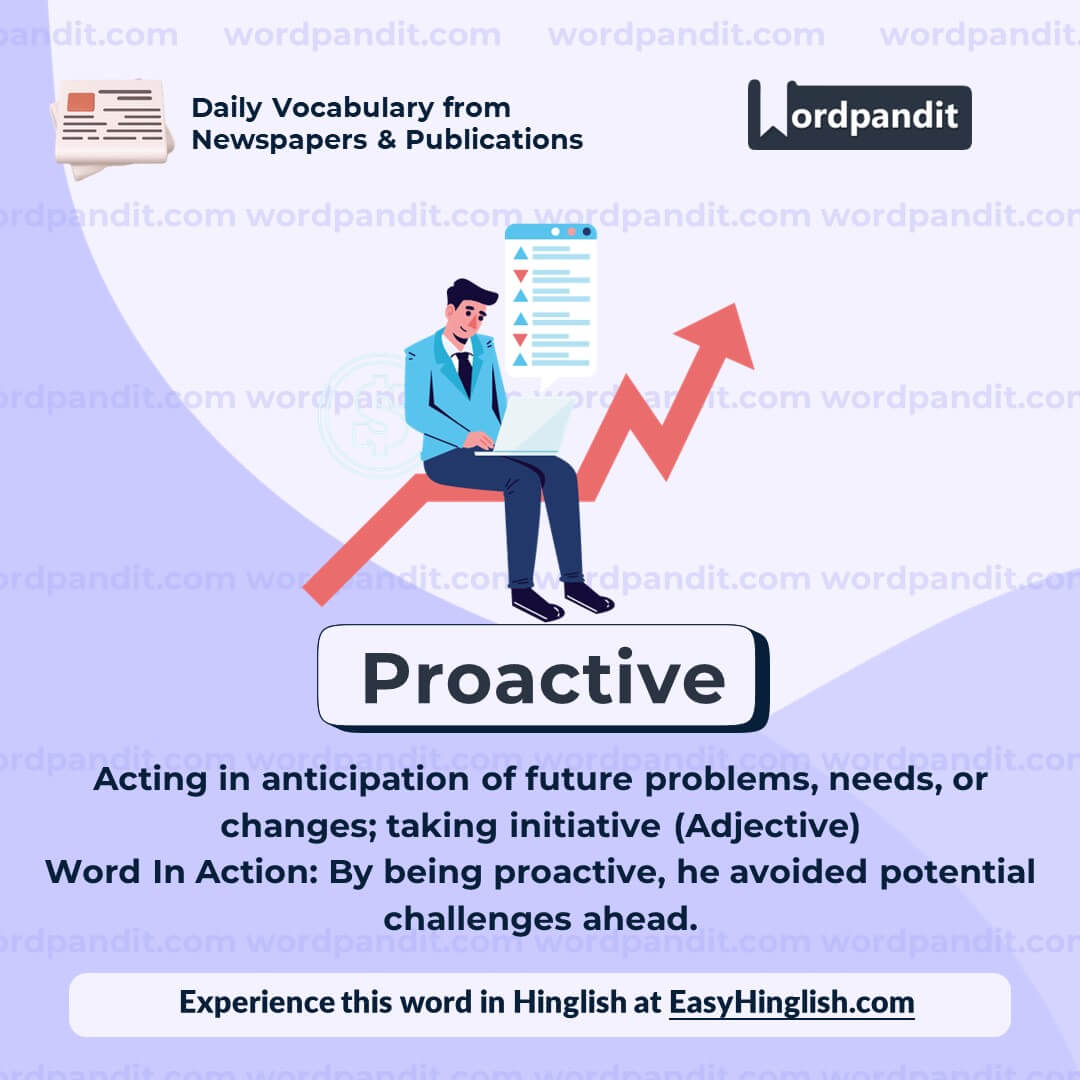
WORD-5: Proactive
Context:
"It is about noticing taken-for-granted social designs and erecting creative defences against powers and arrangements that chip away at one’s ability to exercise self-ownership." - Aeon
Explanatory Paragraph:
“Proactive” describes someone who takes initiative and acts in advance to deal with expected challenges or opportunities. Instead of waiting for problems to arise, a proactive person anticipates them and prepares solutions. In the given context, being proactive involves recognizing harmful social systems early on and building mental or behavioral strategies to maintain autonomy and control over one’s life.
Meaning: Taking action by causing change rather than reacting to events after they happen (Adjective)
Pronunciation: pro-AK-tiv
Difficulty Level: ⭐⭐ Beginner to Intermediate
Etymology: Coined in the mid-20th century from “pro-” (forward) + “active”
Prashant Sir's Notes:
Think of "proactive" as the opposite of "reactive." It's a mindset that’s essential for leadership, personal development, and resilience. Proactive individuals don’t wait for circumstances to push them—they move first. In exams, career, or relationships, being proactive gives you the upper hand.
Synonyms & Antonyms:
Synonyms: forward-thinking, anticipatory, enterprising, preemptive, prepared
Antonyms: reactive, passive, indifferent, unprepared, neglectful
Usage Examples:
- She took a proactive approach to managing her health by exercising daily and eating mindfully.
- Proactive students begin revising for exams weeks in advance instead of cramming last minute.
- The company implemented proactive measures to prevent cybersecurity threats.
- Being proactive about mental health includes recognizing stress and addressing it early.
Cultural Reference:
“Be Proactive” is Habit #1 in Stephen R. Covey’s famous book *The 7 Habits of Highly Effective People*. It emphasizes taking responsibility for your actions and responses, no matter your circumstances.
Think About It:
In what areas of your life could being more proactive help you create meaningful change?
Quick Activity:
Write down one situation you’ve been reacting to instead of preparing for. Now, list two proactive steps you can take this week to regain control.
Memory Tip:
Proactive = “Acting in advance” — it’s like setting up an umbrella before the rain starts.
Real-World Application:
In the workplace, being proactive means taking ownership—like fixing a problem before your boss notices. In personal life, it means budgeting before running out of money or checking in on a friend before they feel isolated. It’s a powerful tool for personal and professional success.


