

Daily Vocabulary from International Newspapers and Publications
Expand Your Vocabulary with Wordpandit’s Global Vocabulary Hub
At Wordpandit, we are committed to helping you develop a truly global vocabulary by drawing from some of the most respected international publications. This section is designed to keep you ahead of the curve by introducing you to words that define global conversations and trends.
The Power of Global Sources
To help you think and communicate on a global scale, we curate vocabulary from renowned international sources, such as:
- The New York Times
- The Washington Post
- BBC
- The Guardian
- The Economist
- Scientific American
- Psychology Today
- And many more...
Stay Global, Stay Competitive
Our daily updates from international publications ensure you are consistently exposed to new words that reflect global news and developments, making sure your vocabulary is not only current but also globally relevant.
Enhance Your Global Perspective
Whether you’re preparing for international exams, aiming to excel in global business communication, or want to enhance your language skills for personal growth, Wordpandit offers the resources you need to thrive in a global context.
Effective Learning, Global Reach
Our learning methodology combines global examples, memory aids, and interactive activities, allowing you to internalize new words effectively and apply them in real-world scenarios.
Begin Your Global Vocabulary Journey Now!
Why Choose Wordpandit?
Practical Learning: Focus on words you'll actually encounter in real-world reading, enhancing your comprehension and communication skills.
Diverse Content: From current affairs to scientific breakthroughs, our varied sources expose you to vocabulary across multiple domains.
Effortless Integration: Make Wordpandit a part of your daily routine. Just a few minutes each day can significantly boost your lexicon over time.
Your Path to Vocabulary Mastery
- Visit our Daily Vocabulary section regularly
- Explore new words and their usage in context
- Practice incorporating these words into your own writing and speech
- Track your progress as your vocabulary expands
Start Your Journey Today
Embark on your vocabulary enhancement journey with Wordpandit. By consistently engaging with our daily posts, you'll build a robust vocabulary that serves you well in academic, professional, and personal contexts.
Remember, a word a day keeps linguistic limitations at bay. Make Wordpandit your daily companion in the quest for vocabulary excellence!
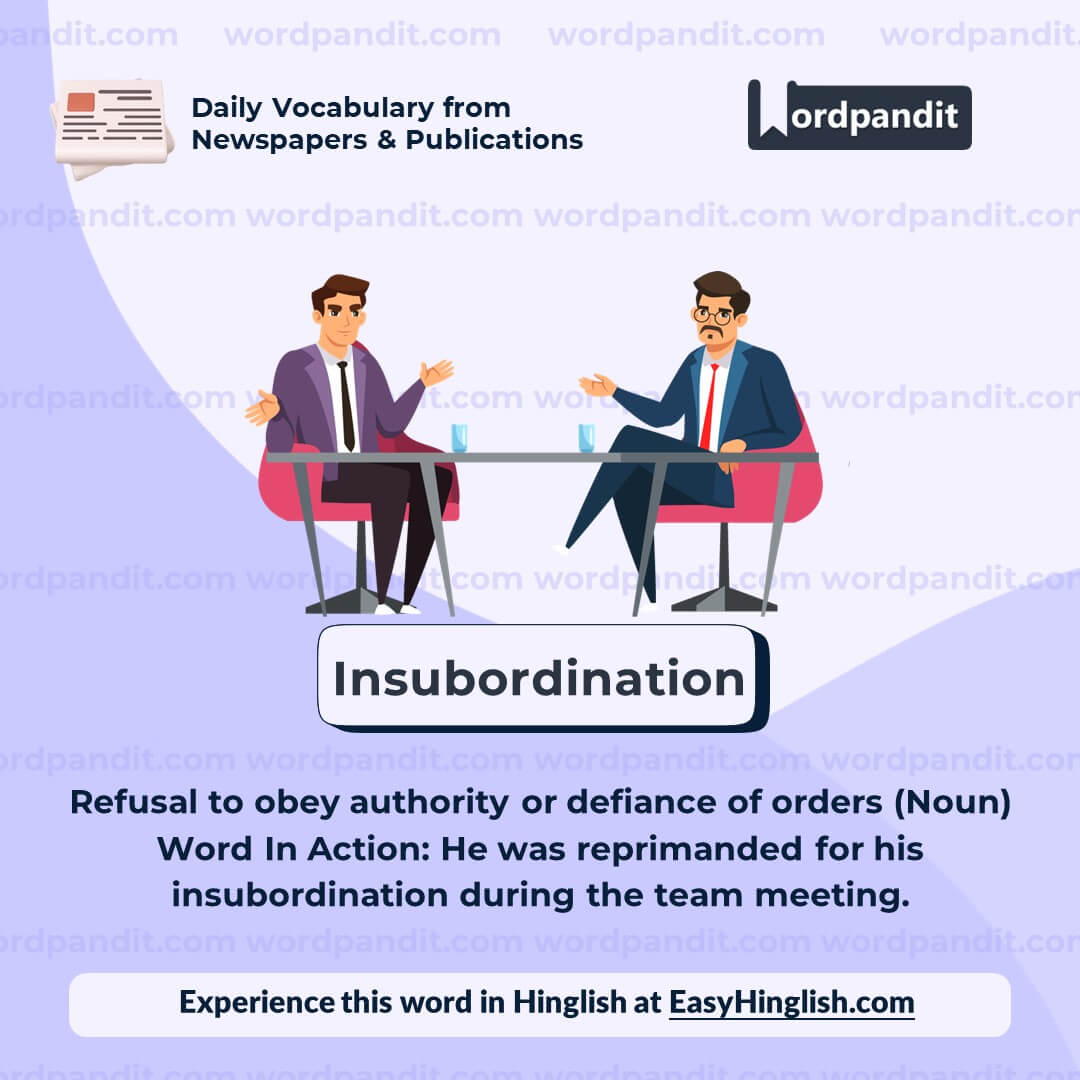
WORD-1: Insubordination
Context:
"People’s ability to carry out ‘petty acts of insubordination’" - Aeon
Explanatory Paragraph:
Insubordination refers to the act of deliberately disobeying authority, especially in a structured or hierarchical setting like the military, workplace, or school. It doesn't always involve loud rebellion—it can be subtle, like ignoring orders or undermining authority in minor ways. The phrase "petty acts of insubordination" suggests small but intentional refusals to comply, which can be a quiet form of resistance or protest.
Meaning: Refusal to obey authority or follow orders (Noun)
Pronunciation: in-suh-bawr-duh-NAY-shun
Difficulty Level: ⭐⭐⭐ Intermediate
Etymology: From Latin *subordinare* (to subject or subordinate), with the prefix *in-* meaning "not" and *subordination* meaning obedience; thus, "not obedient."
Prashant Sir's Notes:
This word is often used in legal, military, or corporate settings. It implies a willful or intentional refusal to comply with someone in authority. Always consider the power dynamics when interpreting this word in context.
Synonyms & Antonyms:
Synonyms: defiance, disobedience, rebellion, mutiny, revolt
Antonyms: obedience, compliance, submission, deference
Usage Examples:
- The manager fired the employee for repeated acts of insubordination.
- Her quiet insubordination during the meeting went unnoticed by most but not by her boss.
- Military officers are trained to handle insubordination swiftly and firmly.
- Teenagers often show subtle insubordination as they try to assert independence.
Cultural Reference:
"Insubordination was a recurring theme in the civil rights movement, where peaceful protestors refused to comply with unjust laws." - History Channel (paraphrased)
Think About It:
Is insubordination always negative, or can it be a form of ethical resistance against unjust authority?
Quick Activity:
Write a short dialogue between a student and a teacher where the student shows insubordination. Identify the moment it happens and reflect on whether it was justified.
Memory Tip:
Break it down: "In-" (not) + "subordinate" (under authority) = not following orders. Think of someone refusing to be "under" control.
Real-World Application:
Understanding insubordination is vital in workplaces, military settings, or schools where hierarchy and rules matter. It helps managers or leaders navigate discipline, communication, and conflict resolution.
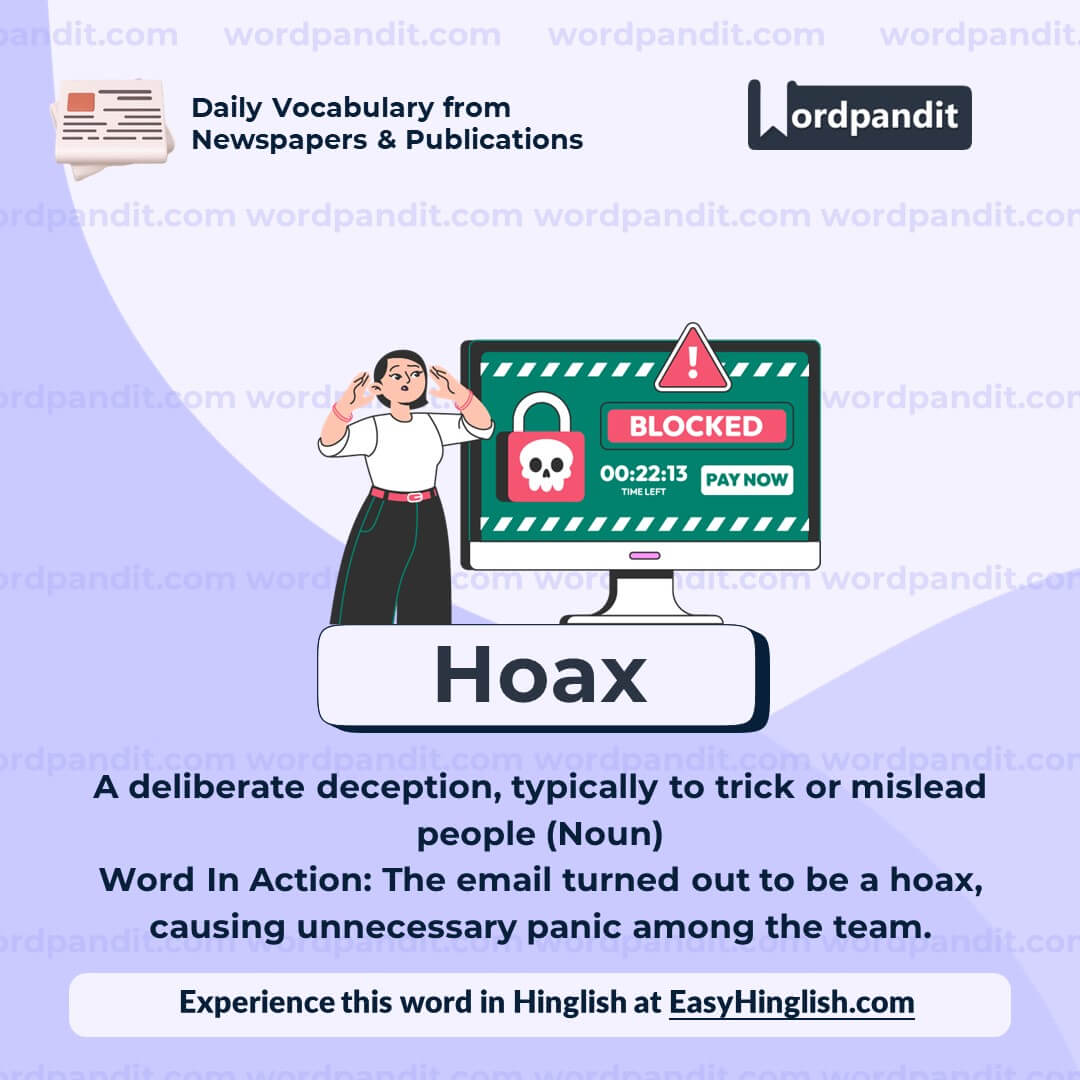
WORD-2: Hoax
Context:
"Coverage of the ‘balloon boy’ hoax forms a withering indictment of for-profit news" - Aeon
Explanatory Paragraph:
A hoax is a deliberately fabricated lie or deception that is made to appear as truth. People create hoaxes to trick, mislead, or gain attention from others. In the context of the "balloon boy" incident, the term highlights how the public and media were fooled by a staged event, revealing vulnerabilities in how quickly misinformation can spread—especially when profit and sensationalism drive the news cycle.
Meaning: A trick or deception intended to mislead people (Noun)
Pronunciation: hohks
Difficulty Level: ⭐⭐ Basic
Etymology: Believed to have originated in the late 18th century, possibly from the word "hocus," a shortened form of "hocus-pocus," meaning nonsense or trickery.
Prashant Sir's Notes:
‘Hoax’ is a short, powerful word with a tone of mischief or malicious intent. Always ask—who benefits from the hoax? This helps understand the motivation behind the deception.
Synonyms & Antonyms:
Synonyms: fraud, scam, deception, trick, con, spoof
Antonyms: truth, fact, reality, authenticity
Usage Examples:
- The viral video turned out to be a hoax created for publicity.
- Authorities fined the man for orchestrating a bomb hoax at the airport.
- Internet hoaxes often spread faster than verified news.
- The museum confirmed the painting was a hoax after a detailed investigation.
Cultural Reference:
"The War of the Worlds" radio broadcast in 1938 famously caused panic because many listeners believed the fictional story of an alien invasion was real—an unintentional but historic hoax-like event. - Media Studies Archive
Think About It:
What responsibility do media outlets have in preventing the spread of hoaxes, and how can we as individuals verify information before sharing it?
Quick Activity:
Look up three famous hoaxes from history and write one sentence explaining what each one was and how people were misled.
Memory Tip:
Think of “hoax” as a mix of “hocus-pocus” and “joke”—a trick that’s meant to fool, but not always funny in the end.
Real-World Application:
Recognizing hoaxes is essential in the digital age where misinformation spreads rapidly. Being able to identify and fact-check hoaxes can help protect yourself and others from false narratives and manipulation.
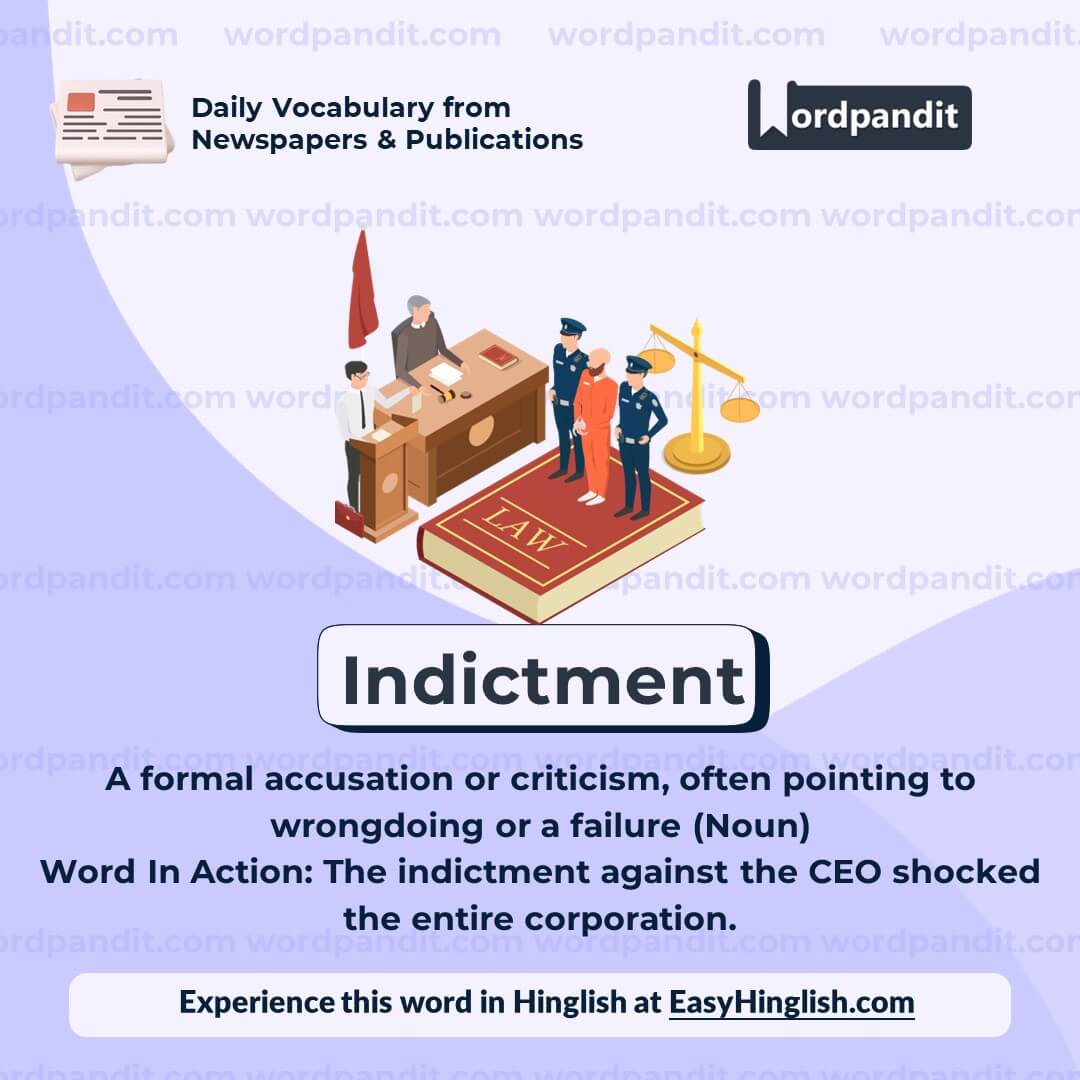
WORD-3: Indictment
Context:
"Coverage of the ‘balloon boy’ hoax forms a withering indictment of for-profit news" - Aeon
Explanatory Paragraph:
An indictment is a formal accusation or strong criticism. While it is commonly used in a legal context to describe a formal charge for a serious crime, it is also used metaphorically to describe strong disapproval or condemnation of a person, system, or practice. In this context, the phrase "a withering indictment of for-profit news" implies that the media’s handling of the hoax reveals deep flaws in how profit-driven journalism functions—criticizing it harshly for prioritizing sensationalism over truth.
Meaning: A formal accusation or strong criticism, often of wrongdoing (Noun)
Pronunciation: in-DITE-muhnt
Difficulty Level: ⭐⭐⭐ Intermediate
Etymology: From Latin *indictare*, meaning "to declare" or "to proclaim," derived from *in-* (toward) and *dictare* (to say or declare).
Prashant Sir's Notes:
This word is powerful both legally and rhetorically. Be careful: it’s pronounced “in-DITE-ment” even though it’s spelled with a ‘c’. It's often used to express moral or social condemnation.
Synonyms & Antonyms:
Synonyms: accusation, charge, condemnation, reproach, criticism
Antonyms: praise, acquittal, approval, exoneration
Usage Examples:
- The grand jury issued an indictment against the company’s CEO for fraud.
- The film is a powerful indictment of political corruption and injustice.
- Her resignation was seen as a silent indictment of the administration’s failures.
- The report served as a harsh indictment of the education system’s inequality.
Cultural Reference:
In 2023, the indictment of a former U.S. president marked a historic moment in American legal and political history, stirring debate over accountability and justice. - Public Records (paraphrased)
Think About It:
Can a piece of art, literature, or journalism serve as an effective indictment of societal issues? What gives it that power?
Quick Activity:
Write a sentence using "indictment" in a non-legal sense. Then rewrite it using a synonym such as "condemnation" or "criticism" and compare the tone.
Memory Tip:
Think: “I’m in deep trouble” — *in-DITE-ment* sounds like being "in" a formal charge or accusation. The silent "c" is tricky—just ignore it!
Real-World Application:
Knowing the word "indictment" helps in understanding legal news, political commentary, and social criticism. It’s often used in journalism and literature to frame discussions about justice, morality, or failure.
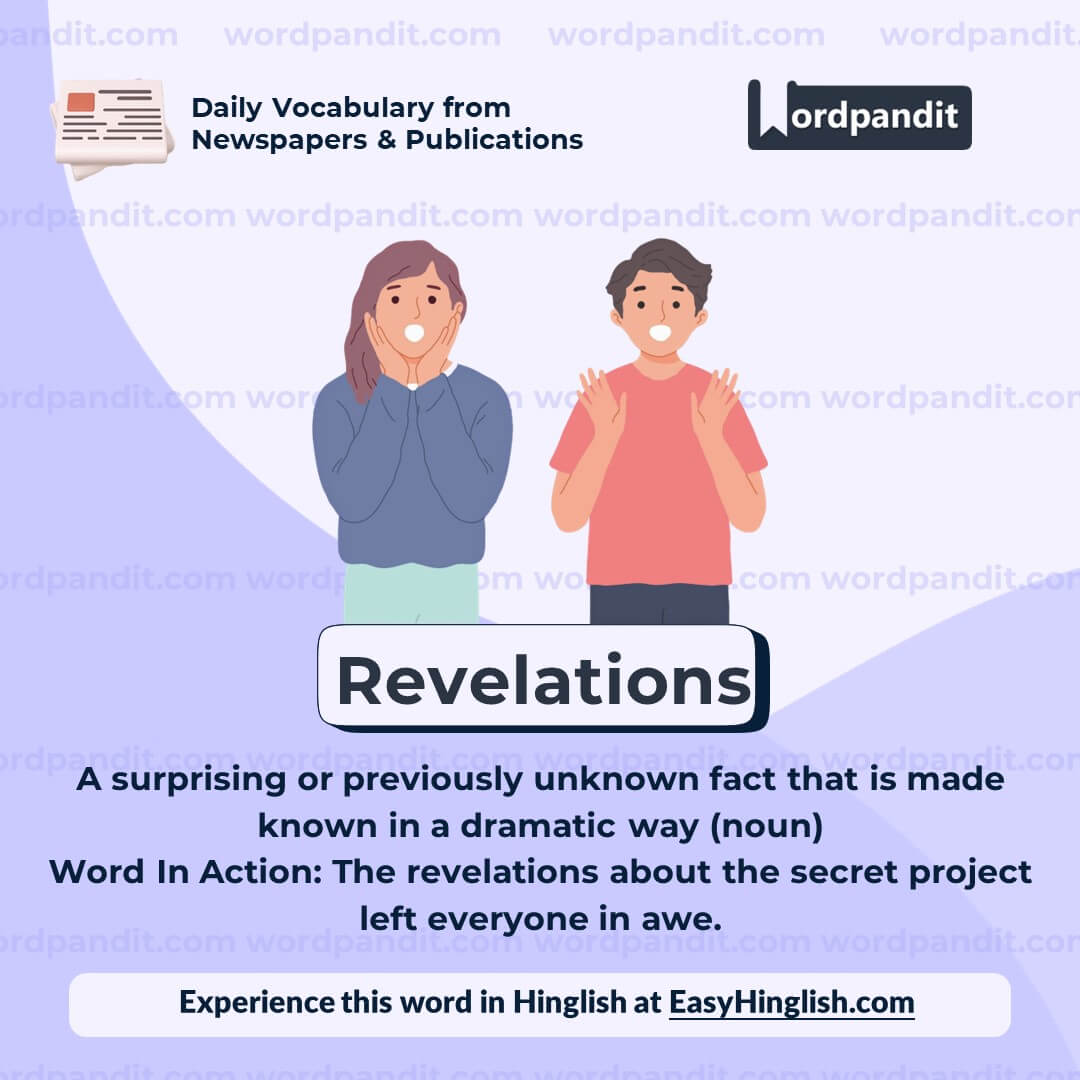
WORD-4: Revelations
Context:
"Further revelations made it clear that it was the news media that had been launched on a wild ride, falling for what was apparently a cynical publicity stunt orchestrated by Heene." - Aeon
Explanatory Paragraph:
Revelations are surprising or previously unknown facts that come to light, often altering how a situation is understood. They can uncover truths that were hidden, misunderstood, or intentionally concealed. In the quoted context, the term “further revelations” implies that new and unexpected information emerged, showing the media had been manipulated. Such disclosures often shift public perception and bring clarity to events clouded by confusion or deception.
Meaning: The act of revealing something previously unknown, often surprising or significant (Noun – plural)
Pronunciation: reh-vuh-LAY-shunz
Difficulty Level: ⭐⭐ Basic
Etymology: From Latin *revelatio*, meaning "disclosure," derived from *revelare* – "to unveil or uncover."
Prashant Sir's Notes:
“Revelations” typically have a dramatic or emotional impact. Think of courtroom scenes, breaking news, or even personal confessions. This word often signals a turning point in narratives.
Synonyms & Antonyms:
Synonyms: disclosures, discoveries, unveilings, exposés, confessions
Antonyms: secrets, concealments, cover-ups, mysteries
Usage Examples:
- The journalist’s report was filled with shocking revelations about corporate misconduct.
- Her diary contained personal revelations that surprised even her closest friends.
- New revelations in the case led to the reopening of the investigation.
- The documentary offered powerful revelations about the hidden lives of whistleblowers.
Cultural Reference:
“The Panama Papers” were a set of explosive revelations that exposed the offshore financial dealings of global elites, changing the conversation around tax avoidance and transparency. - International Consortium of Investigative Journalists (ICIJ)
Think About It:
Can revelations always be trusted, or should we question who is doing the revealing and why?
Quick Activity:
Write down three types of revelations—one personal, one historical, and one scientific. Describe how each could change people's thinking.
Memory Tip:
Think of "reveal" at the heart of "revelations"—like pulling back a curtain to show what was hidden behind it.
Real-World Application:
Understanding the word “revelations” helps when reading news reports, political analysis, biographies, or any narrative where new information reshapes understanding. It signals a shift in what is known or believed.
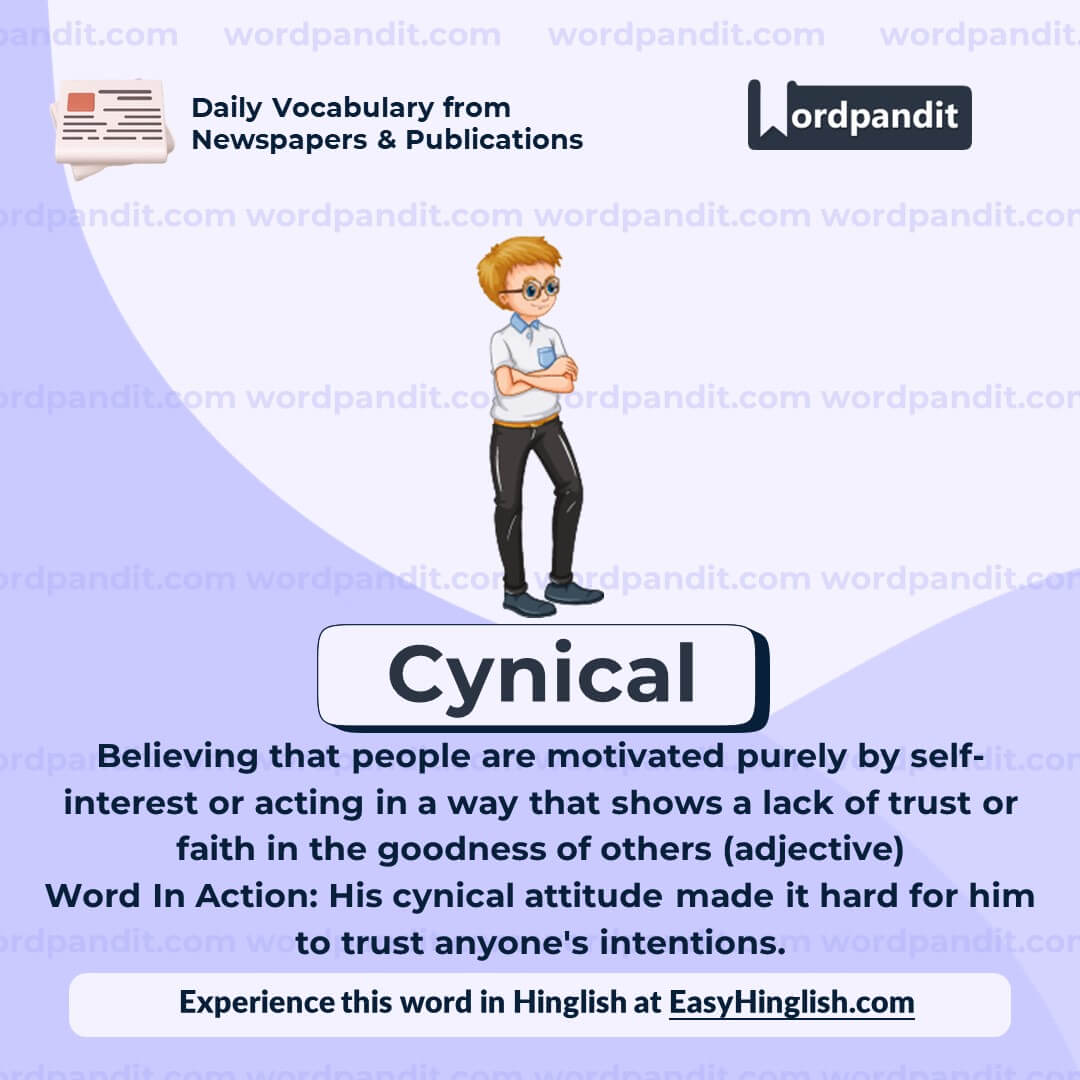
WORD-5: Cynical
Context:
"Further revelations made it clear that it was the news media that had been launched on a wild ride, falling for what was apparently a cynical publicity stunt orchestrated by Heene." - Aeon
Explanatory Paragraph:
To be cynical means to believe that people are primarily motivated by self-interest and to distrust others’ sincerity or integrity. A cynical person expects the worst from human nature. In this context, calling the publicity stunt “cynical” implies that it was done with cold calculation, exploiting the media and public attention for selfish gain without regard for truth or consequences. It suggests manipulation, deception, and a lack of moral concern.
Meaning: Distrustful of others' motives or believing that people are motivated only by self-interest (Adjective)
Pronunciation: SIN-ih-kul
Difficulty Level: ⭐⭐⭐ Intermediate
Etymology: From Greek *kynikos*, meaning "dog-like," originally used to describe the Cynics, a group of ancient philosophers who rejected conventional desires for wealth, power, and fame, and were skeptical of social norms.
Prashant Sir's Notes:
Be careful not to confuse being cynical with being realistic. Cynicism implies negativity and disbelief in goodness or sincerity. The word often carries a bitter or scornful tone.
Synonyms & Antonyms:
Synonyms: skeptical, distrustful, pessimistic, sarcastic, scornful
Antonyms: trusting, optimistic, idealistic, naïve
Usage Examples:
- Her cynical view of politics made her distrust every campaign promise.
- He made a cynical remark about charity being just a way to gain publicity.
- The film offers a cynical take on modern relationships.
- Many people grew cynical after repeated government scandals.
Cultural Reference:
In George Orwell’s *Animal Farm*, the donkey Benjamin embodies cynicism—he believes nothing ever truly changes and views revolution with distrust and irony. - Literature Analysis
Think About It:
Is cynicism a healthy form of skepticism, or does it limit our ability to trust, hope, and collaborate with others?
Quick Activity:
Write two sentences: one that shows a cynical attitude and one that shows an optimistic perspective about the same event. Compare the tone and emotional impact.
Memory Tip:
Think of "cynical" as someone saying, "I SINcerely don’t believe in your intentions"—they doubt everyone’s sincerity and motives.
Real-World Application:
Understanding cynicism helps interpret tone in news, political commentary, and literature. It also allows us to recognize when distrust is warranted—and when it becomes a barrier to progress and connection.


