

Daily Vocabulary from International Newspapers and Publications
Expand Your Vocabulary with Wordpandit’s Global Vocabulary Hub
At Wordpandit, we are committed to helping you develop a truly global vocabulary by drawing from some of the most respected international publications. This section is designed to keep you ahead of the curve by introducing you to words that define global conversations and trends.
The Power of Global Sources
To help you think and communicate on a global scale, we curate vocabulary from renowned international sources, such as:
- The New York Times
- The Washington Post
- BBC
- The Guardian
- The Economist
- Scientific American
- Psychology Today
- And many more...
Stay Global, Stay Competitive
Our daily updates from international publications ensure you are consistently exposed to new words that reflect global news and developments, making sure your vocabulary is not only current but also globally relevant.
Enhance Your Global Perspective
Whether you’re preparing for international exams, aiming to excel in global business communication, or want to enhance your language skills for personal growth, Wordpandit offers the resources you need to thrive in a global context.
Effective Learning, Global Reach
Our learning methodology combines global examples, memory aids, and interactive activities, allowing you to internalize new words effectively and apply them in real-world scenarios.
Begin Your Global Vocabulary Journey Now!
Why Choose Wordpandit?
Practical Learning: Focus on words you'll actually encounter in real-world reading, enhancing your comprehension and communication skills.
Diverse Content: From current affairs to scientific breakthroughs, our varied sources expose you to vocabulary across multiple domains.
Effortless Integration: Make Wordpandit a part of your daily routine. Just a few minutes each day can significantly boost your lexicon over time.
Your Path to Vocabulary Mastery
- Visit our Daily Vocabulary section regularly
- Explore new words and their usage in context
- Practice incorporating these words into your own writing and speech
- Track your progress as your vocabulary expands
Start Your Journey Today
Embark on your vocabulary enhancement journey with Wordpandit. By consistently engaging with our daily posts, you'll build a robust vocabulary that serves you well in academic, professional, and personal contexts.
Remember, a word a day keeps linguistic limitations at bay. Make Wordpandit your daily companion in the quest for vocabulary excellence!

WORD-1: Decontextualized
Context:
"One could almost believe Scott was writing specifically about US foreign policy in the counterterrorism age, making his case against the imposition of grand, decontextualised, ahistorical social engineering projects that discounted those for whom the plans were ostensibly drawn – the people." - Aeon
Explanatory Paragraph:
The word "decontextualized" refers to something that has been removed from its original context or surroundings. In the sentence above, it criticizes policies or plans that are designed without considering the local realities, histories, or specific needs of the people they are meant to affect. When ideas are decontextualized, they lose relevance and meaning because they ignore the circumstances that give them depth or clarity.
Meaning: Removed from the context in which something originally appeared or made sense (Adjective)
Pronunciation: dee-kon-TEKS-chuh-lized
Difficulty Level: ⭐⭐⭐ Intermediate
Etymology: From Latin "de-" meaning "removal" + "contextualize" (from Latin "contextus" meaning "to weave together")
Prashant Sir's Notes:
Important for understanding abstract policy, academic, and philosophical discussions. When a policy is labeled "decontextualized", it often means it's out of touch with ground realities. Learn this word for critiques in essays and opinion pieces.
Synonyms & Antonyms:
Synonyms: disconnected, abstracted, isolated, generalized
Antonyms: contextualized, relevant, grounded, situated
Usage Examples:
- The textbook gave decontextualized vocabulary lists that were hard for students to remember.
- His argument felt decontextualized from the actual problems facing the community.
- Without historical understanding, any policy becomes a decontextualized idea lacking impact.
- Decontextualized data can be misleading and lead to flawed conclusions.
Cultural Reference:
"In a decontextualized world, we risk mistaking information for wisdom." – A paraphrased idea from media theorist Neil Postman.
Think About It:
What are the risks of using ideas or solutions that are decontextualized from the environment or people they are meant to serve?
Quick Activity:
Think of a famous historical event. Write two sentences about it: one in full context, and another that is decontextualized. Compare the difference in meaning.
Memory Tip:
Break the word: "De-" (remove) + "context" = to remove from context. Imagine pulling a puzzle piece out of its full picture—it's hard to understand alone.
Real-World Application:
In education and policymaking, applying decontextualized knowledge can lead to ineffective or even harmful results. Understanding context ensures solutions fit real-life scenarios.
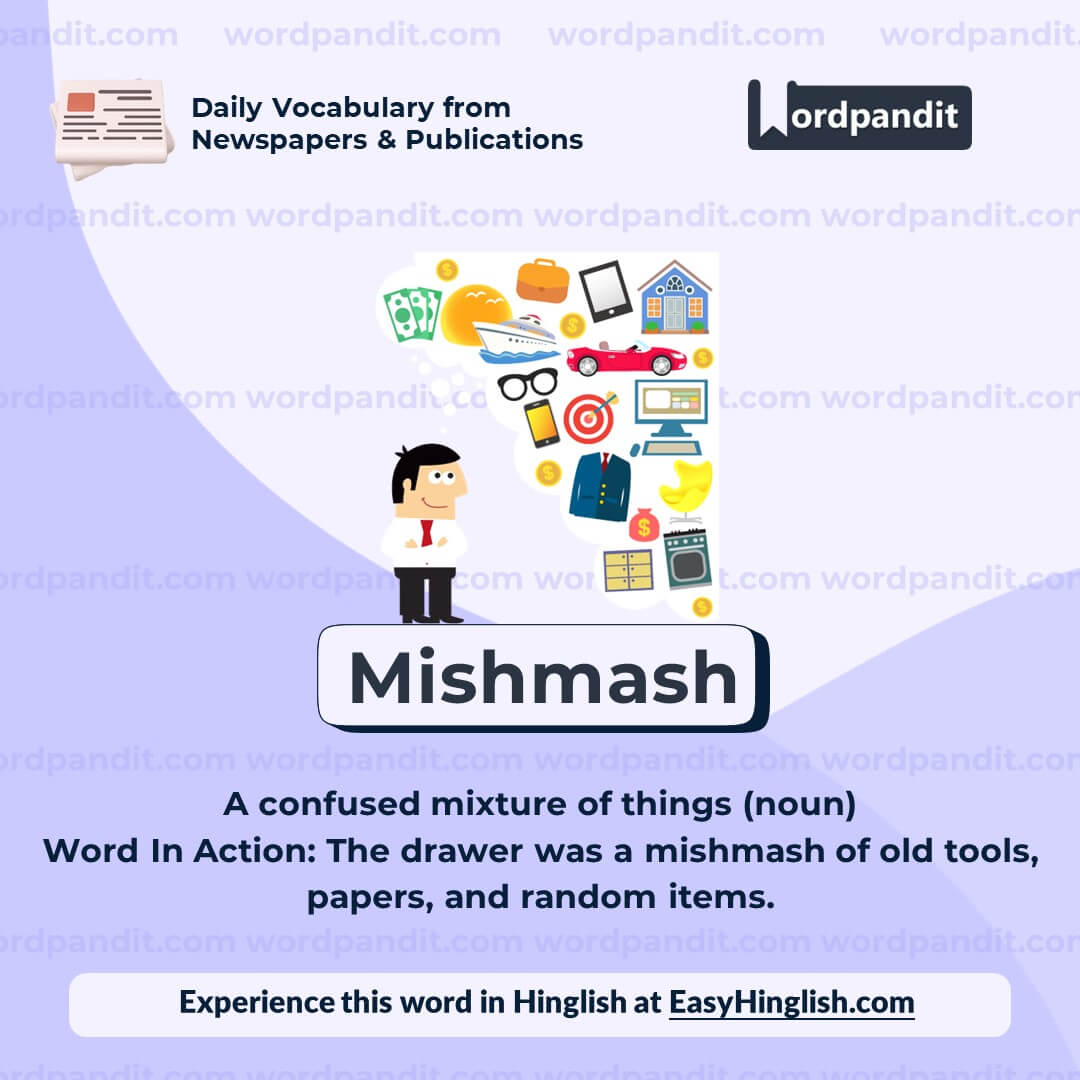
WORD-2: Mishmash
Context:
"One could almost believe Scott was writing specifically about US foreign policy in the counterterrorism age, making his case against the imposition of grand, decontextualised, ahistorical social engineering projects that discounted those for whom the plans were ostensibly drawn – the people." - Aeon
Explanatory Paragraph:
The word "mishmash" refers to a confused mixture or jumble of different things that don’t necessarily go well together. It often implies a lack of order, structure, or harmony. If someone describes an idea, policy, or project as a "mishmash", they likely mean it's a random assortment of elements that feels disorganized or poorly integrated. It’s a casual, somewhat playful word, but it often carries criticism in more serious contexts.
Meaning: A confused mixture of unrelated things; a hodgepodge (Noun)
Pronunciation: MISH-mash
Difficulty Level: ⭐⭐ Basic
Etymology: Reduplicative compound from the 15th century, based on “mash,” likely imitating the sound or sense of messy mixture
Prashant Sir's Notes:
This is a casual but impactful word to describe disorganized or chaotic collections—useful for criticizing unstructured writing, policies, or even meals! Common in everyday speech and informal writing.
Synonyms & Antonyms:
Synonyms: jumble, medley, hodgepodge, mélange, potpourri
Antonyms: order, system, structure, organization
Usage Examples:
- The presentation felt like a mishmash of disconnected ideas with no central theme.
- She served a mishmash of leftovers from the week for dinner.
- The city’s architecture is a charming mishmash of old colonial buildings and modern skyscrapers.
- His essay was a mishmash of quotes with little original analysis.
Cultural Reference:
"The movie was a mishmash of action, romance, and comedy—trying to do too much at once." – Common phrasing in film reviews, especially in The Guardian and The New Yorker.
Think About It:
Can creativity emerge from a mishmash of unrelated ideas, or does true innovation require structure?
Quick Activity:
List five unrelated things (e.g., a banana, a car, a poem, a law, a spaceship). Now, try to create a story from this mishmash!
Memory Tip:
Mishmash sounds like what it means—a “messy mash” of stuff. Think of a plate with spaghetti, cookies, and pickles all mixed up!
Real-World Application:
People use "mishmash" to describe situations in politics, design, or writing where things feel cobbled together without coherence—great for informal critiques or everyday conversations.
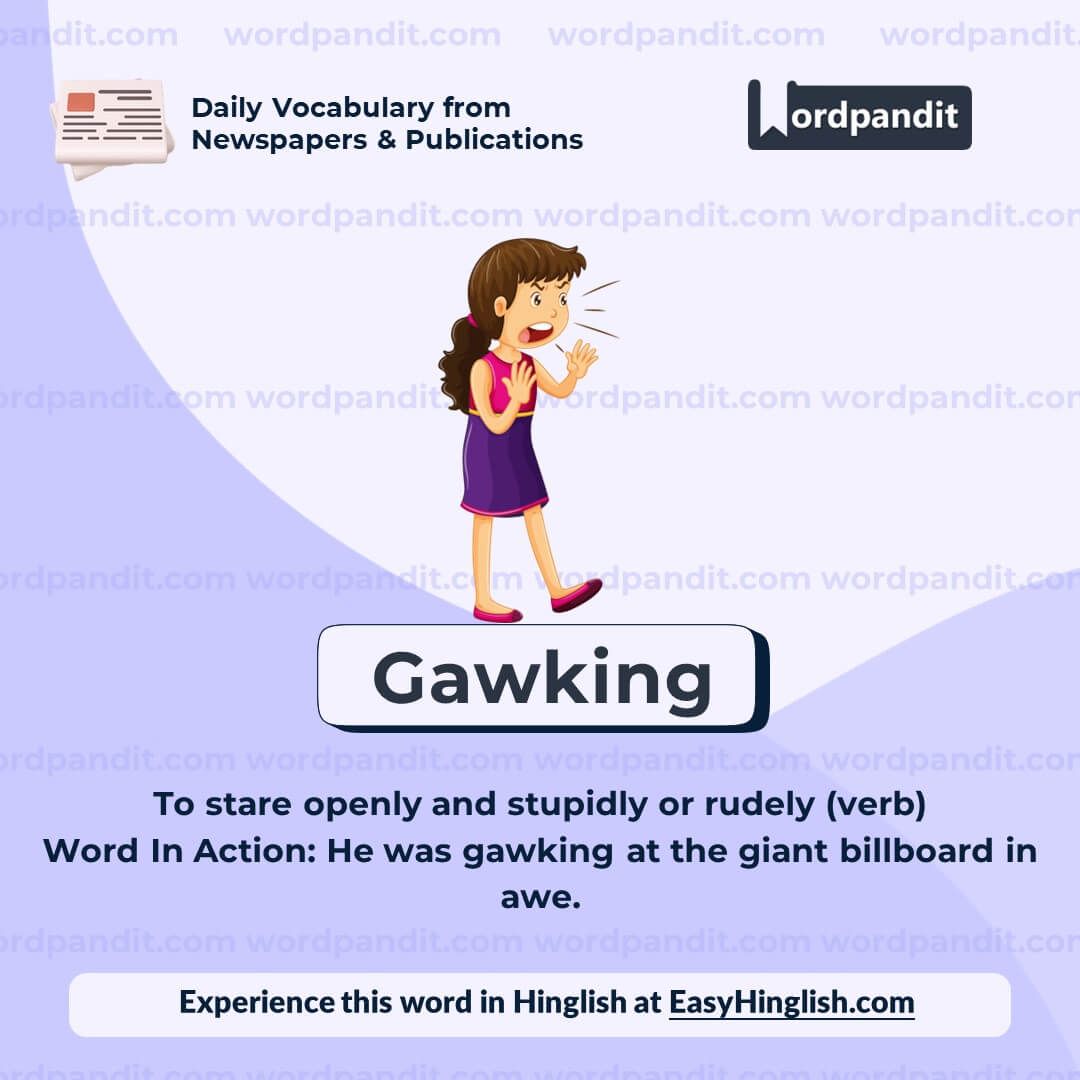
WORD-3: Gawking
Context:
"And, in the process of gawking at the surreal spectacle all over again, viewers may even find themselves a tad implicated in the systems of ‘news coverage’." - Aeon
Explanatory Paragraph:
"Gawking" refers to staring at something or someone in a way that is often rude, overly curious, or thoughtless. It suggests a kind of open-mouthed amazement or mindless fascination. In the context above, it implies that viewers, instead of critically analyzing what they see, are merely staring in fascination at the bizarre nature of the spectacle—perhaps contributing passively to the spectacle itself.
Meaning: Staring openly and stupidly (Verb - present participle of “gawk”)
Pronunciation: GAW-king
Difficulty Level: ⭐⭐ Basic
Etymology: Possibly from Scandinavian origin; related to Norwegian "gauka" (to gape or stare foolishly)
Prashant Sir's Notes:
Commonly used in journalistic or critical writing to describe passive or shallow observation. Good word to describe media behavior, public reactions, or tourist behavior. Use it carefully—it often carries a slightly judgmental tone.
Synonyms & Antonyms:
Synonyms: stare, gape, ogle, rubberneck
Antonyms: glance, ignore, overlook, avert
Usage Examples:
- Tourists stood gawking at the enormous sculpture in the town square.
- He kept gawking at the celebrities instead of enjoying the concert.
- People were gawking at the accident, slowing down traffic.
- The children were gawking at the magician with wide eyes.
Cultural Reference:
"Gawking" is often used in media criticism—like in reality TV or viral video culture—where audiences become passive consumers of sensational content. It also appears in satirical shows like *The Daily Show* to critique modern media habits.
Think About It:
Is gawking just innocent curiosity, or does it reflect a deeper problem of how we consume others’ experiences—especially in media?
Quick Activity:
List three situations where gawking might be considered inappropriate. Then rewrite one as a more respectful way to observe or react.
Memory Tip:
Think of “gawk” as a mix of “gape” and “awkward.” When you gawk, you gape awkwardly at something!
Real-World Application:
Use "gawking" to describe distracted or passive attention—especially in discussions about media consumption, social behavior, or even urban tourism. It can critique unthinking observation.
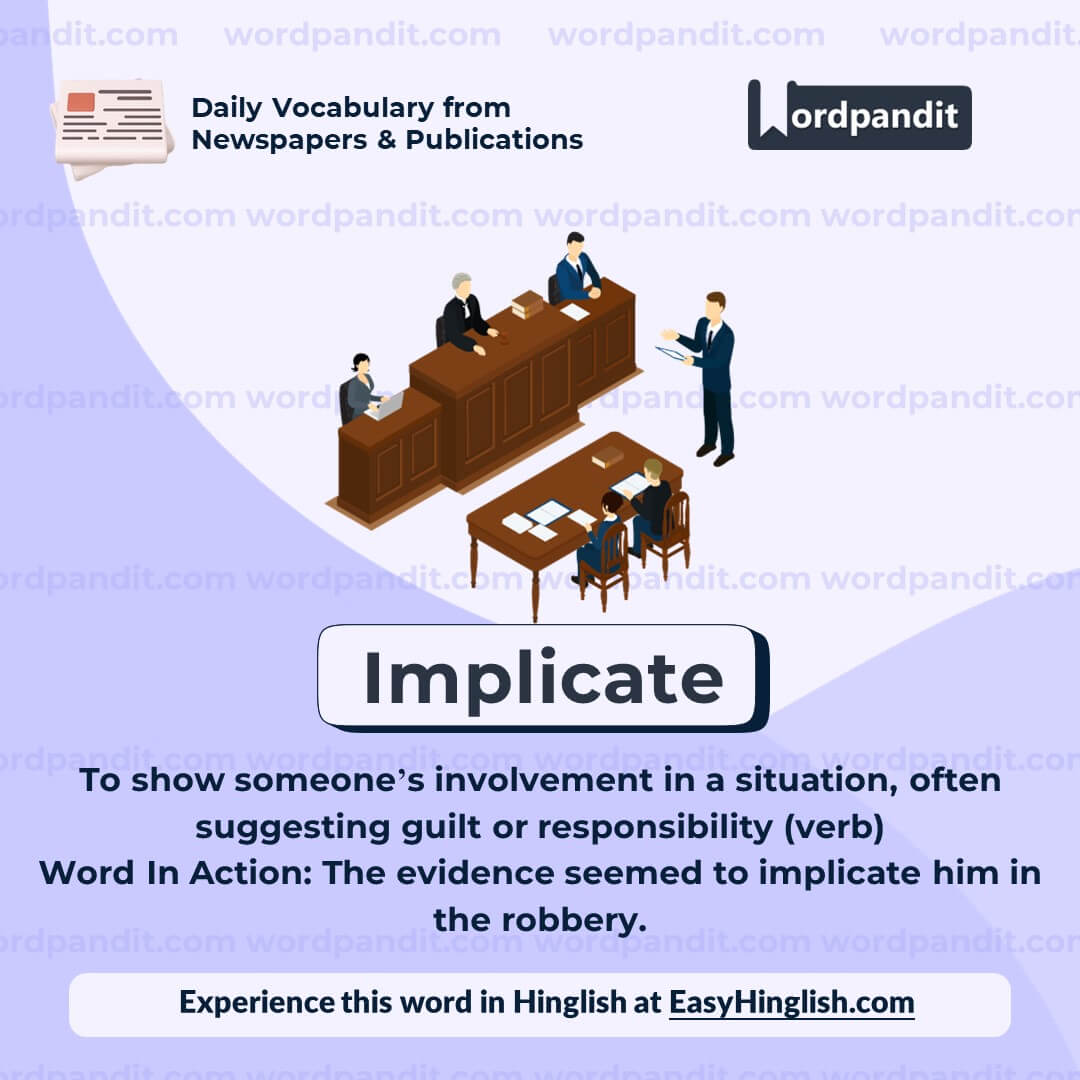
WORD-4: Implicate
Context:
"And, in the process of gawking at the surreal spectacle all over again, viewers may even find themselves a tad implicated in the systems of ‘news coverage’." - Aeon
Explanatory Paragraph:
The word "implicate" means to show or suggest that someone is involved in something—often something negative or questionable. In the sentence above, it implies that by simply watching or consuming the spectacle, viewers might be indirectly participating in or contributing to problematic systems of media. It's a powerful term that highlights moral or ethical entanglement, even when someone isn’t actively doing something wrong.
Meaning: To show or suggest that someone is involved in a crime or questionable activity; to involve someone in a situation (Verb)
Pronunciation: IM-pli-kate
Difficulty Level: ⭐⭐⭐ Intermediate
Etymology: From Latin *implicare*, meaning "to entwine, entangle," from *in-* ("into") + *plicare* ("to fold")
Prashant Sir's Notes:
“Implicate” is useful in both legal and ethical discussions. It’s not just about crime—use it to show involvement, responsibility, or entanglement in broader issues like politics, social behavior, or media. Also a favorite in analytical writing and editorial critiques.
Synonyms & Antonyms:
Synonyms: involve, entangle, associate, incriminate
Antonyms: exonerate, absolve, clear, dissociate
Usage Examples:
- The leaked documents implicated several officials in the corruption scandal.
- Even passive bystanders can be implicated in systems of injustice.
- Her fingerprints on the weapon implicated her in the crime.
- The journalist was careful not to implicate anyone without evidence.
Cultural Reference:
In the famous Watergate scandal, numerous White House staff were implicated in illegal activities, leading to President Nixon’s resignation. The term “implicated” became central to the media coverage of political scandals.
Think About It:
Can someone be implicated in wrongdoing even if they didn’t directly participate? Where should we draw the line between awareness and responsibility?
Quick Activity:
Write two short sentences: one where someone is directly implicated in a wrongdoing, and another where someone is indirectly implicated. Reflect on the difference.
Memory Tip:
Think of "implicate" as getting “wrapped up” in something messy—like being caught in a net. From Latin roots meaning “fold into.”
Real-World Application:
"Implicate" is often used in legal contexts, journalism, and ethics to show someone's involvement—either through action or complicity. It’s especially useful when discussing systems where responsibility is shared or blurry.
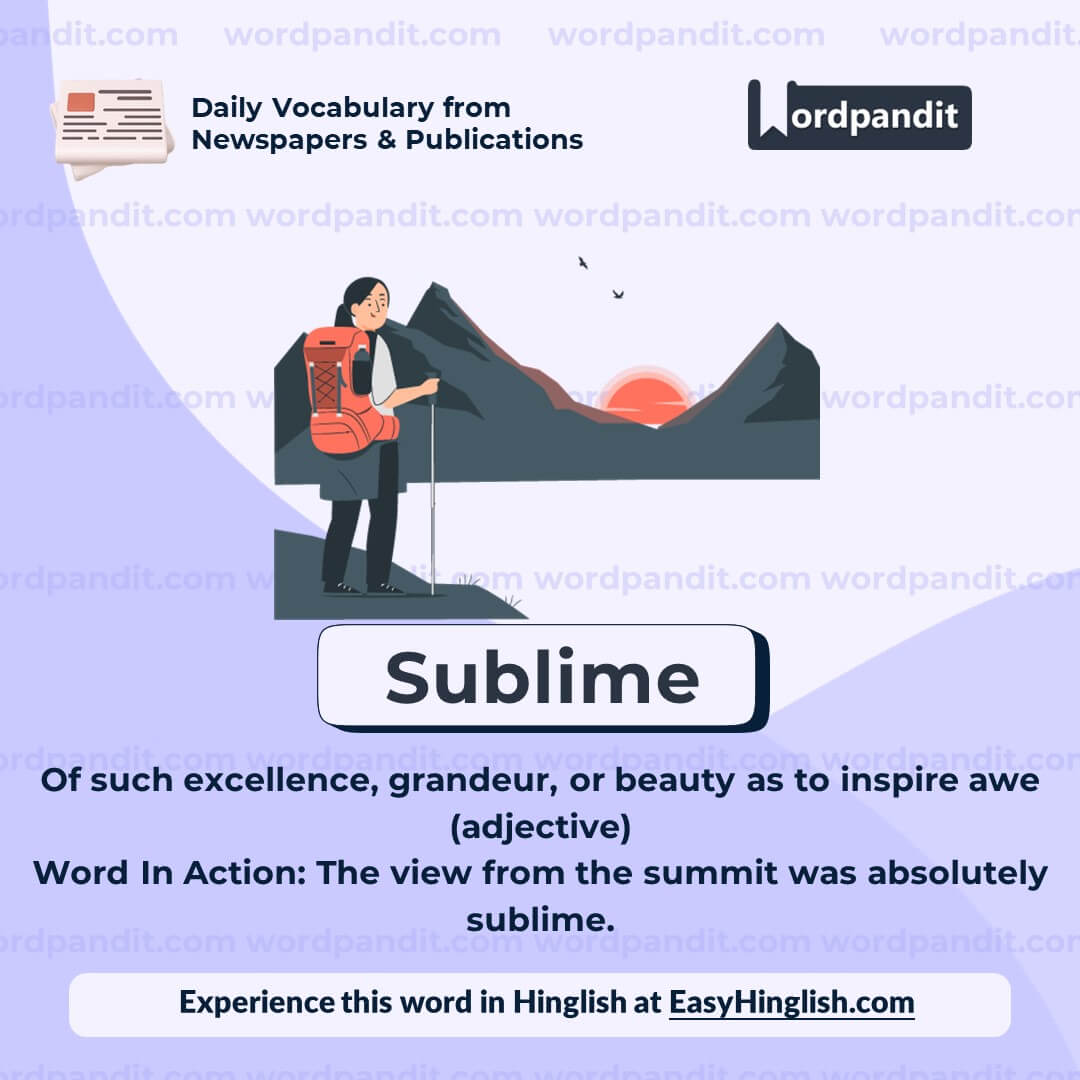
WORD-5: Sublime
Context:
"Laboratories of the impossible: By testing the boundaries of reality, Spanish-language authors have created a sublime counterpart to experimental physics." - Aeon
Explanatory Paragraph:
The word "sublime" describes something so beautiful, grand, or awe-inspiring that it goes beyond ordinary experience—it elevates the mind or spirit. In the context above, it refers to a literary achievement that is not only intellectually impressive but also emotionally moving and almost otherworldly. The word is often used in art, literature, and philosophy to suggest a rare combination of excellence, beauty, and deep impact.
Meaning: Of such excellence, grandeur, or beauty as to inspire great admiration or awe (Adjective)
Pronunciation: suh-BLYME
Difficulty Level: ⭐⭐⭐ Intermediate
Etymology: From Latin *sublimis* meaning “uplifted, exalted” (sub- “up to” + limen “threshold”)
Prashant Sir's Notes:
"Sublime" is a powerful word used in literature and criticism to describe something that elevates human experience. It's not just about beauty—it’s about a kind of overwhelming excellence. Ideal for writing essays on art, literature, philosophy, or even nature.
Synonyms & Antonyms:
Synonyms: majestic, exalted, transcendent, magnificent, glorious
Antonyms: ordinary, mediocre, dull, unimpressive
Usage Examples:
- The view from the mountaintop at sunrise was absolutely sublime.
- Her violin performance reached a sublime level of emotional intensity.
- The novel's ending was sublime—both heartbreaking and beautiful.
- They described the cathedral's architecture as sublime, evoking reverence.
Cultural Reference:
The concept of the "sublime" was central to Romantic poets like Wordsworth and Shelley, who used it to describe nature’s power to evoke deep emotion and spiritual awakening.
Think About It:
Can something man-made ever be as sublime as nature? What qualities must something possess to be called "sublime"?
Quick Activity:
Write down three things (a place, a piece of art, a moment) that you would describe as sublime. Then explain why they deserve that word.
Memory Tip:
Think “sublime” = “so lovely it lifts you up.” The word literally comes from Latin for “up to the threshold” (of heaven!).
Real-World Application:
Use "sublime" to describe experiences that transcend the ordinary—whether in art, nature, literature, music, or even rare moments in daily life that leave you speechless with awe.


