

Daily Vocabulary from International Newspapers and Publications
Expand Your Vocabulary with Wordpandit’s Global Vocabulary Hub
At Wordpandit, we are committed to helping you develop a truly global vocabulary by drawing from some of the most respected international publications. This section is designed to keep you ahead of the curve by introducing you to words that define global conversations and trends.
The Power of Global Sources
To help you think and communicate on a global scale, we curate vocabulary from renowned international sources, such as:
- The New York Times
- The Washington Post
- BBC
- The Guardian
- The Economist
- Scientific American
- Psychology Today
- And many more...
Stay Global, Stay Competitive
Our daily updates from international publications ensure you are consistently exposed to new words that reflect global news and developments, making sure your vocabulary is not only current but also globally relevant.
Enhance Your Global Perspective
Whether you’re preparing for international exams, aiming to excel in global business communication, or want to enhance your language skills for personal growth, Wordpandit offers the resources you need to thrive in a global context.
Effective Learning, Global Reach
Our learning methodology combines global examples, memory aids, and interactive activities, allowing you to internalize new words effectively and apply them in real-world scenarios.
Begin Your Global Vocabulary Journey Now!
Why Choose Wordpandit?
Practical Learning: Focus on words you'll actually encounter in real-world reading, enhancing your comprehension and communication skills.
Diverse Content: From current affairs to scientific breakthroughs, our varied sources expose you to vocabulary across multiple domains.
Effortless Integration: Make Wordpandit a part of your daily routine. Just a few minutes each day can significantly boost your lexicon over time.
Your Path to Vocabulary Mastery
- Visit our Daily Vocabulary section regularly
- Explore new words and their usage in context
- Practice incorporating these words into your own writing and speech
- Track your progress as your vocabulary expands
Start Your Journey Today
Embark on your vocabulary enhancement journey with Wordpandit. By consistently engaging with our daily posts, you'll build a robust vocabulary that serves you well in academic, professional, and personal contexts.
Remember, a word a day keeps linguistic limitations at bay. Make Wordpandit your daily companion in the quest for vocabulary excellence!
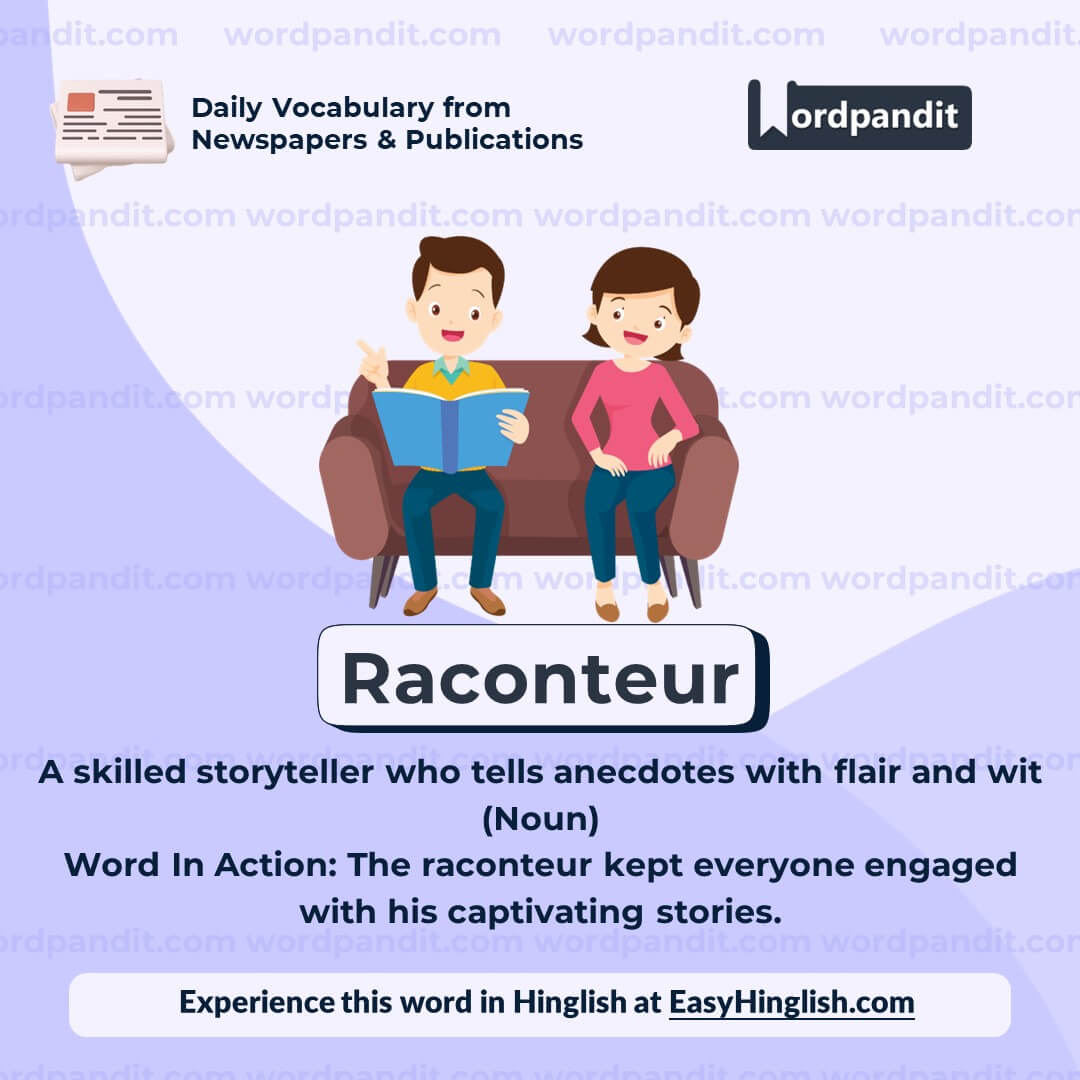
WORD-1: Raconteur
Context:
"The late Daniel C Dennett (1942–2024) was a man of many parts. Sailor, sculptor, singer, pianist, raconteur, aficionado of ribald limericks, much-loved mentor to many young (and not so young) academics, trenchant critic of religion, and the prime mover behind The Philosophical Lexicon (9th ed, 2008)." - Aeon
Explanatory Paragraph:
A "raconteur" is someone gifted in the art of storytelling—someone who can captivate a room with anecdotes, humor, or clever tales. It’s not just about telling a story; it's about delivering it with wit, style, and flair that makes people want to listen. Raconteurs often become the center of social gatherings due to their charisma and command over narrative.
Meaning: A person who tells anecdotes or stories in an engaging and amusing way (Noun)
Pronunciation: rack-on-TER
Difficulty Level: ⭐⭐⭐ Intermediate
Etymology: Borrowed from French "raconteur", derived from "raconter" meaning "to recount or tell".
Prashant Sir's Notes:
Remember, a raconteur isn’t just someone who speaks a lot—it’s someone who speaks *well*. The charm lies in the delivery. Think of people at parties or on stage who naturally draw attention through entertaining stories—they are raconteurs.
Synonyms & Antonyms:
Synonyms: storyteller, narrator, anecdotalist, spinner of tales, talker
Antonyms: listener, recluse, introvert (contextual), noncommunicator
Usage Examples:
- As a natural raconteur, she held the dinner table in rapt attention with stories from her travels.
- The late-night host’s success was partly due to his skill as a raconteur with a sharp comedic sense.
- Even in casual conversations, Mark emerged as a raconteur, weaving humor into everyday incidents.
- Grandpa was the family raconteur, recounting war tales with such vividness that it felt like history came alive.
Cultural Reference:
"Garrison Keillor is perhaps America's best-known modern raconteur, famous for his Prairie Home Companion radio show." - NPR
Think About It:
In an age of social media and short attention spans, do you think the art of being a raconteur is declining or evolving?
Quick Activity:
Write a 5-line anecdote about something funny or unusual that happened to you recently. Try to tell it in a way that would make others smile—be a raconteur!
Memory Tip:
Think of “raconteur” as someone who *recounts* stories with flair—“rack on tour” could also sound like someone going on a storytelling *tour*.
Real-World Application:
Being a raconteur can help in interviews, networking, teaching, or leadership. People who communicate ideas with engaging stories often inspire and connect more deeply with their audience.
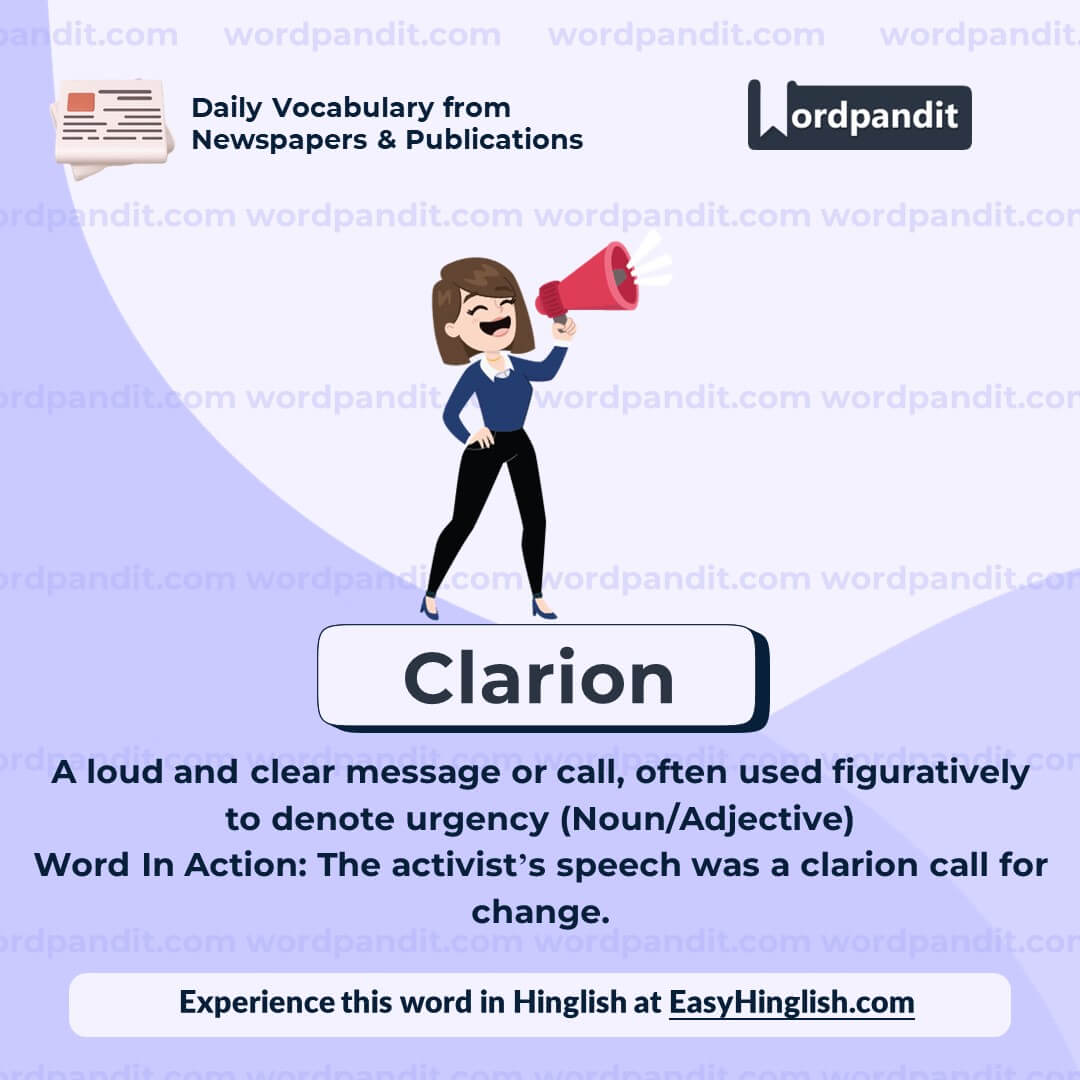
WORD-2: Clarion
Context:
"Scott’s works served as a clarion call for a radically different approach." - Aeon
Explanatory Paragraph:
The word "clarion" originally referred to a medieval trumpet known for its clear, piercing sound. Over time, it evolved metaphorically to describe anything that delivers a strong, unmistakable, and urgent message. A "clarion call" is now commonly used to describe an inspiring appeal or a bold demand for action, especially in contexts involving reform, justice, or innovation.
Meaning: A strong and clear request or message that urges people to act (Noun); Loud and clear (Adjective)
Pronunciation: KLARE-ee-un
Difficulty Level: ⭐⭐ Beginner to Intermediate
Etymology: From Latin *clario*, via Old French *cleron* — a type of trumpet; later used metaphorically for its clear tone.
Prashant Sir's Notes:
The phrase “clarion call” is an important idiomatic usage. It means a powerful and inspiring appeal. You’ll often see it in essays, editorials, and speeches. Think of it as a call to arms—but for ideas, causes, or change.
Synonyms & Antonyms:
Synonyms: call to action, appeal, summons, trumpet call, rallying cry
Antonyms: whisper, murmur, silence, indifference
Usage Examples:
- The leader’s speech was a clarion call for unity in troubled times.
- Her resignation letter was a clarion message about the need for workplace reform.
- Environmental activists issued a clarion call to protect the rainforests.
- Martin Luther King Jr.'s “I Have a Dream” speech remains a clarion voice in the fight for civil rights.
Cultural Reference:
"Give me liberty, or give me death!"—Patrick Henry's famous line is considered a clarion call of the American Revolution. - U.S. History Archives
Think About It:
What issues in today’s world do you believe deserve a clarion call—and who should deliver it?
Quick Activity:
Write one sentence that acts as a “clarion call” for something you care deeply about (climate change, mental health, education, etc.).
Memory Tip:
Think of a trumpet’s *clear* and loud sound—*clarion* sounds like *clarity* + *horn* → a call that’s impossible to ignore.
Real-World Application:
In persuasive writing, speeches, and leadership, issuing a “clarion call” can inspire action and rally support. It’s especially powerful in social movements and advocacy campaigns.
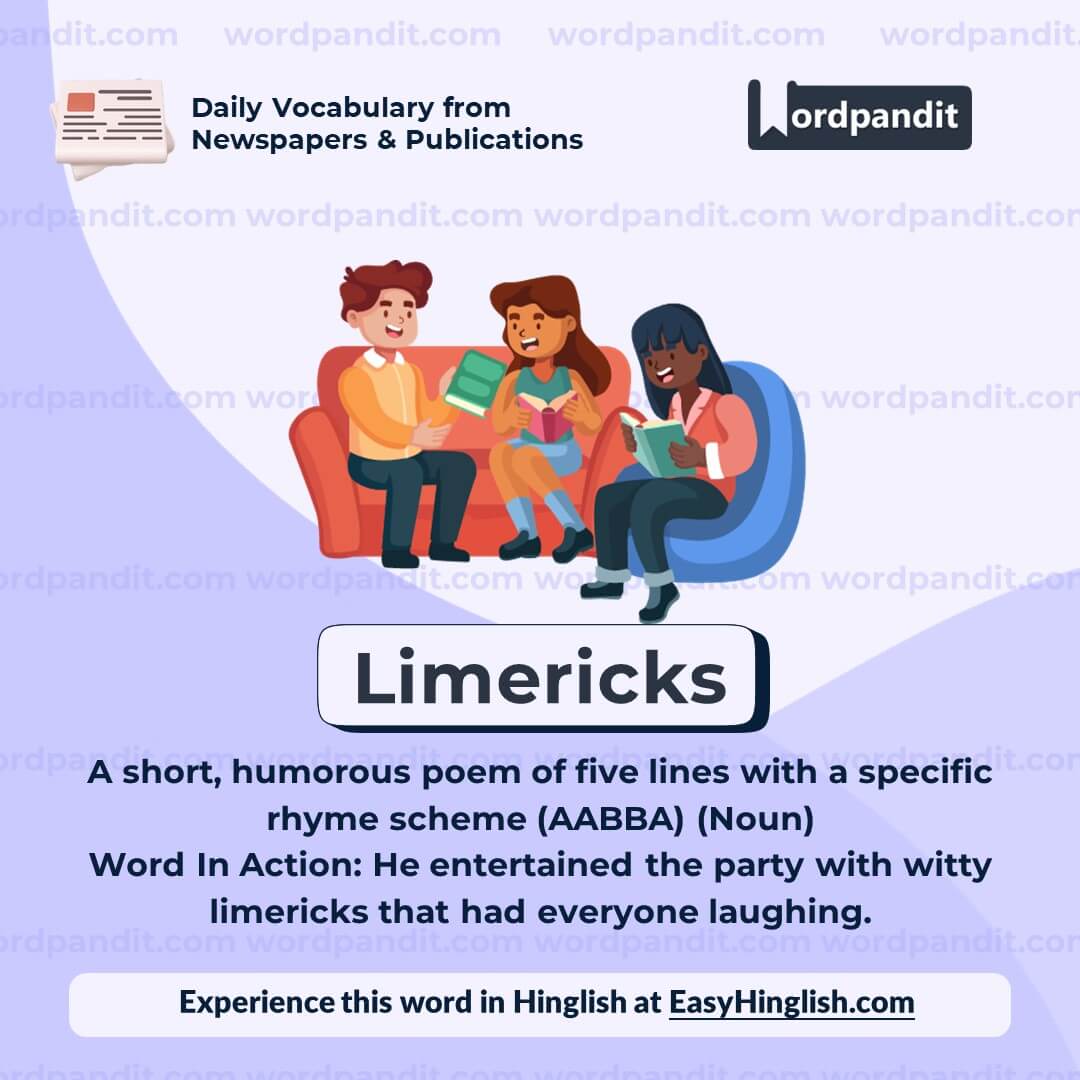
WORD-3: Limericks
Context:
"The late Daniel C Dennett (1942–2024) was a man of many parts. Sailor, sculptor, singer, pianist, raconteur, aficionado of ribald limericks, much-loved mentor to many young (and not so young) academics, trenchant critic of religion, and the prime mover behind The Philosophical Lexicon (9th ed, 2008)." - Aeon
Explanatory Paragraph:
Limericks are short, humorous poems consisting of five lines with a distinctive rhythm and rhyme scheme (AABBA). Known for their wit, wordplay, and often nonsensical or risqué content, limericks are a popular form of light verse. They're usually written to entertain and amuse, making them a beloved staple in both literary circles and casual settings.
Meaning: A humorous five-line poem with a specific rhythm and rhyme pattern (Noun)
Pronunciation: LIM-uh-ricks
Difficulty Level: ⭐ Beginner
Etymology: Possibly derived from the Irish city of Limerick, where a style of verse may have originated or gained popularity in 18th-century pub songs.
Prashant Sir's Notes:
Remember the classic 5-line structure: lines 1, 2, and 5 rhyme with each other, and lines 3 and 4 share a shorter rhyme. Try writing a few—it’s a fun and creative exercise that strengthens rhythm and rhyme sense!
Synonyms & Antonyms:
Synonyms: comic verse, humorous poem, nonsense rhyme, rhymed quatrain (loosely)
Antonyms: prose, epic poem, serious verse
Usage Examples:
- He entertained the children with a series of clever limericks about animals.
- The poet's limericks were filled with wordplay and subtle humor.
- Writing limericks is a great way to teach kids about rhyme and rhythm.
- She collected limericks from around the world in a small, illustrated book.
Cultural Reference:
"There once was a man from Peru, who dreamt he was eating his shoe…" — a classic example of a limerick popularized in children's books and humor anthologies.
Think About It:
Why do you think short and humorous forms like limericks remain popular in a world that often values long-form storytelling?
Quick Activity:
Try writing your own limerick using the AABBA rhyme scheme. Keep it funny, clever, or even nonsensical!
Memory Tip:
Think of “Limerick” as a “little lyric” — both start with “Li” and are short, lyrical, and light-hearted in tone.
Real-World Application:
Limericks are used in classrooms to teach rhyme and meter, in comedy for quick laughs, and even in advertising for catchy, memorable phrases. They're a creative tool for both education and entertainment.
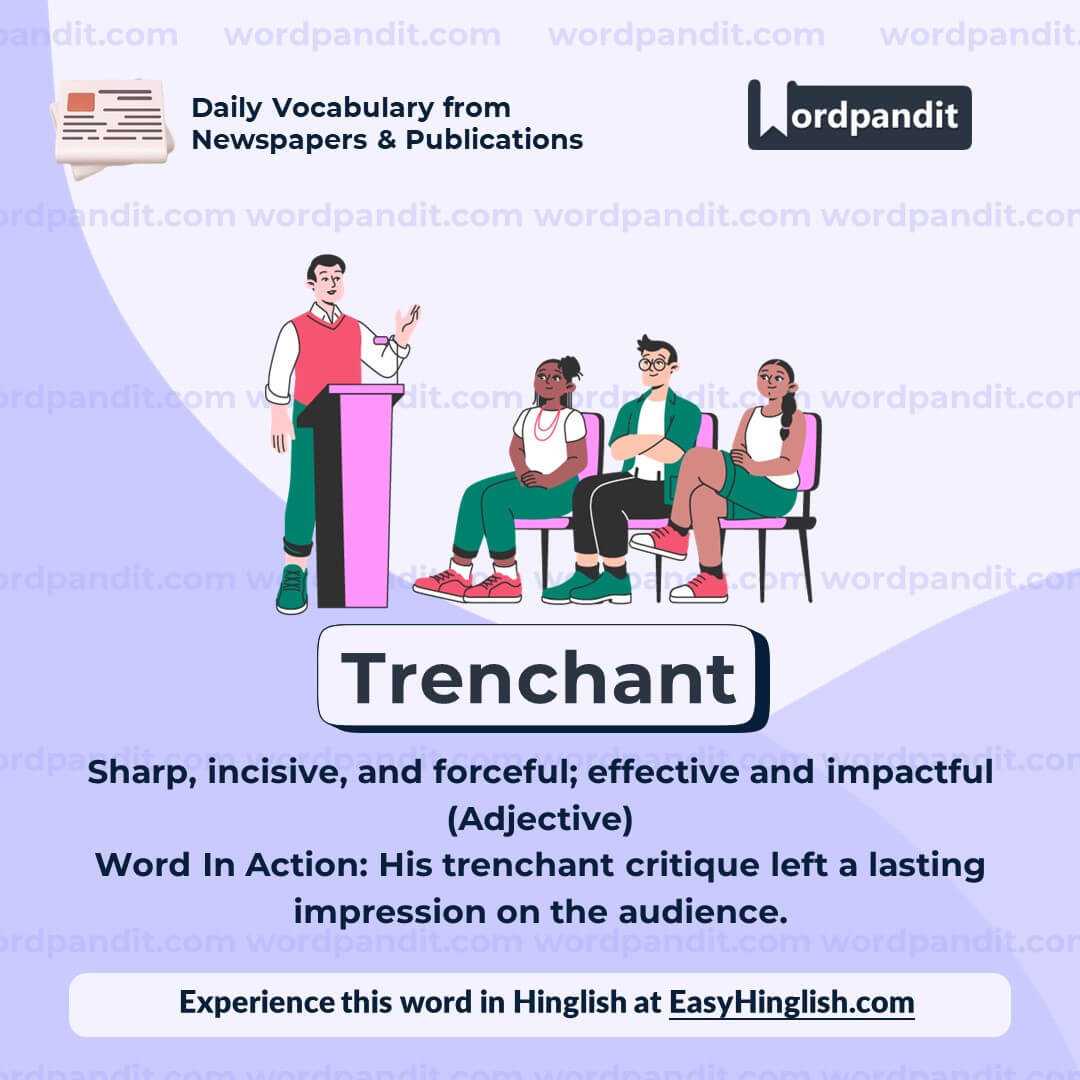
WORD-4: Trenchant
Context:
"The late Daniel C Dennett (1942–2024) was a man of many parts. Sailor, sculptor, singer, pianist, raconteur, aficionado of ribald limericks, much-loved mentor to many young (and not so young) academics, trenchant critic of religion, and the prime mover behind The Philosophical Lexicon (9th ed, 2008)." - Aeon
Explanatory Paragraph:
"Trenchant" is used to describe speech, writing, or criticism that is sharp, incisive, and effective. A trenchant remark cuts to the heart of the issue with clarity and precision, often revealing uncomfortable truths. People known for trenchant opinions don’t shy away from being direct or bold, and their observations are usually insightful—even if they're controversial.
Meaning: Incisive, sharp, and forceful in expression or style; penetrating and clear (Adjective)
Pronunciation: TREN-chunt
Difficulty Level: ⭐⭐⭐ Intermediate
Etymology: From Old French *trenchant* ("cutting"), present participle of *trenchier* ("to cut") — reflecting the "cutting" nature of trenchant remarks.
Prashant Sir's Notes:
Trenchant doesn't mean "angry" or "rude"—it means powerfully insightful and often direct. Use it to describe writing or speech that slices through confusion and gets to the point. Great editorial writers and critics often have a trenchant style.
Synonyms & Antonyms:
Synonyms: incisive, sharp, penetrating, cutting, acerbic
Antonyms: vague, dull, bland, weak, indecisive
Usage Examples:
- The journalist’s trenchant critique of the policy exposed its fundamental flaws.
- Her trenchant wit made her both admired and feared in academic circles.
- He delivered a trenchant speech that challenged long-held assumptions.
- The review was trenchant, praising the film’s risks while dismantling its flaws.
Cultural Reference:
"Christopher Hitchens was known for his trenchant essays and debates, especially on politics and religion." — The Atlantic
Think About It:
Can trenchant criticism be constructive, or does it risk alienating those it aims to influence?
Quick Activity:
Write a trenchant one-sentence critique of a common societal norm or practice. Be direct but insightful.
Memory Tip:
Think of *trenchant* as a "trench-cutting" comment—deep, sharp, and powerful enough to leave a mark.
Real-World Application:
In professional settings like journalism, academia, or public speaking, a trenchant style can help clarify complex issues, persuade audiences, and challenge assumptions effectively.
WORD-5: Contour
Context:
"The years BD (‘before Dennett’), philosophers assumed that their job was to chart the contours of our ordinary thought and talk about the mind." - Aeon
Explanatory Paragraph:
"Contour" refers to the outline, shape, or form of something. While it's often used in physical or visual contexts (like maps or faces), it can also be used metaphorically to describe the structure or defining features of abstract things—such as ideas, theories, or social trends. In the given context, it means identifying and mapping the structure or main lines of how we think and talk about the mind.
Meaning: The outline or general shape of something; a defining boundary or structure (Noun)
Pronunciation: KON-toor
Difficulty Level: ⭐⭐ Beginner to Intermediate
Etymology: From French *contour*, from Latin *contornare* — *con-* (completely) + *tornare* (to turn on a lathe); literally meaning to "turn around" or "outline".
Prashant Sir's Notes:
Think of "contour lines" on a map—they define shape and elevation. Similarly, when we speak of "contours of thought" or "contours of policy," we're referring to their structure, direction, and defining edges. It's a versatile word, used in both physical and abstract contexts.
Synonyms & Antonyms:
Synonyms: outline, shape, profile, form, structure
Antonyms: core, center, inside, interior (contextual)
Usage Examples:
- The sculptor carefully followed the contours of the model’s face.
- Satellite images reveal the contours of the mountain range with great detail.
- The essay traced the contours of modern political thought.
- Makeup artists often use shading to enhance the natural contours of the face.
Cultural Reference:
"Contour lines" are heavily used in topographic maps to indicate elevation changes. These maps are crucial in fields like geography, urban planning, and hiking navigation. – National Geographic
Think About It:
How do the "contours" of your personal beliefs shape the way you perceive new information or challenges?
Quick Activity:
Pick an abstract idea (e.g., freedom, identity, education) and write a sentence describing its “contours” — what defines its boundaries or shape?
Memory Tip:
Think of “con-tour” as taking a “tour” around the “outline” of something — the edge that defines the shape.
Real-World Application:
In design, art, geography, and even philosophy, understanding contours helps define structure. Whether you're reading a map, sketching a face, or analyzing a theory, recognizing contours is essential for seeing the whole picture clearly.


