

Daily Vocabulary from International Newspapers and Publications
Expand Your Vocabulary with Wordpandit’s Global Vocabulary Hub
At Wordpandit, we are committed to helping you develop a truly global vocabulary by drawing from some of the most respected international publications. This section is designed to keep you ahead of the curve by introducing you to words that define global conversations and trends.
The Power of Global Sources
To help you think and communicate on a global scale, we curate vocabulary from renowned international sources, such as:
- The New York Times
- The Washington Post
- BBC
- The Guardian
- The Economist
- Scientific American
- Psychology Today
- And many more...
Stay Global, Stay Competitive
Our daily updates from international publications ensure you are consistently exposed to new words that reflect global news and developments, making sure your vocabulary is not only current but also globally relevant.
Enhance Your Global Perspective
Whether you’re preparing for international exams, aiming to excel in global business communication, or want to enhance your language skills for personal growth, Wordpandit offers the resources you need to thrive in a global context.
Effective Learning, Global Reach
Our learning methodology combines global examples, memory aids, and interactive activities, allowing you to internalize new words effectively and apply them in real-world scenarios.
Begin Your Global Vocabulary Journey Now!
Why Choose Wordpandit?
Practical Learning: Focus on words you'll actually encounter in real-world reading, enhancing your comprehension and communication skills.
Diverse Content: From current affairs to scientific breakthroughs, our varied sources expose you to vocabulary across multiple domains.
Effortless Integration: Make Wordpandit a part of your daily routine. Just a few minutes each day can significantly boost your lexicon over time.
Your Path to Vocabulary Mastery
- Visit our Daily Vocabulary section regularly
- Explore new words and their usage in context
- Practice incorporating these words into your own writing and speech
- Track your progress as your vocabulary expands
Start Your Journey Today
Embark on your vocabulary enhancement journey with Wordpandit. By consistently engaging with our daily posts, you'll build a robust vocabulary that serves you well in academic, professional, and personal contexts.
Remember, a word a day keeps linguistic limitations at bay. Make Wordpandit your daily companion in the quest for vocabulary excellence!
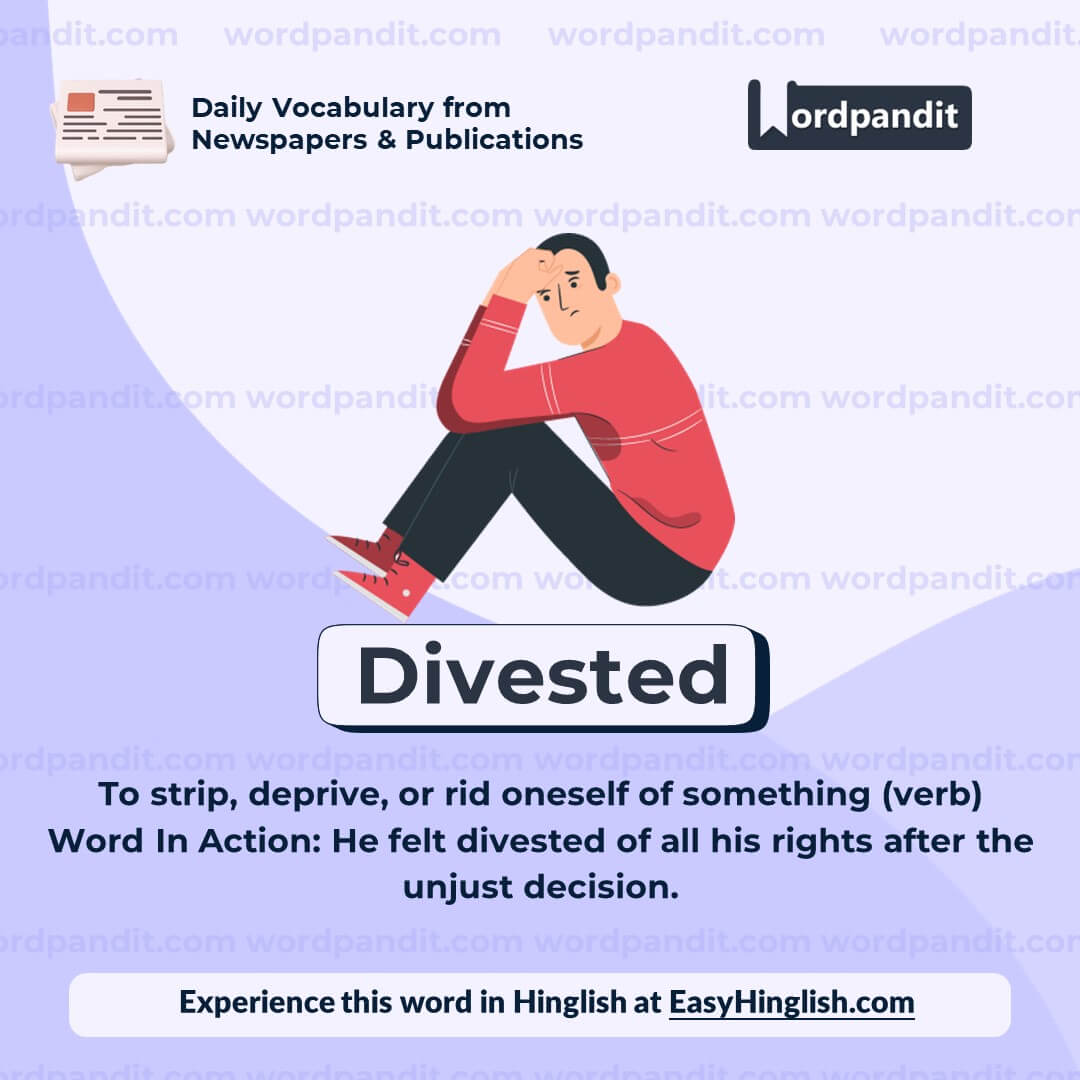
WORD-1: Divested
Context:
"Philosophy of mind divested itself of its obsession with our ordinary thought and talk about the mind, and instead took its inspiration from science – in particular, neuroscience." - Aeon
Explanatory Paragraph:
The word "divested" means to strip away, remove, or rid oneself of something. In the context of ideas or philosophies, it refers to intentionally letting go of previously held beliefs or attachments. In the sentence provided, the philosophy of mind has rid itself of older, possibly traditional notions and embraced a more scientific and empirical perspective. The shift suggests a conscious removal of past influences to make way for a new approach.
Meaning: To strip or remove something, especially rights, responsibilities, or possessions (Verb)
Pronunciation: dih-VEST-ed
Difficulty Level: ⭐⭐⭐ Intermediate
Etymology: From Latin 'divestire' — 'di-' (apart) + 'vestire' (to clothe), literally meaning "to un-clothe"
Prashant Sir's Notes:
Think of "divest" as the opposite of "invest." Just like you invest money into something, to "divest" is to pull your resources, interest, or involvement away from it. This word is often used in business (divesting from companies), in politics (divesting interest or control), and in abstract contexts (divesting beliefs or habits).
Synonyms & Antonyms:
Synonyms: remove, strip, deprive, rid, relinquish, eliminate
Antonyms: invest, retain, keep, acquire, hold
Usage Examples:
- The company divested its interest in fossil fuels to focus on renewable energy.
- He gradually divested himself of outdated ideas and embraced a more modern worldview.
- In her speech, the activist urged universities to divest from unethical industries.
- The ruler was divested of power after a peaceful transition to democracy.
Cultural Reference:
"The global fossil fuel divestment movement gained momentum in the 2010s, as institutions, universities, and even governments pledged to pull investments from coal, oil, and gas industries." - Climate Policy Review
Think About It:
What are some outdated beliefs or assumptions that society needs to divest from in order to progress?
Quick Activity:
List three things—beliefs, habits, or material possessions—you would consider divesting from in your own life. Reflect on why.
Memory Tip:
Think: "di-VEST" — taking off a "vest" or outer layer — to *divest* is to remove something.
Real-World Application:
In the corporate world, companies may divest from certain assets or industries for ethical, financial, or strategic reasons. Similarly, individuals may divest from social media or fast fashion to live more intentionally.

WORD-2: Obituary
Context:
"In the words of The Guardian’s obituary this April, Dennett ‘helped shift Anglo-American philosophy from its focus on language and concepts towards a coalition with science.’" - Aeon
Explanatory Paragraph:
An "obituary" is a notice or article that reports a person's death, often accompanied by a summary of their life, achievements, and contributions. Typically published in newspapers or online, obituaries serve to honor the deceased and inform the public of their passing. In the context above, The Guardian published an obituary for philosopher Daniel Dennett, reflecting on the intellectual shifts he helped bring about in philosophy.
Meaning: A published notice of a person’s death, often with a brief biography (Noun)
Pronunciation: uh-BICH-oo-air-ee
Difficulty Level: ⭐⭐ Basic
Etymology: From Latin 'obitus' meaning "death" and 'obire' meaning "to go toward, to die"
Prashant Sir's Notes:
This is one of those words that frequently appears in newspapers and magazines, especially when a notable figure passes away. An obituary is not just a death notice—it often celebrates the life and contributions of the deceased, offering a respectful summary for readers.
Synonyms & Antonyms:
Synonyms: death notice, memorial article, tribute, eulogy (in some contexts)
Antonyms: birth announcement, biography (ongoing life), celebration of life (can be distinct in tone)
Usage Examples:
- The newspaper published a heartfelt obituary honoring the late scientist’s groundbreaking work.
- She was surprised to find an obituary for her former professor in the weekend edition.
- Writing obituaries requires a unique blend of journalistic skill and empathy.
- The obituary emphasized not only his accomplishments but also his deep commitment to community service.
Cultural Reference:
"The New York Times is renowned for its detailed and often literary obituaries, which chronicle the lives of famous figures and unsung heroes alike." - NYT Features
Think About It:
If someone were to write your obituary today, what would you hope it says about the life you've lived so far?
Quick Activity:
Pick a famous personality who passed away recently. Search for their obituary and note down three key aspects highlighted about their life. Reflect on what made them memorable.
Memory Tip:
Think of “obituary” as “object + burial” — it’s a written object or article marking a burial (death) of a person.
Real-World Application:
Obituaries are a key part of journalism and cultural memory. Writers, editors, and historians use them to preserve the legacy of individuals and reflect on societal values through the lives we choose to honor.
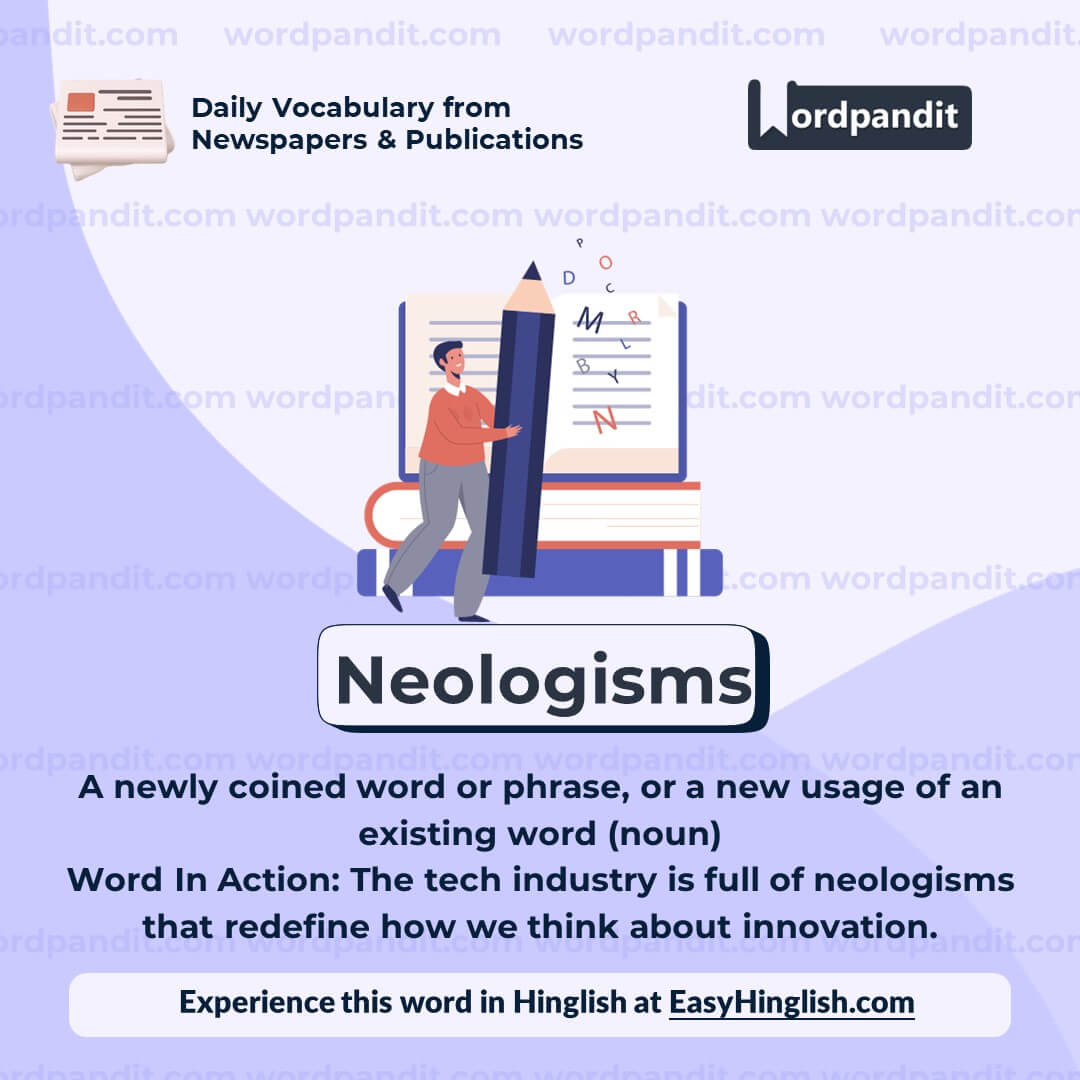
WORD-3: Neologisms
Context:
"The prime mover behind The Philosophical Lexicon (9th ed, 2008), a dictionary of satirical neologisms based on the names of influential philosophers." - Aeon
Explanatory Paragraph:
"Neologisms" are newly coined words or expressions that may not yet be fully accepted into mainstream language. These words often arise in response to new technologies, cultural shifts, or creative needs. In the context above, "satirical neologisms" refers to humorous or ironic new terms invented by the authors of *The Philosophical Lexicon*, often inspired by well-known philosophers’ names and ideas.
Meaning: Newly invented words or expressions (Noun – plural)
Pronunciation: NEE-oh-loh-jiz-uhmz
Difficulty Level: ⭐⭐⭐ Intermediate
Etymology: From French ‘néologisme’, based on Greek ‘neo’ (new) + ‘logos’ (word, speech)
Prashant Sir's Notes:
Think of neologisms as linguistic inventions. Whenever a society or field evolves, it needs new terms to describe fresh ideas or phenomena—these are neologisms. They can be playful, serious, or technical. Some stick around and become mainstream; others fade away.
Synonyms & Antonyms:
Synonyms: coinages, new terms, invented words, portmanteaus
Antonyms: archaic words, outdated terms, clichés, traditional expressions
Usage Examples:
- Technology gives rise to neologisms like "selfie" and "google" as a verb.
- Shakespeare was famous for inventing neologisms that are now everyday English words.
- Modern internet culture is a fertile ground for humorous neologisms.
- The author's frequent use of neologisms added a quirky charm to her writing.
Cultural Reference:
"The term 'bromance'—a blend of 'brother' and 'romance'—is a classic example of a neologism that quickly gained popularity in popular culture." - Urban Dictionary Chronicles
Think About It:
How do neologisms reflect the evolution of human thought, and can they shape the way we perceive the world?
Quick Activity:
Invent your own neologism by combining two existing words. Write a definition for it and use it in a sentence!
Memory Tip:
Break it down: "Neo" = new, "logism" = word or speech — so a *neologism* is literally a "new word."
Real-World Application:
Neologisms are essential in fields like technology, marketing, and social media, where innovation demands fresh vocabulary to describe new products, behaviors, or ideas.
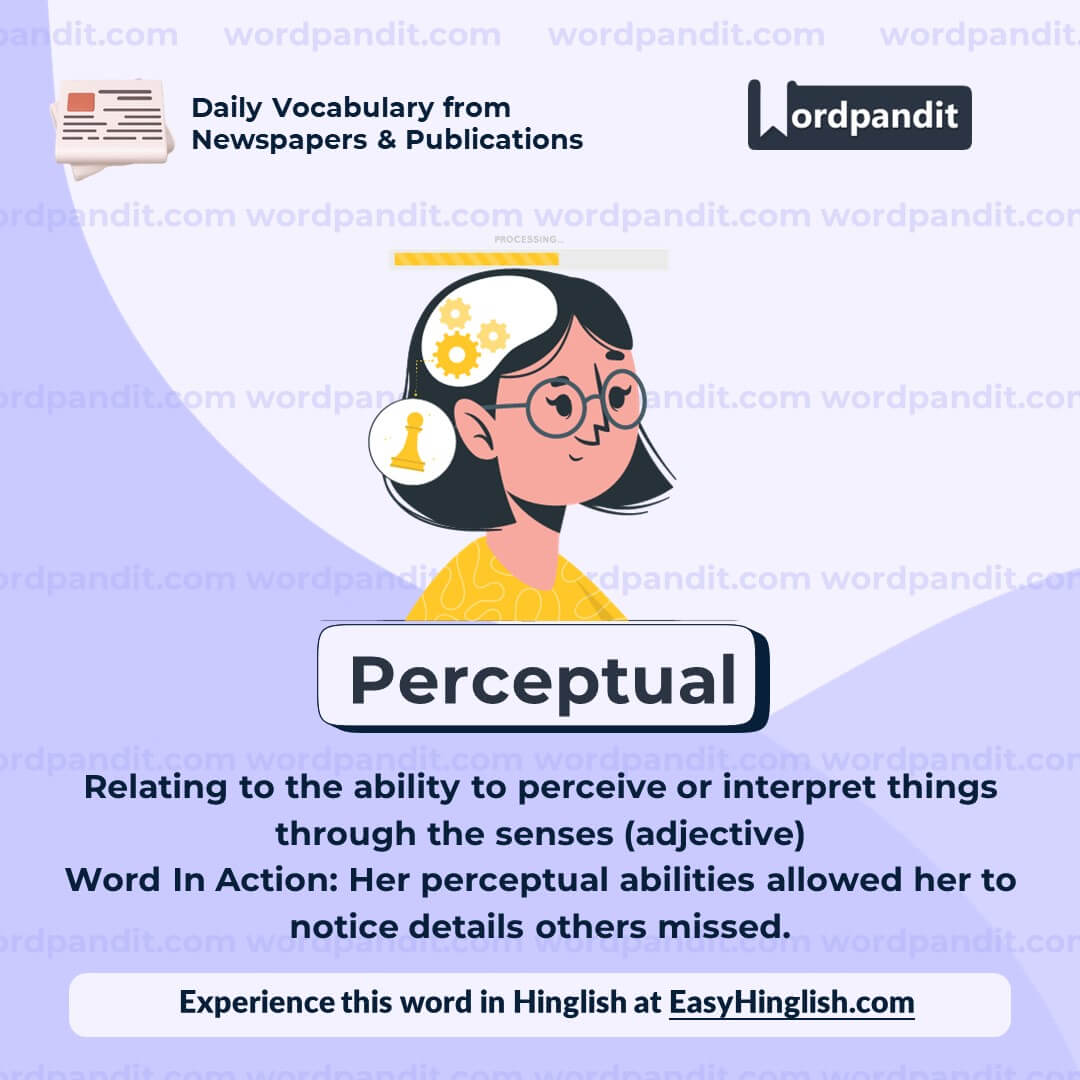
WORD-4: Perceptual
Context:
"Much of what we do. And it assumes that we are subjects of consciousness – creatures who undergo perceptual, emotional and bodily experiences." - BBC
Explanatory Paragraph:
"Perceptual" refers to anything related to the process of perceiving—how we see, hear, feel, or otherwise become aware of things through our senses. In this context, the word emphasizes that humans experience the world not just intellectually, but also through their perceptions—sight, sound, touch, and so on. It highlights the sensory aspect of consciousness and how we interact with our environment in a deeply felt, often automatic way.
Meaning: Relating to perception or the ability to interpret sensory information (Adjective)
Pronunciation: per-SEP-choo-uhl
Difficulty Level: ⭐⭐⭐ Intermediate
Etymology: From Latin ‘percipere’ meaning "to seize, understand, or take in fully" + ‘-al’ (forming adjectives)
Prashant Sir's Notes:
"Perceptual" is closely tied to how we experience the world moment to moment. It’s different from *conceptual* (which is about ideas). Think of "perceptual" as anything processed through your senses—sight, hearing, touch, etc. Psychology often discusses perceptual abilities like depth perception or color recognition.
Synonyms & Antonyms:
Synonyms: sensory, observational, cognitive (in some contexts), experiential
Antonyms: imperceptible, unnoticeable, oblivious (context-dependent)
Usage Examples:
- Children develop key perceptual skills through play and exploration.
- Artists often rely on heightened perceptual awareness to capture detail.
- Virtual reality is designed to stimulate our perceptual systems for a more immersive experience.
- Perceptual illusions can trick the brain into seeing things that aren’t really there.
Cultural Reference:
"In his experiments, psychologist James Gibson revolutionized how we understand perceptual systems by emphasizing the importance of direct interaction with the environment." - Psychology Today
Think About It:
Can two people perceive the same event in completely different ways due to differences in their perceptual filters?
Quick Activity:
Observe a simple object (like a cup) for 30 seconds. Write down everything you perceive about it—color, texture, sound when tapped, etc. This strengthens your perceptual attention.
Memory Tip:
Link “perceptual” to “perceive”—if it’s perceptual, it’s related to what you *perceive* through your senses.
Real-World Application:
Perceptual skills are crucial in fields like design, piloting, sports, and even surgery, where sensory input must be rapidly and accurately processed to make decisions.
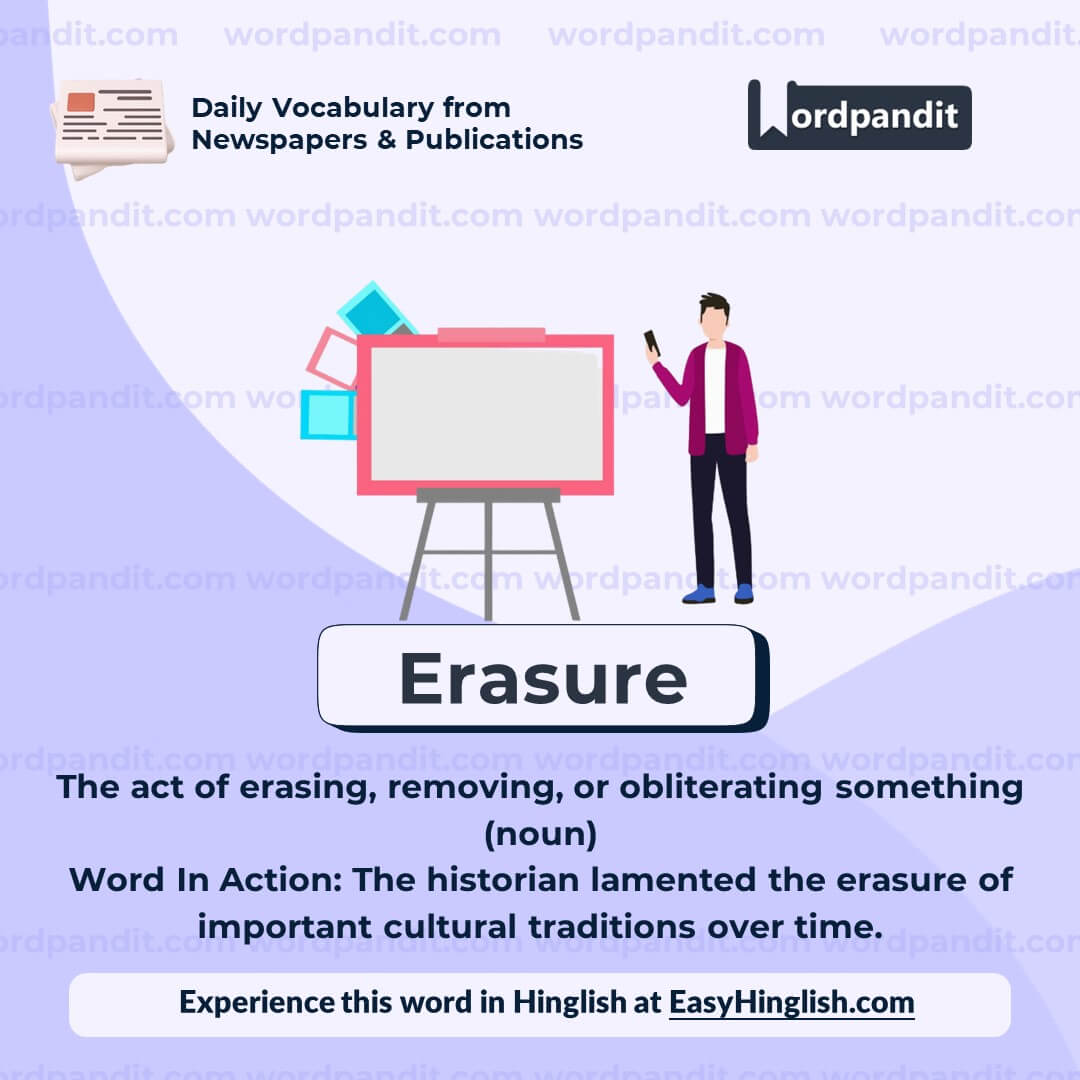
WORD-5: Erasure
Context:
"In its most extreme form, this erasure manifested as a claim of terra nullius – or nobody’s land – where the coloniser claimed that the Indigenous population lacked any form of political organisation or system of land rights at all." - Aeon
Explanatory Paragraph:
"Erasure" refers to the act of removing, wiping out, or eliminating something—whether physically, ideologically, or historically. In the context of colonialism, it signifies the deliberate denial or destruction of Indigenous cultures, rights, and histories. The quote highlights how colonizers attempted to erase Indigenous identity by declaring the land as uninhabited or politically void—a strategic and unjust act of cultural and legal erasure.
Meaning: The removal or obliteration of something, often deliberately (Noun)
Pronunciation: ih-RAY-sher
Difficulty Level: ⭐⭐⭐ Intermediate
Etymology: From Latin 'erasura', from 'eradere' meaning "to scrape out or erase"
Prashant Sir's Notes:
Erasure isn't just about physically removing something—it's about the loss of identity, memory, or recognition. Historical erasure can be dangerous because it hides the truth, especially about marginalized communities. In academics, this word often appears in postcolonial, gender, and cultural studies.
Synonyms & Antonyms:
Synonyms: deletion, obliteration, removal, suppression, elimination
Antonyms: preservation, inclusion, recognition, remembrance
Usage Examples:
- The museum exhibit highlighted the erasure of Indigenous voices from official historical records.
- Efforts are being made to reverse the cultural erasure caused by decades of colonization.
- She spoke out against the erasure of women's contributions from scientific history.
- Digital erasure of files can often leave behind recoverable traces.
Cultural Reference:
"In literature and activism, 'erasure' is used to describe the systemic silencing of minority groups. Works like Claudia Rankine’s *Citizen* explore the psychological and social consequences of such erasure." - The Atlantic
Think About It:
What are some examples of cultural or historical erasure in your country or community, and how can they be addressed?
Quick Activity:
Choose a historical figure or group that has been marginalized or erased from mainstream history. Research one key contribution and write a short paragraph restoring their place in the narrative.
Memory Tip:
“Erasure” comes from “erase.” If something is erased, it disappears — sometimes intentionally, like from a chalkboard or from memory.
Real-World Application:
Understanding erasure is crucial in education, journalism, and activism. It allows us to critically examine whose stories are told, whose are ignored, and how to build a more inclusive and accurate representation of the past and present.


