

Daily Vocabulary from International Newspapers and Publications
Expand Your Vocabulary with Wordpandit’s Global Vocabulary Hub
At Wordpandit, we are committed to helping you develop a truly global vocabulary by drawing from some of the most respected international publications. This section is designed to keep you ahead of the curve by introducing you to words that define global conversations and trends.
The Power of Global Sources
To help you think and communicate on a global scale, we curate vocabulary from renowned international sources, such as:
- The New York Times
- The Washington Post
- BBC
- The Guardian
- The Economist
- Scientific American
- Psychology Today
- And many more...
Stay Global, Stay Competitive
Our daily updates from international publications ensure you are consistently exposed to new words that reflect global news and developments, making sure your vocabulary is not only current but also globally relevant.
Enhance Your Global Perspective
Whether you’re preparing for international exams, aiming to excel in global business communication, or want to enhance your language skills for personal growth, Wordpandit offers the resources you need to thrive in a global context.
Effective Learning, Global Reach
Our learning methodology combines global examples, memory aids, and interactive activities, allowing you to internalize new words effectively and apply them in real-world scenarios.
Begin Your Global Vocabulary Journey Now!
Why Choose Wordpandit?
Practical Learning: Focus on words you'll actually encounter in real-world reading, enhancing your comprehension and communication skills.
Diverse Content: From current affairs to scientific breakthroughs, our varied sources expose you to vocabulary across multiple domains.
Effortless Integration: Make Wordpandit a part of your daily routine. Just a few minutes each day can significantly boost your lexicon over time.
Your Path to Vocabulary Mastery
- Visit our Daily Vocabulary section regularly
- Explore new words and their usage in context
- Practice incorporating these words into your own writing and speech
- Track your progress as your vocabulary expands
Start Your Journey Today
Embark on your vocabulary enhancement journey with Wordpandit. By consistently engaging with our daily posts, you'll build a robust vocabulary that serves you well in academic, professional, and personal contexts.
Remember, a word a day keeps linguistic limitations at bay. Make Wordpandit your daily companion in the quest for vocabulary excellence!
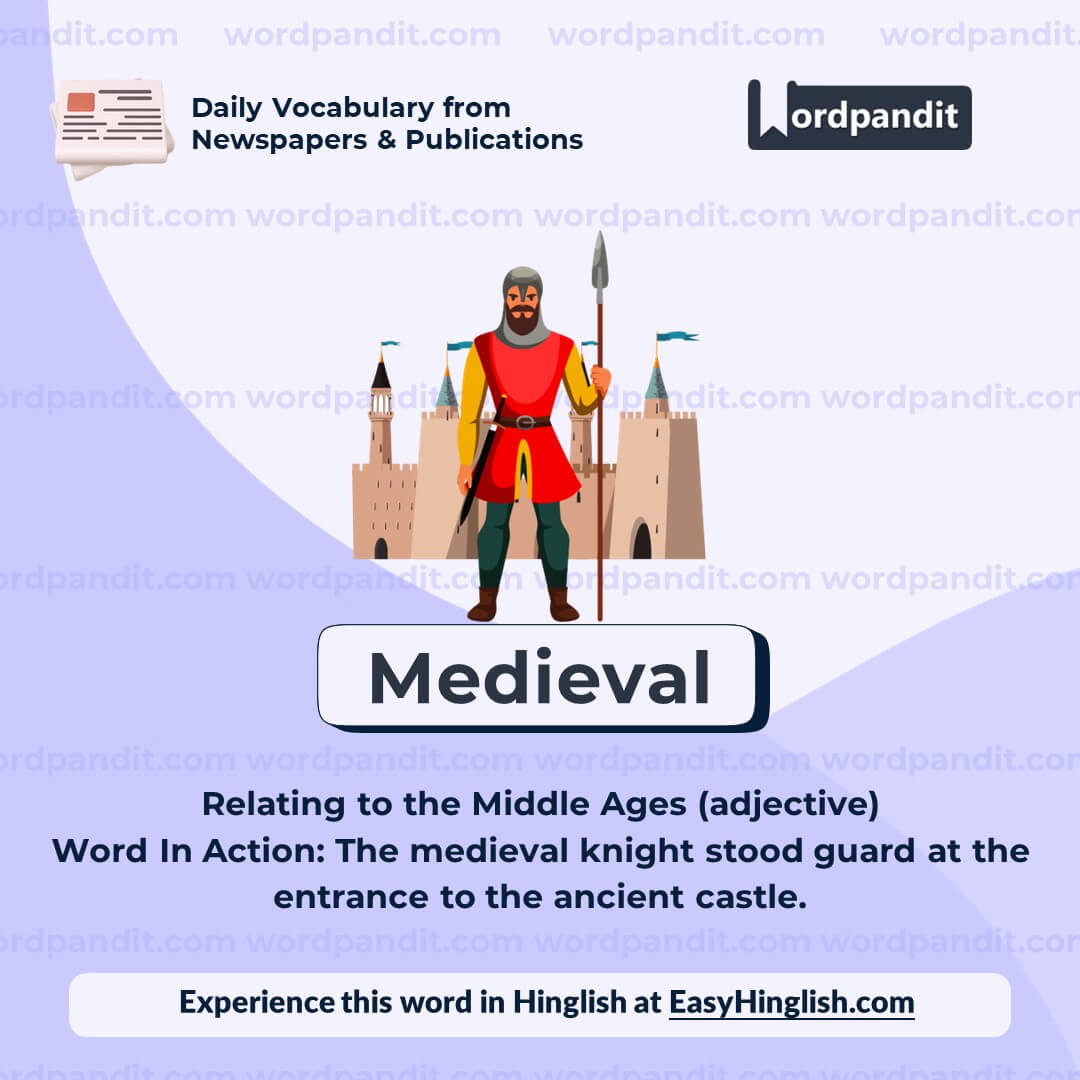
WORD-1: Medieval
Context:
"Manifest image (temperature, respiration, lightning) or will (some of) these phenomena go the way of the unicorns, gryphons and dragons of medieval bestiaries – entities that have no place within a scientifically informed catalogue of what there is? It is this question, more than any other, that lay at the heart of Dennett’s project." - Aeon
Explanatory Paragraph:
The word "medieval" refers to something relating to the Middle Ages, a historical period in Europe roughly spanning from the 5th to the 15th century. In modern usage, it can also carry connotations of being old-fashioned, outdated, or belonging to a time of myths and superstition. In the context provided, "medieval" highlights the fantastical creatures from that era’s bestiaries, which are no longer considered real in the light of modern science.
Meaning: Relating to the Middle Ages; outdated or primitive in modern contexts (Adjective)
Pronunciation: meh-DEE-vee-uhl
Difficulty Level: ⭐⭐ Basic
Etymology: From Latin *medium aevum* meaning "the Middle Age"; adopted into English from Modern Latin *mediaevalis* in the 19th century.
Prashant Sir's Notes:
Think of "medieval" both as a historical term and a metaphor for ideas or beliefs that are outdated. In philosophy or science writing, it’s often used to refer to discarded concepts from the past, such as mythical creatures or primitive explanations.
Synonyms & Antonyms:
Synonyms: archaic, old-fashioned, feudal, antiquated, ancient
Antonyms: modern, contemporary, current, up-to-date
Usage Examples:
- The castle had a distinctly medieval feel, with stone towers and wooden drawbridges.
- Her views on gender roles seem almost medieval in today’s progressive society.
- The documentary explores medieval beliefs about medicine and the human body.
- Some punishments still practiced in certain areas are considered downright medieval.
Cultural Reference:
"Game of Thrones brought medieval politics and fantasy creatures to a new generation." - Popular Culture Analysis
Think About It:
Why do modern societies sometimes romanticize or criticize the medieval period, and what does that say about our own time?
Quick Activity:
List 3 words or inventions you associate with the medieval period, and explain whether they are still relevant today.
Memory Tip:
Remember “medieval” by breaking it into “medi” (middle) + “eval” (age) = “Middle Ages”.
Real-World Application:
Understanding the word “medieval” is useful in literature, history, architecture, and even political discourse when analyzing old systems or outdated beliefs.
WORD-2: Prospects
Context:
"Different take on the prospects of intentional states was defended by Paul and Patricia Churchland. The Churchlands shared Fodor’s assumption that intentional talk attempts to capture the underlying causal structure of the mind." - Aeon
Explanatory Paragraph:
The word “prospects” refers to the possibilities or expectations for the future, often relating to success, development, or potential outcomes. In the context of the sentence, “prospects” refers to the future potential or viability of a certain theory — specifically, how likely it is that intentional states (such as beliefs and desires) will be upheld or explained within a scientific framework of the mind.
Meaning: The outlook for the future; possibilities or expectations of success or development (Noun – usually plural)
Pronunciation: PRAHS-pekts
Difficulty Level: ⭐⭐ Basic
Etymology: From Latin *prospicere*, meaning “to look forward or look out.”
Prashant Sir's Notes:
“Prospects” is a powerful word for discussing the future potential of ideas, careers, technologies, or people. It helps evaluate whether something has promise or is likely to succeed or evolve. In philosophical or academic contexts, it refers to the future viability of theories or viewpoints.
Synonyms & Antonyms:
Synonyms: outlook, potential, chances, expectations, opportunities
Antonyms: hopelessness, impossibility, doubt, stagnation
Usage Examples:
- Her job prospects improved after she earned her master’s degree.
- The economic prospects of the region are uncertain due to political instability.
- Scientists are exploring the prospects of life on Mars.
- Despite early setbacks, the project still holds promising prospects.
Cultural Reference:
"Prospects for peace in the Middle East remain elusive." - A common theme in international diplomacy reporting
Think About It:
What factors most influence your personal or professional prospects, and how much control do we really have over them?
Quick Activity:
Write down 3 areas in your life where you see positive prospects and 1 area where improvement is needed. Reflect on why.
Memory Tip:
“Prospects” sounds like “pro-spect” — think of someone “spectating” the future with optimism.
Real-World Application:
The term “prospects” is widely used in business, career planning, science, education, and social development to forecast future potential and inform decision-making.

WORD-3: Lethargy
Context:
"Physical symptoms: among these possible symptoms are fatigue and lethargy; feeling achy or heavy in the body; a loss of appetite or, conversely, an urge to eat for comfort; or disrupted sleep patterns." - Psyche
Explanatory Paragraph:
The word “lethargy” refers to a state of tiredness, lack of energy, or sluggishness. It is often used to describe both physical and mental fatigue, when someone feels unusually slow, inactive, or indifferent. In the context above, lethargy is listed as a common physical symptom — a feeling of low energy that may accompany emotional distress, illness, or exhaustion.
Meaning: A state of physical or mental sluggishness; lack of energy (Noun)
Pronunciation: LEH-thur-jee
Difficulty Level: ⭐⭐⭐ Intermediate
Etymology: From Latin *lethargia*, from Greek *lēthargia*, meaning "forgetfulness" or "inactive state", related to *lēthē* (forgetfulness) and *argos* (idle).
Prashant Sir's Notes:
Lethargy is more than being tired — it suggests a deeper or ongoing fatigue that affects both motivation and activity. Watch for it in medical, psychological, or emotional contexts. It’s useful in essays to describe characters, situations, or moods lacking vitality.
Synonyms & Antonyms:
Synonyms: fatigue, sluggishness, drowsiness, weariness, inertia
Antonyms: energy, vitality, alertness, liveliness, enthusiasm
Usage Examples:
- After the long flight, she was overcome by a wave of lethargy.
- The hot weather made everyone feel a sense of lethargy and indifference.
- Depression often manifests with symptoms such as lethargy and loss of interest.
- He tried to fight the lethargy by going for a brisk walk each morning.
Cultural Reference:
"The Lethargy of Distance" is the title of a biography about historian Manning Clark, using the word to reflect emotional and national inertia. - Australian literary reference
Think About It:
What are some underlying causes of lethargy in our daily lives, and how can we better respond to them?
Quick Activity:
List 3 situations in which you’ve felt lethargic. Write one change in each scenario that could help increase energy or motivation.
Memory Tip:
Think of “lethargy” as “lethal to energy” — it drains your will to act.
Real-World Application:
Recognizing lethargy is essential in healthcare, self-care, and workplace well-being, as it may indicate burnout, illness, or emotional strain that requires attention and recovery strategies.
WORD-4: Misconstrue
Context:
"In his view, both approaches are guilty of a common failing: they misconstrue the point of intentional-state talk. Drawing on the work of his mid-century heroes – most notably Ryle – Dennett argued that we appeal to beliefs, desires and intention." - Aeon
Explanatory Paragraph:
The word “misconstrue” means to interpret or understand something incorrectly. When someone misconstrues an idea, statement, or intention, they misunderstand it in a way that often leads to confusion or false assumptions. In the context above, the author suggests that both philosophical approaches incorrectly interpret the purpose behind discussing intentional states — like beliefs and desires — thereby missing the point Dennett emphasizes.
Meaning: To interpret (something) wrongly or inaccurately (Verb)
Pronunciation: miss-kun-STROO
Difficulty Level: ⭐⭐⭐ Intermediate
Etymology: From Middle English *misconstrue*, combining “mis-” (wrongly) + “construe” (to interpret); ultimately from Latin *construere*, meaning “to build” or “arrange.”
Prashant Sir's Notes:
Be cautious with “misconstrue” — it’s often used in formal, academic, or diplomatic settings where misunderstanding has deeper implications. It's especially useful when discussing misinterpretations of arguments, laws, emotions, or intentions. Unlike simply “not understanding,” misconstruing usually implies a specific and often damaging misreading.
Synonyms & Antonyms:
Synonyms: misinterpret, misunderstand, misread, distort, misjudge
Antonyms: interpret, understand, perceive correctly, grasp
Usage Examples:
- She misconstrued his silence as disapproval, when he was simply deep in thought.
- The media often misconstrues scientific findings to fit sensational headlines.
- His words were misconstrued and sparked unnecessary controversy.
- Don’t misconstrue my feedback — I’m trying to help you improve.
Cultural Reference:
"The biggest communication problem is we do not listen to understand. We listen to reply — or worse, we misconstrue." — Inspired by Stephen R. Covey's teachings on communication
Think About It:
Why do people so often misconstrue others' intentions, and how can we become better at interpreting meaning accurately?
Quick Activity:
Write a short sentence that could easily be misconstrued. Then, rewrite it for clarity. Compare the difference.
Memory Tip:
Break it down: “mis-” (wrong) + “construe” (interpret) = to wrongly interpret. Think of "missed the true meaning."
Real-World Application:
“Misconstrue” is essential in fields like law, diplomacy, media, and everyday relationships where precise understanding of language and intent is critical to avoid conflict or error.
WORD-5: Espousing
Context:
"Some theorists consider Dennett as espousing eliminativist views about consciousness – making him a ‘consciousness denier’, as Galen Strawson once put it in The New York Review." - BBC
Explanatory Paragraph:
The word “espousing” refers to the act of adopting, supporting, or advocating a belief, cause, or theory. It’s often used in academic, philosophical, or ideological contexts where someone publicly aligns themselves with a particular viewpoint. In the sentence above, Dennett is described as espousing eliminativist views — meaning he is seen as actively supporting the controversial position that consciousness, as traditionally conceived, might not exist.
Meaning: To adopt or support a cause, belief, or theory (Verb)
Pronunciation: es-POW-zing
Difficulty Level: ⭐⭐⭐ Intermediate
Etymology: From Old French *espouser*, from Latin *sponsare* meaning “to betroth, promise in marriage”; evolved to mean “to commit to” or “embrace a cause.”
Prashant Sir's Notes:
Think of “espousing” as formally embracing or advocating a position. It’s more intellectual or ideological than emotional — someone espouses theories, values, or principles, especially in debates or scholarly arguments. Be mindful: it doesn’t mean casual support; it implies deep or public commitment.
Synonyms & Antonyms:
Synonyms: advocate, support, embrace, promote, champion
Antonyms: reject, oppose, denounce, disavow, repudiate
Usage Examples:
- She is known for espousing progressive values in her public speeches.
- The scientist was criticized for espousing a theory that contradicted decades of research.
- Many leaders espouse the importance of education, but fail to implement effective policies.
- He espoused a minimalist lifestyle after years of consumer excess.
Cultural Reference:
“Gandhi espoused non-violence not only as a tactic, but as a way of life.” – A foundational theme in Indian independence history
Think About It:
What beliefs or principles do you personally espouse, and how do your actions reflect that commitment?
Quick Activity:
Write a sentence beginning with: “I espouse the idea that…” and explain your reasoning in one more sentence.
Memory Tip:
Think of “espousing” like “spouse” — to commit to something deeply, just as one commits in a marriage.
Real-World Application:
“Espousing” is a useful word in academic writing, debates, and journalism when discussing the positions people take on theories, ideologies, or movements — whether in politics, philosophy, science, or ethics.


