

Daily Vocabulary from International Newspapers and Publications
Expand Your Vocabulary with Wordpandit’s Global Vocabulary Hub
At Wordpandit, we are committed to helping you develop a truly global vocabulary by drawing from some of the most respected international publications. This section is designed to keep you ahead of the curve by introducing you to words that define global conversations and trends.
The Power of Global Sources
To help you think and communicate on a global scale, we curate vocabulary from renowned international sources, such as:
- The New York Times
- The Washington Post
- BBC
- The Guardian
- The Economist
- Scientific American
- Psychology Today
- And many more...
Stay Global, Stay Competitive
Our daily updates from international publications ensure you are consistently exposed to new words that reflect global news and developments, making sure your vocabulary is not only current but also globally relevant.
Enhance Your Global Perspective
Whether you’re preparing for international exams, aiming to excel in global business communication, or want to enhance your language skills for personal growth, Wordpandit offers the resources you need to thrive in a global context.
Effective Learning, Global Reach
Our learning methodology combines global examples, memory aids, and interactive activities, allowing you to internalize new words effectively and apply them in real-world scenarios.
Begin Your Global Vocabulary Journey Now!
Why Choose Wordpandit?
Practical Learning: Focus on words you'll actually encounter in real-world reading, enhancing your comprehension and communication skills.
Diverse Content: From current affairs to scientific breakthroughs, our varied sources expose you to vocabulary across multiple domains.
Effortless Integration: Make Wordpandit a part of your daily routine. Just a few minutes each day can significantly boost your lexicon over time.
Your Path to Vocabulary Mastery
- Visit our Daily Vocabulary section regularly
- Explore new words and their usage in context
- Practice incorporating these words into your own writing and speech
- Track your progress as your vocabulary expands
Start Your Journey Today
Embark on your vocabulary enhancement journey with Wordpandit. By consistently engaging with our daily posts, you'll build a robust vocabulary that serves you well in academic, professional, and personal contexts.
Remember, a word a day keeps linguistic limitations at bay. Make Wordpandit your daily companion in the quest for vocabulary excellence!
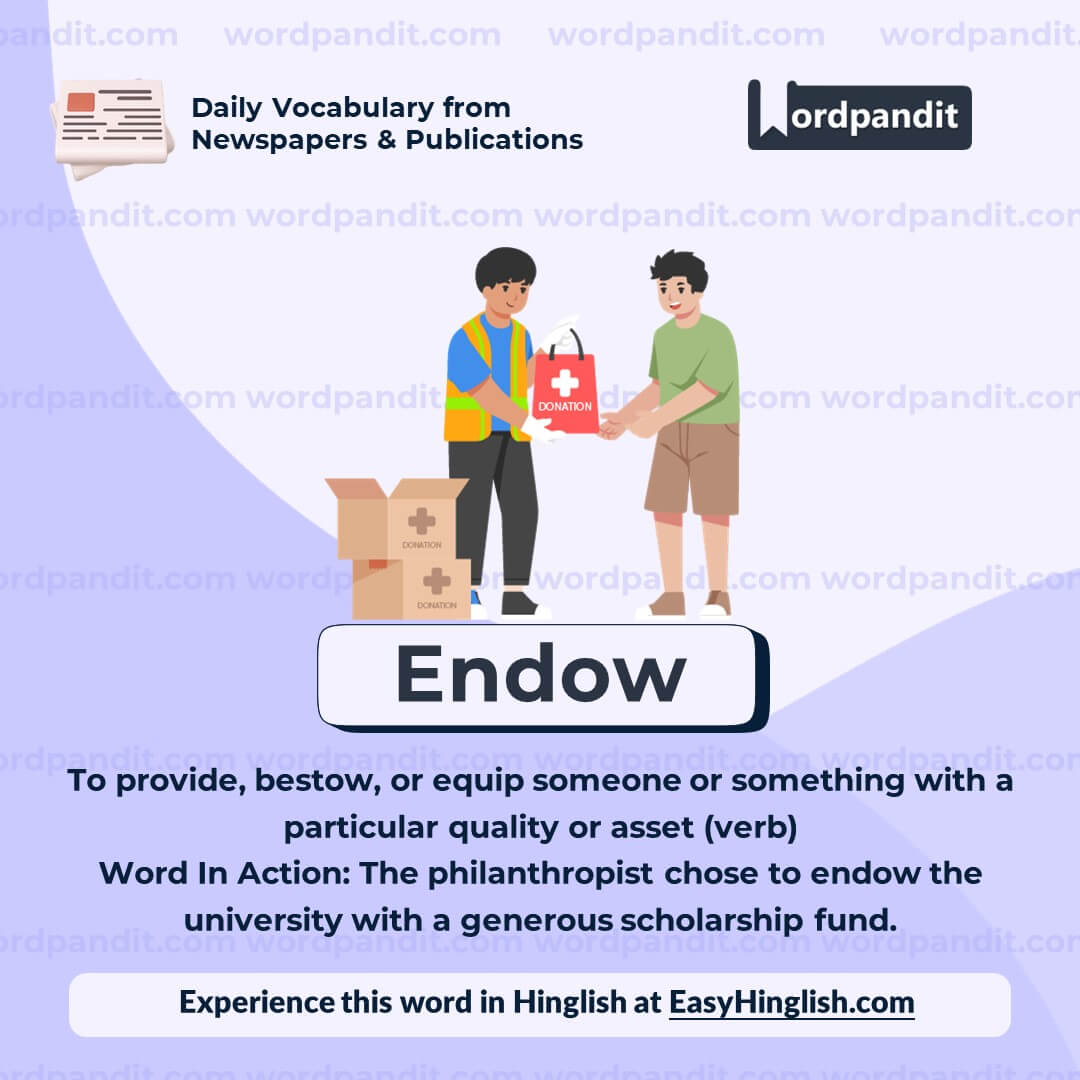
WORD-1: Endow
Context:
"Excavating the sediments our predecessors left in our collective consciousness is not a task that we are naturally disposed to perform. It is an act of remembrance and self-understanding that can destabilise our identities because it counters the processes that endow them with authenticity." - Aeon
Explanatory Paragraph:
The word "endow" refers to the act of giving something valuable, often permanently, to someone or something. It typically implies bestowing a quality, characteristic, or resource. In the context of the sentence, "endow" is used to suggest that certain processes give our identities a sense of authenticity. If these processes are challenged or disrupted, it can cause uncertainty or loss of that perceived authenticity.
Meaning: To provide or supply with a quality, ability, or asset (verb)
Pronunciation: en-dow
Difficulty Level: ⭐⭐ Beginner to Intermediate
Etymology: From Middle English 'endowen', derived from Old French 'endouer', based on Latin 'dotare' meaning ‘to provide with a dowry’.
Prashant Sir's Notes:
"Endow" is often used in both physical and abstract contexts. Institutions are endowed with funds, and individuals are endowed with qualities like intelligence or empathy. Try connecting it to the idea of gifting something essential or lasting.
Synonyms & Antonyms:
Synonyms: bestow, grant, equip, furnish, bless
Antonyms: deprive, withhold, strip, divest
Usage Examples:
- The university was generously endowed by a former alumnus.
- She is endowed with a remarkable ability to empathize with others.
- Nature has endowed this region with stunning beauty.
- Good leaders are often endowed with strong communication skills.
Cultural Reference:
"All men are endowed by their Creator with certain unalienable Rights..." - The United States Declaration of Independence
Think About It:
If identities can be endowed with authenticity by certain narratives, can they also be re-endowed with new meanings through deliberate self-reflection?
Quick Activity:
Fill in the blank with the correct form of “endow”:
“The philanthropist ________ the hospital with cutting-edge medical equipment.”
Memory Tip:
Think of "endow" as "in-dowry" — something valuable given or gifted, whether money or a trait like talent.
Real-World Application:
In academic and nonprofit settings, many organizations rely on endowments — funds endowed to them — to support operations, scholarships, or research. Similarly, in psychology or literature, people are often described as being endowed with specific emotional or intellectual traits.
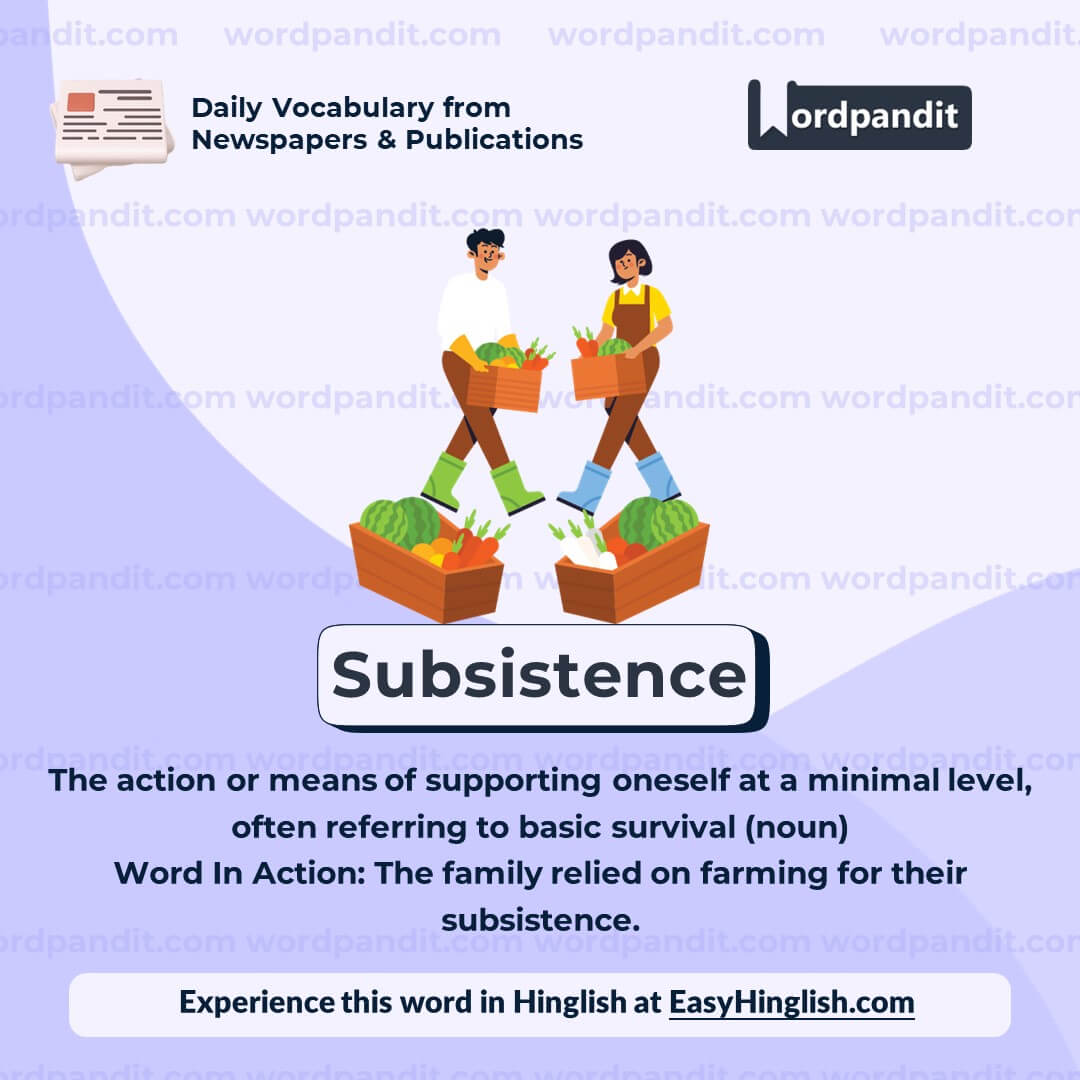
WORD-2: Subsistence
Context:
"Consider our (quasi-)universal agrarian mode of subsistence, and our single nutritional and psychotropic order, which is based on an incredibly small number of starchy crops (including wheat, maize, rice), domesticated animals (cows, chickens) and stimulants (coffee, sugar) uniformly consumed across the planet." - Aeon
Explanatory Paragraph:
"Subsistence" refers to the means by which people maintain their basic needs for survival—especially food, water, and shelter. It often describes a minimal or self-sufficient lifestyle, particularly in farming or traditional societies. In this context, the word describes how most of the global population depends on a uniform set of crops and animals for basic sustenance, forming the backbone of our survival and agricultural systems.
Meaning: The means of maintaining or supporting life, especially at a basic level (noun)
Pronunciation: sub-sis-tenss
Difficulty Level: ⭐⭐⭐ Intermediate
Etymology: From Latin 'subsistentia', from 'subsistere', meaning ‘to stand firm’ or ‘to exist’.
Prashant Sir's Notes:
"Subsistence" is often used when describing survival-level living, especially in agriculture (subsistence farming). Remember, it's about the bare minimum needed to live—not luxury, but necessity.
Synonyms & Antonyms:
Synonyms: survival, livelihood, sustenance, maintenance, existence
Antonyms: abundance, luxury, excess, affluence
Usage Examples:
- Many rural communities rely on subsistence farming to feed their families.
- Their daily struggle was not for profit, but for mere subsistence.
- The tribe's mode of subsistence was deeply tied to seasonal hunting and gathering.
- Economic reforms aimed to lift people above the subsistence level.
Cultural Reference:
"Most of human history was characterized by subsistence economies, where trade and wealth were secondary to mere survival." - From *A People's History of the World* by Chris Harman
Think About It:
If most of humanity depends on a few key crops for subsistence, how vulnerable are we to ecological or agricultural disruption?
Quick Activity:
Fill in the blank:
“The villagers lived at a level of ________, growing just enough food to survive.”
Memory Tip:
Think of "subsistence" as "sub-system existence"—a minimal system just enough to keep life going.
Real-World Application:
The concept of subsistence is key in understanding global poverty, agricultural policy, and food security. It helps policymakers and NGOs target areas where people live on the edge of survival and need infrastructure to move beyond mere subsistence to economic stability.
WORD-3: Facilitated
Context:
"Local languages into global languages and lingua francas – French, Arabic, classical Chinese, Nahuatl, Maya, Greek or Akkadian – which facilitated and intensified cross-cultural relations." - Aeon
Explanatory Paragraph:
The word "facilitated" means to make a process or action easier or smoother. It often refers to helping something happen by removing obstacles or providing support. In the sentence above, global languages such as French or Arabic made it easier for people from different cultures to communicate, trade, and interact, thereby enhancing cross-cultural relations.
Meaning: Made an action or process easier or more likely to happen (verb - past tense of “facilitate”)
Pronunciation: fuh-sih-li-tay-ted
Difficulty Level: ⭐⭐ Beginner to Intermediate
Etymology: From Latin 'facilitare', from 'facilis' meaning ‘easy’
Prashant Sir's Notes:
"Facilitated" is commonly used in academic, business, and cultural discussions. Think of it as the opposite of "hindered"—where one clears the path for something to occur more effectively. Always link it to "ease of doing" something.
Synonyms & Antonyms:
Synonyms: enabled, assisted, promoted, supported, simplified
Antonyms: hindered, obstructed, blocked, impeded
Usage Examples:
- Technology has facilitated faster communication across the globe.
- The translator facilitated dialogue between the delegates.
- Her leadership facilitated a smooth transition during the merger.
- Historical trade routes facilitated cultural and economic exchange.
Cultural Reference:
"The printing press facilitated the spread of knowledge and sparked the Enlightenment." – Common historical summary of Gutenberg’s impact
Think About It:
What are some modern tools or systems that have facilitated cross-cultural understanding in the digital age?
Quick Activity:
Choose the correct synonym for "facilitated":
a) blocked
b) complicated
c) enabled
d) discouraged
Memory Tip:
Think of “facilitated” as “made it feasible.” Both start with “f” and relate to making something easier to achieve.
Real-World Application:
In education and corporate settings, facilitators guide discussions and workshops to ensure smooth collaboration and learning. Likewise, international diplomacy is often facilitated by shared languages and translators who make communication possible across cultural divides.
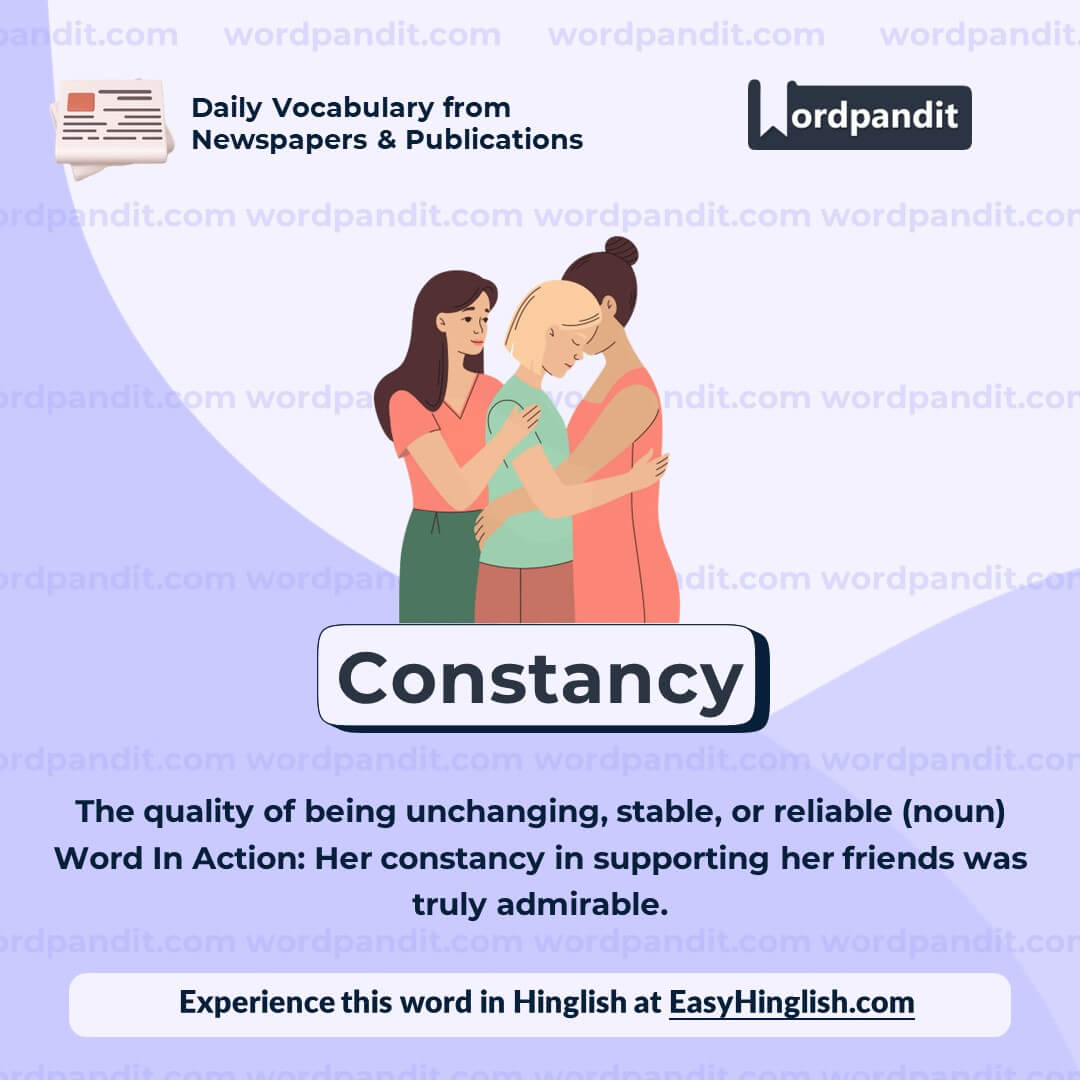
WORD-4: Constancy
Context:
"It displays such a degree of constancy that it must be fundamental to the evolution of human society. Far from being a mere lifestyle or worldview – or an invention of the elite – globalisation can be understood as the mass process through which human culture evolves and perpetuates itself." - Aeon
Explanatory Paragraph:
The word "constancy" refers to the quality of being unchanging or stable over time. It often suggests reliability, consistency, and steadfastness. In the context provided, "constancy" emphasizes that globalisation has shown such consistent presence and influence throughout human history that it appears to be a core, enduring part of societal development—not a recent or superficial trend.
Meaning: The quality of being unchanging, stable, or faithful over time (noun)
Pronunciation: kon-stan-see
Difficulty Level: ⭐⭐⭐ Intermediate
Etymology: From Latin 'constantia', meaning ‘firmness, steadiness’
Prashant Sir's Notes:
“Constancy” is not just about repetition; it’s about unwavering presence—like the constancy of the moon’s appearance or a friend’s loyalty. Use it for things that endure, remain firm, or stay true over time.
Synonyms & Antonyms:
Synonyms: stability, consistency, permanence, loyalty, steadfastness
Antonyms: changeability, inconstancy, fluctuation, inconsistency, fickleness
Usage Examples:
- The constancy of the tides has guided sailors for centuries.
- Despite the turmoil, her constancy gave the team strength.
- Science relies on the constancy of natural laws.
- He admired the constancy of her support during difficult times.
Cultural Reference:
"Love is not love which alters when it alteration finds… O no, it is an ever-fixed mark." – William Shakespeare, Sonnet 116. This reflects the idea of constancy in love.
Think About It:
In a world obsessed with change and novelty, is constancy undervalued or overlooked as a form of strength?
Quick Activity:
Choose the word that best matches “constancy”:
a) unpredictability
b) inconsistency
c) reliability
d) wavering
Memory Tip:
Link “constancy” with “constant” — something that stays the same. Think of a constant friend or a constant star.
Real-World Application:
Constancy is highly valued in relationships, leadership, and institutions. A brand with constancy in its messaging builds trust. In science and technology, constancy of results confirms reliability and truth.
WORD-5: Perpetuate
Context:
"It displays such a degree of constancy that it must be fundamental to the evolution of human society. Far from being a mere lifestyle or worldview – or an invention of the elite – globalisation can be understood as the mass process through which human culture evolves and perpetuates itself." - Aeon
Explanatory Paragraph:
The word "perpetuate" means to cause something to continue indefinitely or to make it last forever. It’s often used in the context of ideas, traditions, systems, or behaviors being preserved and carried forward over time. In the given sentence, it suggests that globalisation helps human culture not only evolve but also sustain and renew itself generation after generation.
Meaning: To cause something to continue or be preserved indefinitely (verb)
Pronunciation: per-petch-oo-ate
Difficulty Level: ⭐⭐⭐ Intermediate
Etymology: From Latin 'perpetuare', from 'perpetuus' meaning ‘continuous, unbroken’
Prashant Sir's Notes:
“Perpetuate” often has a neutral or even negative tone—used in phrases like “perpetuate stereotypes” or “perpetuate injustice.” But in broader contexts like culture or memory, it simply means to preserve and keep alive. Ask yourself: Is it being kept alive intentionally or unconsciously?
Synonyms & Antonyms:
Synonyms: preserve, sustain, maintain, prolong, continue
Antonyms: halt, stop, end, discontinue, extinguish
Usage Examples:
- The media can sometimes perpetuate harmful stereotypes.
- He created a scholarship to perpetuate his parents’ legacy.
- Traditions are perpetuated through rituals and storytelling.
- Some myths perpetuate unrealistic expectations in society.
Cultural Reference:
"Those who cannot remember the past are condemned to repeat it." – George Santayana. This quote implies that historical memory, if not perpetuated, leads to repeating mistakes.
Think About It:
Are we more likely to perpetuate values consciously, or do most traditions and behaviors continue out of habit and inertia?
Quick Activity:
Fill in the blank:
“Social media has the power to _________ both truth and misinformation.”
Memory Tip:
Think of “perpetuate” as “perpetual + activate” — to keep something active forever.
Real-World Application:
The idea of perpetuation is key in discussions about education, cultural heritage, environmental practices, and even bias. Policies, media, and institutions can either perpetuate inequality—or be reformed to promote justice and inclusion.


