

Daily Vocabulary from International Newspapers and Publications
Expand Your Vocabulary with Wordpandit’s Global Vocabulary Hub
At Wordpandit, we are committed to helping you develop a truly global vocabulary by drawing from some of the most respected international publications. This section is designed to keep you ahead of the curve by introducing you to words that define global conversations and trends.
The Power of Global Sources
To help you think and communicate on a global scale, we curate vocabulary from renowned international sources, such as:
- The New York Times
- The Washington Post
- BBC
- The Guardian
- The Economist
- Scientific American
- Psychology Today
- And many more...
Stay Global, Stay Competitive
Our daily updates from international publications ensure you are consistently exposed to new words that reflect global news and developments, making sure your vocabulary is not only current but also globally relevant.
Enhance Your Global Perspective
Whether you’re preparing for international exams, aiming to excel in global business communication, or want to enhance your language skills for personal growth, Wordpandit offers the resources you need to thrive in a global context.
Effective Learning, Global Reach
Our learning methodology combines global examples, memory aids, and interactive activities, allowing you to internalize new words effectively and apply them in real-world scenarios.
Begin Your Global Vocabulary Journey Now!
Why Choose Wordpandit?
Practical Learning: Focus on words you'll actually encounter in real-world reading, enhancing your comprehension and communication skills.
Diverse Content: From current affairs to scientific breakthroughs, our varied sources expose you to vocabulary across multiple domains.
Effortless Integration: Make Wordpandit a part of your daily routine. Just a few minutes each day can significantly boost your lexicon over time.
Your Path to Vocabulary Mastery
- Visit our Daily Vocabulary section regularly
- Explore new words and their usage in context
- Practice incorporating these words into your own writing and speech
- Track your progress as your vocabulary expands
Start Your Journey Today
Embark on your vocabulary enhancement journey with Wordpandit. By consistently engaging with our daily posts, you'll build a robust vocabulary that serves you well in academic, professional, and personal contexts.
Remember, a word a day keeps linguistic limitations at bay. Make Wordpandit your daily companion in the quest for vocabulary excellence!
WORD-1: Permeate
Context:
"Often unseen at first, it begins to permeate the way a person thinks, feels, behaves. Over time, it can grow bolder and weigh more heavily, until, at its worst, it surrounds the person." - Psyche
Explanatory Paragraph:
The word "permeate" means to spread through or penetrate something thoroughly. It often refers to the way a substance, idea, or emotion moves gradually but persistently through an object or a person's mind or environment. In the context above, it describes how a feeling or influence quietly begins to affect a person’s thoughts, emotions, and behavior, eventually becoming deeply embedded.
Meaning: To spread throughout; to penetrate completely (Verb)
Pronunciation: PUR-mee-ate
Difficulty Level: ⭐⭐⭐ Intermediate
Etymology: From Latin permeatus, past participle of permeare, meaning "to pass through", from per (through) + meare (to go).
Prashant Sir's Notes:
Think of “permeate” like dye in water — it starts in one place but slowly spreads everywhere. This word is especially useful when describing emotions, smells, ideologies, or social influences that gradually take hold.
Synonyms & Antonyms:
Synonyms: infiltrate, saturate, diffuse, pervade, penetrate
Antonyms: block, resist, repel, seal
Usage Examples:
- The scent of fresh coffee permeated the entire apartment by morning.
- Fear began to permeate the community as the storm approached.
- Negative thinking can slowly permeate every aspect of your life if left unchecked.
- The artist’s unique style permeates all her work, making it easily recognizable.
Cultural Reference:
"Let the beauty we love be what we do. There are hundreds of ways to kneel and kiss the ground." — Rumi. His poetic themes of divine love permeate every line of his work. - Rumi’s poetry and influence
Think About It:
Can you think of a belief or habit that gradually permeated your life over time without you realizing it?
Quick Activity:
Write down five intangible things (like emotions, ideas, or values) that could permeate a person’s thoughts or an environment. Then use one of them in a sentence with the word “permeate.”
Memory Tip:
Think of “permeate” like “permit + penetrate” — something is permitted to penetrate and spread all over.
Real-World Application:
“Permeate” is frequently used in psychology, marketing, and science. For instance, marketers aim for their brand message to permeate public consciousness, while in science, a liquid might permeate a porous material like a sponge.
WORD-2: Fatigue
Context:
"Physical symptoms: among these possible symptoms are fatigue and lethargy; feeling achy or heavy in the body; a loss of appetite or, conversely, an urge to eat for comfort; or disrupted sleep patterns." - Psyche
Explanatory Paragraph:
"Fatigue" refers to an overwhelming sense of tiredness, exhaustion, or lack of energy, either physical or mental. Unlike normal tiredness that improves with rest, fatigue can persist and interfere with daily functioning. In the given context, it’s described as a physical symptom often associated with emotional or mental strain, such as stress or depression.
Meaning: Extreme tiredness resulting from mental or physical exertion or illness (Noun)
Pronunciation: fuh-TEEG
Difficulty Level: ⭐⭐ Basic
Etymology: From French fatigue meaning "weariness," from Latin fatigare meaning "to tire out."
Prashant Sir's Notes:
Fatigue is more than just being tired after a long day — it’s a persistent, draining feeling that doesn’t go away with a nap. It’s important to recognize it, especially when linked to mental health or lifestyle habits.
Synonyms & Antonyms:
Synonyms: exhaustion, weariness, burnout, tiredness, drowsiness
Antonyms: energy, vitality, vigor, alertness, liveliness
Usage Examples:
- After hiking for eight hours straight, she was overcome with fatigue.
- Chronic fatigue can be a symptom of deeper health issues like anemia or depression.
- The fatigue from working night shifts began to affect his concentration.
- Mental fatigue is just as draining as physical exhaustion, if not more.
Cultural Reference:
"Fatigue makes cowards of us all." — Attributed to Vince Lombardi, emphasizing how exhaustion can affect performance and decision-making, especially in sports and life challenges.
Think About It:
Do you think fatigue is more commonly caused by physical effort or emotional stress in modern life? Why?
Quick Activity:
List 3 activities that physically tire you and 3 that mentally drain you. Use “fatigue” in a sentence related to one of them.
Memory Tip:
Fatigue sounds like “fat iguana”— imagine a tired iguana too worn out to move. That’s how drained fatigue makes you feel!
Real-World Application:
"Fatigue" is widely used in medicine (e.g., chronic fatigue syndrome), sports (muscle fatigue), and everyday conversations when describing burnout from overwork, lack of rest, or stress.
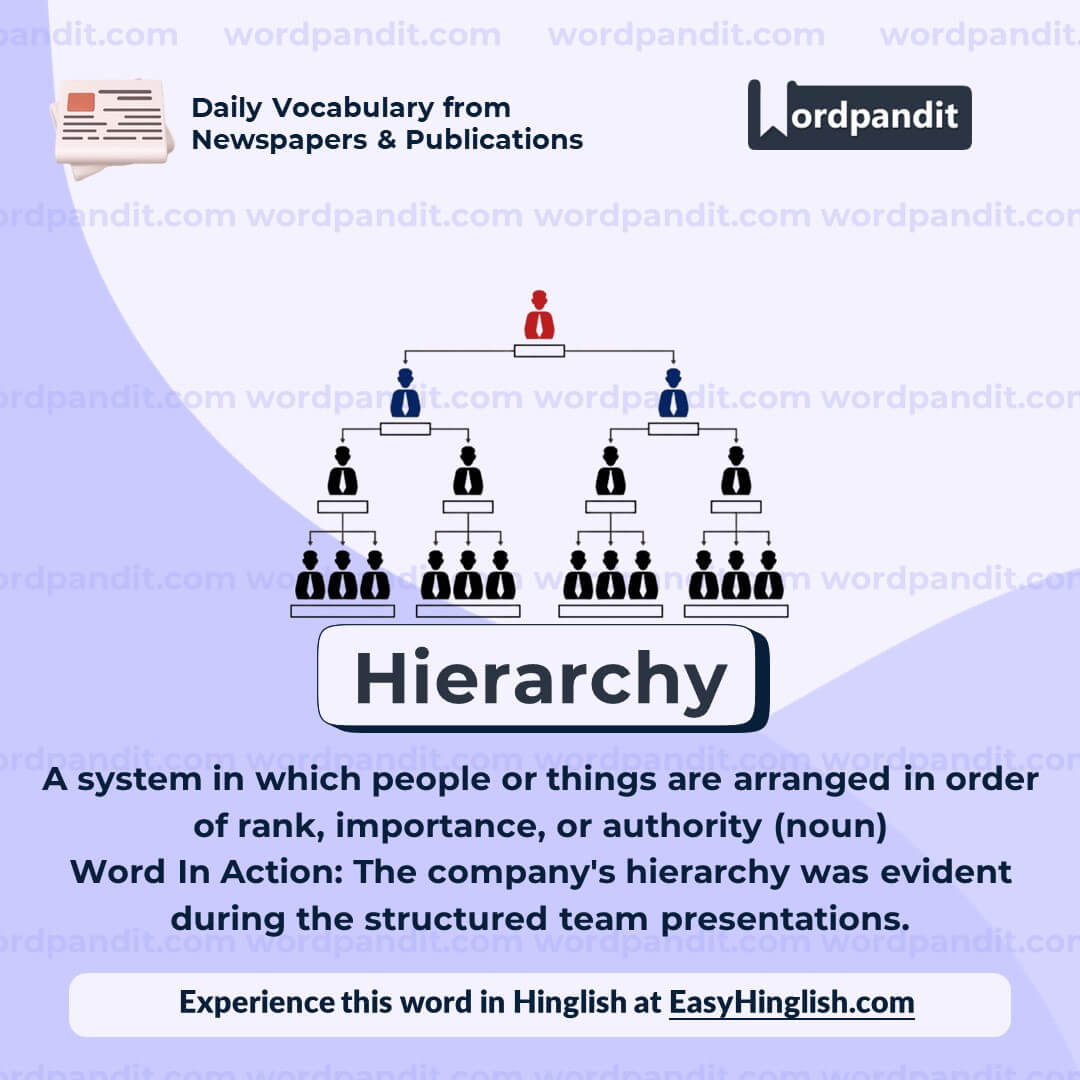
WORD-3: Hierarchy
Context:
"Teaching, too, can reflect the ethos of the Vietnam memorial as Scott saw it: egalitarian, open and participatory, with a preference not for parsimony over loud claims but critical thought and experience over intellectual hierarchies." - Aeon
Explanatory Paragraph:
"Hierarchy" refers to a system in which people, ideas, or things are ranked one above the other according to status, authority, or importance. In this context, “intellectual hierarchies” refers to traditional systems where certain forms of knowledge or thinkers are valued more than others. The quote suggests valuing open dialogue and shared experiences over rigid structures that rank intelligence or expertise.
Meaning: A system or organization in which people or things are arranged according to rank or authority (Noun)
Pronunciation: HYE-uh-raar-kee
Difficulty Level: ⭐⭐⭐ Intermediate
Etymology: From Greek hierarkhia, meaning "rule of a high priest," from hieros (sacred) + archein (to rule)
Prashant Sir's Notes:
Think of a pyramid — hierarchy always involves layers, with some people or ideas at the top and others at the bottom. In learning environments, questioning rigid hierarchies can lead to more inclusive and dynamic discussions.
Synonyms & Antonyms:
Synonyms: ranking, order, pecking order, chain of command, structure
Antonyms: equality, egalitarianism, flat structure, parity
Usage Examples:
- The company has a strict hierarchy, with decisions flowing from the top executives downward.
- Some modern startups are breaking away from traditional hierarchies in favor of collaborative models.
- The military operates with a clear hierarchy to maintain discipline and structure.
- Social media platforms can disrupt traditional hierarchies of fame and influence.
Cultural Reference:
In George Orwell’s *Animal Farm*, the animals start with the ideal of equality, but a new hierarchy emerges — “All animals are equal, but some animals are more equal than others.”
Think About It:
Do hierarchies help create order, or do they limit fairness and creativity in institutions like schools and workplaces?
Quick Activity:
Draw a simple hierarchy chart (e.g., school principal → teachers → students). Then, write one sentence explaining how decisions are made within that structure using the word “hierarchy.”
Memory Tip:
“Hi-er-archy” sounds like “higher-archy”—think of who is higher in rank or power. That’s the essence of a hierarchy!
Real-World Application:
Hierarchies exist in nearly every part of life: corporate structures, governments, educational systems, and even nature (like wolf packs). Understanding them can help you navigate authority and collaboration more effectively.
WORD-4: Recurrent
Context:
"Depression can also be a recurrent condition, with periods of depression (lasting weeks or months) and periods of recovery (lasting weeks, months, or years). Sometimes, depression is a one-off episode that a person recovers from and does not experience again." - Psyche
Explanatory Paragraph:
The word "recurrent" describes something that happens repeatedly or at intervals over time. It doesn’t occur just once but tends to return, often unpredictably. In the given context, "recurrent" is used to describe a pattern of depression that comes and goes, highlighting its cyclical and persistent nature.
Meaning: Occurring often or repeatedly (Adjective)
Pronunciation: ree-KUR-uhnt
Difficulty Level: ⭐⭐ Basic
Etymology: From Latin recurrentem, present participle of recurrere, meaning "to run back, return"
Prashant Sir's Notes:
Think of "recurrent" as a loop — something that doesn't just happen once and end, but keeps coming back, whether it’s a headache, a feeling, or a financial issue. It's a useful word in both medical and everyday contexts.
Synonyms & Antonyms:
Synonyms: repeated, periodic, returning, persistent, cyclical
Antonyms: one-time, unique, isolated, nonrecurring
Usage Examples:
- She experiences recurrent migraines that disrupt her weekly routine.
- The region is prone to recurrent floods during the monsoon season.
- Recurrent technical problems forced the company to upgrade its entire system.
- Recurrent dreams often carry deep psychological significance.
Cultural Reference:
In many ancient cultures, time was seen as cyclical rather than linear — a recurrent loop of life, death, and rebirth. This idea is central to philosophies in Hinduism and Buddhism.
Think About It:
What’s something in your life—positive or negative—that feels recurrent? How do you respond to it when it comes back?
Quick Activity:
Write three sentences about events or habits that recur in your daily or weekly life. Try using “recurrent” in at least one of them.
Memory Tip:
“Recurrent” contains “re-” (again) and “current” (happening now) — so think of something happening again and again in the present.
Real-World Application:
“Recurrent” is used in medical diagnoses (like recurrent infections or depression), economics (recurrent expenses), and even in narratives (recurrent themes in literature or film). Recognizing recurrent patterns helps with planning and intervention.
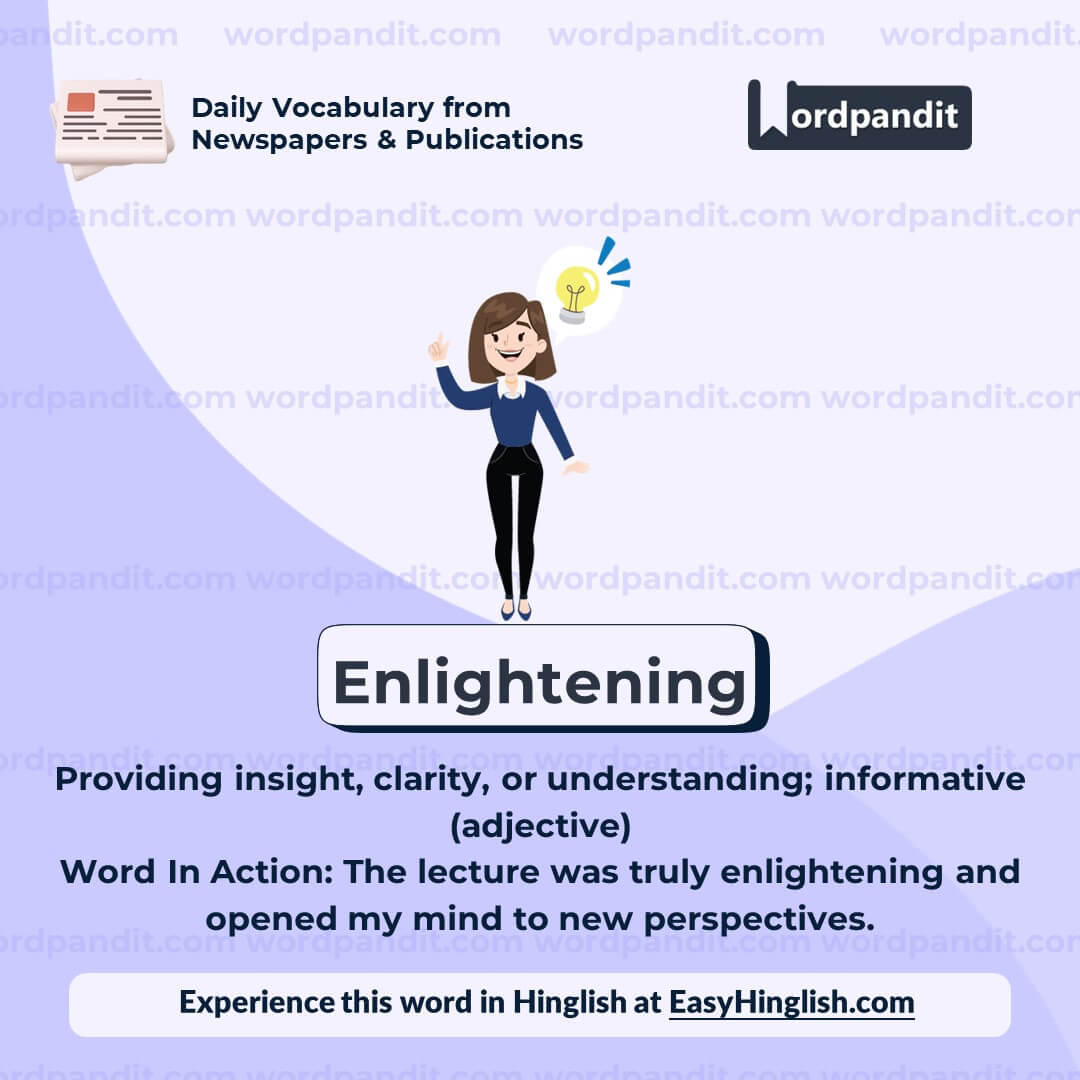
WORD-5: Enlightening
Context:
"This crisis explains some of the others, though – and gives an enlightening perspective on some of the tensions in our everyday lives." - Psyche
Explanatory Paragraph:
The word "enlightening" refers to something that provides new insight, understanding, or clarity. It’s often used to describe experiences, information, or perspectives that help someone see things more clearly or from a deeper, more informed point of view. In the given context, the author describes how the crisis sheds light on everyday tensions, offering an explanation that makes things easier to comprehend.
Meaning: Providing new insight or understanding; making something clearer or more understandable (Adjective)
Pronunciation: in-LYTE-ning
Difficulty Level: ⭐⭐ Basic
Etymology: From the verb “enlighten,” rooted in Old English inlihtan, meaning "to illuminate or shed light upon"
Prashant Sir's Notes:
Think of “enlightening” as turning the lights on in a dark room of confusion. It helps you see clearly, whether you're reading a thoughtful article, having a meaningful conversation, or learning a valuable lesson.
Synonyms & Antonyms:
Synonyms: illuminating, informative, eye-opening, revealing, instructive
Antonyms: confusing, misleading, puzzling, vague, obscuring
Usage Examples:
- The professor's lecture on climate change was truly enlightening.
- I found the documentary about social media both disturbing and enlightening.
- Her personal story gave me an enlightening view of what it's like to live with anxiety.
- The book offers an enlightening analysis of historical power dynamics.
Cultural Reference:
In Buddhism, “enlightenment” (nirvana) represents the ultimate state of understanding and liberation from suffering — a concept that has also influenced Western thought and literature.
Think About It:
What’s the most enlightening experience or conversation you’ve had recently, and how did it change your perspective?
Quick Activity:
List three things (books, films, or personal experiences) that you found enlightening. Choose one and write a short sentence about why it had that effect on you.
Memory Tip:
“Enlightening” contains “light” — think of it as turning on a lightbulb in your brain when you finally understand something new.
Real-World Application:
“Enlightening” is often used in educational, personal development, or media contexts to describe content or experiences that help people learn, grow, or change their views.


