

Daily Vocabulary from International Newspapers and Publications
Expand Your Vocabulary with Wordpandit’s Global Vocabulary Hub
At Wordpandit, we are committed to helping you develop a truly global vocabulary by drawing from some of the most respected international publications. This section is designed to keep you ahead of the curve by introducing you to words that define global conversations and trends.
The Power of Global Sources
To help you think and communicate on a global scale, we curate vocabulary from renowned international sources, such as:
- The New York Times
- The Washington Post
- BBC
- The Guardian
- The Economist
- Scientific American
- Psychology Today
- And many more...
Stay Global, Stay Competitive
Our daily updates from international publications ensure you are consistently exposed to new words that reflect global news and developments, making sure your vocabulary is not only current but also globally relevant.
Enhance Your Global Perspective
Whether you’re preparing for international exams, aiming to excel in global business communication, or want to enhance your language skills for personal growth, Wordpandit offers the resources you need to thrive in a global context.
Effective Learning, Global Reach
Our learning methodology combines global examples, memory aids, and interactive activities, allowing you to internalize new words effectively and apply them in real-world scenarios.
Begin Your Global Vocabulary Journey Now!
Why Choose Wordpandit?
Practical Learning: Focus on words you'll actually encounter in real-world reading, enhancing your comprehension and communication skills.
Diverse Content: From current affairs to scientific breakthroughs, our varied sources expose you to vocabulary across multiple domains.
Effortless Integration: Make Wordpandit a part of your daily routine. Just a few minutes each day can significantly boost your lexicon over time.
Your Path to Vocabulary Mastery
- Visit our Daily Vocabulary section regularly
- Explore new words and their usage in context
- Practice incorporating these words into your own writing and speech
- Track your progress as your vocabulary expands
Start Your Journey Today
Embark on your vocabulary enhancement journey with Wordpandit. By consistently engaging with our daily posts, you'll build a robust vocabulary that serves you well in academic, professional, and personal contexts.
Remember, a word a day keeps linguistic limitations at bay. Make Wordpandit your daily companion in the quest for vocabulary excellence!
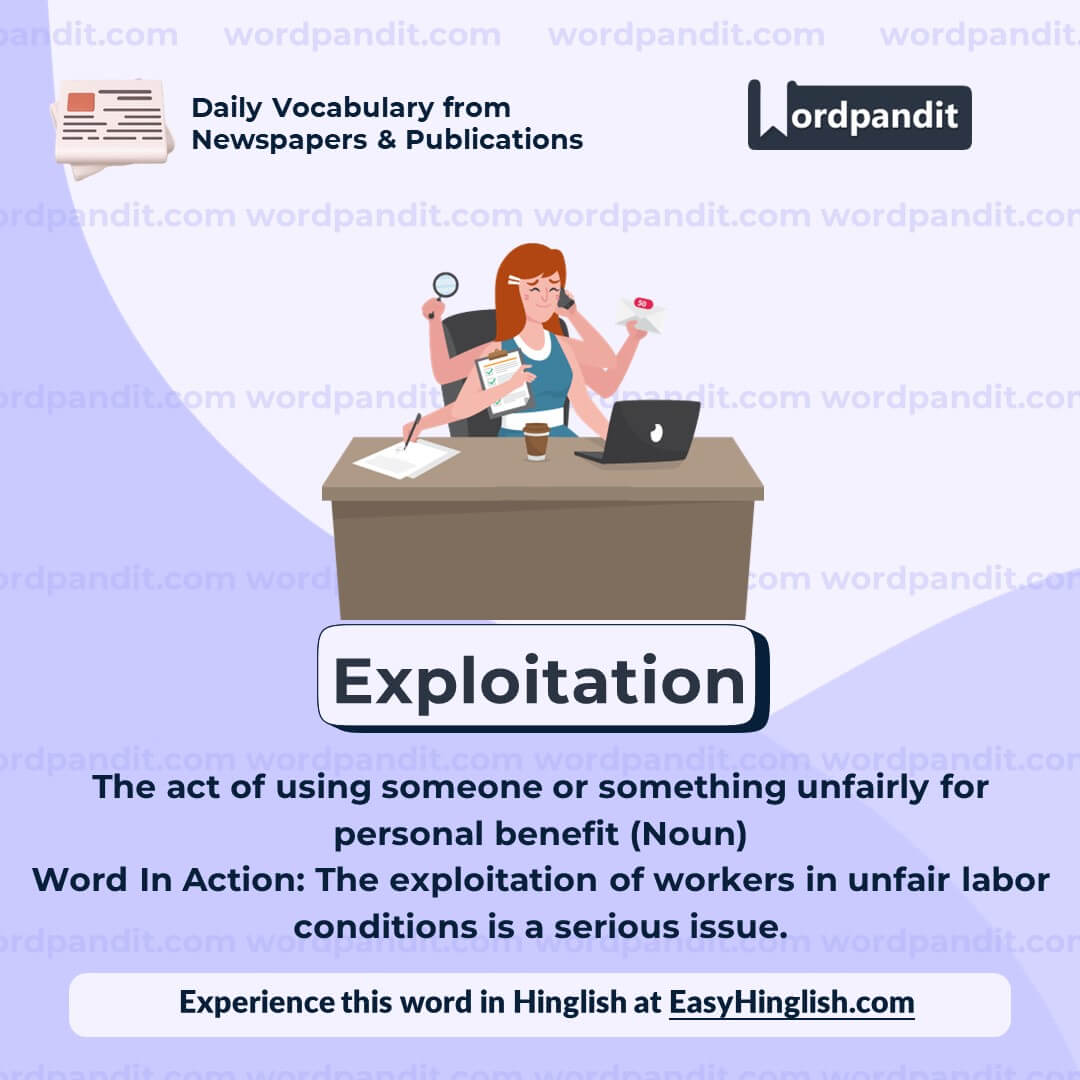
WORD-1: Exploitation
Context:
"The documentary sheds light on the exploitation of migrant workers who are often paid below minimum wage and denied basic rights." - BBC News
Explanatory Paragraph:
Exploitation refers to taking unfair advantage of someone or a situation for personal benefit, often at the expense of others. This could involve using someone’s labor without proper compensation, manipulating resources, or taking advantage of someone's vulnerability. The word typically carries a strong negative connotation, especially when linked to injustice or inequality.
Meaning: The act of using someone or something unfairly for one's own benefit (Noun)
Pronunciation: ek-sploy-TAY-shun
Difficulty Level: ⭐⭐⭐ Intermediate
Etymology: From Latin *exploitare*, via Old French *exploiter*, meaning "to accomplish" or "to profit from"
Prashant Sir's Notes:
This word often arises in contexts of labor rights, capitalism, and social justice. It's essential to distinguish between legitimate use of resources and unethical exploitation.
Synonyms & Antonyms:
Synonyms: abuse, manipulation, misuse, oppression, profiteering
Antonyms: fairness, support, empowerment, aid, assistance
Usage Examples:
- The factory faced legal action due to the exploitation of underage workers.
- Some argue that fast fashion thrives on the exploitation of cheap labor abroad.
- He wrote a book on the exploitation of natural resources by multinational corporations.
- Digital exploitation is a growing concern in today's data-driven world.
Cultural Reference:
"The history of colonialism is deeply rooted in the economic exploitation of conquered nations." - Howard Zinn, *A People's History of the United States*
Think About It:
Can economic growth ever be considered ethical if it is built on the exploitation of vulnerable groups?
Quick Activity:
List three modern industries where exploitation may be occurring. Then, research one example and write 3–5 sentences about how it affects people.
Memory Tip:
Think of “exploit” like “exploring someone for profit”—it helps remember that *exploitation* means unfair use for gain.
Real-World Application:
Understanding *exploitation* is crucial when evaluating company ethics, human rights reports, and global labor practices. It's a key term in activism, journalism, and corporate accountability.
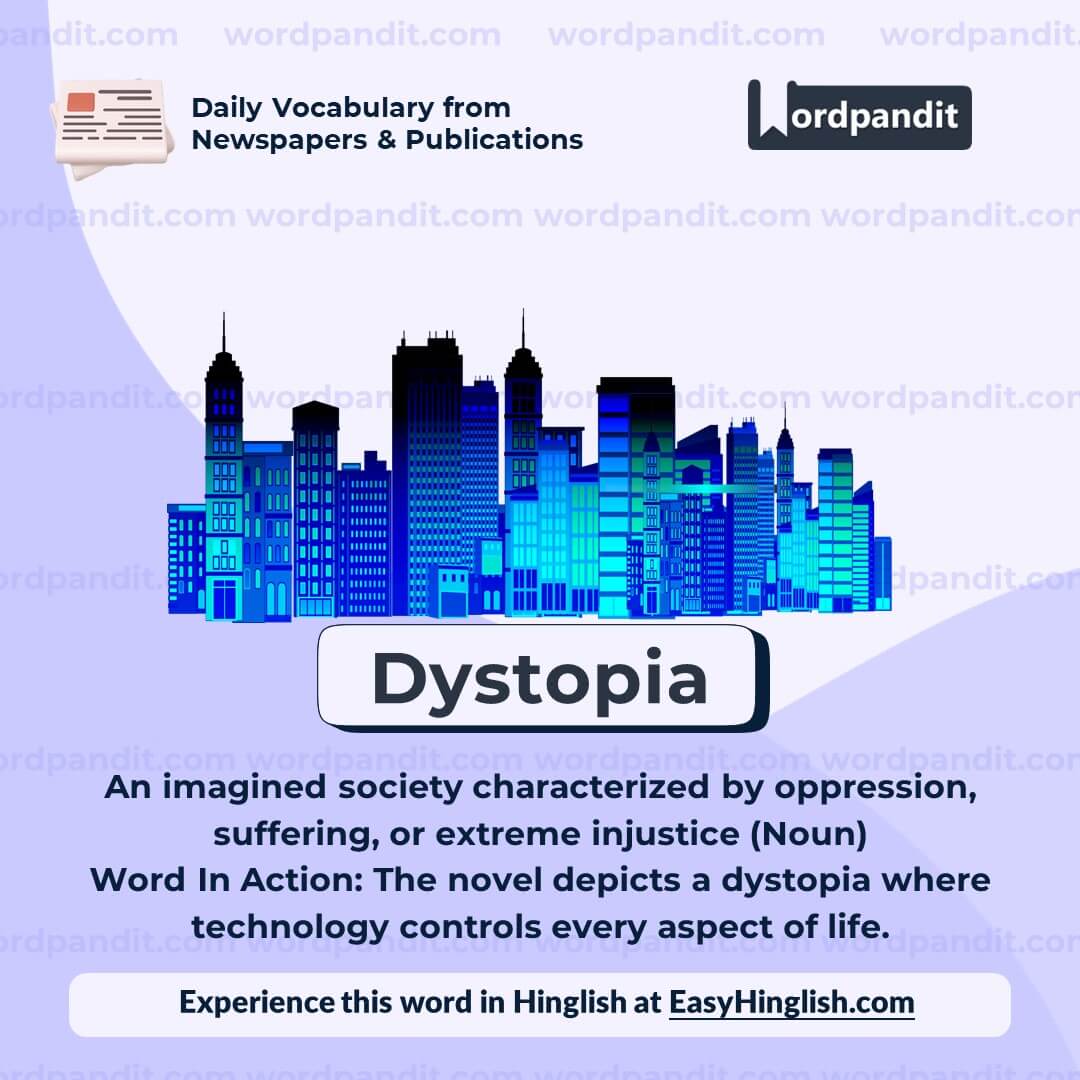
WORD-2: Dystopia
Context:
"The novel paints a chilling picture of a dystopia where surveillance is constant, and individuality is suppressed." - The Guardian
Explanatory Paragraph:
Dystopia refers to an imagined society that is deeply flawed, often characterized by oppression, misery, and the loss of individual freedom. It is the opposite of a utopia (a perfect world). Dystopian settings are common in literature and film, used to critique current social, political, or technological trends by exaggerating their possible negative outcomes.
Meaning: An imagined world or society where everything is unpleasant or oppressive (Noun)
Pronunciation: dis-TOH-pee-uh
Difficulty Level: ⭐⭐⭐⭐ Advanced
Etymology: From Greek *dys-* meaning "bad" and *topos* meaning "place" — literally "bad place"
Prashant Sir's Notes:
Remember: 'Utopia' is the ideal world, while 'Dystopia' is its dark mirror — a society gone wrong. This word is crucial in discussions about literature, politics, and technology.
Synonyms & Antonyms:
Synonyms: nightmare world, totalitarian society, authoritarian regime, anti-utopia, hellscape
Antonyms: utopia, paradise, ideal society, dreamland
Usage Examples:
- The film explores a dystopia ruled by AI, where humans have no free will.
- Writers often use dystopia to highlight the dangers of political extremism.
- His vision of the future was not hopeful—it was a bleak dystopia controlled by megacorporations.
- Books like "The Handmaid's Tale" and "1984" depict famous literary dystopias.
Cultural Reference:
"If you want a picture of the future, imagine a boot stamping on a human face—forever." - George Orwell, *1984*
Think About It:
Are elements of dystopia already present in today’s world, or are they purely fictional warnings?
Quick Activity:
List two dystopian books or movies you’ve seen or read. What social or political issues do they critique?
Memory Tip:
Think “Dys-” means “bad,” and “-topia” means “place” — so *dystopia* is a bad place or society.
Real-World Application:
Understanding *dystopia* is essential in analyzing literature, films, and political commentary that explore the consequences of unchecked power, technological control, or societal collapse.
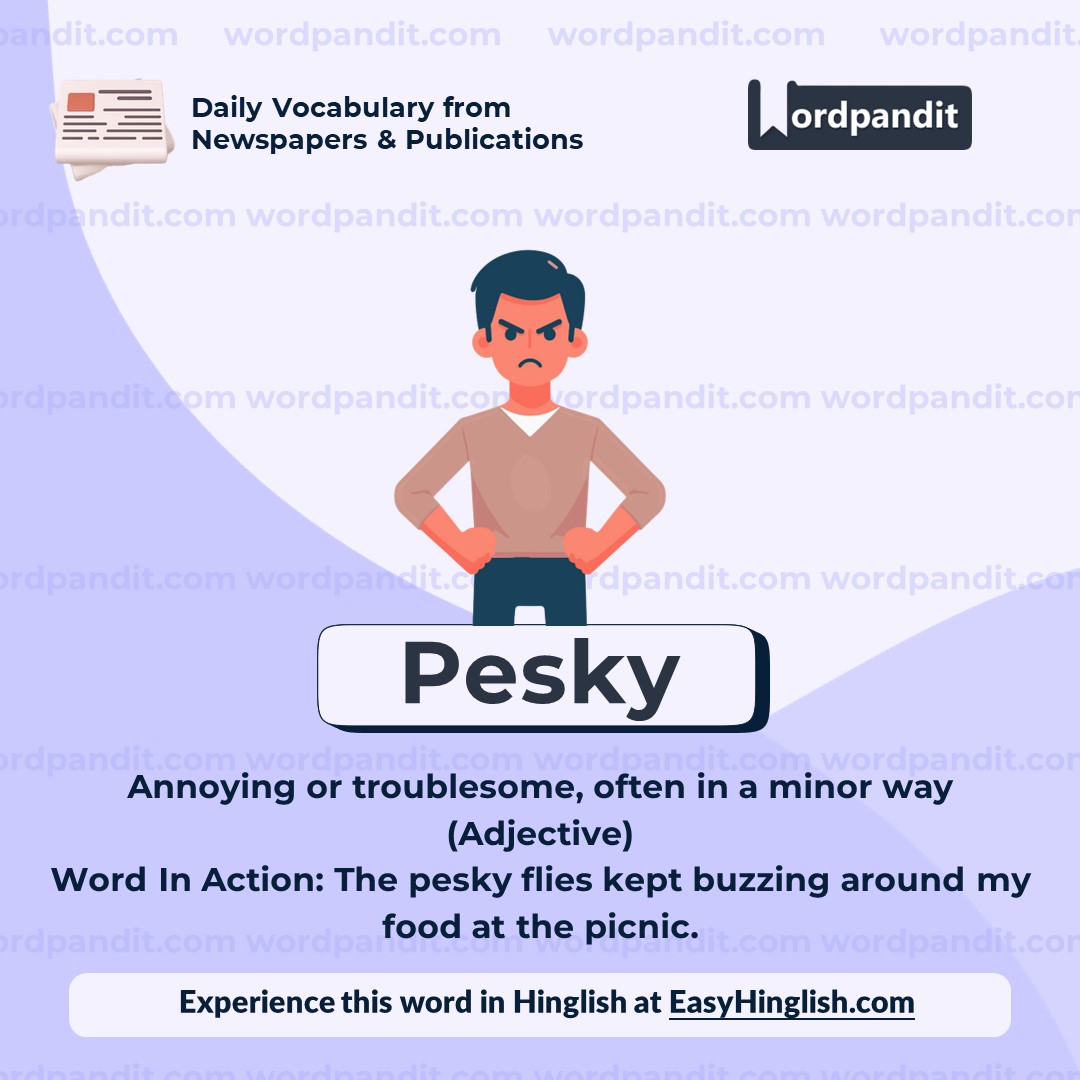
WORD-3: Pesky
Context:
"She tried swatting away the pesky mosquitoes that buzzed around her ears all evening." - National Geographic
Explanatory Paragraph:
Pesky is a light, informal word used to describe something or someone that is annoying or bothersome. While it's usually not used for serious problems, it expresses irritation or mild frustration. It’s often applied to small but persistent nuisances, like bugs, repeated notifications, or a sibling who won’t stop talking.
Meaning: Annoying or troublesome, especially in a minor but persistent way (Adjective)
Pronunciation: PES-kee
Difficulty Level: ⭐⭐ Basic
Etymology: Originated in the mid-19th century from the dialectal use of "pest" with the suffix "-y" to create a mild, descriptive adjective
Prashant Sir's Notes:
Think of "pesky" as a gentler way to complain. It’s more playful than harsh. Use it when something keeps bothering you in a small but constant way.
Synonyms & Antonyms:
Synonyms: annoying, irritating, bothersome, nagging, troublesome
Antonyms: pleasant, agreeable, welcome, helpful
Usage Examples:
- That pesky alarm keeps going off every five minutes!
- She finally found a solution to those pesky pop-up ads on her browser.
- He couldn't focus because of a pesky fly buzzing around the room.
- Dealing with pesky little problems early can prevent bigger ones later.
Cultural Reference:
"Those pesky kids!" — a popular catchphrase from the villain in the cartoon *Scooby-Doo*, often said after the mystery was solved.
Think About It:
Why do you think we often reserve words like "pesky" for minor irritations rather than serious problems?
Quick Activity:
Make a list of three “pesky” things that bothered you this week. Then write how you solved (or could solve) each one.
Memory Tip:
“Pesky” sounds like “pest” — think of a tiny pest like a mosquito that won’t leave you alone!
Real-World Application:
Use “pesky” in casual conversations, blogs, or informal writing when you want to express mild annoyance without sounding too serious or negative.
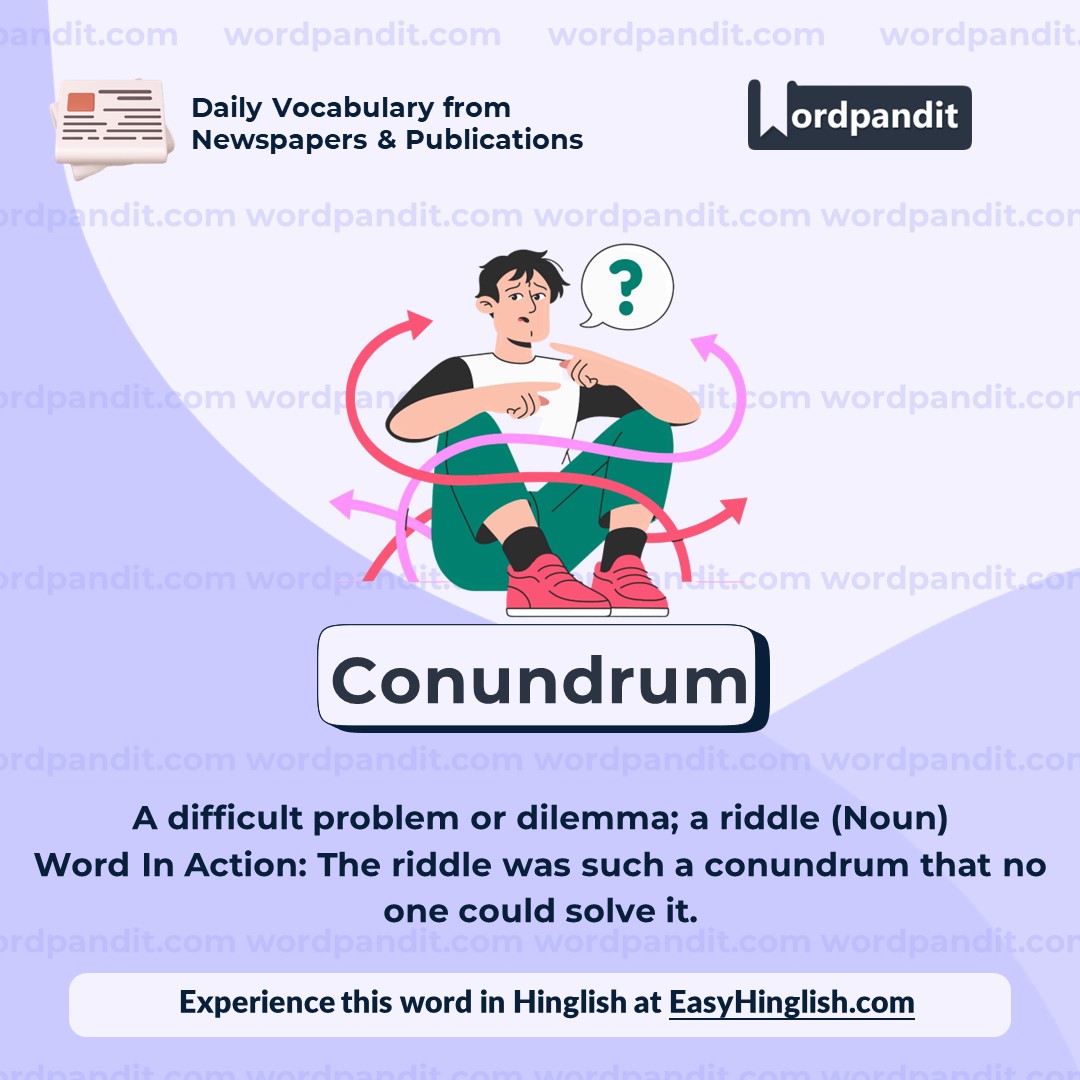
WORD-4: Conundrum
Context:
"The company faced a conundrum: raise prices and risk losing customers or absorb the rising costs and hurt profits." - The Wall Street Journal
Explanatory Paragraph:
Conundrum refers to a confusing and difficult problem or question. It’s often used when there’s no clear or easy solution, and every option seems to come with trade-offs. The word is frequently used in both casual and academic discussions to describe dilemmas, paradoxes, or puzzling situations that require deep thinking or tough decisions.
Meaning: A confusing and difficult problem or question (Noun)
Pronunciation: kuh-NUN-drum
Difficulty Level: ⭐⭐⭐⭐ Advanced
Etymology: Origin unclear; possibly coined in 16th-century Oxford as a humorous Latin-sounding word to describe a riddle or pun
Prashant Sir's Notes:
This is a great word to use instead of “problem” when you're talking about something particularly tricky or puzzling. It’s especially useful in essays, debates, and editorial writing.
Synonyms & Antonyms:
Synonyms: dilemma, puzzle, enigma, mystery, paradox
Antonyms: solution, clarity, answer, resolution
Usage Examples:
- The ethical conundrum left the committee divided and unable to vote.
- She faced a conundrum: should she follow her dreams or choose the safer path?
- Scientists are working to solve the conundrum of dark matter in the universe.
- The story begins with a classic detective conundrum that keeps readers guessing.
Cultural Reference:
“To be, or not to be — that is the question.” This famous line from Shakespeare’s *Hamlet* reflects a deep philosophical conundrum about life and death.
Think About It:
Have you ever faced a personal conundrum where both options felt equally right — or equally wrong?
Quick Activity:
Write down a real-life conundrum you've encountered. Then list two possible solutions and the pros and cons of each.
Memory Tip:
Break it like this: *“con” (against) + “drum” (rhythm/confusion)* — a conundrum knocks your rhythm off with its tricky problem!
Real-World Application:
The word *conundrum* is often used in business, ethics, politics, and philosophy to describe complex situations with no easy answers, helping to elevate the tone of analysis and discussion.
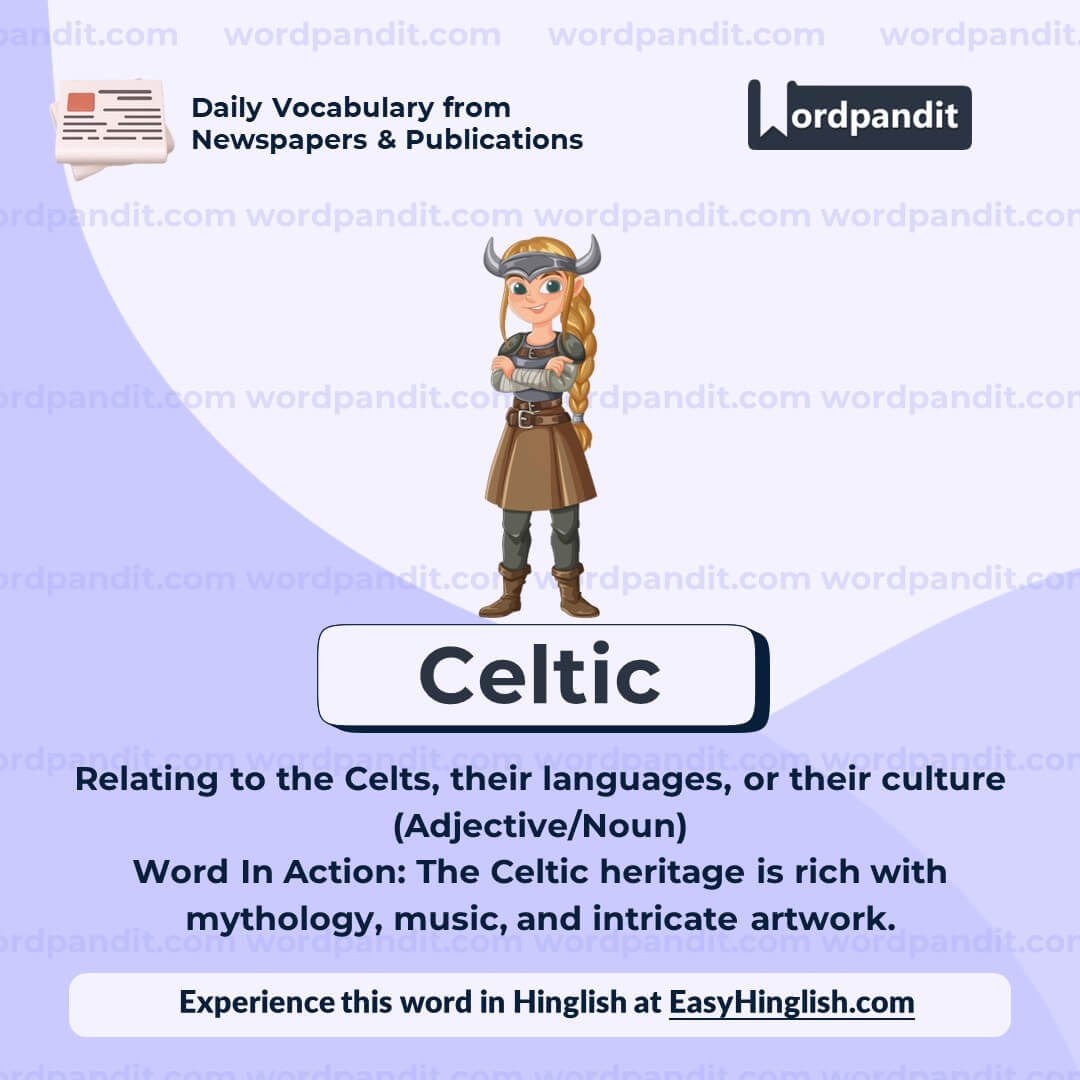
WORD-5: Celtic
Context:
"The festival celebrated traditional Celtic music, complete with bagpipes, folk dancing, and ancient storytelling." - Irish Times
Explanatory Paragraph:
Celtic refers to the culture, languages, and people descended from the ancient Celts, a group of tribal societies that once spread across much of Europe. Today, the term is most commonly associated with the cultural heritage of regions like Ireland, Scotland, Wales, and Brittany. Celtic traditions include unique art styles, music, mythology, and languages such as Gaelic and Welsh.
Meaning: Relating to the Celts or their languages and culture (Adjective); a branch of the Indo-European languages (Noun)
Pronunciation: KEL-tik
Difficulty Level: ⭐⭐⭐ Intermediate
Etymology: From Latin *Celtae* (the Celts), via French *celtique* and English *Celtic*
Prashant Sir's Notes:
Don't be fooled by the spelling! "Celtic" is almost always pronounced “KEL-tik” in historical and cultural contexts. However, the sports team “Boston Celtics” is a rare exception, pronounced “SEL-tiks.”
Synonyms & Antonyms:
Synonyms: Gaelic, Brythonic, Irish, Scottish (contextual)
Antonyms: Non-Celtic, Anglo-Saxon, Roman (in historical or linguistic contexts)
Usage Examples:
- The museum hosts a stunning collection of Celtic artifacts dating back to the Iron Age.
- Celtic languages like Welsh and Irish are being revived through education and media.
- Her Celtic tattoo featured intricate knotwork symbolizing eternity and unity.
- Celtic music is known for its haunting melodies and use of traditional instruments like the harp and fiddle.
Cultural Reference:
The famous “Book of Kells,” an illuminated manuscript from the 9th century, is a masterpiece of Celtic art and Christian tradition housed at Trinity College in Dublin.
Think About It:
Why do you think ancient Celtic culture continues to influence modern art, music, and identity today?
Quick Activity:
Research one Celtic festival or holiday (e.g., Samhain, Beltane) and write 3–4 sentences describing how it's celebrated today.
Memory Tip:
Remember: “Celtic” with a “C” but pronounced like a “K”—think of a *keltic* culture rich in *knots*, *kilts*, and *kelpies* (mythical creatures)!
Real-World Application:
Knowing the term *Celtic* is helpful in understanding European history, cultural studies, art, linguistics, and even pop culture references such as music, fantasy fiction, and sports teams.


