

Daily Vocabulary from International Newspapers and Publications
Expand Your Vocabulary with Wordpandit’s Global Vocabulary Hub
At Wordpandit, we are committed to helping you develop a truly global vocabulary by drawing from some of the most respected international publications. This section is designed to keep you ahead of the curve by introducing you to words that define global conversations and trends.
The Power of Global Sources
To help you think and communicate on a global scale, we curate vocabulary from renowned international sources, such as:
- The New York Times
- The Washington Post
- BBC
- The Guardian
- The Economist
- Scientific American
- Psychology Today
- And many more...
Stay Global, Stay Competitive
Our daily updates from international publications ensure you are consistently exposed to new words that reflect global news and developments, making sure your vocabulary is not only current but also globally relevant.
Enhance Your Global Perspective
Whether you’re preparing for international exams, aiming to excel in global business communication, or want to enhance your language skills for personal growth, Wordpandit offers the resources you need to thrive in a global context.
Effective Learning, Global Reach
Our learning methodology combines global examples, memory aids, and interactive activities, allowing you to internalize new words effectively and apply them in real-world scenarios.
Begin Your Global Vocabulary Journey Now!
Why Choose Wordpandit?
Practical Learning: Focus on words you'll actually encounter in real-world reading, enhancing your comprehension and communication skills.
Diverse Content: From current affairs to scientific breakthroughs, our varied sources expose you to vocabulary across multiple domains.
Effortless Integration: Make Wordpandit a part of your daily routine. Just a few minutes each day can significantly boost your lexicon over time.
Your Path to Vocabulary Mastery
- Visit our Daily Vocabulary section regularly
- Explore new words and their usage in context
- Practice incorporating these words into your own writing and speech
- Track your progress as your vocabulary expands
Start Your Journey Today
Embark on your vocabulary enhancement journey with Wordpandit. By consistently engaging with our daily posts, you'll build a robust vocabulary that serves you well in academic, professional, and personal contexts.
Remember, a word a day keeps linguistic limitations at bay. Make Wordpandit your daily companion in the quest for vocabulary excellence!
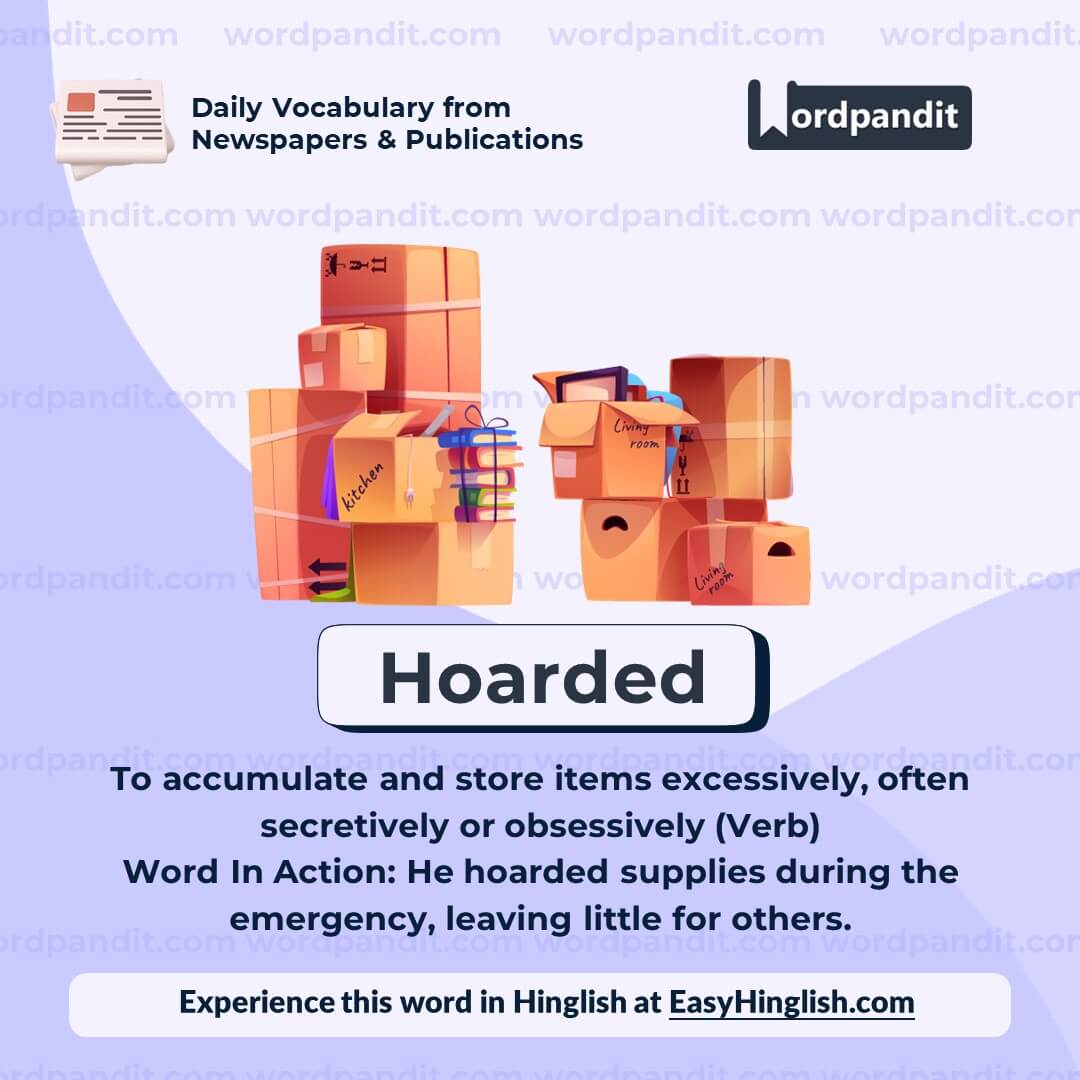
WORD-1: Hoarded
Context:
"In suburbs across the nation, homes filled to the rafters with hoarded junk are common enough to have an ironic idiom: gomi-yashiki (trash-mansions)." - Aeon
Explanatory Paragraph:
The word "hoarded" refers to the act of collecting and keeping a large amount of something, often secretly or excessively, especially when it isn’t needed immediately. People may hoard food, money, or, as in this context, junk or household items. Hoarding often suggests an irrational need to accumulate and an inability to discard even useless things, sometimes resulting in cluttered, unmanageable spaces.
Meaning: To accumulate and store items excessively, often secretly or compulsively (verb)
Pronunciation: HOR-did
Difficulty Level: ⭐⭐ Basic
Etymology: From Old English "hordian," meaning "to treasure or store up," derived from "hord" meaning "treasure, valuable stock."
Prashant Sir's Notes:
When we think of hoarding, imagine someone stacking up newspapers, food, or even wealth without ever using it. It shows an attachment to possession and a fear of scarcity. Emotionally, hoarding often ties into anxiety or trauma. Reflect on the psychological reasons behind hoarding when you use this word.
Synonyms & Antonyms:
Synonyms: stash, stockpile, accumulate, collect, amass
Antonyms: discard, donate, waste, give away, scatter
Usage Examples:
- She hoarded dozens of old magazines, believing they would be useful one day.
- During the pandemic, many people hoarded toilet paper and sanitizers.
- He hoarded his childhood toys in the attic for sentimental reasons.
- The squirrel hoarded nuts throughout the fall to prepare for winter.
Cultural Reference:
"Hoarding: Buried Alive," a reality TV series, delves into the lives of people suffering from compulsive hoarding disorder and the emotional struggles they face. - TLC Network
Think About It:
Is hoarding ever justifiable, or does it always stem from fear and insecurity? When does collecting cross the line into hoarding?
Quick Activity:
List three items you might find someone hoarding in their home. Then, write one sentence using "hoarded" with each.
Memory Tip:
Think of a dragon hoarding gold in a cave — keeping a huge stash of treasure it never uses. "Hoarded" = held on to too much.
Real-World Application:
Understanding the word "hoarded" helps in contexts like economics (hoarded cash during inflation), psychology (hoarding disorder), or disaster planning (people hoarding supplies before a storm).
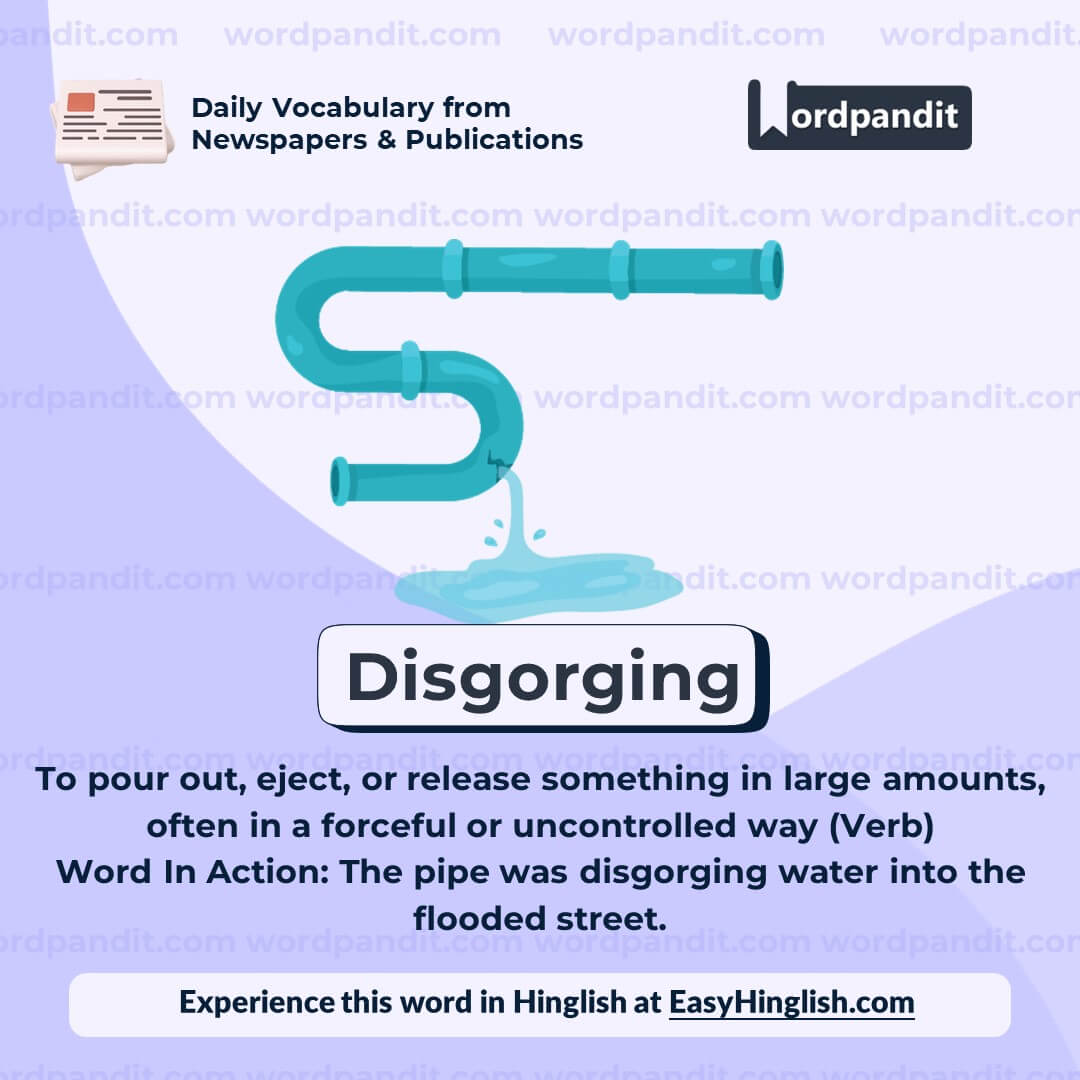
WORD-2: Disgorging
Context:
"And in areas where space is limited, cluttered residences and shops will often erupt, disgorging things onto the street in a semi-controlled jumble so ubiquitous that urban planners have a name for it:" - Aeon
Explanatory Paragraph:
"Disgorging" describes the forceful or uncontrolled release or expulsion of something, often in large quantities. It can refer to physical items being poured or spewed out of a space — like boxes spilling from a crowded shop — or even abstract things like emotions or information being released suddenly. In the context provided, it vividly captures how overfilled shops or homes spill their contents onto public spaces, as if unable to contain them any longer.
Meaning: Releasing or pouring out something forcefully or in large amounts (verb)
Pronunciation: dis-GOR-jing
Difficulty Level: ⭐⭐⭐ Intermediate
Etymology: From Old French "desgorgier," meaning "to throw up," which comes from Latin "dis-" (apart) + "gurgitare" (to flood or pour)
Prashant Sir's Notes:
Think of "disgorging" as the opposite of neatly letting something out — it's messy, unfiltered, and overwhelming. It's a strong, visual verb. When you see a street overflowing with boxes or a dam suddenly releasing water, that’s disgorging in action. It’s especially useful in vivid, descriptive writing.
Synonyms & Antonyms:
Synonyms: eject, expel, spew, pour out, release
Antonyms: absorb, retain, contain, hold in, suppress
Usage Examples:
- The overloaded truck suddenly tipped, disgorging crates onto the highway.
- The volcano erupted, disgorging lava down its slopes.
- The subway disgorged hundreds of commuters onto the street at rush hour.
- After hours of silence, she finally disgorged all her pent-up frustrations.
Cultural Reference:
In Dante’s *Inferno*, the River Styx is portrayed as disgorging tormented souls who have committed wrathful sins — a dark and vivid image of release and chaos in classic literature.
Think About It:
When systems — physical, emotional, or societal — are pushed to their limits, what happens when they finally "disgorge" what they've been holding in?
Quick Activity:
Describe a scene where something is being "disgorged" — it could be a crowd, water, or even emotions. Use vivid language and make it as sensory as possible.
Memory Tip:
Break it into "dis-" (apart) + "gorge" (think of throat or mouth) — like throwing something out of your throat or stomach. Disgorge = throw out forcefully.
Real-World Application:
"Disgorging" is often used in journalism, legal writing (e.g., companies disgorging profits), or environmental contexts (e.g., factories disgorging waste into rivers). It adds a powerful, almost visual impact to formal or descriptive writing.
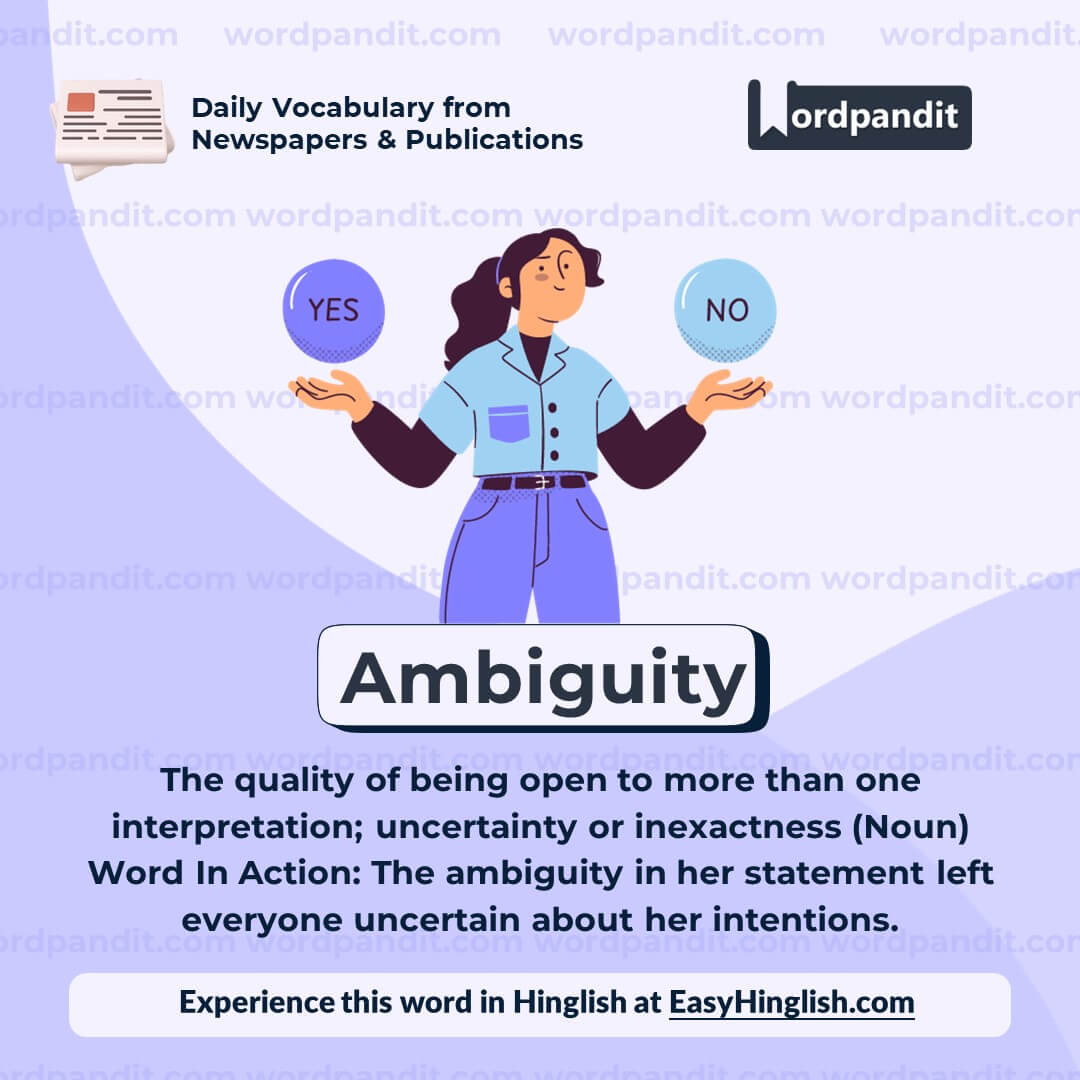
WORD-3: Ambiguity
Context:
"For Anouchka Grose, a psychoanalyst and author who has brought her specialism to bear on such topics as fashion, vegetarianism and eco-anxiety, this tolerance of ambiguity is precisely what makes." - Aeon
Explanatory Paragraph:
“Ambiguity” refers to a situation, statement, or idea that can be understood in more than one way, leading to uncertainty or lack of clarity. It can be intentional — such as in poetry or humor — or unintentional, causing confusion or misinterpretation. In deeper psychological or philosophical contexts, tolerance of ambiguity refers to one’s ability to accept complexity, uncertainty, and contradictory perspectives without becoming anxious or needing definite answers.
Meaning: The quality of being open to more than one interpretation; uncertainty or inexactness (noun)
Pronunciation: am-bih-GYOO-ih-tee
Difficulty Level: ⭐⭐⭐ Intermediate
Etymology: From Latin "ambiguitas," from "ambiguus" meaning “doubtful, uncertain,” from “ambi-” (both) + “agere” (to drive)
Prashant Sir's Notes:
Ambiguity is a powerful concept in both language and life. Words, actions, or decisions can carry more than one meaning, and that uncertainty can either frustrate us or push us to think deeper. The key is learning to sit with the “not-knowing” — that’s where critical thinking grows.
Synonyms & Antonyms:
Synonyms: vagueness, obscurity, uncertainty, equivocation, doubt
Antonyms: clarity, certainty, definiteness, precision, transparency
Usage Examples:
- The lawyer exploited the ambiguity in the contract to challenge the deal.
- Her statement was full of ambiguity, leaving everyone unsure of her true intentions.
- Poets often use ambiguity to add layers of meaning to their work.
- Learning to tolerate ambiguity is essential in today’s fast-changing world.
Cultural Reference:
In Shakespeare’s plays, ambiguity often drives the plot. For instance, the witches’ prophecy in *Macbeth* — “None of woman born shall harm Macbeth” — is intentionally ambiguous and crucial to the tragedy’s outcome.
Think About It:
How comfortable are you with ambiguity in your daily life? Do you seek black-and-white answers, or can you live with the grey areas?
Quick Activity:
Write a short sentence that could be interpreted in two different ways. Then, explain both interpretations.
Memory Tip:
Think of “ambi-” (meaning both) and “guess” — when something has “ambiguity,” you’re guessing between two meanings or directions.
Real-World Application:
Understanding ambiguity is vital in law, diplomacy, literature, and everyday conversations. Misunderstandings often arise from ambiguous language — being aware of it can improve communication and decision-making.
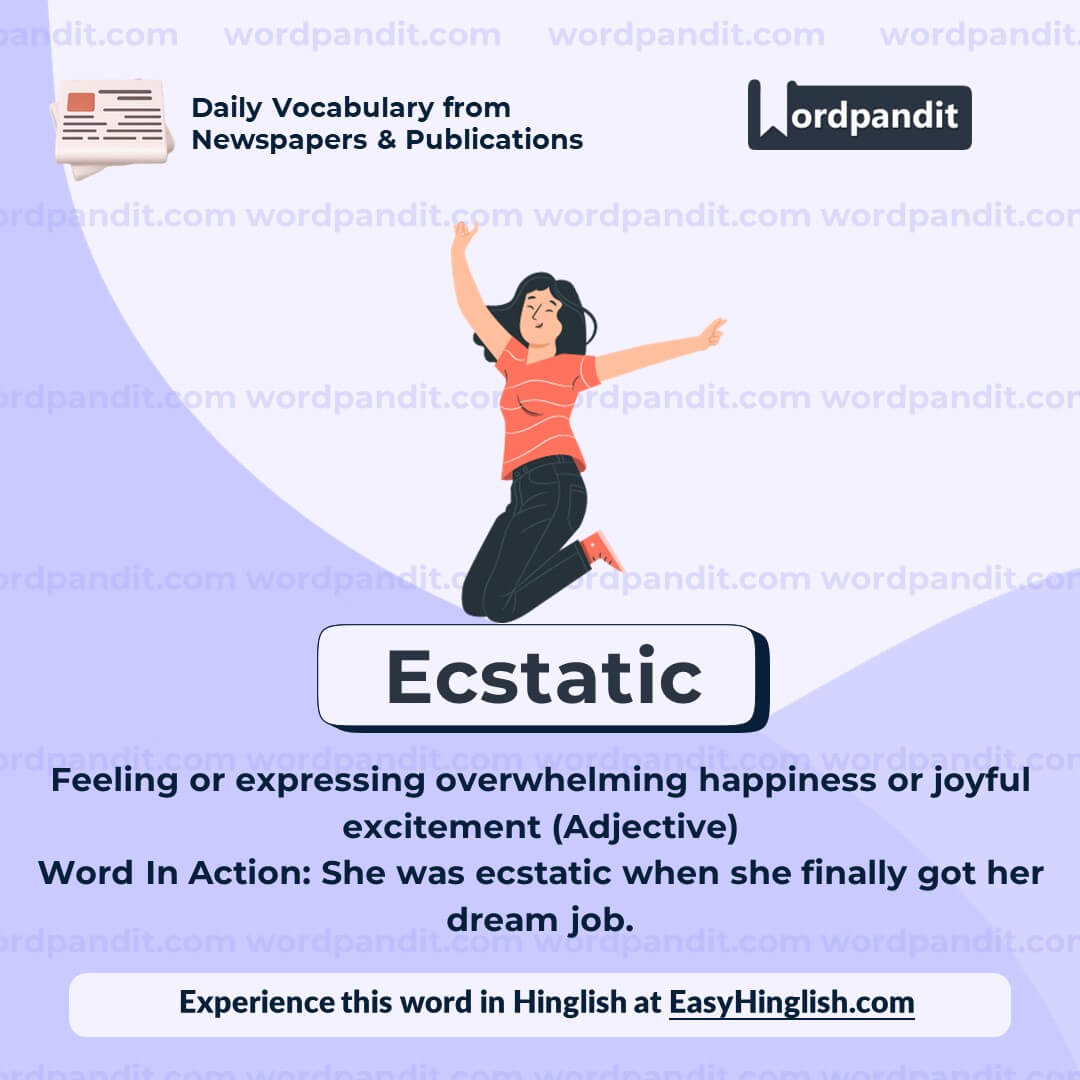
WORD-4: Ecstatic
Context:
"This is an ecstatic, emergent complexity, born less from planning than from organic growth, from the inevitable chaos of lives being lived." - Aeon
Explanatory Paragraph:
"Ecstatic" refers to a state of overwhelming happiness, joy, or emotional intensity. It describes feelings so strong they lift someone out of their ordinary experience. In broader usage, it can also describe something that seems alive with energy and emotion. In the provided context, "ecstatic" is used metaphorically to describe a lively, spontaneous, and vibrant complexity — full of life and movement — as opposed to something carefully designed.
Meaning: Feeling or expressing overwhelming joy or rapture (adjective)
Pronunciation: ek-STAT-ik
Difficulty Level: ⭐⭐ Basic
Etymology: From Greek "ekstasis," meaning "to be outside oneself," from "ek-" (out) + "histanai" (to place or cause to stand)
Prashant Sir's Notes:
"Ecstatic" isn’t just happy — it’s beyond that. It’s the joy you feel when your team wins in the final seconds, or the rush from a breakthrough idea. Also note how the word has moved beyond emotions — in literature or art, it can describe wild, beautiful complexity. That’s how it's being used in this context — not about a person’s emotion, but about a living, joyous system.
Synonyms & Antonyms:
Synonyms: overjoyed, elated, euphoric, blissful, rapturous
Antonyms: miserable, sorrowful, depressed, dejected, gloomy
Usage Examples:
- She was ecstatic when she found out she had been accepted into her dream university.
- The fans erupted in ecstatic cheers as the final goal was scored.
- His face lit up with an ecstatic smile when he saw his newborn child.
- The garden bloomed in an ecstatic riot of color after the monsoon.
Cultural Reference:
The term “ecstatic” is often associated with mystics or spiritual experiences — for example, Saint Teresa of Ávila described her spiritual visions as “ecstatic states,” moments of intense spiritual union beyond normal consciousness.
Think About It:
Can something be "ecstatic" without being human? What might it mean to describe a city, a painting, or even a forest as ecstatic?
Quick Activity:
Write a short paragraph describing a moment when you (real or imagined) felt ecstatic. Focus on sensory details — what did you see, hear, feel?
Memory Tip:
Think of "ecstatic" as being so happy you’re out of your normal state — "ec-" (out) + "-static" (still) — you’re moving with joy!
Real-World Application:
“Ecstatic” is useful when you want to express strong joy or praise — whether in speeches, creative writing, or even product reviews ("I was ecstatic with the results!"). It's a great word for showing extreme positive emotion.
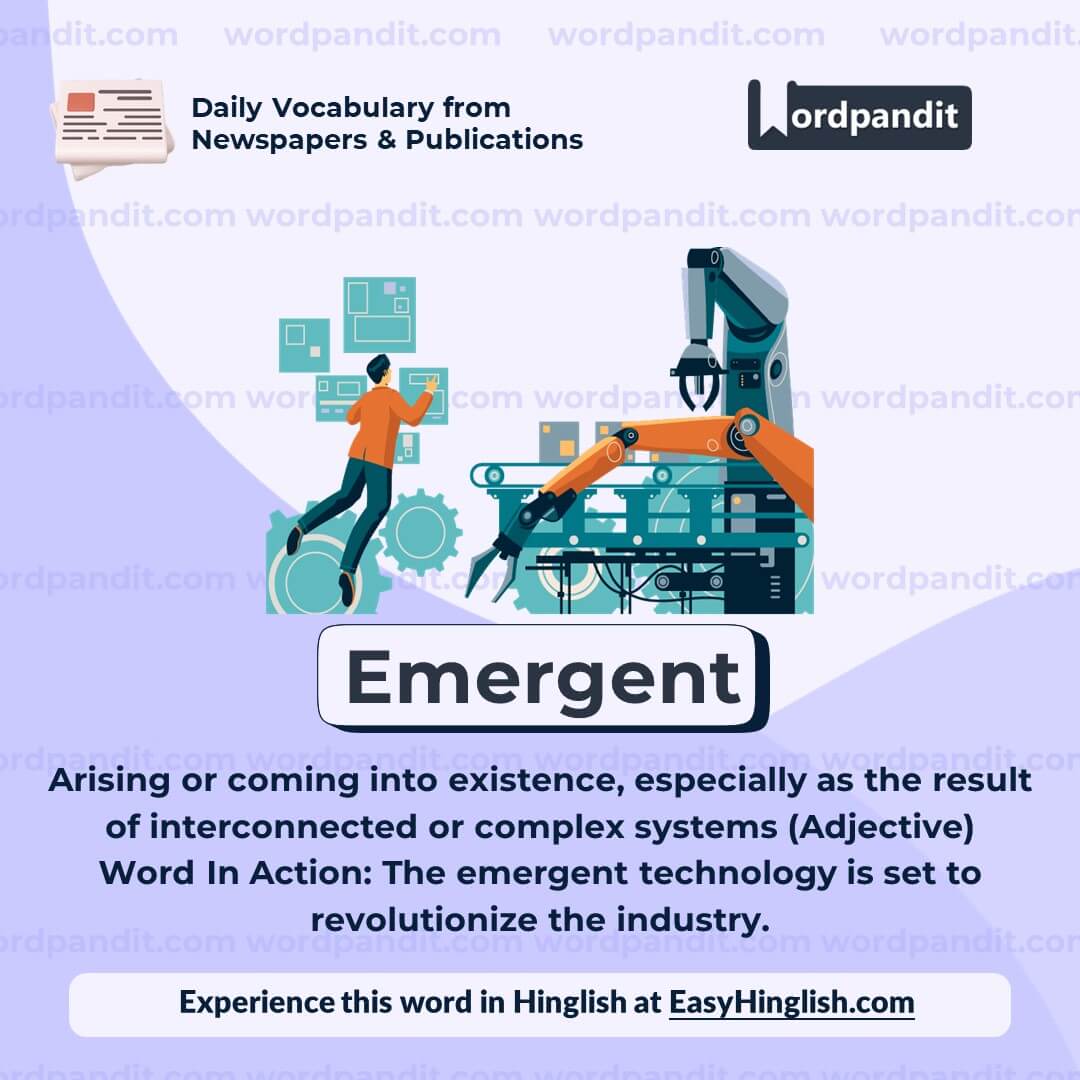
WORD-5: Emergent
Context:
"This is an ecstatic, emergent complexity, born less from planning than from organic growth, from the inevitable chaos of lives being lived." - Aeon
Explanatory Paragraph:
“Emergent” describes something that is coming into being, developing, or arising — often unexpectedly and from complex systems. It's frequently used in scientific, social, and philosophical contexts to describe patterns or properties that arise from simpler interactions but were not explicitly planned or predicted. In the quote, “emergent complexity” refers to an intricate system that forms naturally over time, without central planning — like a city’s organic layout or social behaviors that evolve spontaneously.
Meaning: Beginning to exist or become visible; arising or developing, especially as a result of complex systems (adjective)
Pronunciation: eh-MUR-jent
Difficulty Level: ⭐⭐⭐ Intermediate
Etymology: From Latin "emergere," meaning “to rise out or up,” from "e-" (out) + "mergere" (to dip, plunge)
Prashant Sir's Notes:
“Emergent” is a key word in systems thinking and complexity science. It reminds us that not everything valuable comes from top-down control — sometimes the most intricate or effective systems emerge from simple, decentralized interactions. Think of traffic patterns, ant colonies, or online trends — no one designs them fully, yet they evolve into complex systems.
Synonyms & Antonyms:
Synonyms: arising, developing, surfacing, evolving, unfolding
Antonyms: disappearing, declining, vanishing, subsiding
Usage Examples:
- Scientists are studying the emergent behavior of flocking birds to understand group coordination.
- Urban planners are fascinated by the emergent layout of informal settlements.
- The app gained popularity through emergent user behavior rather than marketing.
- Emergent economies are reshaping the global financial landscape.
Cultural Reference:
In the Marvel film *Doctor Strange*, the “mirror dimension” behaves with emergent complexity — cities fold and reshape spontaneously, illustrating how intricate forms can arise without central design.
Think About It:
What systems in your life or society appear “emergent” — not planned, but developed organically over time? How do we balance control with letting things emerge?
Quick Activity:
List three things that could be described as “emergent” (e.g., behaviors, trends, systems). Then write a sentence using the word for one of them.
Memory Tip:
Think “emerge” = to come out. So “emergent” = just now coming into being — like something rising up from below the surface.
Real-World Application:
“Emergent” is widely used in fields like artificial intelligence, biology, economics, and sociology to describe how simple actions can lead to complex, often unpredictable outcomes. Understanding it helps us analyze systems more holistically.


