

Daily Vocabulary from International Newspapers and Publications
Expand Your Vocabulary with Wordpandit’s Global Vocabulary Hub
At Wordpandit, we are committed to helping you develop a truly global vocabulary by drawing from some of the most respected international publications. This section is designed to keep you ahead of the curve by introducing you to words that define global conversations and trends.
The Power of Global Sources
To help you think and communicate on a global scale, we curate vocabulary from renowned international sources, such as:
- The New York Times
- The Washington Post
- BBC
- The Guardian
- The Economist
- Scientific American
- Psychology Today
- And many more...
Stay Global, Stay Competitive
Our daily updates from international publications ensure you are consistently exposed to new words that reflect global news and developments, making sure your vocabulary is not only current but also globally relevant.
Enhance Your Global Perspective
Whether you’re preparing for international exams, aiming to excel in global business communication, or want to enhance your language skills for personal growth, Wordpandit offers the resources you need to thrive in a global context.
Effective Learning, Global Reach
Our learning methodology combines global examples, memory aids, and interactive activities, allowing you to internalize new words effectively and apply them in real-world scenarios.
Begin Your Global Vocabulary Journey Now!

Why Choose Wordpandit?
Practical Learning: Focus on words you'll actually encounter in real-world reading, enhancing your comprehension and communication skills.
Diverse Content: From current affairs to scientific breakthroughs, our varied sources expose you to vocabulary across multiple domains.
Effortless Integration: Make Wordpandit a part of your daily routine. Just a few minutes each day can significantly boost your lexicon over time.
Your Path to Vocabulary Mastery
- Visit our Daily Vocabulary section regularly
- Explore new words and their usage in context
- Practice incorporating these words into your own writing and speech
- Track your progress as your vocabulary expands
Start Your Journey Today
Embark on your vocabulary enhancement journey with Wordpandit. By consistently engaging with our daily posts, you'll build a robust vocabulary that serves you well in academic, professional, and personal contexts.
Remember, a word a day keeps linguistic limitations at bay. Make Wordpandit your daily companion in the quest for vocabulary excellence!
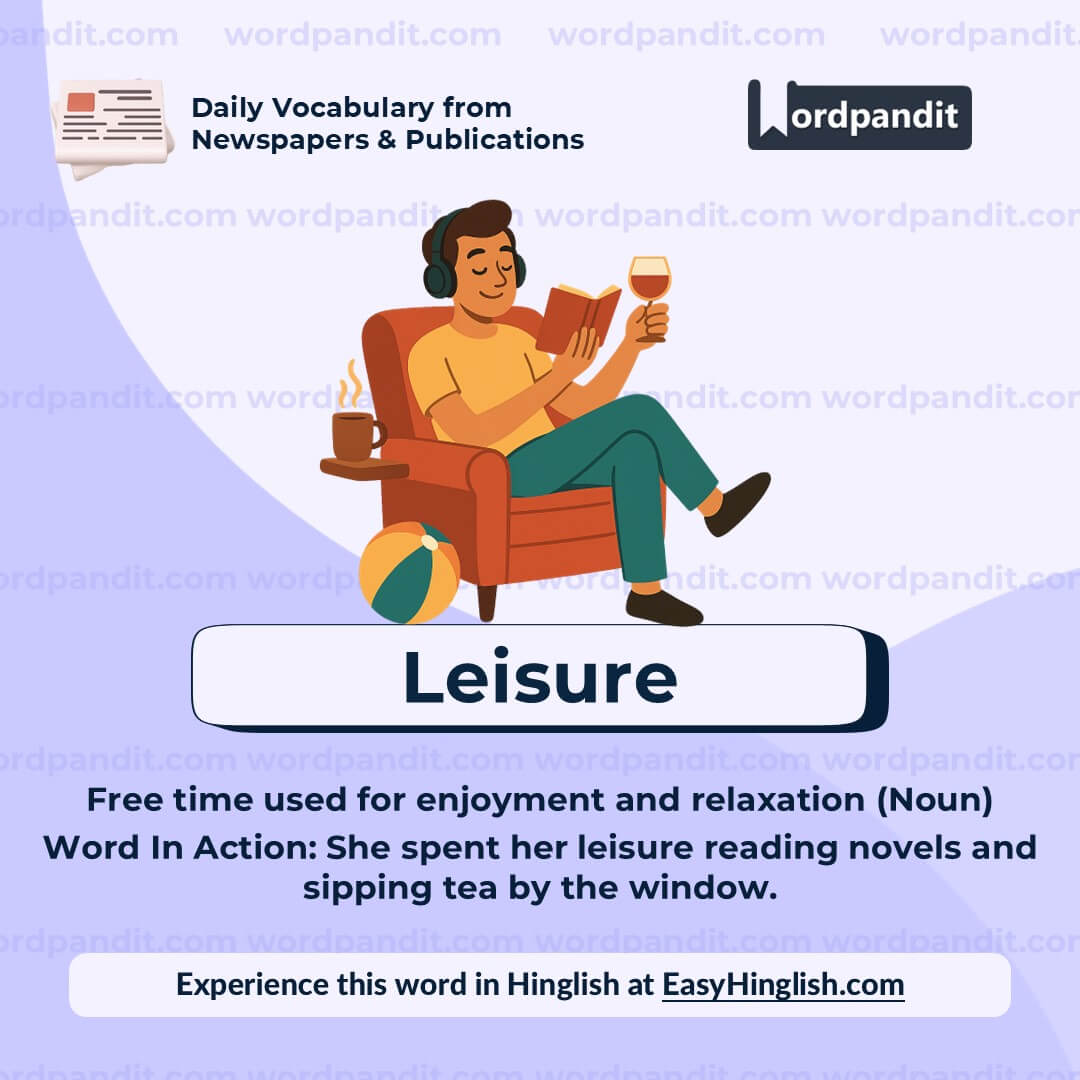
WORD-1: Leisure
Context:
"Had the topics changed since 1922? In the data from the 1990s, women and men discussed work and money roughly the same amount, with those topics taking up almost 40% of women’s conversations, compared to only about 4% in 1922. Similarly, leisure pursuits were the second most popular topic for both sexes." - Psychology Today
Explanatory Paragraph:
Leisure refers to the time when one is not working and can relax or do activities for enjoyment. It's the opposite of obligations or work-related tasks. Whether it’s reading a book, hiking, watching a movie, or simply lounging, leisure activities are chosen freely and bring a sense of refreshment. In discussions about work-life balance, leisure plays a vital role in maintaining overall well-being.
Meaning: Free time used for enjoyment and relaxation (Noun)
Pronunciation: LEE-zher or LEH-zher
Difficulty Level: ⭐⭐ Basic
Etymology: From Old French leisire, from Latin licere meaning "to be permitted."
Prashant Sir's Notes:
This word is key when discussing lifestyle, productivity, and well-being. The concept of “leisure time” helps us understand cultural and economic development over time. It’s a classic example of a word whose social meaning has expanded with modern work culture.
Synonyms & Antonyms:
Synonyms: free time, relaxation, downtime, recreation, respite
Antonyms: work, labor, occupation, hustle, business
Usage Examples:
- After a long week at work, she finally had some leisure to spend with her family.
- Leisure activities like painting and gardening can reduce stress.
- He used his leisure hours to volunteer at the local animal shelter.
- In ancient Rome, the wealthy had ample leisure to pursue philosophy and the arts.
Cultural Reference:
"The end of labor is to gain leisure." – Aristotle
Think About It:
In today’s fast-paced world, do we value and prioritize leisure enough? Or has it become a luxury for the few?
Quick Activity:
List three leisure activities you genuinely enjoy. Reflect on how often you get time for them each week.
Memory Tip:
Think of “leisure” as “pleasure without pressure”—both rhyme and capture its essence.
Real-World Application:
Leisure is central to discussions in sociology, psychology, and economics—used in terms like “leisure industry,” “leisure class,” and “leisure activities” in policy and urban planning.
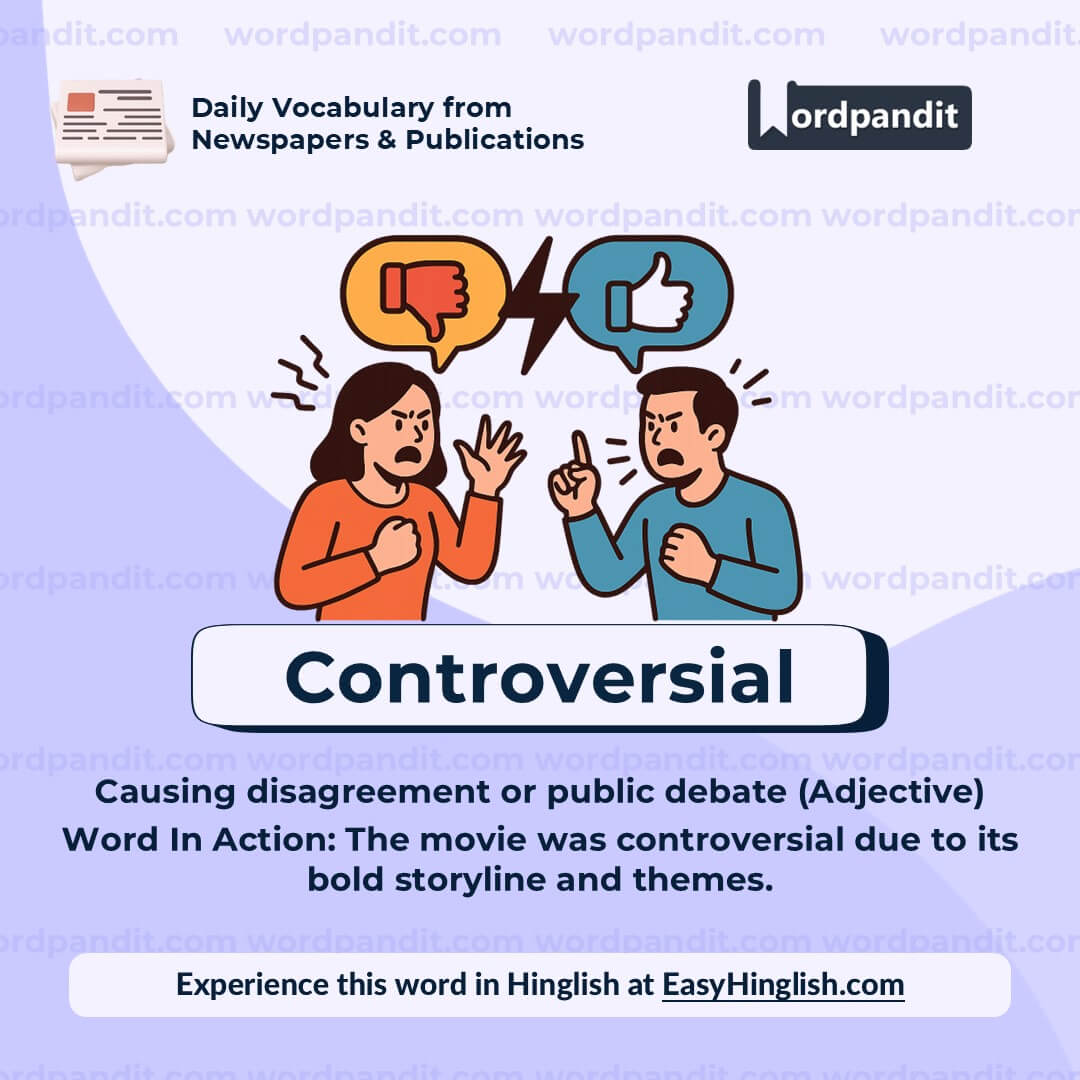
WORD-2: Controversial
Context:
"However, the researchers also found that, for women who had more powerful roles, gender differences diminished and sometimes even reversed, especially in regard to women taking part in conversations about more controversial topics." - Psychology Today
Explanatory Paragraph:
Controversial describes something that causes disagreement or public debate. It refers to topics, people, or issues that provoke strong opposing views. For instance, political decisions, social movements, or even celebrity actions can be labeled controversial when they spark intense discussion or conflict. Using the term often signals that opinions are deeply divided and emotional.
Meaning: Causing disagreement or public debate (Adjective)
Pronunciation: kon-troh-VER-shuhl
Difficulty Level: ⭐⭐⭐ Intermediate
Etymology: From Latin controversia, meaning "a turning against," from contra (against) + vertere (to turn)
Prashant Sir's Notes:
This is a must-know word for current affairs and essay writing. It signals that a subject invites differing opinions—use it to elevate arguments, especially when analyzing debates or policy issues. It often appears in media and academic writing to introduce hot-button topics.
Synonyms & Antonyms:
Synonyms: debatable, contentious, disputed, provocative, polarizing
Antonyms: uncontroversial, agreeable, accepted, undisputed, conventional
Usage Examples:
- The book was banned in several schools due to its controversial themes.
- Her speech on climate change policies sparked a controversial debate in Parliament.
- He’s known for his controversial opinions on education reform.
- Social media has amplified how quickly controversial issues gain attention.
Cultural Reference:
"To avoid criticism, say nothing, do nothing, be nothing." – Often attributed to Aristotle, this quote highlights how controversial action often attracts scrutiny.
Think About It:
Is being controversial always a bad thing, or can it be a sign of necessary change and courage?
Quick Activity:
Pick a controversial topic (e.g., AI ethics, climate policy, or social media regulation). Write one sentence supporting and one sentence opposing it using the word “controversial.”
Memory Tip:
Think of “controversial” as something that causes people to “turn against” each other—just like the Latin root “vertere” (to turn).
Real-World Application:
In journalism, politics, and academic writing, labeling a subject “controversial” helps prepare audiences for a range of strong opinions and encourages critical thinking.
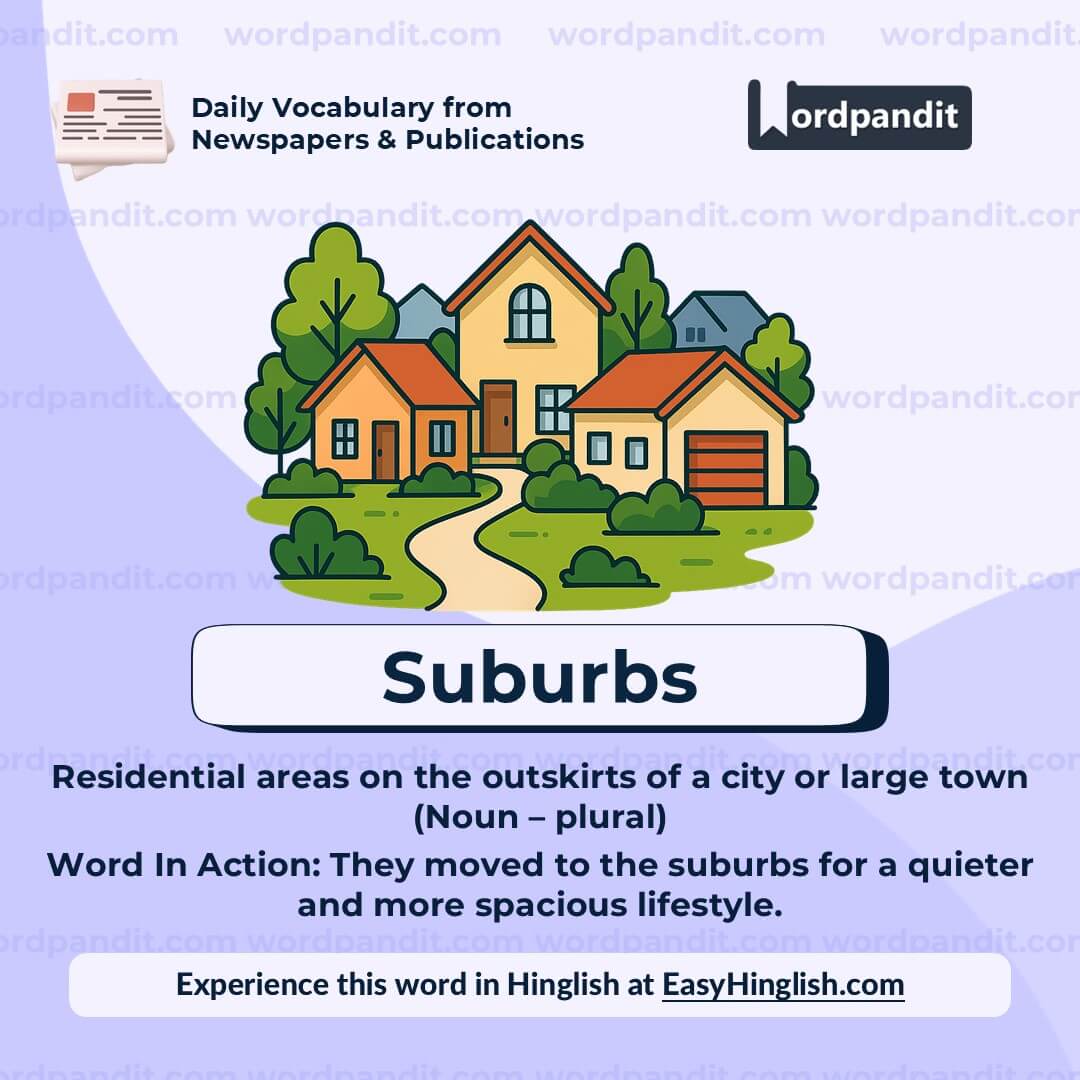
WORD-3: Suburbs
Context:
"Elizabeth Earnshaw, MA, LMFT, CGT, has been a couples therapist for over 15 years and practices in the suburbs of Philadelphia, Pennsylvania." - Psychology Today
Explanatory Paragraph:
The word "suburbs" refers to residential areas that are located just outside the main city. Suburbs typically offer quieter, more spacious living environments compared to urban centers and are often home to families who commute into the city for work. While once seen as primarily residential, modern suburbs may also include businesses, schools, and recreational facilities, creating a blend of urban convenience and suburban calm.
Meaning: Residential areas on the outskirts of a city or large town (Noun – plural)
Pronunciation: SUH-burbs
Difficulty Level: ⭐⭐ Basic
Etymology: From Latin suburbium, meaning “an area near a city,” from sub (under, near) + urbs (city)
Prashant Sir's Notes:
This word is essential for describing geographical and demographic divisions within cities. It often shows up in essays about urban development, transportation, and socio-economic trends. Understanding “suburbs” is key to grasping modern living patterns.
Synonyms & Antonyms:
Synonyms: outskirts, residential district, commuter town, satellite town
Antonyms: city center, urban core, downtown, inner city
Usage Examples:
- They moved to the suburbs to find a larger home and better schools.
- Suburbs are often viewed as ideal for raising children due to their quieter environment.
- Traffic congestion between the suburbs and the city center is a growing concern.
- Many suburbs now offer the same amenities as urban areas, including shopping malls and restaurants.
Cultural Reference:
TV shows like Desperate Housewives and Modern Family portray life in the American suburbs, reflecting cultural ideas of family life, community, and comfort.
Think About It:
How do suburbs shape our lifestyle and values differently from city or rural living?
Quick Activity:
Draw a simple Venn diagram comparing life in the suburbs with life in the city. Note at least three differences and one similarity.
Memory Tip:
Think of “suburbs” as being *sub* (below or near) the *urbs* (urban city)—close enough to reach but not in the hustle of it.
Real-World Application:
Urban planners and sociologists use the term “suburbs” to study population movement, infrastructure needs, and lifestyle trends. It's also crucial in real estate, politics, and public transportation planning.
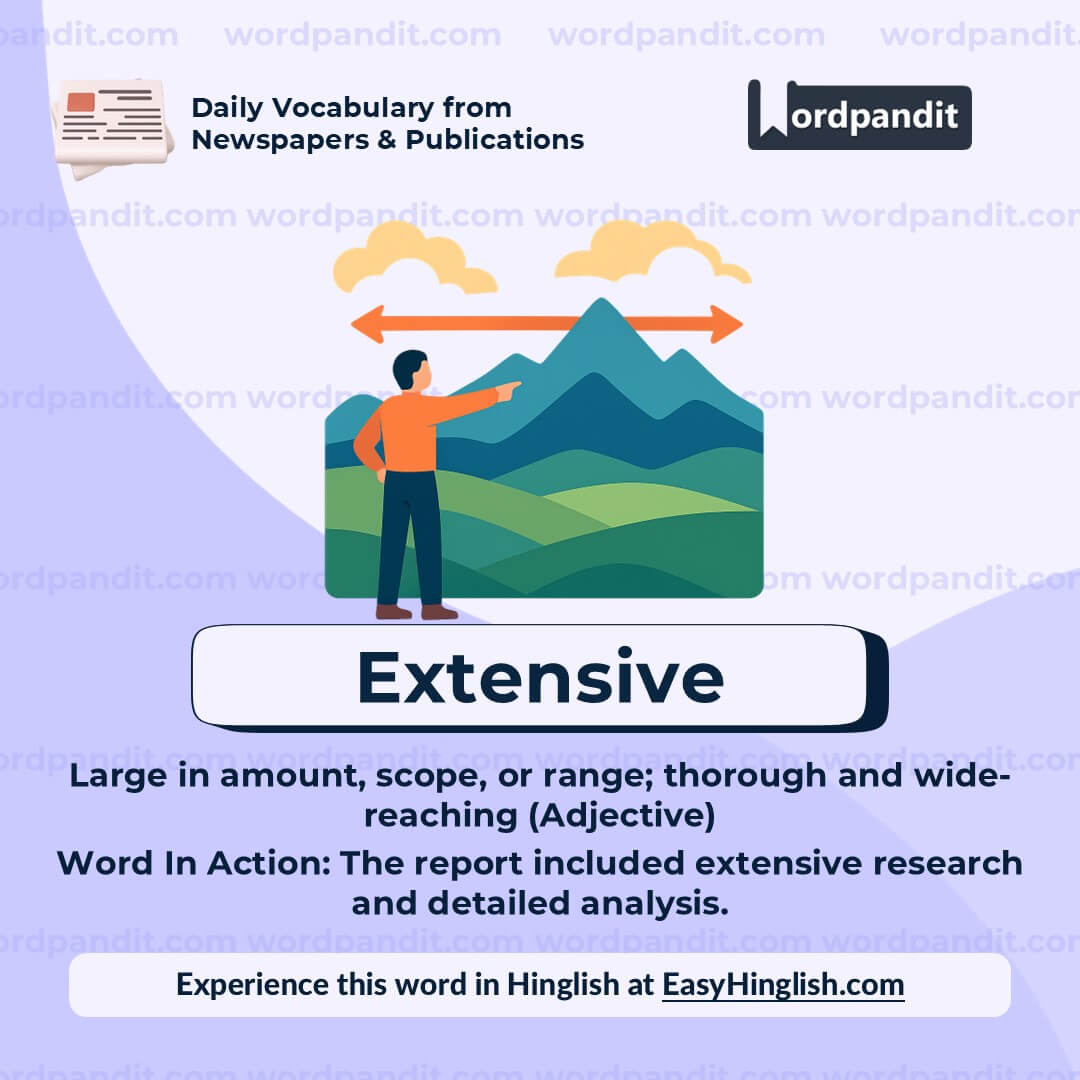
WORD-4: Extensive
Context:
"Her focus is working with overwhelmed, busy couples who are often parents to young children. She has extensive experience working with people experiencing relationship issues, trauma, and challenges related to perinatal mental health." - Psychology Today
Explanatory Paragraph:
The word "extensive" is used to describe something that covers a large area, involves a lot of details, or includes a wide range of things. When applied to knowledge, experience, or effort, it means thorough, deep, and far-reaching. In this context, saying someone has "extensive experience" means they have worked in the field for a long time and with many different types of clients or situations.
Meaning: Large in amount, scope, or range; thorough and wide-reaching (Adjective)
Pronunciation: ek-STEN-siv
Difficulty Level: ⭐⭐ Basic
Etymology: From Latin extensus, past participle of extendere meaning “to stretch out”
Prashant Sir's Notes:
"Extensive" is a great adjective to strengthen your writing—especially when talking about experience, knowledge, or effort. Use it to emphasize depth and breadth, but be careful not to confuse it with "expensive" or "intensive," which sound similar.
Synonyms & Antonyms:
Synonyms: broad, vast, comprehensive, wide-ranging, thorough
Antonyms: limited, narrow, small-scale, minimal, restricted
Usage Examples:
- She has extensive knowledge of child psychology and behavior therapy.
- The repair work required extensive renovations to the old building.
- His research is based on extensive interviews with industry experts.
- They conducted an extensive search before finding the lost hiker.
Cultural Reference:
In resumes and professional bios, phrases like “extensive experience” are commonly used to convey depth and reliability—especially in fields like medicine, education, and psychology.
Think About It:
Does having extensive experience always mean someone is the most effective, or can quality sometimes matter more than quantity?
Quick Activity:
Fill in the blank: "The museum has an __________ collection of ancient artifacts." Then, rewrite the sentence using a synonym for “extensive.”
Memory Tip:
Think of “extensive” as “extends” across many areas—whether time, space, or experience.
Real-World Application:
The word “extensive” is often used in job interviews, academic writing, and journalism to convey depth, range, and credibility. It's a power adjective for describing skills, damage, knowledge, or coverage.
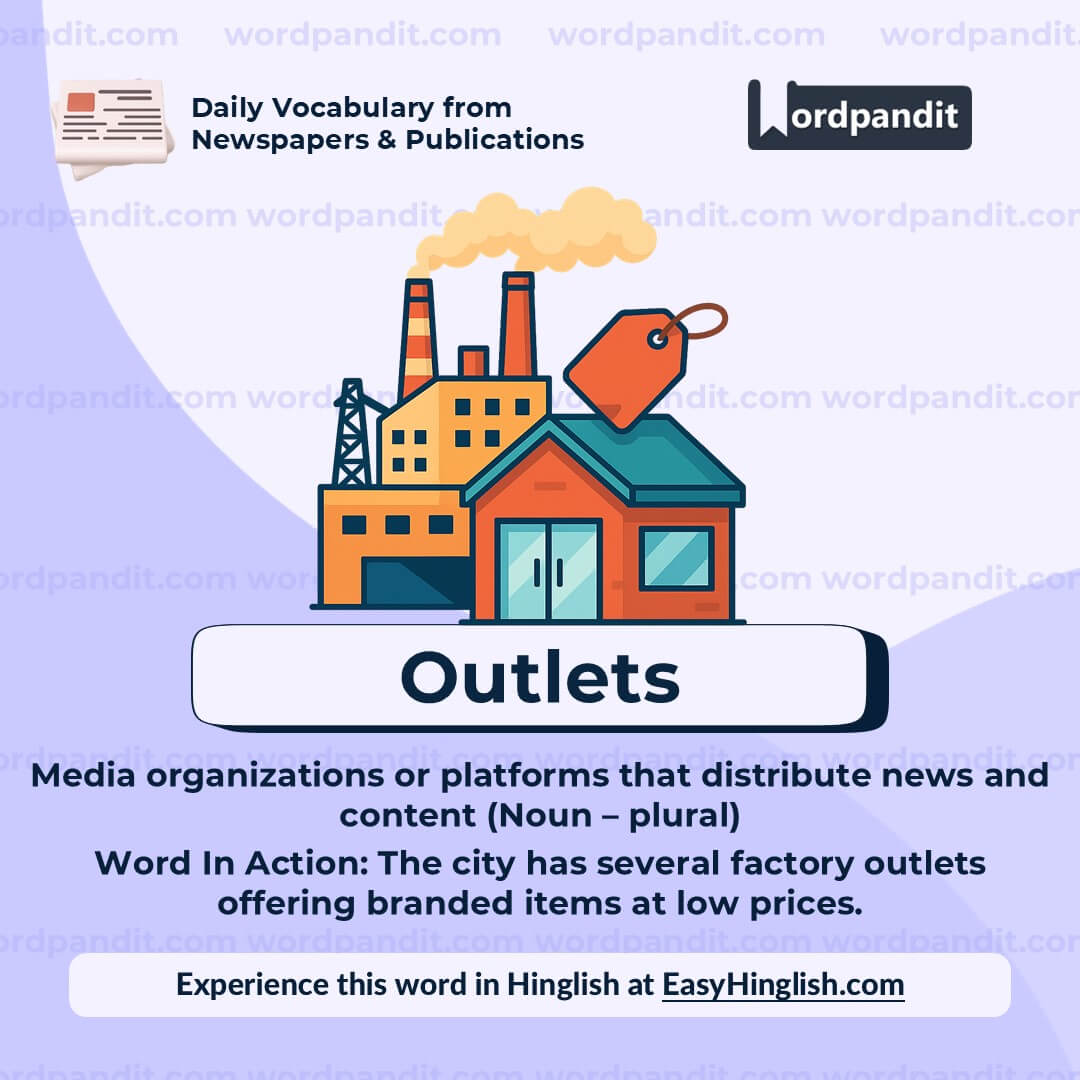
WORD-5: Outlets
Context:
"A Better Life Therapy, in 2013, has a popular Instagram account (@lizlistens) where she shares relationship tips, and she often shares her wisdom with news outlets like The New York Times, The Washington Post, and USA Today." - Psychology Today
Explanatory Paragraph:
The word "outlets" in this context refers to media platforms or organizations that distribute news and information to the public. These include newspapers, magazines, television channels, websites, and other communication sources. The term can also refer more broadly to any means of expression or distribution—such as creative outlets or retail outlets—but in journalism, “news outlets” are the key vehicles for reaching audiences.
Meaning: Media organizations or platforms that distribute news and content (Noun – plural)
Pronunciation: OUT-lets
Difficulty Level: ⭐⭐ Basic
Etymology: From Middle English outleten (to let out), combining “out” + “let” (to allow to pass)
Prashant Sir's Notes:
“Outlets” is a versatile word that appears in media, retail, and psychology. In exams and writing tasks, context is crucial. For example, “news outlets” differ from “emotional outlets” or “shopping outlets.” Always check surrounding words to infer the correct meaning.
Synonyms & Antonyms:
Synonyms: media sources, publications, broadcasters, platforms, news agencies
Antonyms: silence, suppression, private communication (context-dependent)
Usage Examples:
- She frequently writes articles for major news outlets on mental health topics.
- Art can serve as a creative outlet for expressing difficult emotions.
- Retail outlets across the country are offering major discounts this weekend.
- The story was picked up by several international media outlets.
Cultural Reference:
With the rise of digital media, outlets like BuzzFeed, Vox, and The Guardian have shifted how news is consumed—making “news outlets” a daily part of global culture.
Think About It:
In the age of social media, should individuals be more skeptical of the information they receive from various outlets?
Quick Activity:
List three types of outlets (news, emotional, and commercial). Write one sentence using each correctly.
Memory Tip:
Think of an “outlet” as something that “lets something out”—be it information, energy, emotions, or products.
Real-World Application:
Understanding the role of news outlets is crucial in media literacy. It helps people critically evaluate sources, detect bias, and stay informed in a fast-moving digital world.


