

Daily Vocabulary from International Newspapers and Publications
Expand Your Vocabulary with Wordpandit’s Global Vocabulary Hub
At Wordpandit, we are committed to helping you develop a truly global vocabulary by drawing from some of the most respected international publications. This section is designed to keep you ahead of the curve by introducing you to words that define global conversations and trends.
The Power of Global Sources
To help you think and communicate on a global scale, we curate vocabulary from renowned international sources, such as:
- The New York Times
- The Washington Post
- BBC
- The Guardian
- The Economist
- Scientific American
- Psychology Today
- And many more...
Stay Global, Stay Competitive
Our daily updates from international publications ensure you are consistently exposed to new words that reflect global news and developments, making sure your vocabulary is not only current but also globally relevant.
Enhance Your Global Perspective
Whether you’re preparing for international exams, aiming to excel in global business communication, or want to enhance your language skills for personal growth, Wordpandit offers the resources you need to thrive in a global context.
Effective Learning, Global Reach
Our learning methodology combines global examples, memory aids, and interactive activities, allowing you to internalize new words effectively and apply them in real-world scenarios.
Begin Your Global Vocabulary Journey Now!

Why Choose Wordpandit?
Practical Learning: Focus on words you'll actually encounter in real-world reading, enhancing your comprehension and communication skills.
Diverse Content: From current affairs to scientific breakthroughs, our varied sources expose you to vocabulary across multiple domains.
Effortless Integration: Make Wordpandit a part of your daily routine. Just a few minutes each day can significantly boost your lexicon over time.
Your Path to Vocabulary Mastery
- Visit our Daily Vocabulary section regularly
- Explore new words and their usage in context
- Practice incorporating these words into your own writing and speech
- Track your progress as your vocabulary expands
Start Your Journey Today
Embark on your vocabulary enhancement journey with Wordpandit. By consistently engaging with our daily posts, you'll build a robust vocabulary that serves you well in academic, professional, and personal contexts.
Remember, a word a day keeps linguistic limitations at bay. Make Wordpandit your daily companion in the quest for vocabulary excellence!

WORD-1: Brute
Context:
"In this fantastical tale, fire is a shorthand for culture. Its use separates humans from the ‘brute animals’ whose lives are limited to their instinctive uses of the qualities given to them by Epimetheus." - Aeon
Explanatory Paragraph:
The word "brute" is used to describe something or someone that is purely physical, lacking reasoning, or acting out of instinct rather than thought. In literature and philosophy, it often contrasts with the intellectual and emotional capacities that define humans. In the context provided, “brute animals” are those driven only by instinct, lacking the cultural and intellectual sophistication that humans gain through tools like fire, symbolizing progress and civilization.
Meaning: A creature (or person) lacking reason or intelligence; primitive or savage (noun/adjective)
Pronunciation: broot
Difficulty Level: ⭐⭐ Basic
Etymology: From Latin *brutus*, meaning "heavy, dull, stupid"
Prashant Sir's Notes:
"Brute" is often used to contrast raw, uncivilized power or instinct with reason and intelligence. It’s a great word to describe something unrefined or primitive, and it's common in both philosophical texts and everyday speech.
Synonyms & Antonyms:
Synonyms: beast, savage, animal, barbarian, thug
Antonyms: gentleman, intellectual, thinker, humanist
Usage Examples:
- The dictator ruled like a brute, crushing all opposition without mercy.
- She accused him of behaving like a brute during the argument.
- Early humans distinguished themselves from brute animals by developing language and tools.
- Don’t let your emotions reduce you to a brute; use reason to respond.
Cultural Reference:
"Et tu, Brute?" — These famous last words from Shakespeare’s *Julius Caesar* use the name Brutus, but have given the word “brute” an enduring emotional and cultural weight, symbolizing betrayal and shock. - William Shakespeare
Think About It:
What truly separates humans from “brute” animals — is it intelligence, empathy, or the capacity for culture and imagination?
Quick Activity:
Write a short paragraph describing a character who acts like a brute. Highlight how their behavior contrasts with a more refined or intellectual character.
Memory Tip:
Think of a “brute” as someone who is *brutal* — both words start the same and refer to rough, violent, or uncivilized behavior.
Real-World Application:
"Brute" is often used in journalism or commentary to describe individuals who act with excessive force or violence, such as in reports about crime or war. It’s also used metaphorically to describe unrefined methods or sheer force.

WORD-2: Parietal
Context:
"At times, this ‘parietal art’ (the name for human-made art on cave or rock walls) is so similar to animal traces that archaeologists struggle to disentangle and distinguish one from the other." - Aeon
Explanatory Paragraph:
The word “parietal” in this context refers to art found on the walls of caves or rock surfaces — typically prehistoric paintings or carvings. While “parietal” can also be used in anatomy or education, here it specifically refers to something relating to walls. “Parietal art” is a term used by archaeologists and anthropologists to describe ancient human-made images, like those seen in the caves of Lascaux or Chauvet in France, which are etched or painted onto stone walls.
Meaning: Related to walls, especially of a body cavity or structure; in this case, relating to cave wall art (adjective)
Pronunciation: puh-RY-uh-tuhl
Difficulty Level: ⭐⭐⭐ Intermediate
Etymology: From Latin *paries*, meaning “wall”
Prashant Sir's Notes:
"Parietal" is one of those words with multiple meanings depending on the field — anatomy, education, and archaeology all use it differently. Always consider context. In this case, it’s about ancient wall art, not skull bones or college rules!
Synonyms & Antonyms:
Synonyms: mural, wall-based, cave-art, pictographic
Antonyms: portable, movable, freestanding
Usage Examples:
- The parietal art discovered in the cave showed detailed depictions of ancient bison.
- Unlike portable objects, parietal art remains fixed to the cave walls where it was created.
- The museum exhibit replicated famous parietal art from France’s Paleolithic era.
- Archaeologists use special lighting to reveal faint traces of parietal art in dark caverns.
Cultural Reference:
"The walls of the Chauvet Cave reveal humanity’s earliest masterpieces — parietal art that speaks across time." - Interpretation based on archaeological studies
Think About It:
What do the ancient markings of parietal art tell us about the earliest forms of human communication and creativity?
Quick Activity:
Search for one example of parietal art (e.g., Lascaux Cave) and write 2–3 sentences describing what it might have meant to the people who created it.
Memory Tip:
Think of “parietal” as related to “partition” — both come from Latin for “wall.” Parietal art is simply art on a wall.
Real-World Application:
“Parietal” is commonly used in anthropology, archaeology, and art history to distinguish cave or wall art from portable artifacts. It helps classify and interpret human cultural expression over time.

WORD-3: Prehistorian
Context:
"A few years later, however, the French prehistorian Michel Lorblanchet showed that the many crisscrossing lines making up the ‘wounded shaman’ on the calcite surface of the cave were, in fact, gashes in multiple directions left by the claws of cave bears." - Aeon
Explanatory Paragraph:
A “prehistorian” is a specialist who studies human history in the time before written records existed — the prehistoric era. These researchers rely on tools, art, bones, and other archaeological findings to piece together what life was like for early humans. In the context above, Michel Lorblanchet, a prehistorian, used his expertise to distinguish natural markings from ancient human artwork, revealing how cave bear scratches were initially mistaken for intentional cave art.
Meaning: An expert who studies prehistory — the period before written records (noun)
Pronunciation: pree-HISS-tor-ee-uhn
Difficulty Level: ⭐⭐⭐ Intermediate
Etymology: From “pre-” meaning before, and “historian,” meaning one who studies history
Prashant Sir's Notes:
Think of a prehistorian as a detective of the deep past — someone who works without written clues, relying on material evidence to reconstruct how our ancestors lived, created, and survived.
Synonyms & Antonyms:
Synonyms: archaeologist, paleoanthropologist, ancient historian, anthropologist
Antonyms: modern historian, contemporary analyst, futurist
Usage Examples:
- The prehistorian spent decades examining cave sites to understand early human rituals.
- As a prehistorian, she specializes in interpreting stone tools and cave paintings.
- Modern technology has revolutionized how prehistorians analyze fossils and ancient remains.
- The documentary featured interviews with leading prehistorians discussing Neanderthal culture.
Cultural Reference:
“Prehistorians have transformed our view of early humans, showing us not brutes, but artists, toolmakers, and community builders.” – National Geographic
Think About It:
How can prehistorians be sure about human behavior in a time with no writing — and how much of it might still be guesswork?
Quick Activity:
Imagine you’re a prehistorian. List three clues you’d hope to find in a cave to learn about early human life, and explain what each might reveal.
Memory Tip:
Break it down: “Pre-” (before) + “historian” — a prehistorian studies *before* recorded history.
Real-World Application:
Prehistorians contribute to museums, documentaries, and academic research by helping society understand where we came from — often informing debates on human evolution, migration, and culture.
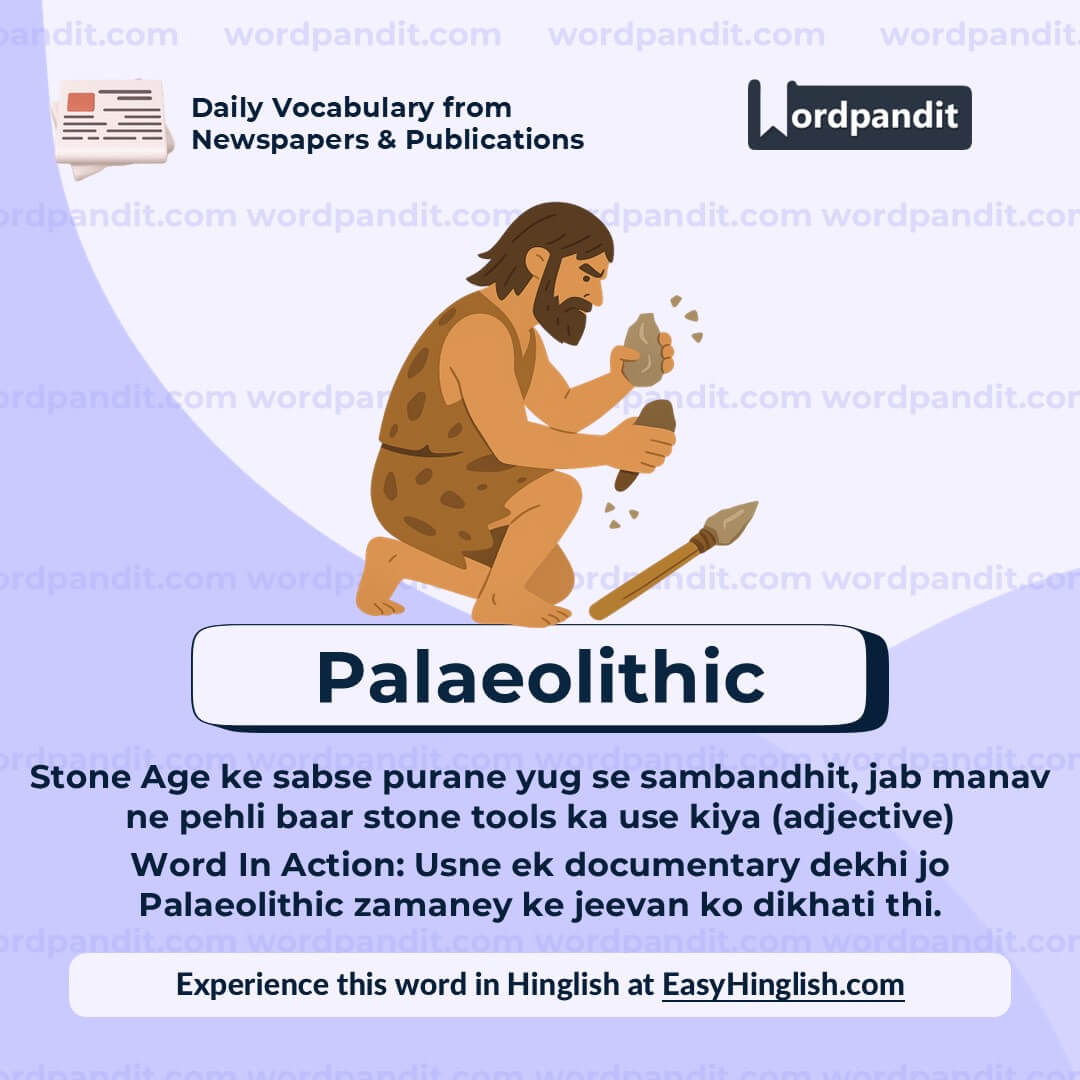
WORD-4: Palaeolithic
Context:
"Lemozi’s ideas were taken up by the Belgian prehistorian Lya Dams in the mid-1980s and extended into a broader exploration of wounded men in Palaeolithic art." - Aeon
Explanatory Paragraph:
“Palaeolithic” refers to the earliest period of human history, often known as the Old Stone Age. This era is marked by the first use of stone tools and the development of early human culture, including hunting, gathering, and cave art. In the context above, "Palaeolithic art" describes the symbolic and artistic expressions—like paintings, engravings, and carvings—created by early humans tens of thousands of years ago. These works give us insight into the thoughts, beliefs, and daily lives of prehistoric communities.
Meaning: Relating to the earliest period of the Stone Age, characterized by the use of rudimentary stone tools (adjective)
Pronunciation: pay-lee-uh-LITH-ik
Difficulty Level: ⭐⭐⭐ Intermediate
Etymology: From Greek *palaios* meaning "ancient" and *lithos* meaning "stone"
Prashant Sir's Notes:
“Palaeolithic” is a foundational word for anyone studying history or archaeology. It marks the beginning of humanity’s journey with tools, fire, and expression. Think of it as humanity’s childhood — raw, inventive, and full of survival instincts.
Synonyms & Antonyms:
Synonyms: Old Stone Age, early prehistoric, ancient human era
Antonyms: modern, Neolithic (New Stone Age), contemporary
Usage Examples:
- The Palaeolithic era was marked by simple tools and a hunter-gatherer lifestyle.
- Scholars have studied Palaeolithic art to better understand symbolic thinking in early humans.
- The tools found at the excavation site date back to the Palaeolithic period.
- Palaeolithic communities lived in small bands and often took shelter in caves.
Cultural Reference:
“The Palaeolithic cave paintings of Lascaux stand as humanity’s first known masterpieces, etched in time by flickering firelight.” – Interpretation of historical consensus
Think About It:
How do the artworks and tools of the Palaeolithic period reflect the emotional and intellectual life of early humans?
Quick Activity:
Create a simple sketch inspired by what a Palaeolithic human might draw — perhaps an animal, a handprint, or a hunting scene — and reflect on why they might have drawn it.
Memory Tip:
“Palaeo” means old and “lithic” means stone — think of the *Old* Stone Age to remember what Palaeolithic refers to.
Real-World Application:
Understanding the Palaeolithic period helps anthropologists, historians, and archaeologists trace the roots of human behavior, including creativity, cooperation, and survival strategies — all of which still influence us today.
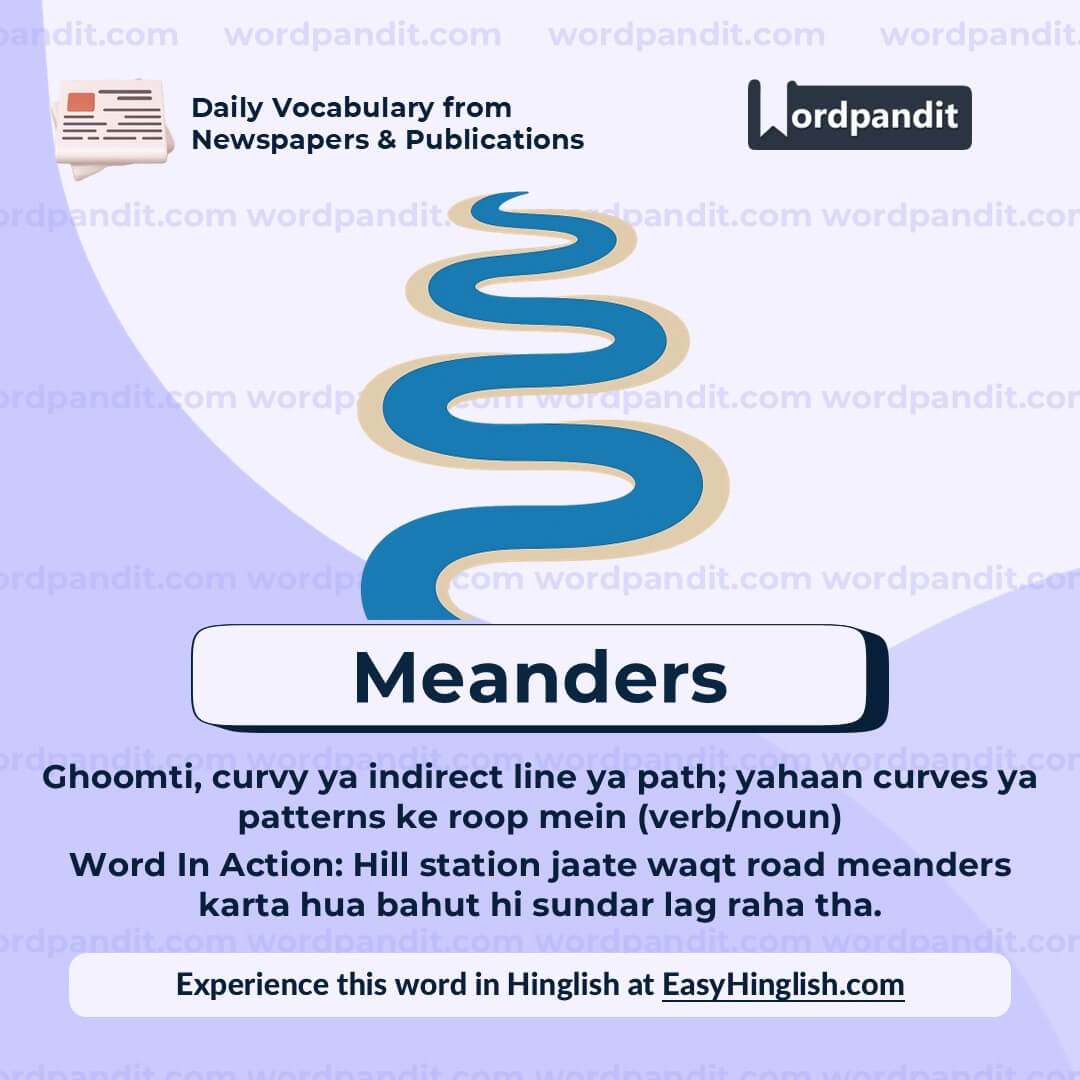
WORD-5: Meanders
Context:
"In several caves in France, such as Bara-Bahau, Baume-Latrone and Margot, human-made finger flutings or ‘meanders’ follow earlier cave bear scratches." - Aeon
Explanatory Paragraph:
The word “meanders” in this context refers to winding, curving lines or paths, particularly those drawn or etched into cave walls. Often resembling natural patterns like river paths or flowing designs, meanders here are human-made finger flutings that mimic or overlay natural marks left by animals. The term suggests a deliberate artistic motion that is not straight or direct, but rather flowing and repetitive, revealing how ancient humans may have interacted visually with the environment around them.
Meaning: To follow a winding or indirect course; in plural, often used to describe curving patterns or lines (verb/noun)
Pronunciation: mee-ANN-durz
Difficulty Level: ⭐⭐ Basic
Etymology: From Latin *Maeander*, a river in Asia Minor known for its winding path
Prashant Sir's Notes:
“Meanders” is both a visual and poetic word. Whether it’s a river meandering through a valley or a child’s finger tracing patterns on a cave wall, it implies movement that’s unhurried and expressive. In ancient art, meandering lines may have held symbolic meaning or simply been a form of expression.
Synonyms & Antonyms:
Synonyms: winding lines, curves, loops, spirals, twists
Antonyms: straight lines, direct paths, linear patterns
Usage Examples:
- The river meanders through the valley, creating a beautiful and unpredictable path.
- She traced meanders in the sand with a stick while daydreaming.
- The artist’s design was full of elegant meanders that mimicked nature.
- In the cave, the ancient meanders carved by human fingers were surprisingly intricate.
Cultural Reference:
“The Greek key” or “meander pattern” is a classical decorative motif that symbolizes infinity or the eternal flow of things — derived from the winding Meander River in Anatolia.
Think About It:
What might have inspired early humans to create meandering patterns in caves — was it imitation of nature, symbolism, or simply instinctive play?
Quick Activity:
Take a pencil and draw a continuous, flowing line without lifting your hand. Reflect on how your movements change naturally — do you begin to create meanders?
Memory Tip:
Think of a river *meandering* across land — a slow, winding path — and link it to any curvy, non-linear design or movement.
Real-World Application:
“Meanders” appear in geography (rivers), art (design patterns), and literature (narrative flow). Recognizing this term helps us understand and describe things that don’t move or develop in straight lines — including thought, creativity, and natural processes.


