

Daily Vocabulary from International Newspapers and Publications
Expand Your Vocabulary with Wordpandit’s Global Vocabulary Hub
At Wordpandit, we are committed to helping you develop a truly global vocabulary by drawing from some of the most respected international publications. This section is designed to keep you ahead of the curve by introducing you to words that define global conversations and trends.
The Power of Global Sources
To help you think and communicate on a global scale, we curate vocabulary from renowned international sources, such as:
- The New York Times
- The Washington Post
- BBC
- The Guardian
- The Economist
- Scientific American
- Psychology Today
- And many more...
Stay Global, Stay Competitive
Our daily updates from international publications ensure you are consistently exposed to new words that reflect global news and developments, making sure your vocabulary is not only current but also globally relevant.
Enhance Your Global Perspective
Whether you’re preparing for international exams, aiming to excel in global business communication, or want to enhance your language skills for personal growth, Wordpandit offers the resources you need to thrive in a global context.
Effective Learning, Global Reach
Our learning methodology combines global examples, memory aids, and interactive activities, allowing you to internalize new words effectively and apply them in real-world scenarios.
Begin Your Global Vocabulary Journey Now!

Why Choose Wordpandit?
Practical Learning: Focus on words you'll actually encounter in real-world reading, enhancing your comprehension and communication skills.
Diverse Content: From current affairs to scientific breakthroughs, our varied sources expose you to vocabulary across multiple domains.
Effortless Integration: Make Wordpandit a part of your daily routine. Just a few minutes each day can significantly boost your lexicon over time.
Your Path to Vocabulary Mastery
- Visit our Daily Vocabulary section regularly
- Explore new words and their usage in context
- Practice incorporating these words into your own writing and speech
- Track your progress as your vocabulary expands
Start Your Journey Today
Embark on your vocabulary enhancement journey with Wordpandit. By consistently engaging with our daily posts, you'll build a robust vocabulary that serves you well in academic, professional, and personal contexts.
Remember, a word a day keeps linguistic limitations at bay. Make Wordpandit your daily companion in the quest for vocabulary excellence!

WORD-1: Mockery
Context:
"Donald Trump has found a new target for his trademark mockery and dismissal: little girls. In comments at a 30 April cabinet meeting, the president seemed to dismiss the economic impact of his chaotic tariff regime on American consumers by citing girls as the primary complainants. “Somebody said, oh, the shelves are going to be open,” Trump said." - The Guardian
Explanatory Paragraph:
Mockery is the act of ridiculing, making fun of, or belittling someone or something in a way that is often scornful or dismissive. It can range from subtle sarcasm to open insult and is typically meant to undermine the dignity or seriousness of its target. In this context, the word is used to describe how Donald Trump trivialized concerns by turning them into a joke at someone else's expense, demonstrating a lack of empathy or seriousness.
Meaning: Behavior or speech that ridicules or makes fun of someone or something, often in a cruel or dismissive way (Noun)
Pronunciation: MOK-uh-ree
Difficulty Level: ⭐⭐ Beginner
Etymology: From Old French mocquerie, based on moquer meaning “to mock,” with origins in Middle French and Latin.
Prashant Sir's Notes:
Mockery is a common theme in politics, satire, and even classroom behavior. Be careful with tone—mockery often crosses into disrespect or bullying. It’s a strong word and should be used precisely when you want to show cruel or dismissive behavior disguised as humor.
Synonyms & Antonyms:
Synonyms: Ridicule, Scorn, Derision, Sneering, Taunt
Antonyms: Praise, Respect, Admiration, Compliment
Usage Examples:
- The comedian’s jokes drew laughter, but many viewed them as mockery of serious issues.
- Her classmates’ mockery left her feeling isolated and humiliated.
- Mockery can be a powerful political tool—but it often alienates rather than persuades.
- The protesters viewed the government’s response as a mockery of justice.
Cultural Reference:
"In Shakespeare’s plays, characters like Iago use mockery as a way to manipulate others and conceal true intentions." - British Library
Think About It:
Is mockery ever justifiable as a form of criticism, or does it always cross into disrespect?
Quick Activity:
Rewrite a mocking sentence into a constructive one. Compare how the tone changes the message.
Memory Tip:
Think of a puppet show making fun of someone—“mock” sounds like “mockingbird,” which mimics. Mockery mimics or exaggerates to insult.
Real-World Application:
Understanding mockery helps you navigate social interactions, media commentary, and satire. Recognizing when humor turns into harm is key to maintaining respectful communication.
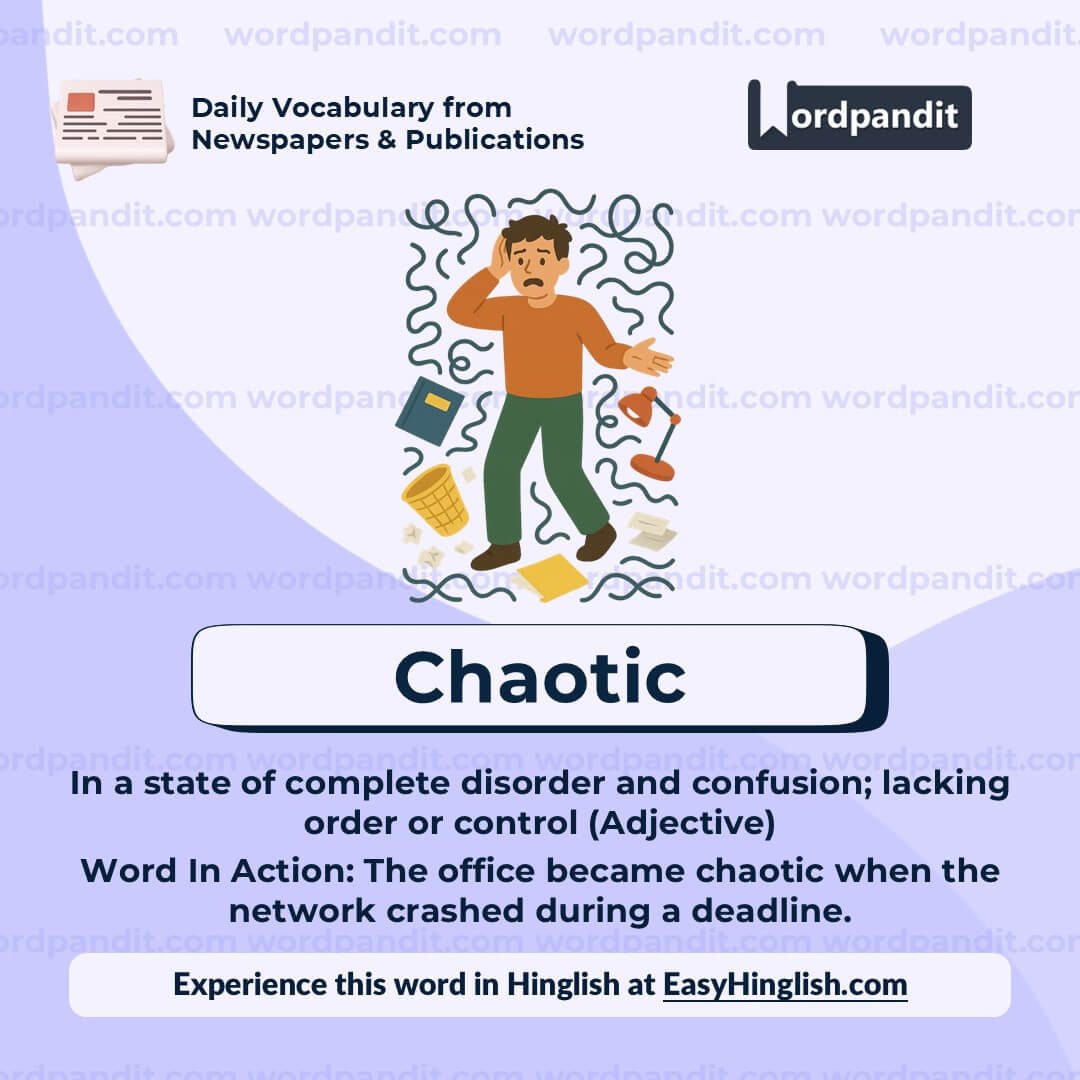
WORD-2: Chaotic
Context:
"Donald Trump has found a new target for his trademark mockery and dismissal: little girls. In comments at a 30 April cabinet meeting, the president seemed to dismiss the economic impact of his chaotic tariff regime on American consumers by citing girls as the primary complainants. “Somebody said, oh, the shelves are going to be open,” Trump said." - The Guardian
Explanatory Paragraph:
Chaotic describes a state of complete confusion and disorder, where things are unpredictable, unorganized, or out of control. It often conveys a breakdown in systems, processes, or expectations. In the given context, the word is used to describe Trump’s tariff regime as being disorganized and erratic, creating economic uncertainty and potentially harming consumers. The term is frequently used to describe environments, events, or actions that lack structure or consistency.
Meaning: In a state of complete disorder and confusion; lacking order or control (Adjective)
Pronunciation: kay-OT-ik
Difficulty Level: ⭐⭐ Beginner
Etymology: From Greek khaos meaning “abyss, void,” the term evolved through Latin and French to describe situations of extreme disorder.
Prashant Sir's Notes:
Very common in journalism, politics, and day-to-day conversation. “Chaotic” is a vivid word that helps paint a picture of messiness or instability. Useful for descriptive writing and analytical essays.
Synonyms & Antonyms:
Synonyms: Disorderly, Turbulent, Confused, Unstable, Jumbled
Antonyms: Orderly, Organized, Calm, Structured, Stable
Usage Examples:
- The classroom became chaotic when the teacher left for just five minutes.
- Protesters described the evacuation as chaotic and unplanned.
- Her chaotic schedule made it difficult to maintain a healthy routine.
- The government’s response to the crisis was widely criticized as chaotic and uncoordinated.
Cultural Reference:
"The chaotic scenes at the airport reflected the panic and disarray caused by the sudden policy change." - BBC News
Think About It:
Does chaos always lead to failure, or can chaotic beginnings sometimes lead to creative breakthroughs and innovation?
Quick Activity:
Write down three chaotic situations you’ve witnessed or experienced. Describe how they could have been better managed.
Memory Tip:
“Chaotic” sounds like “chaos”—think of a whirlwind or messy storm to remember the disorder the word represents.
Real-World Application:
“Chaotic” is used in news articles, workplace conversations, crisis reports, and literature. Being able to describe or analyze chaotic systems helps in fields like leadership, project management, psychology, and even physics.
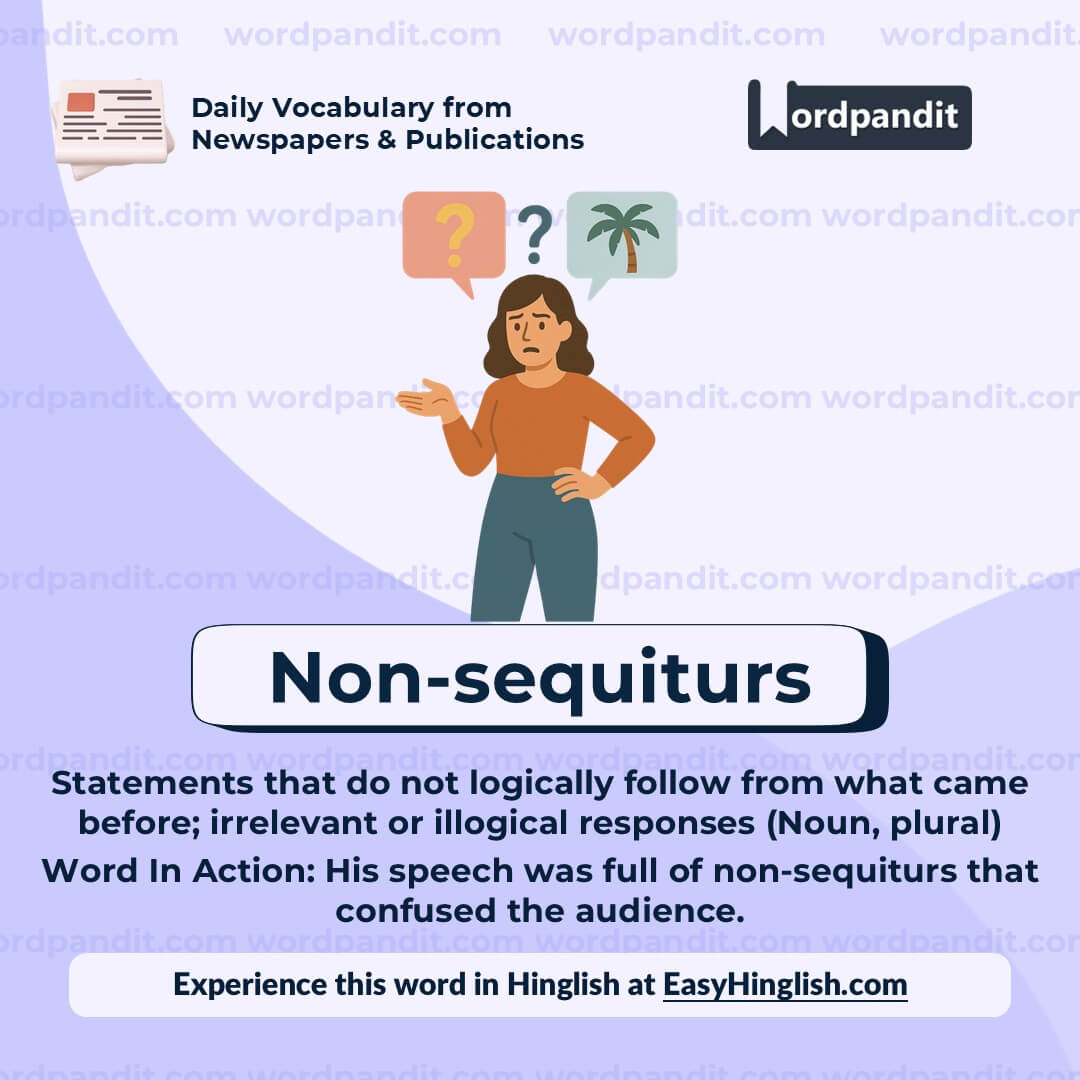
WORD-3: Non-sequiturs
Context:
"Trump is prone to odd non-sequiturs, but the dolls have become something of a sticking point. Onboard Air Force One on 4 May, he doubled down on his insistence that American girls should have fewer toys." - The Guardian
Explanatory Paragraph:
Non-sequiturs are statements or comments that do not logically follow from the previous statement or conversation. The term is often used in both formal logic and casual conversation to describe random, disconnected, or off-topic remarks. In this context, it suggests that Trump frequently makes comments that seem unrelated or illogical in the flow of conversation, causing confusion or deflection. Non-sequiturs can be humorous, absurd, or even intentionally distracting.
Meaning: Statements that do not logically follow from what came before; irrelevant or illogical responses (Noun, plural)
Pronunciation: non-SEK-wi-turz
Difficulty Level: ⭐⭐⭐ Intermediate
Etymology: From Latin non sequitur meaning “it does not follow.” Originally a term in logic, now widely used in everyday language and writing.
Prashant Sir's Notes:
This is a brilliant word for students who want to sharpen their reasoning and communication skills. It’s especially important in debates, essays, and critical thinking—being able to spot a non-sequitur can strengthen your arguments significantly.
Synonyms & Antonyms:
Synonyms: Irrelevant remark, Tangent, Logical fallacy, Random comment
Antonyms: Logical connection, Coherent argument, Relevant point
Usage Examples:
- Her response about the weather was a complete non-sequitur in the middle of a budget discussion.
- The book’s humor relies heavily on absurd non-sequiturs that surprise the reader.
- In debates, non-sequiturs are often used to distract from the original question.
- He’s known for his stream of non-sequiturs that leave his listeners confused or amused.
Cultural Reference:
"Many comedy sketches, like those in *Monty Python’s Flying Circus*, are built around non-sequiturs that challenge linear storytelling." - British Comedy Guide
Think About It:
Can non-sequiturs sometimes reveal hidden truths or shift perspective, even if they don’t follow the rules of logic?
Quick Activity:
Write a short dialogue between two people where one constantly uses non-sequiturs. Identify how it affects communication.
Memory Tip:
“Non” = not, “sequitur” = follow — a non-sequitur doesn’t follow! Imagine someone saying, “I love pizza… did you know frogs can’t swallow with their eyes open?” That’s a non-sequitur!
Real-World Application:
Understanding non-sequiturs helps you analyze flawed reasoning in media, arguments, or political speeches. It also builds stronger, clearer writing and debate skills.
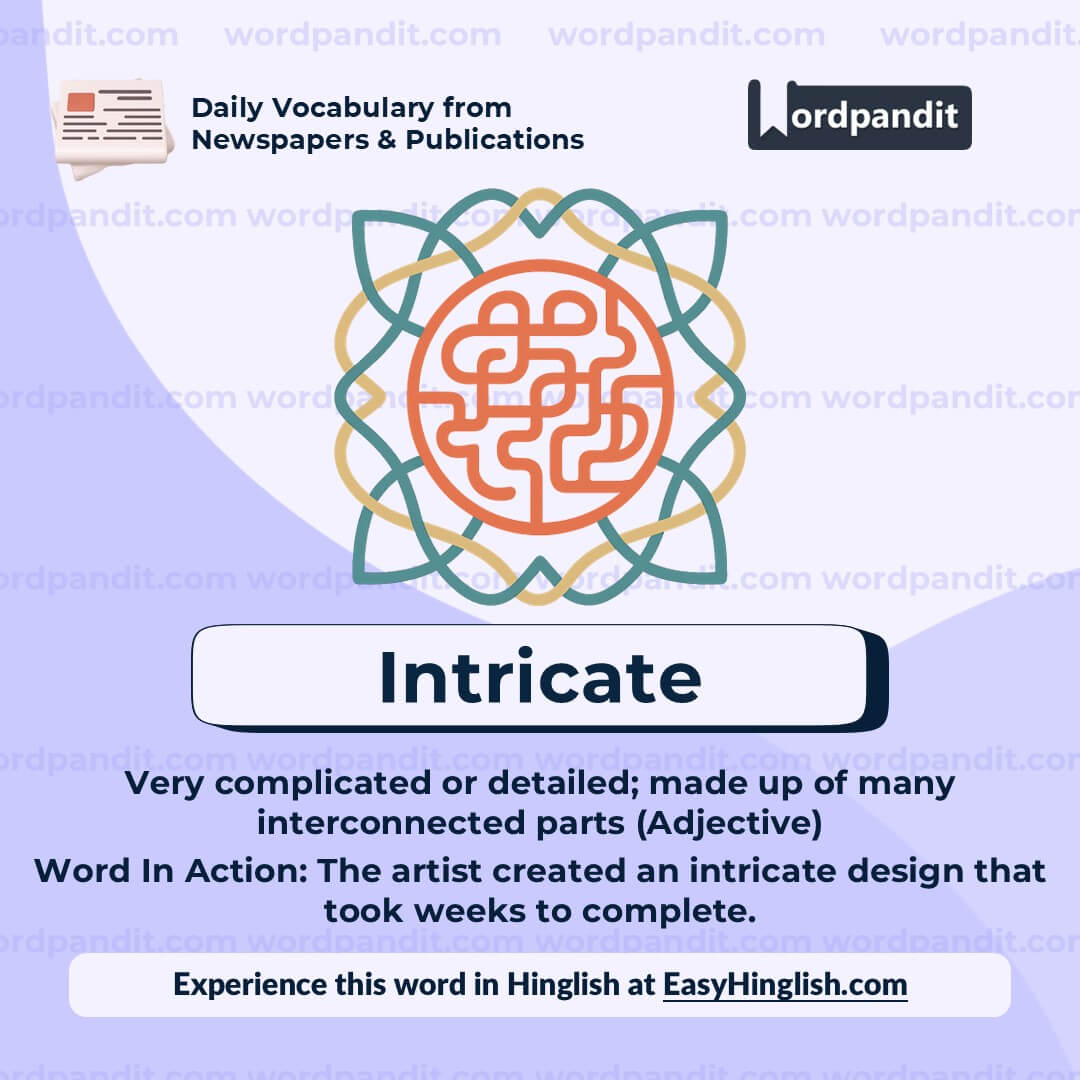
WORD-4: Intricate
Context:
"Life is immensely complex. At every level, from molecules and cells to entire organisms and the intricate ecological balance between species, biologists are amazed by the staggering complexity and interconnectedness of life." - Aeon
Explanatory Paragraph:
Intricate describes something that is very detailed, complex, and often made up of many interconnected parts. It is used to convey the idea of beauty or depth in complexity—something that requires careful observation or understanding. In this context, the term refers to the fine, delicate balance and connections that exist in ecosystems and biological systems, revealing the wonder and sophistication of nature’s design.
Meaning: Very complicated or detailed; made up of many interconnected parts (Adjective)
Pronunciation: IN-tri-kit
Difficulty Level: ⭐⭐ Beginner
Etymology: From Latin intricatus (entangled, perplexed), from intricare meaning “to entangle.” The word evolved into Middle English to mean complex or detailed in structure.
Prashant Sir's Notes:
This word is very useful in descriptive writing—whether for science, art, relationships, or thought processes. It helps convey complexity in a positive or neutral tone. Pair with words like “balance,” “design,” or “web” for vivid imagery.
Synonyms & Antonyms:
Synonyms: Complex, Detailed, Complicated, Elaborate, Sophisticated
Antonyms: Simple, Plain, Straightforward, Uncomplicated
Usage Examples:
- The artist’s intricate patterns drew admiration from the entire gallery.
- The plot of the novel is intricate, with multiple timelines and hidden connections.
- DNA is an intricate molecule that holds the code of life.
- The watchmaker examined the intricate gears with expert precision.
Cultural Reference:
"Islamic architecture is renowned for its intricate geometric patterns, designed to reflect divine order." - Smithsonian Magazine
Think About It:
Why are we drawn to things that are intricate—do they reflect our inner complexity, or challenge us to look deeper?
Quick Activity:
Pick an object around you (e.g., a flower, a gadget, or a piece of art). Describe its intricate details in 3–4 sentences.
Memory Tip:
Think of “intricate” as something that makes you “trick” your eyes—it’s detailed, tangled, or layered. Like a spider web or lace!
Real-World Application:
“Intricate” is often used in science, art, literature, and design. It helps express depth and sophistication in systems, from ecosystems to computer programming, and is perfect for descriptive writing and analysis.
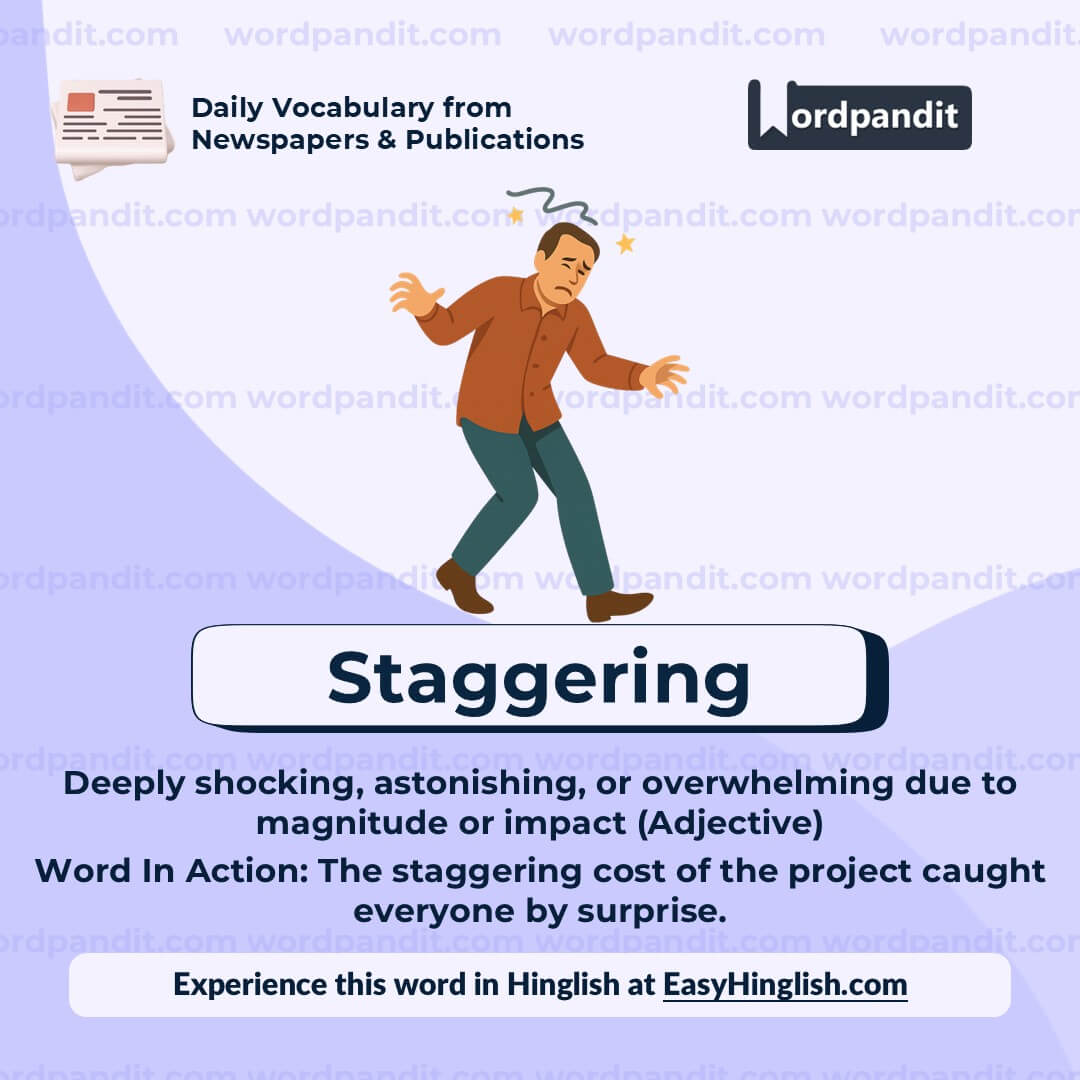
WORD-5: Staggering
Context:
"Life is immensely complex. At every level, from molecules and cells to entire organisms and the intricate ecological balance between species, biologists are amazed by the staggering complexity and interconnectedness of life." - Aeon
Explanatory Paragraph:
Staggering describes something so astonishing, overwhelming, or immense that it causes shock or amazement. It emphasizes the sheer scale or intensity of something—often used to highlight surprising facts, numbers, or beauty. In this context, the word conveys the awe scientists feel when faced with the enormous and interconnected complexity of life on Earth.
Meaning: Deeply shocking, astonishing, or overwhelming due to magnitude or impact (Adjective)
Pronunciation: STAG-uh-ring
Difficulty Level: ⭐⭐ Beginner
Etymology: From the verb “stagger,” meaning to move unsteadily or be overwhelmed; metaphorically used since the 16th century to describe things that are mentally or emotionally overwhelming.
Prashant Sir's Notes:
This is a great word for adding emotional weight and impact to your writing. Whether you’re describing statistics, beauty, loss, or discovery—“staggering” captures that breathless sense of awe or disbelief. Excellent for essays and speeches.
Synonyms & Antonyms:
Synonyms: Astonishing, Overwhelming, Breathtaking, Mind-blowing, Startling
Antonyms: Ordinary, Expected, Predictable, Unimpressive
Usage Examples:
- The company reported a staggering loss of $2 billion last quarter.
- She stood in silence, taking in the staggering beauty of the northern lights.
- The complexity of the human brain is truly staggering.
- They were faced with a staggering amount of data to analyze in just two days.
Cultural Reference:
"The staggering inequality between the world’s richest and poorest is not just economic—it’s moral." – Oxfam Report
Think About It:
What’s one fact or experience that left you staggered—so amazed or overwhelmed that you had to pause and reflect?
Quick Activity:
List three things (in science, nature, or society) that you consider “staggering.” Describe in one sentence what makes each so impactful.
Memory Tip:
Picture someone staggering back in shock or awe—when something is “staggering,” it’s so intense it almost knocks you off your feet!
Real-World Application:
“Staggering” is a high-impact adjective often used in journalism, speeches, and science writing to grab attention and convey emotional or factual intensity. It helps emphasize scale and significance in a powerful way.


