

Daily Vocabulary from International Newspapers and Publications
Expand Your Vocabulary with Wordpandit’s Global Vocabulary Hub
At Wordpandit, we are committed to helping you develop a truly global vocabulary by drawing from some of the most respected international publications. This section is designed to keep you ahead of the curve by introducing you to words that define global conversations and trends.
The Power of Global Sources
To help you think and communicate on a global scale, we curate vocabulary from renowned international sources, such as:
- The New York Times
- The Washington Post
- BBC
- The Guardian
- The Economist
- Scientific American
- Psychology Today
- And many more...
Stay Global, Stay Competitive
Our daily updates from international publications ensure you are consistently exposed to new words that reflect global news and developments, making sure your vocabulary is not only current but also globally relevant.
Enhance Your Global Perspective
Whether you’re preparing for international exams, aiming to excel in global business communication, or want to enhance your language skills for personal growth, Wordpandit offers the resources you need to thrive in a global context.
Effective Learning, Global Reach
Our learning methodology combines global examples, memory aids, and interactive activities, allowing you to internalize new words effectively and apply them in real-world scenarios.
Begin Your Global Vocabulary Journey Now!

Why Choose Wordpandit?
Practical Learning: Focus on words you'll actually encounter in real-world reading, enhancing your comprehension and communication skills.
Diverse Content: From current affairs to scientific breakthroughs, our varied sources expose you to vocabulary across multiple domains.
Effortless Integration: Make Wordpandit a part of your daily routine. Just a few minutes each day can significantly boost your lexicon over time.
Your Path to Vocabulary Mastery
- Visit our Daily Vocabulary section regularly
- Explore new words and their usage in context
- Practice incorporating these words into your own writing and speech
- Track your progress as your vocabulary expands
Start Your Journey Today
Embark on your vocabulary enhancement journey with Wordpandit. By consistently engaging with our daily posts, you'll build a robust vocabulary that serves you well in academic, professional, and personal contexts.
Remember, a word a day keeps linguistic limitations at bay. Make Wordpandit your daily companion in the quest for vocabulary excellence!
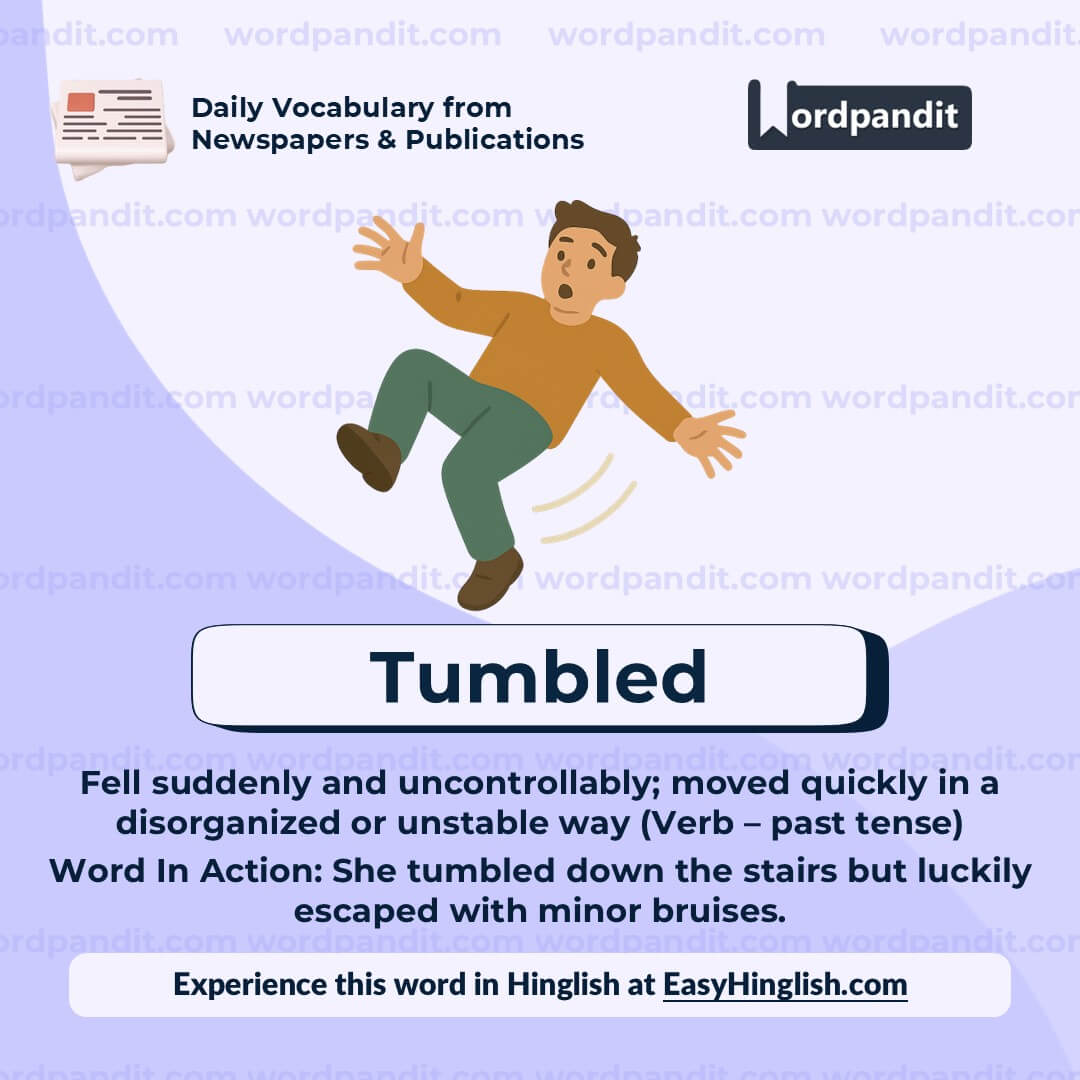
WORD-1: Tumbled
Context:
"We have already tumbled past the first 100 days of the second Trump presidency, careening down the hill with reckless abandon. One hundred days is, of course, a totally arbitrary milestone – a nice, round number that looks monumental because of the number of zeros attached." - The Guardian
Explanatory Paragraph:
Tumbled typically means to fall suddenly, clumsily, or uncontrollably. It can describe a physical action (like falling down stairs) or, in figurative contexts like this one, a rapid and uncontrolled movement through time or events. Here, it suggests that the first 100 days of Trump’s second presidency have rushed by in a chaotic, headlong manner—without order or caution.
Meaning: Fell suddenly and uncontrollably; moved quickly in a disorganized or unstable way (Verb – past tense)
Pronunciation: TUHM-buhld
Difficulty Level: ⭐ Beginner
Etymology: From Middle English tumbelen, related to “tumble,” which originally meant “to dance or leap about” and later came to mean “fall headlong.”
Prashant Sir's Notes:
“Tumbled” is a vivid verb with both literal and metaphorical uses. Writers use it to describe physical falls, economic drops, or the chaotic passage of time. It's perfect for dynamic and emotionally charged writing.
Synonyms & Antonyms:
Synonyms: Fell, Collapsed, Plummeted, Dropped, Stumbled
Antonyms: Rose, Climbed, Ascended, Stabilized
Usage Examples:
- She tumbled down the hill after slipping on a patch of wet grass.
- Stock prices tumbled following the announcement of new tariffs.
- We tumbled through the week without a clear plan or goal.
- His thoughts tumbled one over another as he tried to make sense of the news.
Cultural Reference:
"Jack and Jill went up the hill... and Jack tumbled down" — from the classic nursery rhyme, this word is associated with clumsy or accidental falls from early learning.
Think About It:
What makes certain moments in life feel like we’re “tumbling” through them instead of walking with intention?
Quick Activity:
Write a short paragraph using “tumbled” to describe a sequence of events—either humorous or serious—that spiraled out of control.
Memory Tip:
Imagine someone tripping and rolling downhill—uncontrolled and fast. That’s “tumbling” in both body and spirit!
Real-World Application:
“Tumbled” is frequently used in news reporting (e.g., markets tumbled), fiction (characters tumbling through drama), and personal writing to show instability, movement, and emotional swings.
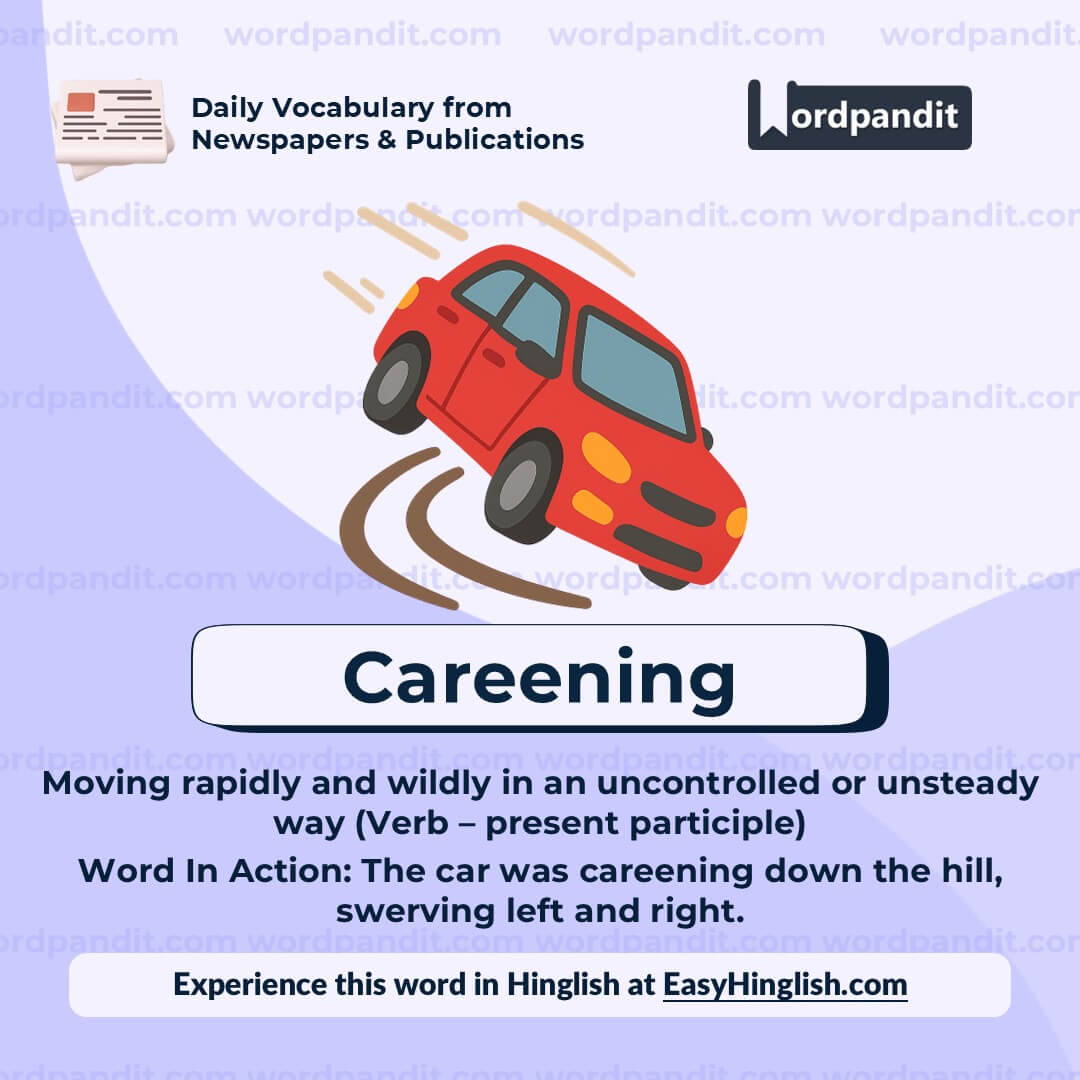
WORD-2: Careening
Context:
"We have already tumbled past the first 100 days of the second Trump presidency, careening down the hill with reckless abandon. One hundred days is, of course, a totally arbitrary milestone – a nice, round number that looks monumental because of the number of zeros attached." - The Guardian
Explanatory Paragraph:
Careening refers to moving swiftly and in an uncontrolled way, often from side to side or with great momentum. Originally used to describe ships tilting or lurching, it now frequently describes wild, unpredictable motion—whether physical, political, or emotional. In this context, it emphasizes the chaotic, reckless pace at which the presidency is progressing, as if out of control and rushing toward unknown outcomes.
Meaning: Moving rapidly and wildly in an uncontrolled or unsteady way (Verb – present participle)
Pronunciation: kuh-REEN-ing
Difficulty Level: ⭐⭐⭐ Intermediate
Etymology: From French carener (to keel a ship), from Latin carina (keel of a ship). It evolved from nautical use to figurative use in describing erratic or high-speed motion.
Prashant Sir's Notes:
“Careening” is great for dynamic, descriptive writing. It's often paired with metaphors of loss of control—cars, governments, emotions. Think of it as high-speed and unbalanced. Visual imagery is key here!
Synonyms & Antonyms:
Synonyms: Lurching, Swaying, Hurtling, Barreling, Veering
Antonyms: Gliding, Crawling, Creeping, Moving steadily
Usage Examples:
- The car was careening down the icy road, barely under control.
- The conversation careened from one outrageous topic to another.
- They were careening toward disaster without a clear strategy.
- Her emotions were careening wildly after the shocking news.
Cultural Reference:
"Careening through history without a map is how some critics describe policy-making in crisis-driven governments." – The Washington Post
Think About It:
Why do we sometimes let things careen out of control in our lives—and what helps us regain balance and direction?
Quick Activity:
Describe a recent moment when your day felt like it was “careening” out of control. What were the signs, and how did you handle it?
Memory Tip:
Think of a car swerving dangerously fast around a bend—that’s “careening”—speeding ahead without stability or control.
Real-World Application:
“Careening” is ideal in journalistic and creative writing to convey a sense of urgency, danger, or instability—whether in politics, finance, emotions, or movement. It adds drama and imagery to any narrative.
WORD-3: Reckless
Context:
"We have already tumbled past the first 100 days of the second Trump presidency, careening down the hill with reckless abandon. One hundred days is, of course, a totally arbitrary milestone – a nice, round number that looks monumental because of the number of zeros attached." - The Guardian
Explanatory Paragraph:
Reckless describes behavior that shows a lack of concern for the consequences or dangers of one's actions. It implies boldness without caution, often resulting in negative outcomes. In the given context, “reckless abandon” intensifies the idea—suggesting a wild, unrestrained approach to governing without careful thought or responsibility.
Meaning: Acting without care for the consequences; dangerously irresponsible (Adjective)
Pronunciation: REK-lis
Difficulty Level: ⭐⭐ Beginner
Etymology: From Old English receleas, meaning “careless,” based on “reck” (to care) + “-less.” The word has long been associated with rash or unthinking behavior.
Prashant Sir's Notes:
Often used in headlines and news to describe irresponsible decisions—by individuals, companies, or governments. It can carry strong emotional weight, so use it when you want to emphasize danger or thoughtlessness.
Synonyms & Antonyms:
Synonyms: Rash, Irresponsible, Thoughtless, Careless, Foolhardy
Antonyms: Cautious, Prudent, Careful, Thoughtful, Deliberate
Usage Examples:
- His reckless driving caused a major accident on the highway.
- The company’s reckless expansion left it bankrupt within a year.
- She invested all her savings in a reckless financial scheme.
- Critics described the new policy as a reckless gamble with public health.
Cultural Reference:
"The phrase 'reckless abandon' is often used in literature and journalism to portray intense, unfiltered action—without limits, without pause." - Oxford English Dictionary
Think About It:
Can being reckless ever be a virtue—like in love, art, or revolution? Or does it always carry risk without reward?
Quick Activity:
List two reckless actions you’ve witnessed (real or fictional). Then rewrite them as cautious alternatives. What changes?
Memory Tip:
“Reckless” = without reck (care). Picture someone diving headfirst into a pool without checking the water—bold, but risky and dangerous!
Real-World Application:
“Reckless” is frequently used in news, law, and leadership discussions. Understanding it helps assess behaviors, policies, and decisions in a wide range of real-world contexts—especially when safety, responsibility, or judgment is involved.
WORD-4: Protagonist
Context:
"There is a memorable scene in Flannery O’Connor’s short story, “Revelation.” The protagonist, a class-conscious, self-righteous woman named Mrs. Ruby Turpin, sits in a physician’s waiting room. As she waits, she privately (and sometimes aloud) assesses the other people in the room, positioning herself as equal to, or better, than each." - Psychology Today
Explanatory Paragraph:
Protagonist is a term used to describe the main character in a story, novel, film, or play. This character is usually at the center of the plot and is often the one who faces challenges, undergoes growth, or drives the action forward. While protagonists are traditionally seen as "heroes," they can also be flawed, complex, or morally ambiguous—like Mrs. Ruby Turpin in the short story “Revelation.” The protagonist doesn’t always have to be likable but is essential to the narrative structure.
Meaning: The main character in a literary work, play, or narrative; the central figure of the story (Noun)
Pronunciation: pro-TAG-uh-nist
Difficulty Level: ⭐⭐ Beginner
Etymology: From Greek protagonistēs, meaning “first actor” or “chief player,” formed from protos (“first”) + agonistes (“actor in a struggle” or “contestant”).
Prashant Sir's Notes:
This is a must-know word for literature, drama, and storytelling. Remember, the protagonist is not always the "good guy"—they’re simply the character the story revolves around. Also useful for analyzing narrative perspectives in essays and films.
Synonyms & Antonyms:
Synonyms: Main character, Central figure, Lead, Hero(ine)
Antonyms: Antagonist, Supporting character, Villain (in contrast)
Usage Examples:
- The novel’s protagonist is a young orphan who dreams of becoming a scientist.
- In most detective stories, the protagonist is the clever investigator solving the mystery.
- Even though the protagonist in the film was deeply flawed, viewers found him relatable.
- Mrs. Turpin, as the protagonist in “Revelation,” is both central and complex in her moral struggle.
Cultural Reference:
"Hamlet is one of Shakespeare’s most famous protagonists—haunted, philosophical, and tragically human." – British Library
Think About It:
Does a protagonist have to be morally good? What happens when the central figure of a story is deeply flawed or even villainous?
Quick Activity:
Think of a book or movie you recently enjoyed. Who was the protagonist? Describe their key conflict and one character trait that stood out.
Memory Tip:
“Pro” means “first” or “forward”—the protagonist is the one who leads the story forward. Think of them as the “main player” on the narrative stage.
Real-World Application:
Understanding the role of a protagonist is essential in literature, film analysis, psychology (for character study), and even branding—where companies craft brand protagonists to tell compelling stories to their audience.
WORD-5: Self-righteous
Context:
"There is a memorable scene in Flannery O’Connor’s short story, “Revelation.” The protagonist, a class-conscious, self-righteous woman named Mrs. Ruby Turpin, sits in a physician’s waiting room. As she waits, she privately (and sometimes aloud) assesses the other people in the room, positioning herself as equal to, or better, than each." - Psychology Today
Explanatory Paragraph:
Self-righteous describes someone who believes they are morally superior to others, often in a smug, judgmental, or hypocritical way. This person tends to assert their beliefs or values as unquestionably correct and may criticize or look down on others. In the story “Revelation,” Mrs. Turpin’s self-righteousness is portrayed in how she compares herself to others and feels assured of her own virtue, despite clear flaws in her character.
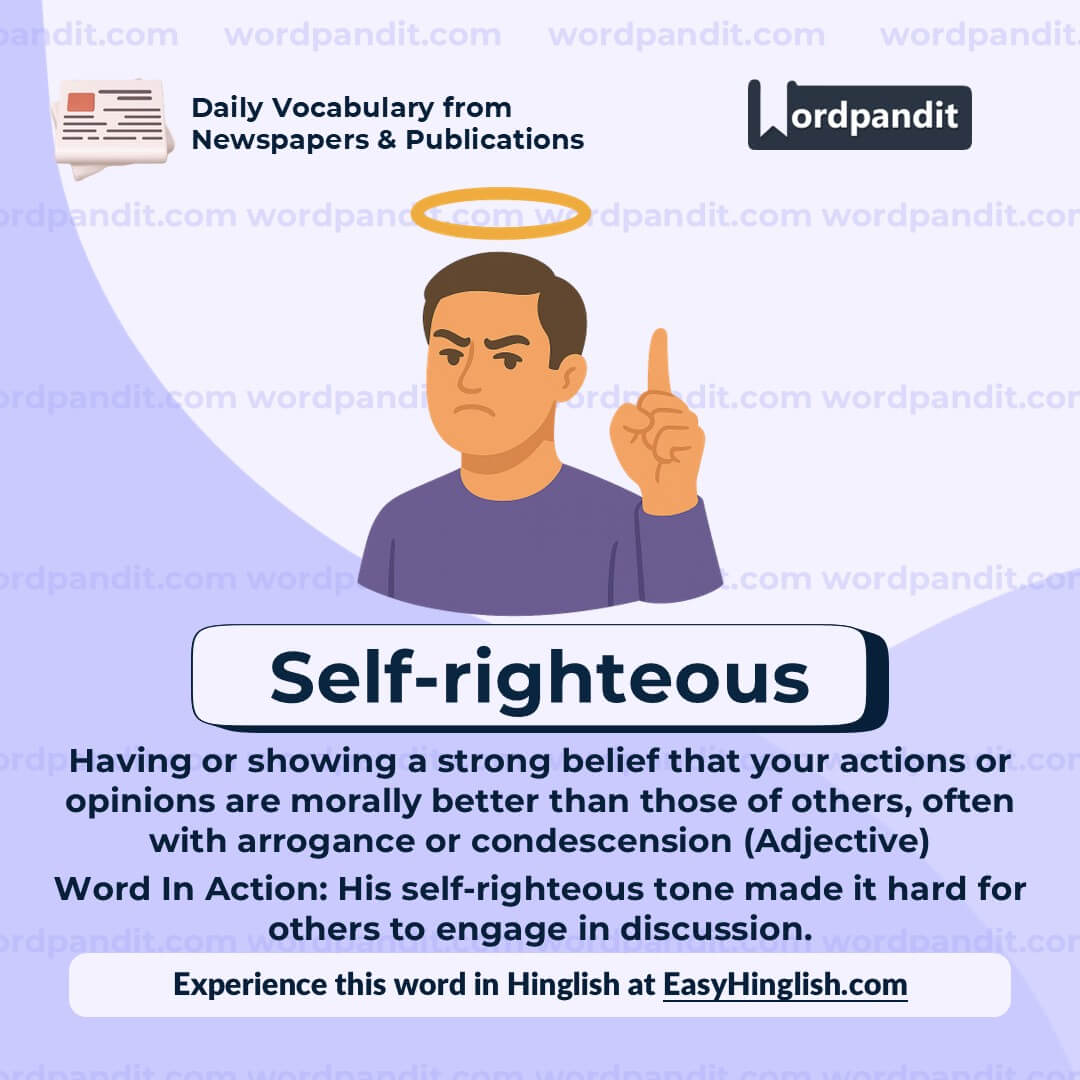
Meaning: Having or showing a strong belief that your actions or opinions are morally better than those of others, often with arrogance or condescension (Adjective)
Pronunciation: self-RITE-chus
Difficulty Level: ⭐⭐⭐ Intermediate
Etymology: Formed from “self” + “righteous,” where “righteous” means morally right. The combined form took on a negative tone in the 19th century, indicating smug moral superiority.
Prashant Sir's Notes:
This word is very useful in literature, psychology, and social commentary. It highlights the dangers of unchecked moral pride. It's important to understand its tone—usually negative and critical. Think of it as “morally blind to one’s own flaws.”
Synonyms & Antonyms:
Synonyms: Sanctimonious, Holier-than-thou, Arrogant, Preachy, Moralistic
Antonyms: Humble, Open-minded, Self-aware, Modest
Usage Examples:
- Her self-righteous attitude made it hard for her to accept constructive criticism.
- He spoke in a self-righteous tone, convinced his opinion was the only correct one.
- The novel explores how self-righteous characters often fail to see their own faults.
- Online debates often become toxic due to self-righteous posturing from both sides.
Cultural Reference:
"In *Revelation* by Flannery O’Connor, Mrs. Turpin's self-righteousness becomes the target of divine irony, as she’s forced to reevaluate her own spiritual arrogance." – Literary Hub
Think About It:
Why is it so easy to spot self-righteousness in others but so hard to recognize in ourselves?
Quick Activity:
Write a dialogue between two characters—one self-righteous, one humble. Highlight how their tones differ even if their values are similar.
Memory Tip:
Think: “Self” + “Righteous” = someone who is sure they’re always morally right. Picture a person standing on a pedestal pointing fingers at everyone else.
Real-World Application:
Understanding self-righteousness is vital in psychology, conflict resolution, literature, and leadership. It helps in recognizing biases, improving self-awareness, and communicating with empathy.


