

Daily Vocabulary from International Newspapers and Publications
Expand Your Vocabulary with Wordpandit’s Global Vocabulary Hub
At Wordpandit, we are committed to helping you develop a truly global vocabulary by drawing from some of the most respected international publications. This section is designed to keep you ahead of the curve by introducing you to words that define global conversations and trends.
The Power of Global Sources
To help you think and communicate on a global scale, we curate vocabulary from renowned international sources, such as:
- The New York Times
- The Washington Post
- BBC
- The Guardian
- The Economist
- Scientific American
- Psychology Today
- And many more...
Stay Global, Stay Competitive
Our daily updates from international publications ensure you are consistently exposed to new words that reflect global news and developments, making sure your vocabulary is not only current but also globally relevant.
Enhance Your Global Perspective
Whether you’re preparing for international exams, aiming to excel in global business communication, or want to enhance your language skills for personal growth, Wordpandit offers the resources you need to thrive in a global context.
Effective Learning, Global Reach
Our learning methodology combines global examples, memory aids, and interactive activities, allowing you to internalize new words effectively and apply them in real-world scenarios.
Begin Your Global Vocabulary Journey Now!

Why Choose Wordpandit?
Practical Learning: Focus on words you'll actually encounter in real-world reading, enhancing your comprehension and communication skills.
Diverse Content: From current affairs to scientific breakthroughs, our varied sources expose you to vocabulary across multiple domains.
Effortless Integration: Make Wordpandit a part of your daily routine. Just a few minutes each day can significantly boost your lexicon over time.
Your Path to Vocabulary Mastery
- Visit our Daily Vocabulary section regularly
- Explore new words and their usage in context
- Practice incorporating these words into your own writing and speech
- Track your progress as your vocabulary expands
Start Your Journey Today
Embark on your vocabulary enhancement journey with Wordpandit. By consistently engaging with our daily posts, you'll build a robust vocabulary that serves you well in academic, professional, and personal contexts.
Remember, a word a day keeps linguistic limitations at bay. Make Wordpandit your daily companion in the quest for vocabulary excellence!
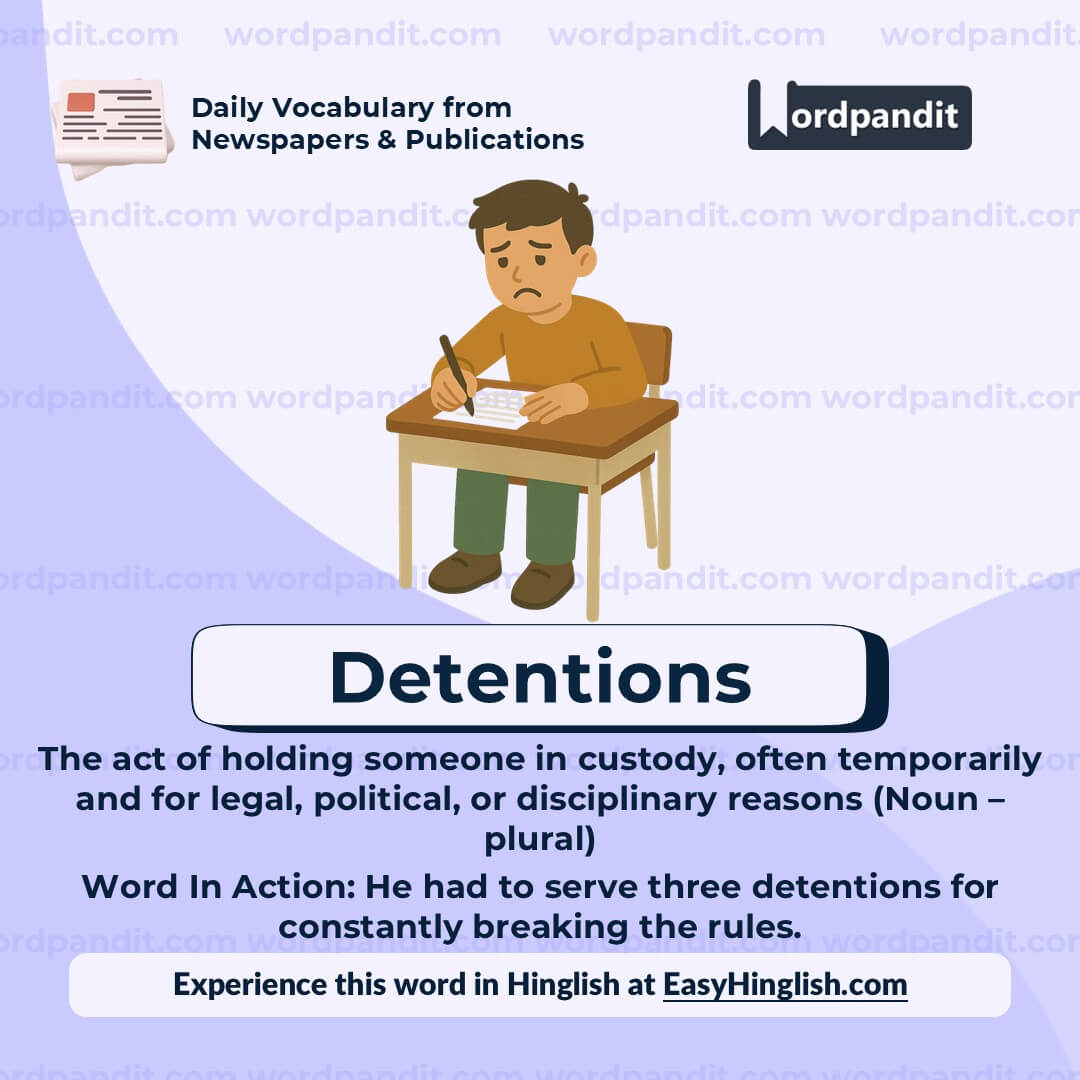
WORD-1: Detentions
Context:
"Last month, a few weeks into the random detentions and denied entries at the US border, I was supposed to go to Princeton University as a guest lecturer to discuss global fascism. I asked the professors who invited me whether they thought it was safe to come." - The Guardian
Explanatory Paragraph:
Detentions refer to the act of keeping someone in custody or under official restraint, especially by law enforcement or immigration authorities. It often implies holding individuals for questioning, investigation, or security purposes. In the context of border control or political regimes, detentions may raise legal or ethical concerns—particularly if they are arbitrary or without clear justification.
Meaning: The act of holding someone in custody, often temporarily and for legal, political, or disciplinary reasons (Noun – plural)
Pronunciation: dih-TEN-shuhnz
Difficulty Level: ⭐⭐ Beginner
Etymology: From Latin detinere (to hold back), from de- (down, away) + tenere (to hold). The word has long been used in legal and school settings.
Prashant Sir's Notes:
Students may first associate “detention” with school punishment, but in political or legal contexts, the word takes on a much more serious meaning. It's important to be able to distinguish between its uses in civil rights, law enforcement, and everyday discipline.
Synonyms & Antonyms:
Synonyms: Arrests, Confinements, Imprisonments, Holdings, Captures
Antonyms: Release, Freedom, Liberation, Discharge
Usage Examples:
- Several travelers reported arbitrary detentions at the airport despite having valid visas.
- The activist’s detentions drew criticism from human rights organizations worldwide.
- Schools often issue detentions for repeated misconduct.
- Protesters rallied against the government's use of mass detentions at the border.
Cultural Reference:
"The term ‘detention center’ has become politically charged, especially in debates over immigration and asylum in the U.S., Europe, and Australia." – Human Rights Watch
Think About It:
When does a detention become a violation of rights? How can societies ensure security without sacrificing individual freedoms?
Quick Activity:
List two contexts—one legal, one educational—where the word “detention” applies. Define how it is used differently in each.
Memory Tip:
Think of “detain” as someone being “held back”—whether at school, at the airport, or by the police. “Detentions” = the official holding actions.
Real-World Application:
Understanding the term “detentions” is essential in global politics, human rights discussions, and legal studies. It helps in evaluating the balance between national security and civil liberties.
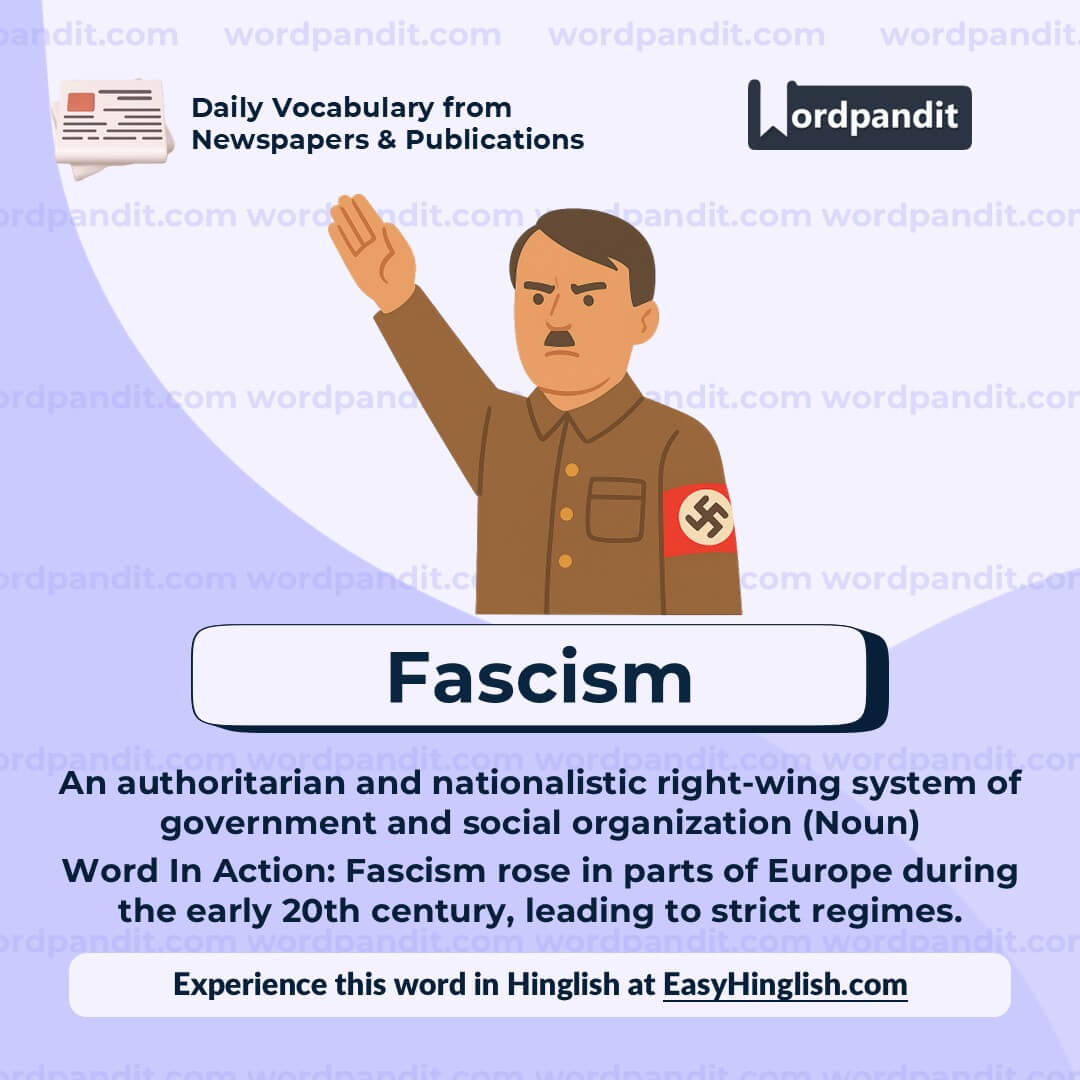
WORD-2: Fascism
Context:
"Last month, a few weeks into the random detentions and denied entries at the US border, I was supposed to go to Princeton University as a guest lecturer to discuss global fascism. I asked the professors who invited me whether they thought it was safe to come." - The Guardian
Explanatory Paragraph:
Fascism is a far-right, authoritarian political ideology that emphasizes dictatorial power, extreme nationalism, and often the suppression of opposition. It typically involves a centralized autocratic government led by a dictatorial leader, rigid social regimentation, and forcible suppression of dissent. The term is most historically associated with regimes like Mussolini's Italy and Nazi Germany, but it continues to be a subject of global political discourse and concern in modern contexts where democratic norms appear threatened.
Meaning: An authoritarian and nationalistic right-wing system of government and social organization (Noun)
Pronunciation: fash-iz-uhm
Difficulty Level: ⭐⭐⭐⭐ Advanced
Etymology: From Italian "fascismo", derived from "fascio" meaning “bundle” or “group”, symbolizing unity and strength.
Prashant Sir's Notes:
This word is deeply political and historical. When studying it, always connect it to historical regimes and present-day warnings about the erosion of democratic values. Look out for its use in critical essays, op-eds, and academic discussions about authoritarianism.
Synonyms & Antonyms:
Synonyms: authoritarianism, totalitarianism, despotism, dictatorship
Antonyms: democracy, liberalism, pluralism, freedom
Usage Examples:
- Fascism rose in Europe during the early 20th century, fueled by economic instability and nationalist fervor.
- Many scholars warn against the subtle signs of fascism in modern political movements.
- The film explores how fascism manipulates media to control public perception.
- Her essay critiques the normalization of fascism in contemporary discourse.
Cultural Reference:
"Fascism is not in itself a new order of society. It is the future refusing to be born." - Aneurin Bevan
Think About It:
How can we recognize the early signs of fascism in a democratic society, and what responsibilities do citizens have to counteract them?
Quick Activity:
List five historical events or leaders associated with fascism. Research one and write a short paragraph on how fascism shaped that period.
Memory Tip:
Think of “Fascism” as a "Fist" (both starting with 'F')—tight, rigid, and forceful—symbolizing control and oppression.
Real-World Application:
Understanding fascism helps in analyzing current political climates and defending democratic values, especially in times of rising populism and autocratic tendencies.
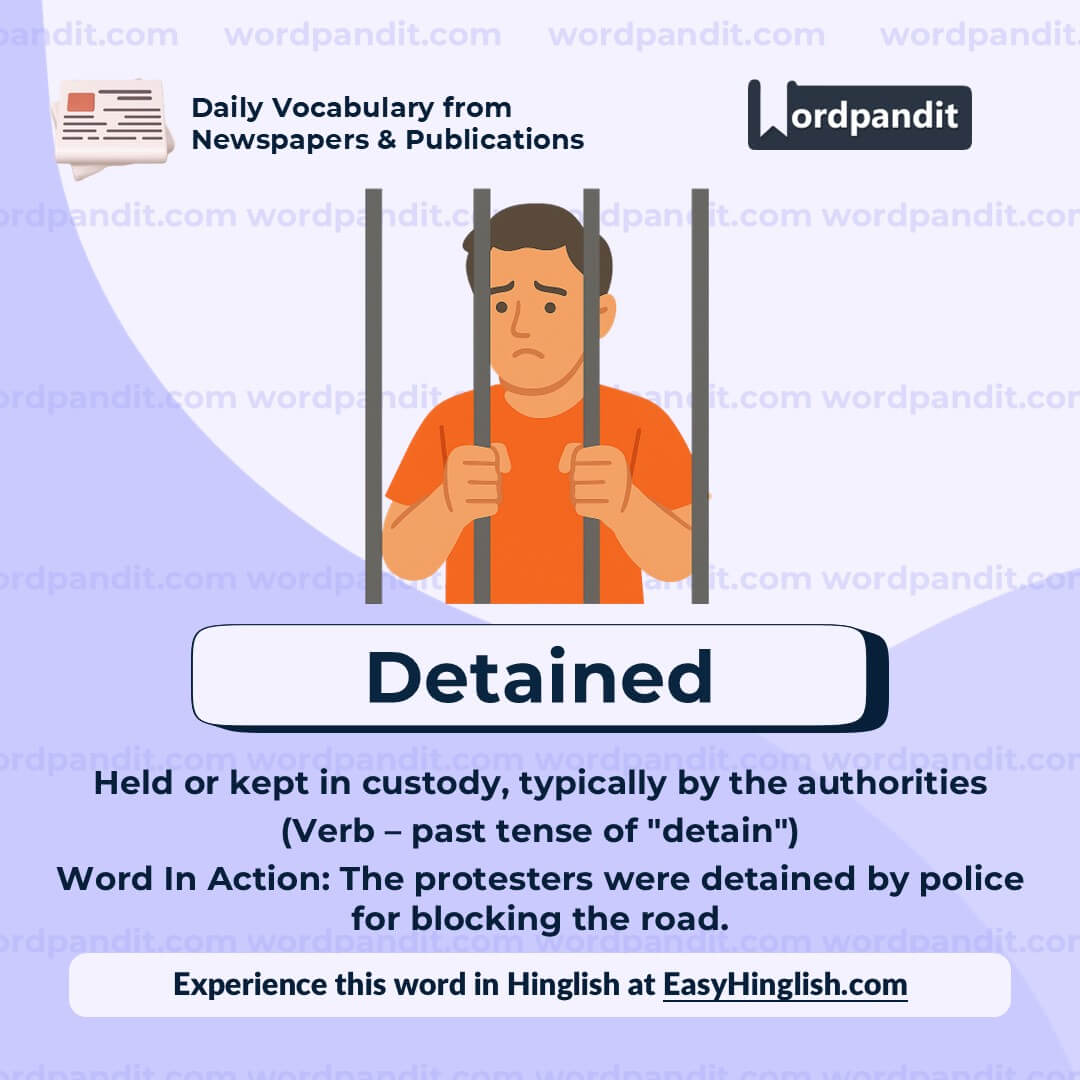
WORD-3: Detained
Context:
"When I was in Turkey, European journalist friends once similarly asked me whether they’d be detained. And just as I did then, the American professors hesitated with half sentences: “Well, you know … ” It was decided that a law firm should be involved." - The Guardian
Explanatory Paragraph:
"Detained" refers to the act of being held back, especially by legal or official authorities, often against one’s will. It typically applies to situations involving law enforcement or immigration authorities where an individual is temporarily deprived of their freedom for questioning, investigation, or security checks. The word can also carry emotional weight, evoking uncertainty, fear, or injustice depending on the circumstances in which the detention occurs.
Meaning: Held or kept in custody, typically by the authorities (Verb – past tense of "detain")
Pronunciation: dih-taynd
Difficulty Level: ⭐⭐ Basic to Intermediate
Etymology: From Old French "detenir", based on Latin "detinere" — "de" (away) + "tenere" (to hold)
Prashant Sir's Notes:
This word frequently appears in news reports related to immigration, criminal justice, and protests. Watch for its use in both neutral and critical contexts. It’s useful to explore its implications in law and human rights discussions.
Synonyms & Antonyms:
Synonyms: hold, arrest, confine, imprison, apprehend
Antonyms: release, free, discharge, liberate
Usage Examples:
- The activists were detained by police during the peaceful protest.
- She was detained at the airport due to visa complications.
- Several journalists were reportedly detained without formal charges.
- After hours of questioning, he was finally released from being detained.
Cultural Reference:
"They detained me, interrogated me, and accused me of terrorism—all because I carried a foreign passport." — Paraphrased from a real account in The Guardian
Think About It:
Should detaining someone without charges ever be justified? Under what conditions might this power be misused?
Quick Activity:
Write a short paragraph imagining a scenario where someone is mistakenly detained. How would they feel, and what rights should they have?
Memory Tip:
“Detained” starts like “detour” — you’re unexpectedly taken off your original path and forced to wait or stay somewhere else.
Real-World Application:
Understanding the term "detained" is essential in legal, immigration, and civil rights contexts, especially when discussing due process and state authority.
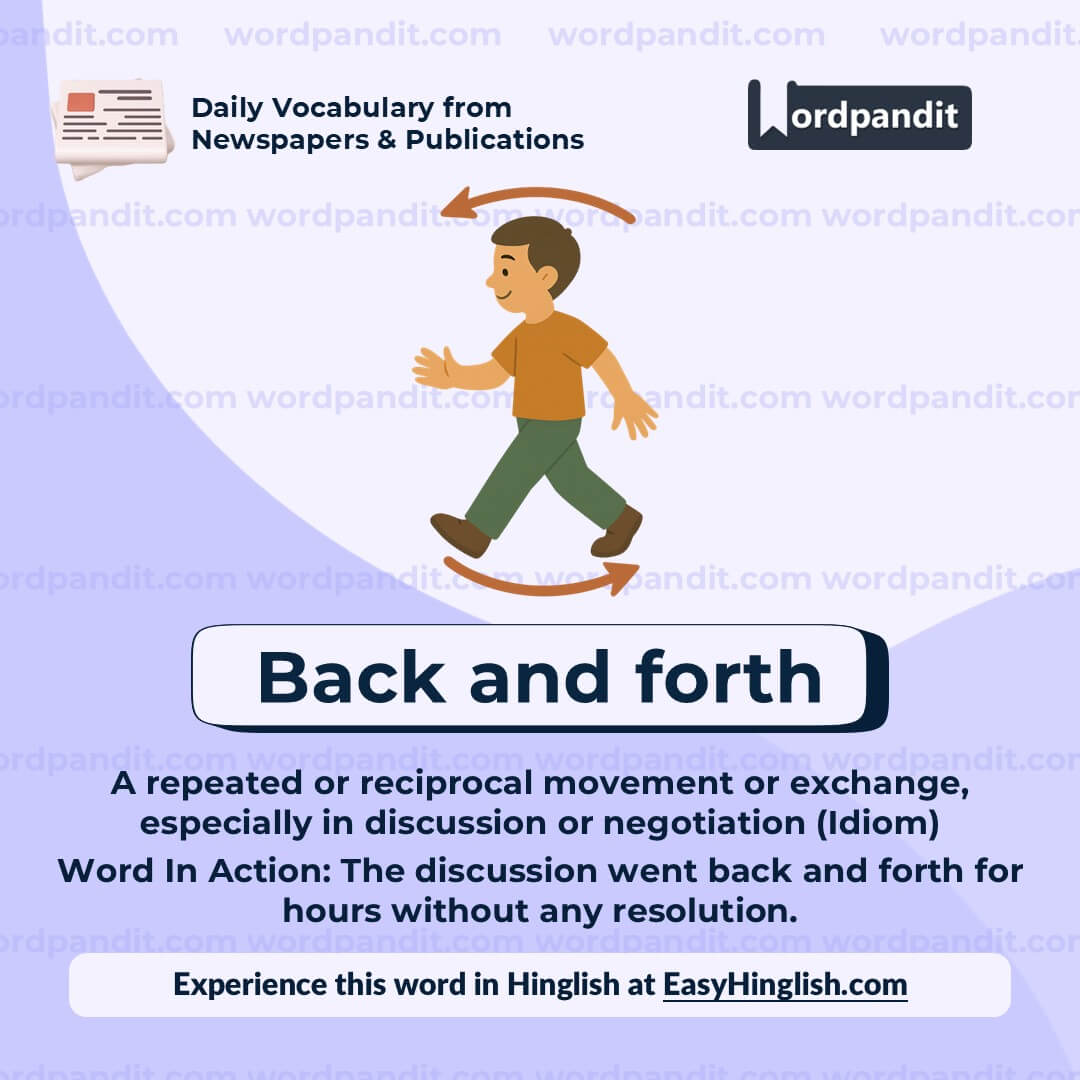
WORD-4: Back and Forth
Context:
"After some back and forth, the final assessment remained unsettlingly ambiguous: “A detention is unlikely, but we cannot be sure.” Eventually, to be on the safe side, we choose the online option." - The Guardian
Explanatory Paragraph:
“Back and forth” is an idiomatic expression used to describe a repetitive or reciprocal movement, discussion, or exchange between two or more parties. In communication, it often refers to a series of responses or negotiations where there is indecision or repeated change of opinion or position. It's frequently used to portray scenarios involving debate, conflict resolution, or collaboration where the outcome is not immediately clear or settled.
Meaning: A repeated or reciprocal movement or exchange, especially in discussion or negotiation (Idiom)
Pronunciation: bak and forth
Difficulty Level: ⭐⭐ Basic to Intermediate
Etymology: Derived from the literal motion of going backward and then forward, later extended metaphorically to debates and communication.
Prashant Sir's Notes:
This phrase is very common in both casual and formal English. It’s great for describing any process that involves negotiation, repeated actions, or indecision. It's especially handy in essays describing decision-making or conflict resolution.
Synonyms & Antonyms:
Synonyms: exchange, seesaw, to and fro, negotiation, debate
Antonyms: resolution, conclusion, agreement, final decision
Usage Examples:
- There was a lot of back and forth between the lawyers before the deal was finalized.
- We had a back-and-forth about where to go on vacation but finally settled on Greece.
- The conversation kept going back and forth without any resolution.
- After much back and forth, the committee reached a consensus.
Cultural Reference:
"The back-and-forth between the characters in Aaron Sorkin's scripts is famous for its rhythm and tension." – A commentary on TV dialogue from Entertainment Weekly
Think About It:
Can prolonged back and forth in decision-making be more harmful than helpful? When is it time to end the discussion and choose a direction?
Quick Activity:
Think of a time when you had a back-and-forth with someone. Write 2-3 lines describing the topic and how it was resolved.
Memory Tip:
Imagine a tennis match — the ball goes “back and forth” across the court, just like ideas do in a debate.
Real-World Application:
Understanding “back and forth” is essential in professional settings where negotiations, feedback loops, or iterative communication are common—like in business, law, and diplomacy.
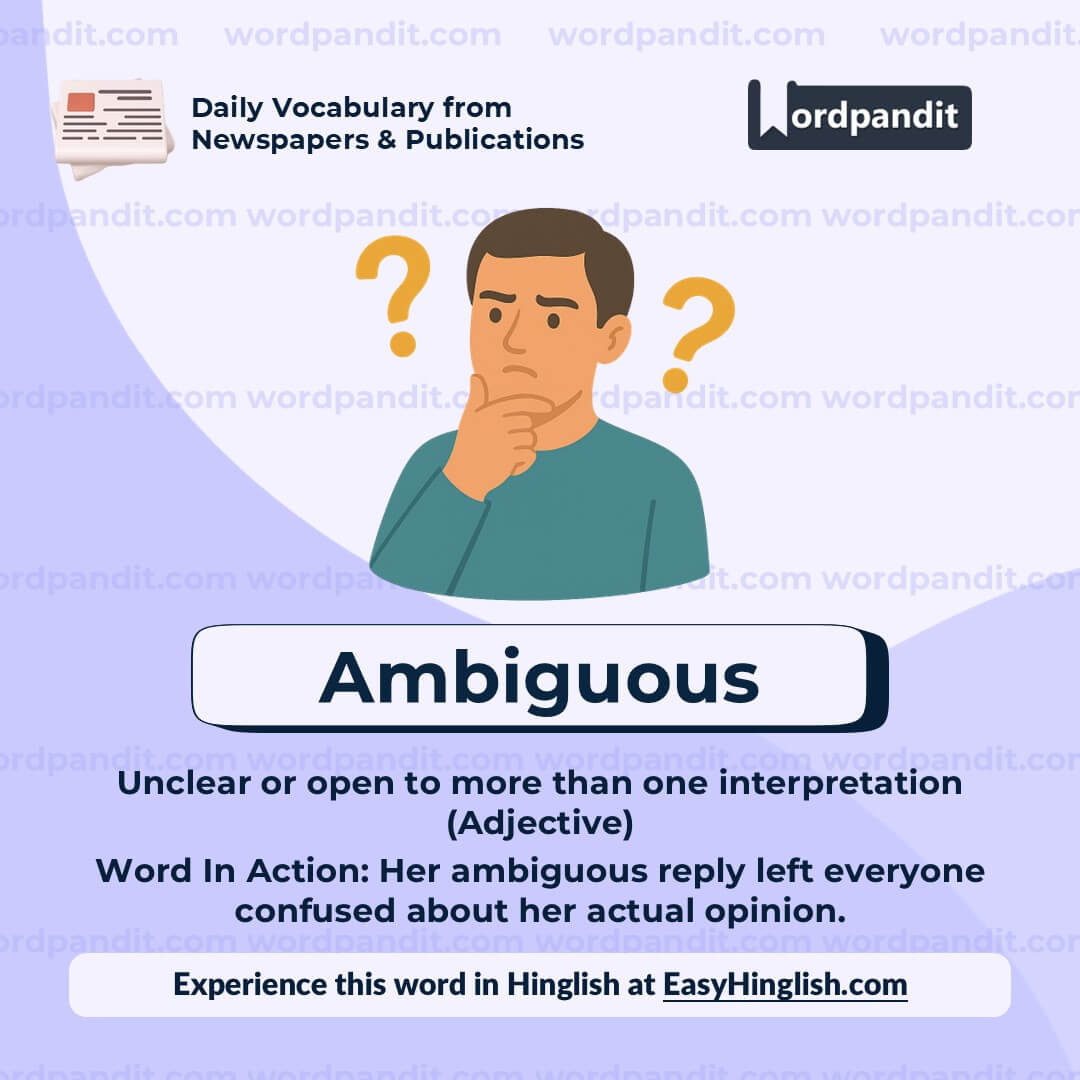
WORD-5: Ambiguous
Context:
"After some back and forth, the final assessment remained unsettlingly ambiguous: “A detention is unlikely, but we cannot be sure.” Eventually, to be on the safe side, we choose the online option." - The Guardian
Explanatory Paragraph:
“Ambiguous” refers to something that is open to more than one interpretation or lacks a clear and definite meaning. It often creates confusion, uncertainty, or a need for further clarification. In both speech and writing, ambiguity can either be a stylistic tool or a challenge, depending on whether it's intentional or unintentional. In real-world situations, ambiguous responses can cause unease, especially when clarity is expected or necessary for decision-making.
Meaning: Unclear or open to more than one interpretation (Adjective)
Pronunciation: am-big-yoo-uhs
Difficulty Level: ⭐⭐⭐ Intermediate
Etymology: From Latin "ambiguus" meaning “doubtful, uncertain,” derived from "ambigere" — “to go around, wander, waver.”
Prashant Sir's Notes:
Ambiguity is common in politics, literature, and law. Understanding this word is essential to grasping how language can both reveal and conceal meaning. Also, keep an eye out for its noun form “ambiguity” and how it's used to critique vague communication.
Synonyms & Antonyms:
Synonyms: unclear, vague, uncertain, equivocal, indefinite
Antonyms: clear, definite, explicit, certain, unambiguous
Usage Examples:
- The politician’s ambiguous answer left everyone guessing about his true intentions.
- Her facial expression was ambiguous—was she amused or offended?
- Legal documents should avoid ambiguous terms to prevent misinterpretation.
- Art often embraces the ambiguous to provoke deeper thought and interpretation.
Cultural Reference:
"That's the beauty of art—its power lies in the ambiguous, in letting you fill in the blanks." – Inspired by critiques of abstract art in The New Yorker
Think About It:
Is ambiguity always a weakness in communication, or can it sometimes serve a valuable purpose?
Quick Activity:
Write one sentence that could be interpreted in two different ways. Underneath it, list both possible interpretations.
Memory Tip:
Think of "ambiguous" as "a big guess" — when something is ambiguous, you’re forced to make a big guess about its true meaning.
Real-World Application:
Understanding ambiguity is critical in reading legal texts, interpreting literature, and evaluating political statements, where precision or vagueness can change outcomes significantly.


